
The emails are methodical. Patient. Almost clinical in their manipulation. On October 9, 2009, Jeffrey Epstein - then a convicted sex offender - sat down and composed a message to Mortimer Zuckerman, billionaire owner of the New York Daily News. The email contained what Epstein called a "proposed answer" to journalist questions about allegations of child sexual abuse. He wanted specific names removed. He wanted the story delayed. He got both.
For years, the Epstein narrative centered on what was most visible and most visceral: the trafficking, the island, the client list, the powerful men who looked the other way. But the million-page document release from the U.S. Department of Justice - beginning in January 2026 and continuing through March - is revealing something colder and more calculated beneath the surface. Epstein did not simply accumulate compromising relationships. He built a financial intelligence apparatus, methodically gaining access to the most private financial details of America's billionaire class, and then used that access as structural leverage.
This was not opportunism. This was architecture.
The Playbook: Get Into the Money First

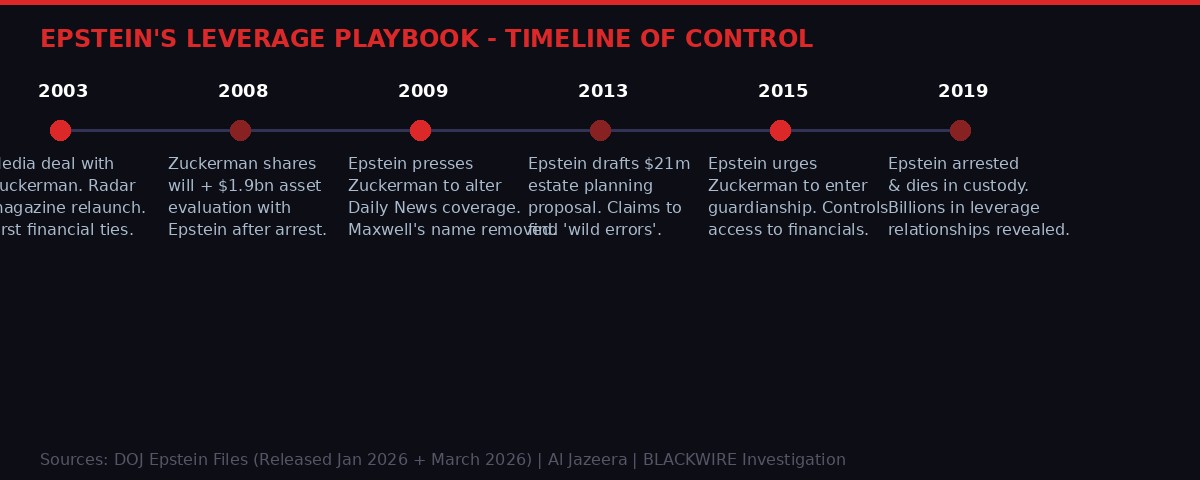
In 2008 - the same year he was arrested and convicted of soliciting a minor for prostitution - Mortimer Zuckerman shared with Epstein a copy of his will and a detailed evaluation of his assets, which put the mogul's net worth at $1.9 billion. He was seeking advice on how to pass on his estate.
This was not an isolated event. It was a pattern. Epstein had, over the course of years, positioned himself as an indispensable financial counselor to wealthy and powerful men. He claimed expertise in estate planning, investment strategy, and financial architecture. He cultivated intimacy through apparent competence. And then, once inside the financial inner sanctum, he stayed.
In 2013, Epstein drafted a formal proposal to provide Zuckerman with "analysing, evaluating, planning and other services" related to estate planning. The first draft proposed a fee of $30 million. He revised it to $21 million. In correspondence around the same period, he claimed to have identified "wild errors" in Zuckerman's accounting of his finances - positioning himself as the only man who could fix what he had found.
"Your questions have been critical to my growing understanding of how much lies ahead before my finances are properly organized. You have been an invaluable friend and in the most constructive way a provocateur - I am completely grateful." - Mortimer Zuckerman, in email to Epstein, October 2013. Source: DOJ Epstein Files
The dynamic that emerges from the documents is not one of predator and prey in the conventional sense. It is subtler and more disturbing. Epstein cultivated dependency. He made himself necessary. He learned the details of a man's financial life that few people ever know - and then he leveraged proximity, intimacy, and apparent expertise to deepen that access year after year.
The Media Suppression Engine

The financial access was the foundation. What Epstein built on top of it was something more immediately dangerous: the ability to shape what the public knew.
In October 2009, New York Daily News journalist George Rush was working on a story about Epstein. The allegations he was investigating included accusations that Epstein and his partner Ghislaine Maxwell had subjected a minor - identified in court documents as "Jane Doe No. 102" - to routine sexual abuse. The story also cited evidence that Maxwell maintained a computer database of hundreds of girls and managed a schedule for Epstein's homes.
Before the story could be published, Epstein drafted a "proposed answer" and emailed it directly to Zuckerman, the paper's owner. He disputed the allegations. He characterized the victim as having admitted to being "an escort, call girl, and massage parlor worker since the age of 15." He asked for Maxwell's name to be removed entirely.
"Take Ghislaine out," Epstein wrote to Zuckerman. "If possible."
Zuckerman replied that the Daily News was "doing major editing over huge objections." He said he would "copy asap." The paper delayed publication. When the story finally ran in December 2009, it contained no mention of Maxwell. The specific allegations about the database of girls and the schedule were omitted. What remained was a sanitized account of a settlement.
"Most people hadn't heard of Epstein at that point. I didn't like Epstein and Maxwell trying to appeal to the owner. But I was relieved that the story wasn't killed, just delayed." - George Rush, former Daily News journalist, to Al Jazeera (2026)
Rush confirmed to Al Jazeera that he was "advised to leave Ghislaine Maxwell out of the story." He framed it as a libel concern at the time. The DOJ files now show Epstein's direct involvement in requesting that removal.
This was not an anomaly. It was a demonstration of what Epstein's network could do. He had access to a major American newspaper owner - a man who owed him financial counsel, who regarded him as a close friend and confidant - and he used that access to shape coverage of his own crimes. The mechanism was not blackmail in the conventional sense. It was something more insidious: relational leverage built on years of carefully cultivated mutual dependency.
When Zuckerman owned a media property, Epstein had a hand on the editorial tiller.
Cognitive Decline as a Weapon

By 2015, Epstein's campaign to embed himself in Zuckerman's life had evolved into something more aggressive. He began urging Zuckerman - in direct, insistent language - to enter a guardianship or conservatorship arrangement, citing what he described as the mogul's "potentially dangerous" cognitive impairment.
The framing was ostensibly protective. "Your friends including me are very concerned that your cognitive impairment has now reached a serious and potentially dangerous level," Epstein wrote. "There is serious concern for your financial, emotional physical and psychological safety."
But the subtext was control. A guardianship arrangement would designate a specific person - or persons - with legal authority to manage Zuckerman's affairs. Epstein suggested that authority be granted to Terje Rod-Larsen, a Norwegian diplomat, along with Zuckerman's nephews and "anyone else you trust." Rod-Larsen had been present at the meeting where the subject first arose.
Epstein was, in effect, attempting to choreograph who would control a $1.9 billion fortune if Zuckerman's capacity declined. He was identifying himself as a central node in that network. He was making himself indispensable to the succession structure of a billionaire media empire.
"MORT, you need a Guardian," Epstein wrote - note the capital letters - "you should choose one now, while your judgment peeks through the haze. Waiting too long will mean most likely a court imposed solution. NOT FUN."
He also advised Zuckerman's nephew Eric Gertler - now the executive chairman of US News and World Report - to oversee the immediate sale of Zuckerman's stocks, art collection, helicopter, and plane.
"I am aware that your condition makes you prone to suspicion but that being said, the future predictable decline will be an ever increasing danger." - Jeffrey Epstein, email to Mortimer Zuckerman, 2015. Source: DOJ Epstein Files
Zuckerman replied expressing what appeared to be genuine concern and gratitude. He asked for recommendations on a lawyer "with experience in such matters." He thanked Epstein for his "thoughtfulness and friendship." The man who had already been convicted of soliciting a minor for prostitution was, to Zuckerman, a close and trusted advisor at the very moment he was being maneuvered into a vulnerability.
Zuckerman announced his departure as chairman of Boston Properties - one of the largest real estate investment trusts in the United States, which he had co-founded in 1970 - approximately six months after his correspondence with Epstein. He cited no health concerns at the time and retained an honorary title.
Whether Epstein's push toward guardianship played any role in that decision remains unclear. What is clear is that Epstein had obtained, over more than a decade, a position of intimate influence over a man worth nearly two billion dollars - a man who owned newspapers and magazines and whose financial succession he had attempted to arrange.
The Architecture of Leverage: Not Just One Man

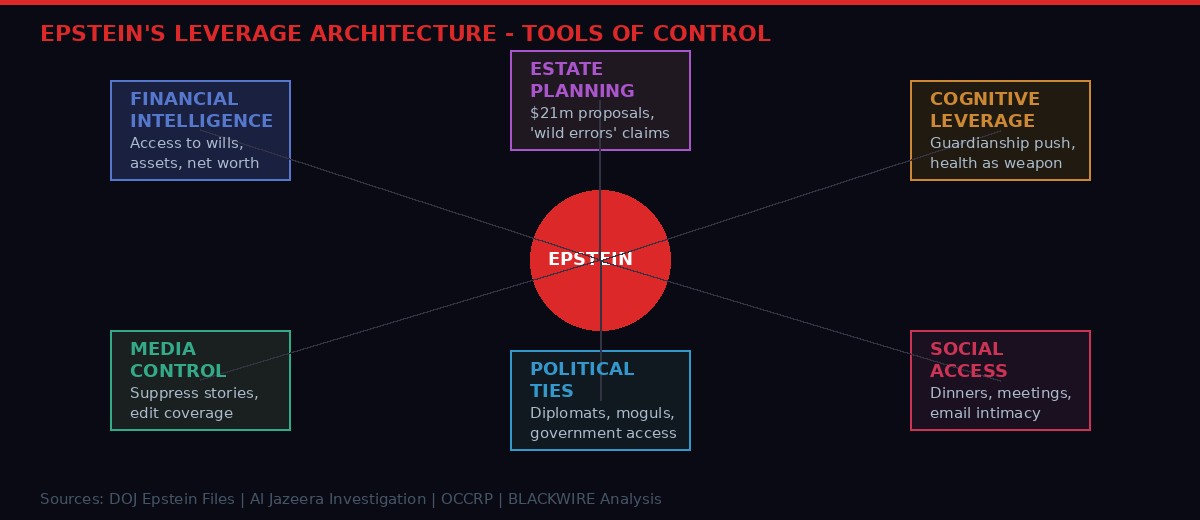
The Zuckerman files are significant not only for what they reveal about that specific relationship, but for the systemic model they expose. Epstein was not simply an opportunist who stumbled into proximity with power. He was a methodical collector of financial intelligence, deploying a consistent and repeatable playbook.
The playbook had identifiable stages. First, establish a social connection through shared circles, investment opportunities, or mutual acquaintances. Second, position yourself as financially sophisticated - a man who sees what others miss, who can find "wild errors" in your accounting, who understands the hidden architecture of your wealth. Third, gain access to the actual documents: the wills, the asset evaluations, the succession plans, the financial correspondence that most billionaires share only with their most trusted advisors. Fourth, deepen the relationship through apparent loyalty and friendship until the target cannot clearly distinguish advisor from dependent. Fifth, leverage that position - whether for direct financial gain, for social access, for media influence, or for the suppression of inconvenient facts.
The DOJ files do not tell us how many men Epstein ran this playbook on. They tell us about Zuckerman in unusually granular detail because the correspondence survived and was eventually included in prosecution files. But the files also hint at a much wider network. Epstein kept meticulous records of financial discussions with multiple clients. His personal assistant Lesley Groff maintained appointment logs that document dozens of dinners, meetings, and consultations with powerful men whose names appear throughout the correspondence.
What the files describe is less a single predator and more an intelligence collection operation with financial leverage as its primary tool and elite access as its product.
The Question That Has Never Been Answered

Here is what the files do not answer, and what remains the central unresolved question: who received the intelligence that Epstein collected?
The financial details of America's billionaire class are, in intelligence terms, extraordinarily valuable. They reveal vulnerabilities, dependencies, succession conflicts, hidden assets, and off-book relationships. A man who knows the contents of a media mogul's will, who has identified "wild errors" in his accounting, who has cultivated the mogul's gratitude and dependency - that man has leverage that extends far beyond any single newspaper story.
Former Israeli intelligence officer Ari Ben-Menashe has alleged in various interviews that Epstein operated as an intelligence asset connected to Israeli intelligence services - a claim that has never been proven, that has been disputed, and that remains unverified. Former CIA director William Barr, who served as Attorney General when Epstein died in custody, oversaw the circumstances of that death without ever publicly addressing the full scope of what Epstein's files might have contained.
The DOJ file releases - now running to over three million pages - were ordered partly in response to congressional pressure following years of questions about what happened to Epstein's records after his arrest. BLACKWIRE has previously reported that the DOJ initially failed to include FBI interview memos naming political figures in its online database, and that a bipartisan congressional subpoena was required to surface those documents.
What we know from the Zuckerman documents: Epstein successfully positioned himself as a trusted financial advisor to a man worth $1.9 billion. He obtained that man's will and asset evaluation. He was proposed as a $21 million financial consultant to that man. He used his relationship with that man to suppress and shape news coverage of his own crimes. He then attempted to influence who would control that man's financial affairs if his mental capacity declined.
What we do not know: how many other men Epstein ran this playbook on, who received the financial intelligence he collected, what happened to his records, and what leverage - if any - survived his death in 2019.
Timeline of the Epstein-Zuckerman Operation
The Vulnerability He Exploited: Elite Trust in Financial Advisors

To understand how Epstein was able to operate this way, it is necessary to understand what the role of a trusted financial advisor actually involves.
The relationship between a billionaire and his estate planner is among the most intimate in American commercial life. The advisor sees the will. The advisor knows who gets what, and who gets cut out. The advisor understands the tax strategies, the offshore structures, the trusts designed to shield assets from scrutiny. The advisor knows about the second family in the Caribbean, the undisclosed stake in a foreign company, the gift to the foundation that was really a gift to a person. An estate planner who is truly trusted knows everything.
Epstein understood this. And he was, by multiple accounts, genuinely intelligent about financial matters - intelligent enough to convince people like Zuckerman that he had valuable insight, that he could see "wild errors" that others had missed, that his counsel was worth millions of dollars. Whether or not Epstein actually had the financial expertise he claimed is almost beside the point. What mattered was that powerful men believed he did, and on the basis of that belief, they gave him access that intelligence agencies would have paid fortunes to obtain.
The scale of that access, across how many billionaires and over how many years, is one of the things the DOJ files may eventually reveal - if sufficient political will exists to surface it. So far, the Zuckerman relationship has emerged as the most documented case. But it is almost certainly not the only one.
When researchers and journalists have attempted to map Epstein's known financial relationships, they have identified connections to figures including Leon Black, the Apollo Global Management founder who paid Epstein over $150 million in advisory fees between 2012 and 2017 - fees that Black has characterized as legitimate consulting payments, but whose scale and scope remain deeply unusual even by the standards of elite wealth management. Black stepped down from Apollo in 2021 after the board investigated his ties to Epstein.
The DOJ files have not yet revealed the full content of Epstein's financial advisory relationships with figures like Black. But the Zuckerman documents establish, in unambiguous detail, what that kind of relationship looked like in practice: a systematic accumulation of intimate financial knowledge, deployed over years, used both for money and for power.
What the Files Still Don't Show Us

Three million pages is an enormous quantity of documents. It is also, investigators say, almost certainly incomplete.
When federal agents searched Epstein's properties after his 2019 arrest, they found compact discs labeled with women's names and sexual references. They found hundreds of photographs of young women and girls. They found what appeared to be a sophisticated record-keeping apparatus. What they did not find - or at least, what has not yet been made public - is the full archive of Epstein's financial correspondence and advisory records.
Congressional investigators have repeatedly raised concerns about gaps in the DOJ database. BLACKWIRE previously reported that FBI interview memos containing specific allegations against named political figures were withheld from the initial release and required a bipartisan subpoena to surface. The memos, once released, contained unverified allegations that the DOJ noted it could not independently confirm - but the fact of their suppression raised serious questions about what else might remain undisclosed.
The question of who was ultimately receiving Epstein's intelligence, if anyone, remains open. The intelligence-community theories - ranging from Israeli intelligence to domestic agencies to private clients - have circulated for years without definitive evidence. What the financial documents do establish is that Epstein had both the access and the organizational capacity to collect and deploy sensitive information systematically. Whether that capacity served a patron, a network, or only his own interests is a question the current file releases have not yet answered.
What the files establish beyond reasonable dispute is the operational template: target wealthy men in vulnerable moments of transition - estate planning, health concerns, succession disputes. Offer expertise. Build dependency. Gain documentary access. Then leverage. The trafficking, the parties, the island - these were perhaps the mechanism of initial contact, the social lubricant that opened doors. The financial intelligence operation is what happened next, in the offices and in the correspondence, over years and decades.
Mortimer Zuckerman: A Portrait of Complicity and Vulnerability

It is worth being precise about what the DOJ files say - and do not say - about Mortimer Zuckerman.
Zuckerman has never been accused of involvement in Epstein's trafficking crimes. His journalist George Rush has confirmed that he did not order the story killed - he permitted it to be delayed and edited, and Rush was ultimately able to publish. The precise nature of the "major editing over huge objections" that Zuckerman described in his reply to Epstein is not fully documented in the released files.
What the files do show is that Zuckerman received Epstein's direct request to remove Maxwell's name from coverage, and that Maxwell's name was in fact removed. They show that Zuckerman was deeply intertwined with Epstein's financial world for over a decade, sharing documents and correspondence that would normally pass only between a man and his most trusted advisors. They show that Zuckerman regarded Epstein with apparent warmth and gratitude, writing to him that he was "very special" and "a great friend" as recently as 2014 - years after Epstein's initial conviction.
And they show that when Epstein suggested Zuckerman might be losing his mental faculties, Zuckerman did not recoil. He asked for a lawyer's name.
The picture that emerges is of a powerful man who made himself dependent on a convicted child sex offender, shared his most intimate financial secrets with him, and allowed that man to influence coverage of his own crimes in a newspaper he owned. Whether this constitutes complicity in the crimes themselves is a legal and moral question that prosecutors have not directly addressed. What it constitutes as a matter of power and accountability is something the public - and Zuckerman's own legacy institutions - will have to reckon with over time.
Zuckerman, now 88, remains the owner and publisher of US News and World Report. His philanthropic organizations did not reply to requests for comment from Al Jazeera or other outlets following the document releases.
Why This Matters Now: The DOJ Files and What Comes Next

The Epstein file releases are happening against a backdrop of significant political turbulence. In 2025 and early 2026, the DOJ initially released a large tranche of files but withheld specific categories of documents - including, as BLACKWIRE has reported, FBI interview memos containing allegations against named political figures. The initial database was discovered to have gaps that were not disclosed.
A bipartisan group of congressional investigators subpoenaed Attorney General Pam Bondi after the gaps were identified. The subpoena ultimately produced the withheld memos. Their release confirmed that investigators had, years before Epstein's death, been told by witnesses that he had sexually assaulted or exposed himself to named political figures - allegations that prosecutors noted were unverified and which those named have denied.
The financial intelligence files now emerging alongside those witness accounts suggest a more complete picture of Epstein's operation. The trafficking was the access mechanism. The financial advisory relationships were the intelligence collection system. And the media connections - embodied most clearly in the Zuckerman correspondence - were the suppression mechanism that kept all of it out of the press for years.
The result was a man who had simultaneously compromised enough members of the elite to prevent effective legal accountability, positioned himself inside the financial succession plans of billionaires, and cultivated friendly relationships with newspaper owners who could dampen inconvenient coverage. It was, as a structural matter, nearly perfect protection.
It held for over a decade. It collapsed in 2019 only when federal prosecutors in the Southern District of New York - operating independently of previous investigations - brought charges that could not be deflected or delayed. Epstein died in custody six weeks after his arrest. The full scope of his operation has not been publicly accounted for in the seven years since.
The three million pages now being released are the closest thing to that accounting that currently exists. What they reveal, page by page, is less a story about the crimes of one man than a portrait of how power actually works in America: through access and dependency, through financial intimacy and cognitive vulnerability, through the willingness of wealthy and powerful men to share their secrets with someone who had already proven willing to use them.
Epstein is gone. The system he exploited is not.
Who Else? The Unanswered Question
The Zuckerman relationship is valuable precisely because it is documented. The emails survived. They were included in prosecution files. They were released when the DOJ opened its database. The pattern they reveal - financial access, dependency cultivation, media leverage, cognitive manipulation - is specific enough to be recognizable as a method.
The question it raises is whether that same method was applied to other men in Epstein's network, and whether those relationships are documented anywhere in the remaining files.
Apollo Global Management's Leon Black paid Epstein $158 million for what Black described as advice on tax planning, estate planning, and philanthropic strategy. Black has maintained that the payments were legitimate and that his relationship with Epstein was strictly professional. The board investigation commissioned by Apollo found that Black had received legitimate advice worth significant fees, but also concluded that Black's continued contact with Epstein after his 2008 conviction reflected "extremely poor judgment." Black stepped down as Apollo's CEO and chairman in 2021.
What the DOJ files may eventually reveal about the Black-Epstein advisory relationship - what documents were shared, what correspondence existed, what financial intelligence Epstein accumulated in the course of providing $158 million worth of advice - is one of the key questions investigators and journalists are now working to answer.
Other figures identified in various Epstein documents as having had financial or advisory relationships with him include a range of wealthy American and European businessmen whose full connections to Epstein's operation remain unclear. The DOJ has indicated that additional file releases are forthcoming. Congressional investigators have indicated they believe significant material remains withheld.
The pattern established by the Zuckerman files is: wherever Epstein had access to a wealthy man's financial documents, that access was eventually leveraged. The question is not whether the playbook was repeated. The question is how many times, with whom, and who is still holding what Epstein collected.
Follow the money. It has always been the right instruction. In Epstein's case, it turns out to mean something more specific: follow whose money Epstein was allowed to see. Because access to that information was never free, and the price has not yet been fully paid.
Get BLACKWIRE reports first.
Breaking news, investigations, and analysis - straight to your phone.
Join @blackwirenews on TelegramSources: U.S. Department of Justice Epstein File Releases (January and March 2026) | Al Jazeera investigations by Hamish Boland-Rudder and team | OCCRP | TRM Labs 2026 Crypto Crime Report | Apollo Global Management board investigation (2021) | George Rush interview with Al Jazeera | congressional testimony and subpoena records. This article draws on reported facts from primary documents. The financial intelligence "operation" framing is BLACKWIRE's analytical interpretation based on documentary evidence - no current criminal investigation has used this specific characterization.