The Woman in the Shadows: Epstein's Russian Assistant, the FSB Father, and the $237,000 Offshore Transfer
OCCRP's bombshell investigation into Svetlana Pozhidaeva - the Russian model who spent years recruiting women for Jeffrey Epstein - reveals a family background steeped in Soviet military intelligence, an offshore trust funneling hundreds of thousands of dollars, and ties to Russia's UN Ambassador and a senior FSB Academy graduate.
In the fall of 2017, Jeffrey Epstein was hunting for young women again. He sent an email. The response came from a woman calling herself "Julia Santos" - a name borrowed from a 1990s American soap opera, All My Children - who told him she had found "a new one" in Paris. "She is my new favorite as of now."
The "Julia Santos" alias was not a single person. It was a shared pseudonym, a cover used by a ring of female assistants Epstein had organized to source young women across Europe. The woman behind this particular email exchange, according to OCCRP's new investigation published this week, was Svetlana Pozhidaeva - a 42-year-old Russian former model who worked for Epstein for years, recruited women across multiple continents, attended elite forums at Davos and the United Nations on his behalf, and received more than $237,000 from his offshore Butterfly Trust.
Pozhidaeva agreed to speak to OCCRP over three days of interviews - the most comprehensive public account she has given since the Trump administration's release of 3.5 million Epstein documents in early 2026 inadvertently unredacted her name. But the story she tells sits alongside a second, darker biography - one she disputes and one that investigators and intelligence experts say carries weight. Her father, Yury Pozhidaev, a retired Russian lieutenant colonel, has a career profile that multiple FSB experts say fits the pattern of a "seconded personnel" officer: formally retired from Russian intelligence, but continuing to report to the agency while embedded in strategic state-linked enterprises.
No evidence has emerged that Epstein discussed state secrets with Yury Pozhidaev, or that Svetlana's relationship with the financier was directed by Russian intelligence. But the accumulation of connections - an elite Soviet family background, a father's FSB pension communications, offshore money flows, and Epstein's own documented relationships with senior Kremlin figures including Russia's UN Ambassador - has fueled serious questions about what Epstein's network was, and who was paying attention to it.
Who Was Svetlana Pozhidaeva?
To understand Pozhidaeva's trajectory, it helps to understand where she came from. This is not a story of a naive girl stumbling into Epstein's orbit. It is the story of someone born into the Soviet elite, who combined that background with personal vulnerability and financial need in ways that made her useful - and perhaps observable - to multiple parties.
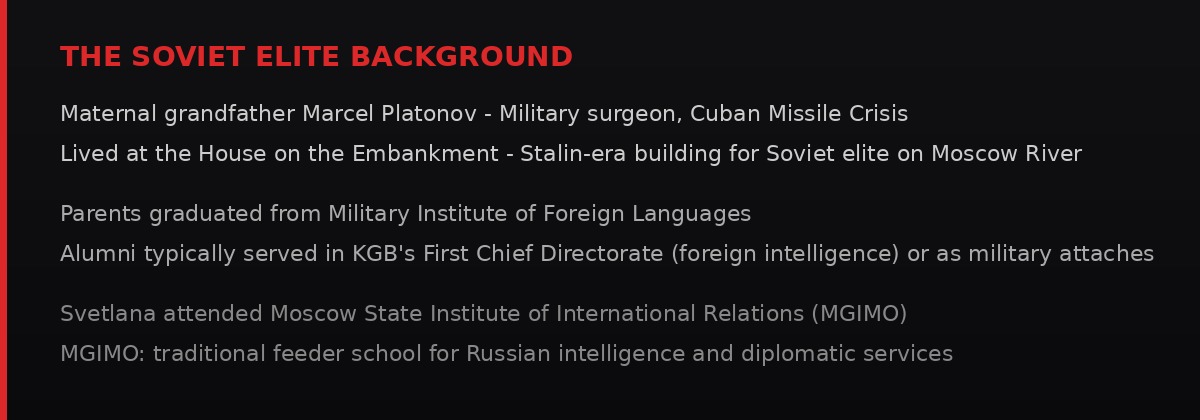
Her maternal grandfather, Marcel Platonov, was a military surgeon and gynecologist who participated in the Soviet operation that triggered the 1962 Cuban Missile Crisis. He was subsequently granted an apartment in the House on the Embankment - the infamous Stalin-era building on the Moscow River that housed the Soviet elite, where residents included military officers, scientists, political figures, and, frequently, their handlers.
Her parents, Yury and Irina, both graduated from the Military Institute of Foreign Languages in Moscow. This institution has a specific significance: its alumni, particularly those trained in strategically important languages, frequently served in the KGB's First Chief Directorate - the foreign intelligence division - or as military attaches at Russian embassies abroad. It is not a general university. It is a production line for the Russian intelligence apparatus.
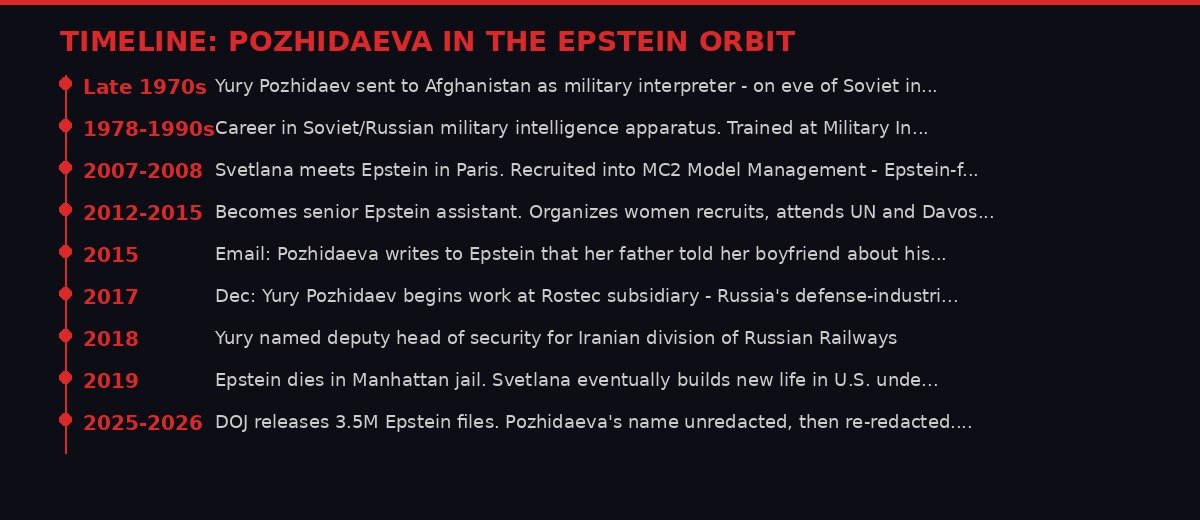
Yury Pozhidaev was trained as a Persian-language military interpreter. In 1978, one year before the Soviet invasion of Afghanistan, he was deployed to the country as part of an advisory corps. The timing is not coincidental: pre-invasion advisory deployments were standard intelligence preparation.
Svetlana herself attended Moscow State Institute of International Relations - MGIMO - which is the traditional feeder institution for careers in Russian diplomacy and intelligence. She earned both undergraduate and Master's degrees there, learned multiple foreign languages, and completed internships at the Russian foreign ministry, the oil giant Lukoil, and Russian investment firms.
She tells OCCRP she was introduced to Epstein in Paris in late 2007 or early 2008, drawn in by his apparent worldliness and the promise of professional opportunity. She was hired by MC2 Model Management - Epstein-funded but run at arm's length by a man later described as a "disgraced associate." Within a few years, she was embedded as a senior assistant, traveling with Epstein to his island, scouting properties in Morocco, attending elite conferences, and managing the network of women he expected from her.
"He told me that he would teach me real business. And as soon as I started asking: Shall I start taking English communication classes, or maybe accent reduction classes, anything to improve professionally? He said, well, you should start learning how to do massage. And that was the only class he encouraged." - Svetlana Pozhidaeva to OCCRP, March 2026
She describes years of psychological manipulation, bullying, eating disorders, and what she calls physical abuse beginning on her first visit to Epstein in Florida. She says she was isolated from her family, that her visa was controlled by an Epstein foundation, and that her celebrity encounters - photos with Bill Gates, Norwegian diplomat Terje Rod-Larsen, and others - masked a reality in which she was waiting behind closed doors to clear the plates after meetings ended.
The Emails That Changed Everything
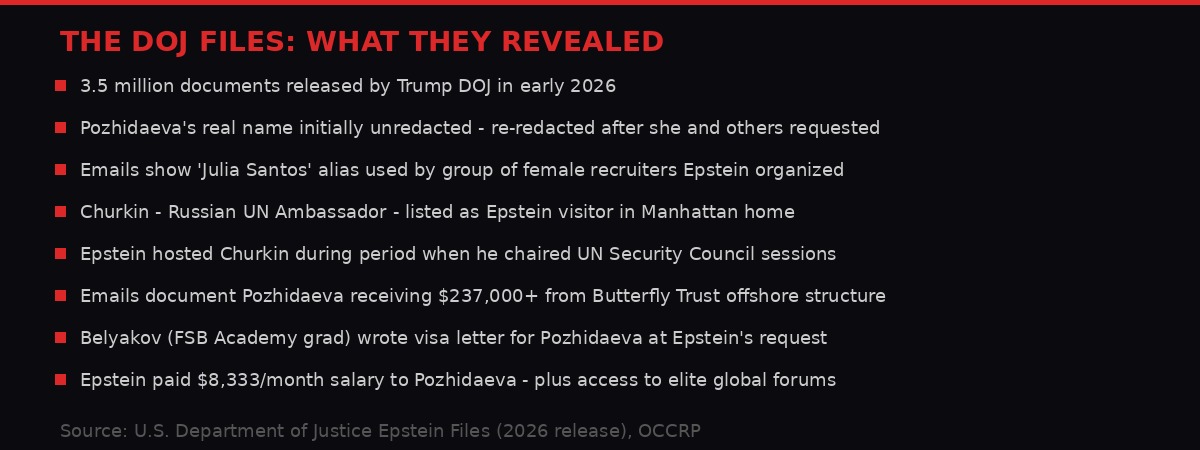
The Trump administration's mass release of Epstein documents in early 2026 - 3.5 million files, many of them emails - did several things simultaneously. It revealed the industrial scale of Epstein's operation. It named names that had been protected for years. And in Svetlana Pozhidaeva's case, it revealed that she had been paid like an employee at the heart of his network, not merely exploited as a victim at its periphery.
The emails show Pozhidaeva actively searching for "new" women across Europe. They show her sending a nude photograph of a candidate to Epstein. They show her making dismissive assessments of women who did not meet his requirements: "Bad skin, huge boobs, said [she was] 24yo." They show her helping women in Ukraine obtain passports and Schengen visas - streamlining access for women Epstein had targeted.
The DOJ files also show Epstein treating Pozhidaeva as a valued asset rather than a peripheral associate. He arranged her appearances at the UN and at Davos. He paid her a monthly salary of $8,333. He introduced her to foreign heads of state and senior financiers. His offshore Butterfly Trust transferred more than $237,000 to her account - a transaction marked "for the family." She maintains this was a loan.
The files confirmed what Russian investigative outlet iStories had previously uncovered through cross-referencing: the "Julia Santos" alias was Pozhidaeva. Personal details mentioned in emails sent under the Santos alias matched travel records and communications sent under her real name. The DOJ's failure to properly redact her identity, then its belated correction after she and other self-identified victims requested it, has added a layer of political controversy to an already explosive story.
The Butterfly Trust
Epstein's offshore Butterfly Trust was one of several financial structures he used to obscure payments to people in his network. The trust was registered in the Virgin Islands and used to funnel money to associates, assistants, and others with limited paper trails back to Epstein directly. The $237,000-plus transfer to the Pozhidaeva family was one of multiple transactions that investigators have flagged as requiring further scrutiny.
Brad Edwards, Pozhidaeva's attorney, notes that Epstein routinely recruited foreign models who wanted to remain in the United States and held their visa status over their heads as a coercive mechanism. He also used medical control: "If [the women] had any medical issues, [Epstein] made sure they went to his doctors. Those doctors provided the records to him, not even to the women."
Ali Hopper, a counter-trafficking expert who frequently testifies before U.S. federal and state legislatures, puts the ethical ambiguity plainly: "When a victim is pulled into a trafficking operation and later takes on a role recruiting, managing, or profiting off other victims, that shift matters. You can hold two truths at once: they were victimized, and they later contributed to the victimization of others."
The Father's File
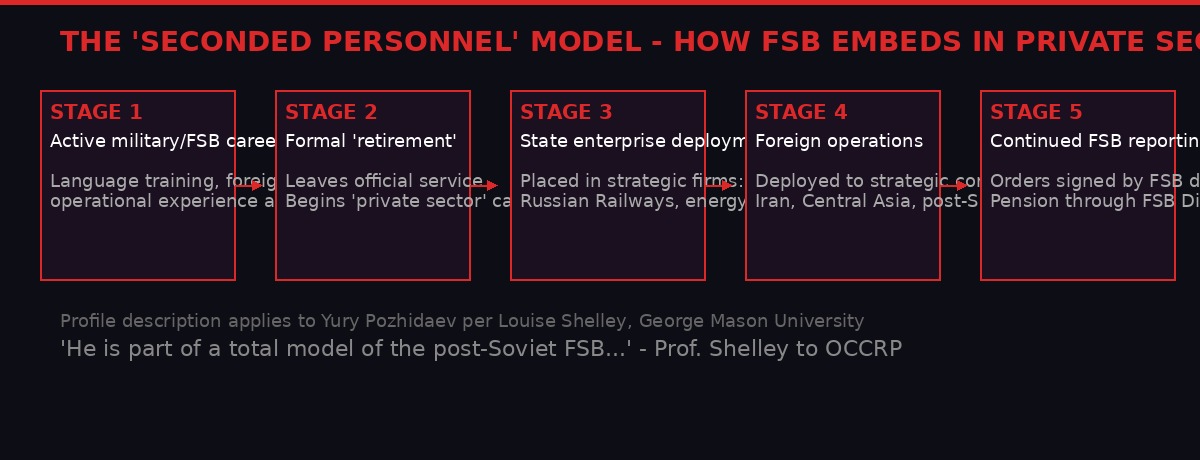
The intelligence thread runs through Yury Pozhidaev. The evidence does not prove he was an active FSB asset. But it meets the threshold that multiple experts describe as the standard profile for what Russians call "seconded personnel" - officers who formally retire from state service but continue to operate under FSB direction while employed in strategic industries and geographic corridors.
In a December 2015 email, Svetlana Pozhidaeva wrote to Epstein that, on a trip to the United States, her father had told her boyfriend stories of his "FSB pa[s]t." When confronted with this email by OCCRP, Pozhidaeva said it was a misguided attempt to impress her boyfriend - that her father was simply "bragging." Her father did not respond to requests for comment.
The employment history is harder to explain away. After leaving the Soviet military in the late 1990s and spending several years in the private sector selling coffee and wine, Yury Pozhidaev resurfaced in December 2017 working for a subsidiary of Rostec - Russia's state-owned defense-industrial anchor, which manufactures weapons, military equipment, and strategic infrastructure. His positions were consistently in high-value security and oversight roles.
In 2018, he was named deputy head of security for the Iranian division of Russian Railways - overseeing a project developing a strategic transport corridor that connected Russia through Iran toward the Persian Gulf. The following year, he concurrently took on the role of deputy general director for security at Caspian Services, the primary contractor for Russia's transport ministry on the same project. He was working in Iran. He was managing security for state transport infrastructure. He spoke fluent Persian.
"He is part of a total model of the post-Soviet FSB, in which they alternate between the private sector and serving state projects overseas, where their language skills and knowledge of the environment help serve the Russian state and its interests. He fits a profile." - Louise Shelley, Professor Emerita, George Mason University - expert on Soviet and Russian security services, to OCCRP
Then there is the pension data. Russian investigative outlet Explainer, working with leaked courier data, found that Yury Pozhidaev sent multiple pieces of correspondence to the pension department of the FSB Directorate for Moscow and the Moscow Region in 2022. The FSB manages pensions only for its own officers. Military retirees claim pensions through the Ministry of Defense. Pozhidaeva told OCCRP her father was claiming a retirement benefit for annual sanatorium stays - but she could not explain why those communications went to an FSB office rather than the defense ministry.
The Kremlin Connections in Epstein's Address Book
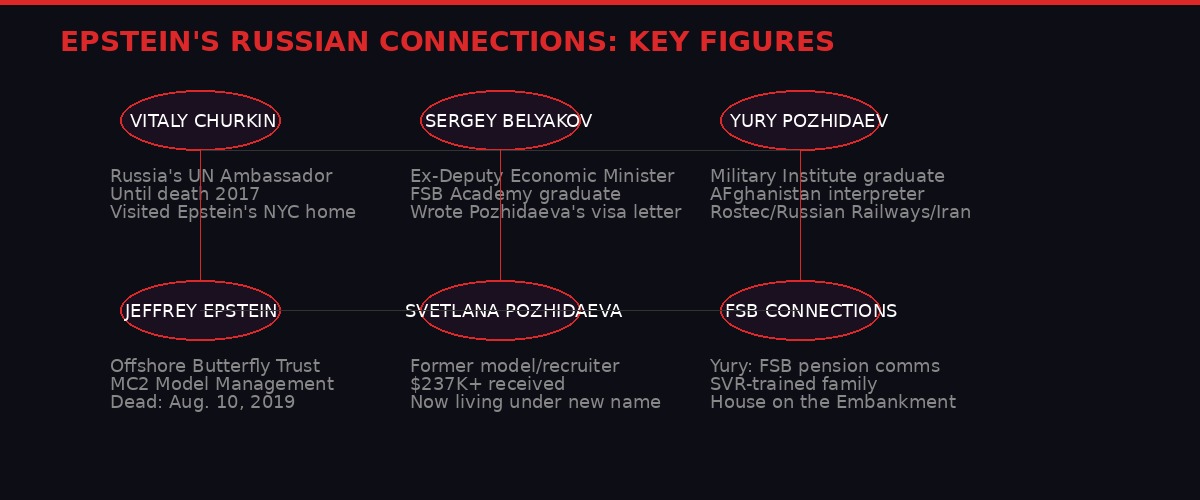
Pozhidaeva's father is not the only Russian intelligence-adjacent figure to surface in the Epstein files. The documents reveal a pattern of Epstein cultivating relationships at the highest levels of the Russian state - a pattern that, set alongside the Pozhidaeva family's background, raises questions that remain unanswered.
Vitaly Churkin - Russia's UN Ambassador from 1994 until his sudden death in February 2017 - appears in both the DOJ files and Pozhidaeva's own account. Churkin was a friend and visitor to Epstein's Manhattan home. The files show Epstein hosted the ambassador during a period when Churkin chaired UN Security Council sessions - a position of considerable geopolitical significance. Churkin also mentored his son Maxim, helping him seek employment on Wall Street at Epstein's facilitation.
Churkin was not a peripheral Kremlin official. He was Russia's most senior diplomatic representative in New York for more than two decades, with direct access to Security Council deliberations on Ukraine, Syria, Iran, and other flashpoints. His documented friendship with a convicted pedophile and intelligence-adjacent figure like Epstein has received little scrutiny in Western media.
Sergey Belyakov is a second documented Russian connection. A former deputy economic development minister and graduate of the FSB Academy - the institution that trains FSB officers - Belyakov ran the prestigious St. Petersburg International Economic Forum. Epstein asked him to write a letter of recommendation for renewal of Pozhidaeva's U.S. visa, claiming she helped plan the forum's agenda. Pozhidaeva told OCCRP this was an embellishment Epstein requested - she attended the forum but played no organizational role. Belyakov wrote the letter anyway.
An FSB Academy graduate writing fabricated credential letters for a Russian model who worked for Jeffrey Epstein and whose father communicated with FSB pension offices. Each data point, taken alone, can be explained. Taken together, they construct a picture that would warrant serious investigation by Western intelligence services - and may already have one.
Money, Offshore Structures, and the Family Visit
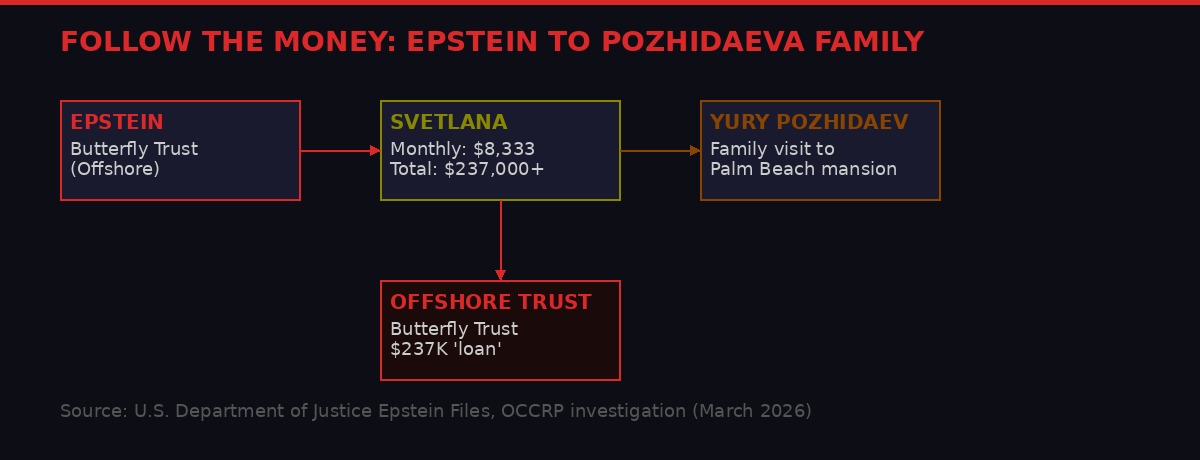
The money trail is one of the clearest threads in the OCCRP investigation. The $237,000-plus transfer from the Butterfly Trust is marked "for the family" - not "salary," not "consulting fee," not a normal employment designation. It arrived in Pozhidaeva's bank account and she characterizes it as a loan. There is no evidence of any repayment arrangement.
The Epstein files document that her parents - Yury and Irina Pozhidaev - visited Epstein at his Palm Beach mansion. After the visit, Irina Pozhidaeva wrote the financier a "rapturous thank-you email" in which she described him as the "Great Getsby (sic)." Ahead of the family's visit, the offshore transfer of more than $237,000 hit Svetlana's account.
The combination of elements - elite Soviet military family, daughter embedded in the inner circle of a suspected intelligence-collecting pedophile, offshore cash transfers designated "for the family," family visits to the principal's property, father's subsequent deployment to Iran on FSB-adjacent security work - is the kind of matrix that a counterintelligence analyst would flag for further investigation.
There is a second financial dimension worth noting. The Butterfly Trust was one of several offshore structures Epstein used to obscure his financial flows. Investigators have repeatedly noted that Epstein's finances remain poorly understood despite years of scrutiny. His known wealth - in the range of $500-600 million by the time of his 2019 death - was disproportionate to any transparent business activity. The origin of his fortune, routed through figures like Les Wexner and a series of offshore trusts, remains a live question.
The Public Statement and the Denials
Svetlana Pozhidaeva chose her moment to go public carefully. The initial unredaction of her name in the DOJ files - and the subsequent viral attention in Russian media, particularly coverage by OCCRP's partner iStories - forced her hand. She spoke first to the Wall Street Journal, then to OCCRP over three separate days of interviews.
Her denials are comprehensive. She denies her father's FSB ties. She says the "FSB past" email was youthful exaggeration. She says the $237,000 was a loan. She says she was a victim of Epstein's manipulation, not a knowing participant in a trafficking network.
Her lawyer, Brad Edwards, has represented numerous Epstein victims in legal proceedings and is a credible advocate. The description of abuse - bullying, physical violence, eating disorders, visa control, medical surveillance - is consistent with documented patterns across Epstein's known victims. The psychological mechanisms of entrapment and manipulation are well-established.
None of this, however, resolves the question of her father. Yury Pozhidaev did not respond to OCCRP's repeated requests for comment. His employer at the time, Russian Railways' Iranian division, did not respond. Rostec did not respond. The FSB did not respond.
What OCCRP and its investigative partners have documented is a pattern. The pattern does not prove Russian state involvement in Epstein's network. But it documents, with specificity, that Epstein cultivated relationships with the Kremlin's senior diplomatic representative in New York, an FSB Academy graduate who ran a key state economic forum, and the daughter of a retired military officer whose employment history, foreign deployments, and pension communications all align with the "seconded personnel" profile that intelligence analysts associate with continued FSB reporting.
The Broader Intelligence Question
The release of the Epstein files in 2026 was politically framed as a transparency exercise by the Trump administration. But the documents' contents have proved more complicated than a simple victim-villain narrative. What they reveal, in aggregate, is a network that was not just about sex. It was about access - to billionaires, heads of government, senior scientists, and intelligence-adjacent figures across multiple countries.
The question intelligence professionals have asked for years is whether Epstein's network was being observed, cultivated, or actively run by state actors. The Israeli intelligence angle has received the most media attention, given the role of figures like Ghislaine Maxwell and Robert Maxwell in the story. The Russian angle has received less scrutiny, despite the documented presence of Churkin, Belyakov, Pozhidaev, and potentially others in the files.
Louise Shelley, the George Mason University expert on Russian intelligence who assessed Yury Pozhidaev's profile for OCCRP, put it plainly: he "fits a profile." Profiles are not proof. But they are the beginning of investigation, and in the Epstein case, serious investigation was systematically avoided for decades - in part, investigators have alleged, because of the reach of those protected by the network.
Pozhidaeva says Epstein still haunts her. "Sometimes I even feel like he's alive. I still have nightmares he's alive." She questions the official version of his death - the supposed hanging with bedsheets that ended his life in a Manhattan federal detention facility in August 2019, while two guards slept and surveillance footage malfunctioned. "It's hard to imagine him being so brave to take his life," she says. "It's a very wild way of taking his life."
Whether she is a victim, a perpetrator, a Russian intelligence asset, or some layered combination of all three, her story opens a door that has been closed too long. The question of who was watching Epstein - and who was using what he had - remains unanswered. The files are out. The names are surfacing. The money can be traced. What remains is the willingness to follow where it leads.
What Happens Now
Pozhidaeva now lives in the United States under a new name, working in finance, building what she describes as a support network for fellow Epstein survivors. She has declined to identify her current location over safety concerns, and OCCRP has honored that request.
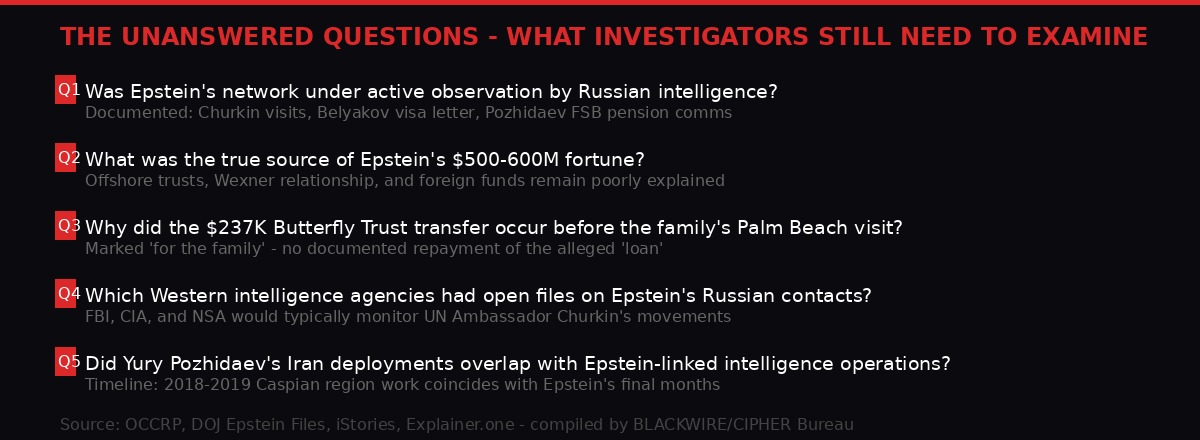
OCCRP's investigation is not the end of this thread. It is a documented opening. The FSB pension communications. The Iran deployments. The Churkin relationship. The Belyakov visa letter. The offshore trust. Each element is a verifiable fact. Together they describe a pattern that intelligence agencies with access to classified material could either confirm or explain away.
The Trump DOJ's mass release of Epstein files created an unusual situation: a flood of primary-source material that overwhelmed the media's capacity to analyze it properly. Stories that would have dominated front pages for weeks were processed in days and replaced by the next controversy. Pozhidaeva's story - and the Russian intelligence question embedded in it - risks being treated the same way.
It should not be. The Epstein network was the most documented intelligence-adjacent pedophile operation in modern American history. Its foreign connections - whoever was behind them - represent a national security question as much as a criminal one. The documents have been released. The names are there. The money can be traced. Follow it.
Get BLACKWIRE reports first.
Breaking news, investigations, and analysis - straight to your phone.
Join @blackwirenews on TelegramSources
OCCRP: "Amid Reports of Family Ties to Russian Intelligence, Longtime Epstein Assistant Speaks Out" (March 2026) | U.S. Department of Justice Epstein Files (2026 release, 3.5 million documents) | iStories (Russian investigative outlet, OCCRP partner) | Explainer.one (Russian investigative outlet) | The Newsground | Wall Street Journal interview with Pozhidaeva | Louise Shelley, George Mason University | Ali Hopper, counter-trafficking expert | Brad Edwards, attorney for Epstein victims