Europe's Nuclear Scramble: How the Iran War Killed the Anti-Atom Consensus and Rewired a Continent

Five weeks of war in the Persian Gulf have done what decades of policy arguments, climate summits, and energy white papers could not: they have broken Europe's anti-nuclear consensus.
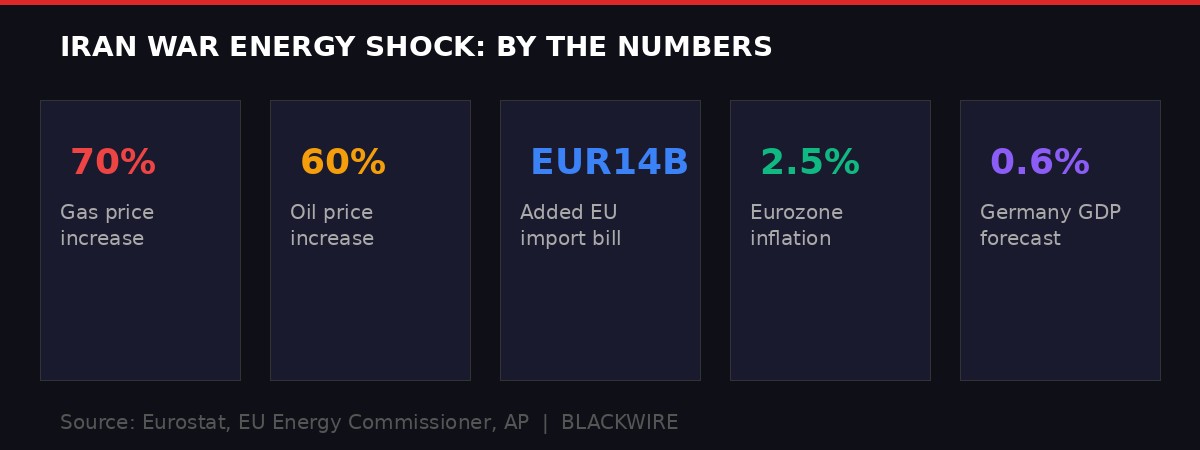
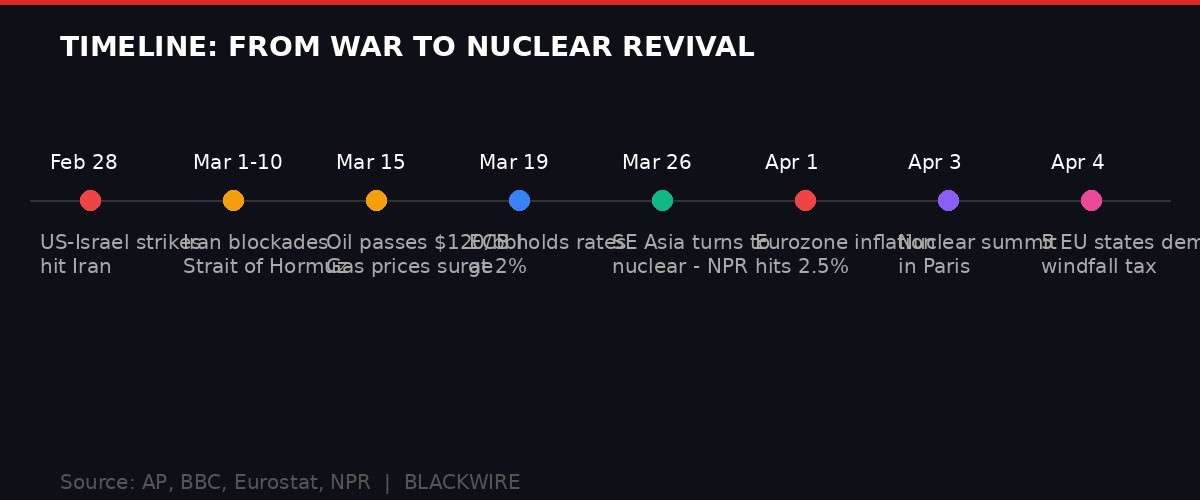
Since the United States and Israel launched strikes against Iran on February 28, Tehran's blockade of the Strait of Hormuz has strangled roughly 20% of the world's oil and gas transit. Gas prices in Europe have surged 70%. Oil is up 60%. The European Union's fossil fuel import bill has swelled by 14 billion euros in barely a month, according to EU Energy Commissioner Dan Jorgensen. Inflation in the eurozone jumped to 2.5% in March - up from 1.9% in February - with analysts at ABN AMRO now predicting the European Central Bank will raise interest rates at both its April and June meetings to contain the damage (AP News).
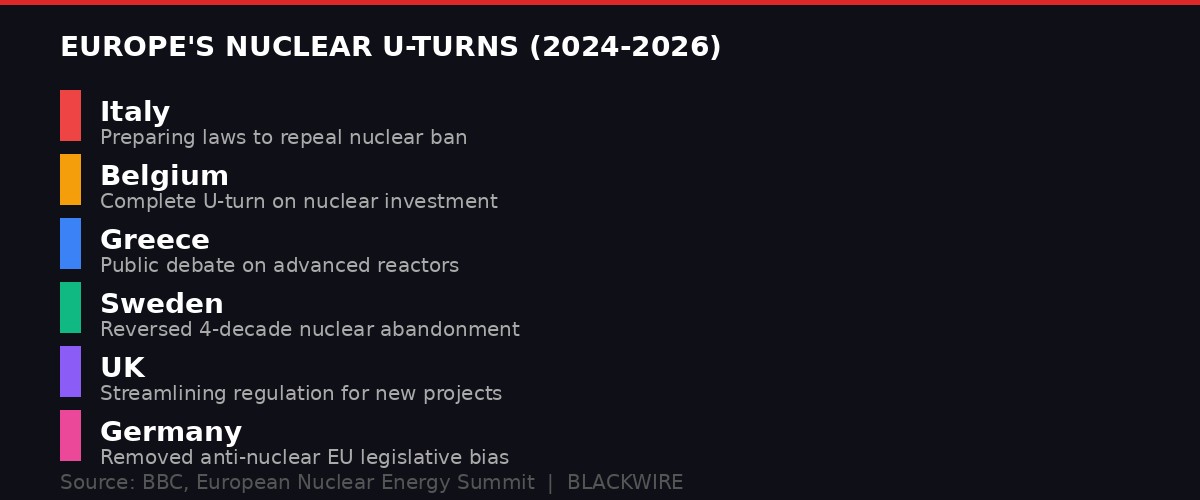
And in the middle of this storm, something remarkable happened. Country after country began reversing decades of nuclear energy policy. Italy is drafting legislation to repeal its longstanding ban. Belgium executed what analysts call a "complete U-turn." Greece opened a public debate on advanced reactor designs. Sweden reversed a four-decade-old decision to abandon nuclear technology. The UK's Chancellor Rachel Reeves announced streamlined regulation for new nuclear projects. Even Germany - the country that shut down its last reactor in 2023 after the Fukushima disaster - quietly agreed to remove anti-nuclear bias from EU legislation (BBC News).
This is not a gradual shift. It is a stampede.
The Trigger: Hormuz Shuts, Europe Shudders

To understand how Europe arrived at this nuclear moment, you have to follow the fuel. The Strait of Hormuz, a narrow waterway between Iran and Oman, is the single most important chokepoint in the global energy supply chain. In peacetime, approximately 21 million barrels of oil per day pass through it. When Iran began enforcing what amounts to a toll-and-blockade system in the strait's first weeks of the conflict, global markets panicked. When the blockade tightened further in mid-March, they cratered.
Europe was uniquely exposed. The continent imports more than 50% of its total energy, predominantly oil and gas. After the 2022 Russian invasion of Ukraine, the EU slashed its dependence on Russian gas from 45% to roughly 10% - a remarkable decoupling. But it replaced Russian molecules with liquefied natural gas (LNG) from Qatar, the United States, and other producers. Much of that LNG still transits or is priced against waterways now disrupted by the Iran conflict (AP News).
Commissioner Jorgensen delivered the blunt assessment this week: "Even if that peace is here tomorrow, still we will not go back to normal in a foreseeable future." He warned of increasing constraints on global gas markets, pressure on diesel and jet fuel supply, and rising electricity prices that would persist for months regardless of ceasefire timing.
The numbers back him up. German electricity prices for next month are now five times those of France, according to future contract data cited by the BBC. Berlin's top economic research institutes more than halved their 2026 GDP growth forecast to a predicted 0.6%, driven almost entirely by energy costs. In Rome, vegetable vendors at the Trionfale market told the AP that fuel surcharges were already pushing up the price of zucchini and eggplant - the Iran war reaching European dinner tables through diesel invoices (AP News).
The European Commission's response was to tell citizens to work from home more and travel less. That buys weeks, not years. For a structural answer, Europe's political class turned to a source of energy it had spent a generation trying to bury.
The Paris Summit: From Strategic Mistake to Strategic Pivot

The European Nuclear Energy Summit in Paris, held in late March and early April, was supposed to be a routine policy conference. Instead, it became a declaration of continental intent. European Commission President Ursula von der Leyen - who served as a minister in the German government when it voted to phase out nuclear power in 2011 - stood before the assembled delegates and called Europe's abandonment of nuclear energy "a strategic mistake."
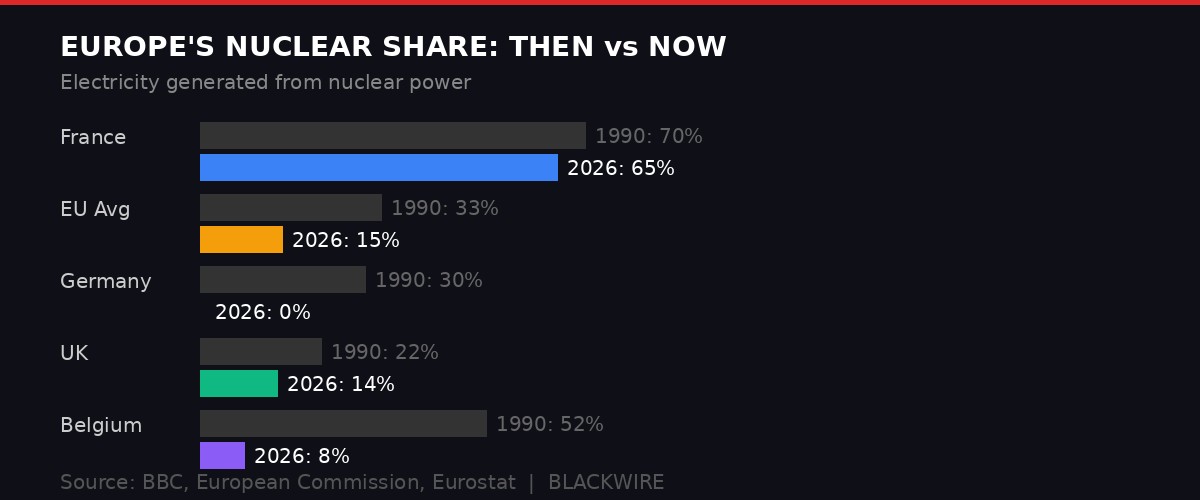
The irony was not lost on anyone. But von der Leyen was stating a mathematical reality. In 1990, Europe generated roughly a third of its electricity from nuclear power. By 2026, that share had fallen to an average of 15% across the EU. The continent had traded energy sovereignty for fossil fuel dependence, and the Iran war had just presented the invoice.
"We left ourselves completely dependent on expensive and volatile imports. That vulnerability is now fully exposed." - Ursula von der Leyen, European Commission President, Paris Nuclear Energy Summit (BBC News)
France's President Emmanuel Macron, long the continent's most vocal nuclear advocate, was characteristically forceful. France generates approximately 65% of its electricity from nuclear power - making its electricity bills a fraction of Germany's. Macron told the summit that nuclear was "key to reconciling both independence, and thus energy sovereignty, with decarbonisation, and thus carbon neutrality."
He went further, linking nuclear energy to a domain that commands even more political attention than climate: artificial intelligence. "The ability to open data centres, to build computing capacity and to be at the heart of the artificial intelligence challenge" depends on cheap, reliable baseload power, Macron argued. In the AI arms race, energy is ammunition. France's nuclear fleet gives it a structural advantage that Germany's wind farms - dependent on weather and backed by gas peakers now priced into the stratosphere - cannot match.
The Domino Effect: Six Nations in Six Weeks

The speed of the nuclear reversal has stunned even energy policy veterans. Prior to the Iran war, nuclear power was a settled issue in most of Western Europe. Germany had shut its last plants. Italy's ban dated to a 1987 referendum held in the shadow of Chernobyl. Belgium was on an exit path. Greece had never seriously considered it. The political calculus was simple: nuclear was expensive, slow to build, carried waste disposal headaches, and was associated in the public mind with Fukushima and Chernobyl. Renewables were cheaper and politically popular.
The Iran war changed that calculus overnight. When gas prices spiked 70% and voters started seeing it at the pump and in their utility bills, the political risk of supporting nuclear evaporated. The political risk of opposing it appeared.
Here is what happened, country by country:
Italy is preparing draft legislation to repeal its nuclear ban entirely. The ban, originally imposed after Chernobyl and reconfirmed in a 2011 referendum after Fukushima, had seemed permanent. Prime Minister Giorgia Meloni's government - already pivoting toward energy independence through Mediterranean gas deals - began the legislative process in March. Italian media report broad cross-party support.
Belgium made perhaps the sharpest U-turn. The country had been on a nuclear phase-out trajectory since 2003, with its last reactors scheduled for closure by 2025. The previous government extended their lifetimes under pressure from the 2022 energy crisis. Now, the current government is investing in new nuclear capacity - a complete reversal of two decades of policy.
Greece, historically cautious about nuclear power due to seismic risk (the country sits on one of Europe's most active fault zones), opened a formal public consultation on advanced reactor designs in March. The fact that Greece is even having the conversation marks a seismic shift of a different kind.
Sweden reversed a nuclear abandonment policy that dated to a 1980 referendum. The center-right government had already signaled interest in new nuclear in 2023, but the Iran war gave the initiative political urgency and public backing that previous advocates lacked.
The United Kingdom - technically outside the EU but deeply enmeshed in European energy markets - saw Chancellor Rachel Reeves announce regulatory streamlining for nuclear projects. "To build national resilience, drive energy security and deliver economic growth, we need nuclear," Reeves declared. New YouGov polling shows majority support for nuclear energy even in Scotland, where opposition had been a defining political position for decades.
Germany did not announce new reactors. That would require a political earthquake beyond even what the Iran war has produced. But Berlin did something arguably more significant at the EU level: it stopped blocking legislation that treated nuclear energy on par with renewables. For years, Germany had been the primary obstacle to EU nuclear policy. Its decision to step aside effectively removed the continental veto. Analysts note the shift coincides with Germany's request that France extend its independent nuclear deterrent to European partners - a defense arrangement agreed this month that would have been unthinkable two years ago (BBC News).
The French Advantage and the German Nightmare

The contrast between France and Germany has become the single most cited data point in Europe's nuclear debate. France operates 56 nuclear reactors generating approximately 65% of its electricity. Germany operates zero, having closed its last three in April 2023.
The consequences are now impossible to ignore. Based on forward energy contracts, German electricity prices for May 2026 are five times French prices. Five times. For industrial consumers - the chemical plants, automotive factories, and steel mills that form the backbone of the German economy - this is not a marginal competitive disadvantage. It is an existential one.
Berlin's top economic research institutes published their spring forecast this week. They more than halved Germany's 2026 GDP growth projection from 1.4% to 0.6%. The primary driver: energy costs. The institutes warned that prolonged high gas prices could push the German economy into recession for a third consecutive year - something unprecedented in the postwar period.
Meanwhile, France is positioning itself as the continent's energy anchor. Macron has openly framed nuclear power as a competitive weapon, arguing that cheap baseload electricity is the prerequisite for Europe's AI ambitions. France is already Europe's largest electricity exporter, selling surplus nuclear-generated power to neighbors including Germany, Italy, and the UK. The Iran war has dramatically increased both the volume and the price of those exports.
The irony cuts deep. Germany's decision to exit nuclear was driven by genuine safety concerns after Fukushima - a tsunami-triggered disaster at a coastal plant in an earthquake zone. Germany has neither tsunamis nor major earthquakes. But the political momentum of the Green movement, combined with genuine public fear, made the phase-out politically inevitable. The calculation was that renewables plus Russian gas would bridge the gap. Both pillars of that strategy have now been demolished - the first by Vladimir Putin's invasion of Ukraine in 2022, the second by the Iran war in 2026.
The resulting energy vulnerability has also reshaped European defense politics in unexpected ways. Germany's request for French nuclear deterrent coverage - an arrangement with massive sovereignty implications - is directly connected to energy dependence. A country that cannot power its own grid independently has limited leverage in defense negotiations. France agreed to the nuclear umbrella extension, but the terms remain classified. European defense analysts describe it as the most significant bilateral defense shift since NATO expansion.
The SMR Promise and the Reality Gap
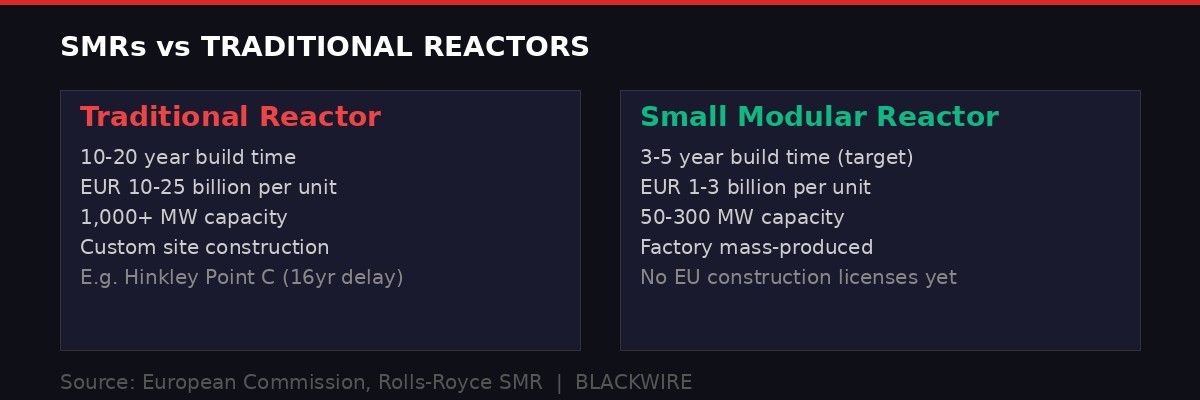
If traditional nuclear reactors are the answer to Europe's energy crisis, they are an answer that arrives a decade too late. Building a conventional 1,000+ megawatt reactor takes 10-20 years in Europe. Hinkley Point C in the UK, approved in 2013, will not generate power until at least 2030 - and its costs have ballooned from an initial estimate of 18 billion pounds to over 35 billion pounds. Flamanville-3 in France, meant to demonstrate the next generation of French nuclear technology, ran 12 years behind schedule and four times over budget.
This is the central tension in Europe's nuclear scramble. The political will has arrived. The engineering timeline has not changed.
Enter small modular reactors - SMRs. These are nuclear reactors with a capacity of 50-300 megawatts, compared to the 1,000+ megawatts of a conventional plant. The pitch is compelling: factory-built components, standardized designs, 3-5 year construction timelines, costs in the low single-digit billions rather than the tens of billions. They are particularly well-suited to powering AI data centers - the fastest-growing source of electricity demand in Europe - as well as hydrogen production and district heating networks.
The European Commission has "rushed to embrace" SMRs, as the BBC put it. The US and Japan announced a $40 billion joint project to develop SMRs in Tennessee and Alabama last week. The UK's environment secretary published regulatory justification for Rolls-Royce's plan to build the first commercial SMRs in Britain. France's EDF is developing its own SMR design, the NUWARD, targeting first commercial deployment in the early 2030s.
But there is a hard reality beneath the promise. As of early 2026, no construction licenses for SMRs have been granted anywhere in the European Union. The technology is commercially unproven at scale. Russia and China have operational SMRs - Russia's floating nuclear plant, Akademik Lomonosov, has been running since 2020 - but Western SMR designs remain in the licensing and prototype phase.
Chris Aylett, a research fellow at the Environment and Society Centre at Chatham House, delivered a measured assessment to the BBC: "You're ignoring the history of nuclear in Europe if you think it can just slot in as an easy energy crisis solution." Nuclear energy is part of the answer, Aylett argued, but many of Europe's existing reactors are aging and require significant investment just to maintain their current output. Increasing nuclear's share requires "a lot of time and a lot of money" - two commodities that European governments, already stretched between welfare, defense, and the Iran war's economic fallout, have in short supply.
Nuclear is also being beaten on price by renewables. The cost of solar and wind power has plummeted over the past decade. In Spain, which invested heavily in both, average electricity prices for the rest of 2026 are forecast at roughly half of Italy's, where gas still sets the price 90% of the time. The economic case for nuclear is strongest as a complement to renewables - providing reliable baseload power that wind and solar cannot guarantee - rather than a replacement for them.
The Windfall Tax Fight: Who Pays for the Crisis?

While the nuclear debate plays out over years and decades, the immediate political crisis is about who pays for the energy shock happening right now. On Saturday, the finance ministers of Spain, Germany, Italy, Portugal, and Austria published a joint letter demanding the European Commission impose a bloc-wide windfall tax on energy companies.
The letter, spearheaded by Spanish Economy Minister Carlos Cuerpo, cited "market distortions" caused by the Iran war price spike and argued that "those who profit from the consequences of the war must do their part to ease the burden on the general public" (AP News).
This is not unprecedented. In 2022, after Russia's invasion of Ukraine sent European gas prices into the stratosphere, the EU imposed a "solidarity contribution" that included caps on excess energy profits. Energy companies protested, but the measure passed with broad political support. The current proposal follows the same template - but in a very different political environment.
In 2022, Europe was united against Russia. In 2026, Europe is divided over the Iran war itself. Some member states - notably France and several Eastern European nations - have been sharply critical of the US-led military campaign. Others, particularly the UK and parts of the Baltics, have been more supportive. The windfall tax debate sits atop this deeper fissure: should Europe impose costs on its own energy companies for a war it did not start and many of its members do not support?
Commissioner Jorgensen acknowledged the possibility of a windfall tax but stopped short of endorsing it, calling it "a possibility" while noting he does not foresee a repeat of the 2022 gas crisis where companies reaped extreme profits. The "toolbox" of emergency measures the Commission is developing will reportedly include mechanisms for member states to decouple gas prices from electricity prices - a long-sought reform that the crisis may finally make politically achievable.
The ECB, meanwhile, faces its own dilemma. Inflation at 2.5% and rising would normally demand rate hikes. But the European economy is already weakened by energy costs. Raising rates risks tipping fragile economies - particularly Germany's - into outright contraction. ECB President Christine Lagarde warned earlier this month that businesses may be "quicker to raise prices" during this inflation episode due to memories of 2022, creating a self-reinforcing cycle of expectations that the central bank must break early or risk losing control of.
Analysts at Oxford Economics expect two rate hikes this year. ABN AMRO's head of macro research, Bill Diviney, is more aggressive, predicting hikes at both the April and June meetings "in order to pre-empt any de-anchoring of inflation expectations." The last time Europe raised rates while its largest economy was contracting was during the 2011 eurozone debt crisis. That episode is not remembered fondly.
The Russian Complication: Nuclear Power's Geopolitical Baggage

Europe's nuclear renaissance comes with a geopolitical complication that few summit speeches acknowledge: Russia. Several Central European countries - notably Hungary and Slovakia - depend heavily on Russian nuclear technology and Russian uranium. Hungary's Paks II nuclear expansion project is being built by Rosatom, Russia's state nuclear corporation. Slovakia's Mochovce plant operates on Russian-designed VVER reactors fueled by Russian uranium.
This creates an uncomfortable parallel with the gas dependence Europe spent four years trying to escape. Replacing fossil fuel imports from one adversarial state with nuclear fuel imports from another does not solve the sovereignty problem - it relocates it. The EU is aware of the issue. Discussions at the Paris summit included proposals for a European uranium enrichment capacity, but existing facilities in France and the Netherlands would need significant expansion to cover Central European demand.
There is also the matter of reactor design. The Western nuclear industry's two flagship reactor designs - France's EPR and the American AP1000 - have both suffered spectacular construction delays and cost overruns. The EPR at Flamanville took 17 years from groundbreaking to grid connection. The AP1000 projects at Vogtle in Georgia, USA, saw Westinghouse go bankrupt during construction. These track records do not inspire confidence that a rapid nuclear buildout is feasible even with political will and public funding.
Russia, by contrast, has been delivering nuclear projects on time and on budget across the developing world. Rosatom has built or is building reactors in Turkey, Egypt, Bangladesh, India, and across Central Asia. Its financing terms are generous - often involving Russian state loans that amount to geopolitical leverage. For countries like Hungary, the Rosatom option is not just cheaper; it is the only option that fits within their fiscal constraints.
The EU's answer, for now, is to bet on SMRs as a technology that can be developed entirely within Western supply chains. But that bet will not pay off for at least five to seven years. In the interim, Europe's nuclear expansion will rely on extending the lives of existing reactors - many of which are approaching or have passed their original design lifetimes - and on French electricity exports that are already strained by domestic demand.
The Deeper Current: Energy Sovereignty as the New European Project

Step back far enough and the nuclear scramble reveals something larger than energy policy. It reveals a continental identity crisis.
The European project was built on trade. Open borders, integrated markets, shared currencies - the EU's foundational logic is that economic interdependence prevents war and generates prosperity. Energy was supposed to fit this model. Europe would import cheap gas from Russia, cheap oil from the Middle East, and focus its domestic resources on high-value manufacturing and services. The global market would provide.
That model has now failed twice in four years. First Russia weaponized gas supply. Now the Iran war has weaponized oil transit routes. Each crisis forced emergency responses - frantic LNG procurement in 2022, nuclear U-turns in 2026 - but neither addressed the structural vulnerability. Europe remains a continent that cannot power itself.
The nuclear revival is the first serious attempt to change that equation. Unlike renewables, which require massive grid expansion and battery storage to provide reliable baseload power, nuclear offers dispatchable electricity generation that does not depend on weather, imports, or the goodwill of authoritarian regimes. Unlike fossil fuels, it does not produce the carbon emissions that Europe has committed to eliminating. Unlike energy conservation - the Commission's "work from home and travel less" advice - it does not require permanent economic contraction.
But the timeline problem is real. Even aggressive nuclear buildout scenarios put meaningful new capacity a decade away. SMRs might shorten that by a few years if the technology proves out at commercial scale. In the meantime, Europe faces a strategic window of maximum vulnerability: dependent on fossil fuel imports it cannot control, committed to a nuclear expansion it cannot complete, and confronting an inflation crisis that threatens social stability in its weakest economies.
The five finance ministers demanding a windfall tax are responding to the immediate crisis. The leaders at the Paris nuclear summit are responding to the structural one. Both are right. Neither alone is sufficient.
What is missing is the middle game - the 5-10 year bridge between today's fossil fuel dependence and tomorrow's nuclear-renewable mix. That bridge will likely be built from a combination of extended reactor lifetimes, accelerated renewable deployment, demand reduction, and diplomatic efforts to reopen or bypass the Strait of Hormuz. It will be expensive. It will be politically painful. And it will define whether Europe emerges from the Iran war era as a more sovereign continent or a more fragile one.
Commissioner Jorgensen's warning bears repeating: "Even if that peace is here tomorrow, still we will not go back to normal in a foreseeable future." The Iran war exposed a vulnerability that a ceasefire cannot fix. Only infrastructure can. And Europe has just begun the most ambitious infrastructure pivot of the 21st century - decades later than it should have, but with an urgency that no peacetime government could have generated.
The anti-atom consensus is dead. What replaces it will determine whether Europe powers the next century or gets powered by it.
Get BLACKWIRE reports first.
Breaking news, investigations, and analysis - straight to your phone.
Join @blackwirenews on Telegram