The $5 Loophole: How Cartels Buy American Aircraft
It costs five dollars to register a private plane in the United States. No background check. No license. No questions. For the Sinaloa and Jalisco New Generation cartels, that is not a fee - it is a bargain price for cover that keeps their aircraft out of foreign crosshairs.

American-registered aircraft carry a hidden advantage for drug traffickers: a tail number starting with N that makes foreign authorities far less likely to intercept them. Credit: Pexels
On April 13, 2022, a private jet was abandoned in the remote grasslands of Venezuela. Cocaine traffickers had used it for a run and left it to rot in the savanna. Colombian prosecutors who tracked the plane's ownership history found it had been sold by a California company called R Consulting & Sales Inc.
Eighteen months later, in October 2023, a different jet was found burnt and destroyed deep in a Honduran jungle. Another suspected drug run, another plane consumed by fire to eliminate evidence. That aircraft had also passed through the hands of R Consulting & Sales.
In December 2023, a third aircraft vanished while supposedly on a sightseeing flight over the Caribbean Sea. Weeks later, it turned up in Ghana with traces of cocaine inside. The seller of record: R Consulting & Sales.
Three cases. Three countries. Three planes. One seller. The man who actually ran R Consulting from behind the scenes, using his girlfriend as the on-paper CEO, is Lance Zane Ricotta, a 54-year-old aircraft broker from near San Diego, California.
A joint investigation by OCCRP and partners, drawn from the leaked NarcoFiles document cache from Colombia's prosecutorial office, has found that of at least 30 planes sold since 2014 by companies Ricotta controlled, 11 - more than one third - ended up in drug trafficking incidents, seizures, or investigations. In several cases, the trail leads directly to Mexican cartels.
None of it was necessarily illegal. That is the point.
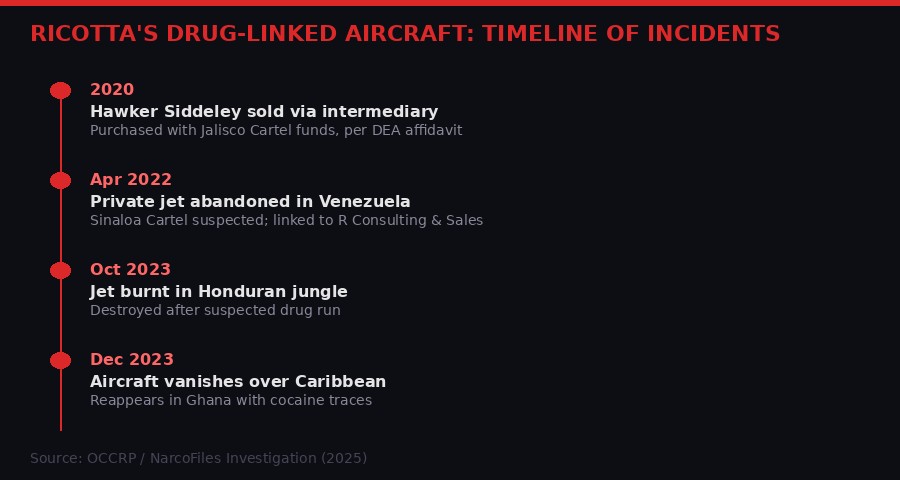
Key drug-linked aircraft incidents involving planes sold by Lance Zane Ricotta or R Consulting & Sales. Source: OCCRP / DEA records.
A $5 Registration, A Billion-Dollar Cover
To understand why drug cartels covet American aircraft, you need to understand what a US tail number means at 30,000 feet over Latin America.
Every American-registered aircraft carries a tail number starting with the letter N. When those planes fly over foreign territory, their "N-number" carries significant weight. Foreign militaries and law enforcement agencies - particularly in Latin America, where drug interdiction is a live and dangerous operation - are far less likely to intercept or shoot down an aircraft that might belong to an American citizen, a US corporation, or a tourist operator.
The calculus is simple: intercepting a foreign cartel plane is acceptable. Accidentally shooting down an American business jet creates a diplomatic incident. Traffickers have understood this dynamic for decades.
What makes the current situation particularly acute is how easy it has become to get that coveted N-number. Under FAA rules, all that is required to register an aircraft is a proof of purchase, a single form, and a $5 registration fee. No background check. No license. No verification of the buyer's identity or source of funds.
"There's more regulation on car dealers, and you have to have a license to even sell yachts, but not airplanes. It's amazingly unregulated."
- Scott Weigman, former Homeland Security Investigations special agent, to OCCRP
Technically, US law requires aircraft to be registered to US citizens or entities. But the law is full of holes large enough to fly a Gulfstream through. Foreign nationals can and do register planes in the US by setting up American shell companies or financial trusts, which can be done in states like Delaware or Wyoming in a matter of days, with no requirement to disclose the true beneficial owner.
Of the 11 planes in Ricotta's sales history that ended up linked to drug trafficking, three were sold to anonymous trusts and four to anonymously owned shell companies. In every case, the FAA's registry accepted the paperwork without question.
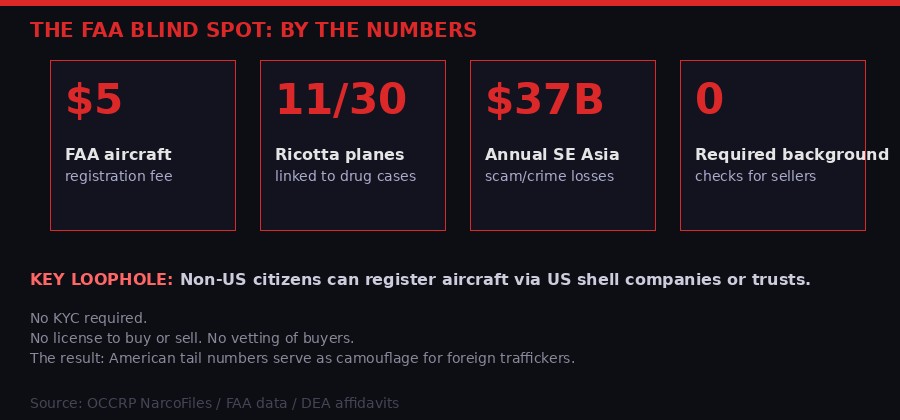
The regulatory gap that makes US-registered aircraft attractive to transnational criminal organizations. Source: FAA data, OCCRP, DEA filings.
Lance Zane Ricotta: Profile of a Plane Broker
Ricotta grew up near San Diego. His father was a deputy sheriff and DEA agent who flew air guard for two US presidents. The son went a different route - at least in terms of his clients' backgrounds.
As a teenager in the late 1980s, Ricotta was refueling planes at an airport north of San Diego. He got his pilot's license and began ferrying aircraft for local brokers. He built a client list that over the years included Hollywood names: Sylvester Stallone, Goldie Hawn, the Discovery Channel, a five-star Las Vegas hotel. By his own account, he sold "hundreds" of planes over his career.
But R Consulting & Sales - the company his girlfriend nominally ran - was where the pattern emerged. The company was first incorporated in California in 2005, then in Nevada in 2012. In practice, Ricotta ran it. In a 2018 court deposition over a disputed insurance claim, his girlfriend was unable to answer detailed questions about the company's operations. When an attorney asked who would have "greater knowledge about the operation of the company," she replied: "Lance Ricotta."
Ricotta was also listed as CEO on corporate documents, signed bills of sale as the company's president, and communicated directly with clients in emails introduced as court exhibits. A separate legal dispute claimed under oath that R Consulting was a "front" that used his girlfriend's name to shield Ricotta's assets from creditors - including restitution he owed from a mid-2000s conviction for conspiracy to commit fraud involving aircraft.
When OCCRP contacted Ricotta, he confirmed some of his planes had ended up in drug trafficking incidents but called them a small fraction of the "hundreds" he had sold. He declined to answer specific questions about individual sales. He posed a rhetorical question to his questioners: "Are you responsible if you sold a car to a guy and he goes and robs a bank?"
He is legally correct. There is no law in the United States requiring a plane broker to vet their buyers for criminal history, cartel connections, or terrorist ties. No license is required to buy and sell aircraft. OCCRP found no evidence Ricotta knew any specific sale was funded with cartel money or that buyers intended to use the planes for drug trafficking.
But experts interviewed by OCCRP used a specific legal phrase to describe the practice of selling to anonymous trusts and shell companies without asking questions: "willful blindness." In banking and financial services, that standard can establish criminal liability. In aviation, it doesn't - because no equivalent oversight framework exists.
The Cartel Connection: Jalisco, Sinaloa, and the Colombian Leak
The investigation's paper trail leads from the grasslands of Venezuela to the courtrooms of the United States, passing through the offices of Colombia's prosecutorial service.
Ricotta's companies first surfaced in the NarcoFiles - a massive leak of documents from Colombia's Attorney General's office that OCCRP and partner organizations obtained and analyzed beginning in 2022. The leak included Colombian prosecutors' investigative findings on the jet abandoned in Venezuela in April of that year.
Colombian investigators had traced the plane's ownership and concluded that Mexico's Sinaloa Cartel was behind the trafficking operation. The aircraft had been owned by R Consulting & Sales at the time of its sale to the ultimate users.
A separate cartel connection emerged from US court records. In 2020, Ricotta sold a Hawker Siddeley jet through an intermediary that quickly transferred ownership to a Wyoming shell company called TWA International Inc. TWA was owned by Texas-based aircraft dealer Carlos Rocha Villaurrutia - the nephew of Ricotta's former business associate, Christian Eduardo Esquino Nunez, known as Ed Nunez.
In a 2021 DEA affidavit, a federal agent stated that Rocha had provided investigators with a list of tail numbers of "planes that were purchased with the proceeds of the drug funds received from the Jalisco New Generation Cartel." The Hawker Siddeley that passed through Ricotta was on that list.
The same affidavit described how Nunez had admitted to US investigators that he had been procuring aircraft on behalf of the Jalisco Cartel. Documents show that Nunez was serving as TWA's sales manager around the time of the Hawker Siddeley transaction. The plane's purchase, according to court records, had been financed with cartel money.
"To track ownership is going to be very difficult if buyers undertook any measures to try to remain anonymous, which they can do very easily."
- Michael Vigil, former head of international operations, US Drug Enforcement Administration
Ricotta did not respond to specific questions about whether he knew Rocha or TWA was the ultimate buyer of the Hawker Siddeley, or whether he knew about Nunez's cartel procurement role. What is documented is that the sale went through his company, the plane was purchased with drug money, and no law was broken in completing the transaction.
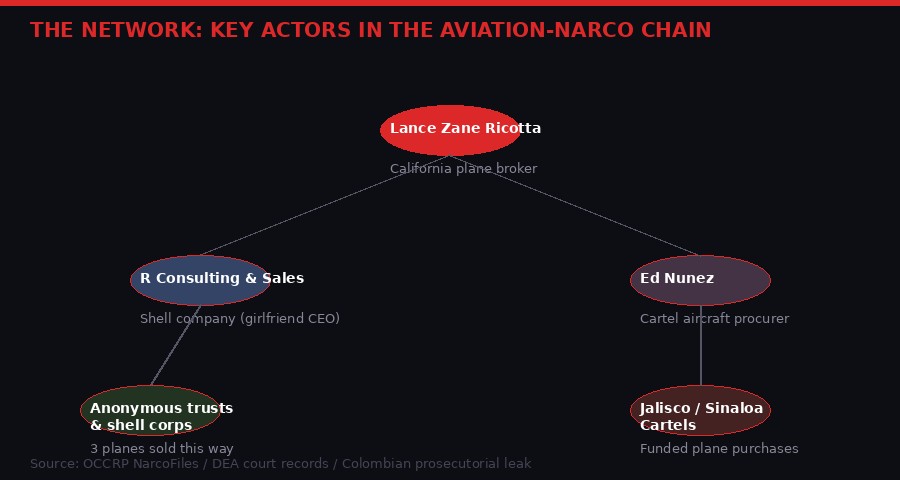
The chain of individuals and entities linking R Consulting & Sales to cartel aircraft procurement. Source: OCCRP / DEA court filings / Colombian prosecutorial records.
The Ghost Plane That Crossed an Ocean
The most striking case in the investigation involves a plane that should never have made it to Ghana.
On December 22, 2023, the aircraft was reported missing during what was described as a sightseeing flight over the Caribbean Sea. Searches found nothing. The plane seemed to have simply vanished.
Then it appeared in Ghana - a flight of roughly 5,400 kilometers across the Atlantic Ocean, an extraordinary journey for a light aircraft, accomplished without triggering any official notice or interception. Inside the plane: traces of cocaine.
The capacity of drug trafficking networks to use American-registered aircraft for intercontinental smuggling runs - across the Atlantic, not just within the Americas - reflects how thoroughly the N-number has been weaponized. An aircraft that successfully passed from the Caribbean to West Africa without official interdiction, carrying cocaine, is not an anomaly. It is an operational proof of concept.
The plane had passed through R Consulting & Sales before ending up with its final registered owners. Who those owners were, and exactly how the aircraft made its Atlantic crossing, remain subjects of investigation.
West Africa has emerged in recent years as a critical transit zone for cocaine moving from South America to European markets. The seizure of a US-registered aircraft with cocaine traces in Ghana fits a documented trafficking pattern - and raises questions about whether the N-number's protective shield extends not just in the Americas but across the Atlantic.
Senator Grassley vs. The FAA: A Fight Nobody Wins
The FAA's registration system is not a secret vulnerability. US lawmakers have been aware of it for years. The problem is that awareness has not translated into meaningful reform.
Senator Charles Grassley, the Iowa Republican who co-chaired the Senate Caucus on International Narcotics Control, issued a scathing security assessment last year targeting what he called the FAA's "overindulgent registration practices." His report documented how transnational crime organizations were exploiting the system to register planes in large numbers, and how the FAA's passive approach to ownership verification created what investigators described as a national security blind spot.
Grassley's assessment pointed to the same structural problem experts had identified for years: the FAA's aircraft registry can only be searched using a plane's current owner, not its history. There is no comprehensive public record of a plane's ownership chain. When reporters at OCCRP wanted to trace the history of Ricotta's sales, they had to file Freedom of Information requests with the FAA and cross-reference open-source aircraft databases - a months-long process that the agency itself cannot do in real time.
The FAA, asked by OCCRP to comment on the investigation's findings, said it has "a robust relationship" with its foreign partners to identify US-registered aircraft that foreign nationals may own. It declined to respond to questions about specific planes or the documents uncovered by reporters.
The contrast with other regulated industries is stark. Banks are required by law to know their customers, verify their identities, understand the source of their funds, and report suspicious activity. Failure to comply carries criminal penalties. Lawyers, accountants, and real estate agents face similar - if sometimes weaker - obligations in many jurisdictions.
Aircraft brokers face none of these requirements. A person with a prior fraud conviction, like Ricotta, faces no legal barrier to selling planes. A cartel intermediary buying with drug money faces no identity check at the point of sale. An anonymous Delaware LLC faces no disclosure obligation when it registers a $3 million jet with the FAA for five dollars.
"But then you run into Lance Ricotta and it's over and over and over again. You're in a different ballgame."
- Steve Tochterman, former FAA special agent, to OCCRP
Tochterman's framing is precise. One drug-linked plane sale could be coincidence. Two might be bad luck. Eleven out of thirty is a pattern that demands explanation - and under the current regulatory framework, the only explanation required is that no law was broken.
The Wild West of American Aviation Commerce
To understand how deeply unregulated the private aircraft market is, consider what it takes to enter it.
To sell a car commercially in California, you need a dealer's license. To sell a yacht, federal and state regulations require licensing under maritime commerce rules. To sell a firearm, you need a federal firearms license and are legally required to run background checks on buyers. To open a bank account for a business, you must submit to know-your-customer verification.
To sell a private jet worth $5 million to an anonymous Wyoming shell company with no disclosed beneficial owner? You need nothing. No license. No background check. No reporting obligation. No audit trail.
The aircraft brokerage industry occupies a regulatory black hole that has persisted for decades, largely because the victims of aviation-enabled drug trafficking live in other countries. The cocaine that moved through American-registered aircraft lands in Venezuela, Honduras, Ghana, or Europe - not in the congressional districts of legislators who oversee the FAA.
What makes the Ricotta investigation significant beyond the individual case is what it reveals about systemic willful blindness - not just by individual brokers but by the regulatory architecture itself.
The NarcoFiles leak from Colombia's prosecutorial office represents one of the most comprehensive exposures of Latin American narco-trafficking networks in recent years. Within that trove of leaked documents, one thread led from a plane abandoned in Venezuelan grassland all the way back to a California broker operating in the shadows of a girlfriend's company name.
That thread exists because Colombian prosecutors were doing the work that American regulators weren't. The FAA's own records, self-reported and impossible to audit historically, would not have led anyone to Ricotta's pattern. It took a foreign government's leaked files to make the connection visible.
Of at least 30 aircraft sold since 2014 by companies Lance Zane Ricotta controlled, 11 - more than one third - ended up in seizures, investigations, or confirmed drug trafficking cases. The trail leads to the Sinaloa and Jalisco New Generation cartels. No law was broken. No regulatory framework required Ricotta or his buyers to answer questions that would have prevented any of it.
What Reform Would Actually Look Like
The path from the current situation to a functional system is not technically complicated. The obstacles are political and economic.
The most straightforward reform would apply know-your-customer standards to aircraft sales above a threshold value - say, $500,000. Sellers would be required to verify the identity of buyers, confirm the beneficial owner of any purchasing entity, and conduct basic due diligence on the source of funds. Banks already do this for transactions of far smaller amounts.
A second reform would require public disclosure of beneficial ownership for any US-registered aircraft - stripping the anonymity from the shell companies and trusts that currently serve as the primary vehicle for cartel plane ownership. The UK has moved toward this model for corporate ownership more broadly, though implementation has been slow and enforcement slower.
A third option, favored by some anti-narcotics experts, would create a licensing regime for aircraft brokers equivalent to what already exists for dealers in vehicles, yachts, and firearms. Licensing would create an accountability structure and enable the revocation of operating rights when brokers consistently end up connected to trafficking incidents.
None of these reforms are on the FAA's current agenda. The agency's focus has been on drone regulation, air traffic modernization, and safety investigations following high-profile crashes. Aviation security in the narco-trafficking context has largely been left to DEA, Homeland Security Investigations, and the Customs and Border Protection Air and Marine Operations unit - agencies that operate reactively, after the trafficking has already occurred.
Senator Grassley's report created a brief window of political attention. That window appears to have closed without action. Meanwhile, the five-dollar fee remains in place, the shell company loophole remains open, and American tail numbers continue to serve as camouflage for aircraft moving cocaine across continents.
Follow the Money, Follow the Planes
The standard tools of financial crime investigation - follow the money, trace the beneficial owner, identify the network - are built for a world where financial transactions leave paper trails. Aircraft, when properly laundered through anonymous trusts and shell corporations in permissive US states, leave trails too thin to follow without a foreign government's leaked files dropping the answer into investigators' laps.
The Colombian prosecutorial leak that started this investigation was not a system working as intended. It was a system failing - and foreign counterparts filling the gap.
Ed Nunez, the cartel aircraft procurer who admitted his role to US investigators, was described in court documents as the "right-hand man" of a major drug trafficking figure. His nephew Rocha ran TWA International, buying planes with Jalisco Cartel money. The chain from cartel cash to FAA registry to Venezuelan grassland is documented in DEA affidavits and Colombian court records. It passed, at some point, through a California broker's hands.
Ricotta's legal defense is accurate and damning at the same time. He is not legally responsible for what buyers do with aircraft after the sale. But the broker who sold eleven planes that ended up in drug trafficking cases, who had a prior fraud conviction, who ran a company through a girlfriend to obscure his assets, who sold to anonymous trusts and shell companies without apparent question - that person represents exactly what a "willful blindness" doctrine is designed to address.
The FAA's $5 registration fee is not the problem. It is the symptom. The problem is an aviation commerce system built in an era before transnational criminal organizations had the resources, sophistication, and legal advice to exploit every structural gap in US regulatory architecture. That era ended a long time ago. The regulatory framework has not caught up.
Eleven planes. Three cartels. Five dollars per tail number. The math is not complicated. The question is whether anyone in a position to change the equation has the political will to do it.
Get BLACKWIRE reports first.
Breaking news, investigations, and analysis - straight to your phone.
Join @blackwirenews on TelegramPRIMARY SOURCES
- OCCRP / NarcoFiles: "Trail of Drug-Linked Planes Leads Back to California Seller - and US Aviation Regulatory Blind Spot" (December 2025)
- NarcoFiles: Leaked documents from Colombia's Attorney General's Office (2022-2025)
- DEA Affidavit, 2021: Carlos Rocha Villaurrutia and Jalisco New Generation Cartel aircraft procurement
- Senator Charles Grassley, Senate Caucus on International Narcotics Control: FAA registration security assessment (2024)
- FAA Aircraft Registry: Freedom of Information responses to OCCRP
- California / Nevada corporate records: R Consulting & Sales Inc
- Court deposition, 2018: Insurance dispute revealing Ricotta's operational role at R Consulting
- US Treasury / OFAC: Designations database
- UNODC: "Transnational Organized Crime and the Convergence of Criminal Networks in Southeast Asia" (2025)