The Fed Flip: Rate Hike Fears Return, Bitcoin Holds the Line, and DeFi Gets Squeezed
Weeks ago, traders were pricing in near-certain rate cuts. Now the CME FedWatch Tool shows a 30% probability of an actual rate hike by year-end 2026. Oil hit $111. Inflation expectations are climbing. The Nasdaq entered correction. And Congress wants to ban DeFi yield entirely. This is the full damage report.

The Fed's policy calculus has shifted sharply in March 2026 as energy prices and geopolitical shocks upend inflation expectations. (Pexels)
Market Snapshot - March 29, 2026
From Cuts to Hikes: The Fastest Policy Flip in Years

Market pricing on Federal Reserve policy has executed a near-complete 180-degree reversal in less than six weeks. (Pexels)
The speed of this reversal has no recent precedent. Six weeks ago, prediction markets on Polymarket and Kalshi were pricing rate cuts for 2026 as close to a certainty. The Fed had already executed a cutting cycle through late 2024 and early 2025, bringing the fed funds rate down to its current 3.50%-3.75% range. More cuts were the consensus baseline.
Then the Iran war arrived. US forces began strikes on Iranian nuclear infrastructure in late February 2026. Within days, Brent Crude - which had been trading around $70 per barrel - started its vertical climb. By March 29, it had hit $111 per barrel. That is a 58% surge in under five weeks.
The transmission mechanism into monetary policy was immediate and brutal. Energy drives inflation. Inflation drives Fed thinking. And the Fed was already dealing with core inflation that, as of February's reading, came in at 2.5% year-over-year - still above its 2% target despite months of tightening. The 5-year inflation breakeven sits at 2.5%. The 10-year at 2.3%. Neither is moving toward target.
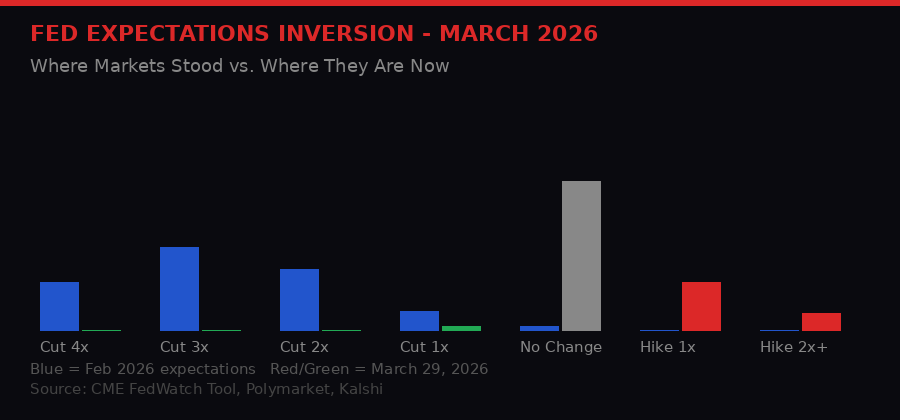
The probability distribution across Fed scenarios has completely inverted. Cuts are essentially off the table. Hikes are live. (BLACKWIRE / CME FedWatch data)
The CME FedWatch Tool now shows nearly a 30% chance that the fed funds rate will be higher at year-end than its current level. The odds of any cut at all have collapsed to 2.9%. The 10-year Treasury yield has climbed from below 4% to 4.40% in a matter of weeks - that is a 40+ basis point move that hammers growth stock valuations and mortgage rates alike.
"Food and energy prices are tragically going to climb and remain high for a while, at least until the utter mess of Middle East shipping is sorted out. Even if a peace deal were to be agreed tomorrow - unlikely - that would take months at best."
- Crypto is Macro Now Newsletter, March 2026
The Nasdaq entered correction territory on Friday, falling more than 10% from its 2026 highs. The S&P 500 has shed 8% in the past month. These are not panic numbers yet - but the direction is clear, and the catalyst (energy-driven inflation reignition plus a tightening Fed) has historically preceded deeper drawdowns when it persists.
What changed the calculus specifically? The Strait of Hormuz remains at risk. The US military presence in the region has expanded, with reports of potential ground operations around strategic oil infrastructure including Kharg Island. Iran handles roughly 20% of global seaborne oil exports through those waters. A disruption - even partial, even temporary - has a structural floor effect on crude prices that is very difficult to cap short of a ceasefire.
Bitcoin at $66,400: The Macro-Resistant Asset That Isn't

Bitcoin has held the $65,000-$70,000 range through the Iran war's first month - but the broader trend from its October 2025 highs is unambiguous. (Pexels)
Bitcoin is trading at approximately $66,400 as of Sunday evening in Europe. Down 23.7% year-to-date. Down roughly 39% from its all-time high of $109,000 set in early October 2025.
The headline is that it has "outperformed" in the Iran war period. Technically true on a short timeframe. Gold is down about 20% since the US attacks began - though it had doubled in the preceding year and entered the conflict at an elevated level. The Nasdaq has dropped 10%. Bitcoin, which had already been falling for months, has held relatively steady in the $65,000-$70,000 corridor.
But the framing matters enormously here. Bitcoin's apparent resilience during the Iran shock is less a bullish signal than a reflection of pre-exhaustion. The asset had already capitulated through late 2025. The speculative excess was already being wrung out before oil started climbing. What you're watching is the difference between an asset that has already priced in bad news and one that hasn't yet.
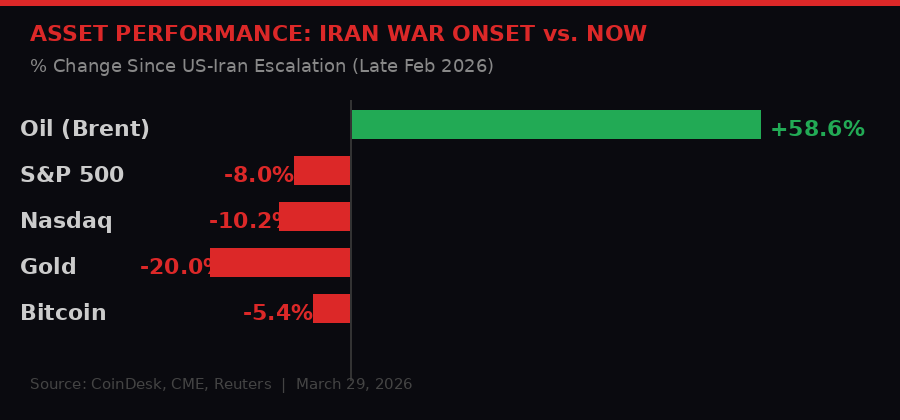
Oil is the biggest mover. Bitcoin's apparent outperformance is relative - it simply dropped earlier and further before the Iran war began. (BLACKWIRE analysis)
Bitwise's analysis aligns with this read. Luke Deans, senior research associate at the firm, told CoinDesk that Bitcoin "typically responds earlier to shifts in risk appetite" and that digital assets "began reflecting tighter financial conditions ahead of many traditional risk assets." The Mayer Multiple - which compares spot price to the 200-day moving average - has sat in the lower historical percentiles since January, suggesting valuation compression has already occurred.
The dangerous signal is the Bitfinex long position data. As of March 29, BTC/USD longs on Bitfinex have climbed to 79,343 - the highest reading since November 2023. This is historically a contrarian indicator. CoinDesk data shows that when this metric spikes, Bitcoin price tends to fall further, not rally. The crowd is piling into long bets at exactly the moment the macro environment is at its most hostile.
"The latest surge in longs, combined with macro factors, point to a growing risk that bitcoin's bear market could deepen."
- CoinDesk analysis, March 29, 2026
The specific risks stacking against a near-term BTC recovery: a 40% chance of zero rate cuts in 2026 per prediction markets, reports of US ground troop deployment in Iran signaling a longer conflict, oil prices with no ceiling while the Strait of Hormuz remains contested, and a Congress actively advancing legislation that would restructure the crypto yield ecosystem (more on that below).
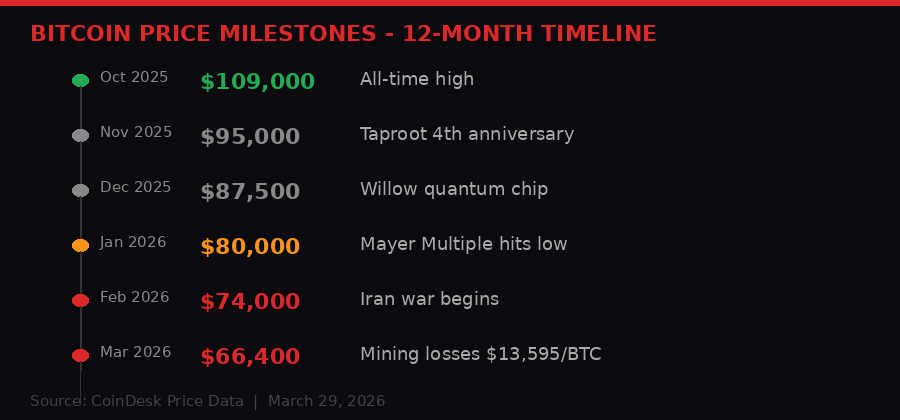
Bitcoin's path from $109,000 in October 2025 to $66,400 today has been relentless. Each macro shock took another chunk out of the price. (BLACKWIRE analysis)
The CLARITY Act's Yield Bomb: DeFi's Existential Problem

Congress's CLARITY Act is targeting yield on stablecoins - and the collateral damage to DeFi protocols could be severe. (Pexels)
If you're holding AAVE, UNI, COMP, DYDX, or SUSHI, the latest version of the CLARITY Act deserves your full attention. It contains a provision that bans yield - or anything resembling yield, including rewards - on stablecoin balances.
The stated goal is regulatory clarity: stablecoins are payment rails, not savings products. Banks run savings products. The logic tracks from a regulatory standpoint. But the secondary effects extend far beyond Circle and Tether into the heart of decentralized finance.
10x Research's Markus Thielen spelled out the mechanism in a report published March 29. "This represents a clear re-centralization of yield," he wrote. The proposal pulls yield back into banks, money market funds, and regulated wrappers, stripping crypto-native platforms of their competitive edge on returns. If you can't earn yield on stablecoin deposits onchain, a major incentive to use DeFi protocols evaporates.
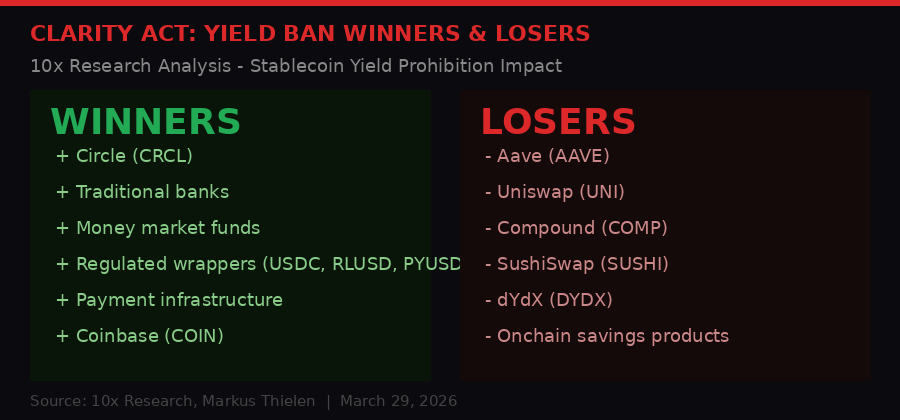
The CLARITY Act's yield ban creates a stark divide: regulated infrastructure wins, DeFi token holders lose. (BLACKWIRE / 10x Research)
The early hope was that a ban on centralized yield would push users onchain, toward DeFi. That logic has a fatal flaw: the regulatory framework is likely to extend to front-end interfaces and token models where fee generation or governance starts to resemble equity. Decentralized exchanges like Uniswap and SushiSwap, and lending protocols like Aave and Compound, are exactly the kind of structures that become targets under a more expansive interpretation of the yield prohibition.
The structural winners are Circle (CRCL) and regulated stablecoin issuers. USDC, RLUSD (which surpassed $1 billion in market cap within its first year), and PYUSD get embedded deeper into payment rails. The compliance overhead becomes a moat rather than a cost. Traditional finance captures the yield that onchain protocols currently offer. Coinbase (COIN) benefits as regulated infrastructure. The incumbents of the existing financial system, it turns out, are well-positioned for a crypto framework that prioritizes regulatory compliance over permissionless innovation.
"The proposed restriction on yield would shift value toward regulated players and away from decentralized finance tokens. Circle is structurally bullish under this framework. DeFi token holders face tighter constraints around operations and value distribution."
- Markus Thielen, 10x Research, March 29, 2026
The CLARITY Act has bipartisan support in its current form and has survived its committee markups with the yield provision intact. This is not theoretical risk anymore. This is legislative pipeline risk with a realistic path to becoming law. Every DeFi protocol that depends on stablecoin yield mechanics to attract liquidity needs to be modeling a world where that mechanic gets legislated out of existence.
Mining's Breaking Point: $79,995 to Produce One Bitcoin

Bitcoin miners are caught between declining hash prices and the enormous capital costs of pivoting to AI infrastructure. (Pexels)
The numbers from CoinShares' Q1 2026 mining report are not sustainable, and the industry knows it.
The weighted average cash cost to produce one bitcoin among publicly listed miners reached approximately $79,995 in Q4 2025. Bitcoin has been trading in the $65,000-$70,000 range. That means miners are losing an estimated $10,000 to $15,000 on every single bitcoin they mine. At the current spot price of $66,400, you're losing roughly $13,595 per coin just on cash production costs - not including depreciation on hardware, interest on debt, or corporate overhead.
Hash price - the metric that determines miner revenue per unit of computing power - hit an all-time post-halving low of approximately $28 to $30 per petahash per day in early March. The network's hashrate has already declined: from a peak of approximately 1,160 exahashes per second in early October 2025 to roughly 920 EH/s today. Three consecutive negative difficulty adjustments have occurred - the first such streak since July 2022.
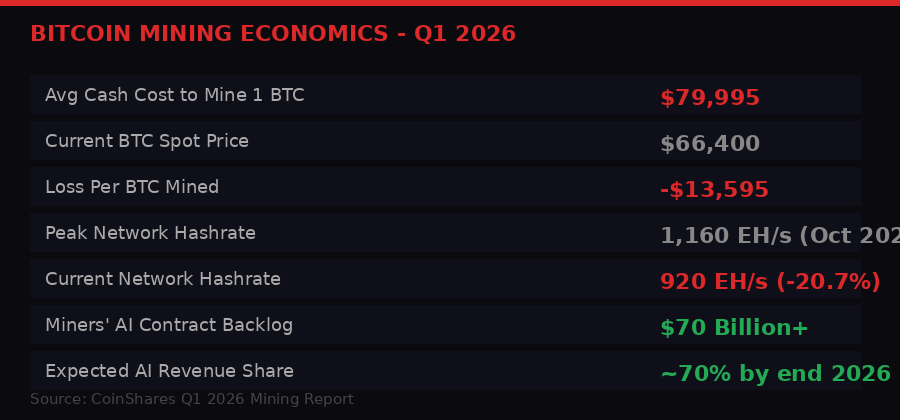
The math is brutal: miners spend $79,995 to produce a coin worth $66,400. The AI pivot is not optional - it is survival. (BLACKWIRE / CoinShares Q1 2026)
The industry response has been dramatic and accelerating. Over $70 billion in AI and high-performance computing contracts have been announced across the public mining sector. CoreWeave and Core Scientific have a $10.2 billion, 12-year deal. TeraWulf has $12.8 billion in contracted HPC revenue. Hut 8 signed a $7 billion, 15-year lease for AI infrastructure at its River Bend campus. Cipher Digital has a multi-billion-dollar arrangement with Google-backed Fluidstack.
The numbers are moving fast. Core Scientific's AI colocation revenue already accounts for 39% of its total. TeraWulf is at 27%. Listed miners could derive as much as 70% of their revenue from AI by the end of 2026, up from roughly 30% today. The market has already priced the bifurcation: miners with secured HPC contracts now trade at 12.3 times next-twelve-month sales, versus 5.9 times for pure-play miners. The premium for AI exposure is real and reinforces the incentive to pivot further.
Financing this transformation is happening through two channels. First, debt at infrastructure scale: IREN now carries $3.7 billion in convertible notes. TeraWulf has $5.7 billion in total debt. Cipher Digital's quarterly interest expense surged from $3.2 million for the first nine months of 2025 to $33.4 million in Q4 alone after a debt issuance. Second, bitcoin sales. Publicly listed miners have collectively reduced BTC treasuries by over 15,000 coins from peak levels. Core Scientific sold roughly 1,900 BTC worth $175 million in January. Marathon, the largest public holder at 53,822 BTC, quietly expanded its authorization to sell from its entire balance sheet reserve - partly driven by pressure on its $350 million bitcoin-backed credit facility where the loan-to-value ratio has climbed to 87%.
The systemic question nobody wants to answer directly: if miners are burning their BTC treasuries to fund AI data centers, they are defunding the security budget of the bitcoin network itself. The hashrate data already shows this dynamic playing out. Whether it reverses depends almost entirely on bitcoin returning to $100,000 or above. At $66,400, the transition accelerates.
The Quantum Clock Is Ticking - and Bitcoin's Response is Silence

Google set a 2029 corporate deadline for post-quantum migration. Ethereum launched a dedicated PQ hub with eight years of work behind it. Bitcoin has no coordinated response. (Pexels)
This story isn't getting the attention it deserves because it's technical and the timeline feels distant. It shouldn't feel distant. Google just published an announcement that it is setting a 2029 deadline to migrate all its authentication services to post-quantum cryptography.
This is the company that builds the quantum computers. When they tell the world to migrate by 2029, they are telling you the timeline for when a "cryptographically relevant quantum computer" - one capable of breaking current encryption standards - arrives on the curve of plausibility. Google's security engineering team wrote explicitly that quantum computers "will pose a significant threat to current cryptographic standards, and specifically to encryption and digital signatures."
Android 17 is already integrating post-quantum digital signature protection. Chrome already supports post-quantum key exchange. Google Cloud offers post-quantum solutions to enterprise customers. These are not research press releases. These are production deployments.
Bitcoin uses ECDSA - Elliptic Curve Digital Signature Algorithm - to sign transactions. This is precisely the category of cryptography Google flagged as requiring migration before quantum computing catches up. A sufficiently powerful quantum computer running Shor's algorithm could derive private keys from public keys, allowing an attacker to spend any bitcoin whose public key has been exposed on the blockchain. That means every single UTXO that has ever been spent is theoretically at risk once a capable enough quantum system exists.
Ethereum's response to the same threat has been eight years of coordinated work. The Ethereum Foundation launched pq.ethereum.org this week, a dedicated hub mapping specific milestones across four upcoming hard forks. Over 10 client teams are shipping weekly devnets through what the foundation calls PQ Interop. Ethereum co-founder Vitalik Buterin was calling for urgency in October 2024. The contrast with Bitcoin's posture could not be sharper.
"Elliptic curve cryptography is on the brink of obsolescence. Whether it's 3 or 10 years, it's over and we need to accept that. The only thing that matters is how quickly blockchain developers recognize that they need to bake in cryptographic mutability into their networks."
- Nic Carter, co-founder Castle Island Ventures, March 2026
Carter, one of Bitcoin's most prominent public advocates, described Bitcoin's approach as "worst in class" compared to Ethereum's "best in class" response. His assessment: there is currently one group working on a quantum-related proposal for Bitcoin that has "received zero buy-in from top devs," with developers pointing to isolated pieces of research as evidence of progress while having "no coherent strategy, no roadmap."
Bitcoin's governance model makes coordinated multi-year engineering responses structurally difficult. There is no Ethereum Foundation equivalent to fund and direct the work. Protocol changes require broad consensus among a decentralized developer community that has historically moved slowly by design. The last major cryptographic upgrade - Taproot - took years of discussion before activation in 2021. With a potential 2029 deadline now on the table, the runway for Bitcoin's characteristic deliberate pace may not be long enough.
Prediction Markets Under Political Assault

State attorneys general are moving aggressively to classify prediction markets as gambling. Kalshi faces legal pressure in Washington state even as it secures institutional licenses. (Pexels)
Prediction markets are the most politically exposed sector in crypto right now, and the pincer movement is tightening on two fronts simultaneously.
Washington state's attorney general filed suit against Kalshi on Friday, alleging the platform offers "gambling products dressed up as prediction markets." This follows similar legal pressure in Nevada and Arizona, where Kalshi has also faced challenges around its classification. The core regulatory argument from state AGs is that contracts on political and sports outcomes cross the line from financial instruments into prohibited gambling under state law.
The irony is that Kalshi is moving simultaneously in both directions. On the same day Washington filed its lawsuit, Kalshi announced it had secured a license to offer margin trading to institutional investors - a significant expansion that departs from the fully collateralized model that traditional prediction markets have used. The industry was seeing growing trading volumes and institutional interest. ICE (Intercontinental Exchange) completed its $2 billion acquisition of Polymarket's parent company just weeks ago, signaling serious institutional validation of the sector.
The tension between state-level gambling regulators and federal financial regulators who view prediction markets as legitimate financial instruments is not resolving itself. It is escalating. The outcome of the Washington lawsuit - and whether it triggers a wave of similar filings in other states - could define whether platforms like Kalshi and Polymarket can operate freely in the US market or face a patchwork of state-by-state restrictions that effectively limit their reach.
For anyone who used prediction markets to track the Fed rate probability data cited earlier in this article, that legal uncertainty has operational implications. These are increasingly the most liquid and accurate forecasting tools available for macro events, and their fate in US courts over the next 12-18 months will determine whether that information infrastructure survives.
The Compounding Squeeze: All Pressures at Once

For crypto markets, the current environment combines geopolitical shock, regulatory pressure, mining-sector stress, and monetary policy reversal simultaneously. (Pexels)
What makes the current moment distinctively difficult for crypto markets is that every major pressure vector is pointing negative at the same time.
Monetary policy: The Fed has flipped from "cutting in 2026" to "possibly hiking in 2026." Rate hikes are catastrophic for risk assets. Bitcoin's sensitivity to liquidity conditions is well-documented. The 2022 rate hike cycle took Bitcoin from $48,000 to $16,000. The current situation is not yet that extreme, but the directional risk is the same.
Geopolitical: The Iran war has no clear resolution timeline. Each week that oil stays above $100 reinforces the inflation argument against cuts. Pentagon planning documents suggesting weeks of continued operations mean this is not a short-term shock that resolves in days. The Strait of Hormuz risk is structural for as long as Iran's navy and coastal defense capabilities remain intact.
Regulatory: The CLARITY Act is advancing with a yield ban that could restructure DeFi economics. Prediction markets face state-level legal challenges. Canada and the UK have moved to ban crypto election campaign donations, adding to a list of jurisdictions tightening the regulatory envelope. Each of these is individually manageable. Combined, they represent a regulatory tide that is moving against the permissionless model.
Industry fundamentals: Miners are losing money on every coin they produce and are selling treasury BTC to fund AI pivots. Hashrate has declined 20% from peak. The network's security budget is under pressure from the economics of the business that provides it. This is a structural issue, not a market cycle issue.
The Bitwise analysis frames Bitcoin's current compression as historically associated with "reduced downside sensitivity" - assets that have already repriced tend to have less room to fall than those that haven't adjusted yet. That is the bull case: Bitcoin already took its beating before stocks did. The bear case is simpler: when the Fed raises rates, risk-off means risk-off, and Bitcoin remains in the risk-on bucket regardless of how it's framed in marketing materials.
What to Watch This Week

The next 7-10 days will be critical across multiple fronts - from Fed speak to CLARITY Act votes to Strait of Hormuz shipping reports. (Pexels)
The macro calendar for early April 2026 is loaded. March CPI data arrives in the second week and will either confirm or complicate the rate-hike narrative. Any reading above 3.5% year-over-year locks in the hike pricing and potentially forces an emergency Fed statement before the scheduled FOMC meeting.
On the geopolitical front, watch Kharg Island. It handles approximately 90% of Iran's oil exports. If US or coalition forces move on it as part of an extended operation, Brent Crude will not stop at $111. Analysts at several major commodity desks have cited $130-$150 as plausible in that scenario, which would completely rewrite the inflation and monetary policy equation.
The CLARITY Act moves through its next legislative stage this week. The yield ban provision is the one to track. If it survives with its current language intact, the DeFi repricing that 10x Research flagged will move from theoretical to concrete. Aave, Uniswap, and Compound would all need to model operational structures without yield incentives - a fundamental re-architecture of their token economics.
And watch Bitcoin's $65,000 support level. It has held through the Iran war's first month. If the Bitfinex long surge is indeed a contrarian signal - as it has been historically - a break below $65,000 with conviction could target the $58,000-$60,000 range, where significant on-chain cost basis concentration sits. The network hashrate decline reduces selling pressure from miners, which is a partial counterbalance. But in a rate-hike environment with oil at $111, the gravitational pull is downward.
The crypto market entered 2026 expecting a year of regulatory clarity, institutional adoption, and rate cuts. It is getting regulatory uncertainty, institutional skepticism about DeFi's legal future, and a Fed that is now seriously discussing hiking. The gap between the January narrative and the March reality is about as wide as it gets. How these converging pressures resolve - through a ceasefire in Iran, a surprise CPI print, or a CLARITY Act compromise - will define crypto's trajectory for the remainder of the year.
Get BLACKWIRE reports first.
Breaking news, investigations, and analysis - straight to your phone.
Join @blackwirenews on TelegramSources: CoinDesk (March 29, 2026), CoinShares Q1 2026 Mining Report, CME FedWatch Tool, 10x Research (Markus Thielen), Bitwise Asset Management (Luke Deans), Crypto is Macro Now Newsletter, Kalshi, Polymarket. All market data as of March 29, 2026 approximately 18:30 UTC.