The Bounty Machine: How FinCEN Turned Every Employee Into a Federal Informant
The U.S. Treasury is offering up to 30% of recovered penalties to anyone who reports financial crimes. Seven hundred tips arrived in the first week. The compliance industry will never be the same.

The U.S. Treasury building in Washington. The department just weaponized its workforce against itself. Photo: Pexels
On March 30, 2026, the Financial Crimes Enforcement Network published a Notice of Proposed Rulemaking in the Federal Register that will reshape American financial enforcement for a generation. The document, reference number 2026-06271, runs dozens of pages of dense regulatory language. The substance is simple: the federal government will now pay you - handsomely - to rat out your employer.
Not metaphorically. Not through some vague "civic duty" framework that has historically produced a trickle of tips from disgruntled ex-employees. This is a formal bounty program. Ten to thirty percent of whatever the government collects. For penalties that routinely hit nine and ten figures in financial crime cases, a single whistleblower tip could produce a payout in the tens of millions of dollars.
Treasury Secretary Scott Bessent went on Fox News to announce the program's launch, comparing it to airport security awareness campaigns. "It's almost like a suitcase in an airport," he said. "If you see something, say something." Within the first week, the government received more than 700 leads through a newly launched confidential online portal. The program covers violations of the Bank Secrecy Act, OFAC sanctions, tariff fraud, money laundering, Medicare and Medicaid fraud, and misuse of COVID-era relief funds.
The call, as compliance analysts have been saying since the filing dropped, is coming from inside the house.
The Legal Architecture: What FinCEN Actually Built
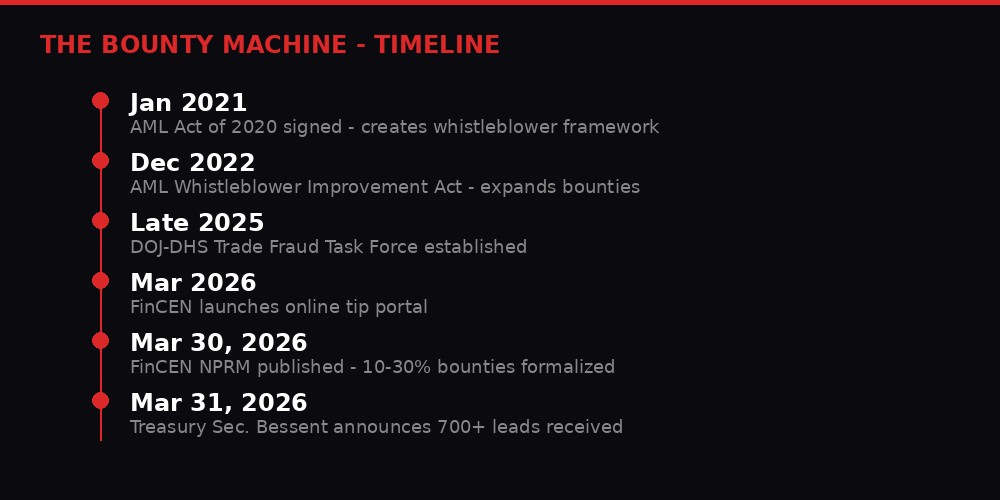
The bounty machine was years in the making. The final piece dropped March 30, 2026. Infographic: BLACKWIRE
The roots of this program trace back to the Anti-Money Laundering Act of 2020, signed into law as part of the National Defense Authorization Act in January 2021. That legislation created the legal framework for a whistleblower incentive program within the BSA enforcement apparatus. But frameworks don't enforce themselves. The Act sat largely dormant through the remainder of the Biden administration, which was occupied with broader crypto regulatory battles and FinCEN's designation of Tornado Cash.
The real acceleration came in December 2022, when Congress passed the AML Whistleblower Improvement Act as part of the Consolidated Appropriations Act. This law did something critical: it expanded the scope of violations eligible for bounty payouts beyond the original BSA framework to include sanctions violations administered by the Office of Foreign Assets Control. In one stroke, Congress turned every OFAC compliance failure into a potential bounty target.
For three years after that, the machinery sat idle. FinCEN had the authority but hadn't built the plumbing - no portal, no formal rules governing payout calculations, no intake process. That changed in early 2026. In February, FinCEN quietly launched a dedicated, confidential online submission portal. On March 30, the NPRM dropped, formalizing the entire payout structure with specificity that left no room for ambiguity.
The proposed rule defines a "covered action" as any judicial or administrative enforcement action resulting in monetary sanctions exceeding $1 million. Whistleblowers who provide "original information" - meaning information not already known to the government and not derived exclusively from public sources - become eligible for bounties. The payout structure is tiered: up to 30% on the first $100 million recovered, and up to 5% on amounts between $100 million and $500 million.
Consider the math. When FinCEN hit TD Bank with an $800 million penalty for BSA violations in 2024, a whistleblower providing the original tip under this new framework could have earned roughly $50 million. When OFAC fined a European bank hundreds of millions for sanctions evasion, a compliance officer who flagged the violations internally and then reported to FinCEN could have earned more than most executives at the bank make in their entire careers.
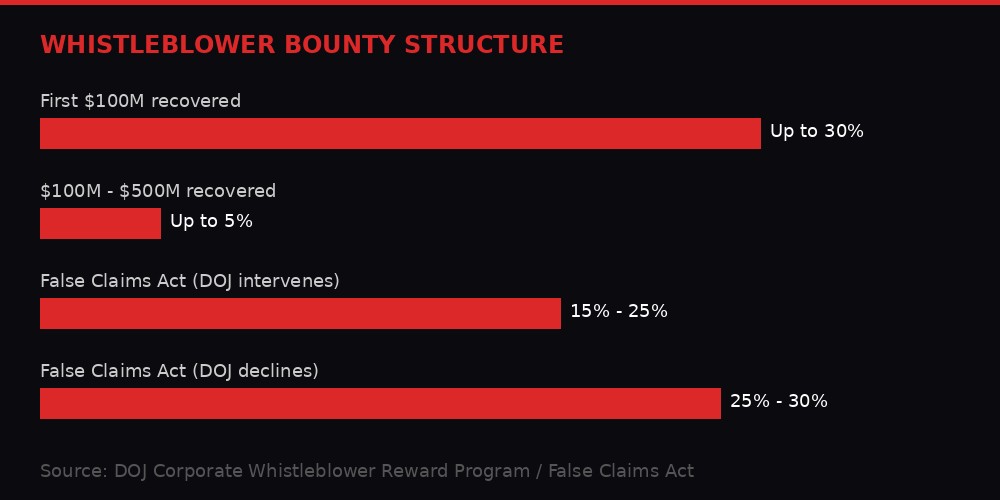
The payout math is staggering. On a $100M penalty, a whistleblower could pocket $30M. Infographic: BLACKWIRE
The program explicitly modeled itself on the SEC and CFTC whistleblower programs, which have collectively paid out over $2.2 billion since their inception. FinCEN reviewed those programs' implementing rules - codified at 17 CFR 240.21F and 17 CFR 165 respectively - and adapted the framework for financial crime enforcement. The SEC's program alone has generated more than 90,000 tips since 2012, with individual awards reaching as high as $279 million.
FinCEN clearly studied what worked. The proposed rule includes anti-retaliation protections, confidentiality guarantees, and a streamlined submission process designed to eliminate barriers. The friction to report has been reduced to filling out an online form.
The Trade Fraud Angle: DOJ and DHS Join Forces

Billions in tariff fraud flows through America's ports each year. The government just opened a tip line. Photo: Pexels
Running parallel to FinCEN's bounty program, the Department of Justice and Department of Homeland Security established a cross-agency Trade Fraud Task Force in late 2025. The task force targets companies using fraudulent means to evade customs duties and tariffs - a problem that has mushroomed since the Trump administration imposed sweeping new tariffs on goods from China, the EU, and dozens of other trading partners.
The task force is explicitly promoting whistleblower rewards. Under the False Claims Act, whistleblowers who file what are known as "qui tam" lawsuits can receive between 15% and 30% of government recoveries from tariff fraud cases. The DOJ's Criminal Division also operates a Corporate Whistleblower Reward Program offering up to 30% of the first $100 million recovered.
The types of fraud the task force is targeting are well-documented but historically hard to prosecute: country of origin fraud, where importers route Chinese goods through third countries like Vietnam or Malaysia to avoid tariffs; undervaluation schemes, where invoices are doctored to reduce assessed duties; and misclassification fraud, where goods are deliberately described under the wrong tariff codes to pay lower rates.
One case already on CBP's radar involves multiple importers of low-speed personal transportation vehicles from China, including companies named Denago, Evolution, and ICON, which are being investigated for duty evasion. CBP announced interim measures in March 2026 and is expected to issue final determinations by late 2026.
The scale of the problem dwarfs the enforcement capacity. U.S. Customs and Border Protection processes roughly $3.4 trillion in imports annually. The Government Accountability Office has estimated that tariff evasion costs the federal government billions of dollars per year, though exact figures are impossible to pin down because the fraud is, by nature, hidden. The Supreme Court's earlier strike-down of some Trump tariffs forced the White House to pivot to Section 301 investigations covering 60+ economies, with public hearings scheduled to begin May 5, 2026.
By incentivizing insiders to report - warehouse workers who see mislabeled containers, shipping clerks who notice doctored invoices, customs brokers who are pressured to file false entries - the task force is attempting to crowdsource its enforcement. The Office of Special Counsel has also instituted a new policy encouraging federal agencies to financially reward government employees who blow the whistle on tariff fraud and customs corruption, including bribery of CBP officers.
Inside the Compliance Panic: The Internal Threat

Every compliance officer, every analyst, every departing employee is now a potential informant. Photo: Pexels
The immediate impact of the FinCEN rule has been felt not in courtrooms but in compliance departments. Global Radar, a risk management platform provider, published an analysis within 24 hours of the NPRM's release calling it "the weaponization of internal compliance data." Their assessment was blunt: "The primary risk is no longer solely about an external regulatory audit catching a skipped OFAC check, a failing compliance program, or a delayed Suspicious Activity Report. The risk is now internal."
The logic is straightforward and devastating. Every mid-level compliance analyst who has ever been told to ignore a red flag, every BSA officer who has watched management override an automated sanctions alert, every departing employee who has witnessed corner-cutting in KYC procedures - all of these people now have a direct financial incentive to document what they've seen and submit it to FinCEN. And the amounts involved make the incentive impossible to ignore.
Consider the dynamics inside a mid-size bank or crypto exchange. A compliance analyst earning $85,000 a year observes that management routinely overrides automated transaction monitoring alerts to avoid filing Suspicious Activity Reports on high-revenue clients. Under the old system, the analyst's options were limited: file an internal complaint that might get buried, contact a regulator and hope for the best, or stay silent. Under the new system, the analyst can submit a confidential tip through FinCEN's portal, and if the resulting enforcement action produces a $50 million penalty, walk away with $5 million to $15 million.
That is not a theoretical scenario. It is the exact pattern that has played out hundreds of times under the SEC's whistleblower program. The largest single SEC whistleblower award - $279 million, paid in 2023 - went to a financial industry insider who documented compliance failures and reported them to the Commission. The FinCEN program is modeled on the SEC's framework. The same dynamics will inevitably follow.
The compliance consulting industry has reacted with alarm. Firms are advising clients to immediately audit their override logs - the records of when human judgment was used to overrule automated compliance systems. They are urging companies to invest in tamper-proof audit trails, so that no departing employee can selectively export records to build a misleading narrative for regulators. They are recommending that internal reporting channels be upgraded to compete with FinCEN's external portal.
"If an employee spots a compliance failure, your internal reporting mechanism must be more trusted, responsive, and secure than FinCEN's external portal. Cultivating a genuine 'speak-up' culture is no longer just an HR initiative; it is a critical financial defense strategy." - Global Radar analysis, March 31, 2026
The Cato Institute's Dominik Lett, who has been analyzing DOGE's cost-cutting measures, pointed to a deeper irony: the same administration that fired 260,000 federal workers and gutted regulatory agencies is now asking the private sector's workforce to do the enforcement work that federal employees used to handle. It is outsourced regulation through incentive alignment.
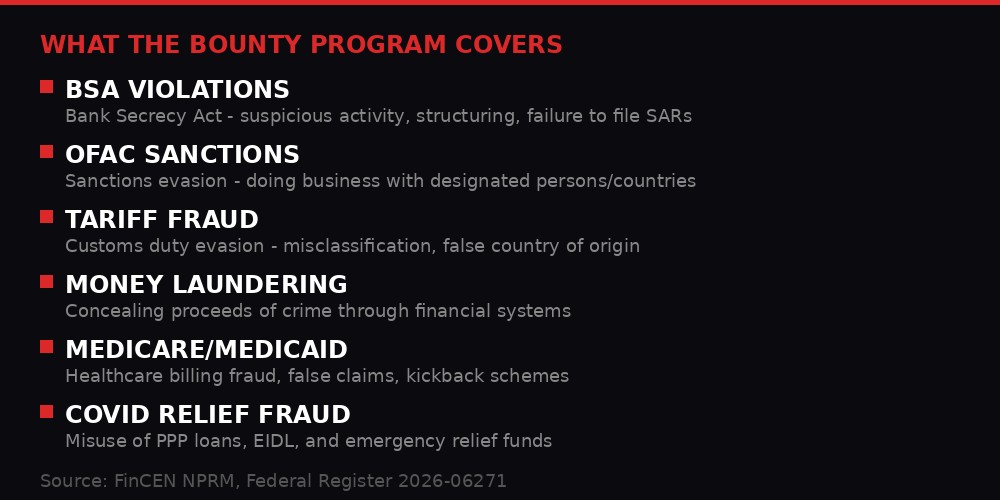
The scope is vast - from sanctions evasion to tariff fraud to healthcare billing. No financial crime is excluded. Infographic: BLACKWIRE
The DOGE Paradox: Gutting Regulators While Crowdsourcing Enforcement

DOGE emptied federal agencies. Now Treasury is asking the private sector to fill the enforcement vacuum. Photo: Pexels
The timing of this whistleblower program is impossible to separate from the broader context of what the Department of Government Efficiency did to federal enforcement capacity over the past year. Between March 2025 and early 2026, DOGE's actions - led by then-adviser Elon Musk - resulted in more than 260,000 federal workers leaving government service through mass firings, reductions in force, early retirements, and a hiring freeze.
The Social Security Administration alone lost approximately 7,000 workers, roughly 12% of its workforce, at a moment when baby boomers were hitting retirement age in record numbers. The SSA hit a 50-year staffing low even before DOGE arrived. Field office workers described being "on eggshells," skipping breaks to manage crushing caseloads. Wait times at field offices stretched to months. The agency stopped releasing real-time wait time data last summer and has not published updated 2026 averages.
The IRS was similarly hollowed out. BLACKWIRE previously reported on DOGE's dismantling of IRS enforcement divisions that had been targeting billionaire tax avoidance. The irony is acute: the administration gutted the agencies responsible for catching financial crime, then turned around and launched a program that pays civilians to do the catching instead.
Elaine Kamarck of the Brookings Institution estimated that roughly 25,000 DOGE-fired workers had to be rehired because they were deemed essential. She pegged the net savings at somewhere between $100 billion and $200 billion, though the figure remains "highly uncertain." A GAO analysis found that layoffs in the Education Department's civil rights division alone may have cost $38 million in severance and backpay, with employees paid months after termination while producing no work.
Musk himself, in a December 2025 interview with conservative influencer Katie Miller, admitted DOGE was only "somewhat successful" and said he wouldn't do it again. By then, the damage was done. Enforcement capacity at FinCEN, OFAC, the IRS, and CBP was degraded. The whistleblower bounty program can be read as the administration's implicit acknowledgment that it broke the enforcement apparatus and now needs the private sector to subsidize the replacement.
More than a dozen lawsuits remain active against the administration for DOGE-related actions. The U.S. Institute of Peace case - where 300+ employees were fired, rehired by court order, then fired again when an appeals court stayed the ruling - is currently suspended pending a Supreme Court decision that could expand presidential control over independent agencies. Thea Price, a former USIP program operations manager who was fired while returning from maternity leave, was forced to use a food pantry when the government shutdown stopped her SNAP payments.
"Nobody was prepared for the complete destruction," Price told the Associated Press. "And for what?"
The Canaccord Precedent: What the Bounty Machine Will Hunt

FinCEN's $80 million penalty against Canaccord Genuity is exactly the kind of case the bounty program was built for. Photo: Pexels
To understand what the bounty machine will actually produce, look at what FinCEN just did to Canaccord Genuity LLC. On March 28, 2026 - two days before the NPRM was published - FinCEN issued $80 million in penalties against the U.S. subsidiary of Toronto-based Canaccord Genuity Group for systematic anti-money laundering failures spanning 2018 to 2024.
The consent order described a company that failed to implement an adequate AML program, failed to detect suspicious activity, and processed transactions connected to sanctioned Russian oligarchs and stock fraud schemes. The firm's compliance systems were so deficient that they allowed sanctioned individuals to move money through the U.S. financial system for years without triggering adequate scrutiny.
Under the new bounty framework, a Canaccord compliance officer who had flagged these failures internally and then reported to FinCEN could have earned up to $24 million - 30% of the $80 million penalty. That is more than most compliance professionals will earn in their entire careers, across all employers, combined.
The Canaccord case is not unique. It sits in a long line of failures that the bounty program is designed to surface faster. The Huione Group case from Cambodia - where the former chairman Li Xiong was extradited to China on April 1 after FinCEN designated the company a "primary money laundering concern" for processing at least $4 billion in illicit funds between 2021 and 2025 - illustrates the scale of financial infrastructure that enables transnational crime. Treasury Secretary Bessent said Huione "established itself as the marketplace of choice for malicious cyber actors like the DPRK and criminal syndicates, who have stolen billions of dollars from everyday Americans."
The question is not whether there are more Canaccords and Huiones operating in the global financial system. The question is how many compliance employees inside those institutions already know about the failures and are now calculating the math of a FinCEN tip submission.
The Healthcare Gold Mine: Medicare Fraud and the Schwartz Problem

Healthcare fraud costs the U.S. an estimated $100 billion annually. The bounty program just opened the floodgates. Photo: Pexels
Healthcare fraud is where the bounty program could generate its most spectacular results - and its most politically uncomfortable collisions. The program explicitly covers Medicaid and Medicare fraud, which the Government Accountability Office estimates costs the federal government somewhere between $60 billion and $100 billion annually. It is the single largest category of federal fraud by dollar volume.
The timing intersects with ProPublica's devastating March 2026 investigation into Joseph Schwartz, a nursing home empire operator convicted of a $39 million fraud scheme who was pardoned by President Trump after serving just three months of a three-year federal prison sentence. Schwartz's company, Skyline Healthcare, operated facilities across multiple states where residents suffered neglect while the company siphoned Medicare and Medicaid payments.
Trump's pardon wiped Schwartz's federal conviction, but it did not affect a separate Arkansas state conviction for Medicaid fraud and tax evasion. Nor did it erase the civil claims by families of patients who suffered under Skyline's care. The White House defended the pardon by claiming Schwartz's offense was an example of "over prosecution" and that no funds were used for personal enrichment - claims directly contradicted by the court record and Schwartz's own guilty plea.
The Schwartz case illustrates a tension that the bounty program will intensify. The same administration that pardoned a convicted healthcare fraudster is now offering up to 30% bounties to people who report healthcare fraud. The same Vice President who is heading the "Task Force to Eliminate Fraud" is operating under a president who has used his pardon power to free convicted fraudsters.
Independent journalists Nick Shirley and James O'Keefe have recently released investigations alleging hospice fraud, daycare fraud, and election fraud in California. Bessent has pointed to these investigations as evidence that the problem is vast, while simultaneously complaining that states like New York and California are too "opaque" for federal investigators to penetrate. The bounty program is designed to solve that opacity problem by incentivizing insiders to provide the visibility that overwhelmed federal agents cannot achieve on their own.
Scott Walter, president of the Capital Research Center, identified the game theory at play. "There is no honor among thieves," he told The National News Desk, "so it is entirely possible that you would have some thieves angry at other thieves and turning them in, and then you would blow up the entire operation." He's describing the prisoner's dilemma applied to fraud networks: once one participant realizes they can earn a $10 million bounty by reporting the scheme, the rational move for every participant is to race to be first to the tip line.
The Crypto Dimension: Sanctions, Stablecoins, and the New Liability
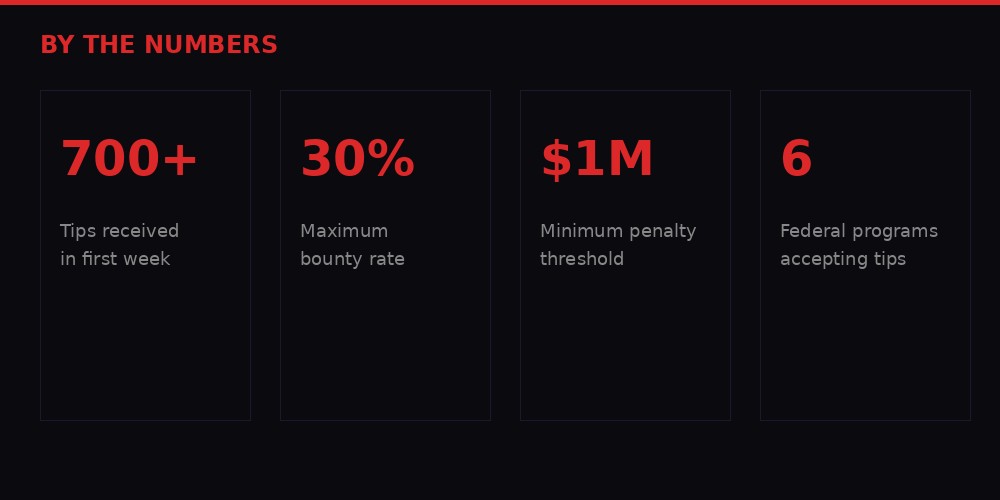
The numbers tell the story. Seven hundred leads in a week. Thirty percent bounties. One million dollar minimum threshold. Infographic: BLACKWIRE
The cryptocurrency industry faces particularly acute exposure under the new framework. FinCEN's NPRM explicitly covers sanctions violations, and the intersection of crypto and sanctions has become the most litigated frontier in financial regulation.
The case of Roman Storm, co-founder of Tornado Cash, remains unresolved. Storm was convicted on charges related to operating an unlicensed money transmitter and conspiracy to commit money laundering, but jurors deadlocked on the most severe charges - conspiracy to launder money and to evade sanctions. His case is heading back to court in Q2 2026, according to DL News. Meanwhile, the broader question of when a smart contract developer becomes liable for how their code is used remains legally unsettled.
The Huione Group case demonstrates how crypto infrastructure enables transnational money laundering at scale. Huione operated a cryptocurrency exchange and online marketplace that FinCEN designated as a primary money laundering concern in May 2025, citing at least $4 billion in illicit transactions including proceeds from North Korean state-sponsored hacking operations. The group's entities facilitated pig butchering scams and romance fraud operations that victimized thousands of Americans.
Under the bounty program, employees at crypto exchanges, stablecoin issuers, OTC desks, and DeFi protocol operators who witness sanctions screening failures or suspicious transaction patterns now have a direct financial incentive to report. The $1 million minimum threshold for "covered actions" is easily met in crypto enforcement - OFAC penalties against crypto entities have routinely exceeded that amount.
The Xinbi Guarantee marketplace, which BLACKWIRE previously investigated, processed an estimated $24 billion in illicit transactions through Chinese-language Telegram channels before being hit with UK sanctions in March 2026. The marketplace facilitated everything from money laundering to human trafficking to stolen data sales. An employee or associate who had reported Xinbi's activities to FinCEN could be looking at a bounty in the hundreds of millions.
Treasury's 2026 National Risk Assessment explicitly documents crypto-based laundering as a known methodology. The assessment notes that prosecutors are increasingly likely to argue that exchanges were "on notice" about illicit activity and that failure to escalate beyond SAR filing constitutes willful blindness. The bounty program gives compliance officers at those exchanges a way to protect themselves financially while simultaneously protecting themselves legally - reporting to FinCEN before the enforcement action arrives.
What Happens Next: The Bounty Economy

The whistleblower program creates a new economy - where information about financial crime becomes the most valuable commodity. Photo: Pexels
The NPRM is open for public comment. The formal rule-making process will take months. But the behavioral shift is already happening. Seven hundred tips in the first week means the pipeline is filling before the rules are even finalized. Legal firms specializing in whistleblower representation are already marketing to potential tipsters. The DOJ, DHS, FinCEN, IRS, SEC, CFTC, and state attorneys general all have intake mechanisms. The government has created a marketplace for information about financial crime.
The implications extend well beyond individual enforcement actions. Companies are now incentivized to invest heavily in compliance not because regulators might catch them, but because their own employees might turn them in. The cost of a compliance failure is no longer limited to the penalty itself - it includes the bounty paid to the whistleblower, the legal costs of defending the action, the reputational damage, and the loss of the employee's institutional knowledge and loyalty.
Attorney Nick Oberheiden, who represents whistleblowers in federal cases, told the National Law Review that prospective whistleblowers should work with experienced counsel before submitting tips to maximize their award eligibility. The timing of when information is submitted, the quality and originality of the evidence, and the whistleblower's ongoing cooperation with investigators all factor into the final payout calculation. A cottage industry of whistleblower attorneys is emerging to service this market.
For corporations, the defensive playbook is clear but expensive. Compliance systems must produce irrefutable audit trails. Override permissions must be strictly controlled and documented. Internal reporting channels must be responsive enough that employees trust them over FinCEN's portal. Access controls must prevent departing employees from selectively exporting compromising records. And all of this must be implemented across every jurisdiction, every subsidiary, and every business line.
For the government, the bounty program represents a bet that financial incentives can compensate for the enforcement capacity that DOGE destroyed. Whether that bet pays off depends on whether the tips that flow in are actionable, whether prosecutors have the bandwidth to pursue them, and whether the courts cooperate. The SEC's whistleblower program suggests the model works at scale. But the SEC also has significantly more enforcement attorneys per tip than FinCEN currently maintains.
What is certain is that the information asymmetry that protected financial criminals for decades - the assumption that insiders wouldn't talk because they had too much to lose - has been fundamentally disrupted. When the bounty for reporting a sanctions violation exceeds the salary the violator was paying you to keep quiet, the math speaks for itself.
Seven hundred tips. One week. The bounty machine is running.
Key Sources
- FinCEN NPRM: Federal Register, Document 2026-06271, "Whistleblower Incentives and Protections," published April 1, 2026
- Treasury announcement: Scott Bessent interview, Fox News, March 31, 2026; The National News Desk report, March 31, 2026
- DOJ-DHS Trade Fraud Task Force: National Law Review analysis, April 1, 2026; DOJ press release, late 2025
- Global Radar analysis: "The Paradigm Shift in AML and OFAC Compliance," March 31, 2026
- DOGE impact data: PBS/AP, "A year after Trump's DOGE cuts," March 27, 2026; Business Insider/AOL, April 1, 2026
- Canaccord Genuity penalty: FinCEN Consent Order, March 28, 2026; Newstracs report, March 30, 2026
- Huione extradition: The Record, AP, ABC News, Channel News Asia, April 1, 2026
- Schwartz pardon: ProPublica investigation, March 29, 2026
- AML Whistleblower Improvement Act: Public Law 117-328, December 29, 2022
Get BLACKWIRE reports first.
Breaking news, investigations, and analysis - straight to your phone.
Join @blackwirenews on Telegram