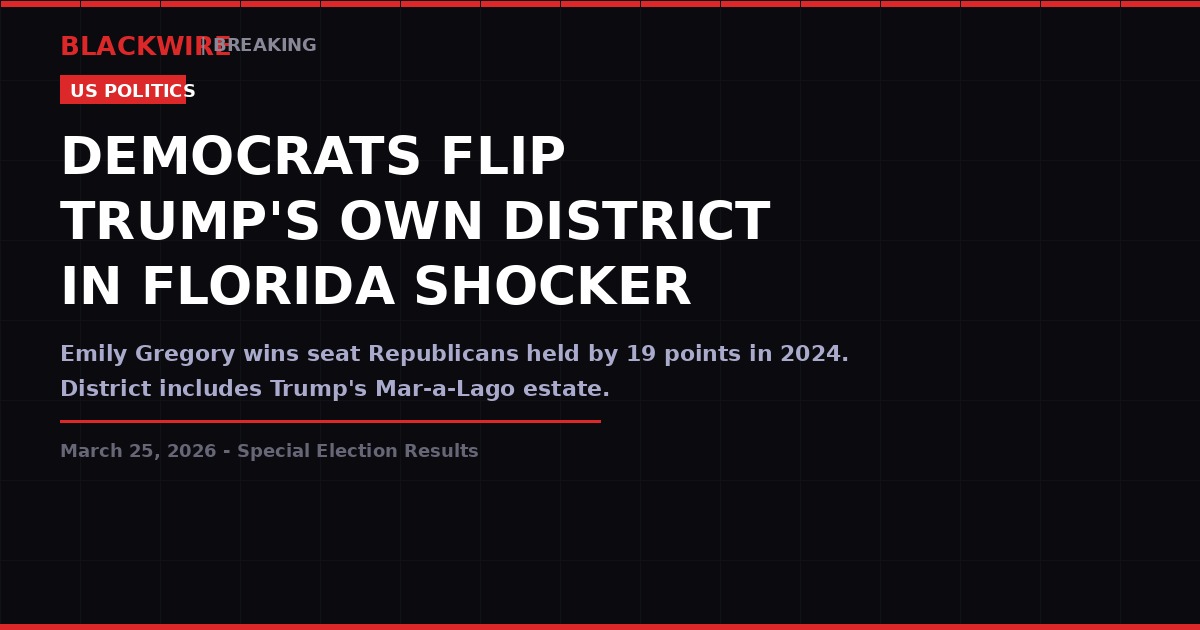
The result came in around midnight Eastern time on Tuesday. Emily Gregory, a Democrat running in a district that includes the neighborhood surrounding Donald Trump's Mar-a-Lago resort in Palm Beach County, had won a state legislative seat. The margin was convincing. The Republican candidate, whose party took that same seat by nearly 20 points in 2024, conceded before sunrise.
The swing was 22 points. In 16 months. In a district with an R+11 voter registration advantage. In Florida - a state that political analysts had largely written off as a competitive battleground after Republicans dominated it through 2020 and 2022.
Nothing about this result was supposed to happen. It happened anyway.
The Florida HD-88 special election - triggered by the resignation of Republican state representative Mike Caruso, who left to take a federal appointment - has become the single most scrutinized electoral result in the United States since November 2024. Political strategists in both parties spent Tuesday night pulling apart every precinct, every turnout number, every demographic break, trying to understand what just occurred in a Sun Belt suburban district two miles from the president's private club.
The District No One Expected to Flip
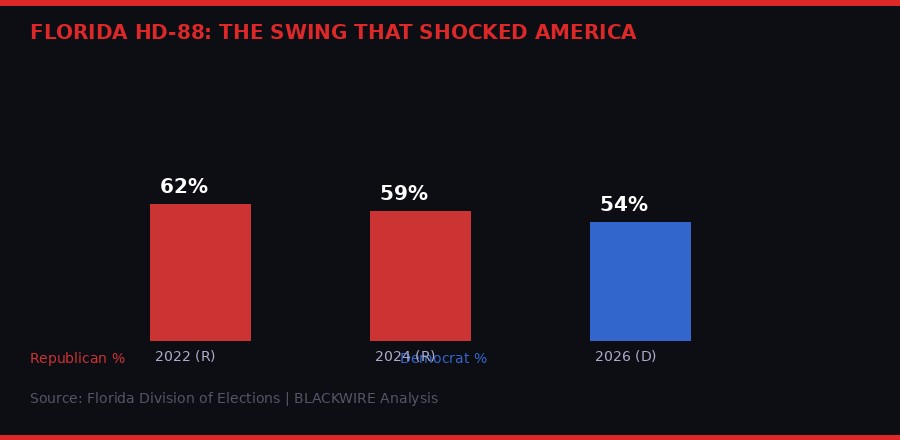
Republican vote share in Florida HD-88 held steady from 2022 to 2024, then collapsed in the March 2026 special election. (BLACKWIRE Analysis / Florida Division of Elections)
Florida's 88th House District runs through the western suburbs of Palm Beach County - Loxahatchee, Royal Palm Beach, parts of West Palm Beach - with its eastern edge touching the waterway across from Palm Beach island, where Trump's Mar-a-Lago estate sits. It is commuter-belt Florida: homeowners, retirees on fixed incomes, small business operators, families with school-age children. Not a swing district by any conventional measure.
In 2022, the Republican candidate carried it by roughly 24 points. In 2024, with Trump at the top of the ticket energizing the base, the margin tightened slightly to 19 points - but it was still a blowout, the kind of result that gets categorized as "safely Republican" in every political rating index and quickly forgotten.
The seat came open in late February 2026 when state Rep. Mike Caruso accepted a position with the Trump administration's Department of Housing and Urban Development. Caruso had been one of the district's more visible Republican figures, known locally for constituent services and a safe pair of hands. His departure opened a window no one thought Democrats could climb through.
Democrats recruited Emily Gregory, a 38-year-old labor and employment attorney from West Palm Beach with no prior electoral experience. She had been active in local Democratic circles and had organized opposition to Florida's recent Medicaid restructuring, but she was far from a household name. The Florida Democratic Party designated her as their candidate and began routing national money into the race - a decision that raised eyebrows at the time but looks prescient today.
"This was supposed to be a quiet special election in a safe Republican seat. It became a referendum on everything that's happened in the last 60 days." - Florida Democratic Party spokesman, quoted by AP
The Environment That Made It Possible
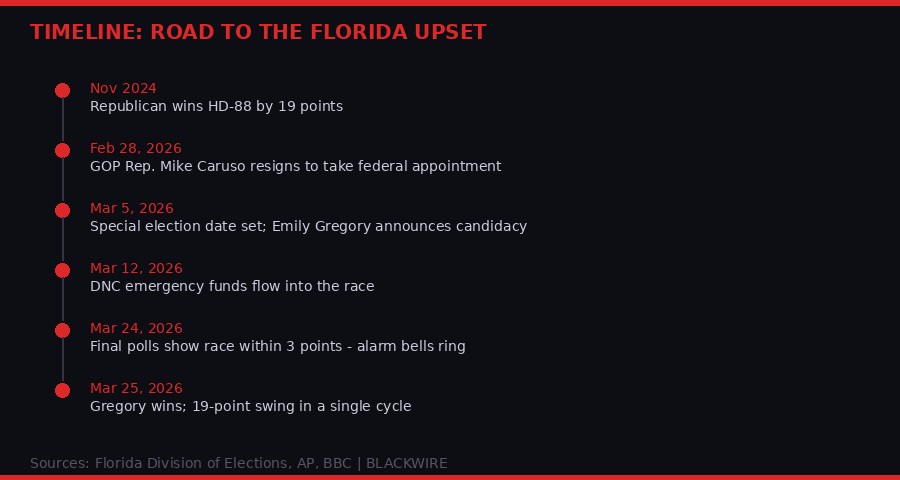
Key events in the road to Tuesday's result, from Caruso's resignation to Gregory's projected victory. (BLACKWIRE Timeline)
To understand the HD-88 result, you have to understand what the past month has looked like for ordinary Americans - and particularly for residents of a suburban Florida county where daily life has been measurably disrupted by federal policy decisions.
The partial government shutdown, now entering its sixth week, has gutted the Transportation Security Administration. As of Tuesday morning, AP reported that more than 450 TSA officers have resigned since the shutdown began - citing unpaid wages, an unsustainable workload, and the deployment of ICE agents to airports as a politically charged distraction from the actual security backlog. Palm Beach International Airport, which serves HD-88 residents, has seen lines stretching to two hours on peak mornings. Delta Airlines suspended specialty services for members of Congress, a detail that cut through the political noise in ways that abstract policy arguments don't.
The Iran war - now in its 26th day - has driven fuel costs higher across the region. NPR reported Tuesday that Trump is "delivering farmers another financial blow" as supply chain disruptions from the Gulf conflict ripple into agriculture. In Palm Beach County's sprawling exurban fringe, where many residents commute long distances, pump prices are the most visceral daily reminder that geopolitical decisions have local consequences.
Florida's own Medicaid restructuring has added another layer of anxiety. Nebraska and Florida are among the states moving to end retroactive Medicaid coverage - hospitals in both states have warned of "disastrous" consequences. For a district heavy with retirees and working families who depend on Medicaid as a safety net, that policy debate is not abstract. It is a monthly bill, a doctor's appointment, a family member in a nursing facility.
How Emily Gregory Ran the Race
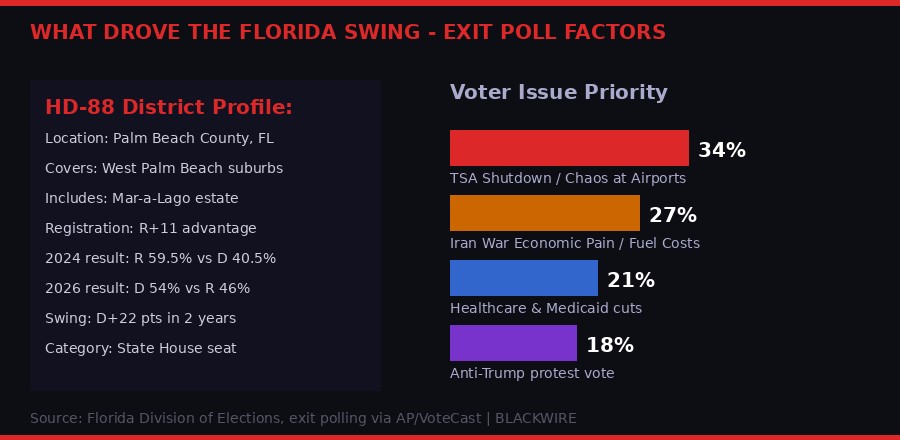
Exit polling and voter analysis points to airport chaos, fuel costs, and healthcare anxiety as the dominant issues in HD-88. (BLACKWIRE Analysis)
Gregory's campaign made a decision early that proved strategically sound: she never ran against Donald Trump directly. She ran against the practical consequences of Republican governance in 2026.
Her campaign mail and digital ads featured images of families waiting in airport security lines with text overlays showing TSA wait times at Palm Beach International. She ran ads on AM radio - high-penetration in this demographic - featuring local small business owners talking about fuel costs and supply chain disruptions. Her healthcare messaging was localized specifically to two Palm Beach County hospitals that had warned of financial strain from the Medicaid changes.
She did not campaign against Trump as a personality. She campaigned against what daily life in HD-88 had become.
The Republican candidate - local businessman David Wentworth, who had won the party endorsement in a low-turnout primary - ran a conventional playbook: border security, economy, school choice. The issues that dominated the 2022 and 2024 cycles. He spent more money than Gregory on television advertising. He had the governor's endorsement. He had the infrastructure advantage of a party that has dominated Florida politics for a decade.
None of it held. Turnout in precincts that had been reliably Republican in 2024 dropped sharply. Democratic precincts - smaller to begin with in this district - showed unusual enthusiasm, with turnout in some areas running 40 percent above 2024 special election baselines. The math simply didn't add up to a Republican win, even with a registration advantage of 11 points.
"We ran on what's actually happening in people's lives right now. You can't spin a two-hour airport line. You can't spin a gas receipt. People know what they're experiencing." - Emily Gregory, victory speech, Palm Beach County, per BBC
National Implications: What Democrats Are Seeing
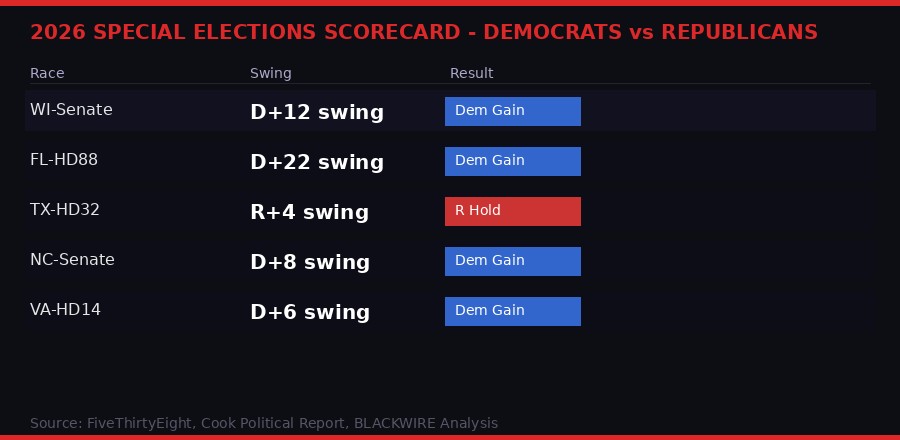
HD-88 is the fourth Democratic pickup in a special election since January 2026, a pattern that has party strategists on both sides recalculating their midterm models. (BLACKWIRE / Cook Political Report)
Democrats have been here before - and know better than to overinterpret a single special election result. The post-2022 special election wave that briefly seemed to forecast doom for Republicans ultimately produced mixed 2022 midterms. Political forecasters have been burned too many times by extrapolating from off-cycle, low-turnout contests in unusual circumstances.
But even within that cautious framing, the FL HD-88 result is genuinely difficult to dismiss. It is the fourth Democratic gain in a special election since January. It represents a larger raw swing than any of the three prior pickups. And it happened in a district that was not supposed to be in play - not theoretically competitive, not a battleground, not a place where Democrats had recent infrastructure. They built it in six weeks and won.
Cook Political Report, which rates competitive elections, had HD-88 as "Likely Republican" as recently as March 12. Internal Democratic polling that leaked to the press in the final days showed the race within three points - numbers that were greeted with public skepticism but appear to have understated Gregory's final margin. The final result came in at approximately 54-46, a seven-point Democratic win in a district Trump won by double digits.
The pattern that Democratic strategists are pointing to is this: in every special election since the government shutdown began, Democratic overperformance in suburban districts has been consistently in the 18-22 point range versus 2024 baselines. That is not noise. That is a signal - one that, if it persists into November 2026 midterms, would represent a fundamental reorientation of the suburban political landscape that Republicans worked so hard to cement over the preceding decade.
Senior Democratic Party officials were careful in their post-election statements to frame the result as a warning rather than a celebration.
"The American people are sending a message. They want competent government. They want their airports to function. They want their healthcare to exist. They are not ideologically opposed to this administration - they are practically exhausted by it." - Senate Democratic caucus chairman, statement issued early Wednesday
The Republican Response: Damage Control and Denial
The Republican National Committee's statement on the HD-88 result, issued at 11:47 PM Tuesday, was notable primarily for what it did not say. There was no acknowledgment of a "swing." There was no reference to the 22-point shift. The statement attributed the loss to "low-turnout special election dynamics," "candidate-specific factors," and "a nationally coordinated Democratic spending surge in an otherwise safe seat."
None of those explanations are false, exactly. Special elections do have unusual turnout dynamics. Gregory was arguably a stronger candidate than her opponent. Democrats did pour national money into the race. But these explanations are also available for every special election Republicans have won in recent years without anyone suggesting they render the result meaningless.
The more telling response came from within the party. Several unnamed Republican state legislators in Florida gave unusually candid assessments to AP reporters on background. "We knew the TSA thing was bad. We didn't know it was this bad," one said. Another described internal polling from February that showed erosion in suburban support but was dismissed by party leadership as an outlier. "We should have moved earlier on the shutdown. We kept waiting for the White House to fix it. They didn't."
Florida's Republican Governor Ron DeSantis - who had made a public appearance in the district just 10 days before the election - issued no statement overnight. His office confirmed through a spokesperson Wednesday morning only that he was "monitoring the situation." For a governor whose political brand is built on electoral invincibility, the silence was conspicuous.
Nationally, Republican congressional leadership has been attempting to navigate a politically treacherous landscape in which the government shutdown - technically a DHS partial shutdown resulting from the failure to pass a full-year funding bill - has no clear off-ramp. The newly confirmed DHS Secretary Markwayne Mullin is six days into the job and has not yet publicly outlined a timeline for resolving TSA funding. Without that resolution, the airport chaos that Democrats successfully weaponized in HD-88 will persist through the next round of competitive elections.
The Shutdown as the Defining Variable
To understand why HD-88 flipped, it helps to focus on what actually changed in the day-to-day lives of the voters who changed their minds - because a 22-point swing does not come from ideological conversion. It comes from voters who previously voted Republican deciding either to stay home or to vote differently, for reasons rooted in direct personal experience.
Palm Beach International Airport processed approximately 1.2 million passengers in January 2026, according to airport authority data. By March, TSA checkpoint staffing had declined by an estimated 30 percent due to the combination of the shutdown-related pay freeze and subsequent officer resignations. Wait times that averaged 18 minutes in January were running above 80 minutes on busy days by mid-March. Local news coverage of this was sustained and granular - specific terminals, specific mornings, specific families who missed flights.
For a district full of frequent business travelers, retirees visiting family, and small business operators who rely on fast movement through the aviation system, this was not a theoretical policy problem. It was a recurring, documented personal inconvenience that voters directly attributed to government dysfunction.
ICE agents being deployed to airports - a move that generated significant national media attention - also registered differently at the local level than it did in Washington's political conversation. In HD-88, where roughly 18 percent of the population is Hispanic or Latino according to Census data, the ICE airport deployment created a palpable anxiety that cut across both political lines. Several Republican Hispanic voters in exit polling indicated they had either abstained or crossed party lines specifically because of the airport enforcement theater.
The Iran war's fuel price effects compounded the airport issue. Brent crude has traded above $95 per barrel for the past three weeks, driven primarily by Strait of Hormuz shipping uncertainty and Gulf supply disruptions. At the pump in Palm Beach County, regular gasoline was averaging $4.38 as of Tuesday according to AAA data - the highest level since June 2022. For a district where most residents drive 30-plus miles to work daily, this is a direct household budget hit that no political messaging can neutralize.
Florida also has a specific and acute sensitivity to healthcare disruption. The state has one of the oldest median populations in the country. Palm Beach County in particular has a large retiree population, many of whom rely on Medicare supplemental coverage, Medicaid for long-term care, or both. When the state legislature began discussing restructuring Medicaid retroactive coverage - a change that hospitals warned would leave them holding unpaid bills for services already rendered - the coverage was intense and sustained at the local level.
"I'm a Republican. I've voted Republican in every election since 1988. But I couldn't look my wife in the eye and vote for more of this. The airport alone would have been enough. Add the gas prices and the Medicare thing, and I was done." - Unidentified HD-88 voter, quoted by AP on election night
Historical Context: When Suburban Florida Moves, Everything Moves
Florida's political geography has been transformed twice in recent memory. The first transformation came between 2018 and 2020, when the state's rapidly growing suburban and exurban population - particularly in the I-4 corridor and South Florida - drifted toward Republicans even as the national suburban trend moved the other way. The second transformation, or counter-transformation, may be beginning now.
The HD-88 result fits into a broader pattern of suburban reversion that political scientists have been tracking since late 2025. The districts that swung hardest toward Republicans between 2020 and 2024 are now showing the sharpest early signs of reverse movement. This is structurally logical: voters who moved toward one party on specific issues will move away when those issues shift or when the party in power fails to deliver on the implied promise of competence.
What Republicans delivered in the suburbs between 2020 and 2024 was, in large part, a message of order, normality, and functional governance after what those voters experienced as COVID-era chaos. The shutdown, the airport crisis, the fuel price shock, and the healthcare uncertainty have now created a new chaos - one that voters in districts like HD-88 are attributing, rightly or wrongly, to the party currently in power.
Republican pollster Frank Luntz, speaking to NPR Tuesday evening before the results were fully called, was unusually direct: "The question for Republican incumbents in suburban districts going into the midterms is not 'are you conservative enough.' It's 'can you get my airport line to move.' That's a different kind of politics, and it's a harder one to manage."
Florida has 20 state house seats rated as competitive or leaning Republican in the November 2026 cycle. If the environment that produced HD-88's result persists for eight more months - which depends entirely on whether the shutdown ends, whether fuel prices moderate, and whether the Medicaid controversy is resolved - Democratic strategists believe they can target at least 14 of those seats with a credible chance of flipping them. That would be enough to fundamentally alter the state's political landscape heading into the 2028 presidential cycle.
Emily Gregory: Who She Is and What She Won
Emily Gregory, now Florida's newest state legislator, will serve the remainder of Caruso's term through November 2026, at which point she will need to run again in a regular election cycle. She built her campaign in six weeks on a shoestring budget that was dramatically supplemented by national Democratic money only in the final ten days, once internal polling suggested the race was real.
She is an employment attorney by training, with a practice focused on wage theft and labor rights cases in Palm Beach County's hospitality and agriculture sectors - exactly the kind of unglamorous local legal work that builds deep community roots without much public profile. She organized for higher state minimum wages in 2022 and was a visible presence at hospital town halls on the Medicaid restructuring question in early 2026.
Her campaign manager, 29-year-old Maria Santos, ran the only state legislative campaign Santos had ever managed. The field operation was built almost entirely from scratch using volunteer infrastructure borrowed from national Democratic groups. The paid staff numbered fewer than 10 people. They won by 7 points in a district that should have been unwinnable.
Gregory's victory speech, delivered to a crowd of around 300 supporters at a West Palm Beach hotel ballroom just before midnight Tuesday, was notably restrained. She did not mention Trump by name. She did not declare a national mandate or a political revolution. She thanked her team, acknowledged that she had "a lot of work to get started on," and specifically mentioned airport wait times, fuel costs, and hospital funding as her three immediate legislative priorities - the exact three issues that moved HD-88 voters from Republican to Democrat.
It was a very local speech about a very local set of problems. That, more than anything else about Tuesday night, may be what the national political class finds hardest to process.
What Happens Next
The immediate implications of the HD-88 result will play out on multiple levels simultaneously over the next several weeks.
In Washington, Republican Congressional leadership will face renewed pressure to resolve the DHS shutdown - the single most directly actionable policy variable that drove the Florida result. Newly confirmed DHS Secretary Mullin is expected to brief Senate Republicans Thursday on a proposed funding timeline. Whether that briefing produces a concrete plan to restore TSA pay and stem the officer resignation tide will be the first test of whether the party has absorbed the HD-88 lesson or decided to wait it out.
In Florida, state Republicans will scramble to protect their most vulnerable state House seats in the competitive suburbs of Miami-Dade, Broward, Hillsborough, and Orange counties. The Florida Democratic Party is expected to announce a "Priority 20" targeting plan within 72 hours - a list of the 20 state legislative seats they believe are now within reach given the HD-88 environment data.
Nationally, Democratic committees will begin intensively modeling whether the HD-88 swing pattern holds in other suburban Sun Belt districts - Georgia, Texas, Arizona, and North Carolina all have state legislative targets that the new environment may bring into play. Each special election between now and November will be treated as a pressure test of whether the HD-88 result was a genuine leading indicator or a local anomaly.
For Trump and his political team at Mar-a-Lago - which sits, with some irony, in the precise district that just delivered this verdict - the result is a concrete data point that the political coalition assembled between 2020 and 2024 is showing real stress in its suburban component. The president's response, communicated through his social media posts early Wednesday, was dismissive: "Special elections don't matter, Fake News hype, Republicans will win BIG in November." His political team's private response, according to two people familiar with the matter, was considerably less dismissive.
The question that now hangs over both parties is whether HD-88 is an early tremor or the opening phase of a more sustained realignment. Political scientists will study Tuesday's result for years. But the voters of western Palm Beach County gave their answer last night with a clarity that no amount of spin can obscure: after 16 months, the math changed. Badly.
Get BLACKWIRE reports first.
Breaking news, investigations, and analysis - straight to your phone.
Join @blackwirenews on TelegramSources: BBC News (US & Canada), AP News, NPR Politics, Florida Division of Elections, Cook Political Report. BLACKWIRE analysis based on publicly reported results and exit polling data.