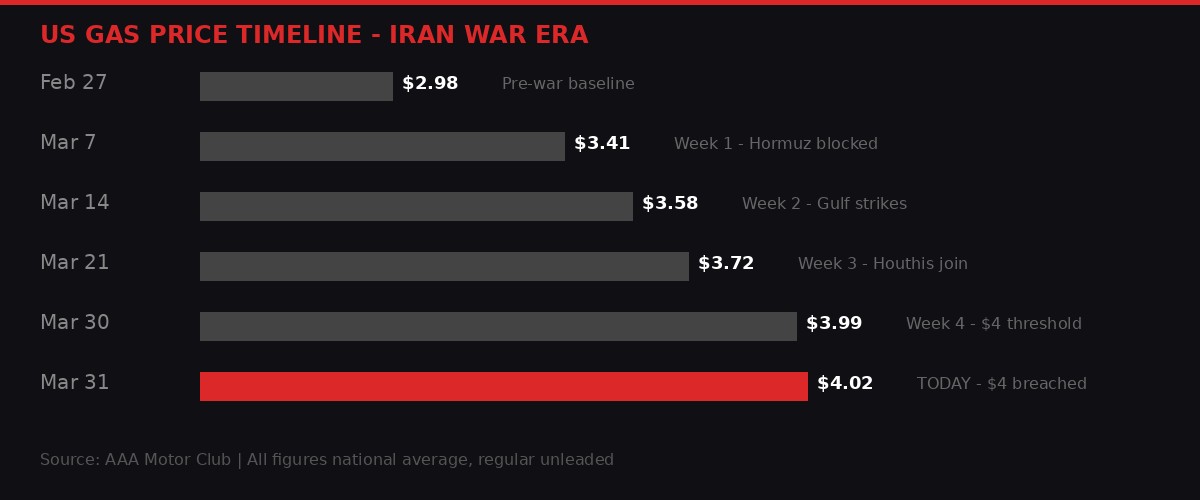
The number on the gas pump sign changed on Tuesday morning, and with it, a psychological barrier shattered. According to AAA, the national average for a gallon of regular unleaded gasoline in the United States hit $4.02 - more than one dollar higher than the price Americans were paying before the United States and Israel launched their joint military campaign against Iran on February 28. The last time the country collectively stared at numbers this high was nearly four years ago, in August 2022, when Russia's invasion of Ukraine sent shockwaves through global energy markets.
This time the shockwave started in the Strait of Hormuz, the 21-mile-wide chokepoint between Iran and the Arabian Peninsula through which roughly one-fifth of the world's oil passes on any given day. For over four weeks now, that passage has been effectively closed. Only a handful of ships make it through each day. Twenty million barrels of crude that once flowed freely now sit trapped in the Persian Gulf, their owners waiting for a war to end that shows no sign of ending.
The result is an energy crisis that the International Energy Agency's director, Fatih Birol, has publicly described as worse than the 1970s oil shocks combined. Not a comparison that anyone involved in policymaking wanted to hear. And not one that the families pulling up to gas stations across the American South and Midwest - where prices are climbing fastest - needed explained to them.
They can see it every time they fill the tank.
The Numbers That Tell the Story
The raw data is brutal in its clarity. Before the war began on February 28, the national average for regular unleaded sat at $2.98 per gallon, according to AAA. Within the first week, as the Strait of Hormuz effectively shut down and Iranian retaliatory strikes hit energy infrastructure across the Gulf, that figure jumped to $3.41 - a 43-cent spike in seven days. By the end of the second week, it reached $3.58. By the end of the third, $3.72. On Monday, March 30, it was $3.99 - one penny short of the psychological barrier. On Tuesday morning, it crossed.
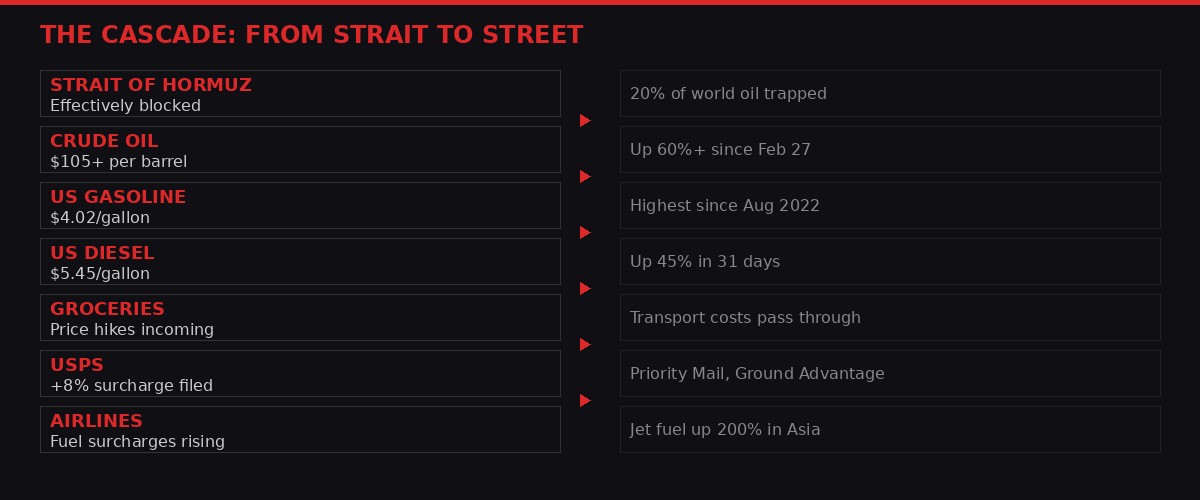
That 35% increase in 31 days would be alarming enough on its own. But gasoline is only one piece of the picture. Diesel - the fuel that powers the trucks hauling food to grocery stores, packages to front doors, and goods to factories - now averages $5.45 per gallon nationwide, up from $3.76 before the war. That's a 45% jump. Diesel drives the real economy in ways that regular unleaded doesn't, because virtually every physical product Americans buy at some point rode in a diesel-powered vehicle.
Meanwhile, crude oil itself, the raw commodity from which all of this flows, has been on a relentless climb. American-produced WTI crude settled above $90 in the first week of the war and has continued rising. Brent, the international benchmark, topped $104 on March 26 after Iran denied that any talks with Washington were taking place, killing hopes of a near-term de-escalation. That denial sent Asian markets into a tailspin, with key indexes in Tokyo, Seoul, and Hong Kong all posting sharp declines.
The numbers are not abstract. They translate directly into household budgets. A family that drives 12,000 miles per year in a vehicle getting 25 miles per gallon was spending roughly $1,430 annually on gas before the war. At $4.02 per gallon, that same family is now on track to spend $1,930 - an extra $500 per year, or roughly $42 per month, pulled from a budget that was already stretched by two years of elevated food prices and stagnant wage growth.
By the Numbers - March 31, 2026
- Regular Unleaded (national avg): $4.02/gallon (was $2.98 on Feb 27)
- Diesel (national avg): $5.45/gallon (was $3.76 on Feb 27)
- Brent Crude: $104+/barrel
- Strait of Hormuz: Effectively blocked since late February
- IEA Emergency Release: 400 million barrels pledged from member stockpiles
- War duration: 31 days and counting
The Workers Who Can't Absorb the Hit
Leslie Sherman-Shafer drives for Uber in the San Francisco Bay Area. She used to fill her Toyota Corolla for about $25. Since the war began, that same fill-up costs her closer to $40. She picks up passengers five days a week after retiring from a career as a dental office assistant. The math no longer works the way it did six weeks ago.
"We don't get reimbursed for gas. We rely on the generosity of the tip." - Leslie Sherman-Shafer, Uber driver, San Francisco Bay Area (AP)
Some passengers have started tipping more to compensate. Most don't tip at all, she told the Associated Press. So she works extra hours. That's the solution available to her: trade more of her day for the same income. It's the kind of quiet erosion that doesn't make headlines until millions of people are doing it simultaneously, which is exactly what's happening right now.
Sherman-Shafer is not alone in this. According to the U.S. Bureau of Labor Statistics, nearly 27% of civilian workers cited driving as a physical demand of their jobs last year. That covers millions of people - delivery drivers, ride-share operators, electricians, nannies, home health care aides, real estate agents, salespeople who cover regional territories in their personal vehicles. For these workers, gas is not a discretionary expense. It's the cost of showing up.
Gig workers are the most exposed. Uber, Lyft, DoorDash, and Instacart classify their drivers as independent contractors, which means those drivers bear the full cost of fuel without reimbursement. Some platforms have introduced temporary incentives - DoorDash, for example, has rolled out fuel bonuses - but these are stopgap measures designed to keep drivers from quitting, not to make them whole. The IRS standard mileage deduction rate for 2026 is 72.5 cents per mile, but deductions only help at tax time. The gas station wants cash today.
Molly Kenefick owns Doggy Lama Pet Care in Oakland, California. She recently raised her gas reimbursement rate to 80 cents per mile for fifteen employees who use their own vehicles. She's planning a price increase for May. But she's worried about losing clients who are themselves feeling the squeeze. So she's dipping into savings to bridge the gap.
"The economy is hard for people. Everybody's under strain. I can take some of the load and the company can take some of the load, provided this doesn't go on too long." - Molly Kenefick, Doggy Lama Pet Care, Oakland (AP)
That conditional - "provided this doesn't go on too long" - is doing enormous work. Because everyone who's made a short-term adjustment is operating on the assumption that this crisis is temporary. If the Strait of Hormuz reopens, if a ceasefire materializes, if the IEA reserve release stabilizes markets - then the budget math works again. But five weeks into a war with no visible exit ramp, that assumption is getting harder to sustain.
The Cascade Effect: From Pump to Pantry
Gas prices don't exist in isolation. They are the most visible expression of a much larger energy shock that is now rippling through every sector of the American economy. When diesel costs 45% more than it did five weeks ago, every supply chain that touches a truck or a train or a shipping container absorbs that cost somewhere. And eventually, it passes through to the consumer.
The United States Postal Service fired the first visible shot on this front last week, filing notice with the Postal Regulatory Commission seeking a temporary 8% surcharge on Priority Mail, Priority Mail Express, USPS Ground Advantage, and Parcel Select. The surcharge, if approved, would take effect April 26 and remain in place until January 17, 2027.
"This temporary price adjustment will provide needed flexibility for the Postal Service by helping to ensure that the actual costs of doing business are covered, as required by Congress." - USPS statement (AP)
USPS noted that its competitors - meaning UPS and FedEx - have already implemented fuel surcharges. The Postal Service claimed its proposed increase amounts to less than one-third of what competitors charge for fuel alone. First-Class Stamps would not be affected. But for the millions of small businesses that rely on USPS for shipping, an 8% hike on package delivery is not trivial. It lands on top of already elevated supply costs and compressed margins.
Grocery prices are next. Analysts at multiple firms have flagged food as the most immediate pass-through category because grocery stores restock frequently and their supply chains are transportation-intensive. Fresh produce, dairy, frozen foods - anything that rides in a refrigerated truck - is particularly exposed. The diesel price at $5.45 per gallon means that every mile a refrigerated truck covers costs measurably more than it did in February. Those costs don't vanish. They show up on the shelf tag.
Chris Willatt runs Alpine Maids, a housekeeping company in Denver. He pays cleaners the federal reimbursement rate of 72.5 cents per mile for driving to clients' homes. That rate was set before the war, and it no longer covers actual fuel costs in a $4-per-gallon world. His cleaners are effectively taking a pay cut. Willatt has responded by reducing how often staff must report to the office - from daily to once per week - and reorganizing cleaning assignments to minimize driving distance. If prices climb further, he says he'll raise what he charges customers.
This is the cascade in action. Oil price goes up. Gas goes up. Diesel goes up. Shipping goes up. Services go up. Goods go up. Everyone in the chain either absorbs the cost, passes it forward, or works more hours for the same effective income. In a macroeconomic environment where consumer prices were already elevated from the post-pandemic inflation cycle, this new shock layer is landing on tissue that was already bruised.
The Government Response: Reserves, Waivers, and Political Pressure
Washington has not been idle. The International Energy Agency coordinated a release of 400 million barrels from emergency stockpiles across its member nations, the largest coordinated draw in the organization's history. The United States has contributed from the Strategic Petroleum Reserve, though President Trump initially resisted the idea - he had previously advocated refilling the reserve, not draining it.
Beyond reserves, the Trump administration has pulled several additional levers. It temporarily eased sanctions on Venezuelan oil to bring more supply online. It temporarily relaxed sanctions on Russian oil exports - a move that would have been politically unthinkable two years ago but now carries the justification of wartime necessity. And the White House issued a 60-day waiver of the Jones Act, the century-old maritime law requiring goods shipped between US ports to travel on American-built, American-crewed vessels. The waiver allows foreign-flagged tankers to move fuel between domestic ports, theoretically easing distribution bottlenecks along the coasts.
None of it has been enough, and market analysts are blunt about why. Al Salazar, head of macro oil and gas research at Enverus, told the AP: "The more news we get, the more it seems like this is going to last a really long time." The fundamental problem is structural. The Strait of Hormuz is not partially blocked - it is functionally closed. Only a handful of vessels transit each day, down from the hundreds that normally pass through. Until that changes, no amount of reserve drawdowns will fully close the gap between global supply and global demand.
There are also timing problems with the reserve strategy. Refineries purchase crude oil in advance, which means some are currently processing barrels they bought at peak prices. Even if new, cheaper supply enters the market tomorrow, it takes weeks for that supply to be refined, distributed, and reflected at the pump. The price consumers see today is the downstream echo of purchasing decisions made two to four weeks ago.
And seasonal factors are working against relief. Spring and summer typically bring higher gas prices in the United States as demand increases. More Americans drive during warmer months, and refineries switch from cheaper winter-blend fuel to more expensive summer-blend formulations that reduce smog. The timing of this war could hardly be worse for American consumers: the conflict's peak price pressure is landing right as seasonal demand was already set to push costs upward.
Politically, the $4 milestone is a loaded number. A recent AP-NORC poll found that 45% of US adults are now "extremely" or "very" concerned about being able to afford gas in the next few months. That figure was 30% shortly after Trump won the 2024 presidential election on promises to lower costs for working families. The gap between those two numbers represents a real erosion in public confidence - and Democrats have wasted no time weaponizing it ahead of the 2026 midterm elections, framing the war's economic fallout as a direct consequence of Republican policy.
The Global Dimension: From Manila to Myanmar
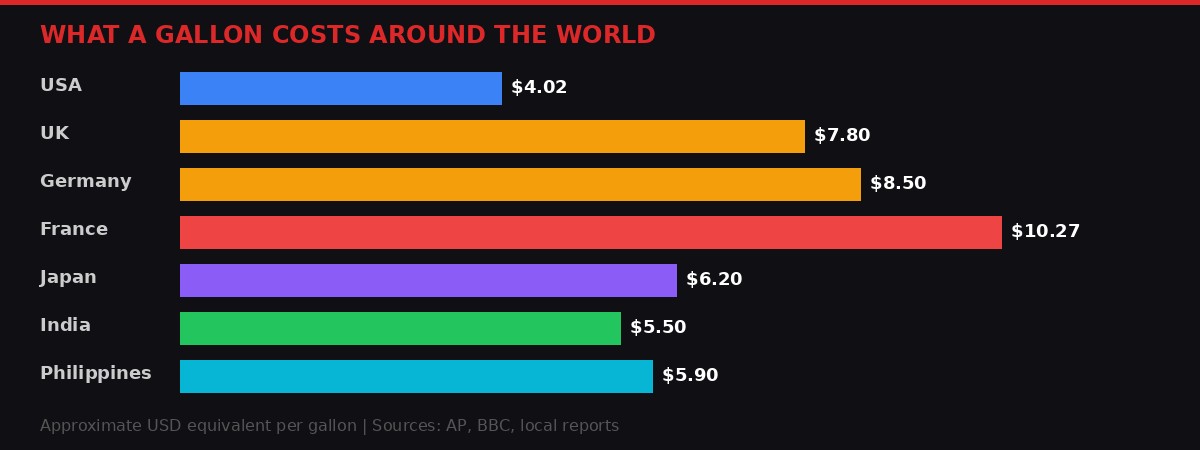
If Americans are uncomfortable at $4.02 per gallon, they should consider what the rest of the world is dealing with. Nearly 90% of the oil and gas that passes through the Strait of Hormuz is bound for Asian countries. When that strait closed, it didn't just raise prices in Asia. It triggered an energy emergency that is reshaping daily life across an entire continent.
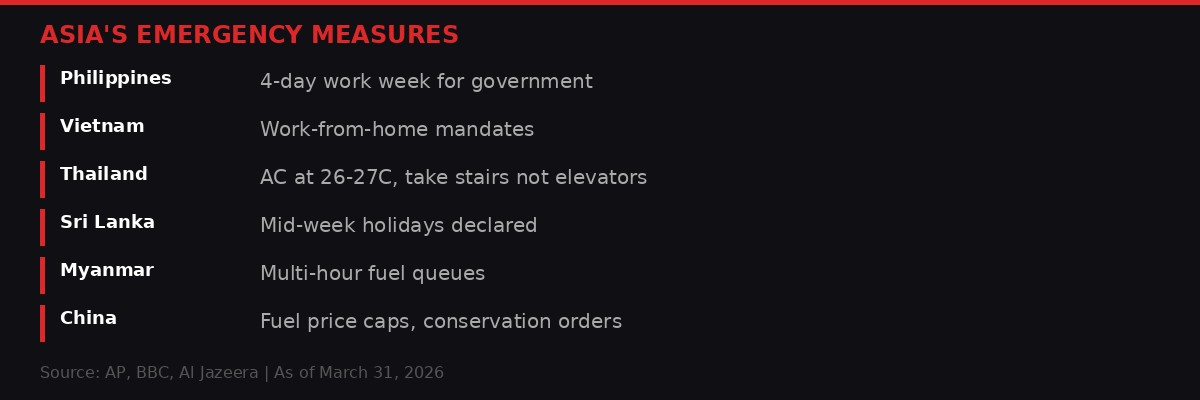
In the Philippines, the government has switched to a four-day work week for government employees to cut fuel consumption. Offices have been ordered to shut off computers during lunch breaks and keep air conditioning no lower than 24 degrees Celsius. Jeepney drivers - the backbone of Manila's public transit - have seen their daily wages collapse. Carlos Bragal Jr., a driver who used to earn 1,000 to 1,200 pesos for a 12-hour shift, now takes home 200 to 500. Some of his colleagues make nothing at all.
"If this continues, it will definitely kill us and our family." - Carlos Bragal Jr., jeepney driver, Manila (BBC)
In Vietnam, the government has issued work-from-home mandates to reduce commuting. In Thailand, Prime Minister Anutin Charnvirakul has asked government employees to take the stairs instead of elevators and keep air conditioning at 26-27 degrees Celsius. Thai PBS news anchors removed their blazers on air to promote the message of dressing appropriately for the heat rather than cranking the AC. Thailand has since negotiated a separate deal with Iran for its tankers to pass through the strait - a diplomatic workaround that highlights just how fractured the global response has become.
In Sri Lanka, which only recently emerged from a devastating financial crisis that left the country unable to import fuel in 2022, the government has declared mid-week holidays to conserve energy. In Myanmar, drivers queue for hours at petrol stations. In India, charcoal stoves have reappeared in restaurant kitchens as LPG supplies from the Gulf dwindle. Chinese authorities, sitting on an estimated three months of fuel reserves, have imposed price caps and conservation orders.
In Europe, the shock is equally severe but differently distributed. Gas in Paris has climbed to 2.34 euros per liter - the equivalent of roughly $10.27 per gallon in US terms. Diesel prices doubled across the continent in the war's first two weeks. Jet fuel prices in Asia have surged nearly 200%, according to Claudio Galimberti, chief economist at Rystad Energy. Korean Air announced emergency measures to deal with soaring fuel costs. QatarEnergy declared force majeure on some LNG contracts after production disruptions linked to the conflict.
The IEA's Birol was not exaggerating when he said this crisis surpasses the 1970s. The 1973 oil embargo and the 1979 Iranian Revolution each disrupted supply from one or two major producers. The current conflict has simultaneously knocked offline or constrained output from Iran, Kuwait, Qatar, and parts of Saudi Arabia's refining capacity, while physically blocking the transit route for exports from every Gulf state. It is, by any measure, the most severe energy supply disruption in modern history.
The Gulf Allies Want More War, Not Less
Against this backdrop of global economic pain, the political dynamics driving the war's continuation are shifting in unsettling ways. According to US, Gulf, and Israeli officials speaking to the Associated Press on condition of anonymity, Saudi Arabia and the United Arab Emirates are now actively urging President Trump to continue prosecuting the military campaign against Iran - arguing that Tehran has not been weakened enough to guarantee long-term security for its Arab neighbors.
This represents a significant evolution from the war's opening days, when Gulf states privately complained that Washington had launched the attack without giving them adequate advance notice. That irritation has given way to something more calculated. Officials from Saudi Arabia, the UAE, Kuwait, and Bahrain have conveyed in private conversations that they do not want the military operation to end until there are "significant changes" in Iranian leadership or a "dramatic shift" in Iranian behavior.
The UAE has emerged as the most hawkish voice, pushing hard for Trump to order a ground invasion. The Emirates have endured more than 2,300 missile and drone attacks from Iran since the war began - strikes that threaten to tarnish Dubai's carefully cultivated image as the safe, monied hub for global trade and tourism. Iran struck a tanker off the coast of Dubai on Tuesday, underscoring the point. Kuwait and Bahrain also favor escalation. Only Oman and Qatar, which have historically served as intermediaries between Iran and the West, are pushing for a diplomatic solution.
For American consumers watching gas prices climb past $4, this dynamic creates an uncomfortable paradox. The Gulf states whose oil the world desperately needs are the same states lobbying for a war that keeps their oil from reaching market. Saudi Arabia's argument to Washington - that ending the war now won't produce a "good deal" - prioritizes long-term regional security over short-term economic relief. It's a rational calculation for Riyadh, which has vast financial reserves to weather a prolonged crisis. It's a less rational calculation for the Uber driver in San Francisco or the jeepney operator in Manila.
Trump himself has vacillated, alternating between claiming Iran is ready to negotiate and threatening further escalation if a deal doesn't materialize. On Sunday, flying back to Washington from Florida, he told reporters: "Saudi Arabia's fighting back hard. Qatar is fighting back. UAE is fighting back. Kuwait's fighting back. Bahrain's fighting back. They're all fighting back." None of those countries have joined the offensive strikes. All of them host US forces and bases from which those strikes are launched.
The $5 Question
The question nobody in Washington or on Wall Street wants to answer is how high prices can go. The all-time record for US average gas prices was set in June 2022 at just over $5 per gallon, in the aftermath of Russia's invasion of Ukraine. That crisis eventually eased as supply routes adjusted and Russian oil found alternative buyers. The structural disruption was significant but ultimately adaptable.
The current crisis is different. The Strait of Hormuz is not a single pipeline that can be rerouted. It is a geographic bottleneck with no alternative. Oil tankers that once transited the strait to reach Asian markets cannot simply take a different path. The Cape of Good Hope route around Africa adds weeks to transit times and enormous fuel costs to each voyage. Some shipments are being rerouted, but nowhere near enough to replace the volume that normally flows through the Gulf.
If the strait remains effectively closed through April - which most analysts now consider the baseline scenario - prices at the US pump could approach or breach $5 per gallon by late spring. That would put the country back at its all-time record, with the crucial difference that this time the crisis is accompanied by an active shooting war involving American forces, a government shutdown that has left DHS workers unpaid, and a midterm election cycle that has already turned toxic.
The IEA's 400-million-barrel reserve release provides a temporary buffer, but reserves are finite by definition. The US Strategic Petroleum Reserve, already drawn down significantly during the Biden administration's response to the 2022 crisis, has limited room for further depletion. Once the buffer is spent, the market faces unmediated exposure to whatever the war delivers next.
Refineries are the other constraint. The US refining system was already operating near capacity before the war. Adding crude from Venezuela or other alternative sources doesn't help if there's no refining capacity to process it. Many US refineries on the East and West coasts are designed to process heavy, sour crude from the Middle East and Venezuela - not the light, sweet crude that American producers pump from the Permian Basin and the Bakken. Matching supply to refining capability is not a switch that flips overnight.
The economic forecasts are getting darker. Consumer confidence surveys show rising anxiety about household budgets. The AP-NORC poll's finding that 45% of Americans are extremely or very concerned about affording gas - up from 30% just months earlier - reflects a rapid deterioration in public sentiment. Groceries come next. Then services. Then hiring freezes, if businesses decide the cost environment is too uncertain for expansion.
The Trump administration is betting that the war ends quickly enough to prevent a full-blown stagflation cycle. Gulf allies are betting that it continues long enough to permanently cripple Iranian regional power. American consumers are caught between those two bets, watching the numbers change on the sign at the gas station and doing the math on what they can still afford.
It's $4.02 today. The question is what it will be next Tuesday.
Get BLACKWIRE reports first.
Breaking news, investigations, and analysis - straight to your phone.
Join @blackwirenews on Telegram