The Silencing: How France Is Criminalising Dissent From Mosques to Parliament
In a single week, France tried to ban Europe's largest Muslim gathering, arrested a sitting MEP for a social media post, and pushed a law that could imprison people for five years for political speech. This is not a crackdown on extremism. This is a crackdown on expression.
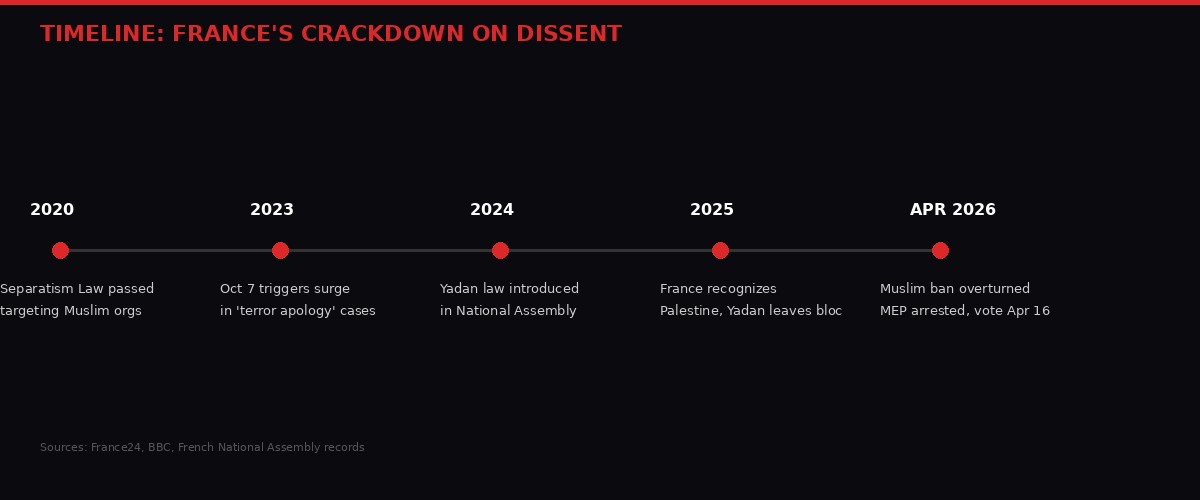
Six years of escalating restrictions on Muslim communities and pro-Palestinian expression in France. BLACKWIRE/PIL
Two hours. That is how close France came to banning the largest Muslim gathering in Europe on April 3, 2026.
The Annual Encounter of Muslims of France - a four-day conference that used to draw tens of thousands of people from across the continent before its seven-year hiatus - was scheduled to open at 2:00 PM in northern Paris. At 12:00 PM, the Paris police department was still insisting the event posed an unacceptable terrorist risk. The organizers, the Muslims of France association, had filed an emergency injunction. The administrative court ruled in their favor, overturning the ban with just 120 minutes to spare. (BBC)
That same day, 350 kilometers south in a Paris police station, Rima Hassan - a 33-year-old French-Palestinian member of the European Parliament - sat in custody for hours over a social media post about a 1972 airport attack. She was released with a court date: July 7, 2026, where she will face trial for "advocating terrorism committed online." The maximum penalty is seven years in prison and a 100,000-euro fine. (France 24)
And twelve days from now, on April 16, the French National Assembly will vote on the Yadan law - legislation that would make it a criminal offense, punishable by five years in prison, to call for the "destruction" of any country recognized by France. The law's own preamble makes clear which country it means: Israel. (France 24)
These three events are not coincidences. They are coordinates on the same map. France - the country that gave the world the Declaration of the Rights of Man and of the Citizen, the country whose national motto promises liberty, equality, and fraternity - is building a legal architecture designed to silence specific forms of political and religious expression. And it is doing so while a war rages in the Middle East, while its own human rights commission says the evidence does not support the law's core premise, and while international courts have used the exact language this law would criminalize.
This is the story of how the republic of Voltaire became the republic of the gag order.
I. The Gathering They Tried to Kill
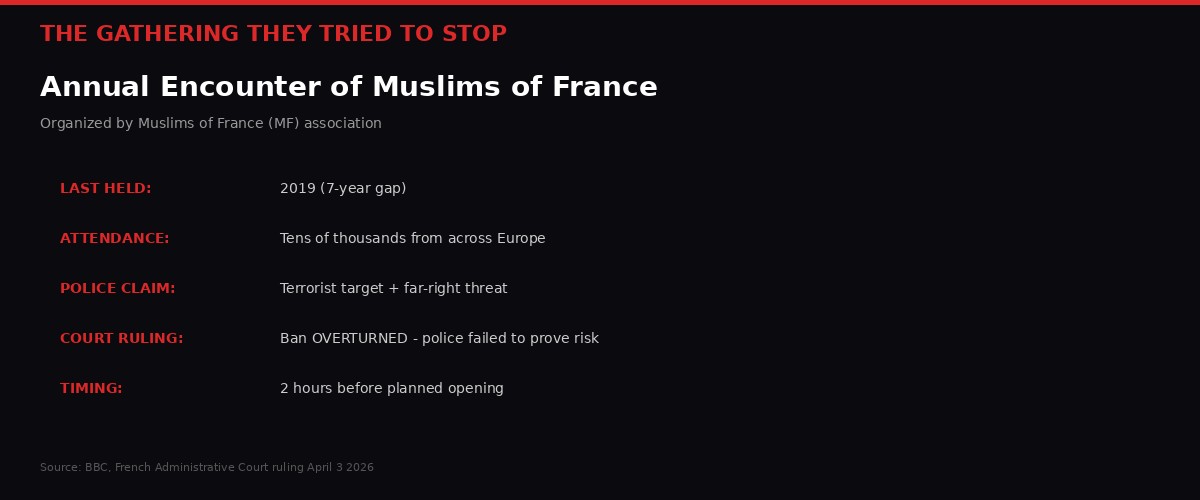
The Annual Encounter of Muslims of France returned after a seven-year absence - nearly blocked by police two hours before opening. BLACKWIRE/PIL
The Annual Encounter of Muslims of France is not a rally. It is not a protest march. It is part cultural conference, part religious gathering, part trade fair - the kind of event that most Western democracies would classify as utterly unremarkable. Before its suspension after 2019, it regularly drew tens of thousands of attendees from across Europe. Families came. Scholars spoke. Vendors sold books and clothing. It was, by any reasonable standard, a community event.
The Paris police department saw it differently. In a statement justifying the ban, police argued that the gathering was "exposed to an important terrorist risk toward the Muslim community" in "an international and national context which is particularly tense." They claimed that "small far-right groups could mobilise with a view to disrupting the event." They even floated the idea that disruptions could be "conducted remotely by foreign influences" - a reference to France's longstanding accusation that Russia and Iran fund proxy provocateurs on French soil. (BBC)
The logic is worth pausing on. The police did not claim that the Muslim gathering itself posed a threat. They claimed that other people - far-right groups, foreign operatives - might target it. And their proposed solution was not to protect the gathering from those threats. It was to cancel the gathering entirely.
It is the equivalent of banning a synagogue service because neo-Nazis might attack it. The victim becomes the problem. The target becomes the threat.
The administrative court was not persuaded. In its ruling, the court said that the evidence provided by police "did not establish the risk of counter-demonstrations, or that the gathering would be targeted by far-right groups." It dismissed the claim that the event would strain police resources, noting that the organizers had arranged their own security. The ban was overturned. The gathering opened, two hours late but defiant.
The Muslims of France association - France's largest Muslim body - has long been accused by critics of ties to the international Muslim Brotherhood, a charge it denies. But the association's alleged ideological leanings are beside the point. The right to assemble is not conditional on whether the government approves of your theology. That is the entire purpose of having the right in the first place.
"The police department's arguments did not establish the risk of counter-demonstrations, or that the gathering would be targeted by far-right groups."- French Administrative Court ruling, April 3, 2026 (BBC)
The timing of the attempted ban is impossible to ignore. It arrived alongside the French government's announcement of a new "anti-separatism" law - the second such legislation in five years - aimed at Muslim structures promoting ideas "contrary to the principles of the republic." Interior Minister Laurent Nunez told a radio station that the government wanted to expand its ability to control "collective childcare" and to "ban publications which carry appeals to hate, violence or discrimination." (BBC)
The MF's lawyer, Sefen Guez Guez, said at the injunction hearing that banning the event was a "manifest breach of the right to assemble" and was clearly designed to "promote the government's new law." A police lawyer countered that the sole reason was to preserve public order. "This is not an anti-Muslim or anti-Islam decree," he said.
The court disagreed. The people arrived. The conference opened. But the fact that it took a last-minute court order to stop the French government from shutting down a community gathering tells you everything about where the political center of gravity has shifted in Paris.
II. The Woman They Keep Arresting
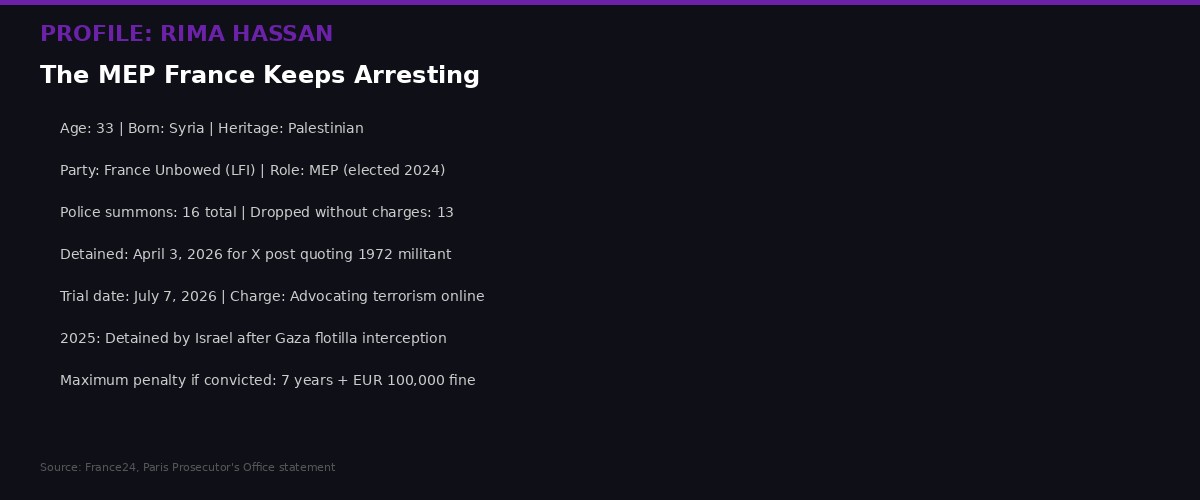
Rima Hassan has been summoned by police 16 times. Thirteen of those cases were dropped without charges. BLACKWIRE/PIL
Rima Hassan does not look like a terrorist. She is a 33-year-old lawyer, born in Syria to Palestinian parents, elected to the European Parliament in 2024 for the France Unbowed party. She is loud, confrontational, and unapologetic about her support for Palestinian rights - qualities that have made her one of the most visible and polarizing political figures in France.
On April 3, 2026, Hassan was taken into police custody in Paris. The charge: "advocating terrorism committed online." Her alleged crime was a post on X, published on March 26 and later deleted, in which she quoted a statement by Kozo Okamoto, a Japanese Red Army militant convicted for his role in the 1972 Lod Airport massacre in Tel Aviv that killed 26 people. (France 24)
The International League Against Racism and Anti-Semitism and the European Jewish Organization had lodged complaints. The Paris prosecutor's office confirmed that Hassan would face trial on July 7, 2026. If convicted, she faces up to seven years in prison and a 100,000-euro fine.
Here is what makes Hassan's case extraordinary: this is not her first rodeo with French prosecutors. She has been summoned for police questioning in 16 separate cases. Thirteen of those cases have been dropped without charges. She has been investigated, questioned, detained, and released more times than most career criminals. The pattern is not prosecution - it is harassment through process. (France 24)
Hassan's history of confrontation with French and Israeli authorities is well documented. In 2025, she was detained by Israeli security forces after they intercepted a Gaza-bound aid flotilla. She and three other French nationals on board were held in solitary confinement before being expelled from Israel. She returned to France more defiant than before.
Jean-Luc Melenchon, the founder of France Unbowed, called the proceedings against Hassan "politically motivated." Interior Minister Laurent Nunez dismissed the accusation: "There are rules to be respected. Advocating terrorism is a very serious offence."
The question is whether quoting a historical figure on social media - even a convicted militant - constitutes "advocating terrorism." France's definition of the offense is already broad enough that hundreds of activists, trade unionists, researchers, and left-wing politicians have been summoned for police questioning since October 7, 2023, over statements about the Israel-Palestine conflict. The French investigative outlet Mediapart has documented a significant increase in convictions under the "apology for terrorism" statute since the Hamas attacks. (France 24)
In a side note that reads like a bureaucratic afterthought, the Paris prosecutor's office also revealed that police found cannabidiol (CBD) and what appeared to be the designer drug 3-MMC in Hassan's possession during the arrest. These will be treated separately. Hassan said in a public statement that she takes CBD for medical reasons. The drug allegation, tacked onto a terrorism charge, has the odor of a prosecution team reaching for anything that sticks.
III. The Yadan Law: Criminalizing Thought in the Name of Fighting Hate
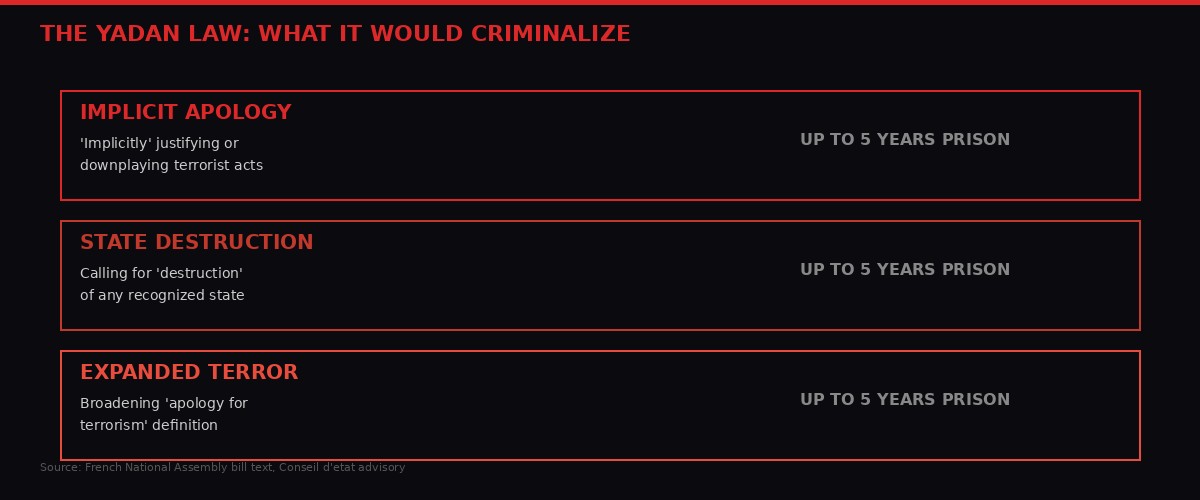
The Yadan law would expand the definition of 'terror apology' and criminalize calls for a state's destruction - with up to five years in prison. BLACKWIRE/PIL
The legislation heading for a vote on April 16 is named after Caroline Yadan, the lawmaker who first introduced it at the end of 2024. Its stated purpose is to combat anti-Semitism. Its actual effect, critics argue, would be to criminalize a range of political speech about Israel and Palestine.
The current version of the Yadan law would do two things. First, it would broaden the definition of "apology for terrorism" to include speech that "implicitly" justifies or downplays acts deemed terrorist. Second, it would make it illegal to call for the "destruction" of any country recognized by France, punishable by up to five years in prison. (France 24)
The law's preamble leaves nothing to interpretation: "Today, anti-Jewish hatred in our country is fuelled by an obsessive hatred of Israel, whose very existence is regularly delegitimised and criminalised. This hatred of the State of Israel is now inseparable from hatred of Jews."
Earlier drafts went further. One version would have outlawed any comparison between Israel and Nazi Germany as "trivialising" the Holocaust. Another banned public speech calling for the "denial" of a state's existence - a term so vague it could theoretically cover academic debates about statehood. The Conseil d'etat, France's highest administrative court, advised against both provisions. They were removed. But the core architecture survived.
A petition on the National Assembly's official website protesting the bill had gathered more than 160,000 signatures as of April 4 - a scale of organized opposition that is unusual for legislative petitions in France.
Prime Minister Sebastien Lecornu has been the law's most prominent champion. Speaking at the 40th annual dinner of the Representative Council of French Jewish Institutions (CRIF) in February 2026, Lecornu declared that "contemporary anti-Zionism has become the mask of an old anti-Semitism." He said calls for Palestine to be free "From the River to the Sea" constituted an explicit call for Israel's destruction, since the phrase refers to Israeli territory. He accused those describing Israel's war on Gaza as a "genocide" of "stripping Jews of their history and transforming them from victims into executioners." (France 24)
"Talking about 'genocide' in Gaza erases their memory of the Holocaust. It downplays it and reverses it."- Prime Minister Sebastien Lecornu, CRIF dinner, February 2026 (France 24)
This is a remarkable statement for a head of government to make, because it directly contradicts the findings of multiple international legal bodies. The International Court of Justice warned in January 2024 that Israel's Gaza campaign could "plausibly amount to genocide." A UN Commission of Inquiry in 2025 went further, labeling Israel's actions in the Palestinian territory as "genocidal in nature." Under the Yadan law, using language that aligns with these international rulings could theoretically land a French citizen in prison.
IV. The Contradiction: When International Law Becomes Domestic Crime
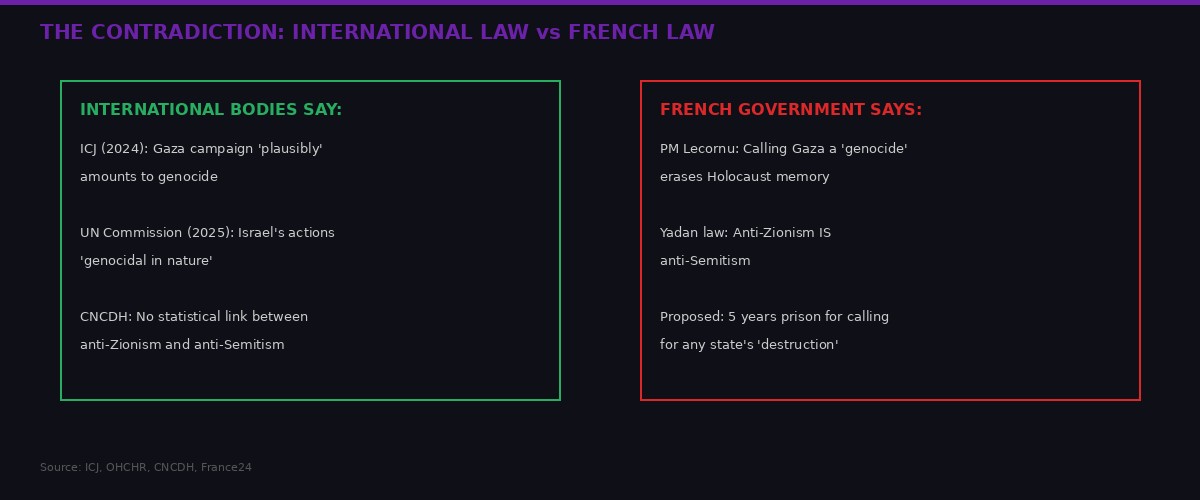
International courts say genocide is 'plausible.' France wants to imprison anyone who agrees with them. BLACKWIRE/PIL
The core tension at the heart of the Yadan law is not political. It is legal. France is attempting to criminalize language that the highest courts in the international system have already used in formal legal proceedings.
The International Court of Justice's January 2024 ruling in the South Africa v. Israel case did not declare that Israel committed genocide. But it found that the claim was "plausible" - a legal threshold that triggered provisional measures ordering Israel to prevent genocidal acts in Gaza. The ICJ's language was deliberate and calibrated. It was not a protest slogan. It was a judicial finding by the principal judicial organ of the United Nations.
In September 2025, the UN Commission of Inquiry on the Occupied Palestinian Territory released its most comprehensive report to date. Its conclusion: Israel's actions in Gaza were "genocidal in nature." The commission documented patterns of conduct - mass displacement, destruction of civilian infrastructure, restrictions on humanitarian aid, and the targeting of civilian populations - that met the legal criteria for genocide under the 1948 Genocide Convention.
France recognized these institutions. France sits on the UN Security Council. France participated in drafting the Genocide Convention. And now France is proposing a law that could imprison its own citizens for using the same word that these institutions have used in formal legal proceedings.
France's own National Consultative Commission on Human Rights (CNCDH) - the government's official advisory body on racism and discrimination - published its 2024 annual report with a finding that directly undercuts the Yadan law's premise. The commission's surveys found "no statistically significant connection between respondents holding a negative view of the political or religious ideology of Zionism and anti-Semitic prejudices." The report concluded: "It is therefore difficult to view anti-Zionism as the key driver of contemporary anti-Semitism." (France 24)
The government's own research arm is telling it that the law's foundational assumption is wrong. The government is proceeding anyway.
Francois Dubuisson, a professor of international law at the Universite libre de Bruxelles, has been one of the sharpest academic critics of the legislation. He told France 24 that France already possesses extensive legislation targeting incitement to racial hatred and glorification of terrorism. "In my view, the current legislation in France is sufficient," he said. He noted that the existing offense of "advocating terrorism" is already "extremely broad" and "often heavily criticised by a number of international human rights organisations." (France 24)
On the question of criminalizing calls for a state's "destruction," Dubuisson was blunt: "To my knowledge, this does not exist anywhere in the world. I'm not aware of any legislation - and particularly in Europe - that contains such an offence." He argued that calls for the violent destruction of a state and its people would already be covered by existing laws criminalizing incitement to violence. The new provision adds something else entirely: the criminalization of political positions about the existence of states.
V. The Political Chessboard: Who Wants This Law and Why
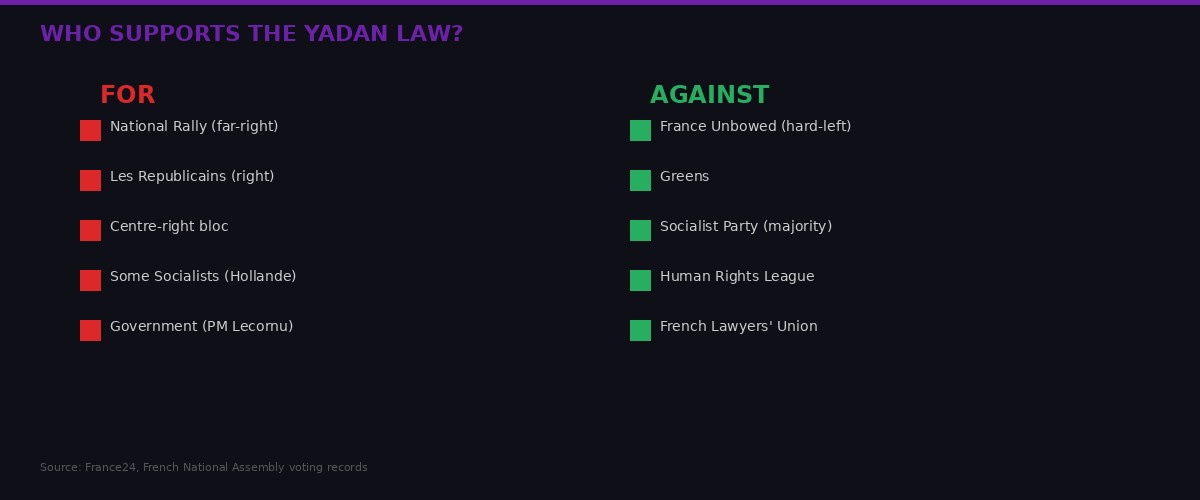
The Yadan law has created unusual bedfellows - the far-right National Rally and the centre-right government on the same side. BLACKWIRE/PIL
The Yadan law has created one of the strangest political coalitions in recent French history. Its supporters include the far-right National Rally, the right-wing Les Republicains, the centre-right government bloc, and a handful of Socialist Party members including former president Francois Hollande. Its opponents include the hard-left France Unbowed, the Greens, the majority of the Socialist Party, the French Lawyers' Union, and the Human Rights League.
The coalition is revealing. Marine Le Pen's National Rally - a party that has spent decades courting voters with anti-Muslim rhetoric, that was founded by a man convicted of Holocaust denial, and that has consistently opposed immigration from Muslim-majority countries - is now positioning itself as the defender of the Jewish community by supporting a law that restricts pro-Palestinian speech. The political calculus is not complicated: supporting the Yadan law allows the National Rally to attack the left, to appear moderate on questions of anti-Semitism, and to advance its broader project of restricting Muslim political expression - all with a single vote.
Caroline Yadan herself left President Emmanuel Macron's parliamentary group after France officially recognized the state of Palestine in September 2025. Her departure was a protest against what she saw as the government's insufficient commitment to Israel. The irony is layered: the law she authored would also criminalize calls for the destruction of Palestine, which France now formally recognizes. Far-right Israeli settlers who use the phrase "From the River to the Sea" to assert Jewish sovereignty over all of historic Palestine would, in theory, be equally subject to prosecution under French law.
Nathalie Tehio, president of France's Human Rights League, identified the fundamental danger with precision: "In reality, it equates French Jews with Israel - which is dangerous in and of itself, as this very equation fuels anti-Semitism. But it also gives the impression that there is a double standard, because it is a law that targets the issue of anti-Semitism while also serving as a defence of Israel - so there is a double risk of reinforcing anti-Semitism." (France 24)
Tehio pointed out that anti-Zionist Jews themselves - including those who campaign for a "one-state solution" in which Israelis and Palestinians share a single state with full and equal rights - could find their political advocacy criminalized under the new legislation. The law does not distinguish between anti-Semitic incitement and principled political disagreement about how nation-states should be organized. It treats them as the same thing.
The French Lawyers' Union warned in January that criminalizing statements that "implicitly" justify or incite acts of terror would turn judges into "thought police." The word "implicitly" is doing an enormous amount of legal work in the proposed text. It removes the requirement that a statement explicitly call for violence. It replaces it with a standard that requires judges to interpret what a speaker might have meant - or what a reasonable person might have inferred. This is a standard that can be applied to virtually anything.
VI. The Architecture of Silence: Three Laws, One Target
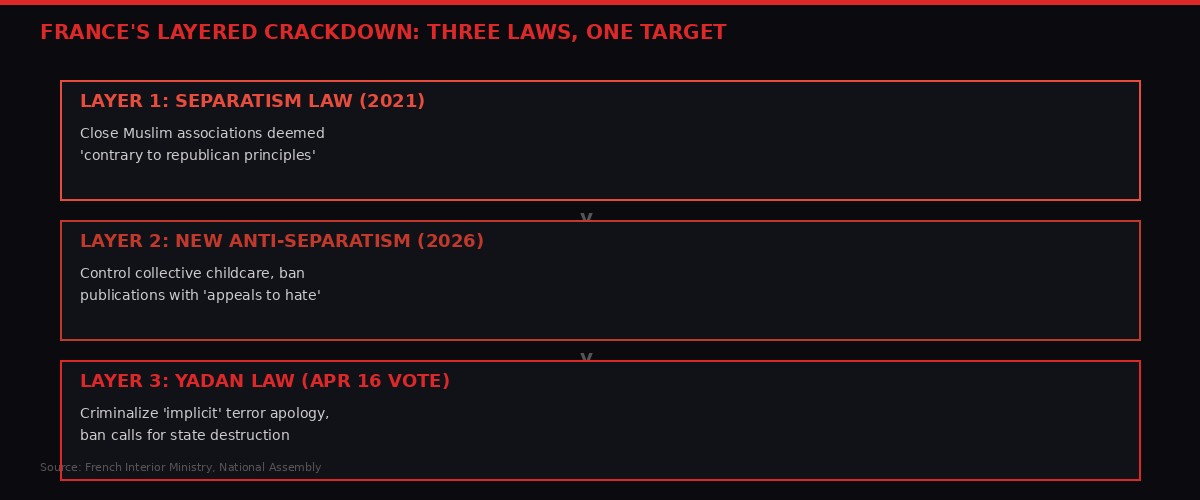
The separatism law, its 2026 successor, and the Yadan law form a cascading legal architecture targeting Muslim communities. BLACKWIRE/PIL
The Yadan law does not exist in isolation. It is the third layer in a legal structure that has been under construction for six years, each layer building on the one before it, each one narrowing the space in which French Muslims and their allies can operate.
The first layer was the 2021 separatism law - formally known as the Law Confirming Respect for the Principles of the Republic. Passed in the aftermath of the beheading of teacher Samuel Paty by an Islamist extremist, the law gave the French government sweeping powers to dissolve Muslim associations deemed to be promoting "separatism" from republican values. It expanded the grounds on which mosques could be closed, imposed new oversight requirements on religious schools, and tightened restrictions on foreign funding of religious organizations.
The law was pitched as a defense of secularism. In practice, it overwhelmingly targeted Muslim organizations. The government used it to close several mosques and dissolve organizations including the Collective Against Islamophobia in France (CCIF), a civil rights group that documented anti-Muslim discrimination. Critics argued that the law conflated violent extremism with legitimate religious practice, and that its vague definitions of "separatism" gave the state arbitrary power over Muslim civic life.
The second layer arrived in April 2026 - the new anti-separatism legislation announced alongside the attempted ban on the Muslim gathering. Interior Minister Laurent Nunez said the new law would fill gaps left by the 2021 version, extending government control over "collective childcare" and allowing the banning of publications deemed to carry "appeals to hate, violence or discrimination." The law explicitly targets "structures which we have been unable to reach" under existing legislation. (BBC)
The third layer is the Yadan law. Where the separatism laws target Muslim institutions, the Yadan law targets political speech. Together, they form a comprehensive system: you cannot organize freely (separatism law), you cannot gather freely (attempted gathering ban), and you cannot speak freely (Yadan law). The architecture is complete.
None of this is happening in a vacuum. France has been at war - not on its own soil, but through the conflict raging across the Middle East. The US-Israel military campaign against Iran, now in its 36th day, has polarized French society along lines that map almost perfectly onto the Yadan law's battle lines. Macron publicly broke with Trump on Iran in late March, but domestically, his government is pursuing policies that align with those of Israel's strongest supporters.
The disconnect is startling. France positions itself internationally as a voice of restraint and multilateralism. Domestically, it is building a legal framework that would make it a crime to agree with the International Court of Justice.
VII. The Human Cost: Who Gets Silenced
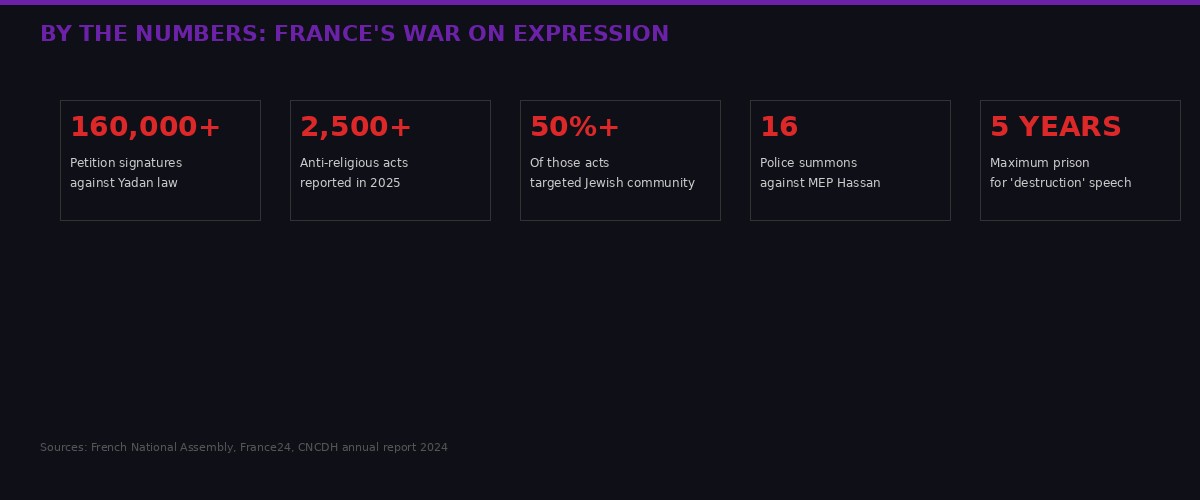
The numbers behind France's escalating restrictions on political and religious expression. BLACKWIRE/PIL
Behind the legal abstractions are real people whose lives have been disrupted, careers damaged, or freedom restricted by France's expanding apparatus of speech control.
There are the academics. University researchers who study the Israel-Palestine conflict have reported an atmosphere of self-censorship on French campuses. The broad definition of "apology for terrorism" has made scholars cautious about the language they use in lectures, papers, and public commentary. A history professor who discusses the Nakba - the displacement of Palestinians during the creation of Israel in 1948 - must now calculate whether their framing could be construed as denying a state's right to exist. An international law scholar who cites the ICJ's genocide ruling must weigh whether quoting the court constitutes "implicit" justification of terrorism.
There are the trade unionists. French labor organizations have historically been vocal supporters of Palestinian solidarity. The Confederation Generale du Travail (CGT), one of France's largest trade unions, has organized solidarity events and issued statements condemning Israel's military operations in Gaza. Union members who participate in these activities now operate under the shadow of potential prosecution. The chilling effect is not theoretical - it is the stated purpose of the law.
There are the community organizers. The attempted ban on the Muslim gathering was not an isolated incident. Since the passage of the 2021 separatism law, dozens of Muslim associations have been dissolved or investigated. Community leaders who organize cultural events, educational programs, and religious services have described a climate of suspicion in which any gathering of Muslims is treated as a potential security threat until proven otherwise.
And there are the artists and writers. France has a long tradition of politically engaged literature, theater, and cinema. The country that produced Zola's "J'accuse" and Sartre's commitment to engaged literature is now proposing laws that would make certain forms of political engagement criminal. A playwright who stages a production about Palestinian displacement could face prosecution. A novelist who writes about the destruction of Gaza could be accused of implicit terrorism apology. A poet who uses the phrase "From the River to the Sea" in a verse could be charged with calling for a state's destruction.
The irony cuts deep. France is home to Europe's largest Jewish population and Europe's largest Muslim population. Both communities have roots in the country going back centuries. Both have contributed enormously to French culture, politics, and intellectual life. And both are being instrumentalized by a political class that has decided to treat their relationship as a zero-sum game in which protecting one requires surveilling, restricting, and criminalizing the other.
Anti-Semitism in France is real and rising. More than half of all reported anti-religious acts in 2025 targeted the Jewish community. This is a genuine crisis that demands genuine action. But the Yadan law does not address the sources of anti-Semitism. It addresses the symptoms by criminalizing political speech that the government associates - correctly or incorrectly - with anti-Jewish sentiment. It is the legislative equivalent of treating a fever by banning thermometers.
VIII. What Happens Next
The vote on April 16 is not a foregone conclusion. The opposition is substantial, the petition signatures are mounting, and the legal community has raised serious constitutional objections. The Conseil d'etat has already forced the removal of some of the law's most extreme provisions. A successful constitutional challenge, should the law pass, is not implausible.
But even if the Yadan law fails in its current form, the damage has been done. The political conversation has shifted. The Overton window on what constitutes acceptable speech about Israel and Palestine has narrowed. The precedent has been set: a French prime minister stood at a podium and declared that using a word endorsed by the International Court of Justice constitutes an erasure of the Holocaust. A sitting MEP has been arrested 16 times for her political speech. A Muslim gathering was nearly banned because other people might have threatened it.
The machinery of silence does not need to succeed in every instance to achieve its purpose. It only needs to exist. It only needs to make people think twice before speaking. It only needs to make a community organizer wonder whether their next event will be the one that gets banned. It only needs to make an academic calculate whether their next paper will trigger a police summons.
France anti-Semitism is being used as the justification. But the people doing the justifying cannot explain why their own human rights commission says the data does not support their premise. They cannot explain why their law contradicts the findings of international courts. They cannot explain why protecting Jewish citizens requires criminalizing Muslim gatherings, arresting Palestinian-heritage MEPs, and turning judges into thought police.
What they can explain - though they would never say it aloud - is that this is an election season, and fear sells. That the National Rally is breathing down the government's neck. That appearing tough on "Islamic separatism" polls well in the suburbs of Lyon and Marseille. That the war in the Middle East has given them political cover to do things they have wanted to do for years.
The Annual Encounter of Muslims of France opened on April 3, 2026, two hours late. Families arrived. Scholars spoke. Vendors sold books and clothing. The gathering was, by any reasonable standard, utterly unremarkable.
That it required a court order to happen is the most remarkable thing about it.
Get BLACKWIRE reports first.
Breaking news, investigations, and analysis - straight to your phone.
Join @blackwirenews on Telegram