The Alliance Breaks: France Says 'This War Is Not Ours' as G7 Splits From Washington on Iran
Secretary of State Marco Rubio flew to a 12th-century abbey outside Paris on Friday to sell an Iran war that America's closest allies had already decided they weren't buying. What emerged from the G7 foreign ministers meeting at Vaux-de-Cernay wasn't a coalition. It was a formal, public record of rupture - the moment Western allies stopped quietly declining and started saying so out loud.

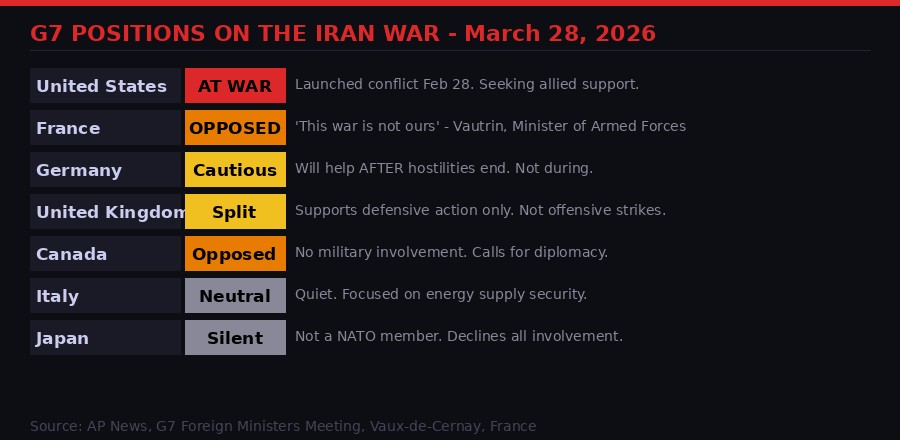
France's position was the sharpest. Catherine Vautrin, the French Minister of the Armed Forces, said on Europe 1 and CNews radio on Friday that the Iran war "is not ours," adding that France's stance is "strictly defensive" and that the "only" path to peace is through diplomacy. It was not a quiet abstention from a distant conflict. It was a public, named repudiation - on the record, in France's own words - of the war the United States and Israel launched on February 28 without consulting their partners.
Britain's Foreign Secretary Yvette Cooper acknowledged a direct split from Washington's approach. "We have taken the approach of supporting defensive action, but also we've taken a different approach on the offensive action that has taken place as part of this conflict," she told reporters after the meeting, according to the Associated Press. Germany's Foreign Minister Johann Wadephul said Berlin was prepared to play a role in post-war shipping security - not during the war, but after it ends.
Rubio emerged from the abbey trying to frame the differences as manageable. He said the U.S. was "not asking for anybody to join the war," only that countries most affected by the Hormuz closure "should be willing to do something about it." That reframe is significant. The conversation has shifted - in public, at least - from asking allies to join the fight to asking them to help pick up the pieces when it ends. That is not the same thing as allied support.
What Rubio Was Actually Selling in France

The G7 foreign ministers did agree on a formal declaration. French Foreign Minister Jean-Noel Barrot announced after the meeting that the group called for the "immediate cessation" of attacks against civilian populations and infrastructure. It also "reaffirmed" the need to restore free navigation in the Strait of Hormuz.
That sounds like solidarity with Washington. On closer reading, it is not. A call to halt attacks on civilians applies to all parties - including the US and Israel, whose strikes have killed and displaced Iranian civilians throughout the 28-day campaign. And calling for open navigation is something every nation on earth agrees on. It is not the same as supporting the military campaign that created the crisis in the first place.
Barrot said that once US military objectives are achieved, allied nations could provide "escort missions" to restore maritime traffic through Hormuz. Wadephul said something similar. Cooper talked about a "diplomatic path." None of them endorsed what Trump ordered on February 28. None agreed to deploy their own forces while the bombs are still falling.
"Not only is this illegal, it's unacceptable. It's dangerous to the world. And it's important that the world have a plan." - Secretary of State Marco Rubio, on Iran's potential tolls on the Strait of Hormuz, March 28, 2026 (AP News)
Rubio's post-meeting press conference also touched on something that has not been fully reported: Iran's potential move to set up a toll on the Strait of Hormuz - charging vessels for passage through what is legally international waters. Rubio called it illegal and unacceptable. The G7 allies likely agree. But agreement on what's unacceptable is not the same as agreement on what to do about it.
Trump Lights the Fire, Rubio Puts Out the Smoke

The diplomatic backdrop to the France meeting was made harder by Trump himself. A day before the G7 gathering, Trump launched fresh attacks on NATO allies during a Cabinet meeting, saying "NATO has done absolutely nothing" and complaining that allies were not "stepping up." He added: "We are very disappointed with NATO." Those remarks set the stage for every conversation Rubio had in Vaux-de-Cernay.
Rubio, by all accounts, struck a softer tone in France. He said the US would seek international cooperation on keeping the strait open after the war ends. He played down the risk of a widening conflict. He said the US can achieve its objectives without ground troops. But the softening in tone is increasingly disconnected from the hardening on the ground.
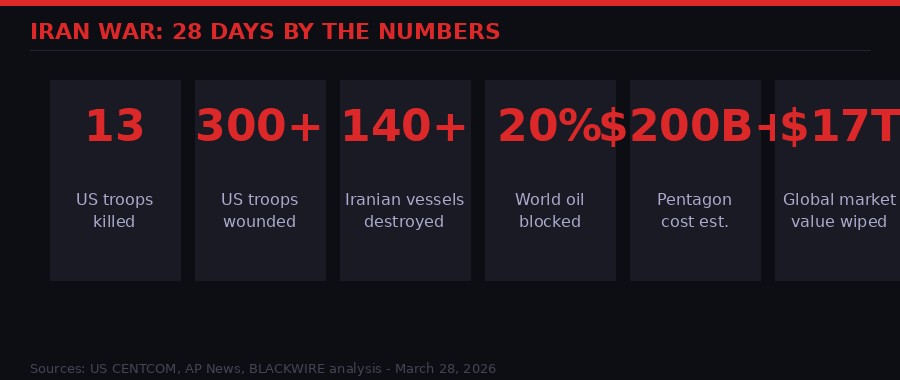
The Pentagon is actively preparing to deploy at least 1,000 troops from the 82nd Airborne Division - a unit trained to parachute into hostile or contested territory to secure key positions and airfields - to the Middle East in the coming days, according to AP reporting. Two Marine units adding approximately 5,000 Marines and thousands of sailors are also being positioned in the region. Rubio told reporters that the US is "always going to be prepared to give the president maximum optionality."
That language - "maximum optionality" - is the diplomatic way of saying ground troops remain on the table, whatever Rubio says publicly. The 82nd Airborne does not deploy for beach parties. The gap between what Rubio says to allies in France and what the Pentagon is moving in the Gulf is visible and growing.
The War's Unfinished Objectives

Trump has outlined five objectives for the war. A clear-eyed look at where they stand, four weeks in, shows a mixed picture that neither Washington nor its allies can easily ignore.
Objective 1: Completely degrade Iranian missile capability. The administration says missile and drone attacks on US forces are down 90 percent from the start of the conflict. But Iran struck Prince Sultan Air Base in Saudi Arabia on Friday, wounding at least 10 US service members - two seriously - and damaging several US refueling aircraft, according to two US officials who spoke to AP on condition of anonymity. "Never in recorded history has a nation's military been so quickly and so effectively neutralized," Defense Secretary Pete Hegseth said on Thursday. On Friday, Iranian missiles hit a US base in Saudi Arabia. The words and the battlefield do not match.
Objective 2: Destroy Iran's defense industrial base. US CENTCOM has struck missile and drone manufacturing facilities. Iranian attacks against Gulf neighbors and Israel continue. Hegseth's own Pentagon update last week said Iran's programs are being "overwhelmingly destroyed." But a nation whose programs are overwhelmingly destroyed does not wound 10 American troops the next morning.
Objective 3: Eliminate Iran's navy and air force. The US has damaged or destroyed more than 140 Iranian vessels, according to CENTCOM. A US submarine sank an Iranian warship in early March. Two Iranian vessels sought sanctuary in Sri Lanka and India and have not been destroyed or captured. Iran's Revolutionary Guard navy - which operates smaller swarm vessels and mines - remains partially active. Mines remain an open threat.
Objective 4: Prevent Iran's nuclear capability. Israel struck the Shahid Khondab Heavy Water Complex in Arak and the Ardakan yellowcake facility in Yazd Province on Friday, claiming responsibility and saying the strike was "a major blow to Iran's nuclear program." Iran's Atomic Energy Organization said there were no casualties and no contamination risk. But roughly 970 pounds of enriched uranium remain in Iran's possession, buried under a mountain facility that would require Iranian cooperation - or a ground assault - to access. Trump said Monday the US would retrieve the uranium through a deal. No deal exists.
Objective 5: Open the Strait of Hormuz. It is still closed. Iran agreed Friday to allow humanitarian aid and agricultural shipments through, in response to a UN request. Oil, gas, and general commercial shipping are not included. The strait handles about 20 percent of the world's crude oil in normal times. Four weeks into the war, that oil is not moving.
Ukraine in the Room No One Is Talking About

The G7 meeting was not only about Iran. Ukraine sat at the center of every conversation, even when it was not the stated agenda item. German Foreign Minister Wadephul said explicitly that "there must be no cuts when it comes to maintaining Ukraine's defense capability." That sentence was directed at Washington, not Moscow.
AP has reported that American Patriot air-defense missiles have been moved from Europe toward the Middle East as Washington redirects military resources to the Iran campaign. Ukrainian President Volodymyr Zelenskyy has warned that Kyiv will "definitely" face shortages of Patriot systems because of the war. Rubio acknowledged at the G7 that weapons redirections could happen: "If we need something for America and it's American, we're going to keep it for America first. But as of now, that has not happened."
Zelenskyy this week told Reuters that the US was conditioning security guarantees for Ukraine on Kyiv ceding the Donbas region to Russia. Rubio publicly denied it: "That's a lie." He said the US only conveyed Russian demands to Ukraine - "we're not advocating for it." The Ukrainian presidential office declined to comment on the discrepancy.
For European allies gathered in France, the Ukraine dimension is not abstract. They have spent billions of euros and significant political capital supporting Kyiv. They watch US military resources shift south. They listen to Rubio say weapons diversions haven't happened yet. "Yet" is not a reassurance. It is a timeline.
The Houthis at the Door

Overnight Friday into Saturday, Israel's military announced that Yemen had launched a missile toward Israel - the first time the Houthis had fired directly at Israeli territory in the context of the current Iran war. Sirens sounded around Beer Sheba and near Israel's main nuclear research center. The Houthis did not immediately acknowledge the strike.
The significance is structural, not just tactical. The Houthi rebels, backed by Tehran, had maintained an uneasy ceasefire with Saudi Arabia since 2023, which stayed largely intact even after they disrupted Red Sea shipping during the Israel-Hamas conflict in 2023 and 2024. That ceasefire created a kind of strategic buffer - a reason for the Houthis to stay on the sidelines of the current war. That buffer may now be gone.
Houthi military spokesman Brig. Gen. Yahya Saree issued a prerecorded statement Friday listing conditions under which the group would "directly intervene militarily." Those conditions included the "continuation of the escalation against the Islamic Republic and the Axis of Jihad and Resistance." That is not an idle threat from a sidelined faction. The Houthis spent roughly 14 months attacking more than 100 merchant vessels in the Red Sea during the previous conflict, sinking two ships and killing four sailors. If they re-enter the Red Sea targeting game, global shipping faces a second chokepoint to go with Hormuz.
The Red Sea corridor handles approximately $1 trillion in goods annually during normal operations. The Hormuz strait handles 20 percent of global oil. If both are simultaneously disrupted, the economic impact moves beyond oil shock into a structural supply chain break that affects fertilizers, food, manufactured goods, and every region that depends on those lanes.
What the French Moment Actually Means

The G7 meeting at Vaux-de-Cernay matters less for what it decided than for what it made permanent. France did not quietly abstain. France's Minister of Armed Forces said on national radio: "This war is not ours." That statement is now on the record, in the minister's voice, broadcast to the French public. It cannot be walked back as a diplomatic misunderstanding. It is French policy, stated publicly, four weeks into a US-led war that is escalating.
Britain's split - supporting "defensive action" while refusing to back "offensive action" - is similarly structural. Britain is the United States' closest intelligence partner. When London publicly distinguishes between what it will and will not support in the same conflict, that is not a minor tactical disagreement. It is a statement about limits, on the record, at a G7 meeting.
Germany's language about playing a role "after the end of hostilities" is equally telling. Not now. After. Germany is parsing the war into phases and assigning itself to the cleanup, not the campaign. That is a deliberate political choice about legitimacy and liability.
Trump responded to all of this by complaining that NATO "has done absolutely nothing" and pointing out that the US has spent "hundreds of billions" defending Europe and Asia without reciprocal support. That framing - the US as the world's expendable guarantor, owed favors it never collects - has been Trump's view of alliances since 2016. What is different now is that the specific complaint is about a war that the US launched unilaterally, without consultation, against the explicit advice of most of its partners. The allies have a point that is hard to dismiss: they were not asked, they were not briefed, and now they are being blamed for not joining a fight they never agreed to start.
The April 6 Horizon

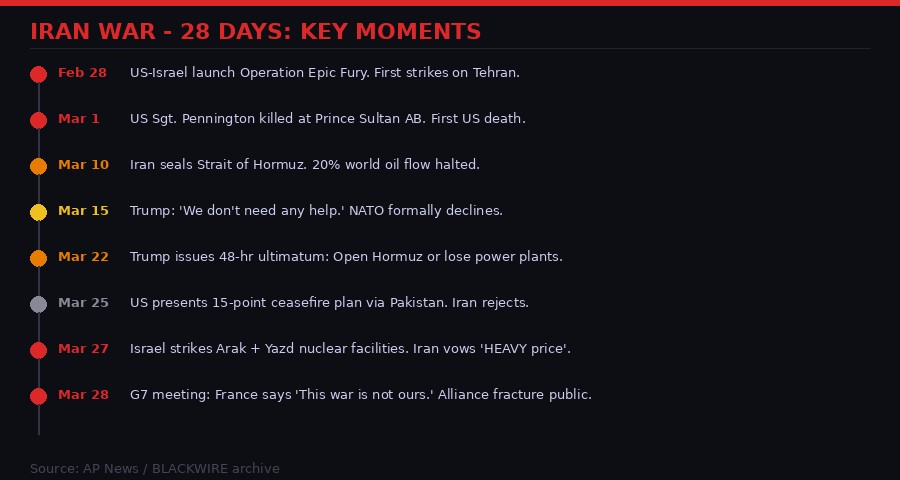
Trump's standing ultimatum to Iran carries a deadline of April 6. He threatened to "obliterate" Iran's power plants if the Strait of Hormuz is not reopened by that date. The April 6 deadline, now nine days away, is shaping every diplomatic conversation happening in every capital.
Iran agreed Friday to allow humanitarian and agricultural goods through the strait - a partial, symbolic gesture likely designed to slow international pressure without making the core concession Washington demands. Tehran has denied that negotiations are taking place, even as the Trump administration has said a 15-point ceasefire plan was transmitted to Iran via Pakistan as an intermediary. The gap between those two positions is not a nuance - it is a fundamental disagreement about whether there is even a process underway.
The 82nd Airborne deployment, the Marine positioning, and the continued US and Israeli strikes on Iranian territory all indicate that Washington is not preparing to stand down before April 6. The question for the G7, for the region, and for the global economy is what happens when that date arrives and the strait is still closed.
For Rubio, the task in France was to hold the line long enough to get to whatever comes next - a deal, an escalation, or an exit that can be called something else. He said the right things about multilateralism and postwar planning. He softened the edges of Trump's sharper ultimatums. But the facts of the war - US troops wounded in Saudi Arabia, Israeli strikes on Iranian nuclear sites, Houthi missiles fired at Israel for the first time, and four weeks of zero oil flow through Hormuz - do not soften.
France said it plainly: "This war is not ours." Whether that clarity is the beginning of a serious break in Western order, or just the loudest moment in a long series of allied complaints that ultimately get absorbed, depends on what April 6 looks like. Nine days from now, the deadline either breaks or it doesn't. Either way, the alliance arrived in France already fractured, and it leaves with that fracture on the record.
Get BLACKWIRE reports first.
Breaking news, investigations, and analysis - straight to your phone.
Join @blackwirenews on Telegram