BLACKWIRE / GHOST Bureau
Hassan Faqawi stands in a market in central Gaza, staring at prices that have doubled in two weeks. The vegetables he could afford last month are now luxury items. The supply trucks from Israel that used to roll through Kerem Abu Salem crossing have slowed to a crawl. He asks the only question that matters.
"What does the war between Iran and Israel have to do with us? Prices have doubled here. Goods aren't coming in like before. In this situation, the whole world is focused on Iran, America and Israel, and Gaza is forgotten."
He is not wrong. Gaza is forgotten.
On Day 32 of the US-Israeli war on Iran, every camera in the world is pointed at the Strait of Hormuz, at B-52 bombers flying over Tehran, at $117 oil barrels and $4-per-gallon gasoline in America. Donald Trump is telling Britain to "go get your own oil." Pete Hegseth is briefing reporters about 11,000 targets struck in 30 days. Spain has closed its airspace. Italy has denied the use of Sigonella. France has blocked overflights.
Meanwhile, in a strip of land 41 kilometers long and 10 kilometers wide, a ceasefire is dying. And the instruments of its death are remarkably familiar: Hamas consolidation, Israeli military operations, international neglect, and a reconstruction process that exists only on paper.
This is the story of how a peace plan unraveled while nobody was looking.
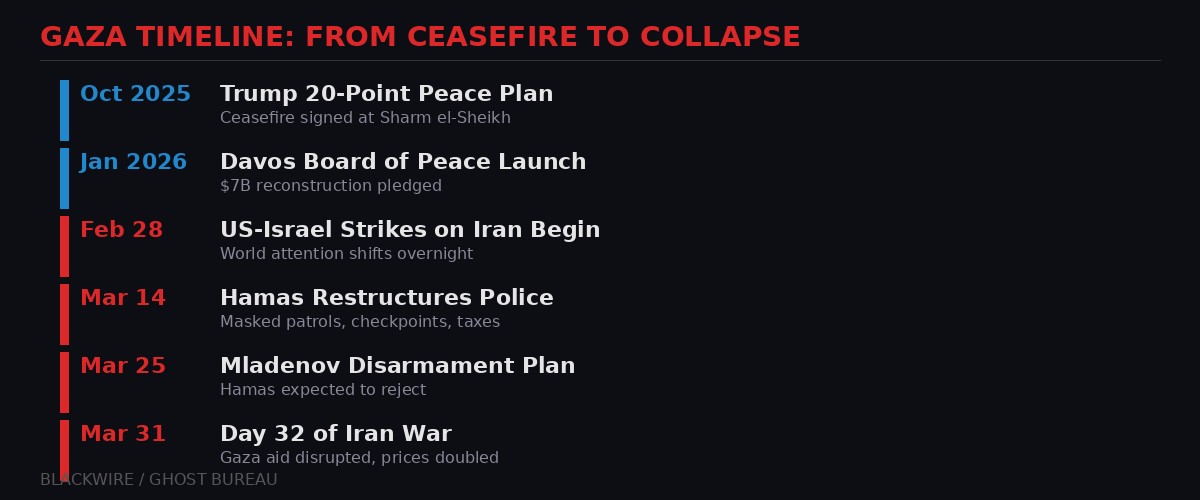
Timeline: From ceasefire to collapse - BLACKWIRE/GHOST Bureau
The Ceasefire That Never Became a Peace
The architecture looked impressive on paper. In October 2025, at Sharm el-Sheikh, the Trump administration brokered a 20-point peace plan that halted the fighting in Gaza. The deal was signed with ceremony and optimism. By January 2026, a Board of Peace was formally launched at the World Economic Forum in Davos, presided over by the UN's High Representative for Gaza, Nickolay Mladenov. In February, $7 billion in reconstruction funding was pledged at a Washington conference attended by Gulf states, European governments, and international financial institutions.
The plan had all the right components: a technocratic committee to govern Gaza, an international stabilization force, 200,000 temporary housing units, 5,000 Palestinian police officers trained in Egypt, and a phased Israeli withdrawal contingent on Hamas disarming. On the surface, it was the most comprehensive peace framework the Palestinian territories had seen in decades.
But the plan had a fatal flaw: it assumed the world would keep paying attention.
When US and Israeli bombs started falling on Iran at the end of February, the attention economy - which is the only economy that matters in international diplomacy - shifted overnight. Every diplomatic channel, every Security Council session, every press briefing, every cable news segment pivoted to the escalation in the Persian Gulf. Gaza didn't just drop down the priority list. It fell off the list entirely.
Riyad Mansour, the Palestinian envoy to the UN, has been trying to keep Gaza on the diplomatic agenda. He told the BBC that work continues on the technocratic committee and the temporary housing units. But his own words betray the reality.
"It is complicated. We will see in the coming weeks and months how this second phase of the plan will be implemented, and of course to keep the issue alive while other things are happening in the wider region is important."
"Keep the issue alive." That is the language of a diplomat who knows the patient is on life support.
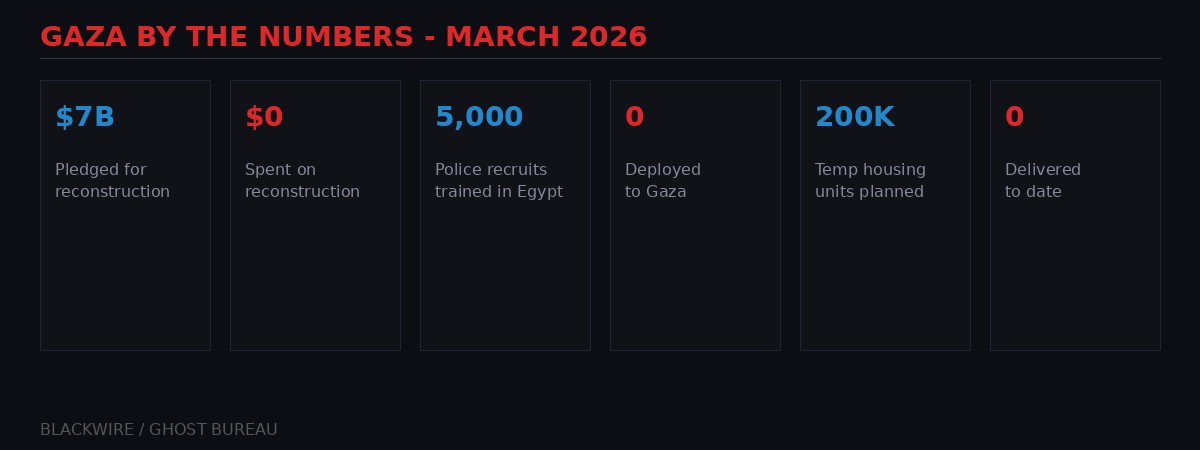
The gap between promise and reality - BLACKWIRE/GHOST Bureau
Seven Billion Dollars and Nothing to Show
The reconstruction pledged at the February Washington conference was supposed to mark the beginning of Gaza's recovery. Seven billion dollars is not a trivial sum. It was meant to clear rubble, rebuild water infrastructure, restore sewage systems, reconnect the electrical grid, and construct the first tranche of temporary housing for the more than one million Gazans still displaced from the 2023-2024 war.
None of it has materialized.
Israel has blocked construction materials from entering Gaza on security grounds, arguing that concrete, steel, and pipes could be repurposed by Hamas for tunnel construction and weapons manufacturing. This is the same justification that Israel used to restrict building materials after the 2014 war, and the 2021 confrontation, and every other conflict that produced rubble. It is a cycle so predictable that aid organizations have stopped being surprised by it.
Bushra Khalidi, Oxfam's Policy Lead based in Ramallah, described the situation in terms that strip away any remaining optimism.
"You know a huge amount of our effort is spent negotiating for the smallest crumbs, like a crossing to reopen or a few litres of fuel. So, progress towards recovery is limited and almost not there, really. We're not seeing large-scale debris removal, we're not seeing proper rehabilitation of underground infrastructure, and there's still nowhere near enough fuel to run power systems. So, this is basic survival in Gaza."
"Basic survival." Not reconstruction. Not recovery. Not the implementation of a peace plan that was signed five months ago with champagne in Davos. Survival.
The 200,000 temporary housing units? Not a single one has been delivered. The 5,000 police officers trained in Egypt? They exist, but have no date to enter Gaza. The international stabilization force? Still a concept on paper, with no contributing nations, no rules of engagement, and no deployment timeline.
COGAT, the Israeli military body responsible for managing the crossings into Gaza, denied to the BBC that there were aid shortages and accused Hamas of "exploiting resources." This is also part of the cycle: Israel blocks supplies, then blames Hamas for the resulting scarcity, then uses the scarcity as evidence that Hamas cannot be trusted with more supplies.

The reconstruction gap: billions pledged, nothing delivered - BLACKWIRE/GHOST Bureau
Hamas Fills the Vacuum
When the international community abandons a governance vacuum, someone fills it. In Gaza, that someone is always Hamas.
While the Davos-anointed technocratic committee remains outside Gaza with "no date" for its arrival, Hamas has been systematically rebuilding its administrative and security apparatus. BBC sources reported that the Hamas Interior Ministry has restructured its executive apparatus in March 2026, appointing new police directors, establishing temporary headquarters and detention facilities, and deploying security patrols across the strip.
Witnesses describe masked men in military-style uniforms who have set up dozens of checkpoints throughout Gaza. After 9 PM, they stop and search vehicles and civilians. This is not the behavior of a group preparing to disarm and hand over governance to an internationally recognized technocratic body. This is the behavior of a group consolidating control.
The financial dimension is equally revealing. Traders and shopkeepers in Gaza report that Hamas has imposed heavy taxes on goods and services, pushing already inflated prices even higher. In a territory where the average family was already spending 80% of its income on food before the Iran war disrupted supply lines, additional taxation by Hamas is not governance - it is extraction.
"Unfortunately, no one is controlling Gaza right now except Hamas. We pray to God that peace will be imposed, and that the national committee will come and control Gaza."
That is Hanaa, a displaced Gazan woman, speaking the truth that diplomats in New York and Washington prefer not to acknowledge: Hamas won the waiting game. The longer the international community delayed the deployment of the technocratic committee and the stabilization force, the more time Hamas had to re-entrench. And now that the Iran war has consumed every ounce of diplomatic bandwidth, that delay has become indefinite.
The publicly stated Hamas position on the peace plan is instructive. Hamas spokesperson Bassem Naim criticized Mladenov's disarmament framework, saying it linked "all key issues including the entry of the technocratic committee and international forces into the Gaza Strip to Hamas's weapons." He accused Mladenov of trying to "reshape the process" to suit Israel's agenda, with "no real guarantees" for implementing future commitments.
In translation: Hamas will not disarm. The central precondition of the entire peace plan - weapons decommission in exchange for Israeli withdrawal and reconstruction - is rejected. The plan is dead. It just hasn't been pronounced dead yet because nobody important enough is in the room to call time of death.

The police state returns - BLACKWIRE/GHOST Bureau
The Strikes That Nobody Counts
There is a ceasefire in Gaza. It says so on paper. It was signed at Sharm el-Sheikh. It was endorsed by UN Security Council Resolution 2803. It was celebrated at Davos. And under its nominal protection, dozens of Palestinians - including children - have been killed by Israeli air strikes since the Iran war began.
Israel says it is targeting Hamas. The dead include commanders of Hamas's military wing and police officers. But the dead also include people who were not commanders and were not police officers. They were people who happened to be near the places Israel chose to strike.
The pattern is not new, but the context is. Previous Israeli military operations in Gaza drew international scrutiny. Cameras were present. Reporters filed stories. The UN counted bodies. Diplomats issued statements. Now, with every camera pointed at Isfahan and the Strait of Hormuz, Israeli strikes in Gaza proceed with minimal coverage and no diplomatic consequences.
A senior official in the National Committee for Gaza Administration acknowledged the problem. Speaking to the BBC, the official confirmed that there is "no date yet for a return to Gaza." The committee exists. It has been appointed. But it has not entered the territory it is supposed to govern, and no one can say when it will.
Amjad Iraqi, a senior analyst at the International Crisis Group, summarized the situation with precision.
"There's still a lot of distrust about whether this programme can actually move forwards. There's a lot of pressure on Hamas to have to accept it, including from mediators as their attention drifts toward Iran."
"As their attention drifts toward Iran." That is the polite way of saying: the people who were supposed to implement this peace plan are busy with a different war, and there is no backup team.

Strikes continue under the cover of the Iran war - BLACKWIRE/GHOST Bureau
The Disarmament Framework Nobody Believes In
Last week, Nickolay Mladenov presented what he described as a "comprehensive framework" to the UN Security Council for decommissioning weapons held by Palestinian armed groups. The plan starts with "the most dangerous weapons, rockets, heavy munitions, explosive devices and assault rifles." In exchange, Israel would begin a phased withdrawal from Gaza over six to nine months, and large-scale reconstruction would commence.
Mladenov framed the choice starkly: "a renewed war, or a new beginning."
The framework has three fundamental problems that make it unworkable in the current environment.
First, Hamas will not disarm voluntarily. This is not speculation. A Palestinian official familiar with Hamas affairs told the BBC directly that the group "would reject the proposals." Hamas views its weapons as the only leverage it holds. In a world where diplomatic attention is finite and currently allocated elsewhere, surrendering weapons means surrendering the only thing that forces anyone to negotiate with Hamas at all.
Second, Israel has no incentive to withdraw while the Iran war provides diplomatic cover for continued military operations. Benjamin Netanyahu stated on March 30 that Hamas must disarm "either the easy way or the hard way." Those are not the words of a leader preparing to make concessions. Those are the words of a leader who sees the Iran war as an opportunity to resolve the Gaza question on Israeli terms, without the usual international constraints.
Third, the enforcement mechanism does not exist. The international stabilization force that was supposed to provide security guarantees for both sides has no troops, no mandate, no timeline, and no contributing nations. You cannot implement a disarmament framework without a credible security guarantee, and you cannot provide a credible security guarantee when the organizations responsible for providing it are consumed by a different crisis.

The disarmament plan nobody believes in - BLACKWIRE/GHOST Bureau
The Supply Line Collapse
The Iran war's impact on Gaza is not limited to the diplomatic dimension. It has physical, material consequences that are being felt right now in the markets and homes of the strip.
Supply lines from Israel into Gaza pass through crossings that are controlled by the Israeli military. When the Iran war began, Israel diverted military and logistical resources to the northern front. The frequency and volume of supply convoys through Kerem Abu Salem and other crossings decreased. Merchants in Gaza report that goods from Israel - which constitute the majority of imported consumer products - have slowed dramatically.
The global oil shock has compounded the problem. Fuel that powers generators, water pumps, and hospital equipment in Gaza comes through the same constrained supply chain. With Brent crude at $117 a barrel and global fuel rationing spreading from Sri Lanka to Slovenia, the price of fuel in Gaza has risen beyond what most families can afford. The electrical grid, which was already operating at a fraction of capacity before the ceasefire, remains broken.
Heavy rains in March caused sewage systems to overflow in the crowded tent camps where displaced Gazans live. These are not refugee camps in any formal sense. They are improvised settlements without sanitation infrastructure, without drainage, without the construction materials needed to build proper shelters. The Trump peace plan pledged "immediate resumption of full aid" and "rehabilitation of essential infrastructure." Neither has happened.
The humanitarian organizations on the ground are careful with their language, but the desperation bleeds through. When Oxfam's policy lead describes progress as "limited and almost not there, really," that is an organization that has seen crises on every continent telling you that this one is being abandoned.
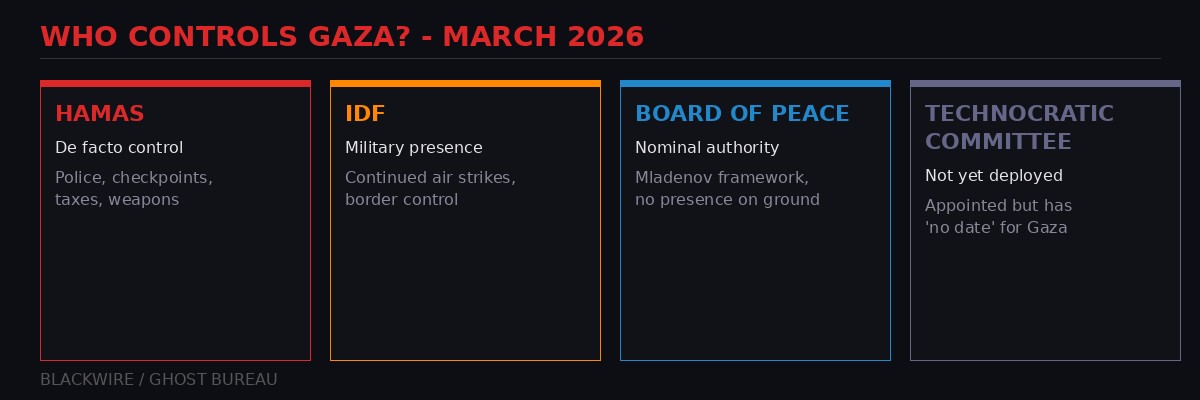
Four actors, one vacuum - BLACKWIRE/GHOST Bureau
The Death Penalty Law and What It Signals
On the same day that the Iran war entered its 32nd day, Israel's Knesset passed a law making the death penalty the default sentence for Palestinians convicted of deadly attacks deemed "acts of terrorism." The vote was 62-48. Benjamin Netanyahu voted in favor. Far-right National Security Minister Itamar Ben-Gvir wore a noose pin on his lapel.
The law applies to Palestinians tried in Israeli military courts. In theory, Jewish Israelis could also face execution, but the law is written so that the death penalty can only be applied when the attack's intention was to "negate the existence of the state of Israel" - a condition that functionally applies only to Palestinians.
Four European nations - the UK, France, Germany, and Italy - expressed "deep concern" that the law risks "undermining Israel's commitments with regard to democratic principles." The Palestinian Authority called it an attempt to "legitimise extrajudicial killing under legislative cover." Amnesty International called it "carte blanche to execute Palestinians while stripping away the most basic fair-trial safeguards."
The timing matters. This law passed while the world's diplomatic apparatus was focused on the Iran war. It passed while European governments were consumed by their own crises - Spain closing airspace, France blocking overflights, Italy denying base access, and everyone scrambling for alternative fuel supplies. It passed in the narrow window of distraction that the Iran war created.
Hamas responded by warning that the law "threatens the lives" of Palestinian prisoners in Israeli jails. The Association for Civil Rights in Israel has petitioned the Supreme Court, calling the law "unconstitutional, discriminatory by design and - for West Bank Palestinians - enacted without legal authority." The court will decide whether to hear the challenge.
Israel has executed exactly two people in its 78-year history. One was Adolf Eichmann. The passage of this law does not mean executions will begin tomorrow. But it signals the direction of Israeli policy toward Palestinians at a moment when the mechanisms of international accountability are offline.
What Comes Next
The scenarios for Gaza in the coming weeks are limited, and none of them are good.
In the first scenario, the Iran war ends through some negotiated settlement, diplomatic attention returns to Gaza, and the Trump peace plan is revived. This requires Hamas to accept a disarmament framework it has already signaled it will reject, Israel to withdraw forces it has no political incentive to pull back, and the international community to deploy a stabilization force that does not yet exist. The odds of all three conditions being met are low.
In the second scenario, the Iran war escalates further - a ground operation at Kharg Island, Houthi closure of Bab al-Mandab, a wider regional conflagration - and Gaza drops even further below the threshold of international attention. Hamas continues to consolidate. Israeli strikes continue. The ceasefire becomes a legal fiction. Eventually, the "renewed war" that Mladenov warned about becomes reality, but by then nobody remembers there was supposed to be a peace plan.
In the third scenario - the one that looks most likely right now - nothing dramatic happens. The ceasefire nominally holds. Hamas nominally cooperates. Israel nominally restrains itself. But the reconstruction never comes. The technocratic committee never arrives. The disarmament never happens. Gaza settles into a permanent state of managed decay, neither at war nor at peace, neither governed nor ungoverned, just... forgotten.
Hassan Faqawi, the man in the market, already knows which scenario is unfolding. He just didn't have a framework to describe it. He only has the price of vegetables and the silence where the world's attention used to be.
What You Need to Know
Sources: BBC, Al Jazeera, AP, Oxfam, International Crisis Group, UN Security Council briefings. All claims sourced from reporting published between March 28-31, 2026.
Timeline: The Collapse in Real Time
October 2025 - Trump 20-point peace plan signed at Sharm el-Sheikh. Ceasefire takes effect. Hamas publicly welcomes technocratic committee framework.
January 2026 - Board of Peace formally launched at World Economic Forum in Davos. Nickolay Mladenov appointed High Representative for Gaza.
February 2026 - $7 billion in reconstruction funding pledged at Washington conference. 5,000 Palestinian police recruits begin training in Egypt.
February 28, 2026 - US and Israeli strikes on Iran begin. Every diplomatic channel pivots to the new war. Gaza coverage drops to near zero.
March 2026 - Hamas Interior Ministry restructures, appoints new police directors, establishes detention facilities. Masked armed patrols resume across Gaza.
March 14 - Israeli air strikes in Gaza kill dozens of Palestinians including children. Minimal international coverage.
March 25 - Mladenov presents disarmament framework to UN Security Council. Hamas official tells BBC the plan will be rejected.
March 30 - Netanyahu demands Hamas disarm "the easy way or the hard way." Knesset passes death penalty law for Palestinians.
March 31 - Day 32 of Iran war. Supply convoys to Gaza disrupted. Prices doubled. No reconstruction materials delivered. Technocratic committee has "no date" for deployment.
The ceasefire in Gaza was supposed to be the beginning of something. Instead it became a pause - a temporary silence before the next round of the same cycle that has defined this strip of land for two decades. The world looked away. Hamas moved in. Israel kept striking. And two million people were left to survive on promises that nobody intends to keep.
This is what happens when a peace plan depends on attention, and the attention goes somewhere else.
Reporting based on BBC, Al Jazeera, Associated Press, Reuters, Oxfam, International Crisis Group, and UN Security Council briefings published March 28-31, 2026. All direct quotes attributed to original reporting sources.
Get BLACKWIRE reports first.
Breaking news, investigations, and analysis - straight to your phone.
Join @blackwirenews on Telegram