
Young Indians Are Saving Europe's Dying Trades

Skilled trade apprenticeships - known as Ausbildung - are central to Germany's workforce model. Source: Pexels
When the Last Butcher Closes
Joachim Lederer has been running a butcher shop for 35 years in Weil am Rhein, a small city pressed between Germany's Black Forest and the borders of Switzerland and France. When he started, there were eight shops like his within a 10-kilometer radius. By 2021, he was the only one left.
Germany's small butchery trade has been collapsing for two decades. From 19,000 small, family-run businesses in 2002, fewer than 11,000 remained by 2021, according to trade association records. The crisis isn't unique to butchers - it runs across the entire skilled trades sector in Germany, from bakers to road builders, lorry drivers to mechanics, even kindergarten teachers in municipal government offices.
The reason is demographic. Germany's baby boomer generation - the workers who built the country's post-war economic miracle - is aging out of the workforce. And there are not enough young Germans to replace them. The country's birth rate has been below the replacement level of 2.1 children per woman since the 1970s. That half-century of underpopulation is now arriving as a workforce crisis.
"When I started out 35 years ago, there were eight shops like mine within a 10km radius. Now I'm the only one left. I wouldn't be in business today without India." - Joachim Lederer, master butcher, Weil am Rhein, Germany. Source: BBC, March 2026
A 2024 study by the Bertelsmann Foundation, one of Germany's most prominent think tanks, quantified the problem in stark terms: the country needs to attract 288,000 foreign workers per year just to maintain its current workforce levels. Without sustained immigration, Germany's total workforce could shrink by as much as 10% by 2040. That is not a political projection - it is arithmetic. Fewer babies born in the 1970s and 80s means fewer workers today.
For decades, German politicians debated immigration with the anxiety that still grips much of European politics - the fear of cultural disruption, the right-wing backlash, the sense that foreign workers are a stopgap rather than a solution. But the butcher shops kept closing. And someone had to make the sausages.
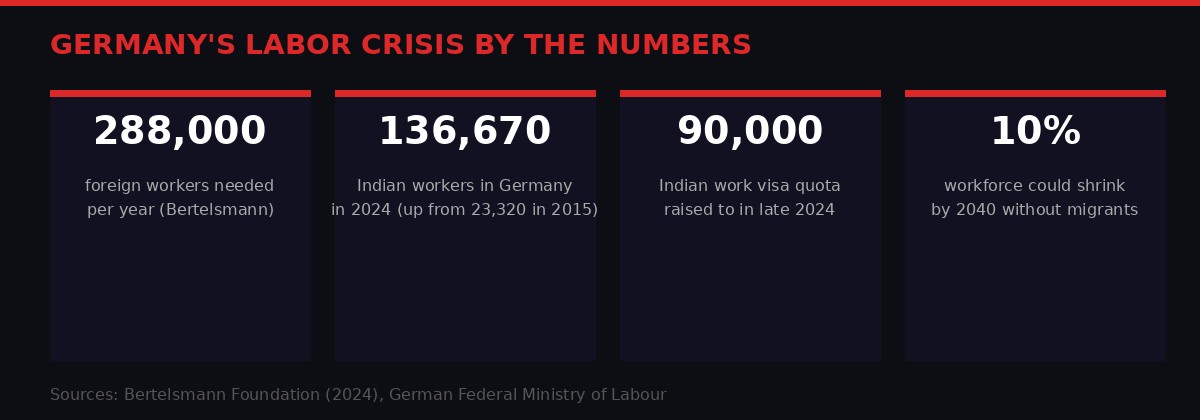
The scale of Germany's labor deficit is not a prediction - it is already happening. Source: Bertelsmann Foundation 2024, German Federal Ministry of Labour
The Email That Started a Pipeline
Handirk von Ungern-Sternberg was working for the Freiburg Chamber of Skilled Crafts in southwest Germany when, in February 2021, an email arrived in his inbox from India.
The message was from Magic Billion, an Indian employment agency. The pitch was simple: India has an enormous surplus of young, motivated people who want to work. Germany has jobs that no one is filling. Could they talk?
Von Ungern-Sternberg picked up the phone. Within months, he had arranged for 13 young Indians - including a 21-year-old woman named Anakha Miriam Shaji - to travel to Germany and begin apprenticeships in local butcher shops. It was the first time any of them had left India.
That cohort of 13 has grown into a pipeline. By March 2026, there are 200 young Indian workers in German butchers' shops alone. Von Ungern-Sternberg has since left the Chamber and founded his own employment agency, India Works, in partnership with Aditi Banerjee of Magic Billion in India. They are preparing to bring 775 young Indians to Germany this year across a range of professions: road builders, mechanics, stonemasons, bakers, logistics workers, and kindergarten teachers.
"India is a country with 600 million people below the age of 25. Only 12 million come into the workforce every year. So there's a huge labour surplus." - Aditi Banerjee, co-founder, Magic Billion employment agency. Source: BBC, March 2026
The pipeline has a legal backbone. In 2022, Germany and India signed a Migration and Mobility Partnership Agreement, creating a formal framework for skilled worker visas. At the end of 2024, Germany announced it would increase the skilled work visa quota for Indian citizens from 20,000 per year to 90,000 - a more than four-fold jump. Official German government figures show there were 136,670 Indian workers in Germany in 2024, up from just 23,320 in 2015. That is a nearly six-fold increase in under a decade, according to the German Federal Ministry of Labour.

India Works has placed young Indians in trades ranging from butchery to road construction across southwest Germany. Source: Pexels
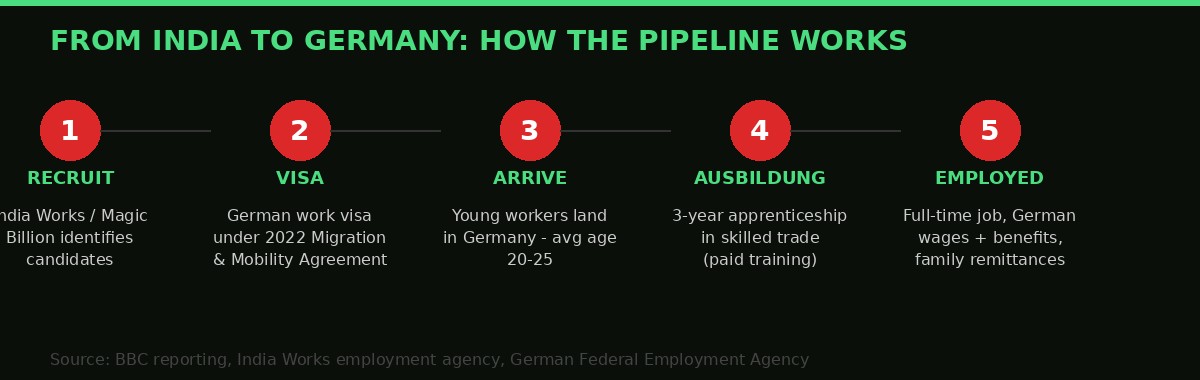
The Ausbildung system - Germany's vocational apprenticeship model - provides structured training and income for recruits from India. Source: BBC reporting, India Works agency
The Humans Behind the Statistics
Anakha Miriam Shaji was 21 when she arrived in Weil am Rhein. She remembers her feelings clearly: excitement, curiosity, and a sharp ambition that the limited job market at home could not satisfy.
"I wanted to see the world. I wanted to make my living standard so high. I wanted good social security." - Anakha Miriam Shaji, 21, from India, now a butcher's apprentice in Weil am Rhein, Germany. Source: BBC, March 2026
Her story is not unusual among the cohort India Works has placed. These are not people fleeing war or famine. They are young adults making a calculated economic decision - trading the familiar for the uncertain in exchange for wages, security, and a future that India's crowded job market cannot reliably provide.
Ishu Gariya, 20, could have pursued a university degree in computers after finishing school in Delhi. He looked at the math and chose differently. A degree would cost money he didn't have and deliver a job with a salary that wouldn't be enough to support himself and send remittances home. So he swapped a Delhi suburb for a village in Germany's Black Forest region, where he rises before dawn to work as a baker's apprentice. His shift doesn't finish until three in the morning in winter.
"We have high wages here. So I'll be able to help my family financially. And I love the clean air in the German countryside." - Ishu Gariya, 20, baker's apprentice, Black Forest, Germany. Source: BBC, March 2026
Ajay Kumar Chandapaka, 25, came from Hyderabad with a bachelor's degree in mechanical engineering. In India, that degree bought him very little. The engineering job market was saturated, salaries were low, and the competition for every position was brutal. In Germany, he drives lorries for Spedition Dold, a haulage company outside Freiburg, earning wages that allow him to send money back to family in Hyderabad and save for his own future.
The wages are not abstract. Entry-level trade workers in India typically earn between $300 and $500 per month - if they find work at all. In Germany, apprenticeship wages during Ausbildung training start at around $900 per month and rise to $1,600-2,200 upon qualification. After completing a three-year apprenticeship, a skilled tradesperson in Germany earns what would constitute a middle-class income in most of Europe.
- Ajay Kumar Chandapaka, 25, mechanical engineer from Hyderabad, now a lorry driver in Germany
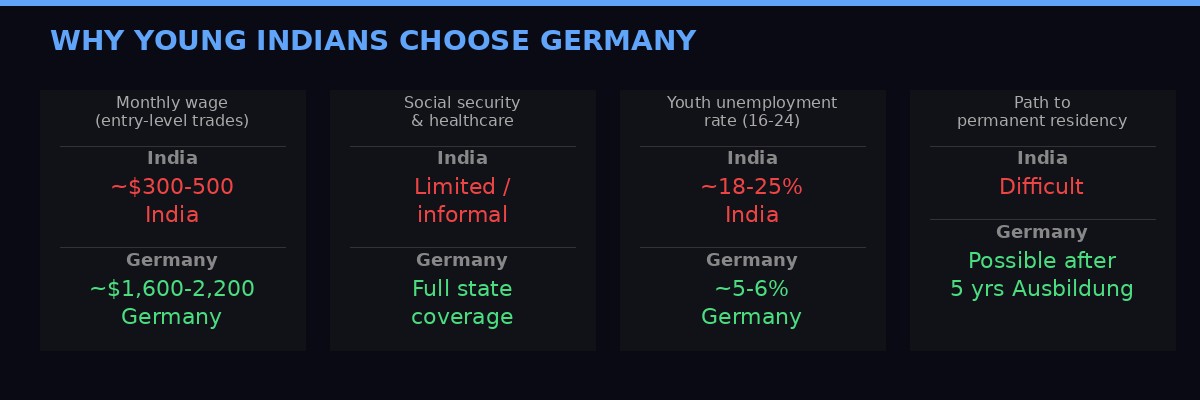
The economic logic behind the migration is stark: German trade wages can be four to six times higher than comparable Indian salaries. Sources: BBC reporting, German Federal Employment Agency, World Bank
Germany's Uncomfortable Reckoning
There is a tension in this story that Germany has not fully resolved. The same country that has cycled through anxious debates about migration, integration, and national identity now finds itself depending on foreign workers to keep its bakeries open and its roads maintained.
The far-right Alternative for Germany (AfD) party has spent years stoking fear about immigration, gaining significant electoral ground with messaging about cultural threat and national identity. In the 2025 federal elections, the AfD became the second-largest party in the Bundestag. Yet the businesses those voters rely on - the local baker, the butcher, the haulage firm - cannot survive without the exact population the AfD has made a political project of excluding.
Diana Stöcker, the mayor of Weil am Rhein and a member of the conservative Christian Democratic Union, found herself grappling with this contradiction in practical terms. Her municipal government needed kindergarten teachers - not someday, but now. They had searched all over Germany. They couldn't find anyone.
"We've been looking for teachers all over Germany. But they're really hard to find. We have to look overseas. It's the only possibility." - Mayor Diana Stöcker, Weil am Rhein, CDU. Source: BBC, March 2026
By March 2026, Stöcker's municipality is in the process of hiring two young men from India to work as kindergarten teachers - public sector jobs, in a town where the mayor comes from the mainstream conservative party. The political narrative and the economic reality are pointing in opposite directions, and the economic reality is winning.
The broader picture across Germany is consistent with what's happening in Weil am Rhein. The Bertelsmann Foundation's 2024 study estimated that without sustained immigration at scale, Germany's workforce would shrink by 10% by 2040. That's not a projection about distant risk - it's a description of a problem already underway, with companies struggling to fill roles from logistics to healthcare to construction.

Germany's traditional small trades - bakeries, butchers, craft workshops - are struggling to attract young Germans. Indian apprentices are increasingly filling the gap. Source: Pexels
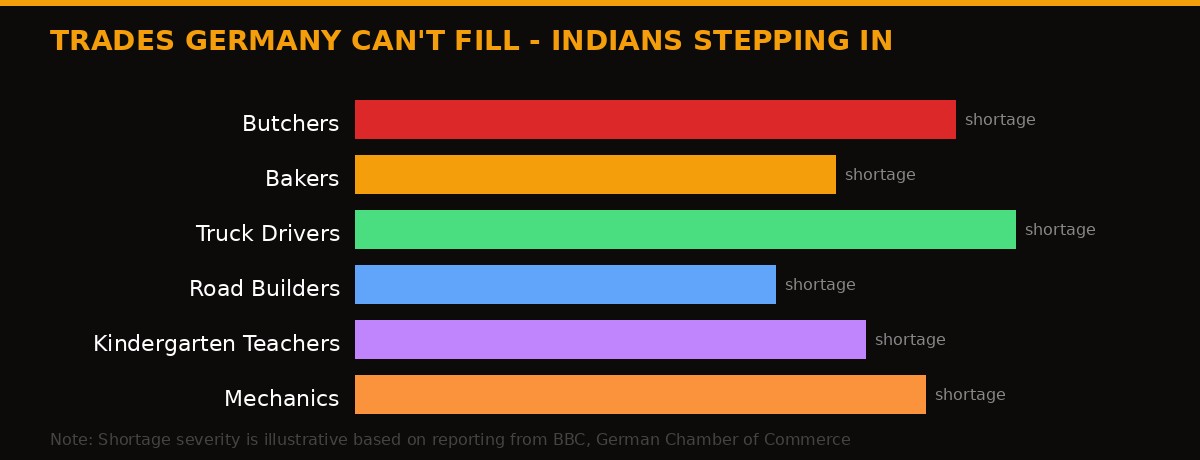
The labor shortage spans nearly every skilled trade sector. German employers say they cannot find domestic candidates at any wage. Source: German Chamber of Commerce, BBC reporting
What This Means for Young India
India's labor surplus is both an asset and a social pressure point. The country has approximately 600 million people below the age of 25 - a demographic dividend that has been celebrated in official projections for decades. But the jobs to absorb that youth population have not materialized at the required scale.
India's youth unemployment rate (ages 16-24) has hovered between 18-25% in recent years, according to World Bank data - significantly above Germany's 5-6% for the same age group. For young people with vocational skills or incomplete degrees, the gap between ambition and opportunity has been grinding.
The German pipeline does not solve that problem at scale - 775 placements per year is a rounding error against tens of millions of young Indians entering the job market annually. But it represents something real for the individuals who take it, and it signals a structural possibility: that the demographic imbalances between aging Europe and young South Asia could produce economic partnerships that work for both sides.
India's Youth by the Numbers
600 million Indians are under the age of 25 (Bertelsmann / BBC reporting)
12 million new workers enter India's job market every year - far outpacing available employment
18-25% youth unemployment rate (16-24) in India vs 5-6% in Germany (World Bank 2024)
136,670 Indian workers now in Germany (2024) - up 486% since 2015 (German Ministry of Labour)
Not every placement works out perfectly. Integration into small German towns can be isolating - language barriers, cultural distance, the loneliness of being 21 years old in a place where you know no one and the nearest Indian community is an hour away. Employment agencies and the German government are developing support infrastructure, including language training and community programs, but it remains incomplete.
There is also the question of remittances and long-term settlement. Most young Indian workers in Germany are sending a significant portion of their earnings home - supporting parents, siblings, sometimes entire extended family networks. This creates a genuinely transnational economic reality: German wages circulating into Indian households, while Indian labor circulates into German kitchens and warehouses and construction sites.

For many young Indians, the Ausbildung route to Germany represents economic security unavailable at home. Source: Pexels
The Timeline: How the Partnership Built
What This Looks Like From the Inside
The human texture of this story does not fit neatly into either the optimistic narrative or the anxious one. It is not a simple tale of opportunity embraced or injustice endured. It is messier - and more real.
Anakha Miriam Shaji, the young woman from India who became a butcher in Weil am Rhein, is now three years into her time in Germany. Her life has changed in ways she expected and in ways she didn't. The wages are real. The social security is real. The loneliness - being far from family, from a culture that is hers, from food and festivals and the ordinary texture of Indian daily life - is also real.
Germany's Ausbildung system, the vocational apprenticeship model that the country has run for over a century, is designed to absorb young workers and give them a structured path to skilled employment. It is genuinely one of the better-designed labor systems in the world - combining classroom learning with hands-on work, with the employer paying a training wage throughout. For young Indians coming from a job market where even engineering degrees don't guarantee work, the structure is both surprising and valuable.
But Ausbildung was designed for Germans. The assumption built into the system is a shared cultural context - an understanding of German bureaucracy, social norms, workplace expectations. Young Indian workers are navigating that system in a second language, in a foreign culture, often in small towns with no diaspora community to fall back on. The agencies placing them are trying to build support infrastructure, but it is still nascent.
"I wanted good social security. I wanted to see the world. I wanted to make my living standard so high." - Anakha Miriam Shaji, 21, butcher's apprentice, Weil am Rhein. She is now three years into her apprenticeship. Source: BBC, March 2026
Joachim Lederer, the master butcher who took two of the original cohort and now employs seven Indians, is clear about what the partnership means for him. He wouldn't be in business. The shop his family has run for 35 years would have closed. His contribution to his community - the local food supply, the employment, the craft itself - would have ended.
The seven young Indians working for him are not stopgaps. They are learning a trade with centuries of German history. They will be among the people who carry that trade into the next generation - and they came from a country 7,000 kilometers away because the people who were supposed to be there chose other paths.
The Bigger Picture: Europe Needs a New Story
Germany is not alone. Across Europe, the combination of low birth rates, aging populations, and the cultural politics of immigration has produced the same tension in different national forms: a workforce crisis that can only be solved by migration, met by political movements that treat migration as an existential threat.
France is running short of nurses and construction workers. Italy's agricultural sector has been dependent on migrant labor for years while politicians campaign against it. Spain passed a sweeping migrant amnesty in early 2026 partly out of economic necessity. The United Kingdom, post-Brexit, is discovering that the free movement of workers it eliminated was doing work that domestic labor markets cannot replace.
What the Germany-India pipeline illustrates is that the question of "who does Europe's work" has an answer - but Europe has not yet built a political consensus around that answer. The workers are arriving. The jobs are being filled. The businesses are surviving. But the political conversation is still largely framed around threat rather than necessity, exclusion rather than partnership.
There is a version of this story that is told only in economic terms: labor supply, demand, wage differentials, demographic curves. That version is accurate but incomplete. Behind every number is a person who left everything they knew, learned a new language, mastered a new trade in a country that is still deciding whether to welcome them or merely tolerate them.
Anakha Miriam Shaji is making sausages in Weil am Rhein. Ishu Gariya is pulling bread out of ovens in the Black Forest before sunrise. Ajay Kumar Chandapaka is hauling goods across southwest Germany in a truck with his name on the door of the cab. These are not abstractions. They are the specific, individual decisions of specific people who took a risk that their home countries could not adequately reward - and found that someone, somewhere, needed exactly what they had to offer.
Germany's dying trades are not dying anymore. That is the story. What Germany - and Europe - makes of it politically will define much of what follows.
Get BLACKWIRE reports first.
Breaking news, investigations, and analysis - straight to your phone.
Join @blackwirenews on Telegram