Germany Is Quietly Requiring Males Aged 17-45 to Get Military Approval Before Leaving the Country

Nobody made an announcement. Nobody held a press conference. Germany's government passed a law in December, it entered force on January 1, 2026 - and this week the German public discovered that males between the ages of 17 and 45 now need explicit military approval before they can spend more than three months outside the country.
The provision went unreported for months. It was not a secret - the regulation is embedded in the Military Service Modernisation Act that parliament voted through at the end of 2024 - but its practical scope was so broad, and its implications so significant, that nobody in the German press corps had fully mapped it until the Frankfurter Rundschau published its analysis this Friday. By Saturday morning, the story had exploded across European social media and was drawing comparisons to wartime mobilisation regimes.
Germany's Defense Ministry has moved to tamp down the alarm, saying that approvals "must generally be granted" and that the government is still developing exemption rules "to avoid unnecessary bureaucracy." But the legal text exists. The infrastructure for enforcement does not yet exist - but that, says the ministry, is "being developed."
What the Law Actually Says

The legal basis traces to Germany's 1956 Conscription Act, which established the framework for military service in the postwar West German state. That law was amended multiple times over the decades. The most recent amendment came in December 2024, updating it as part of the Military Service Modernisation Act - a package of measures Chancellor Friedrich Merz's incoming government pushed through Parliament to begin reversing three decades of post-Cold War military drawdown.
Prior to December's amendment, the requirement to report extended stays abroad applied only when Germany had formally declared a state of national defence or mobilisation. In other words, it was a wartime provision. The December amendment removed that trigger. It now applies in peacetime, effective January 1, 2026.
In a statement provided to BBC, a German Defense Ministry spokesman said that males aged 17 and older were "required to obtain prior approval for stays abroad lasting longer than three months." The spokesman acknowledged the consequences for young people could be "far-reaching" and said work was underway on a regulatory framework for exemptions.
"In the event of an emergency, we must know who may be staying abroad for an extended period." - German Defense Ministry spokesman, statement to BBC, April 4, 2026
The law does not specify what constitutes grounds for refusal. It does not specify what happens if someone leaves without approval. The enforcement mechanism has not been built yet. The ministry says a similar provision "had no practical relevance" during the Cold War - but the Cold War was sixty years ago, and Germany is now in a Europe where the Iran war has blown apart energy markets and Chancellor Merz has pledged to build the Bundeswehr into the continent's most powerful conventional army.
Why Now - The Geopolitical Context

The timing of this law is not accidental. Germany ended compulsory military service in 2011 under then-chancellor Angela Merkel, after years of treating the post-Cold War peace as permanent. That decision looked reasonable in 2011. It looks different now.
Russia's full-scale invasion of Ukraine in February 2022 triggered an immediate reassessment across NATO. Germany pledged a 100 billion euro special defense fund within days of the invasion. Two years of Ukrainian warfare, followed by the outbreak of the Iran war in late February 2026, has transformed the security calculus completely.
The Iran conflict, now in its sixth week, has closed the Strait of Hormuz to most shipping. European gas prices have spiked to levels not seen since the 2022 Russia crisis. Berlin's top economic research institutes this week cut their 2026 German GDP growth forecast to just 0.6 percent, directly attributing the downgrade to energy price increases driven by the war. The German energy-industrial complex - built on cheap gas to power its automotive and chemical sectors - is under acute stress.
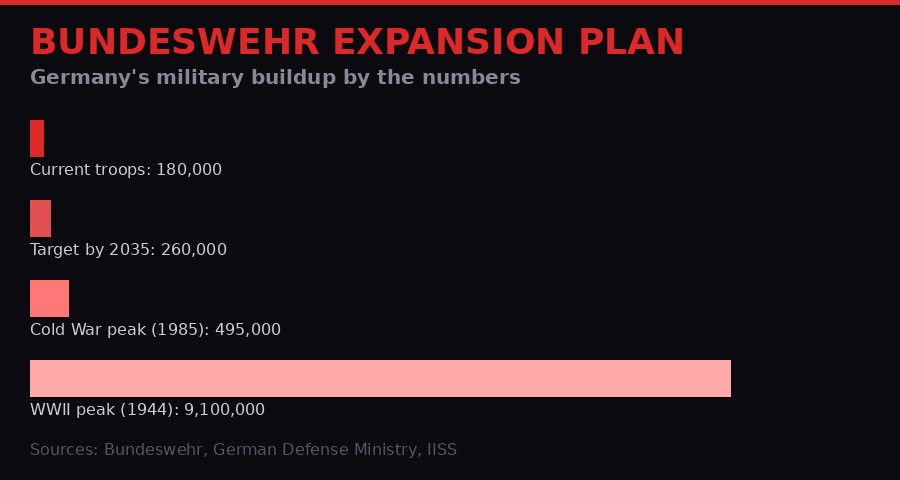
The Military Service Modernisation Act was a response to all of this. Its headline measures were straightforward: expand the Bundeswehr from 180,000 to 260,000 troops by 2035, introduce voluntary military service questionnaires for all 18-year-olds, and establish fitness assessment requirements from July 2027. The travel restriction was a quieter provision - tucked inside the same legislative package, drawing on old law, and apparently noticed by very few people during the parliamentary debate.
Germany has also gone further this month, formally asking France to extend its independent nuclear deterrent to German soil - a request Paris agreed to in principle. The combination of nuclear umbrella extension, Bundeswehr expansion, and a travel restriction law for males of fighting age paints a picture of a country accelerating toward a "defense readiness posture" not seen since the Cold War's end.
The Scope: Who Is Affected and How

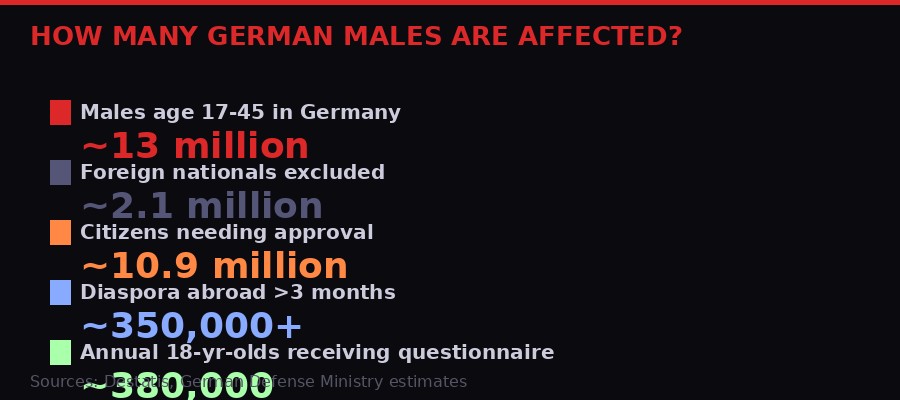
The number is staggering once you sit with it. Germany has approximately 13 million male residents between the ages of 17 and 45. Subtract non-citizens who fall outside the scope of conscription law, and you arrive at roughly 10.9 million German male citizens now technically subject to the travel approval requirement.
For most of them, in practice, nothing will change immediately. The German diaspora - Germans living abroad long-term - numbers in the hundreds of thousands, and existing residents abroad are presumably already captured in registration systems. The immediate effect is most pronounced for young men considering study or work abroad, for seasonal workers, and for the growing number of Germans who spend extended periods outside the country.
The law covers stays of more than three months. A holiday to Mallorca, a business trip to London, a month in Southeast Asia - none of that is affected. The trigger is longer-term absence. The Defense Ministry's position is that approvals will routinely be granted, and that the regulation is primarily about maintaining a functioning military registration database rather than actually restricting movement.
But legal scholars are already pointing out that the infrastructure for "routine approval" does not exist. There is no online portal. There is no clear timeframe for processing requests. There is no defined appeals process. Until the implementing regulations are written - and the ministry says that work is ongoing - the law exists in an enforcement vacuum. Citizens technically must comply with a requirement for which no compliance mechanism exists.
The Historical Echo: Germany, Conscription, and the Weight of the Past

German history makes every conversation about military service politically sensitive in ways that are difficult to overstate. The country that gave the world two world wars, that mobilised millions into the Wehrmacht, that sent men into uniform by the tens of millions - this country abolished compulsory military service in 2011 as a deliberate act of civilizational self-improvement. The Bundeswehr was to be a professional military of volunteers, integrated into NATO, firmly under civilian control, with conscription left behind like a relic of the old Germany.
The 2011 suspension was a decision with real popular support. Germans across the political spectrum had grown weary of the old system's inequities - university students deferring or opting for civilian service while working-class boys were drafted. The suspension felt like progress. Germany's Basic Law, written under Allied supervision in 1949, was designed to ensure the military could never again act as a force independent of democratic civilian authority.
The 2026 Military Service Modernisation Act doesn't restore mandatory conscription. But it comes close enough to provoke real discomfort. The requirement to ask permission to leave your country is a different thing from a draft notice. It is psychologically and politically loaded. Young Germans protested when the law was passed in December, with one organizer writing: "We don't want to spend half a year of our lives locked up in barracks, being trained in drill and obedience and learning to kill."
"We don't want to spend half a year of our lives locked up in barracks, being trained in drill and obedience and learning to kill." - German anti-conscription protest organizer, December 2024, via social media (per AP)
The Defense Ministry is careful to frame the 2026 law as "voluntary" service backed by a registration system, not mandatory conscription. But the legal distinction is becoming less clear. The Military Service Modernisation Act sets July 2027 as the date when all 18-year-olds will undergo mandatory fitness assessments to determine their eligibility for service "should war break out." The law explicitly contemplates compulsory service if voluntary enlistment numbers fall short of targets. And it now restricts the travel of 10 million men without their knowledge, without their consent, and without any public announcement.
Germany ran down its armed forces to around 180,000 troops from a Cold War peak of nearly half a million. Rebuilding that capacity requires personnel, training, and infrastructure - and apparently a legal mechanism to ensure those personnel stay within the country's reach when needed.
European Rearmament: Germany Is Not Alone, But It Is Behind

Germany is not alone in this trajectory. The Iran war and the ongoing Ukraine conflict have triggered a wave of European defense policy shifts that would have seemed implausible five years ago.
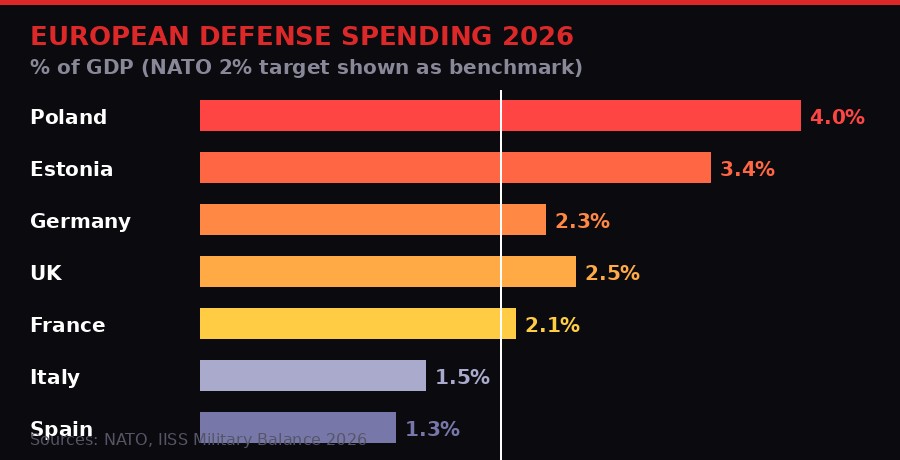
Poland is spending 4.0 percent of GDP on defense, the highest ratio in NATO. Estonia, on Russia's border, is at 3.4 percent. The UK, under Chancellor Rachel Reeves, recently streamlined nuclear energy regulation as part of a broader energy security push. Sweden reversed a four-decade old decision to abandon nuclear power entirely after European energy markets fractured under Iran war pressure. European Commission President Ursula von der Leyen called Europe's abandonment of nuclear power a "strategic mistake" at the European Nuclear Energy Summit in Paris last month.
On conscription specifically, the European picture has shifted dramatically. Finland has maintained its universal conscription system throughout the post-Cold War period - and is now held up as a model. Sweden re-introduced conscription in 2017. Lithuania in 2015. Latvia followed. Denmark extended its conscription age bracket and is debating including women. Germany is arriving late to what its Scandinavian and Baltic neighbors recognized years earlier.
Trump's response to the NATO rifts has sharpened the urgency. The U.S. president told NBC News this week that he was "seriously considering" pulling out of the alliance after European members refused to send military ships to the Strait of Hormuz. Secretary of State Marco Rubio went on Fox News and said the U.S. would need to "reexamine" whether NATO was "still serving that purpose." The combination of American ambiguity about the alliance and a hot war reshaping European energy markets has pushed every NATO member - including Germany - to accelerate their own defense plans independent of Washington.
Germany asking France for nuclear cover, Germany building up its conventional forces, Germany passing a travel restriction law for military-age males - these are symptoms of the same diagnosis. Europe is rearming, and it is doing so fast enough that provisions are being enacted before the administrative infrastructure to manage them has been built.
The Questions the Law Does Not Answer

The most immediate practical problem with the German travel restriction law is that it creates an obligation without creating the infrastructure to fulfill it. There is no designated authority to receive applications. There is no defined response time. There is no appeals process. There is no stated penalty for non-compliance.
The Defense Ministry says this is all being developed. The Frankfurter Rundschau's report triggered the first serious public scrutiny of the regulation, and the ministry is clearly now moving to accelerate the implementing rules. A spokesman told BBC that regulations on exemptions were "being developed in part to avoid unnecessary bureaucracy." That is not a reassuring formulation. It means the bureaucracy has not yet been defined, and neither have the limits on it.
Legal scholars in Germany are already flagging constitutional questions. Germany's Basic Law guarantees freedom of movement. Article 11 specifically protects the right of all Germans to move and reside throughout the federal territory. The European Convention on Human Rights adds a further layer of protection. The question is whether a military registration requirement that can restrict movement crosses the line from regulation into rights violation - particularly when the criteria for denial are undefined and the enforcement mechanism does not yet exist.
"Prior to the latest amendment, the obligation to report extended stays abroad applied only if Germany was in a state of national defence or mobilisation." - German Defense Ministry statement, April 4, 2026
There is a legitimate argument that a registration system with routine approvals does not meaningfully infringe on movement rights. There is also a legitimate argument that a law requiring any male between 17 and 45 to ask the military for permission to go abroad for more than three months - with no defined time limit on the response and no defined grounds for refusal - is a meaningful restriction on one of the European Union's foundational freedoms. Both arguments will end up before German courts. The Federal Constitutional Court in Karlsruhe will almost certainly be asked to rule on this provision within the year.
The Foreign Ministry has a separate wrinkle. German citizens living abroad permanently are already registered through consular services. For them, the law may have almost no practical effect - they are already in the system. The question is about those who are not yet abroad: students considering Erasmus exchanges, young professionals weighing job offers in London or New York or Singapore, and anyone who had not previously thought of a multi-month trip as something requiring government permission.
Timeline: How Germany Got Here
Key Dates in Germany's Military Service History
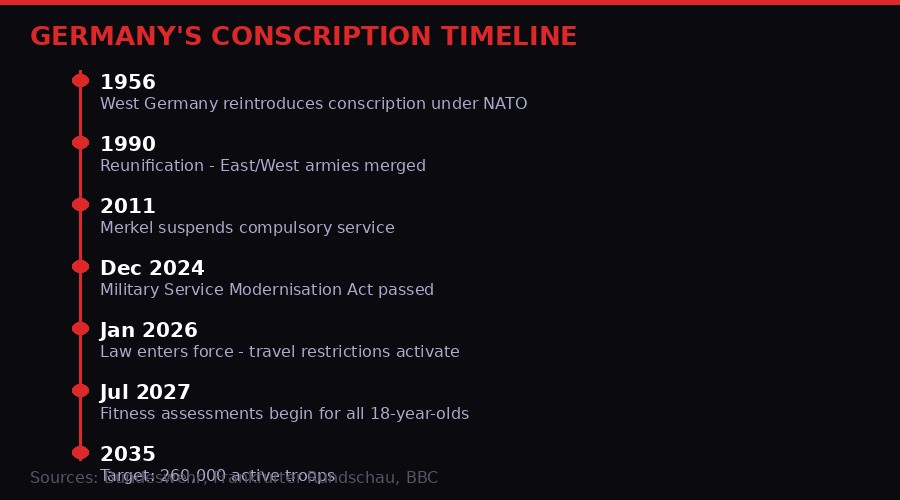
- 1949: Basic Law adopted - Bundeswehr placed under strict civilian democratic control
- 1956: West Germany reintroduces conscription under NATO framework; Conscription Act establishes military registration requirements including travel provisions
- 1989-1990: Fall of Berlin Wall, German reunification - East and West armies merged into unified Bundeswehr; Cold War peak troop strength of 495,000
- 2011: Chancellor Merkel suspends compulsory military service; Bundeswehr shifts to all-volunteer model
- Feb 2022: Russia launches full-scale invasion of Ukraine; Germany pledges 100 billion euro special defense fund within days
- Feb 28, 2026: U.S. and Israel launch coordinated strikes on Iran; Iran closes Strait of Hormuz
- Dec 2024: Military Service Modernisation Act passed by German parliament; travel restriction clause embedded in legislation
- Jan 1, 2026: Law enters force; travel restriction clause for males 17-45 activates without public announcement
- Apr 4, 2026: Frankfurter Rundschau publishes analysis of travel restriction; German public discovers law exists
- Jul 2027: Mandatory fitness assessments begin for all German 18-year-olds under new legislation
- 2035: Target: Bundeswehr expanded to 260,000 active personnel from current 180,000
Expert Perspectives: Necessary Readiness or Democratic Overreach?

Defense policy analysts have been largely supportive of Germany's rearmament trajectory, while raising questions about the specific provision that emerged this week. The consensus view among NATO-aligned analysts is that Germany has been dangerously under-invested in its military for decades, and that the current geopolitical environment requires urgent corrective action. The travel restriction is, in this framing, a minor administrative measure - a registration requirement, not a deployment order.
Behnam Ben Taleblu, senior director at the Foundation for Defense of Democracies in Washington, told AP this week in the context of the Iran war: "A disabled air defense system is not a destroyed air defense system. We shouldn't be shocked that they're still fighting." The same logic applies to military readiness legislation - a country building its military capacity cannot maintain that capacity without a functioning registry of military-age men, especially if the security environment continues to deteriorate.
Civil liberties organizations take a sharply different view. German civil liberties advocates said the provision raised "fundamental questions about the proportionality of restricting the freedom of movement of millions of people based solely on age and sex, during peacetime, with no judicial oversight and no defined criteria for refusal." The absence of defined refusal criteria is particularly striking - a law that says approvals "must generally be granted" without specifying when they can be denied effectively grants unlimited discretion to military administrators.
Iulia-Sabina Joja, a senior fellow at the Middle East Institute in Washington who writes extensively on European security, noted this week that European countries have been "not keen to go into an active warfare situation" on Middle East energy security - but added that the Iran war's economic consequences are forcing every European government to rethink assumptions that seemed permanent just two years ago. Germany is responding to real threats with real legislative tools. The question is whether it is moving faster than its democratic institutions can process.
The constitutional dimension carries special weight in Germany. The Basic Law's founding logic - building a military that is permanently subordinate to democratic civilian oversight - was designed specifically to prevent the kind of military-driven political culture that produced two world wars in thirty years. Laws that restrict civilian movement based on military registration requirements, even if well-intentioned, bump directly against that founding logic. Germany's Federal Constitutional Court will almost certainly be asked to rule on this provision. The ruling will have implications across the European Union, where freedom of movement is a foundational treaty right.
What Happens Next: Three Problems, One Government

Germany's government has three near-term problems to manage from this revelation. First, it needs to design and deploy an approval system before the law creates legal chaos for the thousands of young men who are planning extended trips abroad and now have no idea where to send their application. Second, it needs to get ahead of the constitutional litigation that is certainly coming, which means defining clear, proportionate criteria for refusal - criteria that cannot currently be found in any published document. Third, it needs to manage the political fallout in a country where military service has carried enormous historical weight for eighty years.
Chancellor Merz has been explicit about his ambitions for the Bundeswehr. He wants Germany to have the strongest conventional army in Europe. That requires roughly 80,000 additional troops beyond current levels, a procurement program running into hundreds of billions of euros, and a cultural shift in how Germany thinks about defense. The travel restriction is a small legal provision but a large symbolic signal: Germany is in the business of maintaining a registry of men of fighting age and keeping them within national reach.
The law is in force. The debate is just beginning. The Frankfurter Rundschau's Friday report guaranteed that. By Saturday, German opposition parties were demanding emergency Bundestag committee sessions. The Greens and the SPD called for immediate legislative review. The AfD defended the measure as essential national security policy. The FDP - the liberals who have historically championed individual rights - found themselves caught between coalition instincts and their civil libertarian base.
The Iran war's shadow falls over this entire debate. If the Strait of Hormuz remains closed through Monday - when Trump's 48-hour ultimatum expires - energy prices will spike further. If Pakistan's ceasefire mediation fails and the fighting escalates, Europe faces direct economic damage on top of the ongoing Ukraine conflict. In that environment, the political appetite for questioning Germany's military preparedness laws is smaller than it would normally be.
The travel restriction arrived quietly, slipped inside a military modernization package, and may stay on the books precisely because the geopolitical moment makes it very hard to argue against - even though the administrative infrastructure to implement it does not yet exist, the constitutional basis is contested, and 10 million German men discovered they had already been subject to it for three months before anyone told them.
The Bigger Picture: Europe Is Running the Movie in Reverse
The Germany story sits inside a larger narrative reshaping Europe at speed. A continent that demilitarized for thirty years, shut down nuclear plants, cut conscription, and downsized its armies is now reversing course - urgently, with inadequate preparation, and not always smoothly.
Nuclear power is back on the agenda everywhere. Italy is preparing to repeal its ban. Belgium is reversing its phase-out. Greece has opened a public debate on advanced reactor designs. Germany, which had the most aggressive nuclear phase-out of any major economy, is officially treating that decision as a strategic error - even as former architects of that policy now sit in positions to revise it.
Military spending is rising across the board. The NATO 2 percent target, once aspirational, is now a floor. Poland is at 4 percent. The Baltic states are demanding more. Germany, for the first time in decades, has crossed the 2 percent threshold and is pushing higher. The question for Europe is no longer whether to rearm but how fast, with what legal frameworks, and at what cost to the civil liberties and freedoms that postwar Europe was built to protect.
Germany's travel restriction is a small provision in a large law. But it is a marker. It says: Germany is now in the business of tracking where its men of fighting age are. It says: the peacetime consensus that made that kind of tracking unnecessary is under review. And it says: a government can pass a law affecting 10 million people, have it go unnoticed for three months, and only face scrutiny when a regional newspaper finally connects the dots.
Europe in April 2026 is a different place than Europe in April 2020. The question is whether the institutions built for the old Europe can accommodate the new one without breaking. Germany's courts, Germany's parliament, and Germany's 10 million newly restricted men will provide part of the answer. The rest will come from the wars still burning at Europe's edges.
Get BLACKWIRE reports first.
Breaking news, investigations, and analysis - straight to your phone.
Join @blackwirenews on Telegram