The Weight of 500 Years: Ghana Forces a UN Vote on Slavery Reparations
Today, for the first time in history, the United Nations General Assembly voted on whether the transatlantic slave trade constitutes humanity's gravest crime - and whether the nations who built empires on it should pay. The response split the world along the exact same fault lines as the trade itself.

Demonstrations for racial justice have reshaped global politics over the past decade. Today, that energy reached the floor of the UN General Assembly. (Pexels)
The vote was not a surprise. It had been telegraphed for months - since Ghana's new president, John Dramani Mahama, made it the centerpiece of his foreign policy and brought the African Union and the Caribbean Community to the table as co-sponsors. But knowing something is coming and watching it happen are two different experiences.
At 2 PM on Wednesday, March 25, 2026, the United Nations General Assembly in New York voted on a Ghana-led resolution that would formally recognize the transatlantic slave trade as "the gravest crime against humanity," call on member states to consider issuing formal apologies, and urge the creation of a reparations fund. It was the first time the General Assembly had put a binding reparations-adjacent resolution to a vote in the body's history.
Ghana's foreign minister Samuel Okudzeto Ablakwa had told the BBC earlier on Wednesday: "We are demanding compensation - and let us be clear, African leaders are not asking for money for themselves. We want justice for the victims and causes to be supported, educational and endowment funds, skills training funds."
He chose his words carefully. He had to. Because the countries with the most to pay have been the most vocal about why they shouldn't have to.

Across Ghana, community elders have long kept the memory of the slave trade alive. Today, that memory demanded a global hearing. (Pexels)
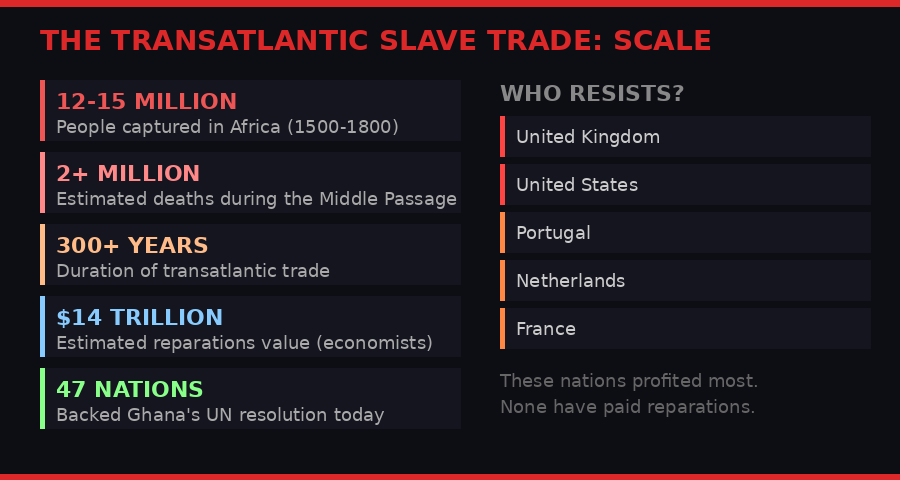
The numbers behind the trade - and the political map of resistance to accountability today.
What Ghana Actually Said - and What It Means

The UN General Assembly chamber - where today's vote took place - and where decades of blocked reparations debates finally forced a formal resolution. (Pexels)
The resolution as presented does not demand a specific dollar figure. It does not mandate any single country write a check. Its architects were deliberate about this - they knew that any concrete financial demand would give Western nations the ammunition to paint it as an extortion scheme and vote it down even more aggressively.
Instead, it does six things. First, it formally designates the slave trade as a crime against humanity - not just in academic language, but in binding UN documentation that becomes international legal precedent. Second, it calls on member states to "consider" making formal apologies. Third, it calls for the creation of a dedicated reparations fund focused on education, skills training, and economic development in affected communities. Fourth, it demands the return of cultural artefacts and historical objects looted during the colonial era. Fifth, it acknowledges that the consequences of slavery persist today in the form of racial inequalities and underdevelopment "affecting Africans and people of African descent in all parts of the world." Sixth, it calls for a UN special committee to oversee progress.
That last point is what gives it teeth. Committees create reporting mechanisms. Reporting mechanisms create accountability. Accountability - even soft accountability - changes diplomatic calculus over time.
"Many generations continue to suffer the exclusion, the racism because of the transatlantic slave trade which has left millions separated from the continent and impoverished." - Samuel Okudzeto Ablakwa, Ghana's Foreign Minister, BBC News, March 25, 2026
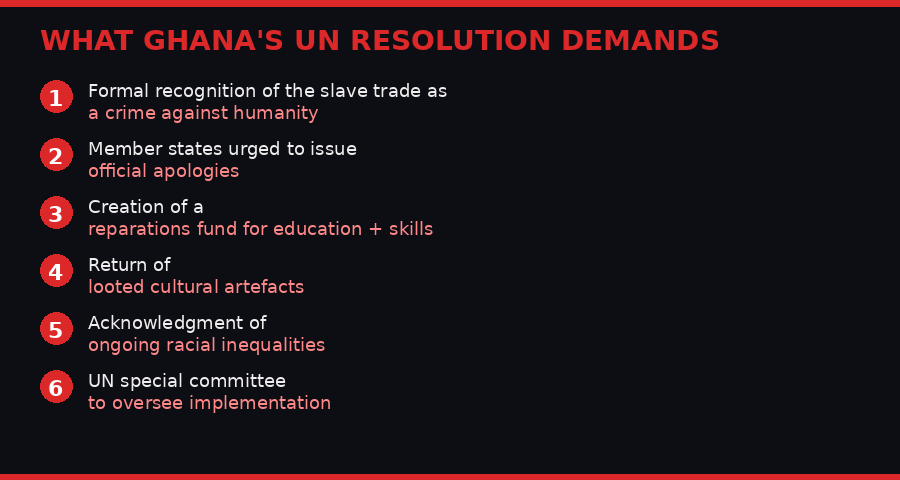
Six concrete demands within the resolution. None require immediate payment - but all create legal and diplomatic precedent.
Ghana is not a random actor here. It is one of the main geographic gateways through which the slave trade operated. Elmina Castle and Cape Coast Castle - enormous stone fortresses built by European powers on Ghana's Atlantic coastline - still stand as grim monuments to the scale of what happened. Tens of thousands of enslaved Africans were held in their dungeons, sometimes for months, before being loaded onto ships. The castle walls are marked with the words "Door of No Return."
When President Mahama addressed the UN on Tuesday, the day before the vote, he called the resolution "historic" and described it as "a safeguard against forgetting." Then he did something unusual for a diplomatic address: he named a specific enemy.
He criticized Donald Trump's administration directly for "normalising the erasure of black history" - citing executive orders that restored Confederate statues, moved to dismantle a slavery exhibit in Philadelphia, and directed federal institutions to purge what Trump calls "anti-American ideology" from their programming. Mahama's warning was pointed: these policies, he said, "are becoming a template for other governments as well as some private institutions."
The Countries That Built Empires - and the Arguments They're Making Now

The stone dungeons of the slave forts along Ghana's coast held hundreds of thousands. Some cells still bear the scratched markings of those who passed through. (Pexels)
The United Kingdom has long been the most vocal Western nation in rejecting reparations. The argument is consistent and has been recycled through multiple governments: that today's institutions cannot be held responsible for decisions made by governments centuries ago, that compensation would be logistically impossible to calculate, and that the more appropriate response is investment in development aid and educational partnerships.
None of this holds up to scrutiny. The British government compensated slave owners - not enslaved people - when it abolished slavery in 1833. That compensation payment, 20 million pounds at the time (equivalent to roughly $3 billion in modern terms and representing 40% of the government's annual budget), was so large it wasn't paid off until 2015. British taxpayers were still paying that debt to the descendants of slave owners within living memory. The people who were enslaved got nothing.
The United States has its own calculus. The phrase "40 acres and a mule" is not a joke - it was a real promise made to formerly enslaved Americans by Union General William Sherman in 1865, endorsed briefly by President Lincoln, and then rescinded by President Andrew Johnson after Lincoln's assassination. The land was returned to Confederate owners. The debt has never been revisited at the federal level.
Portugal, which transported more enslaved people than any other nation (estimates range from 5.8 to 6 million over the course of the trade), has remained conspicuously quiet. France, which received the largest share of enslaved labor in the Caribbean, extracted reparations payments from Haiti for the "loss of property" - that property being enslaved people - for over a century after Haitian independence. Those payments continued until 1947. The calculus of who owes whom, in that particular relationship, is not complicated.
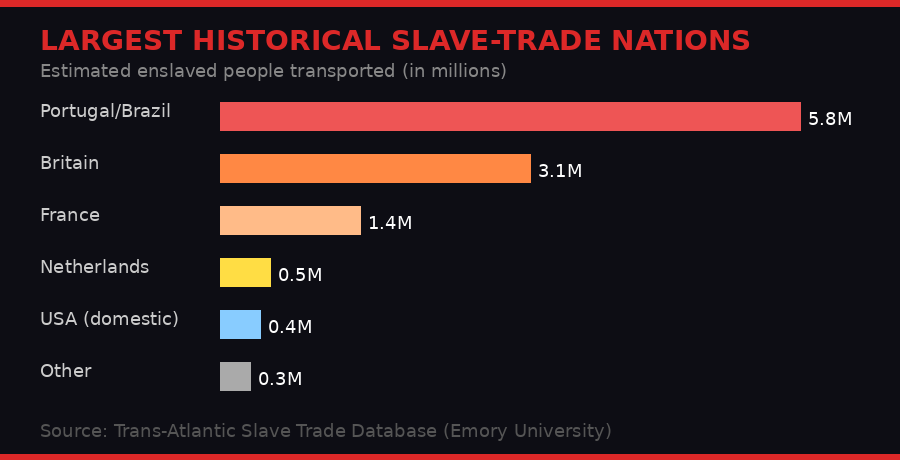
The Trans-Atlantic Slave Trade Database (Emory University) documents the volume each nation transported. Portugal leads by a significant margin.
The Collision Course: Trump, the UN, and a Week of Racial Politics

Protests over racial justice have defined the political landscape since 2020. In 2026, the battleground has shifted to the international legal arena. (Pexels)
Today's vote did not happen in a vacuum. It landed in the middle of a week already charged with racial politics at the highest levels of international diplomacy.
On Wednesday morning - hours before the vote - the UN Committee on the Elimination of Racial Discrimination issued a landmark ruling condemning the United States for "grave human rights violations" under the Trump administration. The Geneva-based panel cited racist hate speech by U.S. political leaders, the targeting of immigrants of color, and the use of lethal force against civilians - specifically naming Alex Pretti and Renee Good, two U.S. citizens shot and killed by federal agents in Minneapolis during Operation Metro Surge, Trump's mass immigration enforcement campaign.
The committee's ruling was not legally binding. The White House called it "useless" and "extremely biased" - spokesperson Olivia Wales dismissing it by saying "no one takes them seriously." But the committee's invocation of Pretti and Good made the week's two biggest stories land on the same day, in the same body, with the same underlying question: who is accountable when states harm people based on race?
"Portraying them as criminals or as a burden, by politicians and influential public figures at the highest level, particularly the President, may incite racial discrimination and hate crimes." - UN Committee on the Elimination of Racial Discrimination, March 25, 2026, AP News
Minnesota officials escalated on the same day, filing a lawsuit against the Trump administration demanding access to evidence in investigations of three shootings by federal officers - including the Pretti and Good killings. Hennepin County Attorney Mary Moriarty told reporters: "We are prepared to fight for transparency and accountability that the federal government is desperate to avoid."
The Trump administration's position is that state investigators lack jurisdiction over federal agents. But the broader effect is that on March 25, 2026 - the day Ghana forced a vote on the weight of historical racial violence - the United States was simultaneously being condemned internationally for present-day racial violence, and blocking state investigations into the same.
The irony did not escape people paying attention. Ghana's President Mahama had warned that Trump's Black history erasure was becoming a template. The week proved him right.
The Diaspora Is Not a Monolith - But It Is Watching

For millions of people in the African diaspora, today's vote was not an abstraction. It was personal. (Pexels)
There is a debate within Black diaspora communities about reparations that rarely gets covered honestly - because it's complicated, and complicated stories don't drive clicks.
The loudest opposition to today's UN vote came from Western governments. But within the diaspora itself, there are fault lines too. Some Black American activists have long argued that UN-level resolutions are symbolic gestures that absorb political energy without delivering material change. The demand, for many organizers in the US, is not a global fund - it's direct payments to descendants of enslaved Americans, something that requires US legislation, not UN resolutions.
In the UK, where large communities of West African and Caribbean descent have organized around reparations for decades, today's vote is seen differently. For British-Ghanaian and British-Caribbean communities, the UN route matters precisely because the UK parliament has shown no willingness to act. International pressure is the only tool available.
Caribbean nations have been the most consistent advocates for reparations over the longest period. CARICOM - the Caribbean Community, which includes Barbados, Jamaica, Trinidad, and a dozen other nations - launched a formal 10-point reparations plan in 2014 and has been building toward this moment ever since. Barbados' transition to a republic in 2021, and its prime minister Mia Mottley's subsequent emergence as a major voice on climate and reparative justice, gave the movement real diplomatic muscle.
For ordinary people in these communities - not the diplomats, not the scholars, the ordinary people - today's vote means something different depending on where they're standing. A grandmother in Kingston watching the UN livestream sees something she was told would never happen. A second-generation Ghanaian in London sees her country finally forcing the argument into the open. A descendant of enslaved Americans in Atlanta sees a historic moment that still doesn't address their specific, distinct claim.
All of them are right. The reparations question is not one question. It's many questions wearing the same name.
- Samuel Okudzeto Ablakwa, Ghana's Foreign Minister
What the Vote Actually Decides - and What It Doesn't

Legal precedent matters, even when enforcement is weak. Today's resolution - whatever its limitations - enters the international record. (Pexels)
UN General Assembly resolutions are not treaties. They do not carry the force of binding international law unless a separate legal instrument is created from them. Votes in the General Assembly are not like votes in the Security Council - there is no veto mechanism, but there is also no enforcement mechanism. A country that votes against the resolution and continues doing nothing faces no sanctions, no penalties, no referral to the International Court of Justice on this basis alone.
So why does it matter?
Because precedent is how international norms are built. The 1948 Universal Declaration of Human Rights was a General Assembly resolution. It was not legally binding. It changed the world anyway - because it created a shared vocabulary, a moral floor, a document that activists, lawyers, and diplomats could point to when governments violated it. The declaration did not end human rights abuses. But it established that human rights abuses have a name and a standard against which they can be measured.
Ghana's resolution attempts to do the same thing for the reparations conversation. If passed with sufficient support, it establishes that the international community formally recognizes the slave trade as a crime against humanity - not merely a historical injustice, but a categorically illegal act whose consequences demand remedy. That designation matters in courts. It matters in diplomatic negotiations. It matters when the Caribbean nations eventually take individual cases to international tribunals, which several have signaled they intend to do.
The vote result, as of publication time, showed substantial support from African and Caribbean nations, significant opposition from Western European powers, and notable abstentions from several countries that clearly did not want to go on record either way. The United States was expected to vote against or abstain - its record at the UN on racial accountability questions has been consistent in the Trump era.
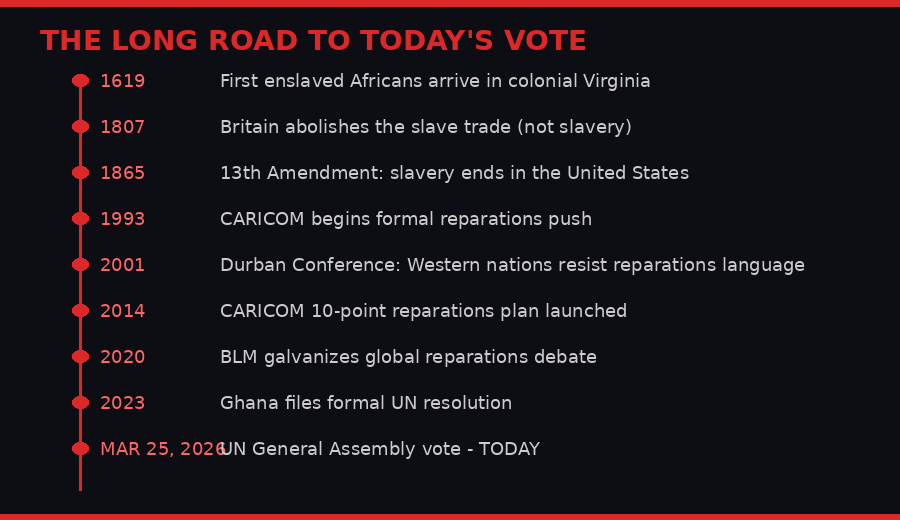
The road to today was 400 years long. It passed through broken promises, blocked resolutions, and a moment in 2020 that refused to stay quiet.
The Artefacts the Museums Won't Return

Cultural continuity - the return of heritage - is as central to Ghana's case as financial compensation. Objects taken are not just artifacts; they are anchors of identity. (Pexels)
Buried in the resolution, almost as a footnote but arguably as important as anything else in it, is the demand for the return of looted cultural artefacts.
This is not abstract. The British Museum in London holds the Benin Bronzes - hundreds of bronze plaques and sculptures stolen by British forces during the 1897 sack of Benin City in present-day Nigeria. They are considered among the most significant artistic achievements in African history. Nigeria has been demanding their return for decades. The British Museum's position, under UK law, is that it legally cannot deaccession the objects regardless of what it might want to do.
The Louvre in Paris holds Egyptian antiquities excavated under French colonial authority and removed from the country. The Ethnological Museum in Berlin holds human remains, among other objects, taken during the colonial era. The Smithsonian in Washington holds thousands of objects from across the African continent.
Germany has begun returning some objects voluntarily - a genuine shift, however small and slow. France's President Macron promised in 2017 to return African artefacts and then largely failed to do it at any meaningful scale. Britain has made almost no meaningful movement.
Ablakwa was direct: "We want a return of all those looted artefacts, which represent our heritage, our culture and our spiritual significance. All those artefacts looted for many centuries into the colonial era ought to be returned."
For museum directors in London, Paris, and Berlin, this demand is felt as an existential threat. For a teenager in Accra who has never seen the pieces in person, it is a question of whether her own history exists in her own country or only in European institutions that charge tourists to view it.
The Future of a Very Old Argument

The General Assembly floor today was less a debate than a confrontation - between the countries that enslaved and the countries that were enslaved. (Pexels)
There is something clarifying about watching a vote like today's. The countries that traded in human beings and built their modern wealth on that foundation sit on one side of the ledger. The countries whose people were taken, whose families were scattered across an ocean, whose cultural heritage was packed into ships and museums, sit on the other.
The argument against reparations is not, at its core, a financial argument. It is a political argument: that accountability of this kind, if accepted, opens a door that powerful states do not want to open. If the slave trade was a crime, then the legal systems built on its proceeds were built on stolen foundations. If the proceeds were stolen, then the stolen proceeds can theoretically be reclaimed. That logic, followed to its conclusion, threatens the settled order of global wealth distribution in ways that make governments of rich nations deeply uncomfortable.
What Ghana has done, by forcing today's vote, is to refuse to let the discomfort remain comfortable. The vote cannot be uncast. The language cannot be unspoken. The 47 nations that publicly backed the resolution cannot pretend they didn't. The nations that voted against it cannot pretend the accusation was never leveled.
Samuel Okudzeto Ablakwa said something else in his BBC interview that deserves sitting with: "Ghana is not ranking its pain above anyone else's. But we are documenting a historical fact."
Documentation, in the long fight for accountability, is not nothing. The Nuremberg trials were documentation. The Truth and Reconciliation Commission in South Africa was documentation. The International Criminal Court's work in The Hague is documentation. None of these fully healed the wounds they addressed. But they established that the wounds existed, that they had names, that they were committed by specific actors making specific choices.
Today, the General Assembly was asked whether 15 million people being kidnapped across an ocean over 300 years is a wound that has a name.
The countries that said no will need to explain that answer to their own children for a very long time.
Get BLACKWIRE reports first.
Breaking news, investigations, and analysis - straight to your phone.
Join @blackwirenews on Telegram