The Rationing: How Thirty-One Days of War Broke the World's Fuel Supply
Sri Lanka shut schools on Wednesdays. Egypt closed shops at 9 PM. The Philippines declared a national emergency. Australia made buses free. Bangladesh triggered planned blackouts. In thirty-one days, the Iran war rewrote the rules of daily life for more than two billion people - and the worst is still ahead.
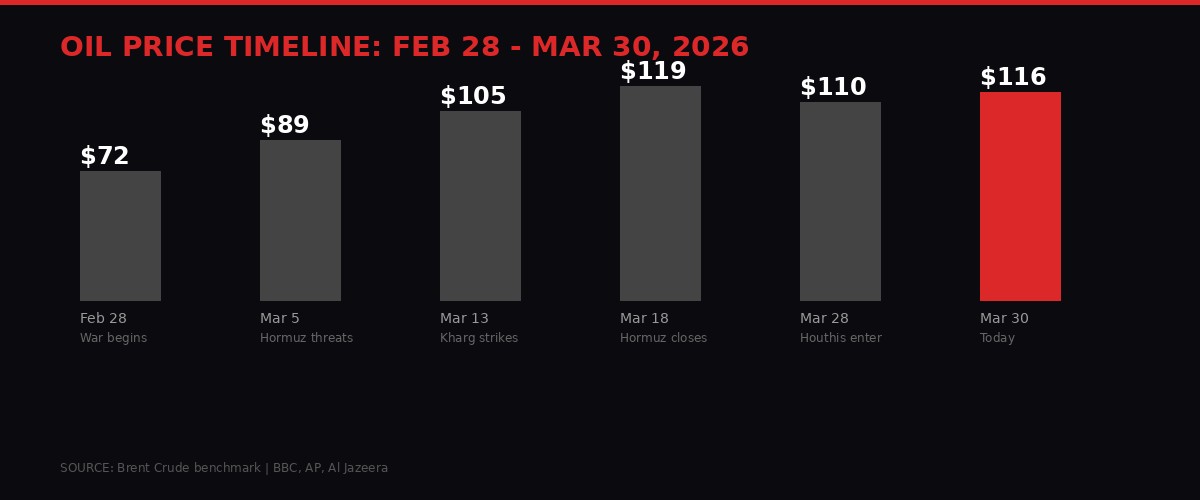
Brent crude's path from $72 to $116 per barrel in thirty-one days - the biggest monthly surge on record. BLACKWIRE graphic.
Thirty-one days ago, Brent crude traded at $72 a barrel. That was the last day of a world that no longer exists.
On February 28, 2026, the United States and Israel launched coordinated strikes against Iran, triggering a conflict that has now entered its fifth week with no ceasefire in sight. The immediate military consequences were devastating enough - more than 1,900 dead in Iran, 19 in Israel, dozens more across Gulf states and Lebanon, according to AP tallies as of March 30. But the war's secondary weapon has proven far more destructive to far more people: the effective closure of the Strait of Hormuz, the narrow waterway between Iran and the Arabian Peninsula through which roughly 20 percent of the world's oil and gas supply normally passes.
On Monday morning, Brent crude climbed past $116 a barrel, with analysts at Lipow Oil Associates projecting $130 within weeks if the strait remains shut. That represents a 61 percent increase in thirty-one days - the steepest monthly rise in the history of the benchmark, eclipsing the 1973 Arab oil embargo and the 1979 Iranian revolution, according to BBC reporting. And the consequences are no longer theoretical. They are being felt in fuel queues in Colombo, darkened storefronts in Cairo, and empty bus fare machines in Melbourne.
This is the story of how a war between four countries rewrote the household economics of dozens more.
The Chokepoint That Broke Everything
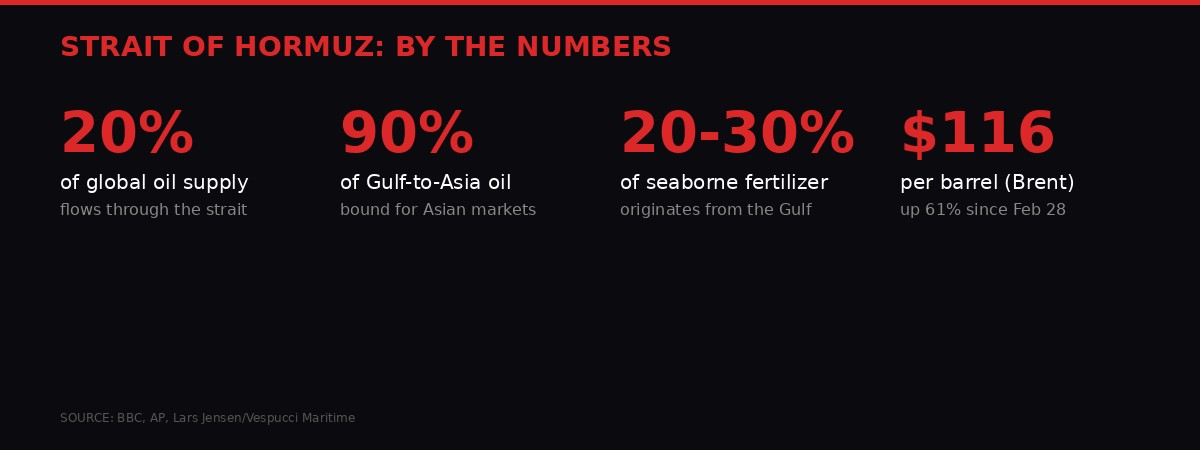
The numbers behind the world's most consequential shipping bottleneck. BLACKWIRE graphic.
The Strait of Hormuz is barely 21 miles wide at its narrowest point. On any given day before the war, roughly 17 million barrels of crude oil passed through it - loaded onto supertankers at terminals in Saudi Arabia, Kuwait, Qatar, the UAE, and Iran itself. Nearly 90 percent of that oil was bound for Asian markets, making the strait not just a global energy artery but the single most important shipping lane for the world's largest and fastest-growing economies, as the BBC reported on March 30.
When Iran began threatening to target ships attempting the passage in early March, international shipping companies pulled back. By March 18, when Brent hit $119.50 - its highest level since June 2022 - the strait was effectively closed to commercial traffic. No government ordered it shut. No mines were confirmed in the water. But the insurance premiums, the threat of Iranian drones and missiles, and the simple mathematics of risk assessment accomplished what a formal blockade would have.
Lars Jensen, a shipping expert and former director at Maersk who now runs the consultancy Vespucci Maritime, told the BBC on March 30 that even if the strait "magically were to open tomorrow," further price rises were already baked in. "We need to keep in mind that a lot of the oil that was loaded in the Persian Gulf prior to this crisis is only now arriving in refineries," he said. The pipeline of supply that existed before the war has been consumed. Rebuilding it will take weeks, regardless of what happens on the diplomatic front.
But Jensen's most alarming warning concerned something most coverage has overlooked: fertilizer. "You've got 20 to 30 percent of the seaborne fertilizer in the world originating from the Gulf," he told the BBC. "This will mean rapidly escalating food prices, especially in poorer countries." The Strait of Hormuz is not just an oil chokepoint. It is a food-security chokepoint. And it has been effectively shut for nearly two weeks.
Judith McKenzie, a partner at investment firm Downing, told BBC Radio 4 on March 30 that the full impact of the war has not yet made its way through the fuel supply chain. "Oil shocks don't show up instantly," she said. "If we can get some resolution in the Gulf this week then, although it's going to take a little bit of time to unwind and we will see inflation, it is fixable." The operative word is "if." And on Day 31, that if remains enormous.
The Philippines: First to Break
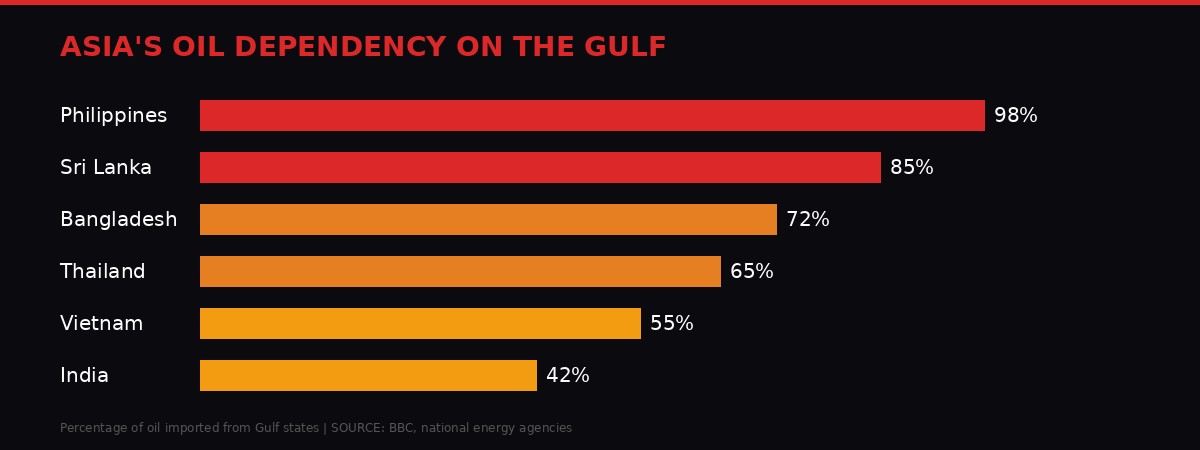
The Philippines imports 98 percent of its oil from the Gulf - the highest dependency of any major Asian economy. BLACKWIRE graphic.
The Philippines was the first country to declare a formal energy emergency, and the arithmetic explains why. Ninety-eight percent of the nation's oil comes from the Gulf. When the Strait of Hormuz closed, so did the Philippines' fuel supply.
President Ferdinand Marcos Jr. placed the country under a state of national energy emergency on March 25, according to BBC reporting. In a televised address, he told Filipinos the government would procure one million barrels of oil to add to existing stocks, which he said were sufficient for 45 days. "We will have a flow of oil," he said. "Not just one delivery, not two deliveries, but a flow of oil-related products."
The emergency declaration gave the government legal authority to impose sweeping measures: subsidies to transport drivers, reduced ferry services, a four-day workweek for civil servants, a ban on non-essential government travel, and the formation of a committee to oversee the distribution of fuel, food, medicines, and other essential goods. Marcos said the declaration would remain in place for one year unless lifted earlier.
"Nothing is off the table. We are looking at everything we can do, whatever suggestion, whatever idea." - Ferdinand Marcos Jr., President of the Philippines, BBC, March 25, 2026
The impact on ordinary Filipinos has been brutal. Diesel and petrol prices have more than doubled since the war began, according to the BBC. Philippine Ambassador to the US Jose Manuel Romualdez told Reuters that Manila was working with Washington to secure exemptions allowing the country to import oil from US-sanctioned nations - an acknowledgment that the war America started has created a crisis America's closest Pacific ally cannot survive without workarounds.
The Kilusang Mayo Uno (KMU), one of the country's main labor coalitions, strongly criticized the emergency declaration, calling it an "admission" that the government had failed to address the oil crisis. The KMU raised particular concerns about clauses that could restrict strikes and protests - effectively using an energy emergency to suppress labor action at a time when workers are already hurting. Business leaders, meanwhile, backed the declaration. Tycoon Manuel V. Pangilinan, who chairs major utilities companies, said his firms were feeling the strain and warned the crisis was beginning to affect operations.
The Philippines is the canary in the coal mine. With 98 percent dependency on Gulf oil, it broke first. But it will not break alone.
Sri Lanka: The Country That Already Knows What Collapse Feels Like
If any nation understands the trajectory of an energy crisis, it is Sri Lanka. In 2022, the island plunged into its worst economic catastrophe in modern history, running out of foreign reserves and becoming unable to import fuel, food, or medicine. Citizens queued for hours at petrol stations. Hospitals ran without power. The president fled the country.
Now Sri Lanka is back in the fuel queue.
On March 17, President Anura Kumara Dissanayake declared every Wednesday a public holiday for government institutions - schools, universities, and non-essential offices - to conserve fuel. "We must prepare for the worst, but hope for the best," he said at an emergency meeting with senior officials, as reported by BBC Sinhala.
The Wednesday closure was chosen deliberately. Officials explained they wanted to avoid three consecutive days off, which would happen if they had picked Friday. The measure also applies to schools and universities but exempts essential services including health and immigration.
More critically, Sri Lanka reactivated the National Fuel Pass system - the same rationing mechanism deployed during the 2022 crisis. Motorists are now limited to 15 liters per week. Motorcyclists get five. The quotas have sparked anger, with many Sri Lankans arguing the limits are too low for daily commuting. But the alternative - unrationed consumption leading to complete depletion - is worse.
Nearly 85 percent of Sri Lanka's oil comes from the Gulf. The country sits roughly 2,000 kilometers from the Strait of Hormuz across open Indian Ocean, and unlike the Philippines, it has no realistic alternative supply route. If the strait remains closed through April, Sri Lanka's 45-day stockpile could be depleted by mid-May - raising the specter of a repeat of 2022's blackouts and hospital shutdowns.
Egypt: The 9 PM Curfew Nobody Calls a Curfew
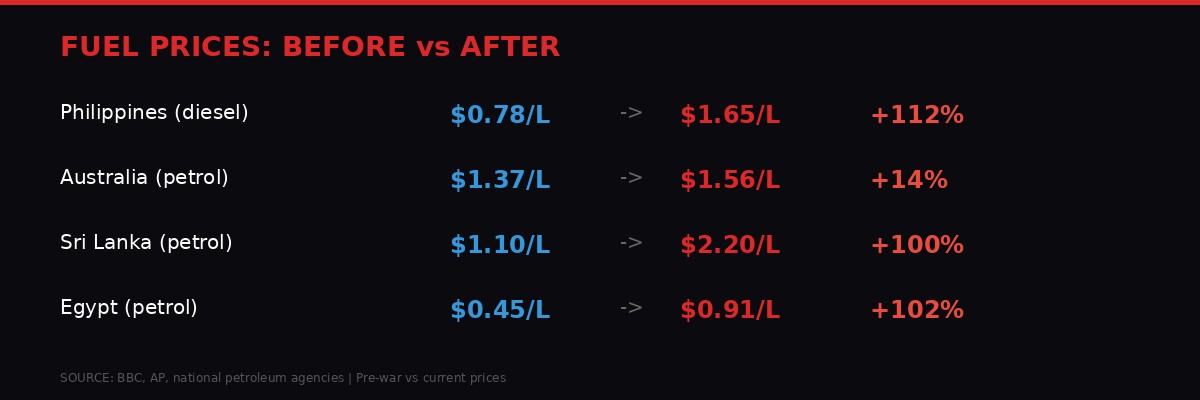
Fuel prices before and after the war began on February 28. BLACKWIRE graphic.
Egypt's response has been the most granular and intrusive of any country outside the immediate war zone. On March 28, the government ordered all shops, restaurants, and cafes to close by 9 PM each night for the next month, according to the BBC. Street lights will be dimmed. Roadside advertising will go dark. Non-essential government workers will work from home one day per week throughout April.
The measures stop short of a formal curfew, but the effect is similar. Cairo's famously late-night street life - the cafe culture, the shisha bars, the food vendors that keep the city alive until 2 AM - has been cut off at the knees. Hotels and tourist attractions are exempt, a carve-out that protects the roughly 10 percent of Egypt's GDP that comes from tourism. Several Cairo hotels, including the Marriott and Cosmopolitan, told broadcaster RFI they had acquired generators in case of power cuts.
Prime Minister Mostafa Madbouly said Egypt's petrol bill alone had more than doubled, from roughly $1.2 billion in January to $2.5 billion in March. The government has already raised petrol prices and public transport fares, slowed energy-intensive state construction projects, and cut government vehicle fuel allowances by nearly a third, according to Reuters.
Egypt has no involvement in the Iran war. It did not fire a missile. It did not close any strait. But because it relies on imported fuel and sits in a region where the cost of crude is set by events in the Persian Gulf, its economy absorbs the shockwave regardless. This is the nature of a war that weaponizes geography: countries with no say in the conflict pay the same price as those waging it.
Ethiopia, Egypt's neighbor and occasional rival, followed suit on March 28, ordering state-owned companies and public institutions to place non-essential staff on leave to conserve fuel used for transport, the BBC reported from Nairobi.
Australia: Free Buses and Halved Taxes
Australia's response has been notably different in character, if not in urgency. The states of Victoria and Tasmania announced free public transport - trains, trams, buses, coaches, and ferries - to incentivize commuters to leave their cars at home. Victoria's measure takes effect Tuesday and runs through April. Tasmania's runs from Monday through the end of June, and extends to school buses, saving families roughly A$20 per week, according to the BBC.
The federal government went further on Monday. Prime Minister Anthony Albanese announced the fuel tax would be halved, effective immediately, as crude topped $116 a barrel. The national average petrol price had risen from A$2.09 per liter at the start of the war to A$2.38 by March 22, according to the Australian Institute of Petroleum - a 14 percent increase that, in a country built around car ownership and long commutes, translates directly into household budgets.
Australia is better positioned than most to weather the crisis. It has its own modest domestic oil production, substantial coal and gas reserves, and a wealthy enough economy to absorb subsidies without immediate fiscal trauma. But even Canberra's response acknowledges what the numbers make plain: the war has repriced the cost of moving around, everywhere, for everyone.
Sean Foley, an energy markets expert from Macquarie University, told the BBC he expects prices to rise further unless the conflict eases. The Houthi strikes on Israel over the weekend - the first time Yemen's Iran-backed militia formally entered the war - have raised concerns that the armed group could also target shipping through the Bab al-Mandeb strait near Yemen, potentially cutting off a further 10 percent of the world's oil supply. "That would put significant strain on global supply chains," Foley said, in what may be the understatement of the week.
The Asian Domino Effect
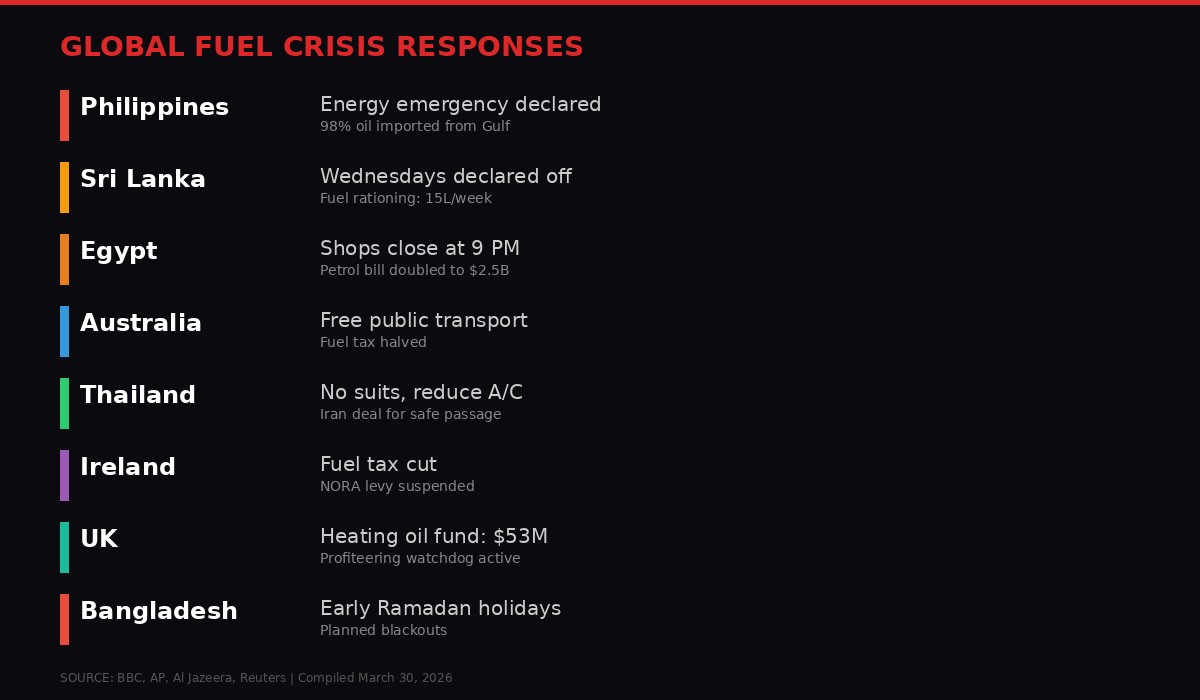
Country-by-country emergency measures triggered by the Iran war. BLACKWIRE graphic.
The Philippines, Sri Lanka, and Egypt are the most dramatic cases. But the rationing impulse has spread across at least a dozen countries on four continents, each improvising its own version of austerity in response to the same supply shock.
Thailand has urged citizens to swap suits for short-sleeved shirts to reduce air conditioning demand. On Saturday, Bangkok announced it had reached a separate agreement with Iran granting Thai oil tankers safe passage through the Strait of Hormuz - a bilateral deal that, if it holds, would give Thailand access to Gulf oil that most other Asian nations cannot reach. The deal underscores a new geopolitical reality: Iran is now offering favorable terms to countries that have not opposed it, using the strait as both weapon and reward.
Bangladesh has brought forward Ramadan holidays for universities and introduced planned blackouts across the nation. With roughly 72 percent of its oil imported from the Gulf and foreign reserves already under pressure, Bangladesh has less fiscal room to absorb price shocks than almost any country in Asia.
Vietnam has "strongly encouraged" citizens to stay at home, ride bicycles, carpool, and use public transport. The government called on people to "restrict personal vehicle use when unnecessary" - language that sounds advisory but, in a one-party state, carries the weight of policy.
Myanmar, already under military rule since the 2021 coup, has restricted private vehicle usage to alternating days based on license plate numbers - odd plates on odd dates, even on even. The junta, which has been nominated to have its chief Min Aung Hlaing serve as president despite Western sanctions, has offered no fuel subsidies. Citizens absorb the full cost.
Ireland has cut taxes on petrol and diesel, suspended the National Oil Reserves Agency levy, reduced VAT on green diesel, and extended heating payments to social welfare recipients for an additional four weeks - a package worth 235 million euros, according to the Irish government.
The United Kingdom has announced a 53-million-pound heating oil fund for low-income households and activated profiteering surveillance on petrol retailers. The RAC reports petrol prices have hit an 18-month high, though the UK's relative insulation from Gulf oil - most of its electricity comes from natural gas and renewables - has buffered the worst impacts. That buffer is thinning. Natural gas prices are rising in sympathy with crude.
The Diplomacy That Is Not Working
Against this backdrop of global austerity, the diplomatic track remains frozen in contradiction.
On Monday morning, President Trump posted on social media that "great progress is being made" in talks with Iran. Minutes later, he threatened to "completely obliterate" Iran's power plants, oil wells, Kharg Island, and possibly even desalination plants if a deal is not reached "shortly." In an interview with the Financial Times published Sunday, he said his preference would be to "take the oil in Iran" - a phrase he used about Kharg Island, the terminal through which nearly all of Iran's crude exports pass.
"Maybe we take Kharg Island, maybe we don't. We have a lot of options." - Donald Trump, interview with Financial Times, March 29, 2026
Iranian Foreign Ministry spokesman Esmail Baghaei acknowledged Monday that Tehran had received a 15-point proposal from the Trump administration, but said there had been no direct negotiations. Iran's parliament speaker, Mohammad Bagher Qalibaf, dismissed talks being facilitated by Pakistan as cover for troop deployment, saying Iranian forces were "waiting for the arrival of American troops on the ground to set them on fire," according to AP's reporting from Iranian state media.
The rhetoric from both sides is escalatory. CBS News, citing sources, reported that Pentagon officials have made "detailed preparations" to deploy ground forces into Iran. Over the weekend, 3,500 additional US Marines arrived in the Middle East aboard the USS Tripoli. Iran has confirmed that the head of the Revolutionary Guard's navy, Rear Admiral Alireza Tangsiri, was killed in an Israeli airstrike - a significant military loss that may harden Tehran's resolve rather than soften it.
Meanwhile, cracks are forming in the Western alliance. Spain on Monday formally closed its airspace to US aircraft involved in the Iran war, with Defense Minister Margarita Robles declaring the war "profoundly illegal and profoundly unjust." Spain had already denied the US use of the jointly operated Rota and Moron military bases in Andalusia. Prime Minister Pedro Sanchez has been the most vocal European critic of the conflict, calling it "reckless" and "illegal."
Trump has previously threatened a full trade embargo on Spain in response - a move whose legality is disputed, since Spain trades under the umbrella of EU trade agreements. The EU has said it expects Washington to honor the trade deal struck in Scotland in 2025.
The diplomatic picture, then, is this: the country prosecuting the war is threatening to widen it while claiming talks are going well. The country being bombed says there are no talks. The country trying to mediate (Pakistan) has no leverage. And one of America's NATO allies has shut its airspace in protest. Resolution is not close.
The $130 Barrel and What Comes After
Andrew Lipow of Lipow Oil Associates told the BBC on Monday that he expects Brent to reach $130 a barrel in the coming weeks if threats against the global energy supply continue. That would represent an 80 percent increase from pre-war levels. The last time oil sustained prices above $130 was during the 2008 financial crisis, when the spike helped trigger a global recession.
Lipow's greatest fear, he said, is "a general economic slowdown around the world, because consumers simply run out of money as they're spending more on energy and, in addition, food."
The transmission mechanism is straightforward. Higher oil prices raise the cost of everything that moves by truck, ship, or plane - which is nearly everything. Food prices rise because farming requires diesel and fertilizer, both of which are now scarce. Manufacturing slows because inputs cost more. Consumer spending contracts because fuel eats a larger share of household income. Central banks face an impossible choice between raising interest rates to fight inflation (which kills growth) or cutting rates to support growth (which feeds inflation).
This is not speculative. It is the same sequence that played out in 1973, 1979, and 2008. The difference this time is speed. In 1973, the Arab oil embargo took months to fully bite. The current crisis has compressed thirty-one days of price action into what previous shocks took quarters to achieve. The Strait of Hormuz closure is more complete than any previous supply disruption. And the war shows no sign of ending.
Timeline: 31 Days of Escalation
- Feb 28 - US and Israel launch coordinated strikes on Iran. Brent at $72.
- Mar 1 - UK agrees to host US bombers at RAF Fairford.
- Mar 5 - Iran threatens to target ships in the Strait of Hormuz. Brent passes $89.
- Mar 8 - Spain denies US use of Rota and Moron military bases.
- Mar 13 - US strikes Kharg Island military targets, spares oil infrastructure. Brent at $105.
- Mar 17 - Sri Lanka declares Wednesdays off. Philippines restricts government travel.
- Mar 18 - Brent hits $119.50, highest since June 2022. Hormuz effectively closed.
- Mar 20 - Trump threatens full trade embargo on Spain.
- Mar 25 - Philippines declares national energy emergency.
- Mar 28 - Egypt orders 9 PM closures for shops and restaurants. Ethiopia places staff on leave. Houthis enter the war, striking Israel from Yemen.
- Mar 29 - Trump tells FT he could "take" Iran's oil. 3,500 more Marines arrive in Middle East. Australia halves fuel tax.
- Mar 30 - Spain closes airspace to US war planes. Brent passes $116. Oil on track for biggest monthly gain on record.
The War Economy Nobody Voted For
The most striking feature of the global rationing response is its breadth. This is not a crisis confined to the Middle East or even to oil-importing nations in Asia. Ireland is cutting fuel taxes. The UK is monitoring petrol retailers for profiteering. Australia is making public transport free. Egypt is dimming its streetlights. Sri Lanka is shutting schools one day a week. The Philippines has declared a year-long emergency. Bangladesh is blacking out neighborhoods. Vietnam is telling people to ride bicycles.
None of these countries started the war. None of them were consulted before it began. None of them have any meaningful say in when or how it ends. But all of them are paying for it, and their citizens are paying more with each passing day.
The Houthi entry into the war over the weekend adds a new dimension of risk. Yemen-based militants striking Israel means the conflict's geographic footprint now stretches from the Mediterranean to the Red Sea. If the Houthis begin targeting commercial shipping in the Bab al-Mandeb strait - the chokepoint at the southern end of the Red Sea through which another 10 percent of global oil passes - the supply disruption could double. Macquarie University's Sean Foley called that scenario one of "significant strain." Others have called it catastrophic.
For now, the world is improvising. Every affected government is pulling from the same playbook: cut taxes on fuel, subsidize transport, ration where necessary, pray for a ceasefire. The improvisation works for weeks. It does not work for months. And at $130 a barrel - a price multiple analysts now consider probable - the fiscal capacity of poorer nations to absorb the shock will be exhausted.
Lars Jensen, the shipping expert, told the BBC that the overall impact of the war "could be substantially larger than the oil crisis of the 1970s, which sparked economic chaos." That crisis reshaped the global economy for a decade. It ended governments, accelerated the development of North Sea oil, and permanently altered the geopolitics of energy. We are thirty-one days into a crisis that may be larger. The rationing has begun. The question now is what comes next.
Get BLACKWIRE reports first.
Breaking news, investigations, and analysis - straight to your phone.
Join @blackwirenews on Telegram