Goldman. Bernstein. Schwab. They All Just Called the Bitcoin Bottom.

Three of the most-watched names on Wall Street published calls this week pointing at the same conclusion: Bitcoin has found its floor. Goldman Sachs. Bernstein Research. Charles Schwab. Not permabull influencers on X. Not anonymous CT accounts. Three separate, rigorously sourced research desks - each arriving at the same number from a different angle.
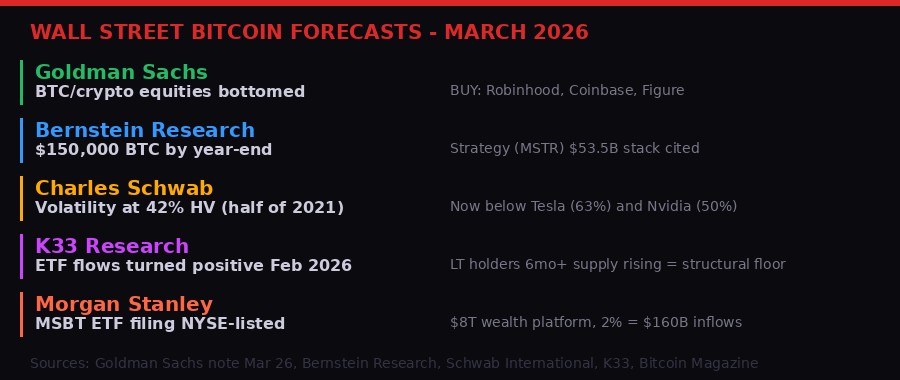
Goldman's analyst James Yaro said crypto-related equities are down 46% since October 2025, but are now showing "volatile but flattish performance" with "increasingly attractive" valuations. Bernstein maintained its $150,000 year-end target and declared the bottom is in. Schwab published data showing Bitcoin's historical volatility dropped to 42% in 2025 - cut in half from 2021 - and now sits below both Tesla (63% HV) and Nvidia (50% HV).
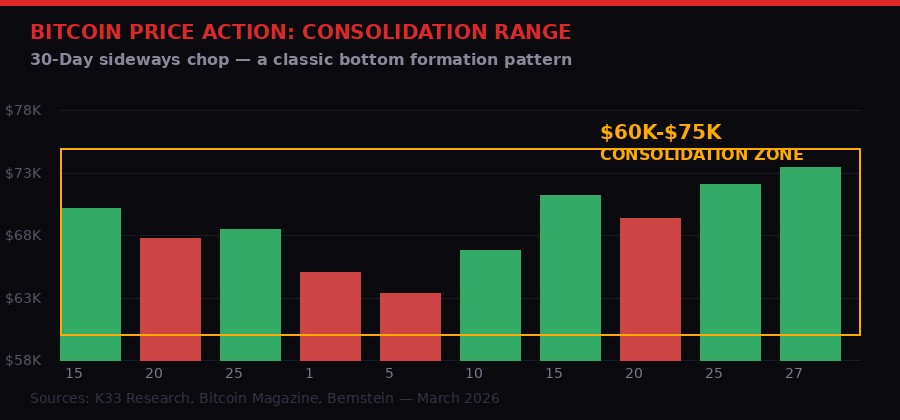
Run the tape: BTC has traded in a $60,000-$75,000 band for roughly 30 days. That range-bound chop - with declining open interest in perpetual swaps, negative funding rates, and ETF outflows finally reversing - reads like distribution ending and accumulation beginning. K33 Research's data backs that interpretation.
Whether or not the bottom is definitively in, the convergence of Wall Street opinion on that thesis is itself a market event. When Goldman, Bernstein, and Schwab say the same thing in the same week, traders listen.
Market Snapshot - March 28, 2026
Goldman's Call: Crypto Equities Approaching Attractive Territory

In a research note published Thursday, March 26, Goldman Sachs analyst James Yaro made the case that cryptocurrency-related equities have been oversold. Crypto stocks are down 46% since October 2025 - a brutal correction that wiped nearly half the sector's value in under six months. But Yaro's note argued the pain may be ending, citing the recent "volatile but flattish performance" as a sign of stabilization rather than continuation.
Goldman's top picks from the note reflect a specific thesis: the firms best positioned for the next leg up are those expanding beyond pure crypto exposure into adjacent financial infrastructure. Robinhood rated Buy, expanding offerings to advanced traders and financial services. Coinbase rated Buy, building out crypto derivatives, subscriptions, and new products including equities trading and banking. Figure Technologies rated Buy, with its price target raised from $39 to $42 - implying 35% upside from current levels - on the strength of its blockchain-based Home Equity Line of Credit business.
"Crypto-related equities are down 46% since October 2025 but are showing volatile but flattish performance in recent weeks, making valuations increasingly attractive." - Goldman Sachs analyst James Yaro, March 26, 2026 (per CNBC)
Goldman did hedge. The note acknowledged that trading volumes could dip further, potentially reducing 2026 revenue by 2% and profits by 4% for the companies in its coverage. But the bank expects volumes to rebound within a median three-month trough period - which, if the October 2025 peak was the prior top, would put the floor around Q1 2026. That's now.
The Figure Technologies target raise is particularly notable. Figure runs a fully blockchain-native HELOC origination platform, processing mortgages directly on-chain. Goldman just raised its price target on a company that puts blockchain at the center of consumer lending - not as a novelty, but as core infrastructure. That tells you something about where the bank thinks the technology is going.
Context matters here. Goldman was famously skeptical of Bitcoin for years. The bank opened a crypto trading desk in 2021, then walked it back when prices fell. For Goldman to publish a bullish note in March 2026 - after a 46% sector correction, with oil over $100, geopolitical tension elevated, and the Fed still hawkish - means their quants and risk desks have cleared it. That's not a trivial signal.
Bernstein's $150,000 Target: The Most Bullish Call With the Most Institutional Backing

Bernstein Research is sticking to its $150,000 year-end Bitcoin target. That's not a casual number. From the current range of $70,000-$75,000, a $150,000 year-end target implies a double in nine months. And Bernstein's analysts aren't making that call on vibes - they're calling it on flows, corporate treasury demand, and what Strategy (formerly MicroStrategy) represents as institutional infrastructure.
Bernstein cited three specific data points to support the bottom call. First: strong ETF flows. After the brutal outflow period from October through January, ETF flows turned mildly positive in late February 2026. The distribution phase appears to have ended. Second: corporate treasury demand remains structurally elevated. Strategy now holds $53.5 billion worth of Bitcoin - a number that keeps growing as Michael Saylor continues accumulating despite the correction. Third: Strategy's preferred shares are drawing additional long-term capital from institutional investors who want Bitcoin exposure with a yield component.
Analysts view the recent correction as a temporary sentiment reset rather than a breakdown in fundamentals, with continued interest in Strategy's preferred shares offering additional long-term capital support. - Bernstein Research, March 2026
The Bernstein framework treats the October 2025 to March 2026 correction - from roughly $108,000 down to as low as $63,000 - as a post-halving distribution phase, not a cycle top. The logic: every Bitcoin halving is followed by a period where early buyers take profit, which creates sustained selling pressure for 6-9 months. That window, under this model, is now closing.
Strategy's (MSTR) continued accumulation through the drawdown is central to Bernstein's thesis. The company didn't panic. It didn't sell. It added preferred shares as a funding mechanism and kept buying. Strategy's 570,000+ BTC stash now represents over 2.7% of total circulating supply permanently parked in a single corporate treasury. That's supply removal at scale - and it changes the marginal price equation.
The counterargument to Bernstein's $150,000 call is macro: if the Federal Reserve doesn't cut rates in 2026, and if the Iran-Israel conflict keeps oil elevated and inflation sticky, Bitcoin's reflexive correlation to risk assets could keep a ceiling on price. Bernstein acknowledges the macro uncertainty but treats it as a headwind, not a ceiling. If macro resolves - which ceasefire signals suggest it might - the path to $150,000 is open.
Schwab's Data: Bitcoin Now Less Volatile Than Tesla and Nvidia

The most structurally significant data point in this week's wave of bullish calls came from Charles Schwab, which manages $12 trillion in client assets. The firm published an analysis confirming what many traders have suspected anecdotally but hadn't seen quantified: Bitcoin is no longer the most volatile major asset.
Schwab's numbers are stark. Bitcoin's historical volatility dropped to 42% in 2025 - roughly half of what it recorded in 2021, when BTC's HV peaked above 80%. In 2025, Tesla posted a 63% HV reading. Nvidia registered 50%. Bitcoin, the asset that was once synonymous with extreme volatility, now moves more calmly than two of the largest technology companies in the world.
Average true range metrics - the daily price swings measured as a percentage of price - confirm the same trend. Bitcoin's day-to-day movements are now comparable to major equities, not outliers. Schwab concluded: "Bitcoin's volatility has calmed down as it matured into a mainstream asset that trades on major exchanges around the world."
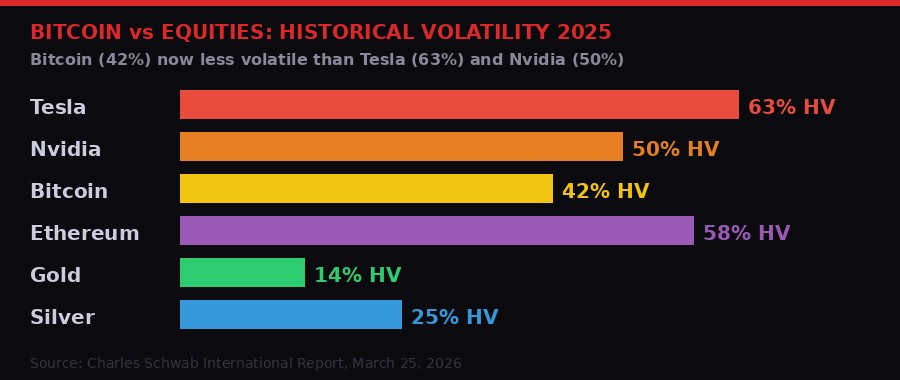
The caveat in Schwab's report: large drawdowns haven't disappeared. Bitcoin fell 32% in 2025 and is down from $108K peaks by roughly 35% in 2026. Over a three-year window, BTC recorded a peak-to-trough decline of 50%. But Tesla fell 54% over the same period, and Nvidia dropped 37% at its worst. The drawdowns are comparable. The narrative that Bitcoin is uniquely dangerous relative to tech stocks is increasingly hard to sustain with data.
The volatility convergence has real implications for institutional portfolio construction. Risk management models - VaR calculations, allocation limits, compliance frameworks - are often calibrated to volatility. When BTC had 80-100% HV, it was automatically excluded from many institutional mandates regardless of return profile. At 42% HV, it fits inside the same volatility bucket as large-cap tech. That's a structural gate that just opened.
Schwab's report also compared BTC to commodities. Silver futures exhibited more erratic daily price movements than Bitcoin in 2025, despite smaller overall drawdowns. Gold maintained lower volatility, but that's expected for a store-of-value commodity with central bank demand smoothing prices. The comparison positions Bitcoin closer to digital gold than to speculative altcoins - which is exactly the narrative institutional allocators need to justify adding it to balanced portfolios.
K33 Research: ETF Flows, Long-Term Holders, and the Structural Floor

K33 Research, one of the sharper quant-driven crypto research shops, published data that underpins the bottom call from a different angle: supply structure. The firm's Head of Research, Vetle Lunde, focused on two specific metrics that have historically marked Bitcoin bottoms: ETF flow direction and long-term holder supply growth.
On ETF flows: after the brutal distribution period from October 2025 through early February 2026 - when the post-peak correction pushed BTC from $108,000 to as low as $63,000 - outflows finally reversed. ETF flows turned mildly positive in late February 2026. That's not a flood of inflows. But the end of persistent outflows signals that the forced selling from ETF redemptions has worked its way through the system.
On long-term holder supply: the percentage of Bitcoin held by wallets that haven't moved coins in six months or more is rising. This metric is one of the cleanest signals in on-chain analysis. When long-term holder supply rises, it means fewer coins are available for sale at current prices. Weak hands have already sold. What's left is increasingly sticky - held by people with a cost basis they're comfortable with and no urgency to exit.
With bitcoin below $100,000, fewer investors are inclined to exit positions, anchoring prices. - K33 Research Head of Research Vetle Lunde, March 2026
The low open interest in perpetual swap contracts is another K33 data point worth noting. Perpetuals are the instrument of choice for leveraged speculation. Low open interest means the market isn't crowded with leveraged longs waiting to get liquidated. The last six months of corrections were partly fuel-supply liquidations - cascading forced sells when overleveraged positions hit their liquidation thresholds. With open interest compressed, that dynamic is much less threatening to near-term price stability.
Negative funding rates - meaning short sellers are paying longs to hold positions - round out the picture. Negative funding typically indicates a market that's more fearful than greedy. It's a contrary indicator. When the crowd is bearish and paying for protection, that's often closer to a bottom than a top. Combined with the ETF flow reversal and rising long-term holder supply, K33's read on the structure is: the floor is in.
Brazil Weaponizes Seized Crypto: Law 15.358 Changes the Government Playbook

While Wall Street analysts were writing their bottom calls, Brazil was passing a law that shows exactly what governments think about seized crypto - and it's not sitting on it in a government wallet.
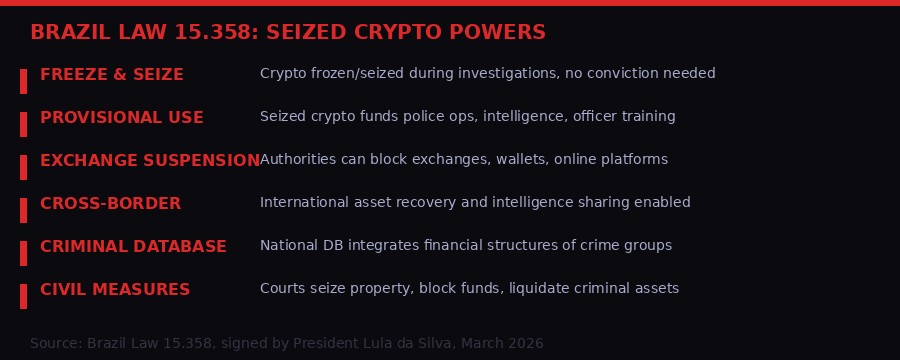
President Luiz Inácio Lula da Silva signed Law No. 15.358 into effect on March 26, 2026. The legislation gives Brazilian law enforcement unprecedented powers over digital assets: freeze and seize crypto during investigations without waiting for convictions, provisionally use seized crypto to fund police operations and intelligence work with judicial approval, and suspend access to exchanges, digital wallets, and online platforms while investigations are ongoing.
The law specifically targets ultraviolent criminal organizations, paramilitary groups, and private militias. The broadened definitions include crimes such as controlling territories, obstructing police operations, and - notably - using encrypted messaging apps and privacy tools to conceal illicit activity. That last clause is worth reading twice: using encryption for privacy can now be treated as evidence of criminal intent under this law's framework.
The practical mechanics matter. "Provisional use" of seized crypto means Brazilian police can spend confiscated Bitcoin before a court has issued a final verdict. The judicial approval requirement is a guardrail, but it's not the same as waiting for a conviction. Assets can be converted and deployed to fund law enforcement operations while the underlying case is still being argued in court. That's a significant expansion of state power over digital assets - and one that other governments are watching closely.
The law also establishes a national criminal database that integrates the financial structures of known criminal organizations. This is the infrastructure for tracking crypto flows at scale - not just seizing individual wallets after the fact, but mapping the financial architecture of criminal networks as they operate. International cooperation provisions allow Brazil to coordinate with foreign governments on asset recovery and intelligence sharing.
For context: Brazil has been moving fast on crypto policy across the spectrum. In February 2026, Brazilian lawmakers introduced a bill proposing the creation of a Strategic Sovereign Bitcoin Reserve (RESBit) - a proposal to gradually acquire one million Bitcoin over five years, prohibit selling seized BTC, and allow federal taxes to be collected in Bitcoin. The same government that wants to build a sovereign Bitcoin reserve is also giving police the power to spend seized BTC before conviction. Both impulses coexist - accumulate for the state, weaponize against criminals. That's a more sophisticated crypto policy posture than most governments are showing.
French energy giant Engie is also exploring Bitcoin mining at its newly launched 895-MW Assu Sol solar plant in northeastern Brazil, according to Reuters. The plant has faced grid-imposed curtailment restrictions. Mining offers a way to monetize excess energy that can't reach consumers. Brazil is simultaneously passing criminal enforcement laws, proposing a sovereign reserve, and attracting industrial-scale miners. The full crypto policy picture there is more complex - and more intentional - than any single headline suggests.
Trust Wallet's AI Agent Kit: When the Wallet Executes Itself

Trust Wallet, the self-custody wallet with 220 million downloads globally, launched a product this week that moves AI-powered crypto execution from demo to production: the Trust Wallet Agent Kit.
The Agent Kit is infrastructure for AI agents to execute real crypto transactions across 25+ blockchains - swaps, limit orders, automations, DCA strategies - while keeping custody with the user at all times. It integrates with the Model Context Protocol (MCP) and is available via CLI, meaning developers can start building AI-powered crypto workflows immediately. Setup time to a working agent: under 15 minutes.
Two modes define the product. In the first, users set up a dedicated AI agent wallet with preconfigured permissions - the AI can DCA into ETH every week, set limit orders below a specified price, trigger alerts - all without requiring per-transaction approvals. In the second mode, an AI agent connects to the user's existing Trust Wallet through WalletConnect and proposes transactions that the user must approve before execution. The second mode adds a human-in-the-loop confirmation step, which matters for regulatory and compliance reasons as regulators start scrutinizing AI-automated trading.
"AI can understand what a user wants to do with their money - but it needs a trusted layer before it can safely act on it. The Agent Kit is that layer." - Felix Fan, CEO of Trust Wallet, March 26, 2026
The timing of this launch isn't accidental. The Bitcoin Policy Institute published a study this month showing that frontier AI models overwhelmingly prefer Bitcoin when given financial choices: BTC was chosen in 48.3% of decision scenarios and dominated as a long-term store of value at 79.1%. Stablecoins lagged. Traditional fiat was rarely selected. The study found AI systems cite Bitcoin's fixed supply, decentralization, and self-custody properties as key advantages - the same properties that Trust Wallet's architecture is built around.
If AI agents are making financial decisions and they have a structural preference for Bitcoin, the question becomes: who owns the infrastructure for AI-executed crypto transactions? Trust Wallet is betting it can be that layer. The Agent Marketplace planned for later in 2026 - where developers publish reusable agent strategies and trading bots that users deploy directly from their wallets - is the monetization play. Build the pipes, then charge for what flows through them.
For traders, the near-term implication is straightforward: AI-automated wallets at scale mean more consistent, programmatic buying pressure into Bitcoin. No emotions, no second-guessing, no hesitation during drawdowns. If 1% of Trust Wallet's 220 million users set up an AI agent that DCA's $100/week into BTC, that's $220 million in weekly programmatic demand. Multiply that by the rest of the wallet ecosystem and the market structure implications are not trivial.
What Convergent Wall Street Consensus Actually Means for Price

There's a meta-argument buried in this week's wave of bullish research: when the most credentialed research desks on Wall Street all publish the same directional call in the same week, the call itself becomes a market force.
Here's why. Institutional allocators - pension funds, family offices, endowments, wealth management platforms - don't make crypto allocation decisions autonomously. They rely on research from exactly the firms that published this week: Goldman, Bernstein, Schwab. When those desks publish bullish notes, the compliance and risk frameworks that govern institutional allocations update. The notes provide cover - documented professional opinion - for allocators who have been waiting for permission.
The Morgan Stanley Bitcoin ETF adds another dimension. MSBT, the proposed spot Bitcoin ETF under NYSE listing review, would be the first spot BTC ETF issued directly by a major U.S. bank - not an asset manager like BlackRock or Fidelity, but a bank with 16,000 financial advisors and trillions in client assets. Phong Le, CEO of Strategy, has calculated that a mere 2% allocation across Morgan Stanley's $8 trillion wealth platform equals $160 billion in Bitcoin inflows. For context, the entire spot Bitcoin ETF market is currently valued at roughly $120 billion.
The macro headwinds are real. The Federal Reserve hasn't cut rates. Oil is elevated above $100 as the Iran-Israel conflict grinds on. PCE inflation data remains sticky. Bitcoin's correlation to risk assets hasn't fully decoupled. A surprise escalation in the Middle East, a hot CPI print, or a Fed policy error could reset the bottom thesis quickly.
But the structural argument is accumulating weight. Bitcoin's volatility convergence with equities opens institutional mandates. ETF flow reversal ends the distribution phase. Long-term holder supply growth removes coins from circulation. Corporate treasuries at Strategy, Metaplanet, and others are not selling - they're accumulating through the dip. Goldman's bottom call gives compliance frameworks a green light. Bernstein's $150,000 target sets a return profile that justifies allocation risk.
And underneath all of this: Brazil is building national policy architecture around seized Bitcoin. The United States passed Bitcoin reserve legislation. El Salvador is holding its stack. The global institutional framework for Bitcoin is not in retreat - it's expanding at every layer, from central bank reserves to corporate treasuries to retail self-custody AI wallets.
The bottom is a probability, not a certainty. Goldman, Bernstein, and Schwab think the probability is high. The data doesn't contradict them. The next six weeks of price action will tell you who was right - but the call has been made, and the capital that follows institutional research notes is substantial enough to shape the outcome it's predicting.
Get BLACKWIRE reports first.
Breaking news, investigations, and analysis - straight to your phone.
Join @blackwirenews on Telegram