
The US Capitol, where Republican leaders are bracing for what one pollster calls "an ugly November." - Pexels
The Unraveling: How Trump's Iran War Is Destroying the Republican Party From the Inside Out
Downed fighter jets. Four-dollar gas. A missing pilot hunted by Iranian civilians. Six months before midterms, the GOP is watching its majority evaporate in real time.
This is not the midterm cycle Republicans planned for. Eighteen months after Donald Trump won the White House on promises to lower costs and end wars, his presidency is defined by a conflict that has killed American service members, cratered his approval ratings, and sent gasoline past four dollars a gallon. On Friday, Iran shot down a US F-15E Strike Eagle over its territory - the first American warplane lost to enemy fire in more than two decades. One crew member was rescued. The other is missing somewhere inside hostile territory, with Iranian state television urging civilians to hunt him down for a bounty.
Two days earlier, Trump stood in the White House and told the nation he had "beaten and completely decimated Iran." The wreckage of an American fighter jet scattered across Iranian soil tells a different story. And Republican strategists know it.
"You're looking at an ugly November," veteran Republican pollster Neil Newhouse told the Associated Press on Saturday. "At a point in time when we need every break possible to hold the House and Senate, our edge is being chipped away."
The political math is brutal. Six months from now, voters will decide control of Congress and key governorships for Trump's final two years in office. Republican leaders who once believed they could preserve their narrow House majority and easily hold the Senate now privately concede that the House is all but lost. Democrats have a realistic shot at taking the Senate. The Iran war - launched without congressional authorization, without a clear exit strategy, without the support of a majority of Americans - has rewritten the entire political map.
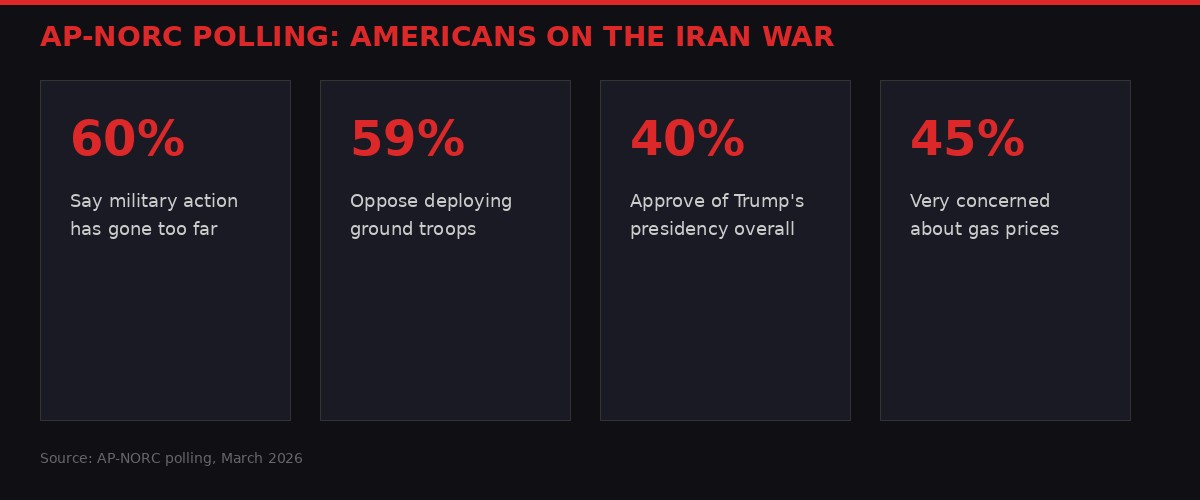
AP-NORC polling shows a majority of Americans believe the war has gone too far. - BLACKWIRE infographic
The Week That Broke the Narrative

The loss of American aircraft in Iranian airspace contradicts weeks of White House assertions about total air superiority. - Pexels
The sequence of events in the past 72 hours has been devastating for the administration's core claim that Iran has been neutralized. On Wednesday evening, Trump delivered his first prime-time address since launching Operation Epic Fury on February 28. He told Americans that Iran's "ability to launch missiles and drones is dramatically curtailed." He said the US was "on track to complete all of America's military objectives shortly, very shortly." He vowed to "hit them extremely hard over the next two to three weeks."
Forty-eight hours later, Iran demonstrated that its military is still capable of downing American jets.
The F-15E Strike Eagle that went down on Friday carried a pilot and a weapons system officer. According to the Pentagon, one crew member was rescued. The other's status remains unknown. Iranian state media identified the aircraft by type, and an anchor on state-affiliated television took the extraordinary step of urging Iranian citizens to hand over any "enemy pilot" to police, promising a reward. Throughout the war, Iran has made false claims about shooting down piloted aircraft. Friday was different - it was the first time civilians were mobilized to search for a downed American.
Separately, Iranian state media reported that a US A-10 attack aircraft crashed in the Persian Gulf after being hit by Iranian defense forces. A US official speaking anonymously told the Associated Press it was unclear whether the aircraft was shot down or crashed, or whether Iran was involved.
The implications rippled through Washington within hours. If Iran can still knock American jets out of the sky after five weeks of punishing airstrikes, what does "completely decimated" actually mean?
"A disabled air defense system is not a destroyed air defense system. We shouldn't be shocked that they're still fighting. This is a regime that is fighting for its life."- Behnam Ben Taleblu, Foundation for Defense of Democracies, speaking to AP
Retired Air Force Brigadier General Houston Cantwell, a former F-16 fighter pilot, told the AP that a shoulder-fired, portable missile likely brought down the fighter jet - weapons that are extremely difficult to detect and reflect how Iran remains "weak but still lethal." The last time a US fighter jet was shot down in combat was an A-10 Thunderbolt II during the 2003 invasion of Iraq.
"The fact that this hasn't happened until now is an absolute miracle," Cantwell said. "We're flying combat missions here, they are being shot at every day."
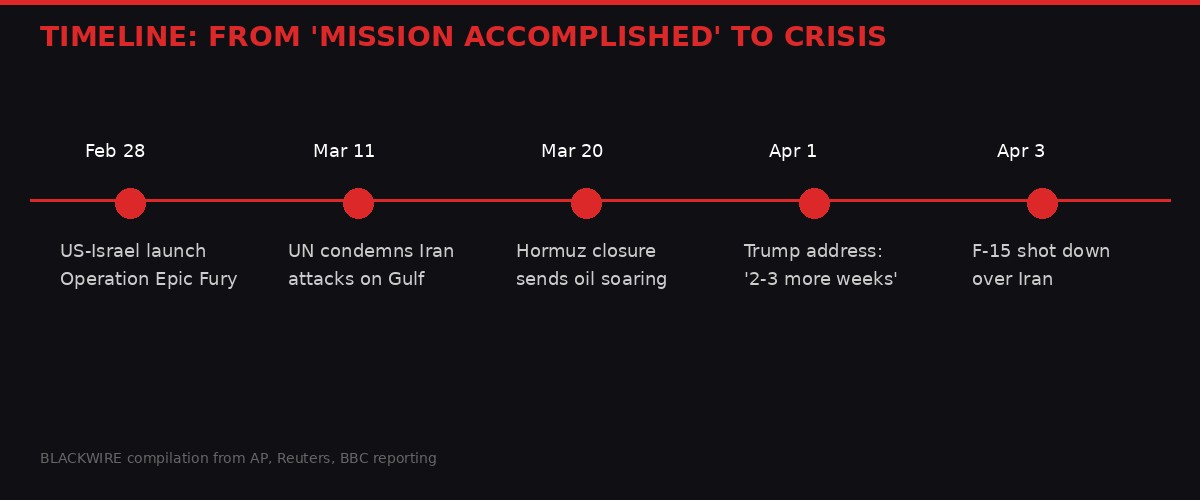
From launch to crisis: a compressed timeline of the war's key turning points. - BLACKWIRE infographic
The Price at the Pump - and at the Polls

The national average for a gallon of gasoline hit $4.08 this week - up nearly a dollar since Biden's last day. - Pexels
For most American voters, the war in Iran is not an abstraction measured in CENTCOM press releases or UN Security Council votes. It is measured at the gas pump. The average price for a gallon of regular unleaded hit $4.08 on Thursday, according to AAA - up almost a full dollar from the $3.12 average on Joe Biden's last day in office. In some parts of California and the Northeast, prices are pushing past five dollars.
The cause is direct and undeniable. Iran's stranglehold on the Strait of Hormuz - through which one-fifth of the world's oil typically flows - has choked global supply. The strait remains effectively closed to most Western shipping, with traffic down approximately 95 percent since the conflict began. A French-owned container ship managed to transit on Friday, hugging the Omani coast, making it the first vessel from a major Western European firm to pass through since late February. A Japanese LNG tanker also made it out. But these are exceptions, not evidence of normalcy.
Trump's response to the Hormuz crisis has oscillated wildly. He has alternately threatened Iran with further strikes if it doesn't reopen the strait, told European allies to "go get your own oil," and posted on Truth Social: "With a little more time, we can easily OPEN THE HORMUZ STRAIT, TAKE THE OIL, & MAKE A FORTUNE." None of these statements constitute a plan.
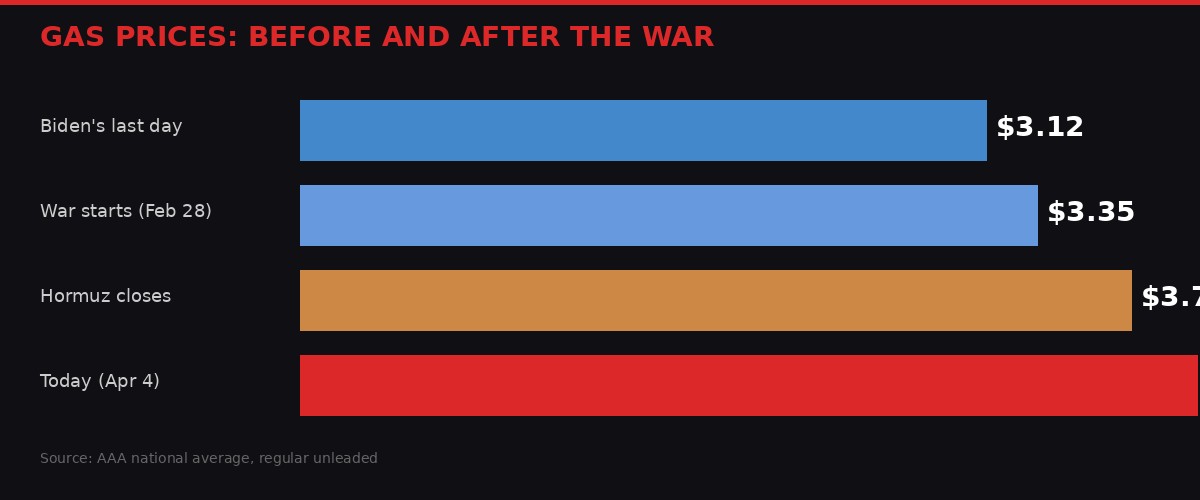
Gas prices have climbed steadily since the war began, with no relief in sight. - BLACKWIRE infographic
AP-NORC polling from mid-March - before the downed jets, before gas hit four dollars - showed that 45 percent of Americans were "extremely" or "very" concerned about being able to afford gasoline in the coming months. That number was just 30 percent in a poll conducted shortly after Trump won reelection. The promise to improve the economy and lower the cost of living was the core of Trump's 2024 campaign. The Iran war has annihilated it.
Iran's parliament speaker, Mohammad Bagher Qalibaf, issued a veiled threat late Friday to extend the disruption to a second critical waterway - the Bab-el-Mandeb strait, which links the Red Sea to the Gulf of Aden and handles more than a tenth of seaborne global oil and a quarter of container shipping. "What share of global oil, LNG, wheat, rice, and fertilizer shipments transits the Bab-el-Mandeb Strait?" he posted on social media, in a message clearly designed as a warning. If Iran follows through, the global energy shock would intensify dramatically.
A Party Divided Against Itself

The Republican Party is fracturing between war hawks, America First isolationists, and candidates who just want to change the subject. - Pexels
The Republican National Committee has largely avoided the war in talking points issued to surrogates over the past month. The leaders of the party's House and Senate campaign committees declined interview requests with the Associated Press. Vulnerable Republican candidates across the country are sidestepping the issue entirely, unwilling to either defend or challenge Trump publicly.
This silence is itself a damning signal. When a party's candidates cannot talk about the defining issue of the cycle, the cycle is already lost.
The fractures are running deep. On one end, Senator Lindsey Graham of South Carolina - Trump's golfing buddy and the war's most vocal cheerleader - is doubling down. "We haven't underestimated Iran at all. We're crushing them," Graham told supporters at his campaign office this week as he filed for a fifth term. Graham has been advocating for direct confrontation with Tehran for more than a decade, and he has finally gotten everything he wanted.
"You're seeing essentially a child on Christmas morning who has gotten everything that he's ever dreamed of. And that's not best for the country, obviously, but it's best for Lindsey Graham's ideology."- Jon Hoffman, Cato Institute research fellow in defense and foreign policy
On the other end, the party's populist-nationalist wing is in open revolt. Former Representative Marjorie Taylor Greene, once among Trump's most loyal allies, lashed out after his Wednesday address. "I wanted so much for President Trump to put America First. That's what I believed he would do. All I heard from his speech tonight was WAR WAR WAR," she wrote on social media. "Nothing to lower the cost of living for Americans."
Former Fox News host Megyn Kelly went further, calling Graham "a homicidal maniac" and asking pointedly: "When did Lindsey Graham become our president?" Kelly said Trump "likes and is listening to him, and Trump's favorite channel is parading him around like a Hefner bunny in stockings on every show."
The party is trapped between two irreconcilable positions. The hawks want more war. The populists want none. The candidates running for reelection in swing districts want to talk about anything else. And the voters are watching gas prices climb.
The Bush Parallel That Haunts Every Strategist

Republican strategists are studying the George W. Bush playbook - and finding mostly warnings. - Pexels
Every Republican strategist who has lived through a wartime midterm knows what comes next. The ghost haunting the 2026 cycle is George W. Bush's Iraq War.
In the spring of 2003, Bush enjoyed a massive surge in popularity after the invasion of Iraq. His approval ratings soared. The stock market rallied. "Mission Accomplished" was not yet an epithet. Republicans held Congress in the 2002 midterms and felt confident heading into 2004.
Then the war dragged on. Public sentiment curdled. The economy soured. By 2006, Republicans lost both the House and the Senate in a wave election driven by anti-war anger. The Iraq War ultimately spawned a generation of anti-war Republicans and sowed the seeds of Trump's "America First" foreign policy.
The critical difference: Bush worked to build public support before going in. He made the case to Congress. He assembled a global coalition. He received authorization to use military force. Trump did none of these things. He launched Operation Epic Fury without congressional approval, without consulting NATO allies, and without a clear articulation of war aims that has remained consistent for more than 48 hours.
Republican strategist Ari Fleischer, who served as Bush's press secretary, acknowledged to the AP that Trump has not received the polling bounce that Bush got after invading Iraq. "My hope is that the Trump experience is the exact opposite of the Bush experience," Fleischer said, arguing that a decisive, quick victory could produce "very significant political upside if things end well, oil comes down and markets rally."
But Fleischer also delivered a warning that should keep every Republican candidate awake at night: "Ultimately, he is not going to get judged on his persuasion or his explanations or his assertions, he's going to get judged on results."
Five weeks in, the results are: 13 US service members dead, hundreds wounded, a fighter jet shot down, a missing pilot, $4 gas, a closed strait, a battered global economy, NATO in near-open revolt, and no credible exit strategy.
The War Beyond the War: Iran Hits Silicon Valley in the Gulf

Iran is targeting American tech infrastructure across the Gulf, opening a new front in the economic war. - Pexels
Even as the air war dominates headlines, Iran is waging a parallel campaign that has received less attention but carries enormous economic implications. On Saturday morning, an apparent Iranian drone damaged the Dubai headquarters of Oracle, the American tech giant. Footage verified by the AP showed a large hole in the building's southwestern corner, with the "e" in Oracle's neon sign destroyed. Dubai's government downplayed the incident as "debris from an aerial interception."
It was not an isolated event. Iran's paramilitary Revolutionary Guard has accused major American tech companies of being involved in "terrorist espionage" operations against the Islamic Republic and declared them legitimate military targets. Earlier in the war, Iranian drone strikes hit Amazon Web Services facilities in both the UAE and Bahrain - attacks on the physical infrastructure of the global cloud economy.
This campaign represents a strategic calculation by Tehran: if you cannot match American firepower in the sky, hit American economic interests on the ground. Oracle, Amazon, and the other tech firms that built data centers across the Gulf did so because the region offered cheap energy, strategic location, and political stability. Two of those three assumptions have been destroyed in five weeks.
Also on Saturday, Iran's Atomic Energy Organization reported that an airstrike hit near the Bushehr nuclear facility, killing a security guard and damaging a support building. It was the fourth time Bushehr has been targeted during the war. The pattern suggests that the conflict is intensifying, not winding down, regardless of what Trump says from the White House podium.
Iran also continues to launch missiles and drones at Israel, with the Israeli military confirming incoming fire on Saturday. In Lebanon, more than 1,300 people have been killed and over one million displaced since the war began. The casualty toll in Iran itself has exceeded 1,900, according to the Armed Conflict Location and Event Data project, a US-based tracking group. The total regional death toll is climbing toward 3,500.
China Fills the Vacuum

As Washington focuses on bombing, Beijing positions itself as the responsible peacemaker. - Pexels
While the United States prosecutes an increasingly unpopular war, China is building a diplomatic architecture designed to make Washington look reckless by comparison. Beijing and Islamabad have unveiled a joint five-point proposal calling for an end to hostilities and the reopening of the Strait of Hormuz. Chinese Foreign Minister Wang Yi has held more than 20 phone calls with regional counterparts. A special envoy has toured the Middle East. China is positioning itself as the reasonable adult in a room that America set on fire.
"The war with Iran is the priority of all countries in and outside the region," said Sun Yun, director of the China program at the Stimson Center. "It is an opportunity China will not miss to demonstrate its leadership and diplomatic initiative."
Former senior US diplomat Danny Russel described China's efforts as "performative," comparing the five-point plan to Beijing's 12-point Ukraine proposal in 2023, which was "filled with platitudes but never acted on." But the optics matter. While Trump threatens to "TAKE THE OIL" in all-caps social media posts, China projects calm, dialogue, and multilateralism. The narrative writes itself - and it writes badly for Washington.
"Its narrative is that while Washington is reckless, aggressive and heedless of the cost to others, China is a principled and responsible champion of peace. What we are seeing from China is messaging, not mediation."- Danny Russel, Asia Society Policy Institute
The Trump administration appears to have little interest in China's efforts. Three US officials told the AP that Washington has "soured on third-party mediation" and has no desire to boost China's international standing. One official described the administration's position on the China-Pakistan plan as "agnostic." But apathy toward diplomacy is not a strategy. It is the absence of one.
China, for its part, is more insulated from the Hormuz disruption than most countries. It relies on Iran for only about 13 percent of its oil imports, maintains large strategic reserves, and is negotiating with Tehran to allow Chinese-flagged vessels through the strait. Russia, meanwhile, benefits from soaring oil prices. Both countries have blocked stronger UN action to reopen Hormuz, arguing that any military mandate would escalate the war further.
At the UN Security Council, Bahrain has significantly watered down its resolution on Hormuz, replacing authorization for "all necessary means" - UN language for offensive military action - with "all defensive means necessary." The vote, originally scheduled for Good Friday, has been pushed to next week. Even this weakened proposal may face vetoes from China and Russia.
No Exit, No Message, No Plan

The war's economic fallout is measured in barrels and ballots. Neither metric favors the White House. - Pexels
The fundamental problem for Republicans heading into November is that there is no coherent story to tell. The war was launched without a congressional vote, making it impossible for candidates to say they were acting on constituent wishes. The stated objectives have shifted repeatedly - from destroying nuclear capabilities (which the administration previously claimed were already destroyed) to eliminating ballistic missiles, to regime change, to reopening Hormuz, to taking Iran's oil. The timeline keeps extending. The costs keep rising.
Trump's Wednesday address was supposed to stabilize the narrative. Instead, it contained a contradiction so fundamental that it may define the rest of the cycle. In the same speech, Trump simultaneously declared that Iran was "eviscerated and essentially is really no longer a threat" and promised to "hit them extremely hard over the next two to three weeks." If Iran is no longer a threat, why are we still bombing it? If we need to bomb it harder, how is it no longer a threat?
Senator Chris Murphy, the Connecticut Democrat, said Trump's speech was "grounded in a reality that only exists in Donald Trump's mind." Murphy added: "We are losing this war. We cannot destroy all their missiles or drones, nor their nuclear program. Iran projects more power in the region than they did before the war, especially if they now permanently control the Strait of Hormuz. We are spending billions we don't have and losing American lives in a war that is destabilizing the world and making us look feckless."
The polling bears this out. About six in ten US adults say military action in Iran has "gone too far," according to AP-NORC data from March. Roughly a third approve of how Trump is handling Iran. About six in ten adults - including roughly half of Republicans - oppose deploying ground troops. Trump's overall approval sits at approximately 40 percent, roughly where it has been throughout his second term. There has been no wartime rally-around-the-flag effect. There is only erosion.
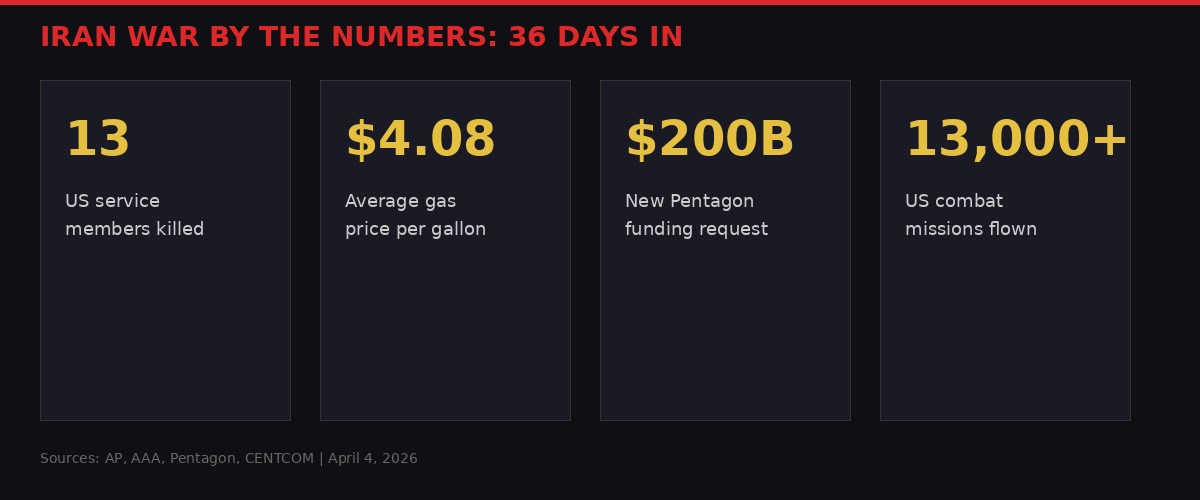
The war's human and economic toll after 36 days of Operation Epic Fury. - BLACKWIRE infographic
Republican Representative Tim Burchett of Tennessee captured the frustration of the party's non-interventionist wing when asked about Graham's push to expand bombing to Lebanon: "Lindsey hasn't seen a fistfight he hasn't wanted to turn into a bombing raid."
The Republican National Committee's silence speaks louder than any talking point could. When a governing party's national committee cannot provide its surrogates with a coherent defense of the president's signature policy, the policy has become a liability too heavy to carry.
What Comes Next

The midterm elections are six months away. Time is not on the GOP's side. - Pexels
The search for the missing American pilot continues deep inside Iranian territory. CBS reports that rescue teams - likely US Air Force pararescue jumpers operating from Black Hawk helicopters - are scouring Khuzestan province. These units, known as the "Swiss Army knives of the Air Force," are trained for precisely this scenario: recovering personnel behind enemy lines under fire. A former pararescue commander told CBS the operation is "harrowing and massively dangerous."
Former US Marine Corps Special Operations specialist Jonathan Hackett told the BBC that the team would be "trying to work backwards from the last point they knew that person was, and fan out based on the speed that person could move under different circumstances in this really difficult terrain." Meanwhile, Iranian forces are conducting their own search. The race to find the missing American could become the defining image of the war.
If the pilot is captured, the political consequences for Trump and the Republican Party would be catastrophic. The images of an American service member in Iranian custody would dominate every news cycle from now through November. If the pilot is rescued, Trump gets a narrative victory - but one that cannot erase the structural damage already done to the party's midterm prospects.
The war shows no signs of ending. Trump says two to three more weeks of heavy strikes. Iran keeps fighting. The strait stays closed. Oil keeps climbing. China keeps negotiating. NATO keeps fracturing. And somewhere in the mountains or plains of Khuzestan province, American special operators are hunting for one of their own, deep inside a country that the president says no longer exists as a military threat.
Ari Fleischer, the former Bush press secretary, put the stakes in the clearest possible terms: Trump will be judged on results, not rhetoric.
Results, as of April 4, 2026:
- 13 US service members killed. Hundreds wounded.
- Two American aircraft shot down in a single day - the first combat losses of crewed US jets in 23 years.
- More than 1,900 dead in Iran. Over 1,300 dead in Lebanon. Thousands displaced across the region.
- The Strait of Hormuz effectively closed for 36 days and counting.
- US gas prices at $4.08 per gallon and rising.
- The Pentagon requesting $200 billion in new war funding.
- No ceasefire. No negotiations. No credible exit strategy.
- Republican pollsters predicting "an ugly November."
- The House majority all but conceded. The Senate in play.
The party that promised to end wars and lower costs is six months from facing voters while presiding over a war it cannot explain and costs it cannot control. The unraveling is not coming. It is here.
Sources: Associated Press (multiple reports, April 3-4, 2026), BBC News, AP-NORC polling data (March 2026), AAA national gas price data, CENTCOM statements, Armed Conflict Location and Event Data (ACLED). All quotes attributed to named sources via AP and BBC reporting.
Get BLACKWIRE reports first.
Breaking news, investigations, and analysis - straight to your phone.
Join @blackwirenews on Telegram