
More than $1.5 billion worth of tokens hit the open market today. Ripple Labs is releasing 1 billion XRP from escrow - roughly $1.37 billion at current prices. Celestia is unlocking 175.6 million TIA tokens, representing 17.20% of total supply. Sui is dumping 53.4 million tokens worth $47.5 million. EigenCloud is adding another $6.5 million. And that is just April 1.
By the end of the week, at least ten separate projects will have released more than $100 million in combined token supply into a market that just finished its worst quarter since the FTX collapse. Bitcoin closed March around $67,800, sitting 52% below its $126,220 all-time high. Ethereum is trading near $2,070, down roughly 60% from its cycle peak. The Fear and Greed Index spent 46 consecutive days in extreme fear territory during Q1. And now comes the flood.
This is not a drill. This is the opening week of Q2 2026, and the crypto market is walking into it with a supply bomb strapped to its chest and no clear buyer of last resort in sight.
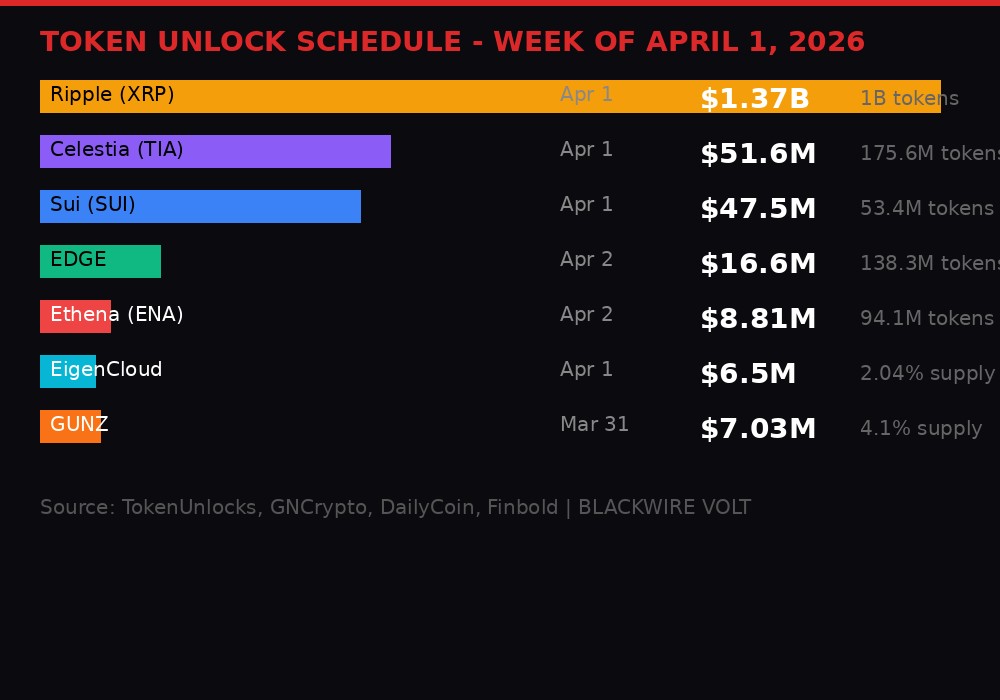

Ripple Labs set the tone for April by unlocking 1 billion XRP from its escrow program at the stroke of midnight UTC on April 1. At XRP's current trading price near $1.37, that represents approximately $1.37 billion in newly available tokens. The escrow release is part of Ripple's long-standing distribution program, established in 2017 when the company locked 55 billion XRP into 55 monthly escrow contracts of 1 billion tokens each, designed to provide transparency and predictability around supply.
The market's reaction to these monthly releases has been muted in recent years - and for good reason. According to analysis from CoinTribune and Finbold, the vast majority of each month's unlocked XRP is re-locked into escrow rather than sold on the open market. Ripple typically uses only a fraction of the released tokens for operational expenses, partnerships, and liquidity provision. The March 1 unlock followed the same pattern: 1 billion XRP released, most re-escrowed within days.
But context changes everything. XRP has already fallen 3.2% in the past 24 hours and nearly 5% over the last week heading into the unlock. The token is struggling to hold the $1.37 level, with analysts at CryptoNews noting that XRP needs to reclaim $1.45 before showing any sign of recovery, followed by $1.50. A move above $1.60 would represent a clean trendline break. None of those levels look achievable when the broader market is hemorrhaging confidence.
The real concern is not this single unlock. It is the cumulative effect of persistent supply inflation at a time when demand is visibly contracting. XRP's 24-hour trading volume has been declining, and the token's position as the fourth-largest cryptocurrency by market cap is under pressure from multiple directions - not least the ongoing uncertainty around the SEC's regulatory posture toward Ripple despite the partial resolution of their years-long legal battle.
FXEmpire reported that Ripple enters April with "fresh catalysts" including institutional expansion and new long-term adoption hopes. But catalysts only matter if there are buyers. Right now, the bid side of the XRP order book looks thin enough to read through.

If Ripple's unlock is the elephant, Celestia's is the grenade. Scheduled for April 1, the Celestia unlock releases approximately 175.6 million TIA tokens into circulation. That number represents 17.20% of TIA's total supply - the single largest percentage-of-supply unlock event for any major project this week, and one of the largest in crypto history by relative terms.
To put 17.20% in perspective: when projects unlock 1-2% of supply, it usually generates headlines and cautious trading. When they unlock 5%, market participants start hedging. At 17.20%, you are looking at a potential supply-side extinction event for price if recipients choose to sell even a fraction of their allocation.
TIA was already in trouble before the unlock date arrived. According to AMBCrypto, spot traders flipped bearish on March 28, offloading approximately $513,000 worth of TIA in a single session after four consecutive days of gradual accumulation. The reversal was significant enough that AMBCrypto's analysts flagged it as a structural shift in positioning. Derivatives data confirmed the same pattern - both spot and futures markets were leaning short heading into the event.
The token broke below a prolonged consolidation range that had held since February 5, ending months of sideways movement. TIA now trades below the $0.2967 support level. A sustained close beneath this threshold, which is entirely plausible given the supply injection, would confirm a continuation of the downtrend and open the path toward the $0.233 region - a further 21% decline from current levels.
The allocation is reportedly directed toward research and development and core contributors within the Celestia ecosystem, which suggests utility-driven distribution rather than pure investor profit-taking. But as AMBCrypto noted, market reactions to unlocks tend to reflect sentiment rather than fundamentals. When sentiment is already bearish, additional supply reinforces the downside regardless of who receives the tokens or what they plan to do with them.
Celestia's modular blockchain thesis remains technically sound. The project offers data availability sampling for rollups, and its architecture is used by a growing number of Layer 2 projects. But good technology does not prevent sell pressure when 17% of your token supply suddenly becomes liquid in a market that cannot absorb it.

Beyond the headline-grabbing Ripple and Celestia releases, the March 30 to April 5 window includes at least ten separate token unlock events adding more than $100 million in aggregate supply. This data comes from GNCrypto, Coinpedia, and DailyCoin, all of which tracked the schedule independently and arrived at similar totals.
Sui leads the non-XRP, non-TIA pack with $47.5 million worth of SUI tokens unlocking on April 1 - 53.4 million tokens equal to 0.53% of total supply. While 0.53% sounds modest compared to Celestia's 17%, the absolute dollar value is substantial enough to generate real order book pressure. SUI traders have been watching price action closely heading into the event, with the token already showing weakness in the last days of March.
Definitive's EDGE token comes in with $16.6 million unlocking on April 2, but the percentage tells the real story: 138.3 million tokens representing 13.8% of total supply. That is the second-highest percentage unlock of the week after Celestia. For a smaller-cap token with thinner liquidity, a 13.8% supply increase could be devastating if even a modest percentage hits the open market.
Ethena's ENA releases $8.81 million on April 2 (94.1 million tokens, 0.63% of supply). GUNZ unlocked $7.03 million on March 31 - 410.3 million tokens representing 4.1% of supply. EigenCloud adds $6.5 million on April 1 at 2.04% of supply. Then come the smaller events: Optimism at $3.39 million, Bitway at $2.91 million, Zama and Zora each in the $2.47-$2.7 million range, and Keeta's KTA at approximately $2.5 million on April 5.
KuCoin's blog noted that unlocks tied to community reserves or DAO treasuries tend to have smaller impacts, while those hitting early investors or advisors can "feel heavier if recipients decide to sell." The April lineup includes both categories. Some releases account for less than 2% of released tokens, yet the absolute dollar figures still reach tens of millions depending on current valuations.
The compressed timeframe is the real problem. Ten unlocks across six days creates overlapping sell pressure that the market has to absorb simultaneously. In a healthy bull market, this would be noise. In Q2 of a bear market that just posted six consecutive months of Bitcoin losses, it is a stress test.
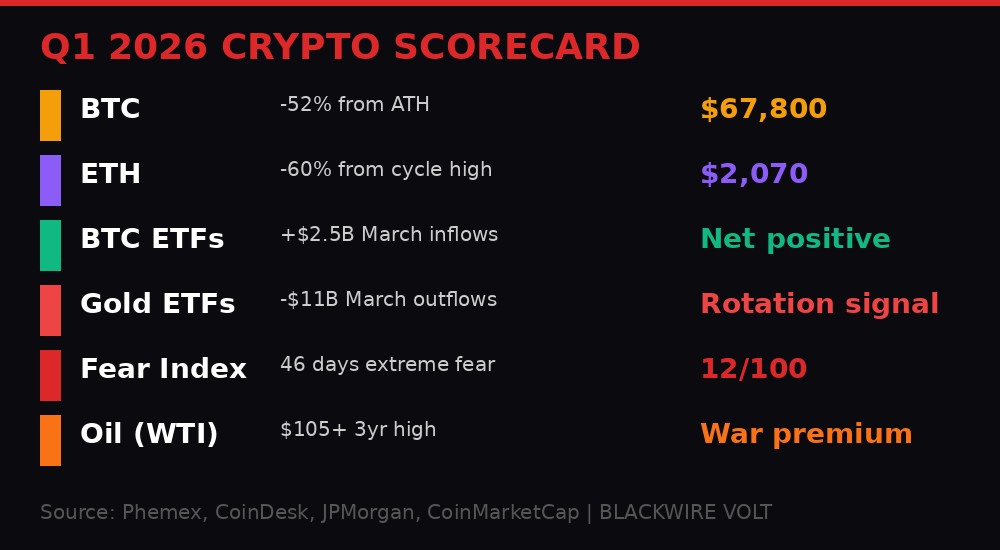
The token flood arrives against the backdrop of what Phemex's research desk called the worst quarter for crypto since the FTX collapse. The numbers are stark. Bitcoin fell 52% from its $126,220 all-time high set in late 2025. Ethereum dropped roughly 60% from its cycle peak. The combined crypto market capitalization shed hundreds of billions of dollars. And the Fear and Greed Index, which measures retail sentiment, spent 46 consecutive days in "extreme fear" territory - the longest sustained fear streak since the Luna/Terra collapse in 2022.
As BLACKWIRE's VOLT bureau reported in late March, Bitcoin has been in a six-month losing streak - only the second time in history that has happened. The first instance was during the 2014-2015 bear market, and the recovery from that took 18 months.
The macro backdrop made everything worse. Oil surged above $105 per barrel on Iran war premium, triggering the highest energy prices in three years. The Federal Reserve held rates steady at the March FOMC meeting but signaled that rate cuts were off the table as long as inflation remained elevated - a hawkish hold that crushed any remaining hope of a dovish pivot. Bitcoin sold off after eight of the last nine FOMC meetings, according to Phemex data.
ETF flows told a split story. On one hand, Bitcoin spot ETFs absorbed $2.5 billion in new investment during March, according to MEXC's research blog, meaning institutions bought roughly 35,000+ BTC that moved into cold storage. On the other hand, BlackRock's IBIT recorded a single-day outflow of $201.67 million in the final week of March, contributing to a weekly spot Bitcoin ETF flow of negative $296.18 million - the first negative week of the month. The signal: institutions are net buying, but they are also actively trimming positions at the margin as quarter-end rebalancing kicks in.
JPMorgan analysts attributed broader selling pressure to rising interest rates, a stronger U.S. dollar, and profit-taking across both retail and institutional accounts. Gold ETFs saw nearly $11 billion in outflows in the first three weeks of March alone, suggesting this was not crypto-specific weakness but a wholesale risk-off rotation across asset classes.
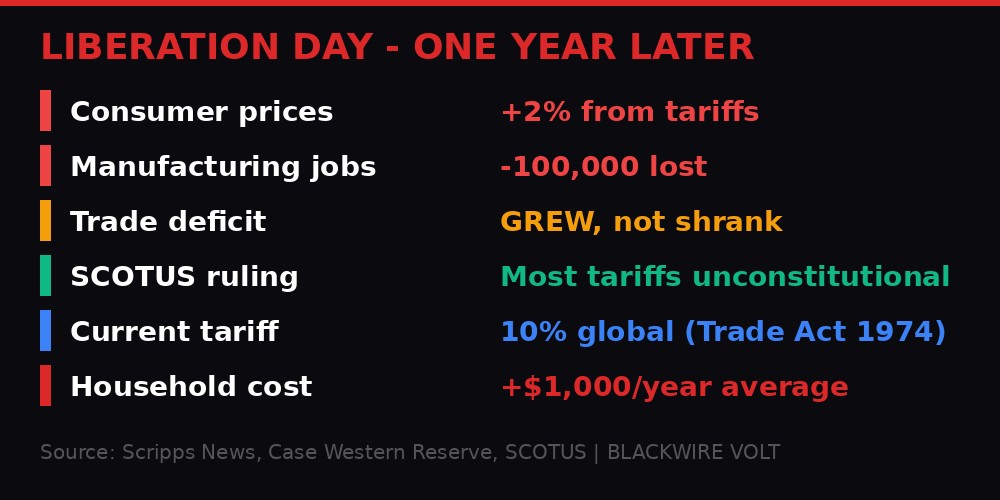
April 1, 2026, also carries a symbolic weight that should not be dismissed. Tomorrow marks the one-year anniversary of President Trump's "Liberation Day" tariff announcement on April 2, 2025 - the day he invoked the International Emergency Economic Powers Act to impose a universal 10% tariff and differential reciprocal tariffs as high as 50% on major trading partners. It was the first time that emergency law had been used for tariffs, and the consequences rippled through every financial market on the planet.
Scripps News published a retrospective noting that by February 2026, the Supreme Court ruled most of the emergency tariffs unconstitutional, kickstarting the "complex and unprecedented process" of issuing refunds to impacted importers. But the damage was already done. According to Jonathan Ernest, an assistant professor of economics at Case Western Reserve University, tariffs drove up consumer goods prices by another 2% over the year, with "somewhere between 90 and 95% of the tariff actual cost essentially being passed on to consumers."
A separate analysis found that Trump's tariffs cost U.S. households an average of $1,000 per year. Manufacturing jobs declined by approximately 100,000 rather than surging as promised. The trade deficit grew rather than shrank. Rathna Sharad, CEO of shipping platform FlavorCloud, said the manufacturing shift never materialized because "the expertise isn't there" and "the labor costs are nowhere near" comparable to existing overseas production.
After the Supreme Court ruling, the Trump administration implemented a replacement global 10% tariff under the Trade Act of 1974 with a 150-day limit. Trump has suggested raising it to 15%, but any extension requires Congressional approval. Kyle Peacock of Peacock Tariff Consulting noted that the refund process to businesses remains unclear, creating a "vicious cycle" where retailers have not received funds and therefore cannot pass savings back to consumers even if they wanted to.
The tariff saga matters for crypto because it was one of the catalysts that kicked off the risk-off rotation in late 2025 that eventually evolved into the current six-month bear trend. The uncertainty created by trade wars, compounded by the Iran-Gulf conflict and the resulting oil price shock, formed a macro environment in which risk assets like Bitcoin struggled to find sustained bid support. The anniversary is not just symbolic - it is a reminder of the structural damage that economic policy uncertainty inflicts on markets.

In a move that encapsulates the mood of the market, Latin America's largest e-commerce company MercadoLibre announced on March 31 that it is shutting down Mercado Coin, its homegrown cryptocurrency, nearly four years after launching it as a loyalty-driven engagement tool. Reuters and CoinDesk both confirmed the decision, reporting that starting April 17, users will no longer be able to buy, sell, or earn cashback in Mercado Coin.
The shutdown is notable for several reasons. First, MercadoLibre (MELI) is not a small player. It is the Amazon of Latin America, a $70+ billion company with hundreds of millions of users across Brazil, Argentina, Mexico, and beyond. When a company of that scale decides that running its own cryptocurrency is not worth the operational and regulatory overhead, it sends a signal to every corporate treasury team that has been flirting with a token launch.
Second, the timing is pointed. Mercado Coin launched in 2022 during the bull market enthusiasm, when every major tech and fintech company was exploring blockchain integration. It survived the FTX collapse, the regulatory crackdowns of 2023, and the slow recovery of 2024. But it did not survive the grinding bear market of late 2025 and early 2026. The company will continue to support Bitcoin trading through Mercado Pago, its fintech arm, suggesting that MELI has not given up on crypto entirely - just on the idea that a corporate loyalty token makes sense in this environment.
Parameter.io noted that MercadoLibre's decision "ends its four-year cryptocurrency rewards program while maintaining Bitcoin" - a distinction that tells you where the company sees lasting value and where it sees failed experiments. Bitcoin stays. Loyalty tokens die. The market is choosing its survivors.

Despite the blood in the water, there are catalysts that could reverse the trend - or at least arrest the decline. Phemex's April 2026 Crypto Playbook identified five specific trade setups worth watching as Q2 begins.
The first is a potential Bitcoin breakout above $72,000. The range between $65,000 and $72,000 has contained price action for most of March, with sellers consistently defending the upper boundary. A weekly close above $72,000 on convincing volume would put the $78,000-$82,000 zone in play. But the April 28-29 FOMC meeting looms as a potential spoiler. Phemex noted that BTC has sold off after eight of the last nine FOMC meetings, and this one could be Fed Chair Powell's last meeting, adding unpredictable political dynamics to an already fraught decision.
The second is Ethereum pre-Glamsterdam positioning. The Glamsterdam upgrade - Ethereum's most significant technical overhaul since the Merge - is targeting a June 2026 launch with a gas limit increase from 60 million to 200 million per block and throughput scaling to 10,000 transactions per second. Historically, ETH has rallied 20-40% in the two months before major upgrades. If Glamsterdam stays on track for June, the positioning window opens now, with Phemex targeting $2,600-$2,800.
The third is AI token rotation. TAO surged 35%, RENDER gained over 30% in five consecutive green days, and FET rebounded from $0.14 to test $0.20 resistance in late March. The combined AI token market cap jumped from $17.6 billion to $19.48 billion in a single session on March 25. The dip-buying opportunity comes when these tokens consolidate and pull back to support levels - TAO at $300-$330, RENDER at $1.50-$1.70, FET above $0.17.
The fourth and fifth plays involve stablecoin yield products as a holding pattern while the CLARITY Act advances, and monitoring new ETF volume data from Q1 to gauge where institutional money is actually flowing. Solana ETFs attracted the most sustained inflows during their first full quarter of trading, while DOGE ETF volumes faded after novelty wore off. April marks the start of Q2 institutional rebalancing, and asset managers who sat out Q1 now have a full quarter of performance data to inform their allocations.
The problem with all five playbook items is that they require patience and precise timing in a market that is actively punishing both. The token unlocks add a layer of supply pressure that makes timing even harder. You might be right on the direction and still get stopped out by a week of forced selling from unlock recipients who need to cover costs or take profits.

The bull case for Q2 rests on three pillars. First, the CLARITY Act reaching markup in the Senate Banking Committee by mid-April would provide the first real regulatory framework for stablecoins and potentially for broader digital asset classification. That legislative clarity has been the crypto industry's white whale for years, and passage would unlock institutional capital that has been sitting on the sidelines waiting for rules of the road. Second, Ethereum's Glamsterdam upgrade represents a genuine technical catalyst that historically produces 20-40% pre-event rallies. Third, Bitcoin ETF flows remain structurally positive - $2.5 billion in March inflows suggests institutional conviction has not broken despite the price decline.
The bear case is simpler and more immediate. Supply is increasing. Demand is uncertain. Macro conditions are hostile. Oil above $100 creates inflationary pressure that keeps the Fed hawkish. The Iran-Gulf conflict shows no signs of resolution, maintaining geopolitical risk premium across all asset classes. The six-month losing streak has destroyed retail confidence - the Fear and Greed Index at 12 is not just a number, it is a behavioral state where investors sell rallies rather than buy dips.
And now comes the unlock wave. The $1.5+ billion in tokens hitting the market this week - headlined by Ripple's $1.37 billion XRP release and Celestia's 17% supply dump - arrives at precisely the wrong moment. In a bull market, these unlocks would be absorbed by eager buyers. In this market, they add to a selling pressure that already exceeds demand on most days.
The historical data on token unlock impact is mixed. A 2024 study by Keyrock found that 90% of token unlocks result in negative price action, with the most pronounced effects occurring when the unlock represents more than 5% of circulating supply. By that metric, Celestia's 17.20% and EDGE's 13.8% are in extreme danger zones. Sui's 0.53% and Ethena's 0.63% are more likely to be absorbed without significant price impact.
But aggregate effects matter too. When multiple projects unlock simultaneously, the general risk-off sentiment spills across the market. A trader who sees TIA dropping 10% on unlock day does not think "that's just Celestia" - they think "tokens are dumping" and sell their positions in other assets defensively. This cross-contamination effect is what makes compressed unlock schedules so dangerous.
Q2 2026 will determine whether crypto is in a cyclical correction within a secular bull market or the early stages of a prolonged bear market similar to 2018-2019. The token unlocks are one variable in a much larger equation that includes Federal Reserve policy, geopolitical stability, regulatory progress, and the pace of institutional adoption.
Bitcoin's $2.5 billion in March ETF inflows against a backdrop of a 52% drawdown from all-time highs suggests that the smart money is accumulating, not fleeing. JPMorgan noted that Bitcoin "held its ground" while gold and silver experienced massive outflows - $11 billion from gold ETFs in three weeks - suggesting a capital rotation from traditional safe havens into digital ones. If that rotation continues, Bitcoin's floor may be closer to $65,000 than the $55,000-$59,000 range that bears are targeting.
But floors only hold if buyers show up. And today, the buyers are looking at a market flooded with billions in new supply, staring down a hawkish Fed, an oil market in wartime mode, and a political landscape where the anniversary of Liberation Day serves as a reminder that trade policy can shatter economic stability overnight.
The crypto market entered 2026 hoping for a year of institutional maturation and regulatory clarity. Instead, it got a six-month drawdown, a Middle Eastern war, $100+ oil, and now the largest concentrated token unlock week in recent memory. April is not going to be boring. Whether it is the month that finds the bottom or the month that breaks the last support level depends entirely on whether the market can absorb the supply flood without drowning.
Position accordingly. And keep your stops tight.
Get BLACKWIRE reports first.
Breaking news, investigations, and analysis - straight to your phone.
Join @blackwirenews on Telegram