The Greenland Grab: How Trump Insiders Built a Mining Empire While the President Threatened to Seize the Island

The story of how the United States became obsessed with Greenland's minerals is, on its surface, a story about national security. China controls roughly 60 percent of rare earth mining and 90 percent of rare earth processing globally. The Pentagon needs these minerals for fighter jets, guided missiles, and next-generation radar systems. Europe needs them for wind turbines and electric vehicle batteries. Whoever controls the supply chain controls the future of both warfare and clean energy.
That is the official justification. The classified briefings. The executive orders. The presidential rhetoric about acquiring Greenland "one way or the other."
But behind the flag-waving and the national security arguments, a much smaller and more familiar story has been playing out. A story about a handful of men - former Trump officials, former Trump Organization employees, former intelligence operatives - who positioned themselves to personally profit from the very policy they helped shape. They used government letterhead to boost private deals. They settled federal ethics investigations with quiet payments. They formed lobbying firms that traded on proximity to the president. And they did it all while their former boss was threatening to seize a sovereign territory by force.
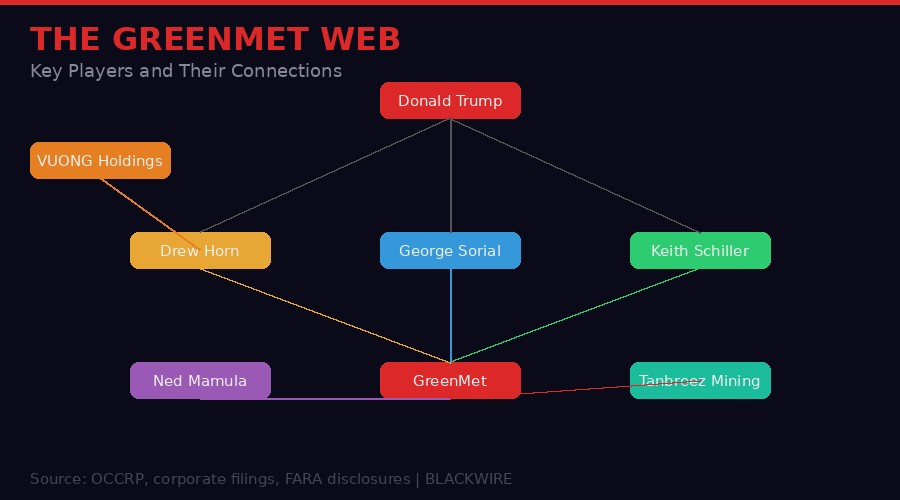
This is the story of GreenMet, Drew Horn, and the revolving door that connects the Department of Energy to the frozen mines of Greenland. It is built on corporate filings in Washington D.C., a Department of Justice settlement, leaked emails, Foreign Agent Registration Act disclosures, and the investigative work of OCCRP and its media partners.
Follow the money. It always leads somewhere.
I. The Man Who Wrote His Own Future

Drew Horn held a sensitive position. As a national security official in the Department of Energy during Trump's first term, he had access to classified briefings about America's critical minerals supply chain. He understood which resources the military needed, which countries controlled them, and how vulnerable the United States was to supply disruptions from hostile powers.
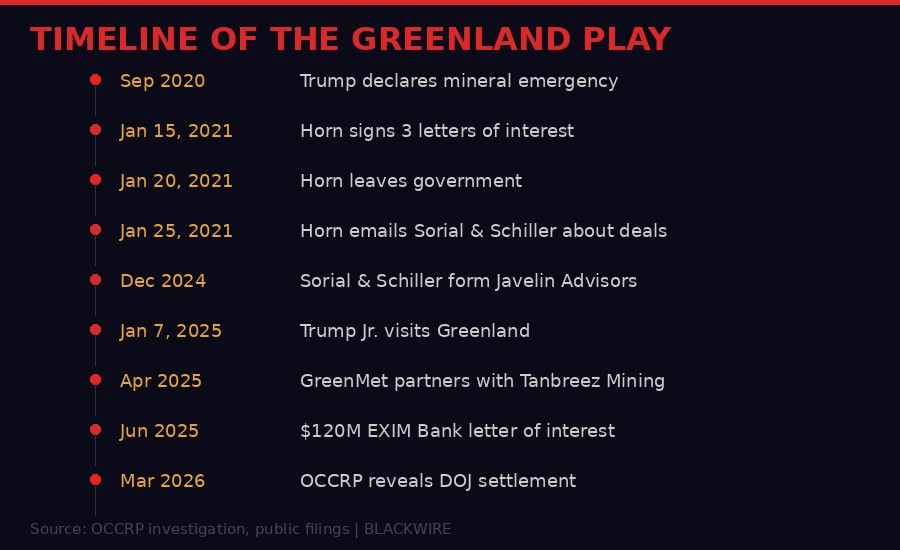
In September 2020, the Trump administration issued an executive order declaring American reliance on Chinese minerals a national emergency. The order directed every relevant federal agency to promote a domestic supply chain for critical minerals - the kind of directive that creates enormous commercial opportunity for anyone who knows it is coming.
Horn knew it was coming. He helped shape it.
In the final weeks of Trump's first term - between late December 2020 and January 2021 - Horn drafted several official letters of interest on Department of Energy letterhead. These letters expressed the United States government's desire to support critical minerals projects needed for defense and green energy sectors. They carried the weight of federal authority.
On January 15, 2021 - exactly five days before leaving his government position - Horn signed three of these letters. One of them proposed something extraordinary: a U.S. government purchase of 10 million tons of mineral scrap from what he described as a "VUONG-Grimstone partnership," priced at $100 per ton. The total value: $1 billion.
That alone would be notable. A departing government official using his last days in office to sign billion-dollar letters of interest raises obvious questions about urgency and motivation.
But the Department of Justice investigation that followed revealed something worse.
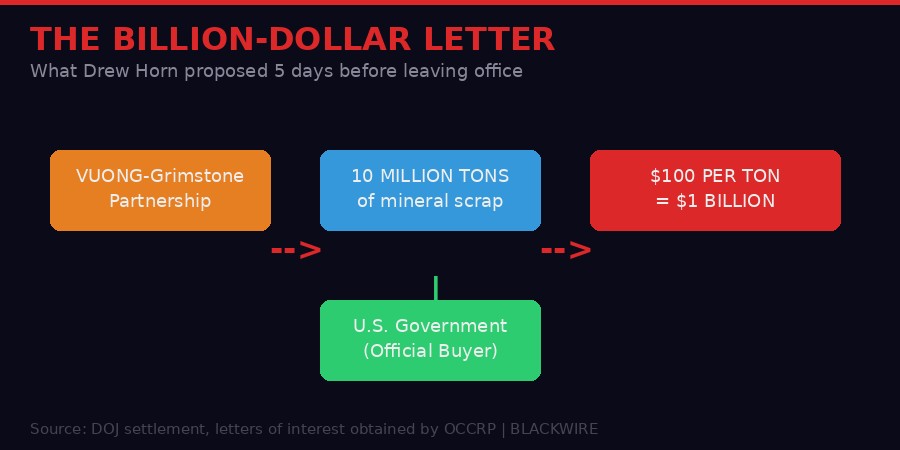
According to the DOJ settlement, at the same time Horn was writing letters of interest for VUONG Holdings - designated "Company 1" in legal documents - he was simultaneously negotiating anticipated post-government employment with the CEO of that same company. He was using his government position to boost a firm he was planning to work for after walking out the door.
The settlement did not name the companies directly. But OCCRP journalists matched the descriptions in the DOJ documents to VUONG Holdings and Grimstone Mining LLC through letters of interest they obtained. The details line up precisely.
Horn paid the government an undisclosed sum to settle the probe. He admitted nothing. The DOJ stipulated that the settlement was not "a concession by the United States that its claims are not well founded." In plain English: the government believed it had a case. Horn preferred to pay rather than fight it.
"I never violated any sort of ethical constraints or did anything that even constituted the start of a conflict of interest."- Drew Horn, in an interview with OCCRP's media partner Berlingske
The DOJ disagreed enough to investigate him. Horn disagreed enough to settle. The public was never told.
II. The Email That Connected Everything

Ten days. That is how long Drew Horn waited after leaving government before revealing his plans.
On approximately January 25, 2021, Horn sent an email from his personal address to two men: George Sorial and Keith Schiller. The subject line read "New Firm." The message, obtained by OCCRP, laid out Horn's vision for projects both domestically and in Greenland.
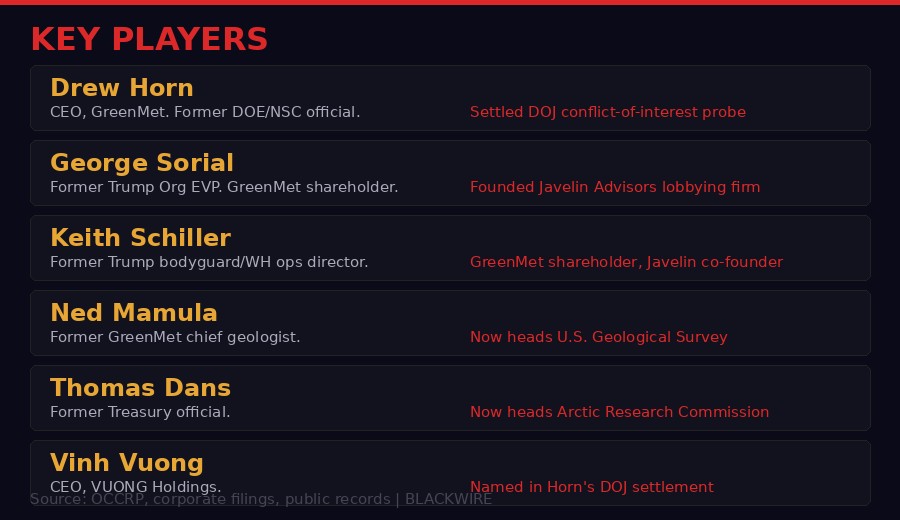
George Sorial was the former executive vice president and chief compliance counsel of the Trump Organization. He reported directly to Donald Trump Jr. and Eric Trump from 2016 until leaving the company in 2019. He wrote a laudatory book about Donald Trump called "The Real Deal." He sat on boards of Trump enterprises in Ireland and Scotland. He was, by any measure, a Trump insider.
Keith Schiller was Trump's former personal bodyguard who became the director of Oval Office operations during Trump's first term. Before that, he served as the Trump Organization's director of security. He traveled with Trump everywhere. He was part of the innermost circle.
In the email, Horn singled out Grimstone Mining - the same company he had just written an official government letter of interest for while still at the Department of Energy.
"The Grimstone opportunity looks great."- Drew Horn, in a January 2021 email to Sorial and Schiller, obtained by OCCRP
Horn wrote that he could secure a $500 million loan from financier Erik Bethel from his private investment fund. The logic was circular and revealing: Bethel's "viewpoint is that if we can secure Letters of Intent from the government for some of the larger projects, he can then lend the money from his private investment fund to get started."
Read that again. Horn had just written such a letter of interest - on government letterhead - while still in his official position. Now, ten days later, he was telling private partners that exactly such letters could unlock half a billion dollars in private financing. The letter he wrote in his government capacity was the key that opened the private vault.
Bethel denied the arrangement. "I don't do business with Drew Horn and never have," he told OCCRP. Neither Horn nor his lawyer answered questions about the relationship.
As for Grimstone Mining, its attorney told OCCRP something equally revealing: "There was no partnership, joint venture, or business agreement with VUONG." Horn's billion-dollar letter of interest had described them as a partnership. The company he was proposing to sell $1 billion in scrap to said the partnership did not exist.
III. From New Firm to GreenMet

The "New Firm" Horn described in that January 2021 email eventually materialized as GreenMet - formally Greentech Minerals Holdings Inc. Washington D.C. corporate registry documents list Horn as CEO, with Sorial and Schiller among the beneficial owners.
The company's focus: rare earth minerals. Its geography: Greenland.
In April 2025, GreenMet announced a strategic partnership with Tanbreez Mining Greenland A/S, a company holding a license to mine one of the world's largest known rare earth deposits. GreenMet described Tanbreez as the "only shovel ready rare earth project in Greenland." The word "shovel ready" matters in mining - it means the deposit has been assessed, the permits are in place, and extraction can begin almost immediately.
By June 2025, GreenMet announced it had helped Tanbreez investor Critical Metals Corp. secure a $120 million letter of interest from the U.S. Export-Import Bank to develop the site. Federal money, flowing through channels that Horn understood intimately from his time in government, was now backing a private venture in which he held a leadership position.
Horn personally briefed Trump's team with photos of the Tanbreez site, according to Bloomberg reporting.
Sorial and Schiller told OCCRP they are "passive minority shareholders" with "no management role." Horn said they "resigned their roles on the board and as advisors in GreenMet in early 2025." But they remain shareholders. Their financial interests in the company's success have not changed.
The distinction between "active management" and "passive ownership" is one of Washington's oldest games. You don't need to attend board meetings to profit from a company's success. You just need to own shares.
Meanwhile, Sorial and Schiller were not exactly idle. In December 2024, the two men formed Javelin Advisors LLC, a lobbying and consulting firm. Their press release announced them as "former Trump advisors." The Javelin website's tagline was brazen: "Founded by Insiders. Defined by Access."
FARA filings show Javelin was hired by the Pakistani government to pursue a proposed rare-earth minerals agreement with the United States. The same men who hold shares in a Greenland mining company were now lobbying the U.S. government on critical minerals policy on behalf of a foreign nation.
In Washington, this is technically legal. In any other context, it would be called what it is: a conflict of interest that spans continents.
IV. The Revolving Door Into the U.S. Geological Survey
Ned Mamula's career path reads like a case study in the revolving door between government, intelligence, and private industry.
According to his LinkedIn profile, Mamula is a former CIA analyst. He worked in the Department of Energy during Trump's first term. He then became GreenMet's chief geologist - the person responsible for assessing whether Greenland's mineral deposits were commercially viable.
In October 2025, Mamula was confirmed as director of the U.S. Geological Survey. The USGS is, as a February 2025 Congressional report described it, "a lead federal science agency responsible for mineral resources research and analysis." The agency produces the maps, the data, and the assessments that determine where America looks for critical minerals - and which deposits are worth developing.
The man now running the agency that evaluates mineral deposits for the U.S. government was, until recently, evaluating mineral deposits for a private company owned by former Trump officials in Greenland.
Mamula is still listed as an advisor on a GreenMet website, although he filed a form this month indicating he divested from the company. Whether divestment papers eliminate the relationships, the expertise, and the knowledge gained during his time as GreenMet's chief geologist is a question ethics lawyers have debated for decades. The answer, invariably, is no.
He co-authored a book with Drew Horn in 2024 called "Undermining Power." Horn wrote the forward. Both men advocated for a strong U.S. role in controlling rare earth critical minerals across the globe. The book was, in effect, a policy blueprint for the very strategy they were simultaneously pursuing as private businessmen in Greenland.
Write the policy. Leave government. Build the company. Get appointed to run the agency that oversees the policy. The circle closes so neatly it barely qualifies as a door anymore. It is more of a highway interchange.
V. The Arctic Commission, the Governor, and the $850 Million Refinery

The web of Trump-connected figures pursuing Greenland interests extends beyond GreenMet's immediate shareholders.
Thomas Dans served as a Treasury Department official during Trump's first term. After leaving government, he became a private operator with a single-minded focus: Greenland. He runs an organization called American Daybreak, registered as an income-tax-exempt non-profit shortly before Trump's re-election in 2024.
American Daybreak's public disclosure document for its brief period of operations in 2024 shows $160,000 in contributions, grants, or gifts. The sources of those funds are not named. For its accomplishments, the organization listed that it had educated Americans "on the ways Greenland's traditions of self-determination influence the relationship between the United States and Greenland."
Dans organized the trips that brought Donald Trump Jr. and Vice President JD Vance to Greenland in January 2025. Trump Jr. arrived aboard a Trump Organization airplane on January 7 - just weeks before his father's presidential inauguration. Sorial shared photos from the trip on LinkedIn with the hashtags #minerals #usa #nationalsecurity.
In December 2025, Trump appointed Dans to head the U.S. Arctic Research Commission. The Commission is a scientific body typically run by academics that advises the president on Arctic policy - which now explicitly includes Greenland's mineral wealth. A former Treasury official who organized trips to Greenland for the president's son now oversees the government body that advises on Arctic resource development.
In a separate but connected move, Trump appointed Louisiana Governor Jeff Landry as special envoy to Greenland in December 2025 - even though Landry had no known prior connection to the Arctic. Donald Trump Jr. had campaigned for Landry during his gubernatorial run in September 2023.
One week before Landry's appointment, Louisiana's economic development officials announced an $850 million planned investment to create a critical minerals refinery in the state. The announcement did not specify where the minerals would be sourced. The company cited in the announcement, ElementUSA, also holds Defense Department contracts for mineral supplies.
The inference is not subtle. The governor of Louisiana is appointed envoy to Greenland. Greenland has rare earth minerals. Louisiana is building an $850 million refinery for rare earth minerals. The pipeline from Arctic mine to Gulf Coast refinery does not need to be drawn on a map - it draws itself.
"Trump's illegal and illegitimate designs on Greenland would be bad enough. But they are made worse by allegations that Trump associates have ties to companies who could benefit from the president's actions."- Norman Eisen, former U.S. ambassador, founder of the Democracy Defenders Fund
VI. The National Security Justification and Its Contradictions
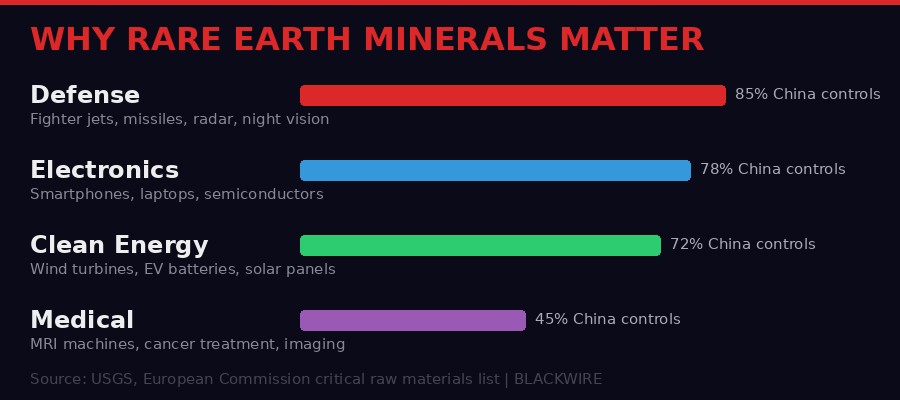
The national security argument for securing rare earth mineral supplies is not fabricated. It is real and it is urgent. China controls approximately 60 percent of global rare earth mining and around 90 percent of processing capacity. The European Commission has designated rare earths as critical raw materials. The Pentagon has identified them as essential for next-generation weapons systems. The minerals found in Greenland - neodymium, dysprosium, terbium, and others - are genuinely vital for everything from F-35 fighter jet engines to the permanent magnets in missile guidance systems.
But the legitimacy of a national security concern does not legitimize every action taken in its name. The Iraq War was justified by weapons of mass destruction that did not exist. The surveillance state was built on terrorism fears that were real but grossly disproportionate to the response. When governments declare emergencies, the private sector moves to profit. This is not conspiracy theory. It is the documented history of American policy since the Eisenhower administration warned about the military-industrial complex in 1961.
What makes the Greenland case distinctive is the compression of the timeline and the smallness of the circle. The same individuals who shaped the critical minerals emergency declaration are now the individuals building the companies positioned to fill that emergency. They wrote the policy. They left government. They built the companies. And in some cases, they returned to government to oversee the agencies that regulate the policy they originally wrote.
Greenland's population of 57,000 people has repeatedly rejected the idea of American acquisition. Danish leaders have called it absurd. The Greenlandic government has insisted on self-determination. But Trump has continued to escalate, telling the U.S. Congress in March 2025 that the United States would get Greenland "one way or the other."
Drew Horn appeared on Fox and Friends in January 2025 to support the administration's position. He told viewers that Greenlanders "are absolutely tired of being exploited and oppressed by the Danes as they have been for the last 100 years." He added, apparently without irony: "You know, the era of colonialism is over."
The irony is not subtle. A former U.S. government official, who settled a DOJ conflict-of-interest probe, who runs a private mining company targeting Greenland's resources, went on national television to argue that Greenlanders need American liberation from colonial exploitation - while his company prepares to extract their minerals for profit.
The era of colonialism, it turns out, is not over. It just files different paperwork.
VII. The Legal Architecture of Impunity

The DOJ settlement with Horn is a case study in how the U.S. government handles conflicts of interest by its own officials: quietly, privately, and with no public accountability.
Horn paid a sum - the amount is undisclosed - to resolve the investigation. He admitted no wrongdoing. The DOJ reserved its right to claim the case had merit. Both sides walked away. The public was not notified. No press release was issued. No hearing was held. The settlement was discovered only through investigative journalism.
This is not unusual. It is the standard operating procedure for ethics violations at the federal level. The Office of Government Ethics can refer cases to the Department of Justice, but enforcement is discretionary. Most cases are settled. Most settlements are sealed or heavily redacted. Most officials return to private life and continue operating in the same policy spaces they occupied in government.
The revolving door between government service and private industry is not a bug in the American system. It is a feature. Officials leave government with expertise, relationships, and security clearances that make them invaluable to private companies operating in the same sectors. The cooling-off period - typically one or two years during which former officials face restrictions on lobbying their former agencies - is routinely circumvented through advisory roles, board positions, and consulting arrangements that stop just short of the legal definition of lobbying.
Horn told OCCRP he "never violated any sort of ethical constraints." The DOJ investigation suggests otherwise. The settlement suggests he preferred paying to fighting. And his subsequent career trajectory - from government official to CEO of a mining company pursuing the very resources he identified as critical during his government service - suggests the constraints, such as they were, constrained nothing.
U.K. barrister and sanctions specialist Alex Prezanti noted that the Greenland situation reflects the broader challenge of balancing national security with the private interests of those who shape national security policy. "EU policymakers have to draw a balance between potential impact of sanctions on Russia and potential impact of sanctions on their domestic economies," he told OCCRP in a different context - but the principle applies everywhere. Policymakers draw lines. Insiders know where the lines are. They build their businesses on the right side of those lines, even when the lines themselves are questionable.
The question is not whether any individual actor broke the law. Horn settled. Sorial and Schiller say they are passive investors. Mamula filed his divestiture papers. Dans heads a scientific commission. Everything is technically compliant.
The question is whether a system that produces this outcome - where the same small group of people write policy, leave government, build companies to exploit that policy, and then return to oversee it - can be called anything other than institutional corruption.
VIII. What Greenland Thinks About All of This

Greenland is not a resource to be acquired. It is a self-governing territory within the Kingdom of Denmark, with its own parliament, its own prime minister, and its own constitution. Its Indigenous Inuit population has lived there for at least 4,500 years. When Trump talks about taking the island, he is talking about overriding the will of a people who have occupied the land since before Rome was an empire.
The majority of Greenlanders oppose American acquisition. Polls conducted in early 2025 showed roughly 85 percent of residents preferred maintaining their current relationship with Denmark rather than joining the United States. Greenland's Prime Minister Mute Egede has repeatedly stated that "Greenland is not for sale" and that the territory's future will be determined by its own people.
Danish Prime Minister Mette Frederiksen called the idea "absurd" during Trump's first round of acquisition rhetoric in 2019 and has not softened her position. The European Union has backed Denmark's sovereignty over the territory.
But none of this has stopped American companies - particularly those connected to the Trump orbit - from pursuing mineral rights, forming partnerships with mining license holders, and securing U.S. government financing for extraction projects. The Tanbreez Mining license was granted by the Greenlandic government. Critical Metals Corp. acquired a controlling interest. GreenMet positioned itself as the facilitator. And federal money - $120 million from the Export-Import Bank - began flowing toward development.
The distinction between diplomatic acquisition and economic colonization is semantic when the result is the same: American companies extracting Greenlandic resources with American government financing, facilitated by American officials who use national security as justification and personal profit as motivation.
Clare Hammond, senior investigator for Global Witness, the environmental advocacy group, identified the driving force clearly: "That's what's driving this race against China, and that's what's driving this vast money-making spree as Trump tries to secure the minerals."
The race against China is real. The money-making spree is real. The question is whether they are the same thing or whether one is being used to camouflage the other.
IX. The Pattern Repeats

The GreenMet network is not an anomaly. It is the latest iteration of a pattern that has repeated throughout American history, accelerating in the post-9/11 era and reaching new intensity in the Trump administration.
Dick Cheney left Halliburton to become Vice President, then oversaw a war that generated billions in Halliburton contracts. Michael Flynn left the military, lobbied for Turkey while advising Trump's campaign, and was convicted of lying to the FBI about his contacts with Russian officials. Rex Tillerson went from CEO of ExxonMobil to Secretary of State in an administration that withdrew from the Paris Climate Agreement. Scott Pruitt ran the Environmental Protection Agency while maintaining close ties to the fossil fuel industry he was supposed to regulate.
The Greenland case adds a new layer. It involves not just the traditional revolving door between government and industry, but a coordinated network of interconnected individuals who simultaneously occupied government positions, held private business interests, and now either lead private companies or have been reappointed to government positions that oversee the same policy areas.
Horn wrote critical minerals policy at the Department of Energy. He is now CEO of a critical minerals company. Mamula evaluated minerals for the government, then for GreenMet, and now runs the U.S. Geological Survey. Dans organized diplomatic missions to Greenland and now heads the Arctic Research Commission. Sorial and Schiller leverage their Trump Organization connections through Javelin Advisors while maintaining ownership stakes in GreenMet.
Each individual relationship is technically legal. The collective pattern is something else entirely. It is a system designed to convert public authority into private wealth, with enough legal complexity and institutional tolerance to ensure that no single person is ever held individually accountable for the aggregate outcome.
The DOJ investigated Horn. It settled. No one else was investigated. The system worked as designed - not to prevent corruption, but to manage its public perception.
X. What Happens Next
As of March 2026, GreenMet remains active. Its partnership with Tanbreez Mining is ongoing. The $120 million Export-Import Bank financing is in process. Ned Mamula runs the USGS. Thomas Dans heads the Arctic Research Commission. Jeff Landry serves as special envoy to Greenland. Drew Horn continues to appear on television advocating for American involvement in Greenland's mineral sector.
Greenland's mineral deposits are estimated to be worth tens of billions of dollars - potentially hundreds of billions over the lifecycle of full extraction. The Tanbreez site alone holds what geologists describe as one of the world's largest known concentrations of rare earth elements.
The companies and individuals positioned to benefit from this extraction are, overwhelmingly, connected to one another and to the Trump administration. They shaped the policy. They left government. They built the companies. Some returned to oversee the agencies. The circle is closed.
The Greenlandic people did not choose this. The American public was not consulted. The DOJ investigation was settled in private. The corporate filings are technically public but practically invisible. The FARA disclosures are buried in databases that few people read. The pattern is visible only to those who take the time to connect the dots across multiple jurisdictions, multiple government agencies, and multiple corporate registries.
That is what investigations journalism does. It connects dots that powerful people prefer to keep separate.
The Greenland grab is not about national security. It never was. It is about a small group of connected insiders using the machinery of the American government to position themselves at the center of a multi-billion-dollar extraction opportunity - while a president threatens military force to give them access to the land.
The era of colonialism, Drew Horn assured Fox viewers, is over.
He should know. He is building the next one.
Get BLACKWIRE reports first.
Breaking news, investigations, and analysis - straight to your phone.
Join @blackwirenews on Telegram