The Shadow Lobby: Gulf States Push Trump Toward Total War With Iran

Thirty-one days into the deadliest US military operation since the 2003 Iraq invasion, the war with Iran has entered a new and potentially irreversible phase. Not because of anything that happened on the battlefield - but because of what is happening behind closed doors in Riyadh, Abu Dhabi, Kuwait City and Manama.
According to an explosive report from the Associated Press published Monday, four Gulf Arab states - Saudi Arabia, the United Arab Emirates, Kuwait and Bahrain - are privately lobbying President Donald Trump to continue prosecuting the war until there are "significant changes in the Iranian leadership" or a "dramatic shift in Iranian behavior." (AP News, March 30, 2026)
Translation: regime change or total capitulation. There is no middle ground.
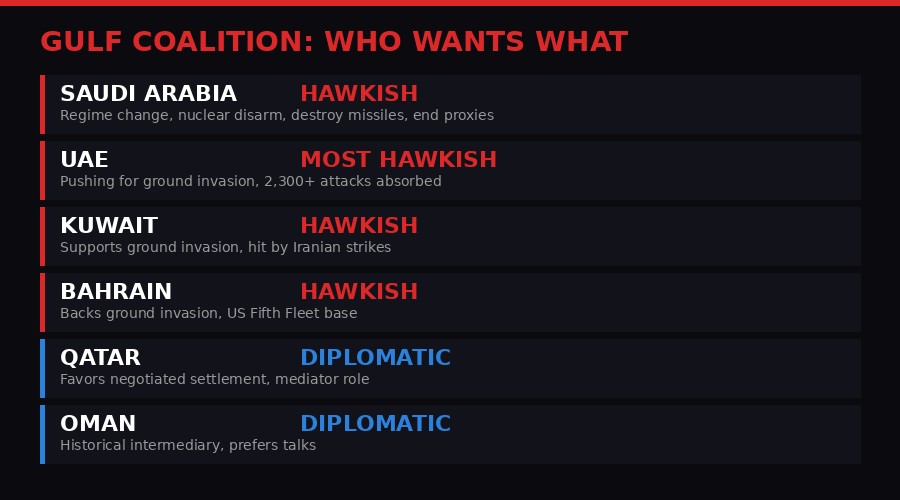
The revelation shatters the official narrative that Gulf states were reluctant participants dragged into a war they didn't want. After initially complaining they weren't given adequate advance notice of the February 28 strikes, the region's richest nations have pivoted hard toward escalation. And the most hawkish voice in the room belongs to the one country most people associate with glittering skyscrapers and luxury tourism: the United Arab Emirates.
The Emirates Want a Ground Invasion
The UAE has emerged as the most aggressive advocate for military escalation. According to the AP's sources - US, Gulf and Israeli officials speaking anonymously - Abu Dhabi is pushing hard for Trump to order a ground invasion of Iranian territory. Kuwait and Bahrain have backed this position. (AP News, March 30, 2026)
The Emirates' fury is not abstract. Since the war began on February 28, the UAE has absorbed more than 2,300 missile and drone attacks from Iran and its proxies. On Monday alone, a drone struck a Kuwaiti oil tanker in Dubai waters, starting a fire that authorities scrambled to contain into Tuesday morning. (AP News, Dubai Media Office statement, March 31)
For a country that has spent decades building its brand as the safe, pristine, monied hub of the Middle East, each incoming missile is an existential threat to something more important than any building: investor confidence.
"An Iranian regime that launches ballistic missiles at homes, weaponizes global trade and supports proxies is no longer an acceptable feature of the regional landscape. We want a guarantee that this will never happen again."
- Noura Al Kaabi, UAE Minister of State for Foreign Affairs, writing in The National (March 31, 2026)
That language - "never happen again" - is the diplomatic equivalent of demanding unconditional surrender. The UAE isn't asking for a ceasefire. It's asking for the permanent defanging of Iranian military power.

Saudi Arabia's Four-Point Destruction Checklist
If the UAE is the loudest voice in the room, Saudi Arabia is the most methodical. Crown Prince Mohammed bin Salman, the kingdom's de facto ruler, has personally conveyed to White House officials that the war must not end prematurely. According to the AP's sources, Riyadh's position boils down to four non-negotiable demands. (AP News, March 30, 2026)
First: Neutralize Iran's nuclear program. The kingdom has watched Iran accelerate enrichment throughout the conflict, with the IAEA reporting that Tehran's stockpile of 60%-enriched uranium has grown significantly since strikes began. Saudi Arabia considers an Iranian nuclear weapon the single greatest threat to its existence.
Second: Destroy Iran's ballistic missile capabilities. Every night, Saudi air defenses intercept Iranian missiles targeting the kingdom's oil infrastructure. On Monday, Saudi forces shot down five missiles aimed at the oil-rich Eastern Province. (AP News, March 31, 2026) The kingdom wants those launch sites eliminated permanently.
Third: End Tehran's support for proxy groups. Hezbollah in Lebanon, the Houthis in Yemen, militias in Iraq and Syria - for decades, these organizations have served as Iran's forward operating bases. Riyadh wants the funding pipelines cut.
Fourth: Guarantee that the Strait of Hormuz can never again be weaponized. Before the war, roughly 20% of the world's oil flowed through this chokepoint. Since Iran effectively sealed it on February 28, the global economy has been hemorrhaging. Only a handful of Chinese-, Indian- and Pakistani-flagged vessels have been granted passage, often after paying what amounts to a $2 million extortion fee per transit. (BBC News, March 31; AP News, March 30)
Achieving these four objectives would require either a fundamental transformation of the Islamic Republic's governing ideology or the removal of the clerical regime that has ruled Iran since 1979. Saudi officials are explicitly telling Washington that they're fine with either outcome.
The April 6 Deadline: Six Days and Counting
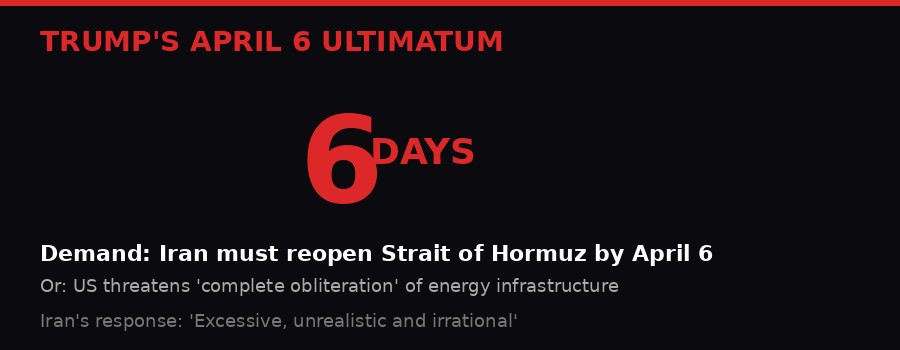
The Gulf lobbying campaign comes at a critical juncture. President Trump has given Iran until April 6 to reopen the Strait of Hormuz. If Tehran refuses, Trump has threatened to "completely obliterate" Iranian power plants, oil wells, Kharg Island, and possibly even desalination plants that supply drinking water to millions. (AP News, March 31, 2026)
Iran's response has been unambiguous. Foreign Ministry spokesman Esmail Baghaei said Tehran had received a 15-point proposal from the Trump administration containing "excessive, unrealistic and irrational" demands. He denied any direct talks are taking place. (AP News, March 31)
Parliamentary speaker Mohammad Bagher Ghalibaf, the former Revolutionary Guard commander whom Trump claims he is negotiating with, went further. He said Iranian forces were "waiting for the arrival of American troops on the ground to set them on fire and punish their regional partners forever." (IRNA via AP News, March 31)
The gap between the two sides is enormous. Trump oscillates daily between claiming "great progress" in talks and threatening total destruction. Gulf allies are whispering in one ear that he must not stop. Domestic public opinion - where approval for the war continues to crater - is shouting in the other ear to bring troops home. The April 6 deadline sits in the middle like a live grenade with the pin half-pulled.
There is a strong argument that Trump boxed himself in. By publicly naming a date, he created a binary: either Iran complies (it won't) or he must escalate (with all the consequences that entails). Walking it back would be read as weakness by the Gulf allies who are spending billions on his campaign and by an Iranian regime that has already called his bluff twice during diplomatic talks that were interrupted by American strikes.

The Force Buildup: 57,000 Troops and Growing
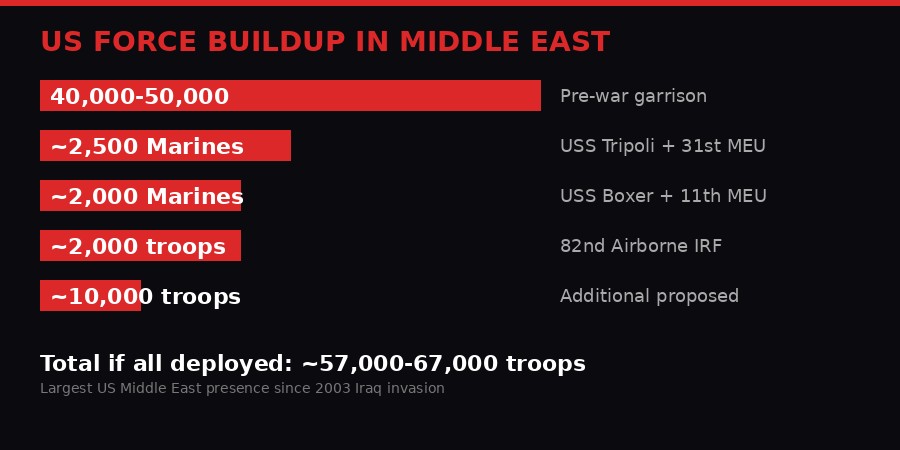
To understand the Gulf states' confidence that escalation is possible, look at the numbers. The United States now has between 57,000 and 67,000 military personnel either in the Middle East or en route. This is the largest American force concentration in the region in more than two decades. (Al Jazeera, AP News, March 30, 2026)
The pre-war garrison numbered 40,000 to 50,000 troops spread across bases in Saudi Arabia, Qatar, Kuwait, Bahrain, the UAE and other locations. Since February 28, a cascade of reinforcements has arrived:
The USS Tripoli Amphibious Ready Group, carrying about 2,500 Marines from the 31st Marine Expeditionary Unit, arrived Saturday. These Marines were pulled from exercises near Taiwan - a strategic redeployment that did not go unnoticed in Beijing. (US Central Command statement via AP, March 29)
The USS Boxer Amphibious Ready Group with the 11th Marine Expeditionary Unit, adding roughly 2,000 more Marines, has been ordered from San Diego. And approximately 2,000 paratroopers from the 82nd Airborne Division's Immediate Response Force at Fort Bragg are deploying or already on the ground.
On top of all this, US media reported Friday that the Pentagon is considering sending a further 10,000 ground troops to the region. (Washington Post, March 29; Al Jazeera, March 30)
Military analysts are divided on what this force could accomplish. John Phillips, a British security adviser and former military instructor, told Al Jazeera the deployments "point to limited, high-intensity operations like seizing Kharg Island or smaller islands in the Strait of Hormuz to stabilize the waterway and reopen shipping lanes, followed by quick extraction." (Al Jazeera, March 30)
Ian Lesser of the German Marshall Fund described the force as "a threat in being" - more useful as a deterrent and bargaining chip than as an invasion force. At 17,000 total deployed troops (including the proposed 10,000), this is nowhere near the 150,000-strong force that invaded Iraq in 2003. (Al Jazeera, March 30)
But seizing Kharg Island isn't Iraq. The island measures just 20 square kilometers. A nighttime parachute assault by the 82nd Airborne combined with an amphibious Marine landing could theoretically take it in hours. The problem, as BBC security correspondent Frank Gardner noted, is holding it. Iran's mainland sits close enough to subject any occupying force to constant bombardment - a scenario Gardner compared to Russia's failed attempt to hold Snake Island in the Black Sea during the Ukraine invasion. (BBC News, March 31, 2026)
The Economic Pressure Cooker
Behind the geopolitical chess moves is a brutal economic reality. The war is bleeding the global economy dry, and the bleeding is accelerating.
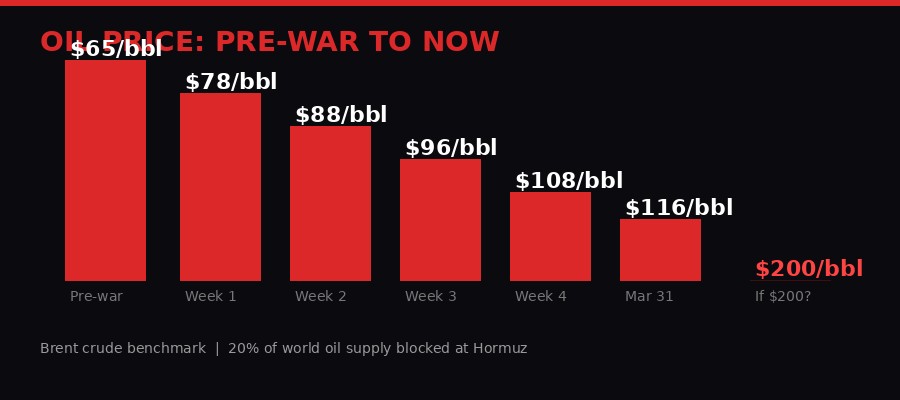
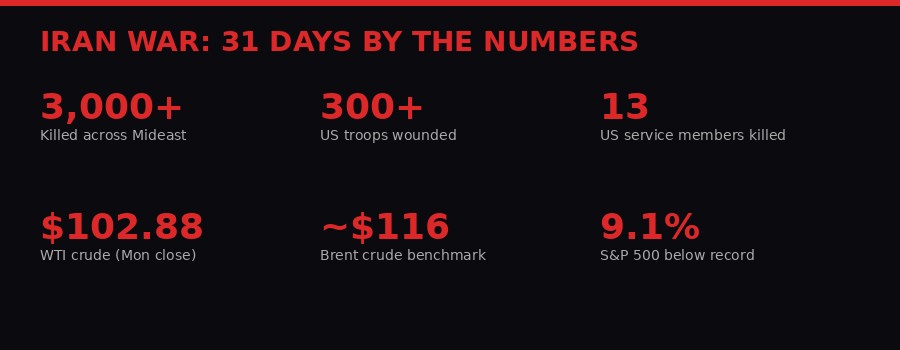
US benchmark crude settled at $102.88 per barrel on Monday, up 3.3% on the day. Brent crude, the global benchmark, climbed toward $116. Before the war, Brent was trading around $65. That's a 78% increase in 31 days. (AP News market data, March 31)
The S&P 500 slipped another 0.4% Monday, extending its loss to 9.1% below its January all-time high. The Dow and Nasdaq are both in technical correction territory - down more than 10% from their records. Morgan Stanley strategists led by Michael Wilson noted "growing evidence the S&P 500 correction is getting closer to its ending stages," but that assessment comes with a massive caveat: if the Federal Reserve decides oil prices threaten sustained inflation, rate hikes could follow, sending markets into free fall. (AP News, March 31; Morgan Stanley research note)
The shipping crisis compounds everything. Lars Jensen, a shipping expert and former Maersk director, told the BBC that the impact of the Hormuz closure could be "substantially larger" than the 1970s oil crisis. International Energy Agency director Fatih Birol went further, calling this "the greatest global energy security threat in history." (BBC News, March 31)
The numbers back those claims. The 1970s Arab oil embargo cut global supply by 5-7%. The current Hormuz closure affects 20% of the world's oil supply - roughly three to four times worse in raw volume terms. Alicia Garcia Herrero, chief economist for Asia Pacific at Natixis, warned of "sharper price spikes, broader inflation pain, and deeper recession risks, especially in import-heavy Asia." (BBC News, March 31)
And here's the detail that should terrify everyone: Jensen noted that oil tankers that left the Gulf more than a month ago are only now finishing their deliveries to refineries worldwide. When that pipeline runs dry - which it will within weeks - shortages will intensify dramatically. "The oil shortages we've been seeing, they're only going to get worse, even if magically the Strait of Hormuz would reopen tomorrow," he said. "We will face massive energy costs, not just while this crisis goes on but also for six to 12 months after it's over." (BBC Today programme, March 31)

The Battlefield: Monday's Toll
While diplomats lobby and economists calculate, people are dying. More than 3,000 people have been killed across the Middle East since February 28, according to AP tallies. Over 300 US service members have been wounded. Thirteen Americans are dead. (AP News, March 30-31)
Monday's violence stretched across multiple fronts simultaneously:
Israel: A fire broke out at an oil refinery in the northern city of Haifa for the second time during the war after an Iranian missile strike. Sirens sounded near Israel's main nuclear research center at Dimona, which has been targeted repeatedly in recent days. The military also intercepted two drones launched from Yemen, where Houthi rebels opened a new front on Saturday. (AP News, March 31)
Saudi Arabia: Five Iranian ballistic missiles were intercepted over the oil-rich Eastern Province. Prince Sultan Air Base, the key US-Saudi installation south of Riyadh, has been hit by Iranian attacks throughout the war, most recently Friday when six ballistic missiles and 29 drones injured at least 15 American troops. The cumulative US casualty count at this single base has climbed steadily. (AP News, March 30-31)
UAE: A fireball erupted over Dubai as a missile was intercepted. Hours later, a drone struck a Kuwaiti oil tanker in Dubai waters. For a city that has positioned itself as the world's safest playground for the ultra-wealthy, fireballs in the sky are an existential brand crisis.
Kuwait: Iran struck a power and desalination plant - the type of dual-use infrastructure that provides both electricity and drinking water. Trump has threatened to target similar facilities inside Iran, a move legal scholars say could constitute a war crime if civilian harm outweighs military advantage. (AP News, March 31)
Lebanon: Two Indonesian UN peacekeepers were killed in an explosion in southern Lebanon, where Israel's ground invasion continues to expand. At least three peacekeepers have died this week alone. (Al Jazeera, UNIFIL statement, March 30)
Baltic Sea: In a parallel conflict that is now intertwined with the Iran war, BBC Verify confirmed Ukraine struck three major Russian oil export facilities near St. Petersburg between March 23-28. The ports of Primorsk and Ust-Luga, which together handled 42% of Russia's oil exports in 2025, have been burning for days. No ships were loaded at any of Russia's three Baltic ports on March 26-27 - the first consecutive two-day loading halt since the 2022 invasion. (BBC Verify, March 31)
Ukrainian President Volodymyr Zelensky said allies have asked Kyiv to reduce strikes on Russian energy infrastructure because of the global energy crisis. He said Ukraine would only stop if Russia stopped targeting Ukraine's energy system. The world's two hottest wars are now feeding each other's economic damage in a vicious cycle with no off-ramp in sight.

The Domestic Problem Trump Can't Bomb Away
For all the Gulf allies' enthusiasm for escalation, Trump faces a wall of opposition at home that no amount of Riyadh lobbying can demolish.
Public support for the war continues to erode. AP-NORC polls show a steady decline since the conflict began, and Trump is under growing pressure from both sides of the aisle to demonstrate results. Gas prices, the single most visible economic indicator for American voters, are climbing relentlessly. Rising fuel costs hit hardest among the working-class voters who form Trump's electoral base. (AP News, March 30)
Congress is simultaneously wrestling with the DHS shutdown that has left TSA workers unpaid, airport security in chaos, and multiple federal agencies crippled. Democrats are demanding immigration enforcement reforms in exchange for funding. The optics of launching a potential ground invasion while the government can't pay its airport screeners are brutal.
Trump tried to address the TSA crisis Friday by ordering emergency backpay. Workers received some - but not all - of what they're owed on Monday. Union leaders reported incorrect pay amounts and missing overtime. More than 500 TSA officers have left the agency entirely. (AP News, AFGE union statement, March 31)
The president's own rhetoric doesn't help. He oscillates between war-hawk pronouncements and deal-maker posturing, sometimes within the same social media post. On Monday, he wrote that "great progress is being made" with "A NEW, AND MORE REASONABLE, REGIME" while simultaneously threatening to obliterate Iran's infrastructure. (Trump Truth Social post, March 31)
Secretary of State Marco Rubio, meanwhile, has been engaged in his own credibility battle. He lashed out at Spain and other NATO allies on Monday for insufficient support for the war effort, just days after the G7 summit exposed deep fractures in the Western alliance over the conflict. In an appearance on Good Morning America, Rubio described Iran's leaders as "religious zealots" with "an apocalyptic vision of the future" and insisted Gulf neighbors are "supportive of the efforts we're conducting." (AP News, ABC GMA, March 31)
Rubio's framing conveniently elides the distinction between Gulf states supporting the US effort and Gulf states demanding escalation beyond what Washington has committed to. The AP scoop reveals those are two very different things.
Iran's Shadow War on European Soil
The battlefield isn't limited to the Middle East. On Monday, French authorities revealed they had arrested two more suspects in connection with a foiled bombing at Bank of America's Paris headquarters near the Champs-Elysees. Five suspects are now in custody, including three minors. (AFP via Al Jazeera, March 30)
Interior Minister Laurent Nunez said authorities were investigating a link to the Iran war due to similarities with other attempted attacks across Europe. A pro-Iran Telegram group calling itself "Harakat Ashab al-Yamin al-Islamia" (Islamic Movement of the Companions of the Right) claimed responsibility for the Paris attempt and for an attack in London last week, where four ambulances belonging to a Jewish charity were set on fire in Golders Green. (Al Jazeera, March 30; French PNAT statement)
"Typically, intelligence services of this country [Iran] operate in this way. They use proxies, a series of subcontractors, often common criminals, to carry out highly targeted actions aimed at US interests, the interests of the Jewish community, or Iranian opposition figures."
- Laurent Nunez, French Interior Minister (March 31, 2026)
The Paris suspect reportedly told police he was recruited through Snapchat to carry out the bombing in exchange for 600 euros. The crude economics of proxy terrorism: you can wage war on European soil for the cost of a used iPhone.
This is the dimension the Gulf allies don't have to worry about. When Saudi Arabia and the UAE push for regime change, the proxy attacks land in London, Paris, Brussels and Amsterdam - not Riyadh or Abu Dhabi. The geography of consequence is wildly asymmetric.

What Happens Next: Three Scenarios
With six days until the April 6 deadline, the war is approaching its most dangerous inflection point. The Gulf lobby has narrowed Trump's options to a binary that both sides understand: escalate or lose face.
Scenario 1: The Kharg Island Raid. The most likely near-term escalation. US Marines and 82nd Airborne paratroopers seize Kharg Island - the 20-square-kilometer hub through which 90% of Iran's oil exports flow. The operation would be a dramatic show of force designed to choke Iran's revenue and force negotiations. But holding the island under constant mainland bombardment could produce a Snake Island scenario: a pyrrhic victory that looks good for 48 hours and turns into a grinding liability. Military analysts estimate high casualties. Iran has reinforced defenses including surface-to-air missiles. (BBC, Washington Post, Al Jazeera analysis, March 30-31)
Scenario 2: Infrastructure Obliteration Without Ground Forces. Trump follows through on his threat to destroy power plants, oil wells and desalination facilities from the air. This avoids the casualty risk of ground operations but crosses a humanitarian red line. Targeting desalination plants that provide drinking water to Iran's 88 million people would draw comparisons to siege warfare and potentially constitute a war crime under international humanitarian law. Legal scholars have repeatedly flagged this. (AP News, March 31)
Scenario 3: The Deal That Nobody Believes. Pakistan-mediated talks produce a framework that allows both sides to claim victory. Iran agrees to loosen its Hormuz chokehold in exchange for a bombing pause. The Strait partially reopens. Oil prices drop. Trump gets his "deal." The problem: Gulf allies have explicitly told Washington they consider anything short of regime change or total disarmament an insufficient outcome. Saudi Arabia's four-point checklist would remain unfulfilled. The Gulf states would view it as a betrayal - and Iran would rebuild.
There is a fourth scenario that nobody in Washington or Riyadh wants to discuss publicly: the war simply grinds on. No deal. No invasion. No decisive strike. Just a slow, escalating hemorrhage of lives, money and global economic stability with no endpoint. The 1970s oil crisis lasted months. The Iran-Iraq war lasted eight years. History suggests that once wars in the Persian Gulf start, they don't end quickly - regardless of what any president promises.
The Precedent Problem
What the Gulf shadow lobby reveals is something deeper than a tactical disagreement about war strategy. It reveals the fundamental architecture of American military decision-making in 2026: a president buffeted by competing pressures from foreign allies who want more war, domestic voters who want less, markets that want certainty, and an enemy that refuses to negotiate on terms anyone in Washington would accept.
The Gulf states have learned from recent history. In 2019, when Iran shot down a US drone and attacked Saudi oil facilities at Abqaiq and Khurais, Trump chose restraint. The Gulf allies viewed that as a catastrophic failure of deterrence. They've spent the intervening years cultivating relationships, making investments, and building the case that the next time an opportunity arose, America must not hesitate.
That next time is now. And they're not going to let Trump walk it back.
The question is whether a president who built his political brand on "deals" can resist the pressure from allies who have explicitly told him they don't want one - at least not the kind that leaves the Islamic Republic standing.
Six days. The clock is running.
Get BLACKWIRE reports first.
Breaking news, investigations, and analysis - straight to your phone.
Join @blackwirenews on Telegram