"Patience Is Not Unlimited": How Iran's Drone Campaign Is Breaking the Gulf States
For five weeks, Kuwait, Bahrain, the UAE, and Saudi Arabia have absorbed Iranian drone and missile strikes with formal restraint, citing de-escalation and diplomacy. The restraint is fracturing. Water is rationed. Oil burns. And the GCC's threshold for absorbing punishment - silent and unreciprocated - is approaching its end.

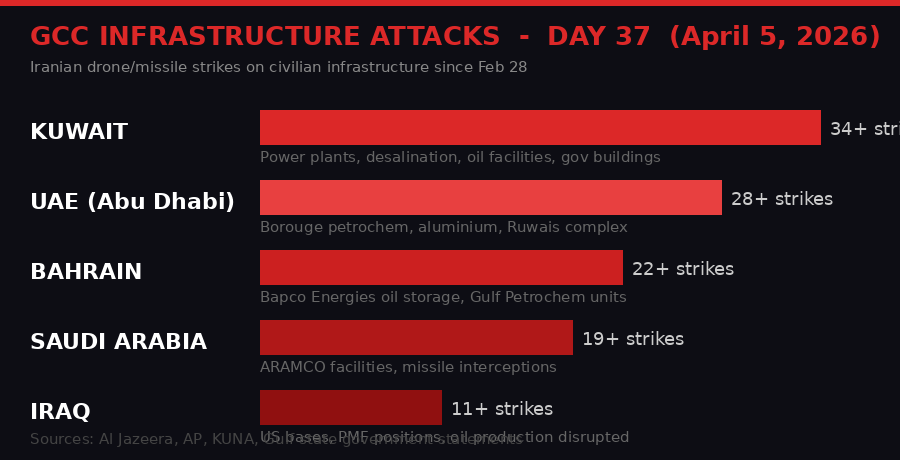
On Sunday morning, Kuwait's Ministry of Electricity, Water and Renewable Energy reported what had become an almost routine announcement: Iranian drone attacks had struck two power and water desalination plants overnight, shutting down two electricity-generating units and causing, in the ministry's words, "serious material damage." The spokesperson, Fatima Abbas Johar Hayat, called it "criminal aggression." [Al Jazeera, April 5]
Routine. That word is the story.
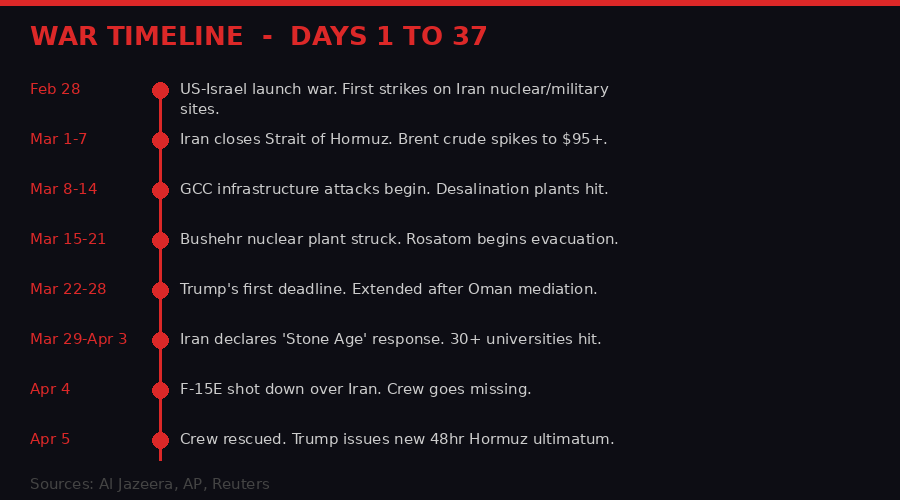
In 37 days of conflict between the United States, Israel, and Iran, the Gulf Cooperation Council states - Saudi Arabia, Kuwait, Bahrain, the UAE, Qatar, and Oman - have been the unacknowledged collateral battlefield. They were not party to the decision to go to war. They were not consulted when the US and Israel launched strikes on Iran on February 28. But they are the ones absorbing Iran's retaliatory fury, one drone wave at a time.
The scale of damage to Gulf civilian infrastructure is now severe. Desalination plants that provide drinking water to populations with almost no alternatives. Oil storage facilities that power national economies. Government buildings. Petrochemical complexes. And as of April 5, the same pattern continues: Kuwait, Bahrain, Abu Dhabi, and Saudi Arabia all reported fresh attacks before noon.
The GCC has maintained extraordinary public restraint, insisting on de-escalation and dialogue. But behind the formal language, a harder calculation is forming. "Gulf patience is not unlimited," Al Jazeera's correspondent in Doha reported on Sunday. Saudi Arabia has specifically invoked Article 51 of the UN Charter - the right to self-defense - in public statements over the past week. [Al Jazeera, April 5]
The question is no longer whether the Gulf states can absorb more punishment. It is how much more they will absorb before the restraint breaks - and what happens to the region when it does.
The Water War Nobody Declared
In Kuwait, around 90 percent of the country's drinking water comes from desalination plants. There is no river. There is no meaningful groundwater to speak of. The plants are not a convenience - they are the difference between a functioning society and a crisis.
Iran struck two of them on Saturday night.
The attacks on the Al Doha and Shuwaikh desalination facilities caused the shutdown of two generating units and, according to the ministry, "serious material damage." The same overnight attack also struck the Shuwaikh Oil Sector Complex, causing fires, and hit a government office complex with what was described as "significant damage." [KUNA / Al Jazeera, April 5]
By Sunday afternoon, the Kuwait Petroleum Corporation had reported additional losses from Iranian drone strikes on several of its facilities. Firefighters were deployed to prevent blazes from spreading. No casualties were reported - but the absence of casualties in these attacks is not proof of Iranian restraint. It is proof that Gulf civil defense systems are effective, and that the attacks are designed to destroy infrastructure rather than kill people directly.
The distinction matters legally. Attacking civilian infrastructure - power plants, water systems, oil facilities not directly involved in military operations - sits in complicated territory under international humanitarian law. The AP reported this week that both sides have drawn warnings of "possible war crimes" from legal observers, as Iranian strikes hit Gulf civilian targets and US-Israeli strikes hit Iranian hospitals, universities, and the Pasteur Institute. [AP, April 5]
Al Jazeera's correspondent Malika Traina, reporting from Kuwait City, described the plant attacks as "devastating news." She noted that the situation was not merely about electricity. Desalination is the backbone of drinking water supply across the entire Gulf. If multiple plants across multiple countries face sustained targeting, the humanitarian implications extend far beyond blackouts.
Kuwait is not alone. The UAE's Borouge petrochemical plant in Abu Dhabi was forced to suspend operations on Sunday after fires broke out, caused by falling debris from intercepted Iranian projectiles. The Abu Dhabi Media Office confirmed the suspension pending damage assessment, and noted no injuries - but the Borouge complex is one of the world's largest integrated polyolefins producers. Its shutdown is an economic blow with global supply chain implications. [Abu Dhabi Media Office statement, April 5]

Bahrain's Daily Crisis
Bahrain is a small island nation of around 1.5 million people. It hosts the US Navy's Fifth Fleet. It has been one of the most consistent targets of Iranian attacks since the war began - perhaps because of its role as the operational hub for American naval power in the Gulf, perhaps because Tehran calculates that Bahrain's close alignment with Washington and Riyadh makes it a legitimate pressure target.
On Sunday alone, Bahrain absorbed strikes on at least two major energy facilities.
Bahrain's Gulf Petrochemical Industries Company reported that several of its operational units were hit by Iranian drones. Bapco Energies - the national oil company - reported that an oil storage tank was struck and caught fire. The blaze was extinguished. Civil defense teams were deployed. Air raid sirens had activated earlier in the day. [Bahraini government statements / Al Jazeera, April 5]
The Interior Ministry confirmed the Bapco fire without specifying the location, describing it as the result of "Iranian aggression." No deaths were reported. But the cadence of these attacks - daily, systematic, targeting the same categories of infrastructure - represents a campaign rather than a series of isolated incidents.
Bahrain's government has maintained public composure while escalating its diplomatic pressure. The kingdom's alignment with the US Fifth Fleet puts it in a delicate position: it cannot publicly condemn the war that its American partner initiated, but it is also absorbing Iranian punishment for hosting that partner. The political cost of that position grows with every burning oil tank.
Saudi Arabia, meanwhile, reported intercepting missiles early Sunday. The kingdom has not confirmed specific damage from this wave, but has been conducting near-daily interceptions for weeks. Saudi Aramco facilities, the world's most critical oil infrastructure, have been targeted multiple times since the conflict began. The country has, for now, contained the damage - but the tempo of attacks shows no sign of abating.
Iran's Strategic Calculus: Hurt the Hosts
Iran's targeting of Gulf infrastructure is not random. It reflects a specific strategic logic that Tehran has maintained consistently across 37 days of conflict.
The theory of the campaign is coercion through pain. Iran cannot strike the American homeland. It cannot easily target Israel's civilian infrastructure at sustained scale. But it can strike the Gulf states that host American bases, provide logistical support to US operations, and whose economic pain gets transmitted directly to global energy markets - and therefore to Western governments that rely on stable fuel prices.
Iran's military command has been explicit about this. Gen. Ali Abdollahi Aliabadi, with Iran's joint military command, issued a statement late Saturday threatening "all infrastructure used by the US military in the region." The framing - US military infrastructure - provides legal cover while the strikes themselves routinely hit civilian desalination plants and petrochemical facilities. [AP, April 5]
Tehran has also been selective in ways that reveal the political rather than purely military nature of the campaign. On Saturday, Iran's Khatam al-Anbiya Central Headquarters announced that Iraqi ships would face no restrictions in the Strait of Hormuz, exempting Baghdad from the blockade. The statement praised Iraq's "struggle against the US" and expressed "profound respect for Iraq's national sovereignty." [Tasnim news agency, April 5]
The message is clear: Iran is using access to the strait and the threat of infrastructure strikes as political tools. Countries that maintain distance from Washington get exemptions. Countries that host US forces - Kuwait, Bahrain, UAE, Saudi Arabia - get drone waves.
This is not war as conventional military theory defines it. It is economic coercion, infrastructure warfare, and political signaling conducted simultaneously, at scale, in real time.

The Hormuz Hostage Situation
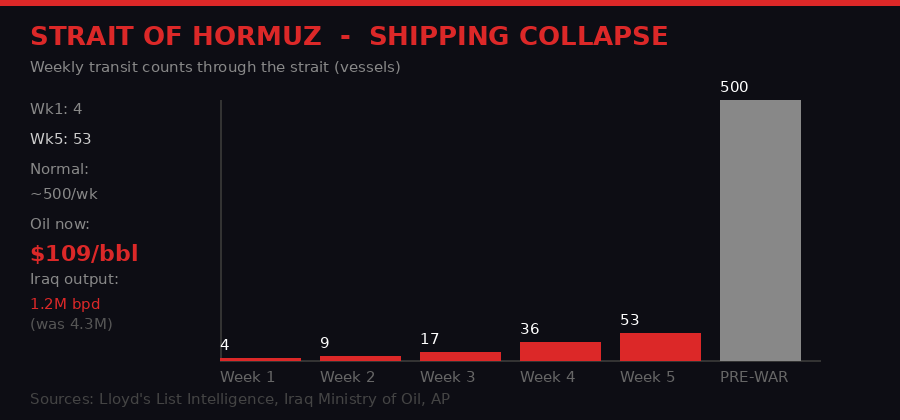
The Strait of Hormuz is 21 miles at its narrowest point. Through it, in normal times, passes roughly one-fifth of the world's oil and liquefied natural gas. Since February 28, Iran has effectively closed it - a blockade that has reordered global energy markets, forced emergency conservation measures across Europe and Asia, and pushed oil to levels not seen since the 2022 energy shock.
As of April 5, Brent crude is trading above $109 per barrel, with analysts forecasting a further surge if the waterway remains blocked. [AP, April 5]
The most recent data from Lloyd's List Intelligence shows 53 vessel transits through the strait last week - the highest since the war began, but still down more than 90 percent from pre-war normal levels. The slight uptick reflects Iran's evolving management of the blockade: a de facto toll system in which certain ships, from certain countries, are permitted to pass under Iranian oversight. Iraqi ships are now explicitly exempted. A French container ship and a Japanese tanker crossed earlier this week in the first apparent transits linked to those nations since the conflict began. [Lloyd's List Intelligence / Al Jazeera, April 5]
Iraq has been hit hardest economically by the blockade, and the numbers illustrate why. Iraq's oil production - the source of more than 90 percent of government revenue - has collapsed from 4.3 million barrels per day to 1.2 million barrels per day since the war began, according to Iraq's Ministry of Oil. A country already struggling with infrastructure decay and political instability is now watching its economic lifeline drain away. [Iraq Ministry of Oil / Al Jazeera]
Trump's latest ultimatum demands Iran reopen the strait by 9 p.m. Eastern time Monday - 1 a.m. GMT Tuesday. If they don't comply, he has promised strikes on Iran's power plants and bridges, threatening in a Truth Social post that the "crazy bastards" would be "living in Hell." He ended the post: "Praise be to Allah." [AP, April 5]
Iran's central military command dismissed the ultimatum as a "helpless, nervous, unbalanced and stupid action." They have heard Trump's deadlines before - he issued similar ultimatums in weeks two and four of the conflict, both of which were extended when Oman-mediated talks produced incremental gestures. The question this time is whether there is any diplomatic movement left, or whether both sides have exhausted the space for face-saving compromise.
Oman's Foreign Ministry confirmed Sunday that deputy foreign ministers and experts from Iran and Oman met to discuss proposals for ensuring "smooth transit" through the strait. Egypt's foreign minister spoke separately with US envoy Steve Witkoff and Iranian Foreign Minister Abbas Araghchi. The diplomatic machinery is still turning. Whether it is generating real movement or just the appearance of movement is the question that will be answered by Tuesday.
The Day 37 Rescue and What It Revealed
The dominant operational story of April 5 was the rescue of the missing American crew member from a downed F-15E Strike Eagle - the colonel who had been missing since the jet was shot down on Friday in Iranian airspace. He became the first known American aviator to go down in Iranian territory since the war began.
Trump confirmed the rescue on Truth Social: "WE GOT HIM!" He described the operation as "one of the most daring rescue missions in US history" and said the colonel was recovered from "deep inside the mountains" in Iran after a "heavy firefight." The airman is seriously wounded but expected to survive. [AP / Truth Social, April 5]
Iran disputed the US account. State television aired footage claiming to show wreckage from US aircraft shot down by Iranian forces. The Islamic Revolutionary Guard Corps claimed to have destroyed two C-130 transport aircraft and two Black Hawk helicopters during the rescue operation, in addition to an MQ-9 Reaper drone. A regional intelligence official briefed on the mission told the AP that the US military deliberately destroyed two transport planes due to technical malfunction and brought in additional aircraft to complete the extraction. [AP, April 5]
Iran's military also reported shooting down a separate US A-10 attack aircraft - the status of its crew unknown. The A-10, a close air support platform not typically deployed in contested high-threat environments, appears to have been operating in a role consistent with the broader Iran campaign's strikes on hardened targets.
What the episode reveals - regardless of whose account is more accurate - is that Iran's air defense network, while degraded by five weeks of US and Israeli strikes, retains the capability to threaten American combat aircraft. Trump had stated publicly that Iran had "no anti-aircraft equipment." The F-15E shootdown and subsequent losses during the rescue operation directly contradict that claim. [AP, April 5]
Princeton historian Julian Zelizer, speaking to the AP, offered the most precise framing: "You can be the most assertive, aggressive president in the world but you don't control what happens overseas."

What the GCC Is Actually Facing
There is a gap between the formal diplomatic language coming out of GCC capitals and the lived reality of what is happening inside those countries.
Formally, the GCC Secretary-General Jassim al-Budaiwi addressed the UN Security Council on April 2 and called for "all necessary measures" to halt Iranian attacks and guarantee freedom of navigation. The statement condemned Iranian strikes as a "flagrant violation of international law." It stressed that GCC states must be included in any negotiations with Iran. [GCC / Al Jazeera, April 2]
In practice, the UNSC is deadlocked. Russia and China have blocked punitive resolutions against Iran. The US has not sought GCC military involvement - it did not consult the Gulf states before starting the war and has not coordinated the campaign with them since. The GCC is absorbing consequences from a conflict it did not choose and has no formal seat in.
The economic stress is real and compounding. The Gulf states are among the world's largest exporters of hydrocarbons. They are also heavily import-dependent for food, manufactured goods, and consumer products - all of which now pass through disrupted global supply chains at elevated cost. Energy revenues are constrained by the Hormuz blockade. Insurance costs for shipping through the region have skyrocketed. Foreign investment, already cautious, is pulling back from announced projects.
Al Jazeera's Victoria Gatenby, reporting from Doha, noted that both Kuwait and the UAE have been at the "epicenter" of Iranian attacks over the past several days. She flagged the central tension: "The concern here in the region is that if Trump and Netanyahu follow through on those threats to escalate attacks on Iran, the result may be that Tehran attacks similar facilities here in the Gulf." [Al Jazeera, April 5]
That is the bind. The Gulf states cannot control US escalation decisions. They cannot stop Iran from retaliating for those decisions against their infrastructure. And they cannot publicly split with Washington without undermining the security relationships that protect them from more direct Iranian pressure.
Mohamed ElBaradei, the former IAEA director-general, put the frustration plainly on April 5. Writing in Arabic on X, he addressed Gulf leaders directly: "Please, once again, do everything in your power before this madman turns the region into a ball of fire." [ElBaradei / X, April 5]

The Article 51 Signal and What Comes Next
The most important signal coming out of Gulf capitals this week is not diplomatic language about de-escalation. It is Saudi Arabia's repeated invocation of Article 51 of the United Nations Charter - the provision that enshrines the inherent right of nations to individual or collective self-defense if armed attack occurs.
Saudi Arabia does not invoke legal frameworks casually. When Riyadh begins publicly building the justification for self-defense, it is constructing the political and legal architecture for potential action. The question is what that action would look like, and what threshold would trigger it.
Al Jazeera's Gulf correspondent said explicitly on Sunday: "While Gulf countries have shown incredible restraint in the face of attacks over the past five weeks, it is not because they lack the ability to respond." Saudi Arabia has one of the most sophisticated and expensive military forces in the Arab world - built over decades of US and British arms sales, operational experience from the Yemen campaign, and investment in air defense systems. Kuwait, the UAE, and Bahrain all have capable forces.
The scenario that most worries regional analysts is not a Gulf state deciding to independently strike Iran. That remains highly unlikely given the political costs and the fear of Iranian retaliation at greater scale. The more probable risk is Saudi Arabia reaching its threshold and formally requesting US strikes on Iranian territory specifically in response to civilian infrastructure attacks on GCC soil. That request would give Trump political cover for another major escalation while shifting the casus belli to a more defensible framework: protecting US-allied civilian populations.
The other variable is what Trump actually does when his Tuesday deadline expires. He has issued deadlines before and extended them when mediators provided political cover. Oman and Egypt are both working the phones. But the rescue mission, the continued Hormuz blockade, and the ongoing Gulf attacks have created domestic political pressure for Trump to show consequences. His allies in Congress are beginning to ask questions about strategy and endgame that he has not answered publicly.
French President Emmanuel Macron said this week that the US "can hardly complain afterward that they are not being supported in an operation they chose to undertake alone." British Prime Minister Keir Starmer has refused to be drawn in despite Trump's pressure. France and the UK are reportedly leading efforts to formalize a mechanism for reopening the strait after fighting ends - but that framing assumes the fighting will end on a timeline that does not cause additional irreversible damage. [AP, April 5]
The allies who were not consulted before the war are now shaping the terms of how it ends - or doesn't.
The Civilian Cost That Goes Uncounted
The official casualty figures from the Gulf attacks are consistently low. Governments report fires contained, facilities damaged, no deaths. The civil defense response in Kuwait, UAE, Bahrain, and Saudi Arabia is fast and professional. The air defense systems - Patriots, THAAD, indigenous systems - intercept significant portions of incoming drones and missiles.
But the damage that goes uncounted is cumulative and structural.
Every desalination plant that goes offline represents a population that loses drinking water - not immediately, because buffer storage exists, but incrementally and dangerously over time. Kuwait's buffer capacity was designed for peacetime maintenance shutdowns, not sustained multi-week hostile disruption. Every oil facility that burns loses production capacity that takes months to restore. Every government building hit reduces the administrative capacity of states already managing a wartime emergency.
The human geography of the Gulf also means that labor migration communities bear disproportionate exposure. In Kuwait, around 70 percent of the population is foreign nationals - migrant workers from South Asia, Southeast Asia, Egypt, and elsewhere, concentrated in less protected residential and industrial zones. Their vulnerability is real and largely undocumented in official casualty counts.
The reciprocity in civilian infrastructure targeting - however each side frames it legally - is creating conditions where civilian populations across the entire region, on both sides of this war, are being subjected to sustained infrastructural harm. Iran's Mahshahr Petrochemical Zone attacks killed five and wounded 170 by Iranian media accounts. US-Israeli strikes have hit 30-plus universities, the Pasteur Institute, and multiple civilian power facilities. [Al Jazeera, April 4-5]
International humanitarian law prohibits attacks on objects indispensable to civilian survival - water infrastructure, food production, power systems - when the purpose is to deny those objects to civilians. The AP's reporting on potential war crimes noted legal concerns about both sides' targeting choices. [AP, April 5] The legal questions will outlast this conflict by years. The damage is accumulating now.
What is happening in the Gulf is not a side story to the Iran war. It is the Iran war's most consequential front - the place where the fight is happening to populations with the least ability to end it, in the most critical geography for global energy and economic stability. The GCC states did not start this. They cannot stop it. And their patience, as their own leaders have now made clear, is running out.
STATUS AS OF APRIL 5, 1600 LOCAL TIME: Kuwait reports damage to two desalination plants and multiple oil facilities. UAE's Borouge plant suspended. Bahrain's Bapco oil tank fire extinguished. Saudi Arabia reports missile interceptions. Trump's 48-hour Hormuz deadline expires Tuesday 0100 GMT. Oman mediation ongoing. GCC has not announced direct military response. Iran has not commented on US rescue operation details.
Get BLACKWIRE reports first.
Breaking news, investigations, and analysis - straight to your phone.
Join @blackwirenews on Telegram