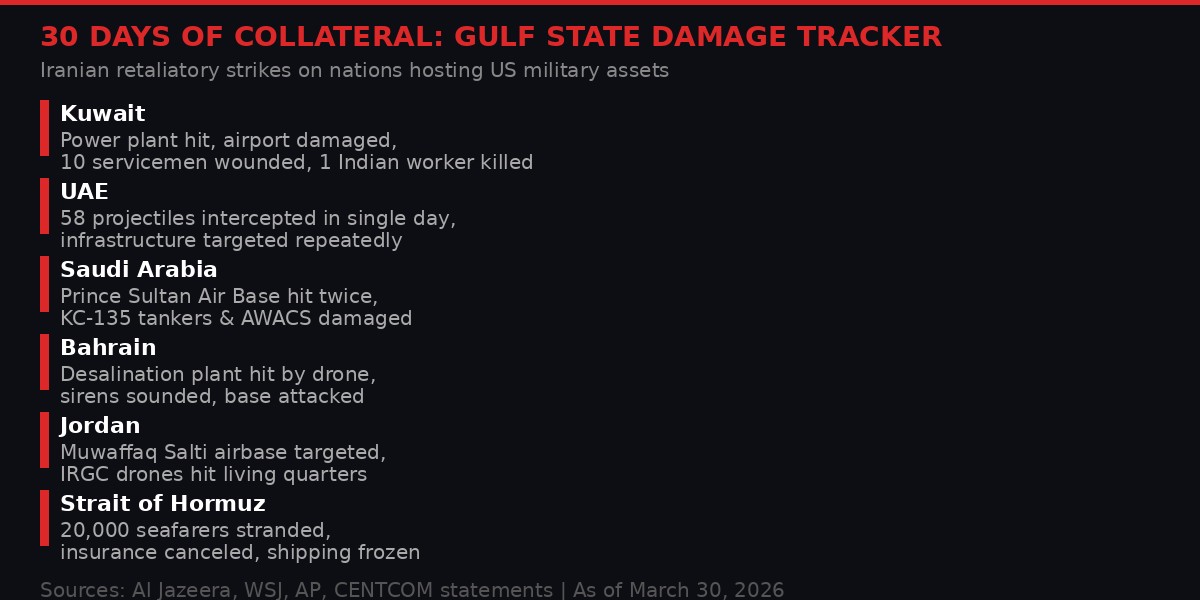
Thirty days of retaliatory strikes across six Gulf nations hosting US military assets. BLACKWIRE infographic.
On Monday morning, Kuwaiti authorities confirmed what residents along the coast had already seen: an Iranian projectile had struck a power and water desalination plant, killing an Indian migrant worker and causing what the Ministry of Electricity called "significant material damage." Technical teams rushed to the site. Operations continued. The dead man's name has not been released.
He is, by every measurable standard, collateral damage - a foreign national employed in critical infrastructure inside a country that did not declare war, did not fire the first shot, and has spent the past thirty days intercepting projectiles aimed at assets belonging to someone else. He worked at a water plant. He died in a war between Washington, Tel Aviv, and Tehran.
The Kuwait strike is not an isolated incident. It is the latest entry in a ledger that now spans all six Gulf Cooperation Council states, Jordan, and the maritime corridors that keep global commerce alive. Since February 28, when the United States and Israel launched their combined operation against Iran, the retaliatory campaign from Tehran has turned the entire Arabian Peninsula into an unwilling theater of operations. Desalination plants. Airports. Air bases. Oil terminals. Chemical factories. The targets are civilian as often as they are military, and the distinction - in a region where US troops live alongside migrant workers, where air bases share fence lines with commercial terminals - has collapsed entirely.
This is the story of those thirty days. Not from Washington or Tehran. From the countries caught in between.
The War That Arrived Uninvited
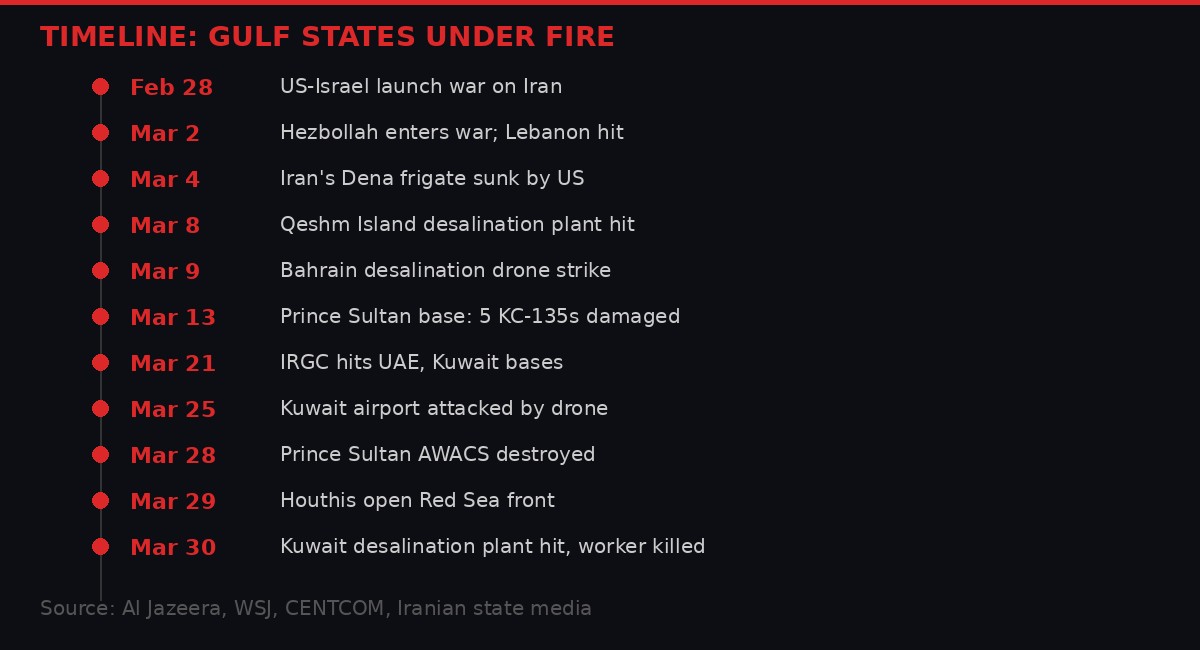
A month-long escalation: Iranian retaliatory strikes have hit every major Gulf state. BLACKWIRE timeline.
The Gulf states did not choose this war. They inherited it through decades of security architecture built around American military presence - bases in Kuwait, Qatar, Bahrain, Saudi Arabia, the UAE, and Jordan that were designed for power projection into Iraq, Afghanistan, and the broader Middle East. Those bases were always a theoretical vulnerability. Now the theory is empirical.
When the US and Israel struck Iran on February 28, Tehran's response was immediate and geographically expansive. Iran did not limit its retaliation to Israel or US naval assets. It targeted every node in the network - every base, every host nation, every piece of infrastructure within missile and drone range that supported the American air campaign. The logic was brutally simple: if these countries allow their territory to be used as a launchpad, their territory becomes a legitimate target.
Iran's foreign ministry has repeatedly warned Gulf neighbors "not to let enemies run the war from their land." The warning was not hypothetical. Within the first week, Iranian drones hit Bahrain's Isa Air Base, where the US Navy's Fifth Fleet is headquartered. Missiles struck near Saudi Arabia's Prince Sultan Air Base, where KC-135 tankers refuel American bombers mid-flight. Kuwait's Ali Al Salem Air Base, home to the US Air Force's 386th Air Expeditionary Wing, took multiple drone waves.
The Gulf states condemned the attacks. They intercepted what they could. They did not fire back. They are, in the precise language of international humanitarian law, non-belligerent states hosting belligerent forces - a legal gray zone that affords them neither the protections of neutrality nor the strategic agency of participation. They absorb the damage. They do not shape the outcome.
"Islamabad has now become the hub of all diplomatic activity to try to bring an end to the US-Israel war on Iran." - Al Jazeera correspondent Osama Bin Javaid, reporting from Islamabad, March 29, 2026
By the end of the first week, Iran had also declared effective control of the Strait of Hormuz, through which roughly 20 percent of the world's oil and liquefied natural gas transits daily. The blockade was not total - Pakistan negotiated passage for 20 of its flagged ships at a rate of two per day - but for commercial shipping, the strait was functionally closed. Insurance companies pulled coverage. Shipping lines rerouted. Oil futures crossed $100 per barrel and kept climbing.
The Gulf states, whose economies depend overwhelmingly on hydrocarbon exports transiting that exact waterway, watched their revenue lifeline constrict in real time.
Kuwait: The Desalination Frontline
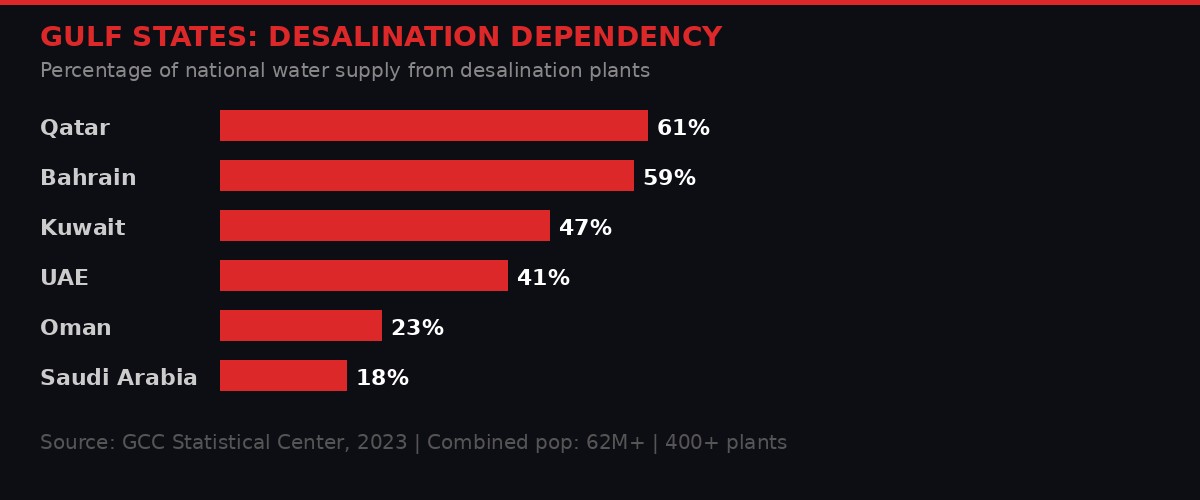
Gulf nations rely on desalination for survival - Qatar at 61%, Bahrain at 59%, Kuwait at 47%. BLACKWIRE data visualization.
Monday's attack on Kuwait's power and water desalination plant is not the first time critical infrastructure has been hit in the emirate, and it will not be the last. But it represents something the previous strikes on military bases did not: a direct hit on the system that keeps civilians alive.
Kuwait derives 47 percent of its total water supply from desalination, according to the GCC Statistical Center. The country has no permanent rivers. Groundwater accounts for most of the remainder, but aquifer levels have been declining for decades. Without functioning desalination plants, Kuwait's 4.5 million residents - roughly 70 percent of whom are foreign nationals - face a water crisis measured in days, not weeks.
The Indian worker killed in Monday's strike was employed in precisely this infrastructure. His death underscores a fact that rarely makes it into the war coverage: the Gulf states' critical systems are not maintained by Gulf citizens. They are maintained by millions of migrant workers from South Asia, Southeast Asia, and East Africa who live in labor camps adjacent to the facilities they operate. When a missile hits a desalination plant, the people inside are overwhelmingly Indian, Bangladeshi, Pakistani, Filipino, and Nepali nationals who came for a paycheck, not a conflict.
Kuwait's Ministry of Electricity said technical and emergency response teams were dispatched immediately to ensure continued operations. Iran's state media reported the damage but offered no official comment. The plant continues to function. The worker is still dead.
The attack came just hours after Kuwait's Defence Ministry reported that 14 missiles and 12 drones were detected in Kuwaiti airspace the previous evening. Several drones targeted a military camp, wounding 10 servicemen who were taken to hospital. Earlier in March, Kuwait's international airport sustained damage from a drone strike. Before that, the Ali Al Salem Air Base was hit repeatedly. The pattern is consistent and accelerating.
Saudi Arabia: The Base That Keeps Getting Hit

Prince Sultan Air Base has been struck twice in 30 days, damaging KC-135 tankers and an AWACS aircraft critical to the US air campaign. Photo: Pexels.
Saudi Arabia presents perhaps the most consequential case of collateral damage in the Gulf theater. The kingdom hosts Prince Sultan Air Base, a Saudi facility roughly 96 kilometers southeast of Riyadh that also serves as a critical hub for US air operations. It has been struck at least twice in the past month, with devastating results for the American air campaign.
On March 13, an Iranian strike damaged five KC-135 Stratotanker aerial refueling aircraft at the base, according to US officials quoted by The Wall Street Journal. The KC-135s are the backbone of the American air campaign - without them, fighter jets and bombers cannot maintain continuous sorties over Iranian territory. Each damaged tanker represents a gap in the refueling schedule, a reduction in the number of aircraft that can be kept aloft simultaneously.
Then, on March 28, Iran struck the base again. This time, the damage was worse. Multiple KC-135s were hit, along with an E-3 Sentry AWACS aircraft - the airborne early warning and control system that serves as the central nervous system of the US battle space. The E-3 is a modified Boeing 707 with a rotating radar dome capable of tracking drones, missiles, and aircraft from more than 375 kilometers away. The US operates a fleet of just 16 E-3s globally. Six have been deployed to the Middle East and Europe for this war. Losing even one creates what defense analysts call "coverage gaps" - periods where the US loses situational awareness over the Gulf.
"The loss of this E-3 is incredibly problematic, given how crucial these battle managers are to everything from airspace deconfliction, aircraft deconfliction, targeting and providing other lethal effects that the entire force needs for the battle space." - Heather Penney, former F-16 pilot and director of studies, Mitchell Institute for Aerospace Studies
At least 15 American soldiers were wounded in the March 28 attack, with five reported in serious condition, according to The Associated Press. Neither the US military nor Saudi Arabia has officially confirmed the incident. Iran's IRGC spokesperson released satellite imagery appearing to show destroyed aircraft at the base.
Saudi Arabia has intercepted numerous Iranian missiles and drones targeting its eastern oil-producing regions. The kingdom's own air defenses have been working at capacity. But the repeated strikes on Prince Sultan demonstrate that interception is not elimination - enough projectiles get through to cause strategic damage, and the consequences fall on Saudi soil.
Riyadh has condemned the Iranian attacks but has conspicuously avoided joining the US-Israeli military operation. Saudi Foreign Minister Faisal bin Farhan Al Saud traveled to Islamabad on Sunday for the four-nation diplomatic talks - a signal that the kingdom's preferred tool remains negotiation, not escalation. The kingdom's calculation is clear: absorb the strikes, maintain the alliance, and push for a ceasefire before the damage becomes irreparable.
The Water Weapon: Desalination as Strategic Vulnerability
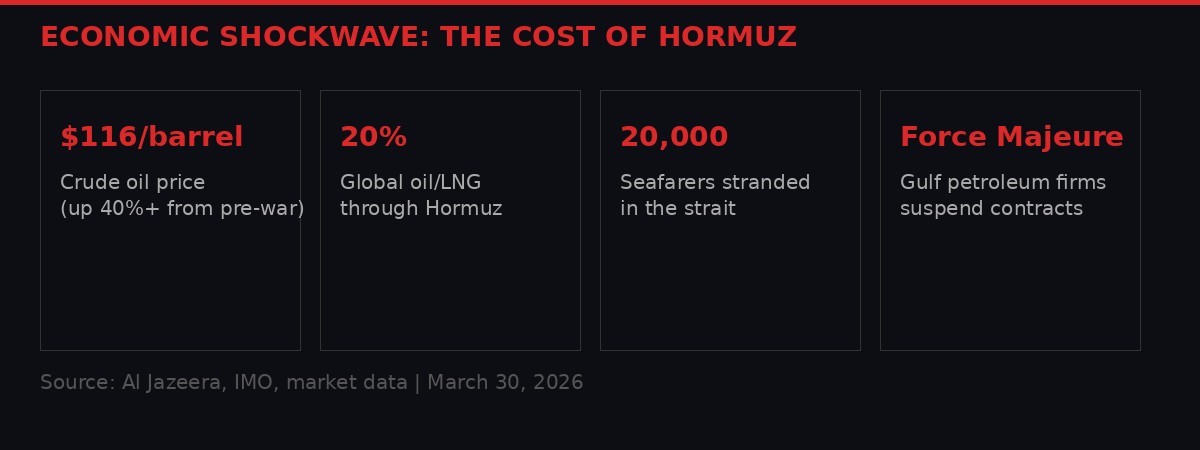
The closure of the Strait of Hormuz has sent oil past $116 per barrel, stranded 20,000 seafarers, and triggered force majeure declarations. BLACKWIRE data.
The targeting of desalination infrastructure deserves its own analysis because it represents a category of warfare that the Geneva Conventions were not designed to address at this scale. The Gulf states are among the most water-scarce territories on Earth. They have no permanent rivers. Their combined population exceeds 62 million people. They produce roughly 40 percent of the world's desalinated water across more than 400 coastal plants.
Qatar depends on desalination for 61 percent of its total water supply - and for more than 99 percent of its drinking water. Bahrain is at 59 percent. Kuwait at 47 percent. The UAE at 41 percent. These are not luxury systems. They are survival infrastructure. A sustained attack campaign against desalination plants in the Gulf would create a humanitarian crisis within 72 hours.
The precedent has already been set. On March 8, Iran's foreign minister accused the US of striking a desalination plant on Qeshm Island in the Strait of Hormuz, cutting water to 30 villages. Within 24 hours, Bahrain reported an Iranian drone had struck one of its own desalination plants near Muharraq. Now Kuwait's plant has been hit. The tit-for-tat targeting of water infrastructure represents an escalation ladder that both sides appear willing to climb but neither has publicly acknowledged as a strategy.
Article 54 of Protocol I of the Geneva Conventions prohibits attacking "objects indispensable to the survival of the civilian population," explicitly listing "drinking water installations and supplies and irrigation works." But the protocol's enforcement mechanisms are, as they have been in every major conflict since 1977, effectively nonexistent. The desalination plants will continue to be hit because they can be hit, and because hitting them creates political pressure that no amount of diplomatic language can replicate.
For the migrant workers who operate these plants - the technicians, the maintenance crews, the security staff - there is no evacuation plan. The Gulf states' labor systems do not provide for the emergency repatriation of millions of foreign workers. The Indian government has not issued a formal travel advisory pulling its nationals from Kuwait. Neither have Bangladesh, Nepal, Pakistan, or the Philippines. The workers remain because leaving means losing their livelihoods, and staying means accepting the risk of being killed at a water treatment facility by a missile intended to send a political message to Washington.
The UAE and Bahrain: Intercepting the Unacceptable
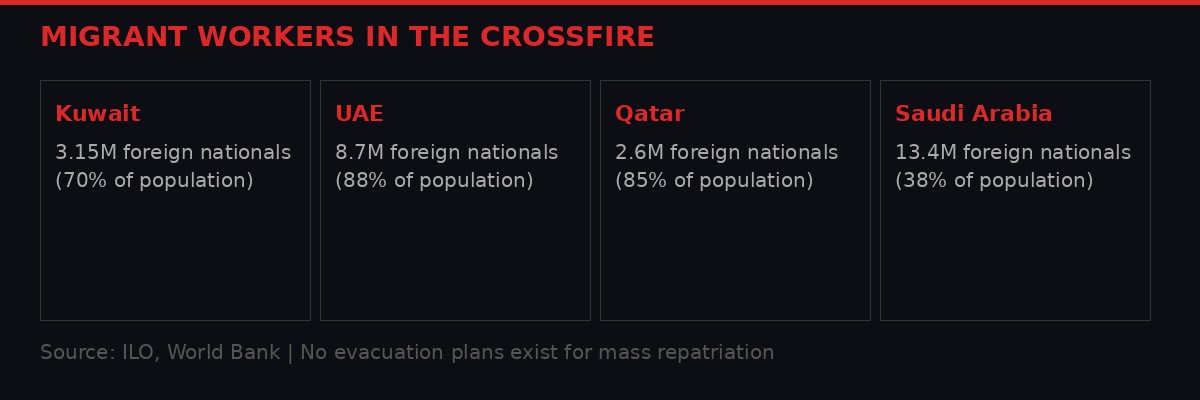
Millions of foreign nationals work in Gulf state infrastructure - none have evacuation plans. BLACKWIRE infographic.
The United Arab Emirates reported intercepting 16 ballistic missiles and 42 drones launched from Iran in a single 24-hour period on March 29. The numbers are staggering. Each interception represents a successful engagement by Emirati air defenses - but also an incoming projectile that, had it evaded the system, could have struck Dubai International Airport, Abu Dhabi's financial district, the Jebel Ali port that handles 15 million containers annually, or the Burj Khalifa itself.
The UAE has invested billions in missile defense systems, including the THAAD (Terminal High Altitude Area Defense) batteries purchased from the United States. Those systems are performing. But performance has limits. In March, Iran reportedly damaged a THAAD system at a US base in the UAE through a saturation attack - launching enough projectiles simultaneously that some evaded the defense umbrella. The THAAD incident has not been officially confirmed, but the implication is severe: the most advanced missile defense system in the American arsenal can be overwhelmed.
Bahrain, home to the US Navy's Fifth Fleet and Naval Support Activity Bahrain, has faced repeated attacks since the war began. The kingdom - geographically tiny, with a population of 1.6 million that depends on desalination for 59 percent of its water - is perhaps the most exposed of all Gulf states. It sits across the water from Iran's Bushehr province. Its territory can be reached by short-range rockets that don't require the sophisticated guidance systems of longer-range ballistic missiles. And its critical infrastructure - the desalination plants, the power stations, the causeway connecting it to Saudi Arabia - is concentrated in an area small enough that any sustained bombardment creates cascading failures.
Sirens have sounded in Bahrain repeatedly. Kuwaiti sirens have wailed through the night. In a region where the sound of an air-raid warning was, until five weeks ago, associated with historical documentaries rather than lived experience, the psychological impact is difficult to overstate. A generation of Gulf residents who grew up believing the American security umbrella would keep them safe are now listening to the evidence that it cannot.
Twenty Thousand Stranded at Sea
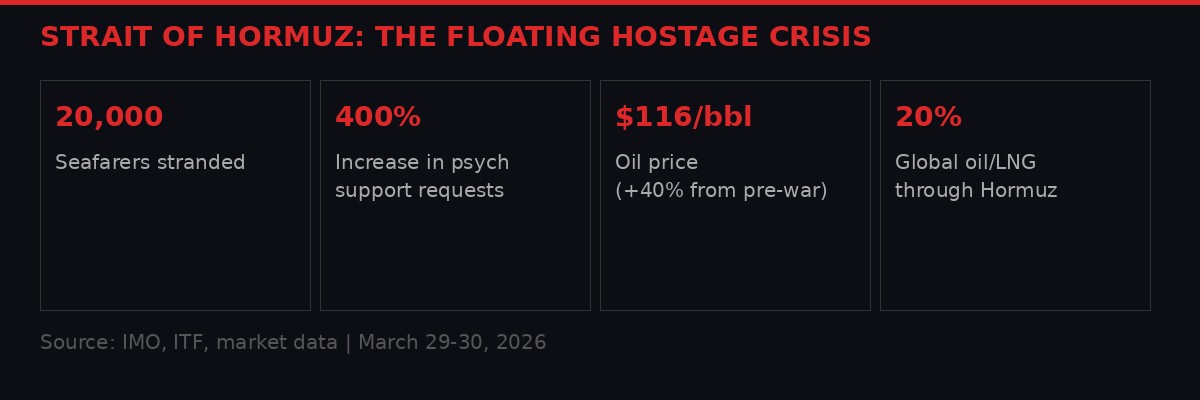
20,000 seafarers are trapped on vessels that cannot transit, dock, or turn back. BLACKWIRE data.
The human cost of the Strait of Hormuz closure extends beyond the nations bordering the waterway. The International Maritime Organization's Secretary-General Arsenio Dominguez delivered a stark warning on March 29: approximately 20,000 seafarers are stranded in or near the strait, trapped on vessels that cannot transit, cannot dock safely, and cannot turn back.
"We can insure the ship, but we cannot insure a human life." - Arsenio Dominguez, Secretary-General, International Maritime Organization, March 29, 2026
The crisis unfolded in stages. First, Iran declared control over waters near the strait and warned commercial vessels against transiting without permission. Then insurance companies - Lloyd's of London, the P&I clubs that underwrite maritime risk - pulled coverage for vessels entering the Persian Gulf. Without insurance, ships cannot legally operate. Without operating ships, crew cannot disembark. The seafarers are effectively hostages to a financial and military reality they had no part in creating.
The stranded workers are predominantly from the Philippines, India, Indonesia, Myanmar, and Bangladesh - nations that supply the vast majority of the world's commercial maritime labor. They work on oil tankers, container ships, LNG carriers, and bulk freighters. Their contracts typically guarantee repatriation at the employer's expense. But repatriation requires a safe port, and the safe ports in the Gulf are themselves under intermittent attack.
The IMO has called for a humanitarian corridor through the strait. Pakistan's negotiation of passage for 20 flagged ships represents the only concrete breakthrough. For the remaining thousands of vessels and tens of thousands of crew, the situation is described by maritime unions as a "floating hostage crisis" without a negotiator.
Mental health concerns among stranded crews are escalating. The International Transport Workers' Federation reported that requests for emergency psychological support from Gulf-stationed seafarers have increased by over 400 percent since the strait's effective closure. Dominguez noted that while ships can be insured and rebuilt, "we cannot insure a human life" - a statement of obvious truth that, in the context of this war, qualifies as radical.
The Islamabad Gambit: Diplomacy of the Desperate
Against this backdrop of cascading damage, the four-nation diplomatic summit in Islamabad represents the Gulf states' last, best effort to end the war through channels that do not involve either Washington or Tehran controlling the conversation.
Egyptian Foreign Minister Badr Abdelatty, Turkish Foreign Minister Hakan Fidan, and Saudi Foreign Minister Faisal bin Farhan Al Saud arrived in Pakistan's capital on Sunday for two days of talks hosted by Deputy Prime Minister Ishaq Dar. The meeting's purpose is not mediation in the formal sense - none of these nations has the leverage to impose a ceasefire on the United States. Instead, the talks represent what analysts describe as the construction of a "regional bloc" that could eventually include Indonesia and Malaysia, creating a diplomatic weight class that Washington cannot easily ignore.
The strategy, according to Middle East policy expert Mahjoob Zweiri, is to appeal directly to Trump's political brand. "They are appealing to the president's sensibilities," Zweiri told Al Jazeera. "The message is: 'You created this board and say you want to achieve peace. Go and make peace in this war.'" The reference is to Trump's Board of Peace initiative, which went dormant after its Gaza proposals failed. The Islamabad bloc wants to resurrect it - and reframe the Iran war as the Board's mandate.
Pakistan's role is particularly delicate. It shares a 900-kilometer border with Iran and is home to the world's second-largest Shia population. Its army chief, General Asim Munir, has developed a personal rapport with Trump, who has publicly called him "my favorite field marshal." Islamabad has condemned the attacks on Iran and Gulf states but named Israel explicitly while carefully avoiding naming the United States - a diplomatic contortion that reveals the tightrope Pakistan is walking.
As a confidence-building measure, Pakistan announced that Iran had agreed to allow 20 Pakistani-flagged ships through the Strait of Hormuz at two per day. The concession is minor in the context of global shipping volumes but significant as proof of concept: negotiation can open the strait. Whether it can end the war is another question entirely.
Political analyst Zahid Hussain characterized Pakistan's position bluntly: "Pakistan is currently playing the role of a messenger rather than a mediator, relaying messages between America and Iran. If the war ends following this initiative, it will significantly elevate Islamabad's diplomacy. But if it continues, Pakistan will be one of the countries most harmed."
The MAGA Fracture: When Your Own Side Breaks Ranks
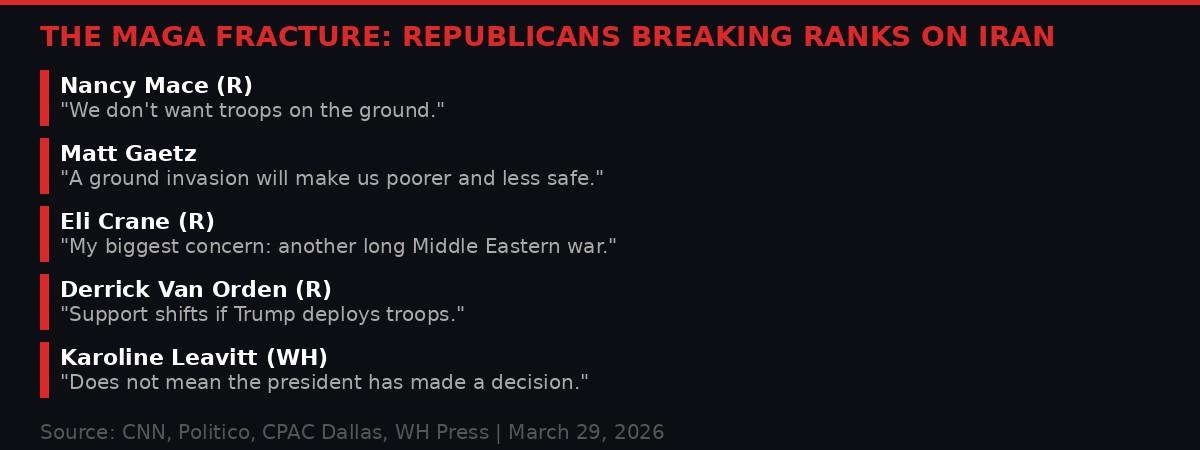
Multiple Republican lawmakers have publicly opposed ground operations in Iran. BLACKWIRE infographic.
The Gulf states' diplomatic offensive has an unexpected domestic ally in Washington: the growing fracture within Trump's own political base over the question of ground troops.
Republican Representative Nancy Mace stated on CNN on March 29 that Congress should authorize any deployment of ground forces to Iran. "If we're going to do a conventional ground operation with Marines and 82nd Airborne, that is a ground war that I believe Congress should have a say," she said. "We don't want troops on the ground. I think that's a line for a lot of people."
Mace is not a fringe voice. She emerged from a classified House briefing on the war with visible concern. Her position is shared by Representatives Eli Crane and Derrick Van Orden - both Republicans, both former military. "My biggest concern this whole time is that this would turn into another long Middle Eastern war," Crane told Politico.
The split reached the Conservative Political Action Conference in Dallas over the weekend, where former Representative Matt Gaetz - a Trump ally - directly condemned any ground invasion. "A ground invasion of Iran will make our country poorer and less safe," Gaetz said. "It will mean higher gas prices, higher food prices, and I'm not sure we would end up killing more terrorists than we would create."
The Pentagon, meanwhile, is preparing for exactly the scenario these Republicans oppose. The Washington Post reported on March 29 that the Department of Defense is planning limited ground operations in Iran, potentially including raids on Kharg Island - the crude export hub that handles 90 percent of Iran's oil shipments - and coastal sites near the Strait of Hormuz. One official estimated the operations would take "weeks, not months." Another said "a couple of months."
White House press secretary Karoline Leavitt did not deny the report. "It's the job of the Pentagon to make preparations in order to give the commander-in-chief maximum optionality," she said. "It does not mean the president has made a decision."
For the Gulf states, the distinction between preparation and decision is academic. Every additional US soldier deployed to the region represents another reason for Iran to strike the bases where those soldiers are stationed. The 3,500 personnel who arrived on the USS Tripoli on March 27, the 2,000 from the 82nd Airborne diverted from the Asia-Pacific, the potential 10,000 more that The Wall Street Journal reported Trump is considering - each increment of American force increases the incentive for Iranian retaliation, and that retaliation lands on Gulf state territory.
Lebanon: The Other Unwilling Front
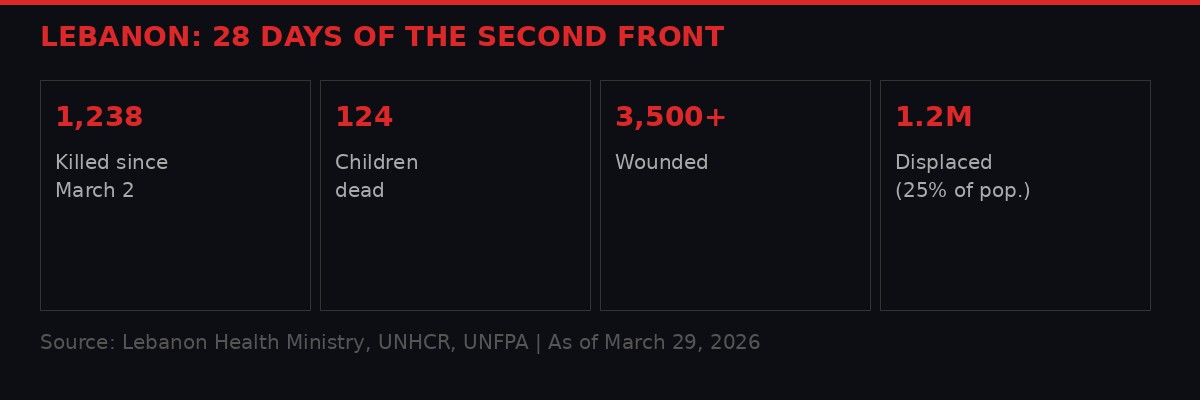
1,238 killed, 1.2 million displaced in 28 days - Lebanon's second devastation in two years. BLACKWIRE data.
The Gulf is not the only geography being consumed by a war it did not start. Lebanon, which was supposed to be under a ceasefire since November 2024, has been dragged back into full-scale conflict after Hezbollah launched retaliatory attacks on Israel in early March following the assassination of Iran's former Supreme Leader Ayatollah Ali Khamenei.
Israeli Prime Minister Benjamin Netanyahu announced on March 29 that he had instructed the military to "further expand the existing security buffer zone" in southern Lebanon. Israeli forces have reached a tributary of the Litani River south of the town of Qantara - a development Al Jazeera's correspondent described as a "big strategic change" that will trigger a major fight with Hezbollah.
At least 1,238 people have been killed in Lebanon since March 2, according to the Health Ministry. The toll includes 124 children. More than 3,500 have been wounded. On a single weekend - March 28-29 - 49 people died, including 10 rescue workers and three journalists killed in a targeted Israeli air strike on a clearly marked press vehicle in Jezzine.
A quarter of Lebanon's population - more than 1.2 million people - has been displaced by mass forced evacuation orders. The UN sexual and reproductive health agency warned that the displacement is "significantly different in the scale and speed and number of people impacted" from 2024. Women have been cut off from prenatal care. Cancer patients cannot access dialysis. Insulin-dependent diabetics have lost access to refrigeration for their medicine.
The National Lifeline for Emotional Support and Suicide Prevention in Lebanon reported a 67 percent increase in daily calls compared to the 2024 Israeli campaign - from about 30 per day to nearly 50. Operations manager Jad Chamoun described the situation as "a continuous trauma, because it's never ending." Lebanon has experienced economic collapse, COVID-19, the Beirut explosion, mass emigration, and now two large-scale Israeli military campaigns in less than two years. A UN mental health report from March 2025 found that three in five Lebanese people screened positive for depression, anxiety, or PTSD. That was before this round began.
A UNIFIL peacekeeper was killed on March 29 when a projectile struck a position near Adchit Al Qusayr in southern Lebanon. Another peacekeeper was critically injured. "We do not know the origin of the projectile," UNIFIL said. "We have launched an investigation." The investigation will take weeks. The war will not wait.
The Houthi Card and the Red Sea Expansion

The combined disruption of Hormuz and Bab al-Mandeb would be unprecedented in modern maritime history. Photo: Pexels.
As if the Gulf theater were not volatile enough, Yemen's Houthi movement launched its first attacks on Israel in late March, opening a new front in the war and raising the specter of a Red Sea shipping crisis layered on top of the Hormuz closure.
The Houthis, backed by Iran, control most of northern Yemen and have demonstrated since 2023 that they can target commercial shipping in the Bab al-Mandeb Strait - the narrow passage between Yemen and Djibouti through which roughly 12 percent of global trade transits. Their entry into the Iran war adds a second maritime chokepoint to the conflict, potentially cutting off the Suez Canal route for vessels attempting to bypass the closed Strait of Hormuz.
Iran's Tasnim news agency quoted an unnamed military source saying Tehran could open a "credible threat" at Bab al-Mandeb if military action targets Iranian islands or territory. A separate source claimed the Houthis are "prepared to play a role if there is a need to control the Bab al-Mandeb Strait to further punish the enemy."
The combined effect of Hormuz and Bab al-Mandeb disruptions would be unprecedented in modern maritime history. Ships attempting to avoid the Persian Gulf by routing through the Red Sea and Suez Canal would face a second gauntlet. Ships attempting to avoid both by routing around the Cape of Good Hope would add 10 to 14 days to their voyages, at a fuel cost increase of hundreds of thousands of dollars per transit. Oil at $116 per barrel would be the beginning, not the ceiling.
The Body Count Nobody Is Counting
Iran's Ministry of Health reports 2,076 people killed since February 28, including 216 children. Lebanon's Health Ministry counts 1,238 dead since March 2, including 124 children. These figures receive coverage. What does not receive coverage - what no ministry tracks and no news agency reports - is the cumulative toll among the Gulf states' populations.
Kuwait confirms one Indian worker dead at the desalination plant and 10 servicemen wounded the previous evening. Saudi Arabia has not confirmed any casualties from the Prince Sultan base strikes, but AP reported 15 Americans wounded with five serious in the March 28 attack alone. The UAE has reported intercepting 58 projectiles in a single day without disclosing whether any got through. Bahrain's casualty figures from repeated base and infrastructure attacks are undisclosed. Jordan's losses from the Muwaffaq Salti airbase drone strike are unknown.
The Gulf states have no incentive to publicize their casualties. Doing so would expose the failure of the American security umbrella they depend on, destabilize domestic populations that include millions of foreign workers who might leave, and invite further Iranian strikes designed to maximize political embarrassment. The silence is strategic. But strategic silence means people die without being counted.
The 20,000 stranded seafarers are not counted as casualties. The migrant workers living in labor camps next to military targets are not counted. The civilians whose water supply was disrupted when Bahrain's desalination plant was hit are not counted. The people in Kuwait City who could not sleep through the sirens are not counted. None of them signed up for this. All of them are paying for it.
Timeline: 30 Days of Gulf Collateral Damage
The war between the United States, Israel, and Iran is 30 days old. It has killed thousands. It has displaced millions. It has sent oil past $116 per barrel. It has stranded 20,000 people at sea. It has hit schools, hospitals, universities, airports, desalination plants, chemical factories, and air bases across a dozen countries.
But the people who will shape its outcome - Trump, Netanyahu, Iran's military council, the IRGC commanders - are not the ones sleeping in labor camps next to water treatment plants. They are not the seafarers whose ships cannot move. They are not the paramedics answering calls in southern Lebanon. They are not the Indian migrant worker whose name Kuwait's Ministry of Electricity has not released.
The Gulf states want this war to end. They have said so through every available channel - diplomatic, economic, and now through the Islamabad bloc. They have intercepted hundreds of projectiles. They have absorbed strikes on their airports, bases, and infrastructure. They have maintained their alliance with Washington while quietly building an off-ramp that Washington might use.
Whether Washington wants an off-ramp is a different question. The 82nd Airborne is packing. The Pentagon is planning raids on Kharg Island. The USS Tripoli just arrived with 3,500 more bodies. Every escalation on the American side produces a corresponding escalation on the Iranian side, and the corresponding escalation lands not in Washington or Tehran but in Kuwait City, Riyadh, Manama, Abu Dhabi, and Amman.
The unwilling battlefield does not get to choose when the war ends. It only gets to count what's left when it does.
Get BLACKWIRE reports first.
Breaking news, investigations, and analysis - straight to your phone.
Join @blackwirenews on Telegram