The Water War: Iran Targets Gulf Desalination Plants and Threatens Drinking Water for 62 Million
A drone hit a power and desalination plant in Kuwait on Monday, killing an Indian worker. It was not the first strike on Gulf water infrastructure - and it will not be the last. The most water-scarce region on Earth is discovering what happens when war reaches the pipes.
More than 400 desalination plants line the Gulf coast, producing 40% of the world's desalinated water. They are now military targets.
The Iranian strike hit a service building at a power and water desalination plant in Kuwait on Monday morning. The blast killed one person - an Indian migrant worker whose name has not been released. Kuwait's Ministry of Electricity confirmed "significant material damage" and said emergency teams were dispatched to keep operations running. Qatar's Foreign Ministry condemned the attack "in the strongest terms."
One worker dead. One building damaged. In any other war, this would barely register. But this is not any other war. This strike hit the machinery that turns seawater into drinking water for a nation where rainfall is essentially nonexistent, where 47 percent of all water comes from desalination, and where 4.9 million people depend on industrial processes to produce the liquid they need to survive.
The Gulf region produces roughly 40 percent of the world's desalinated water. Six countries - Kuwait, Bahrain, Qatar, the UAE, Oman, and Saudi Arabia - operate more than 400 desalination plants along the Arabian Gulf coast. Combined, they serve over 62 million people in one of the most water-scarce regions on Earth. The United Nations threshold for "absolute water scarcity" is 500 cubic metres of natural freshwater per person per year. Gulf states average 120 cubic metres. Without desalination, these countries cannot sustain human life at their current scale.
Iran knows this. Everyone knows this. And after 30 days of war, the desalination plants are no longer theoretical targets. They are confirmed ones.
The Kuwait Strike: What Happened on March 30
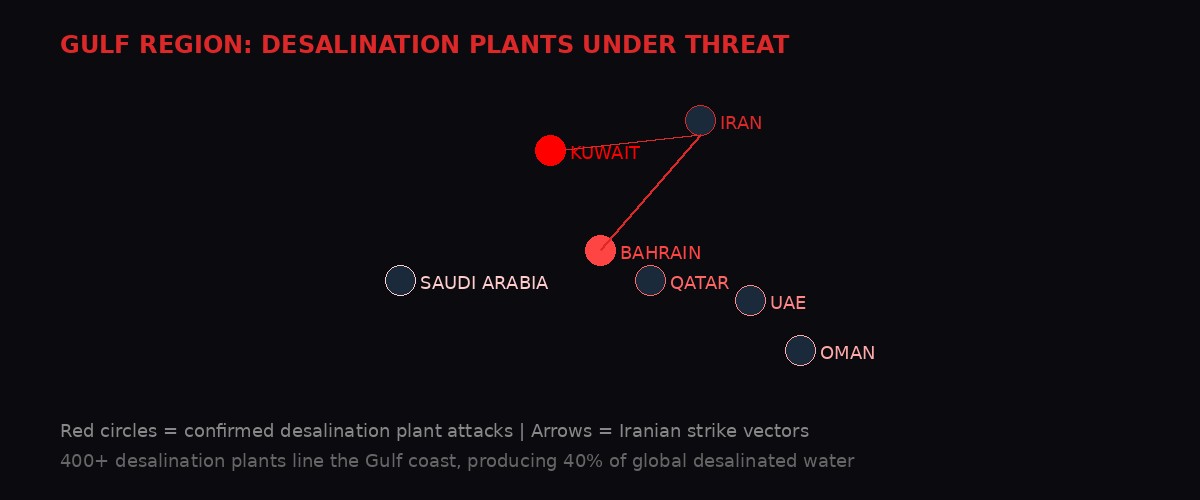
Red markers indicate confirmed strikes on desalination infrastructure. Arrows show Iranian attack vectors across the Gulf.
Kuwait's Ministry of Electricity issued a terse statement Monday confirming that "a service building at a power and water desalination plant was attacked as part of the Iranian aggression against the State of Kuwait." The attack killed one Indian worker and caused what the ministry described as "significant material damage to the building." Technical and emergency response teams were immediately dispatched.
Iran did not comment. Iranian state media, however, quoted the Kuwaiti ministry's damage assessment - an implicit acknowledgment that the strike occurred.
Al Jazeera's Malik Traina, reporting from Kuwait City, provided additional context that the Monday strike was not an isolated incident but part of an intensifying pattern. "Just yesterday evening, the Defence Ministry said that 14 missiles and 12 drones were detected in Kuwaiti airspace, and several of those drones were targeting a military camp, where 10 servicemen were injured," he reported. "They have since been taken to the hospital and have received medical treatment."
The arithmetic is stark. In a single 24-hour period, Kuwait detected 26 incoming projectiles - 14 missiles and 12 drones. Some targeted military installations. At least one found a desalination plant. The air defenses caught some. They did not catch all of them.
Kuwait's desalination infrastructure is not spread across a vast territory. The country is smaller than New Jersey. Its major desalination plants are concentrated along a narrow coastal strip, fed by seawater intake from the Arabian Gulf. These facilities produce approximately 0.8 billion cubic metres of freshwater annually - nearly half of everything the country consumes. The plants are massive, visible from satellite imagery, impossible to hide, and extremely difficult to harden against drone or missile attack without shutting them down entirely.
The dead worker was Indian - one of the estimated 900,000 Indian nationals living in Kuwait, most of them employed in construction, services, and infrastructure maintenance. The Indian Embassy in Kuwait has not yet issued a public statement. India's Ministry of External Affairs has remained silent on the strike. The worker's family, somewhere in India, likely does not yet know that the Gulf war killed their relative in a water treatment facility thousands of kilometres from any front line.
This is what infrastructure war looks like. Not tanks rolling through cities. Not soldiers storming beaches. A drone, a building, a migrant worker dead, and millions of people one step closer to running out of clean water.
A Region That Cannot Survive Without Machines
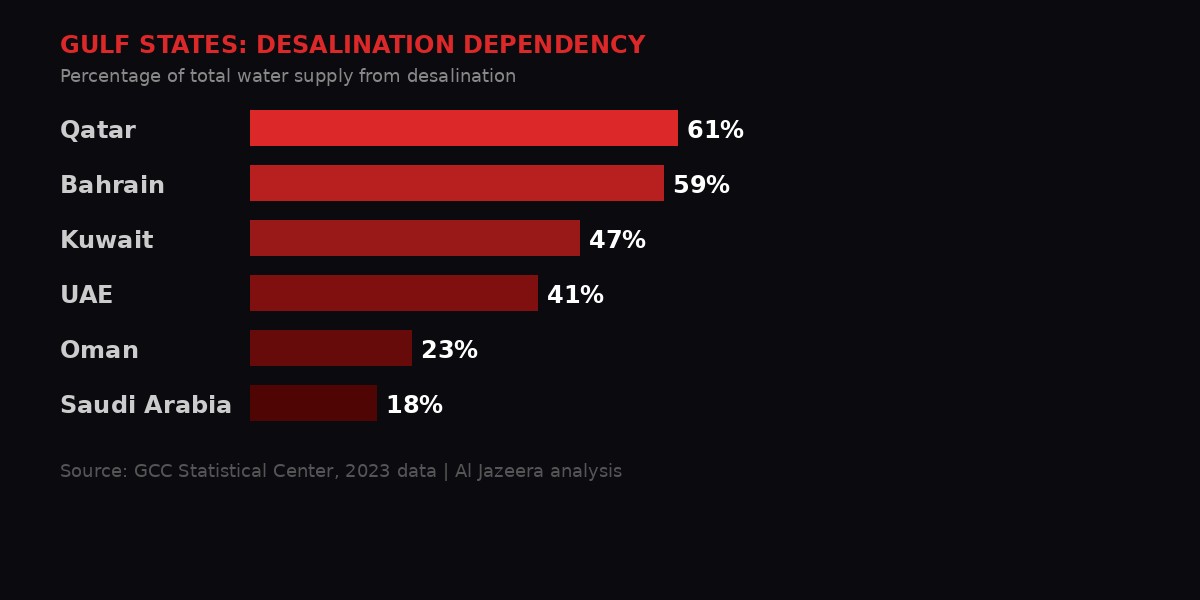
Gulf states' dependency on desalination ranges from 18% (Saudi Arabia) to 61% (Qatar) of total water supply. For drinking water specifically, the numbers are far higher.
The six Gulf Cooperation Council states occupy some of the most inhospitable terrain on the planet for human settlement at scale. There are no permanent rivers anywhere in the Arabian Peninsula. Rainfall is sporadic and negligible. Groundwater aquifers, which took thousands of years to fill, have been depleted at rates that geologists describe as irreversible on any human timescale.
What replaced natural water was technology. Beginning in the 1950s and accelerating through the oil boom decades, Gulf nations built desalination plants - industrial facilities that force seawater through membranes or boil it in thermal processes to extract fresh water. The most common technology is reverse osmosis, which pushes saltwater through semi-permeable membranes at enormous pressure. It is energy-intensive. A single large desalination plant consumes as much electricity as a small city.
According to the GCC Statistical Center's 2023 data, the six Gulf states produced 7.2 billion cubic metres of freshwater through desalination in 2023. That is 7.2 trillion litres. It translates to roughly 334 litres per person per day - the water that fills glasses, flushes toilets, irrigates gardens, runs hospitals, cools data centers, and keeps factories operating. Without it, the modern Gulf ceases to function within days, not weeks.
The dependency varies by country, but the pattern is universal: every Gulf state relies on desalination for survival. Qatar leads at 61 percent of total water supply from desalination - but for drinking water alone, the figure exceeds 99 percent. Bahrain draws 59 percent from desalination and over 90 percent of its drinking water. Kuwait depends on desalination for 47 percent of total supply and approximately 90 percent of drinking water. Even Saudi Arabia, the least dependent at 18 percent of total supply, produces more desalinated water than any other nation on Earth - 3 billion cubic metres annually - and relies on it for 70 percent of its drinking water.
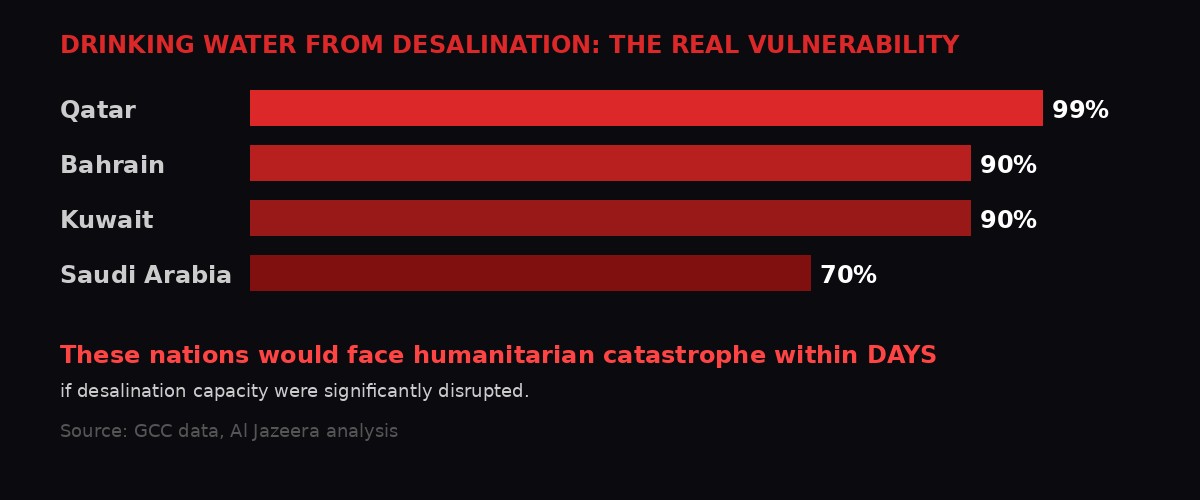
For drinking water specifically, Gulf nations are almost entirely dependent on desalination. Qatar sources 99% of drinking water from plants.
The environmental researcher Naser Alsayed, who specializes in Gulf water security, put it directly to Al Jazeera: "Targeting or disrupting desalination facilities would place much of the region's economic stability and growth at significant risk." He noted that desalination "carries a strong humanitarian dimension and is essential for sustaining daily life in the region, making any disruption to these facilities particularly significant for the population."
This is not hypothetical analysis. This is a description of what Iran has now demonstrated it can do.
The Pattern: Qeshm, Bahrain, Kuwait
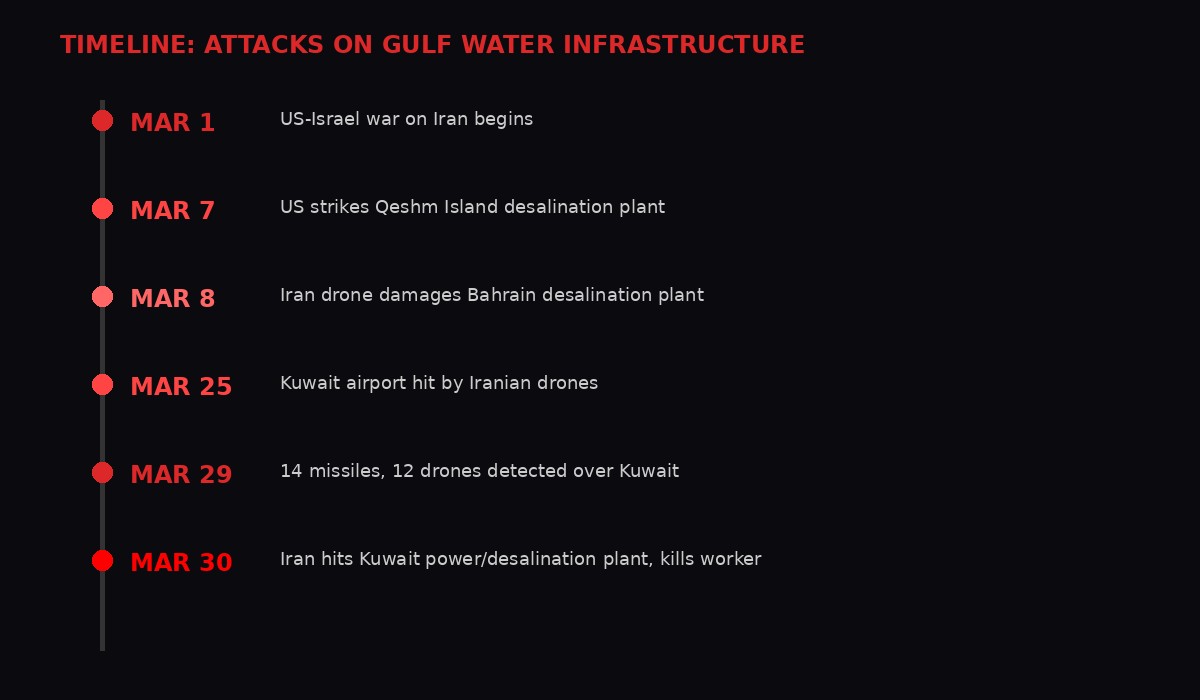
Timeline of confirmed strikes on desalination and water infrastructure since the war began on March 1, 2026.
Monday's Kuwait strike was not the first attack on desalination infrastructure in this war. It was at least the third confirmed incident, following a pattern that began in the war's first week and has escalated steadily.
Iran's Foreign Minister Abbas Araghchi accused the United States of striking a desalination plant on Qeshm Island, off Iran's coast in the Strait of Hormuz. The strike reportedly cut water supply to 30 villages. "Water supply in 30 villages has been impacted," Araghchi said on X. "Attacking Iran's infrastructure is a dangerous move with grave consequences. The US set this precedent, not Iran."
Less than 24 hours after the Qeshm strike, Bahrain reported that an Iranian drone had caused "material damage" to one of its desalination plants near Muharraq. This was the first confirmed attack on a Gulf state's desalination infrastructure. Bahrain, where 59 percent of water comes from desalination and over 90 percent of drinking water depends on these plants, was forced to activate emergency water reserves.
Iranian drones struck Kuwait International Airport, causing significant disruption. While not a direct hit on water infrastructure, the attack demonstrated Iran's ability to reach deep into Kuwaiti territory with precision.
Kuwait's Defence Ministry reported 14 missiles and 12 drones detected in Kuwaiti airspace. Drones targeted a military camp, injuring 10 servicemen. The volume of incoming projectiles overwhelmed reporting - individual strike locations were not all disclosed publicly.
An Iranian strike hits a power and water desalination plant in Kuwait. One Indian worker killed. "Significant material damage" to a service building. Emergency teams deployed to maintain operations.
The pattern is clear. The United States struck a desalination plant on Iranian territory first - Qeshm Island, March 7. Iran responded within 24 hours by hitting Bahrain's desalination infrastructure. Now, three weeks later, the target list has expanded to Kuwait. Iran's Foreign Minister was explicit about the logic: "The US set this precedent, not Iran."
This is tit-for-tat escalation applied to civilian infrastructure, and it carries a specific strategic logic. Iran cannot match the United States or Israel in conventional military capability. Its air force is largely obsolete. Its navy is outgunned in open water. But it possesses a large arsenal of drones and ballistic missiles, and it has identified the Gulf states' greatest vulnerability: their total dependence on industrial infrastructure to produce the most basic human necessity.
Water is not oil. You can live without oil. Economies can contract. Cars can stop running. Air conditioning can shut off. But human beings die within three to five days without water. A sustained disruption to Gulf desalination capacity would create a humanitarian crisis of a scale and speed that the region has never faced - not during the oil shocks of the 1970s, not during the Gulf War of 1991, not during the financial crisis of 2008.
The Strategic Calculus: Why Water Plants Are Ideal Targets
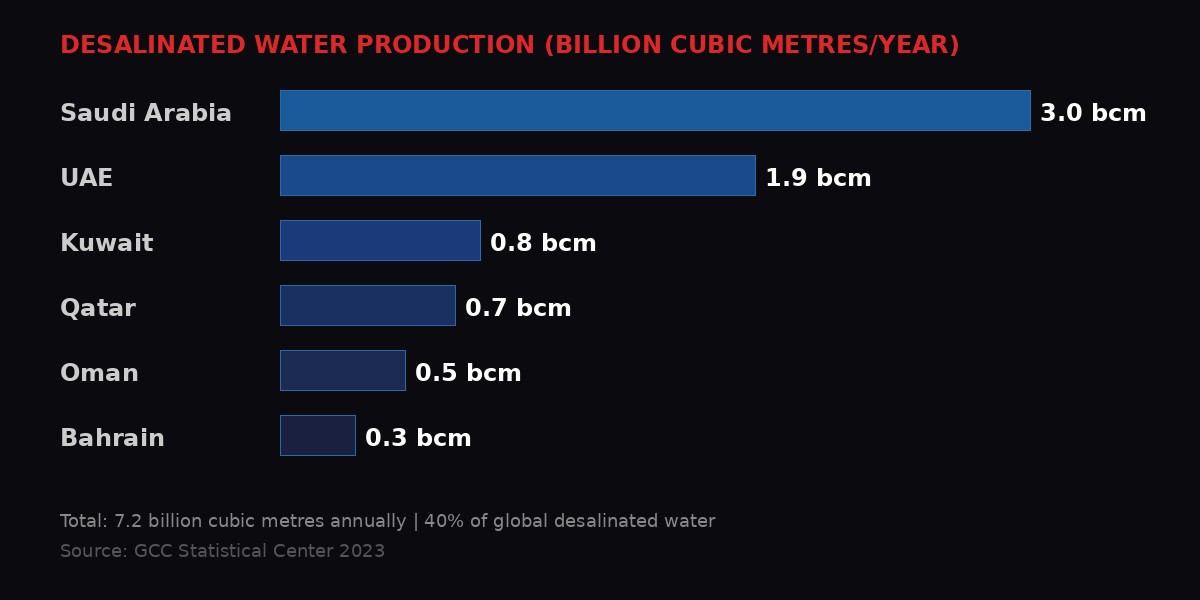
Saudi Arabia leads production at 3 billion cubic metres annually, but smaller states face proportionally greater risk from disruption.
Military strategists have known for decades that desalination plants are uniquely vulnerable targets. They combine several characteristics that make them nearly impossible to defend effectively against modern drone and missile attacks.
First, they are enormous. A major desalination plant occupies hundreds of thousands of square metres. The intake pipes, reverse osmosis membranes, chemical treatment facilities, power generation units, and distribution networks spread across a vast footprint. Hardening these facilities against air attack would require essentially building a bunker the size of an industrial park - a cost that no nation has ever seriously considered.
Second, they are coastal. Desalination plants must be located on the shoreline to access seawater. This means they are exposed to naval approaches, sea-launched missiles, and low-altitude drone attacks that can exploit the radar shadow created by the curvature of the Earth over water. A drone flying at 50 metres altitude over the Gulf can reach a coastal desalination plant with minimal warning time.
Third, they are concentrated. Gulf states did not spread their desalination capacity evenly across their coastlines. Economic and engineering considerations led to the construction of large, centralized facilities - often co-located with power plants to share fuel and cooling systems. This means that a single successful strike can disable both electricity generation and water production simultaneously. The Kuwait attack on March 30 hit exactly this kind of combined power-and-desalination facility.
Fourth, they have no natural redundancy. Unlike military bases, which can be rebuilt or relocated, a destroyed desalination plant cannot be quickly replaced. The reverse osmosis membranes alone take months to manufacture and install. The intake and outfall pipes are custom-engineered for each location. Even a minor disruption - say, contamination of the intake water with debris or chemicals from a nearby strike - can force a plant offline for days while the water quality is verified and the filtration systems are flushed.
Fifth, the cascading effects are immediate. Unlike attacks on oil infrastructure, where strategic reserves and alternative supply chains can buffer the impact for weeks or months, a significant loss of desalination capacity creates a drinking water emergency within 48 to 72 hours. Most Gulf cities maintain water reserves measured in days, not weeks. The smaller states - Bahrain, Qatar, Kuwait - have the least storage capacity relative to their populations and the highest dependency on continuous desalination output.
Iran's drone and missile arsenal is well-suited to exploiting every one of these vulnerabilities. The Shahed-136 loitering munitions that Iran has used extensively throughout this war cost a fraction of the interceptor missiles used to shoot them down. The economics of attrition favor the attacker: Iran can launch dozens of cheap drones at a desalination plant, knowing that even if 90 percent are intercepted, the ones that get through can cause disproportionate damage.
The Hormuz Factor: Energy, Water, and Chokepoints

The Strait of Hormuz carries 20% of global oil and 25% of LNG. Iran has effectively blocked passage, compounding the energy crisis that feeds the water crisis.
The desalination threat does not exist in isolation. It compounds with every other dimension of the Gulf's wartime vulnerability, and the most dangerous amplifier is the Strait of Hormuz.
Iran has effectively blocked the Strait - the narrow waterway connecting the Persian Gulf to the open ocean - through which approximately 20 percent of the world's oil and 25 percent of its liquefied natural gas passes daily. The blockade has driven oil prices to $116 per barrel as of Monday, the highest level since the 2022 price spike following Russia's invasion of Ukraine. But the Strait of Hormuz is not only an oil chokepoint. It is also the primary shipping route for the equipment, chemicals, and materials needed to maintain and repair desalination plants.
Reverse osmosis membranes, which are the core technology in most Gulf desalination plants, are manufactured primarily in the United States, Japan, and South Korea. They have a finite lifespan and require regular replacement. Chemical treatment agents - antiscalants, biocides, coagulants - are imported in bulk. Spare parts for the high-pressure pumps, energy recovery devices, and control systems arrive by sea.
If the Strait remains blocked for an extended period, Gulf states will face a compounding crisis: their desalination plants will degrade even without being directly attacked, simply because the supply chain for maintenance materials has been severed. A plant that cannot replace its membranes on schedule will see declining output and rising energy consumption. A plant that runs out of chemical treatment agents will produce water that fails safety standards. The degradation is gradual, invisible to the public, and cumulative.
Trump's 10-day pause on attacks against Iranian energy infrastructure, extended through April 6, was intended as a negotiating tool. Iran responded with its own implicit threat: if its energy facilities are hit, it will escalate attacks on energy sites "across the Gulf region." The desalination-energy nexus makes this threat more potent than it appears. In the Gulf, energy infrastructure and water infrastructure are often the same infrastructure. The co-located power-and-desalination plants that dot the coastline mean that a strike nominally targeting a power station can simultaneously cripple water production.
Oil at $116 also means that the energy cost of desalination - already the largest single expense in the process - is climbing. Gulf states that export oil benefit from high prices in one column of their ledger while paying more to keep their populations alive in another. The smaller states with limited oil reserves, particularly Bahrain and to some extent Kuwait, face a genuine fiscal squeeze: the war is both destroying their infrastructure and driving up the cost of operating whatever survives.
The Human Cost: Migrant Workers on the Front Line
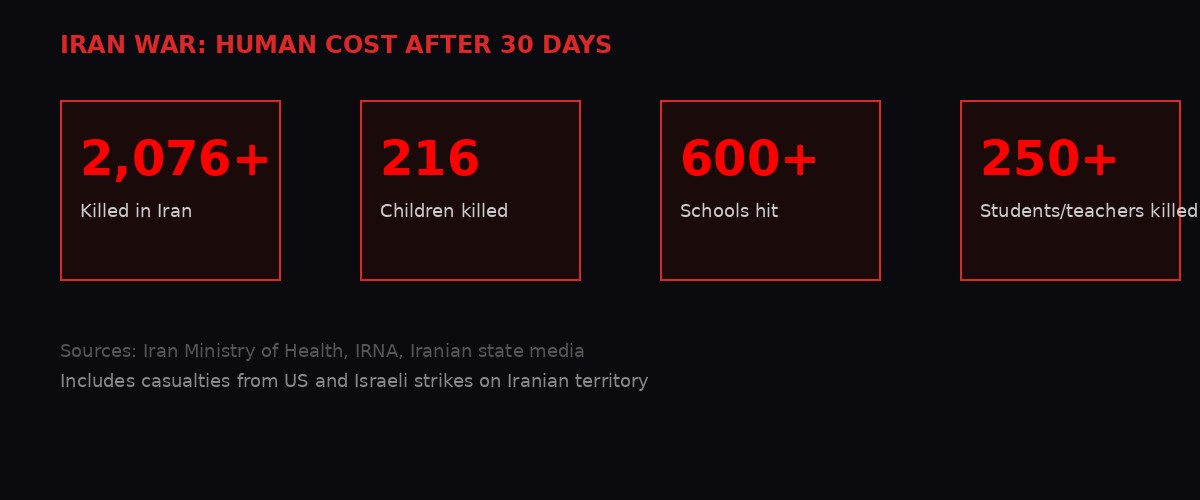
After 30 days, Iran's Ministry of Health reports over 2,076 killed including 216 children. Gulf civilian casualties from Iranian retaliation are mounting.
The Indian worker killed at the Kuwait desalination plant on Monday represents a demographic reality that is easy to overlook in the strategic framing of this war: the people who operate, maintain, and guard Gulf infrastructure are overwhelmingly migrant workers from South Asia, Southeast Asia, and East Africa.
Kuwait's population of approximately 4.9 million includes an estimated 3.4 million non-citizens - roughly 70 percent of all residents. The majority come from India, Bangladesh, Egypt, the Philippines, and Pakistan. They build the buildings, drive the taxis, clean the hospitals, and run the desalination plants. They are the most exposed population to infrastructure strikes because they live closest to their workplaces, often in labor camps adjacent to industrial zones.
India alone has approximately 900,000 nationals in Kuwait, 3.5 million in Saudi Arabia, 3.4 million in the UAE, and significant populations in Bahrain, Qatar, and Oman. The total Indian diaspora in the GCC exceeds 9 million. Add workers from Bangladesh, Pakistan, the Philippines, Nepal, Sri Lanka, and various African nations, and the migrant workforce in the Gulf exceeds 25 million people - a population larger than most countries, with no political representation, limited access to bomb shelters, and evacuation options that depend entirely on commercial air and sea routes that the war has disrupted.
When Iran strikes infrastructure in the Gulf, the statistical probability is that the casualties will be migrant workers. They are the ones inside the plants, on the maintenance crews, at the construction sites. The Indian government has not publicly pressured either the United States or Iran to protect its citizens in the Gulf - a diplomatic silence that reflects India's delicate balancing act between its relationships with Washington, Tehran, and the Gulf monarchies.
The Philippines, which has approximately 1.2 million workers in the Gulf, began offering voluntary evacuation assistance in the war's second week. Bangladesh, with over 600,000 nationals in Saudi Arabia alone, has not issued evacuation advisories. The assumption - or hope - is that the war will end before the infrastructure collapses entirely. That assumption becomes harder to sustain with each new strike.
The dead worker in Kuwait had no stake in the war between the United States, Israel, and Iran. He was there to earn money and send it home. He died because a drone found the building where he worked - a building that converts seawater into something people can drink. There is no more precise summary of what this war has become.
What Comes Next: The April 6 Deadline and Beyond
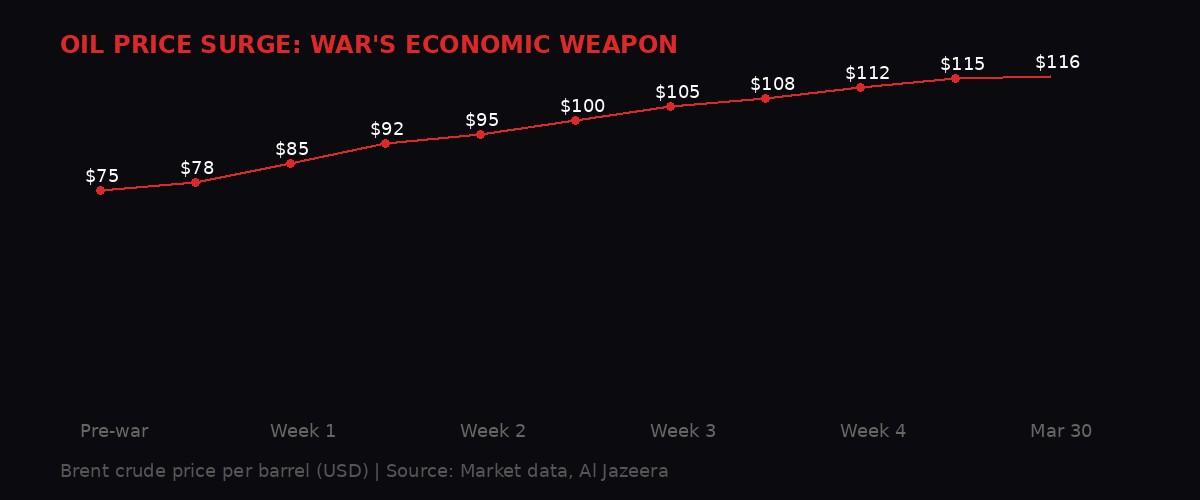
Brent crude has surged from $75 pre-war to $116 per barrel, the biggest monthly rise on record. Energy and water costs are inseparable in the Gulf.
The calendar now points to April 6 - Trump's extended deadline for Iran to accept a 15-point peace plan that Tehran has described as "maximalist" and "unreasonable." If the deadline passes without a deal, the United States has threatened to resume strikes on Iranian energy infrastructure, including power stations and oil facilities. Iran has explicitly stated it will respond in kind against Gulf energy sites.
The 15-point plan reportedly includes demands that critics view as non-starters: Iran's complete abandonment of its nuclear enrichment program, acceptance of permanent restrictions on its missile arsenal, and what amounts to American veto power over Iran's use of the Strait of Hormuz. Iran's five-point counter-proposal demands an end to hostilities, compensation for the more than 2,076 people killed (including 216 children, per Iran's Ministry of Health), guarantees against future attacks, and "exercise of sovereignty over the Strait of Hormuz."
The gap between these positions is not a crack. It is a chasm. And while diplomats negotiate through intermediaries - Turkey, Oman, and Qatar have all offered mediation - the war continues to grind. Israel dropped more than 120 munitions on Tehran on Sunday alone. Iran launched seven missile salvoes toward Israel in the same period. Hezbollah fired rockets at over 100 towns in northern Israel. The Houthis continued launching missiles toward Israeli territory.
For the Gulf states caught in the middle, the strategic picture is grim. Their alliance with the United States - cemented over decades through arms deals, basing agreements, and security guarantees - has made them targets for Iranian retaliation. Kuwait hosts significant American military infrastructure. Bahrain is home to the US Fifth Fleet. Qatar hosts Al Udeid Air Base, the largest American military facility in the Middle East. Saudi Arabia accommodates American forces at multiple installations.
These nations did not choose this war. Most have spent years cultivating diplomatic relationships with Iran precisely to avoid being caught in a US-Iran conflict. The UAE restored its ambassador to Tehran in 2023. Saudi Arabia and Iran reached a Chinese-brokered normalization agreement the same year. Kuwait maintained neutral diplomatic channels throughout the tensions of the late 2010s.
None of it mattered. When the war started on March 1, the Gulf states' geography made them collateral targets regardless of their diplomatic preferences. Their desalination plants sit within range of Iranian missiles. Their airspace is contested. Their water supply depends on infrastructure that was designed for peacetime conditions and has no wartime hardening.
The Doctrine of Thirst: Water as a Weapon
Targeting civilian water infrastructure is prohibited under international humanitarian law. Protocol I of the Geneva Conventions, Article 54, explicitly bars attacks on "objects indispensable to the survival of the civilian population," including "drinking water installations and supplies and irrigation works." The International Criminal Court's Rome Statute classifies the deliberate starvation of civilians as a war crime.
But the legal framework assumes a conflict between parties that recognize each other's legitimacy and submit to international adjudication. Neither the United States nor Iran has demonstrated particular concern for these constraints in the current war. The US struck the Qeshm Island desalination plant on March 7 - an attack on civilian water infrastructure in Iranian territory. Iran's retaliatory strikes on Bahraini and Kuwaiti desalination plants followed the same logic: if you hit our water, we hit theirs.
The result is a doctrine of mutual water destruction that has no precedent in modern warfare. Previous conflicts have involved attacks on water infrastructure - the bombing of water treatment plants in Iraq during the 1991 Gulf War, the targeting of water facilities in Syria and Yemen - but never in a region where the entire civilian population depends on a single technology to survive. The Gulf states have no backup. There are no rivers to divert, no emergency aquifers to tap, no rainwater collection systems that can serve millions. When the desalination plants stop, the water stops. Period.
Environmental security analysts have modeled scenarios involving significant desalination disruption in the Gulf. The projections vary in their specifics but converge on a common conclusion: a loss of more than 30 percent of regional desalination capacity for more than 72 hours would trigger a humanitarian emergency requiring international intervention. Water rationing would begin within the first day. Hospital operations would be compromised within two days as sterilization and cooling systems fail. Agricultural irrigation - already minimal in the Gulf - would cease entirely. Industrial production would halt.
The cascade would not stop at borders. A water crisis in Kuwait would generate a refugee flow toward Saudi Arabia and Iraq. A crisis in Bahrain - an island nation of 1.6 million people with no land border - would require emergency evacuation by sea or air. A crisis in Qatar would threaten the operations of Al Udeid Air Base itself, potentially degrading the American military's ability to conduct the very war that caused the crisis.
This is the strategic paradox at the heart of the Gulf water war. The United States cannot protect its military operations in the region if the civilian infrastructure that sustains those operations is destroyed by Iranian retaliation. The Gulf states cannot defend their water supply without American military support. And American military activity is what provokes the Iranian strikes that threaten the water supply. The loop has no exit that does not involve either a ceasefire or catastrophe.
The Clock Is Running
On Monday morning in Kuwait, an Indian worker went to his job at a desalination plant. A drone found the building where he worked. He did not survive. The plant continues to operate - for now. Emergency teams are on site. The Ministry of Electricity says operations continue normally.
But 14 missiles and 12 drones were detected over Kuwait in the preceding 24 hours. The April 6 deadline is one week away. No deal is in sight. Oil is at $116 and climbing. The Strait of Hormuz is blocked. Hezbollah and the Houthis are opening additional fronts. Iran's parliament speaker has promised to "set American soldiers on fire" if ground operations commence. The Pentagon is reportedly planning limited ground operations including raids on Kharg Island.
The Gulf states' 400-plus desalination plants continue to hum along their coastlines, converting billions of litres of seawater into the fresh water that 62 million people need to live. They were built for a world where the greatest threat was a pump failure or a membrane fouling. They now operate in a world where the threat is a loitering munition with a GPS coordinate and a warhead.
No one has figured out how to defend them. No one has built emergency reserves sufficient to outlast a sustained campaign. No one has an alternative to desalination that can serve these populations. The technology that made the modern Gulf possible - that turned uninhabitable desert into gleaming cities of glass and steel - is now the Gulf's single greatest vulnerability.
The water war is not coming. It is here. One worker is dead. One plant is damaged. The precedent is set on both sides. And the machines that keep 62 million people alive keep running, exposed, along a contested coastline, while the missiles and drones circle overhead.
The clock is running. It has been running since March 1. And nobody knows when the water stops.
Get BLACKWIRE reports first.
Breaking news, investigations, and analysis - straight to your phone.
Join @blackwirenews on Telegram