The Killing Fields of Artibonite: 70 Dead as Gran Grif Unleashes Haiti's Deadliest Massacre of 2026
A US-designated terrorist organization stormed rural communities around Jean-Denis in a 36-hour rampage. The government's response: three armoured vehicles that arrived after the killing was done. Haiti's breadbasket has become its graveyard.

Rural devastation in a conflict zone. Photo: Pexels
Seventy bodies. Thirty wounded. Fifty houses reduced to charcoal. Six thousand people running with whatever they could carry. That is the balance sheet from a single weekend in Haiti's Artibonite department - the agricultural heartland that feeds the nation. And the men who did it have done it before. They will do it again.
The attack on rural communities around Jean-Denis, near Petite-Riviere in Haiti's Artibonite region, began in the pre-dawn hours of Sunday, March 30. It did not stop until the early hours of Monday. Armed fighters affiliated with the Gran Grif gang swept through villages, setting homes ablaze and shooting residents as they tried to flee. The Haitian National Police deployed three armoured vehicles. The gang had already dug trenches in the roads to slow them down. By the time officers arrived, the attackers were gone.
The official death toll - reported by police at 16, by civil protection authorities at 17 - was immediately contested. The Defenseurs Plus human rights group, working with the Collective to Save the Artibonite, put the number at 70 or higher, with 30 wounded and an estimated 6,000 displaced. The United Nations said estimates ranged from 10 to 80, and called for a thorough investigation. A UN spokesperson acknowledged the wide discrepancy in numbers. This gap between what the government says and what the bodies on the ground show is itself a data point.
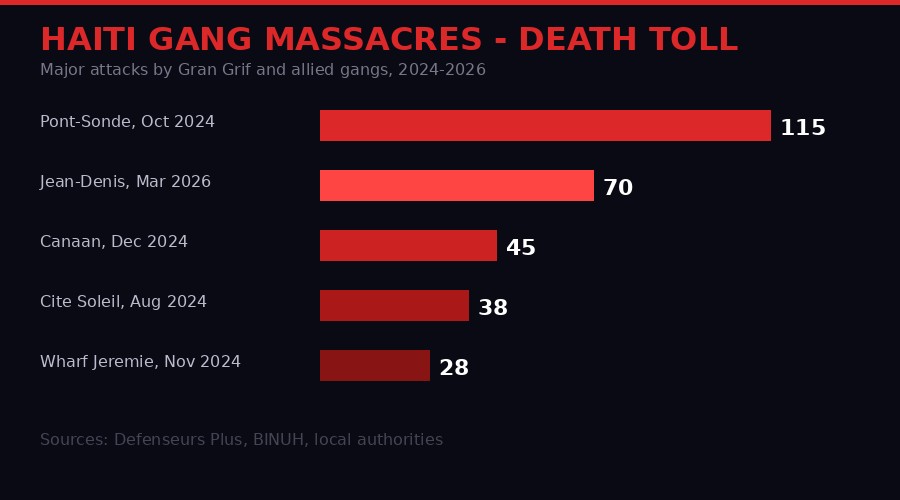
Comparative death tolls from major gang attacks in Haiti's Artibonite region, 2024-2026. Graphic: BLACKWIRE
I. The 36-Hour Rampage

Conflict-driven destruction. Photo: Pexels
The attack followed a pattern that Gran Grif has refined through repetition. An audio message circulated on social media, attributed to Gran Grif leader Luckson Elan, offered the rationale: retaliation. Elan claimed a rival armed group had attacked Gran Grif's base in Savien, and the assault on Jean-Denis was the response. In the logic of Haiti's gang wars, attacking civilians near a rival's territory is considered a legitimate military operation.
Residents and local officials described the assault to Haitian media in fragments. The fighters arrived in the dark. They moved through rural communities systematically. Homes were torched. People who ran were shot. Those who hid waited for hours, listening to gunfire and the sound of structures collapsing. The attack was not a raid - it was an occupation. The armed men held the area for more than 24 hours before withdrawing.
The Haitian National Police said its armoured vehicles encountered holes dug into the road - a deliberate tactic to delay any response. When officers finally reached the area, the scene was already cold. Houses smoldered. The dead lay where they fell. The wounded were transported to a local hospital. The dead were taken to two morgues. Police said they had launched an operation to track down the fleeing attackers, but the statement carried the weight of a formality.
Defenseurs Plus estimated that 50 houses were burned. The UN had already estimated that more than 2,000 people had fled their homes in the days before the massacre, driven out by earlier raids in the surrounding area. The Jean-Denis attack was not an isolated event. It was the crescendo of an escalating campaign.
The displacement figure of 6,000 is approximate by necessity. In Haiti's rural areas, there is no census infrastructure, no registration system for the displaced, and no organized shelter network. People flee to relatives, to churches, to the open road. They become invisible to the institutions that were supposed to protect them.
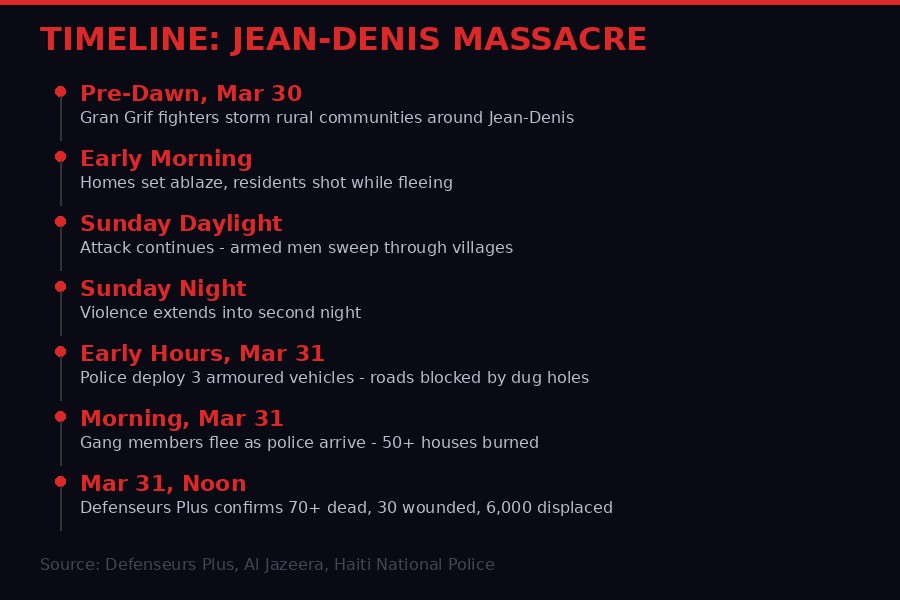
Timeline of the Jean-Denis massacre, March 30-31, 2026. Graphic: BLACKWIRE
II. Gran Grif - Anatomy of a Designated Terrorist Organization

Armed groups have turned Haiti's agricultural heartland into a war zone. Photo: Pexels
Gran Grif is not a street gang. It is a territorial armed group that controls swathes of Haiti's Artibonite department with a level of operational sophistication that most Caribbean security forces cannot match. Led by Luckson Elan, the group has been designated as a "terrorist" organization by the United States, alongside Viv Ansanm, a coalition that groups together hundreds of gangs operating primarily in Port-au-Prince.
The US designation, which came alongside a $3 million bounty for information on the groups' financial activities, reflects Washington's belated recognition that Haiti's armed groups have evolved beyond crime. Gran Grif and its peers have been accused of mass killings, gang rapes, arson, theft, and trafficking in guns, drugs, and human organs. The organ trafficking allegation, documented by Haitian and international investigators, marks a particularly grim evolution - the commodification of violence into a supply chain.
Gran Grif's operational model in Artibonite is territorial rather than transactional. The group does not simply extort communities and move on. It occupies land, controls agricultural output, levies informal taxes on farmers, and attacks any population center that harbors rival groups or refuses to submit. The Artibonite region produces the majority of Haiti's rice crop. Controlling Artibonite means controlling food.
Elan himself remains a figure of limited public profile but significant operational authority. His audio messages, circulated via WhatsApp and Telegram, function as both propaganda and operational orders. The message attributed to him following the Jean-Denis attack was notable for its directness - no ideology, no political framing, just the cold calculus of territorial reprisal. You attacked my base. I burned your villages.
The October 2024 massacre at Pont-Sonde, just a few kilometers from Jean-Denis, killed 115 people. Gran Grif fighters went door to door, executing residents. That attack prompted international condemnation that lasted approximately 72 hours before the news cycle moved on. Nothing structural changed. The group's capacity was undiminished. Five months later, it struck again in the same region, using the same tactics, with similar results.
"The lack of a security response and the abandonment of Artibonite to armed groups demonstrate a complete abdication of responsibility by the authorities."- Defenseurs Plus and the Collective to Save the Artibonite, joint statement, March 31, 2026
III. The Government That Isn't There

Institutional absence defines Haiti's security crisis. Photo: Pexels
Haiti does not have a functioning government in any conventional sense. The country has operated without an elected president since the assassination of Jovenel Moise in July 2021. A transitional council, formed in 2024, holds nominal authority but controls little beyond the capital's government district - and even that is contested. Prime Minister Garry Conille, who took office in June 2024, leads an administration that most Haitians experience primarily through its absence.
The Haitian National Police (HNP), the country's primary security force, has approximately 13,000 officers for a population of 11.7 million. The UN recommends a minimum ratio of one officer per 450 citizens. Haiti's ratio is approximately one per 900. Those numbers overstate the force's effective strength. Equipment shortages, fuel scarcity, corruption, and the sheer danger of operating in gang-controlled territory mean that large portions of the HNP exist on paper only.
The three armoured vehicles deployed to Jean-Denis represent a significant portion of the HNP's heavy equipment for the entire Artibonite region. That the gang was able to neutralize this response simply by digging holes in the road speaks to the asymmetry. Gran Grif does not need to outgun the police. It only needs to outlast them, outmaneuver them, and operate in the spaces where the state does not exist.
The transitional government's response to the Jean-Denis massacre followed a script that has become grimly familiar. Official death toll understated. Statement of condemnation issued. Investigation promised. Arrest operation announced. None of these steps have historically produced results. After Pont-Sonde, the same sequence played out. Elan remains free. Gran Grif remains operational. The villages remain unprotected.
Defenseurs Plus and its partner organization were explicit in their assessment: the authorities have abdicated responsibility for Artibonite. The word "abdicated" is precise. It implies not failure but surrender - a conscious decision, whether explicit or structural, to cede territory to armed groups. In Haiti, the state does not lose battles. It simply does not show up for them.
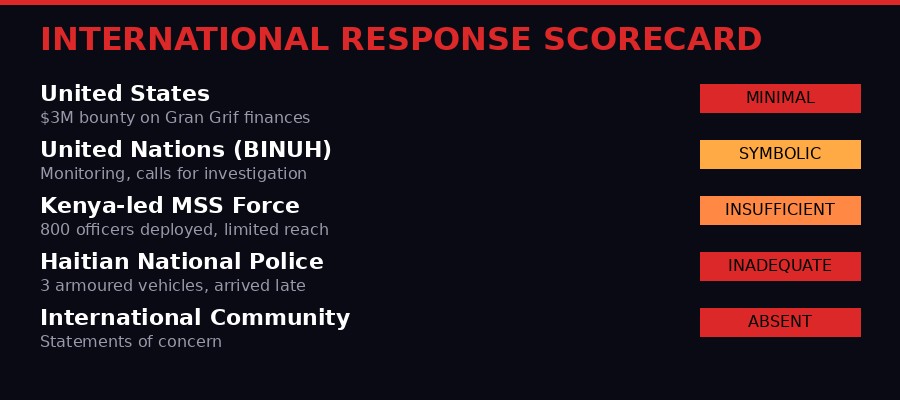
How the world has responded to Haiti's escalating gang violence. Graphic: BLACKWIRE
IV. The Multinational Security Support Mission - Kenya's Impossible Task

International peacekeeping efforts have struggled to match the scale of Haiti's crisis. Photo: Pexels
The Multinational Security Support (MSS) mission, authorized by the UN Security Council in October 2023 and led by Kenya, was supposed to be the answer. Approximately 800 Kenyan police officers have deployed to Haiti, supplemented by smaller contingents from other nations. Their mandate: support the HNP in restoring public order, particularly in Port-au-Prince.
The mission faces structural problems that no amount of political will can resolve. Eight hundred officers cannot secure a capital of 3 million people, let alone a country of 11.7 million spread across mountainous terrain with degraded infrastructure. The MSS operates primarily in Port-au-Prince, where gang violence is most visible to international media. Artibonite, two hours north by road, falls outside the mission's effective operational radius.
Kenya's police officers arrived with equipment suited for urban crowd control, not counterinsurgency operations in rural territory controlled by armed groups with local intelligence networks and the ability to modify terrain. The MSS was never designed to fight Gran Grif. It was designed to provide enough security theater to justify the international community's claim that it was doing something about Haiti.
The United States, which pushed hardest for the MSS mission, has provided logistical and financial support but no troops. Washington's Haiti strategy since 2021 has been built on a consistent principle: maintain enough engagement to prevent a complete humanitarian catastrophe from dominating news cycles, while avoiding the political cost of direct military involvement. The $3 million bounty on Gran Grif and Viv Ansanm's financial networks is the most recent expression of this approach - meaningful enough to announce, insufficient enough to change anything.
The UN's own assessment is bleak. Close to 20,000 people have been killed in Haiti since 2021, according to a recent UN report, with the death toll rising each year. The trajectory is unambiguous. Violence is increasing, displacement is increasing, and the international response is not scaling to match. The MSS mission's mandate comes up for renewal in October 2026. Whether it will be extended, expanded, or quietly abandoned is an open question. What is not open to question is that in its current form, it cannot protect the people of Artibonite.
V. The Displacement Machine

More than 1.4 million Haitians have been displaced by gang violence. Photo: Pexels
More than 1.4 million people - approximately 12 percent of Haiti's population - have been displaced by gang violence. That number, reported by the International Organization for Migration and OCHA, makes Haiti's internal displacement crisis one of the worst in the Western Hemisphere. It is worse, on a per-capita basis, than many active war zones that receive far more international attention and funding.
The displacement is not temporary. In most conflict zones, displacement follows a pattern: violence erupts, people flee, a ceasefire holds, people return. In Haiti, there is no ceasefire to hold. Armed groups do not negotiate withdrawals. Territory taken is territory kept. Communities destroyed are not rebuilt. The displaced do not go home because home no longer exists, or because the men who burned it are still there.
The 6,000 people displaced by the Jean-Denis attack will join a population of internally displaced persons (IDPs) that has no formal status, no organized camp structure, and no realistic prospect of return. Many will end up in Port-au-Prince, where they will join existing IDP populations in neighborhoods already controlled by the same gangs they fled. The displacement machine feeds itself.
Food security in Artibonite is collapsing. The region produces the majority of Haiti's domestically grown rice. Each attack on a farming community destroys not just homes but agricultural capacity. Fields left untended during displacement miss planting windows. Stored grain is looted or burned. The ripple effect reaches every market in Haiti. A massacre in Jean-Denis raises the price of rice in Port-au-Prince within days.
The World Food Programme has reported that approximately 5.4 million Haitians - nearly half the population - face acute food insecurity. The connection between gang violence and hunger is direct and measurable. Every hectare of Artibonite farmland abandoned to armed groups is a hectare that stops producing food for a country that was already importing 80 percent of its rice before the crisis.
Children bear the heaviest burden. Schools in gang-controlled areas have closed. Displacement severs children from education, healthcare, and social networks. UNICEF has reported that armed groups actively recruit displaced minors, offering food and protection in exchange for service. The displacement machine does not just create refugees. It creates the next generation of fighters.
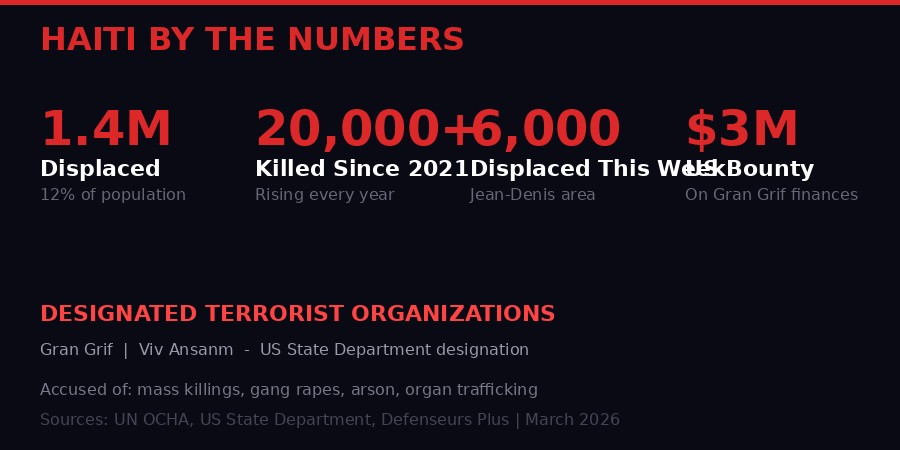
Haiti's crisis in numbers: displacement, death, and the scale of institutional failure. Graphic: BLACKWIRE
VI. The Pattern - From Pont-Sonde to Jean-Denis

The cycle of violence in Artibonite follows a predictable, devastating pattern. Photo: Pexels
The October 2024 attack on Pont-Sonde killed 115 people. Armed men went door to door. They shot residents in their homes, in the streets, in the fields. The attack lasted hours. When it was over, international organizations issued statements. The US government condemned the violence. Media coverage peaked and then subsided. Nothing changed.
Between Pont-Sonde and Jean-Denis - a period of five months - Gran Grif conducted dozens of smaller operations in Artibonite. Roadblocks. Kidnappings. Targeted killings. Crop seizures. Each operation expanded the group's control, tested the government's non-response, and displaced more civilians. The smaller operations did not make international news. They did not need to. Their purpose was territorial consolidation, not spectacle.
The Jean-Denis massacre was the spectacle. But it was also functional. By attacking communities near a rival's base and inflicting mass casualties, Gran Grif accomplishes several objectives simultaneously. It punishes populations perceived as harboring rivals. It demonstrates that no external force - police, MSS, or otherwise - can protect civilians in its operational area. It creates a buffer of depopulated terrain between itself and potential threats. And it sends a message to every other community in Artibonite: compliance or annihilation.
This is the logic of territorial control through terror. It is not irrational. It is not mindless. It is strategic violence deployed by an organization that has calculated, correctly, that the costs of such operations are near zero. Elan has never been arrested. Gran Grif's weapons supply has never been interdicted. Its financing networks, despite the US bounty, continue to function. The incentive structure rewards escalation.
The cycle will repeat. Artibonite's geography - flat agricultural land with limited road networks - favors the attacker. The state's absence means there is no intelligence infrastructure to provide early warning. The MSS mission's urban focus means rural areas are effectively undefended. The conditions that produced Pont-Sonde and Jean-Denis remain unchanged. The next massacre is not a question of if, but of when and where.
VII. The International Abandonment

The world's attention has moved elsewhere. Haiti's people have not. Photo: Pexels
Haiti occupies a singular position in the hierarchy of international crises: close enough to the United States to be politically inconvenient, distant enough from European interests to be ignorable, and lacking the strategic resources that would make intervention profitable. The country has no oil, no critical minerals, no nuclear program, and no geopolitical leverage. It has people. People, in the calculus of international intervention, are not enough.
The global attention economy in March 2026 is consumed by the US-Israeli war on Iran, now in its 32nd day. The Middle East crisis has absorbed the diplomatic bandwidth, military resources, and media attention that might otherwise be directed toward Haiti. This is not an excuse - it is a structural reality. International institutions can process a limited number of simultaneous crises. Haiti has been triaged out.
The United Nations Integrated Office in Haiti (BINUH) said it was "closely monitoring" the events in Jean-Denis. Monitoring is not intervening. The UN spokesperson called for a "thorough investigation." Investigation is not protection. The language of international response has its own grammar - words that sound like action but commit to nothing. Haiti has been subjected to this grammar for decades.
France, Haiti's former colonial power, has been largely absent from the crisis. The legacy of France's extraction of independence reparations from Haiti - payments that continued until 1947 and that economists estimate cost the country between $21 billion and $115 billion in lost development - hangs over any discussion of French responsibility. Paris has shown no appetite for re-engagement. The colonial wound is both cause and excuse.
The Dominican Republic, which shares the island of Hispaniola with Haiti, has responded to the crisis primarily through border fortification. A wall along the Dominican-Haitian border, construction of which accelerated in 2024, reflects Santo Domingo's strategy: contain the crisis rather than address it. Dominican authorities have deported tens of thousands of Haitians, including many with legal residency, in operations that human rights organizations have condemned as discriminatory and potentially illegal under international law.
Canada, which hosts a large Haitian diaspora and has historically been more engaged on Haiti policy than most Western nations, has contributed personnel and funding to the MSS mission but has not deployed troops. Ottawa's approach mirrors Washington's: enough engagement to demonstrate concern, not enough to change outcomes.
VIII. What Comes Next
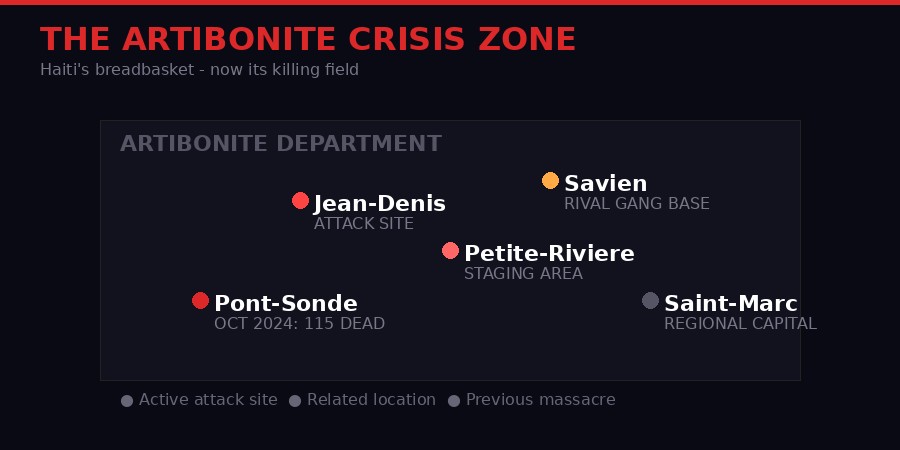
The Artibonite crisis zone: Haiti's breadbasket has become its most dangerous territory. Graphic: BLACKWIRE
The trajectories are clear. Gang violence in Haiti is escalating. The death toll is rising year over year. Displacement is accelerating. Food security is deteriorating. The security forces available - both Haitian and international - are inadequate to the scale of the threat. No diplomatic initiative currently on the table addresses the fundamental asymmetry between armed groups that operate with impunity and a state that barely exists.
The MSS mission needs either radical expansion or honest acknowledgment of its limitations. The current force of approximately 1,000 personnel (including Kenyan police and smaller contingents) cannot secure Port-au-Prince and Artibonite simultaneously. Military analysts have suggested that a force of 5,000 to 10,000 would be necessary to establish baseline security across Haiti's most affected areas. No country has offered to provide such numbers. No funding mechanism exists to sustain them.
Arms interdiction is the single intervention most likely to reduce violence. Haiti does not manufacture weapons. Every gun used by Gran Grif, Viv Ansanm, and their affiliated groups entered the country from outside - primarily from the United States, via the Dominican Republic, and through maritime routes. The US Bureau of Alcohol, Tobacco, Firearms and Explosives (ATF) has traced significant numbers of weapons seized in Haiti back to American dealers. Stopping the flow of arms at the source would require enforcement actions that Washington has shown no willingness to undertake, because the political cost of confronting the American firearms industry exceeds the political cost of Haitian casualties.
Economic intervention - targeted investment in Artibonite's agricultural sector, conditional on security improvements - could address the food security crisis while providing alternative livelihoods. But no international donor is willing to invest in a region where armed groups control the territory and can seize any assets deployed. The chicken-and-egg problem is real: security requires investment, investment requires security.
The people of Jean-Denis are running. Some will reach Port-au-Prince. Some will attempt the dangerous sea crossing to the Bahamas or the Turks and Caicos. Some will die trying. Some will end up in Viv Ansanm-controlled neighborhoods in the capital, trading one armed group's territory for another's. The displacement machine continues.
The Haitian diaspora - approximately 2 million people spread across the United States, Canada, France, the Dominican Republic, and elsewhere - watches these events with a mixture of grief and helplessness. Remittances from the diaspora represent a significant portion of Haiti's GDP and, for many families, the only income that reaches them. Diaspora organizations have called for more aggressive international intervention. Their calls have gone unanswered.
Gran Grif will regroup. Luckson Elan will issue another audio message. Another community in Artibonite will be attacked. The death toll will climb. The displacement numbers will increase. The international community will express concern. And then attention will shift elsewhere, because attention always shifts elsewhere, and Haiti's crisis is not new enough to be newsworthy or old enough to be historical.
Seventy dead in Jean-Denis. One hundred fifteen in Pont-Sonde. Twenty thousand since 2021. The numbers accrete like sediment. Each massacre adds a layer. Each layer is forgotten before the next one forms. The killing fields of Artibonite are not a crisis waiting for a solution. They are a condition - permanent, structural, and accepted by everyone who has the power to change it and the luxury of looking away.
Get BLACKWIRE reports first.
Breaking news, investigations, and analysis - straight to your phone.
Join @blackwirenews on Telegram