The Wartime Purge: Hegseth Fires the Army Chief of Staff as 300 Troops Lie Wounded
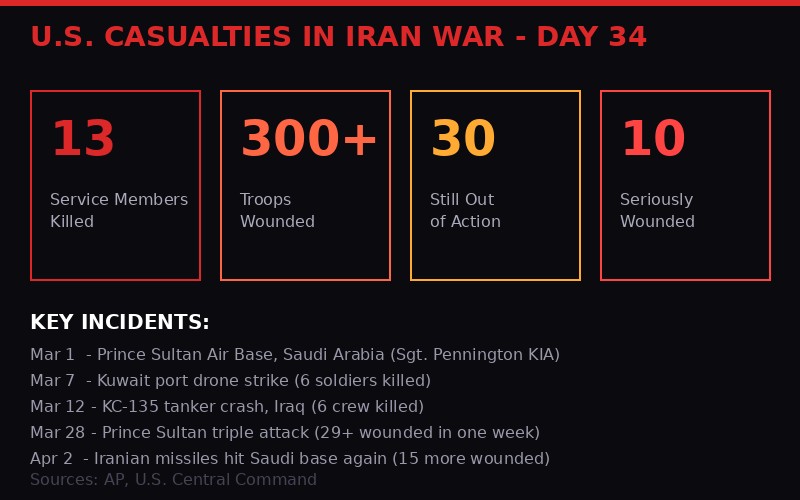
Thirteen American service members are dead. More than 300 are wounded. Iranian missiles are hitting U.S. bases in Saudi Arabia weekly. And the Secretary of Defense just fired the Army's top general for reasons nobody will explain on the record.

On Thursday, April 2, 2026, as Iranian ballistic missiles struck a Saudi air base for the third time in a single week - wounding at least 15 more American troops - Defense Secretary Pete Hegseth asked the 41st Chief of Staff of the United States Army, General Randy George, to resign his position effective immediately.
No explanation was given publicly. The chief Pentagon spokesperson, Sean Parnell, issued a terse statement thanking George for his service and announcing that Army Vice Chief of Staff Gen. Christopher LaNeve would assume the role on an acting basis. An unnamed senior defense official told CBS News it was simply "time for a leadership change in the Army." That was it. That was the justification for decapitating Army leadership on Day 34 of an active shooting war.
The timing is either breathtakingly incompetent or deliberately calculated. Both possibilities should alarm anyone paying attention to how the United States wages war while simultaneously cannibalizing the institution that fights it.
01 // The General Who Got Fired

General Randy George is not a political appointee. He is a career infantry officer who graduated from the United States Military Academy at West Point, served in the first Gulf War, fought in Iraq and Afghanistan, and was nominated for the Chief of Staff position in 2023 by President Biden. His four-year term was supposed to run through 2027. That term ended Thursday, not through retirement ceremony or natural rotation, but through a phone call from a Defense Secretary who has never served a day in military command.
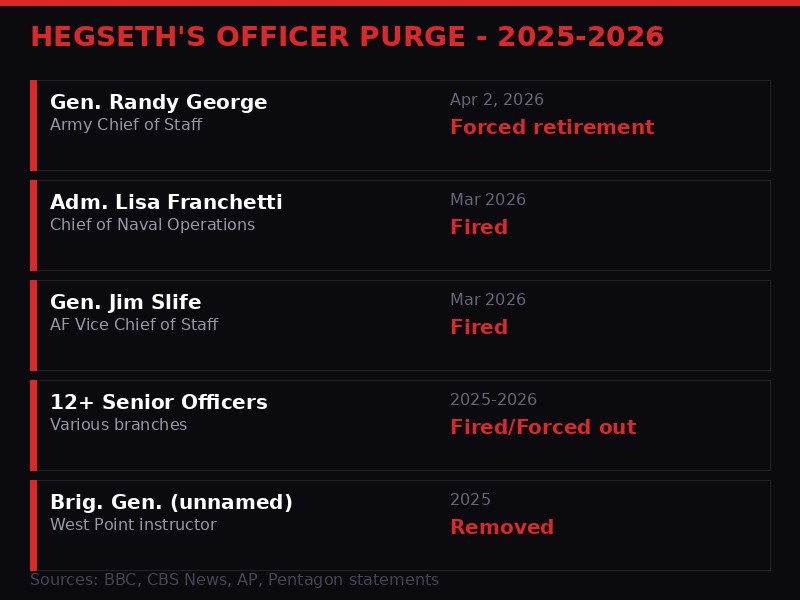
George's removal follows a pattern that has accelerated since Hegseth took the helm at the Pentagon. Since entering the Department of Defense, Hegseth has fired more than a dozen senior military officers, including the Chief of Naval Operations, Admiral Lisa Franchetti, and the Air Force's Vice Chief of Staff, General Jim Slife. The purge has been systematic, targeting officers appointed during the Biden administration and replacing them with figures described internally as "completely trusted" by Hegseth to carry out the administration's vision.
On Wednesday - the day before his removal - George was at West Point, meeting with cadets and sharing what the academy described as "experience-driven guidance with cadets preparing to lead." Twenty-four hours later, his leadership was apparently no longer needed.
Pentagon spokesperson Parnell framed the replacement positively, calling LaNeve "a battle-tested leader with decades of operational experience." The word that sticks, though, is the next one: LaNeve is "completely trusted by Secretary Hegseth to carry out the vision of this administration without fault." Not trusted to win a war. Not trusted to protect American soldiers under fire. Trusted to carry out a vision. Without fault.
"We are grateful for his service, but it was time for a leadership change in the Army."- Unnamed senior defense official, via CBS News, April 2, 2026
No military analyst contacted by wire services could identify a specific operational failure, disagreement, or controversy that precipitated the firing. George had not publicly dissented from administration policy. He had not criticized the Iran campaign. He had simply been appointed by the previous president, which in the current Pentagon appears to be disqualifying regardless of battlefield conditions.
02 // The War That Won't Wind Down

To understand how grotesque the timing of this purge is, you need to understand what Day 34 of the Iran war actually looks like.
On the same day George was fired, the following happened simultaneously across the Middle East: Israel reported incoming fire from Iran. Kuwait and Bahrain reported being under attack. Eight Iranian civilians were killed near a highway bridge linking Tehran to Karaj - they had been celebrating Nature Day, the final day of Nowruz, the Persian New Year, when a U.S. strike destroyed what President Trump called "Iran's biggest bridge." Iran reported the B1 bridge, still under construction and reportedly the tallest in the Middle East, was demolished. Trump posted footage of its collapse on social media and wrote: "Much more to follow."
The death toll since February 28 continues to climb. More than 1,900 Iranians have been killed. 27 Lebanese were killed in Israeli strikes over 24 hours. Nineteen Israelis are dead. More than two dozen people have died in Gulf states and the occupied West Bank. Thirteen American service members have been killed. Over 300 are wounded, according to U.S. Central Command, with 30 still out of action and 10 classified as seriously wounded.
This is the environment in which the administration decided that the Army's most senior uniformed leader needed to be replaced. Not after a defeat. Not after an intelligence failure. Not after a scandal. Just because it was "time for a leadership change."
03 // Prince Sultan Air Base - The Kill Zone

Prince Sultan Air Base sits roughly 96 kilometers from Riyadh. It is operated by the Royal Saudi Air Force but hosts a significant American military presence. Since the war began on February 28, it has been one of Iran's primary targets - and the single deadliest location for U.S. forces in this conflict.
The first American to die in the Iran war, Army Sergeant Benjamin N. Pennington, 26, was wounded during a March 1 attack on the base and died days later. In the five weeks since, the base has come under repeated assault.
This past week alone, Prince Sultan was hit three separate times. The Friday strike - six Iranian ballistic missiles and 29 drones - wounded at least 15 troops, including five seriously. Two earlier attacks in the same week wounded 14 more. In one of those strikes, no personnel were injured but a U.S. aircraft was damaged. The base has become a proving ground for Iran's ability to project force across the Gulf, and the results are getting worse, not better.
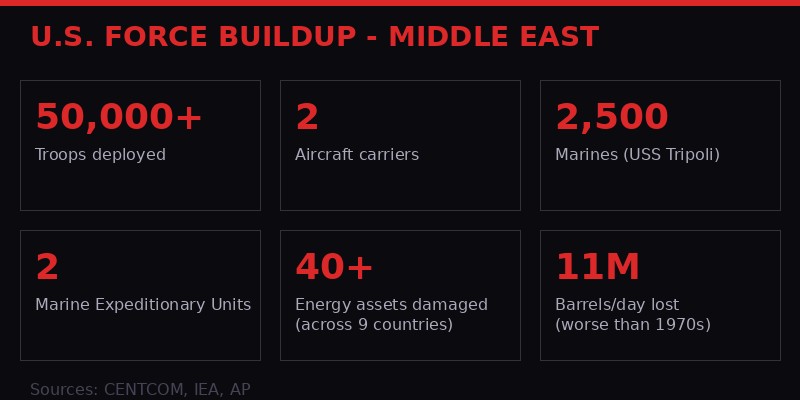
The American force posture in the region is now the largest in over two decades. Over 50,000 troops are deployed. The USS Tripoli, carrying 2,500 Marines from the 31st Marine Expeditionary Unit, arrived in the Gulf after being diverted from exercises near Taiwan. The USS Boxer and two additional ships with another Marine Expeditionary Unit are en route from San Diego. Until recently, two aircraft carriers were on station, though the USS Gerald R. Ford has departed for repairs after a fire damaged sleeping quarters.
Secretary of State Marco Rubio has insisted the U.S. can meet its objectives "without any ground troops." But the buildup tells a different story. Rubio acknowledged that Trump "has to be prepared for multiple contingencies" and that forces are available to give the president "maximum optionality." The gap between the rhetoric of near-victory and the reality of an expanding force deployment is widening by the day.
04 // Hegseth's Pattern: The Brass Purge

Pete Hegseth arrived at the Pentagon with no military command experience. He is a former Fox News host and Army National Guard officer who served in Iraq and Afghanistan in junior roles. His confirmation was contentious - he was approved by the thinnest of margins after allegations of personal misconduct that he denied. What he lacked in institutional credibility, he made up for in political alignment with the White House.
Since taking the helm, Hegseth has embarked on what defense analysts are calling the most aggressive restructuring of military leadership since the Truman administration. The language around these removals is revealing. Officers are not being fired for incompetence or failure. They are being replaced because they are not "completely trusted" to execute the administration's "vision." The distinction matters. Military leaders are supposed to be trusted to fight wars, protect troops, and provide unvarnished advice to civilian leadership. That function - the professional military advisory role - is being explicitly subordinated to political loyalty.
The fired officers share one characteristic: they were appointed or promoted during the Biden years. General George. Admiral Franchetti. General Slife. The unnamed brigadier general removed from West Point. The pattern is unmistakable and undeniable.
Historical precedent for this kind of wartime purge is sparse and unflattering. Abraham Lincoln fired generals during the Civil War, but for losing battles. Harry Truman fired Douglas MacArthur during the Korean War for publicly undermining civilian authority - a specific, documented act of insubordination. Neither of those cases involved removing officers purely because they had been appointed by a political opponent, and both generated massive political backlash.
What Hegseth is doing is qualitatively different. This is not about battlefield performance. This is about ideological conformity within the officer corps. The Pentagon has been renamed the "Department of War" in official communications - a throwback to pre-1947 nomenclature that Hegseth's team views as symbolically important. Spokesman Parnell used the phrase in his statement about George's departure. The symbolism is clear: this is a Pentagon that wants to project aggression, not deliberation.
The consequences of loyalty-based purges during active combat operations are historically devastating. Saddam Hussein's Iraq, where officers were promoted and removed based on tribal allegiance and personal loyalty to the dictator, is perhaps the most studied modern example. The Soviet military under Stalin's Great Purge of 1936-1938 is another - an officer corps decimated by political cleansing that left the Red Army catastrophically unprepared for the German invasion three years later. These are extreme examples, and nobody is suggesting the American military is approaching anything comparable. But the principle is the same: replacing competent commanders with politically reliable ones during wartime degrades military effectiveness. Every time. Without exception.
05 // The Hormuz Crisis and American Absence

While Hegseth was removing the Army's top general, 41 nations were holding an emergency summit - hosted by Britain - to discuss how to reopen the Strait of Hormuz. The United States did not attend.
The absence is staggering. The U.S. launched this war. U.S. strikes triggered Iran's closure of the strait. American military operations are the direct cause of the worst energy crisis since the 1970s oil shocks. And when the world gathered to discuss solutions, Washington sent nobody.
The numbers from the strait are biblical in their scale of disruption. Traffic has dropped 94% compared to the same period last year, according to Lloyd's List Intelligence. Twenty-three commercial vessels have been directly attacked by Iran. Eleven crew members are dead. Two thousand ships and 20,000 seafarers are trapped in the Gulf, unable to transit. Oil prices sit at $111.54 per barrel of U.S. crude - up 50% since the war began.
The head of the International Energy Agency, Fatih Birol, called the crisis a "major, major threat" to the global economy, noting that 11 million barrels per day have been lost - more than the two oil shocks of 1973 and 1979 combined. Gas markets have lost 140 billion cubic meters, nearly twice the impact of the Russia-Ukraine war. The IEA has already released 400 million barrels from strategic reserves - a historic intervention - and is considering further releases.
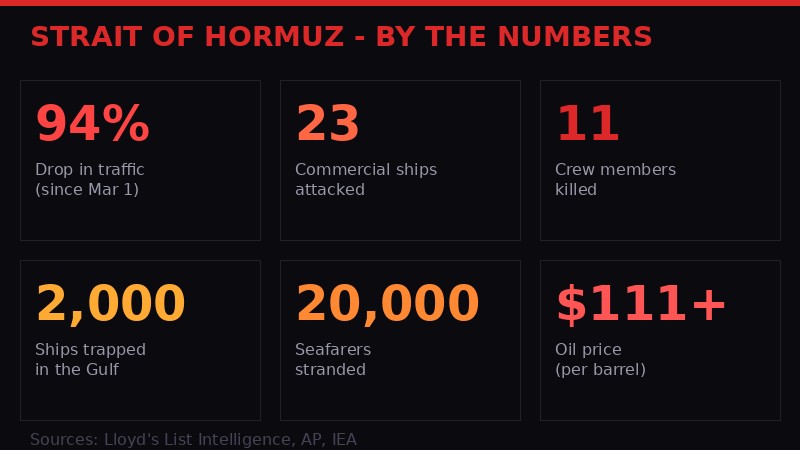
British Foreign Secretary Yvette Cooper accused Iran of "holding the global economy hostage." But the diplomatic response remains toothless without American participation. No country is willing to attempt a military reopening while fighting continues. French President Emmanuel Macron called such an operation "unrealistic," noting that Iran's Revolutionary Guards possess anti-ship missiles, drones, attack craft, and mines that would make any transit suicidal.
Saudi Arabia has begun piping roughly 1 billion barrels of oil per month through alternative routes. Iraq announced Thursday that it had started trucking oil across Syria to avoid the strait entirely. These are emergency measures, not solutions. They represent a fundamental restructuring of global energy logistics forced by a war that Trump claimed in his Wednesday address is nearing completion.
Macron delivered the most pointed European criticism of U.S. handling of the war to date. Speaking from South Korea during a state visit, the French president said: "This is not a show. We are talking about war and peace and the lives of men and women. When you want to be serious you don't say every day the opposite of what you said the day before. And maybe you shouldn't be speaking every day. You should just let things quieten down."
"They then lament that they are alone in an operation they decided on alone. It's not our operation."- French President Emmanuel Macron, April 3, 2026, Seoul
He added: "I feel like there is too much chatter, it's all over the place." When pressed on Trump's personal attacks - the U.S. president mocked Macron's accent at a private lunch and made disparaging remarks about his wife Brigitte - Macron dismissed them as "neither elegant nor up to standard" and said they did not deserve a response.
06 // Iran's Industrial Destruction

The scope of U.S. and Israeli strikes has expanded dramatically in recent days. Iran's two largest steel plants - Khuzestan Steel Company and Mobarakeh Steel Company - have both been shut down. Mehran Pakbin, deputy head of operations at Khuzestan Steel, told Iranian media that "restarting these units will take at least six months and up to one year." Iranian steel production represents a significant portion of the country's non-oil economy. Iran is the world's tenth-largest steel producer, according to the World Steel Association.
Israeli media reported that the steel plant strikes were expected to cause "billions of dollars in damage" to the Iranian economy, and that the plants were linked to the Islamic Revolutionary Guard Corps. The IRGC responded by targeting what it said were "US-linked steel and aluminum facilities" in Gulf states, and struck an Amazon cloud computing center in Bahrain, according to Iranian state media.
Beyond steel, the target list now includes pharmaceutical companies, medical research centers, civilian bridges, and what appears to be a deliberate campaign against the foundations of Iranian economic life. On March 23, strikes hit the Pasteur Institute of Iran, a medical research center in Tehran. A spokesperson for Iran's health ministry called it "a direct assault on international health security" and said it violated the Geneva Conventions. On Tuesday, Tofigh Daru Research and Engineering Company - a manufacturer of anesthetic and cancer drugs - was hit. The IDF claimed the company "transferred chemical substances, including fentanyl, that were used for research and development of chemical weapons."
Trump and Hegseth have stated openly that the goal is to bring Iran "back to the stone ages." The phrase is no longer rhetorical. It is operational doctrine. Power plants, water desalination stations, bridges, steel mills, pharmaceutical factories - the architecture of a modern nation is being systematically dismantled. Legal experts say targeting civilian infrastructure amounts to collective punishment, prohibited under international law.
Iran's internet has been blacked out for 34 consecutive days. Connectivity to the outside world stands at 1% of normal levels, according to NetBlocks. The country is simultaneously being bombed and silenced. Information about conditions on the ground comes through a narrow keyhole of state media, diplomatic channels, and the handful of communications that penetrate the digital blockade.
07 // The Iranian Civilian Experience

Despite severe censorship and the internet blackout, reporting from inside Iran paints a picture of mounting civilian desperation. The BBC obtained testimony from Iranians in six different cities through trusted sources on the ground - shopkeepers, taxi drivers, public sector workers, nurses.
"Setareh," a young woman from Tehran whose name has been changed for her protection, described the moment the war arrived at her office. She heard the explosion, climbed to the roof, saw smoke. "Everyone working in the company panicked. People were shouting and screaming and running away." Her boss shut the business that day and laid off the entire staff.
She now cannot sleep without heavy painkillers. "I can honestly say I haven't slept for several nights and days in a row. The anxiety is so intense that it has affected my body." She is running out of money. "We cannot afford even basic food. What's in our pockets does not match market prices." Food prices had already risen 60% in the year before the war. Sanctions had hollowed out savings. Now the bombs have eliminated income.
"Tina," a nurse at a hospital outside Tehran, described wounded civilians arriving with injuries "that were not recognizable - some had no hands, some had no legs." She is haunted by a pregnant woman caught in an air strike near a military center. "Neither the mother nor the fetus was alive. She had been just two months away from giving birth." Tina's own mother was pregnant with her during the Iran-Iraq war of the 1980s and told her stories of fleeing to bomb shelters. "Now I find myself in the same kind of situation my mother once faced. I cannot believe how quickly history repeats itself."
"Behnam," a former political prisoner still in hiding after being shot during the January 2026 anti-government protests, keeps antibiotics and painkillers stockpiled in his apartment. He showed a BBC contact an X-ray revealing metal fragments still lodged in his torso from when security forces ambushed protesters. "Once you see how easily your life can be threatened - that a simple incident or a twist of fate can mean death or survival - after that, your life no longer holds the same value for you."
The regime has deployed internal security forces to patrol streets. There are arrests, torture, and executions. During the January demonstrations, thousands of civilians were killed by their own government. Now that same government is being bombed by the United States, creating a population trapped between two sources of violence - one domestic, one foreign - with no path to safety from either.
08 // Lebanon's Sectarian Fracture
The war's secondary front in Lebanon continues to deteriorate. Israel has killed more than 1,300 people and displaced over one million in its ground invasion targeting Hezbollah. The displaced are overwhelmingly Shiite, and their movement into Christian, Sunni, and Druze areas has reignited sectarian tensions that Lebanon's fragile post-civil-war order was designed to suppress.
In Beirut, displaced families cannot find housing. Landlords in Christian areas refuse to rent to Shiites or demand exorbitant deposits - $5,000 upfront for two months is standard. Security agencies screen tenants for Hezbollah connections before landlords will sign leases. When Israeli strikes kill people in mixed neighborhoods, locals assume the target was a Hezbollah member and demand the displaced leave.
In mid-March, an Israeli strike on an apartment in Aramoun killed three people, prompting residents to call for the evacuation of all displaced families. In Bchamoun, another strike killed three, including a four-year-old girl. "Had we known that they were linked to Hezbollah, we would have kicked them out," an angry neighbor told the Associated Press at the scene.
When an Iranian missile fell over the predominantly Christian Keserwan region in late March, young men attacked displaced Shiites in the district of Haret Sakher, calling for their expulsion. "We don't want them here," one resident shouted. He said displaced people referred to their hosts as "Zionists" for criticizing Hezbollah. "We don't want national coexistence."
The Lebanese army has beefed up street deployments. Army commander General Rudolphe Haikal toured Beirut and Sidon, telling troops to be "firm in the face of any attempt to undermine internal stability." Police SWAT units now patrol major intersections. A municipality official in the Sunni town of Naameh described opening separate schools for Shiite and Sunni displaced populations to prevent friction. The country that fought a 15-year civil war ending in 1990 is watching its social fabric tear along the same old lines.
Maha Yahya, director of the Carnegie Middle East Center in Beirut, described the atmosphere: "The Israeli targeting campaign has created a lot of paranoia. If you see a displaced person, maybe you wonder, 'What if this person is a target?'" Fear begets suspicion. Suspicion begets hostility. Hostility begets violence. Lebanon has seen this cycle before. It knows how it ends.
09 // Trump's Address and the Credibility Gap
On Wednesday night, Trump addressed the nation about the war. He claimed U.S. military action had been so decisive that Iran, "one of the most powerful countries," is "really no longer a threat." He said "core strategic objectives are nearing completion." He threatened to destroy Iran's power plants. Earlier in the week, he threatened water desalination stations.
He did not explain how the war would end. He did not present a plan to reopen the Strait of Hormuz. He did not address the 300+ wounded American troops or the 13 dead. He encouraged countries that depend on Gulf oil to "build some delayed courage" and go "take" the strait themselves - while making clear the United States would not do so.
Iran's response was defiant. Military spokesman Lt. Col. Ebrahim Zolfaghari insisted Tehran maintains "hidden stockpiles of arms, munitions and production facilities" and called the facilities targeted so far "insignificant." Iran's Foreign Minister Abbas Araghchi wrote on X: "Striking civilian infrastructure only conveys the defeat and moral collapse of an enemy in disarray."
The State Department's Tommy Pigott told Al Jazeera that "the president is always open to diplomacy" and that diplomatic engagement is happening "at the highest levels of this administration." Barbara Slavin, a fellow at the Stimson Center, offered a less charitable assessment: "I think that Donald Trump is looking for a way to end the war without it being an abject failure. And so he is clutching at various straws at this time."
Macron was blunter still. He noted that six months ago, after the initial "Operation Midnight Hammer" strikes, the administration claimed Iran's nuclear program had been completely destroyed. "I remind you that six months ago we were told that everything had been destroyed and all had been sorted out," he said. Now the same administration is fighting a second war over the same issue, having apparently failed to resolve it the first time.
Tulsi Gabbard, Trump's own Director of National Intelligence, told Congress before this war that "Iran is not building a nuclear weapon." And after the 2025 strikes, she confirmed there have been "no efforts" by Iran to rebuild enrichment capacity. The stated justification for the war has been contradicted by the administration's own intelligence chief. This is not a classified assessment leaked by a whistleblower. It is congressional testimony on the public record.
10 // What Happens When You Fire Generals Mid-War
The question that nobody in the Pentagon press corps has been willing to ask directly - at least not yet - is this: What does it mean for combat readiness when the Army's top general is removed during active hostilities for reasons unrelated to battlefield performance?
The answer, drawn from military history, is uniformly negative. Leadership transitions during conflict introduce friction at exactly the moment when institutional knowledge and established relationships matter most. General George knew the deployment plans. He knew the force rotation schedules. He knew which units were stressed and which had capacity. He had relationships with allied military commanders built over decades. All of that institutional capital evaporated Thursday morning.
LaNeve, his replacement, is by all accounts a competent officer. But "competent" is not the standard when you are managing the largest U.S. military deployment since the Iraq invasion. The standard is seamless. The standard is no disruption in the kill chain, the supply chain, the decision chain. Every new commander, no matter how capable, needs time to establish authority, build staff relationships, and process the operational picture. That time, in a shooting war, is measured in lives.
The broader signal to the officer corps is equally corrosive. Every general, every admiral, every colonel watching what happened to Randy George now knows the rules: your job security depends not on how well you fight but on how completely you align with the political vision of the Secretary of Defense. Dissent - even private dissent - is career suicide. Candid advice that contradicts the preferred narrative is a firing offense.
This creates what military scholars call a "yes-man problem." When officers know that honesty gets you fired, they stop being honest. They report what leadership wants to hear. They suppress bad news. They inflate successes. They undercount casualties. They overestimate enemy degradation. They tell the Secretary that his strategy is working brilliantly even when the evidence says otherwise. And then, one morning, an attack succeeds that should not have succeeded, and the after-action report reveals that everyone knew it was coming but nobody said anything because the last person who raised concerns got fired.
This is not theoretical. This is the documented mechanism by which politicized militaries lose wars they should win. The Argentinian junta in the Falklands. The Iraqi military under Saddam in both Gulf Wars. The Soviet forces in Afghanistan. Political loyalty replacing professional judgment. Every single time, the result is the same: tactical surprise, operational failure, strategic defeat.
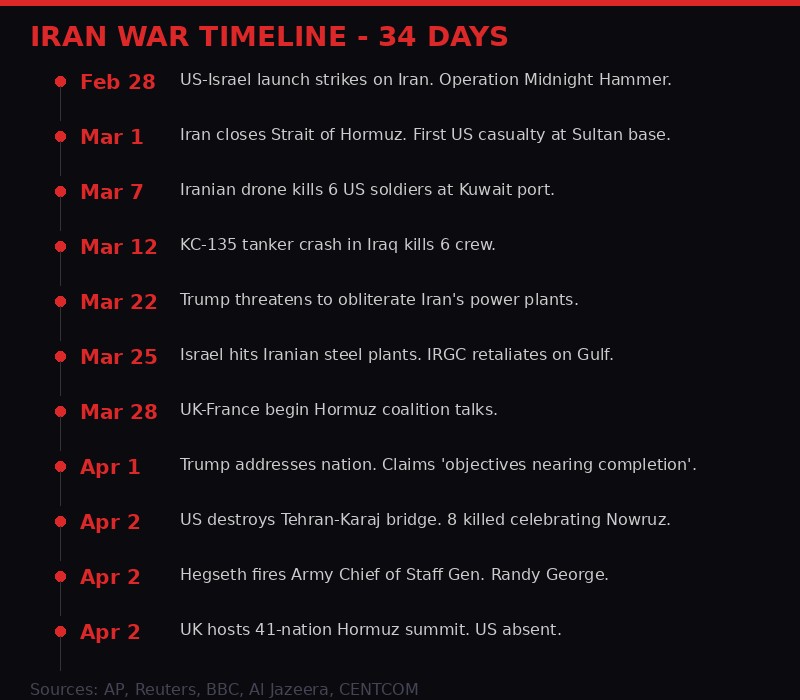
11 // Timeline: 34 Days of War and Purge
Key Events - February 28 to April 3, 2026
- Feb 28: U.S. and Israel launch strikes on Iran. Operation Midnight Hammer II begins. War commences.
- Mar 1: Iran closes the Strait of Hormuz. Sgt. Benjamin Pennington wounded at Prince Sultan Air Base (dies days later).
- Mar 7: Iranian drone kills 6 U.S. soldiers at a civilian port in Kuwait.
- Mar 12: KC-135 refueling tanker crashes in Iraq. 6 crew killed. Not attributed to hostile fire.
- Mar 22: Trump threatens to "obliterate" Iran's power plants. 48-hour ultimatum on Hormuz.
- Mar 23: Pasteur Institute of Iran (medical research) struck. Iran calls it a Geneva Convention violation.
- Mar 25: Israel hits Khuzestan Steel and Mobarakeh Steel plants. IRGC retaliates on Gulf energy infrastructure.
- Mar 28: UK and France begin Hormuz coalition discussions.
- Late Mar: Hegseth fires Chief of Naval Operations and Air Force Vice Chief of Staff.
- Apr 1: Trump addresses nation. Claims objectives "nearing completion." Threatens power plants, desalination stations. Oil at $111+/barrel.
- Apr 2: U.S. destroys Tehran-Karaj bridge. 8 Iranians killed celebrating Nowruz Nature Day. Tofigh Daru pharmaceutical factory hit.
- Apr 2: Iran fires 6 ballistic missiles and 29 drones at Prince Sultan Air Base. 15 U.S. troops wounded.
- Apr 2: UK hosts 41-nation Hormuz summit. U.S. does not attend.
- Apr 2: Hegseth fires Army Chief of Staff Gen. Randy George. "Time for a leadership change."
- Apr 3: Iran, Israel, Gulf states report ongoing strikes. Macron criticizes Trump. IEA warns of economic catastrophe.
12 // The View from Here
Thirty-four days into a war that nobody can explain how to end, the United States finds itself in a position that would be satirical if it weren't killing people. The military is simultaneously fighting its largest overseas conflict in a generation and purging its own leadership. The world's most important shipping lane is closed because of a war America started, and America won't attend the meeting to discuss reopening it. The president claims the enemy is defeated while the enemy fires ballistic missiles at American bases weekly. The administration says it is open to diplomacy while bombing bridges, steel mills, pharmaceutical factories, and medical research centers.
Iran is being driven into the stone age, as promised. But "the stone age" has a population. Setareh can't sleep. Tina watches pregnant women die. Behnam keeps painkillers next to his gun. Twenty thousand seafarers are trapped on ships they cannot move. One million Lebanese are displaced and unwanted. Oil is at $111 and climbing.
And the Army Chief of Staff, a three-decade combat veteran, was fired on Thursday because he was appointed by the wrong president.
The Pentagon renamed itself the Department of War. That might be the only honest thing it has done in 34 days.
Get BLACKWIRE reports first.
Breaking news, investigations, and analysis - straight to your phone.
Join @blackwirenews on Telegram