
Photo: Pexels
Bloody Caddo's Favorite Prosecutor Wants to Be a Judge
Hugo Holland withheld evidence in at least three death penalty cases, compared a Black teenager to a dog, submitted false paperwork to acquire military rifles, and displayed a portrait of a KKK founder in his office. He raised $61,000 in two months for a judicial seat. Nobody seems to mind.
In the fall of 2000, a prosecutor in Shreveport, Louisiana, stood before a jury and pointed at a sixteen-year-old boy named Corey Williams. The boy had a severe intellectual disability. He had been hospitalized as a child for extreme lead poisoning and institutionalized multiple times for mental health crises. He was Black. And the prosecutor wanted him dead.
Hugo Holland, then an assistant district attorney in Caddo Parish, told that jury to treat the teenager like an animal. "Get rid of it," Holland said, comparing Williams to a dog. The jury obliged. Williams was sentenced to death.
What Holland did not tell the jury - what he concealed for fifteen years - was that witnesses on the night of the murder had told police that Williams was innocent. That detectives at the scene believed several older men had committed the crime and were pinning it on the boy. That the prosecution's star witness, Chris Moore, whose gun was used in the killing, was the person multiple people identified as the actual shooter.
Holland hid all of it. The tapes. The witness statements. The detective's own doubts. He buried them, and a child with the mental capacity of someone far younger spent twenty years in a Louisiana prison - the first stretch of that time on death row.
Now, in March 2026, Hugo Holland is running for judge.
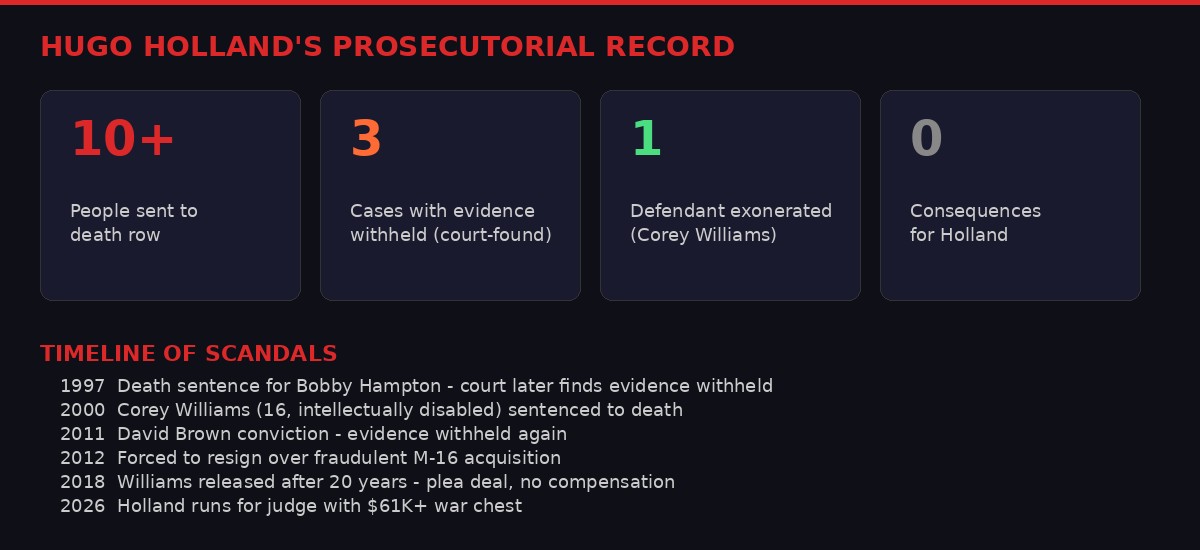
BLACKWIRE analysis of Hugo Holland's prosecutorial record across four decades.
The Prosecutor From Bloody Caddo

Photo: Pexels
To understand Hugo Holland, you must first understand where he operates. Caddo Parish sits in the northwest corner of Louisiana, anchored by Shreveport, a city that has been wrestling with its past for longer than most of its residents have been alive. The parish is known by a name that locals rarely explain to outsiders: Bloody Caddo.
The name is earned. During the Reconstruction era and through the decades of Jim Crow terror that followed, Caddo Parish recorded the second-highest number of lynchings of any county in the entire United States, according to research compiled by the Equal Justice Initiative. The violence was not random. It was systematic - orchestrated by white supremacist organizations determined to enforce racial hierarchy through murder.
The Confederate flag flew in front of the Caddo Parish courthouse until 2011. A monument featuring four Confederate generals stood on the courthouse steps until 2022. Inside that courthouse, the machinery of racial disparity operated with industrial precision. Between 2010 and 2015, Caddo Parish secured more death penalty convictions per capita than any other county in America, according to the Death Penalty Information Center. Eighty percent of the defendants sentenced to death during that period were Black, though Black residents made up just under half the parish population.
Here is a statistic that requires no annotation: No white person has ever been executed for killing a Black person in Caddo Parish. Not once. Not in the entire recorded history of the jurisdiction.
Hugo Holland spent twenty-one years inside that courthouse as an assistant district attorney, from 1991 to 2012. He was, by any measurable standard, one of the most aggressive prosecutors in a jurisdiction already defined by its aggression. He sent at least ten people to death row. The overwhelming majority were men of color. Of those ten death sentences, half have since been overturned or reduced - a failure rate that would end careers in any profession where accountability exists.
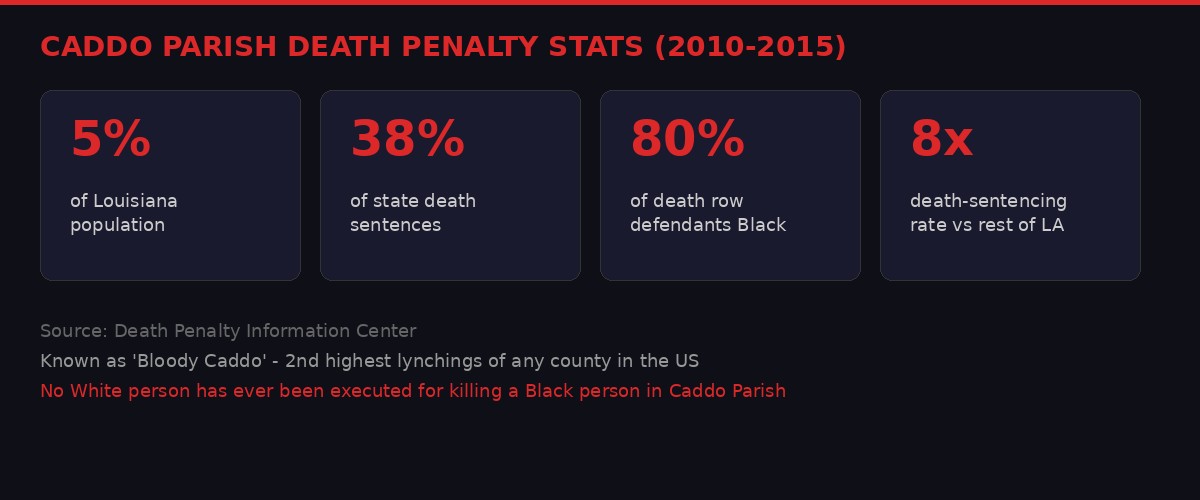
Death penalty statistics from Caddo Parish, compiled from Death Penalty Information Center data.
Three Cases, Three Patterns, Zero Consequences

Photo: Pexels
The legal term for what Hugo Holland did is a Brady violation - named after the 1963 Supreme Court case Brady v. Maryland, which established that prosecutors must turn over evidence favorable to defendants. It is one of the most fundamental rules in American criminal law. Without it, the adversarial system is just theater.
Holland violated Brady in at least three death penalty cases that courts have examined. The pattern is remarkable in its consistency.
Bobby Hampton, 1997. Holland secured a death sentence for Hampton in connection with a murder during a liquor store robbery in Shreveport. What Holland did not disclose: grand jury testimony in which a witness - speaking under oath - identified someone else as the person who fired the fatal shot. The Louisiana Supreme Court eventually found that Holland had indeed withheld this testimony. The court ruled, however, that the omission did not warrant overturning the verdict because prosecutors had turned over a similar (but unsworn) police statement from the same witness. A dissenting opinion on the court noted the obvious distinction: the grand jury testimony was given under oath and unambiguously identified a different shooter. Hampton remains on death row today, still challenging his conviction.
Corey Williams, 2000. The case that should have ended Holland's career. Williams was sixteen years old, intellectually disabled, and had no physical evidence connecting him to the fatal shooting of a pizza delivery driver. After a twelve-hour interrogation - conducted without an attorney and on a child with a severe cognitive deficit - Williams confessed. Holland took that confession to trial. He compared the boy to a dog. He told the jury to "get rid of it." The jury sentenced Williams to death.
Fifteen years later, Williams' attorneys finally obtained what Holland had hidden: tape recordings of witness interviews from the night of the murder. The tapes revealed that multiple eyewitnesses told police Williams was innocent. The original investigating detectives believed older men in the neighborhood had committed the crime and were scapegoating the boy. The prosecution's own star witness - Chris Moore, who owned the murder weapon - was the person witnesses identified as the killer.
Dozens of former U.S. Department of Justice officials and federal prosecutors filed a brief with the U.S. Supreme Court supporting Williams' appeal. The evidence suppression was so flagrant that a former Caddo Parish district attorney, who took office years after Holland's prosecution, acknowledged in 2015 court filings that Holland and his team had withheld evidence. Before the Supreme Court could rule, prosecutors offered Williams a deal: plead guilty to manslaughter and obstruction of justice, walk free, but forfeit any right to compensation for the twenty years stolen from his life. Williams took the deal. He had no choice. He left prison with a criminal record, no money, no work experience, and twenty years of his youth erased. Holland told The Nation he did not conceal anything, calling the accusation "horseshit." He added: "He shouldn't be [out]. He is a murderer."
David Brown, 2011. Brown was one of five prisoners convicted of murdering a guard at the Louisiana State Penitentiary at Angola. Holland prosecuted the case. What he did not reveal: another prisoner had told prosecutors about a jailhouse confession from one of the five co-defendants - a confession in which that man said he and a different inmate, not Brown, had decided to kill the guard. A state judge vacated Brown's sentence in 2014 upon discovering this suppression. The Louisiana Supreme Court reinstated it, reasoning that the withheld confession did not necessarily preclude Brown's involvement. Brown remains on death row.
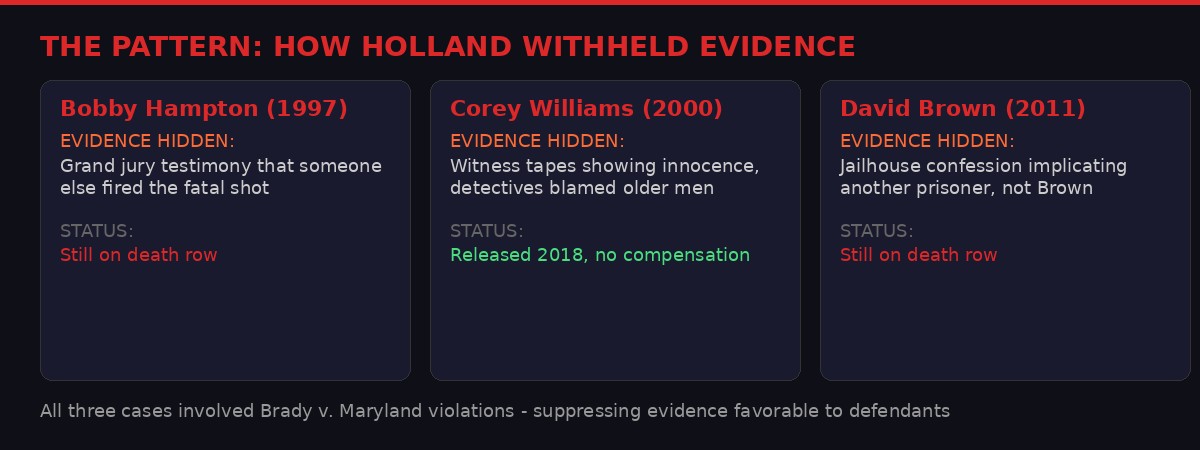
Three documented cases in which courts found Holland withheld evidence favorable to defendants.
The Confederate Portrait and the M-16 Lie

Photo: Pexels
The evidence suppression was not the only red flag in Holland's two decades at the Caddo Parish DA's office. He decorated his office with a portrait of Confederate General Nathan Bedford Forrest - who, beyond his role in the Civil War, was a founding figure of the Ku Klux Klan. When confronted, Holland insisted he admired Forrest for his cavalry tactics, not his racism. The distinction did not comfort the predominantly Black defendants being prosecuted inside that building.
Defense attorneys documented other incidents. In one capital murder case, Holland emailed opposing counsel to say he planned to spend Veterans Day in his pickup truck looking for "a Black guy or a Mex-can." He later called it a joke. The Associated Press reported on the email in the context of broader racial justice investigations in Caddo Parish.
Holland's conduct inside the courtroom matched his conduct outside it. Defense attorney Matilde Carbia, who represented a death row inmate Holland helped convict, described a 2018 postconviction hearing in which Holland followed her around the courtroom as she questioned a witness, standing close behind her with his coat pushed back to expose the firearm on his hip. In a separate incident, Carbia said Holland displayed an AR-15 rifle on his desk when she arrived at his office to review case files. "He was doing everything he could to attempt to intimidate me," she told ProPublica. Another attorney present at the events confirmed Carbia's account.
Then there was the weapons scandal that actually cost Holland his job - temporarily. In 2012, the Louisiana State Inspector General found that Holland and a colleague had submitted "false information" to obtain a cache of fully automatic M-16 rifles through a federal surplus program. Holland justified the acquisition by claiming his office "routinely participate[d] in high-risk surveillance and arrests" - a claim that local law enforcement agencies flatly denied. The inspector general's report was unambiguous: the paperwork was fraudulent. Holland was forced to resign.
In most professions, submitting false federal paperwork to acquire military weapons would mark the end of a career. In Caddo Parish, it was a speed bump. Holland reinvented himself as a prosecutor-for-hire, contracting with more than a dozen district attorneys across Louisiana who needed help trying high-profile murder cases. By 2017, he was being paid to lobby the Louisiana legislature on behalf of the powerful Louisiana District Attorneys Association, successfully killing a bill that would have abolished the death penalty in the state.
"He's demonstrated that he is untrustworthy, unreserved in his aggression and without any judicial temperament. He brings disrepute to the justice system in a way that undermines people's faith in it."- Ben Cohen, defense attorney who represented Corey Williams
The Campaign: $61,000 and Silence

Photo: Pexels
Holland filed to run for judge in the First Judicial District Court in Caddo Parish in early 2026. The campaign finance numbers arrived quickly and aggressively. His first report, released in February, showed more than $61,000 raised in less than two months - roughly double what many candidates for the 1st Judicial Court spend in an entire campaign cycle, according to Jeffrey Sadow, a political science professor at Louisiana State University in Shreveport.
The donor list reads like a roadmap of prosecutorial power in northwest Louisiana. An assistant district attorney from the Caddo Parish DA's office. The district attorney of neighboring Bossier and Webster parishes. A former state judge. Members of major law firms throughout the region. Holland's campaign chairman is Matthew Kay, the head of the local Republican Party, who also served as a Donald Trump elector in 2024.
ProPublica and Verite News contacted ten of Holland's donors. Nine refused to respond or speak about their support. The only donor who agreed to comment was Charles Jacobs, the city attorney for Bossier City and a former state judge, who donated $2,500 and described Holland as a "very fair" prosecutor who "cuts it right down the line - black or white, brown or yellow."
Holland himself declined multiple requests for comment about his candidacy and his record.
The fundraising haul is strategically significant. Sadow noted that the war chest might prove "so daunting that it scares off potential challengers," though candidates have until the end of July 2026 to enter the race. The message to potential opponents is unmistakable: the prosecutorial establishment of northwest Louisiana has chosen its candidate, and the price of opposition will be high.
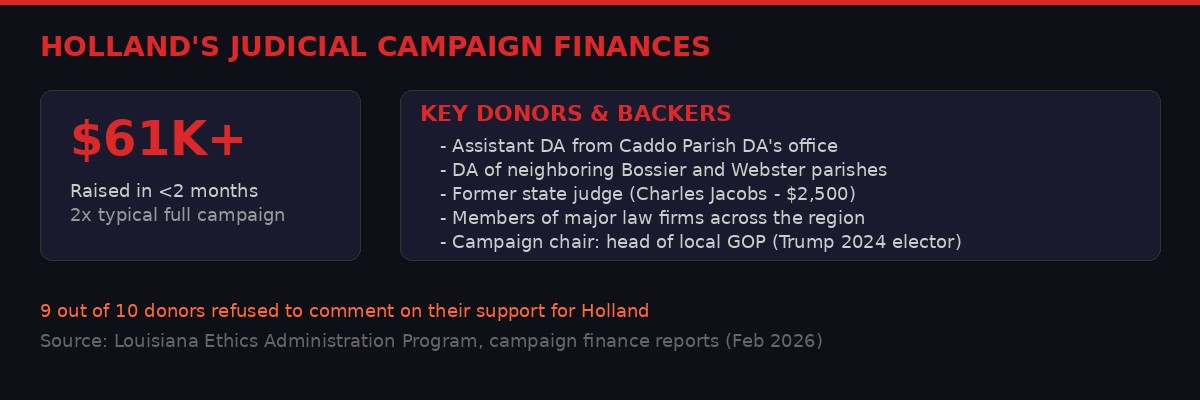
Holland's judicial campaign finance breakdown from Louisiana Ethics Administration filings.
The Broader Pattern: Prosecutorial Immunity and the Path to the Bench

Photo: Pexels
Hugo Holland's judicial campaign is not an aberration. It is a feature of a system that rewards prosecutorial misconduct rather than punishing it.
Under the doctrine of absolute prosecutorial immunity - established in the 1976 Supreme Court case Imbler v. Pachtman - prosecutors cannot be sued for actions taken during the course of prosecution, including the deliberate suppression of evidence. The doctrine was designed to protect prosecutors from frivolous lawsuits by disgruntled defendants. In practice, it has created a class of legal actors who can destroy lives with impunity.
The consequences play out in numbers. A 2020 study by the National Registry of Exonerations found that prosecutorial misconduct contributed to more than half of all wrongful convictions involving exonerations since 1989. Of those cases, fewer than 4% of the prosecutors involved faced any formal discipline. The Innocence Project has documented dozens of cases nationwide in which prosecutors who withheld evidence, presented false testimony, or made improper arguments at trial faced no bar complaints, no criminal charges, and no career consequences.
Holland fits the pattern precisely. Three documented Brady violations. An inspector general finding of fraudulent federal paperwork. Accusations of racial intimidation from multiple defense attorneys. And the consequence? A thriving second career as a prosecutor-for-hire, a lobbying gig with the state's most powerful DA association, and now a well-funded judicial campaign.
The pipeline from aggressive prosecutor to elected judge is well-documented in Louisiana and across the South. A 2018 analysis by the Loyola University New Orleans College of Law found that former prosecutors make up a disproportionate share of elected judges in Louisiana, and that judicial candidates with prosecutorial backgrounds consistently outraise those from defense or civil practice backgrounds. The fundraising advantage reflects the institutional backing of law enforcement, district attorneys' offices, and victims' advocacy groups that view former prosecutors as reliable allies on the bench.
The problem, critics argue, is that a prosecutor who treated evidence as a weapon rather than an obligation does not suddenly develop respect for due process upon donning a robe.
"If that is the kind of perspective that he would bring to the judiciary, that would be wholesale damaging to criminal defendants across the board."- Matilde Carbia, defense attorney
Louisiana's Death Penalty Machine in 2026

Photo: Pexels
Holland's judicial bid arrives at a particularly dangerous moment for criminal defendants in Louisiana. Governor Jeff Landry, who took office in January 2024, declared upon his inauguration that he wanted to execute every prisoner on death row "as quickly as possible." The statement was not rhetorical posturing. Landry has actively pushed to restart executions in a state that has not carried out the death penalty since 2010.
Louisiana currently holds 56 people on death row, according to the most recent data from the Louisiana Department of Public Safety and Corrections. Among them are Bobby Hampton and David Brown - two men whose convictions rest on trials in which Hugo Holland withheld evidence. Both continue to fight their convictions through the appeals process. If Landry succeeds in restarting executions, these men could face lethal injection based on verdicts that courts have acknowledged were obtained through prosecutorial suppression of evidence.
The Louisiana Supreme Court has consistently ruled that while Holland did withhold evidence, the suppression was not material enough to warrant overturning the verdicts. This is the legal standard established in the wake of Brady v. Maryland: prosecutors must disclose favorable evidence, but if courts determine that disclosure would not have changed the outcome, the conviction stands. Defense attorneys and legal scholars have long criticized this standard as circular reasoning - it asks judges to speculate about what juries would have done with evidence they never saw, then uses that speculation to justify the suppression.
Holland himself expressed open contempt for Brady obligations. In a Louisiana Supreme Court argument two years ago, he called the foundational 1995 ruling on evidence disclosure "a very poorly written opinion because it leaves far too much to conjecture by people on the bench." He objected to "judges second-guessing juries." The implication was clear: Holland believes the prosecutorial prerogative to decide what evidence matters should trump judicial oversight.
Now he wants to be the judge.
Glenn Ford and the Ghost of Caddo Parish

Photo: Pexels
No examination of Caddo Parish's death penalty machinery is complete without the case of Glenn Ford. In 1984, Ford - a Black man - was convicted by an all-white jury and sentenced to death for the murder of a Shreveport jeweler. The conviction rested on testimony that was later found to be unreliable, and Ford's defense was handled by two appointed attorneys who had never represented a criminal defendant at trial.
Ford spent thirty years on Louisiana's death row before being exonerated in 2014 when the state conceded that new evidence proved his innocence. He was released from Angola prison with a $20 gift card and the clothes on his back. He was diagnosed with stage IV lung cancer shortly after his release and died in 2015.
A.M. "Marty" Stroud III, one of the prosecutors who put Ford on death row, later wrote a remarkable public letter of apology in which he confessed to arrogance, tunnel vision, and a win-at-all-costs mentality. "I was not going to lose," Stroud wrote. "I had become the very monster I claimed to be protecting the public from."
Dale Cox, who served as acting district attorney in Caddo Parish during Ford's exoneration, responded to questions about the case by telling reporters that Louisiana "needs to kill more people." His office was responsible for one-third of all death sentences in Louisiana between 2010 and 2015. Cox chose not to run for election after his statement attracted national attention.
The 2015 study by Reprieve Australia - conducted in the wake of Ford's exoneration - found that Caddo Parish prosecutors used peremptory strikes against 46% of Black jurors but only 15% of other jurors. One Black prospective juror was removed from a jury pool in 2009 for objecting to the Confederate flag flying in front of the courthouse. Seventy-five percent of people sentenced to death in Caddo Parish in the past decade were represented by at least one lawyer who did not meet recently imposed standards for capital defense attorneys.
This is the ecosystem in which Hugo Holland built his career. This is the courtroom he wants to preside over.
A Changing Parish, an Unchanged Candidate

Photo: Pexels
Caddo Parish is not what it was. Black voters now make up just over half the parish population. In 2015, voters elected the parish's first Black district attorney, James E. Stewart Sr., who pledged to "bring professionalism and ethics back to the district attorney's office." In 2024, voters elected the parish's first Black sheriff by a comfortable margin. The Confederate flag is gone. The monument is gone. The demographics have shifted.
But judicial elections in Louisiana do not work the way parishwide elections do. The First Judicial District Court has fourteen seats, and candidates choose among three districts in which to run. Only one of those districts is majority Black, according to Sadow's analysis. Holland has not announced which district he will run in. But running in a majority white, conservative district - especially one where the incumbent is retiring, eliminating the need for a head-to-head challenge - would substantially increase his odds.
The strategic calculation is transparent. Holland does not need the majority of Caddo Parish voters to support him. He needs a majority of voters in a single district that skews white and conservative - a district where his record of aggressive prosecution and death penalty advocacy may be viewed as virtues rather than disqualifications. His $61,000 war chest and Republican Party backing make it unlikely that he will face a well-funded opponent.
Theron Jackson, pastor of Morning Star Missionary Baptist Church in Shreveport, told ProPublica that a Holland victory would represent "a step back" toward the days of Bloody Caddo - "when the failure of elected officials to protect and serve everybody's community resulted in the victimization of Black people."
Defense attorney Nick Trenticosta, who once faced Holland in a death penalty case, expressed more optimism. "Caddo is not the same Caddo it was 30 years ago," he said. "The voters know who he is."
But knowing who someone is and stopping them from gaining power are not the same thing. The voters of Caddo Parish may understand exactly what Hugo Holland represents. The question is whether that understanding translates into opposition in a low-turnout judicial election in a gerrymandered district where the legal establishment has already placed its bets.
What Justice Looks Like in Caddo Parish
Corey Williams is free. That is the single best outcome in this story, and it required twenty years, a suppressed evidence trove, intervention by dozens of former DOJ officials, and a plea deal that left Williams with a criminal record and no compensation. He left prison in 2018 with nothing. His intellectual disability, which was documented before his arrest, has not improved. He lost his adolescence, his twenties, and the first years of his thirties inside Louisiana's prison system. He was sixteen years old when Holland compared him to a dog.
Bobby Hampton is on death row. He has been there since 1997 - twenty-nine years. The Louisiana Supreme Court acknowledged that Holland withheld grand jury testimony in his case. Hampton remains condemned.
David Brown is on death row. His sentence was vacated in 2014 after a judge found that Holland suppressed a jailhouse confession. The Louisiana Supreme Court put the sentence back. Brown remains condemned.
Hugo Holland is running for judge. He has $61,000 in campaign funds, the backing of the local Republican Party, the support of prosecutors and law firms across northwest Louisiana, and a judicial seat within reach. He has never faced criminal charges for evidence suppression. He has never been disbarred. He was not even permanently removed from prosecutorial practice - his 2012 "forced resignation" for fraudulently obtaining military weapons merely redirected him into a more lucrative career as a freelance death penalty prosecutor.
The system that produced Hugo Holland is not broken. It is operating exactly as designed. The prosecutors who suppress evidence face no personal consequences. The defendants who are wrongly convicted bear the full weight. And when the prosecutor decides he wants a promotion, the same legal establishment that looked the other way on evidence tampering writes him checks and chairs his campaign.
Candidates have until the end of July 2026 to file for the First Judicial District Court race. Holland has not announced which district he will seek. The election is expected in the fall.
Bobby Hampton and David Brown will likely still be on death row when it happens.
Sources: ProPublica / Verite News joint investigation (March 2026), Death Penalty Information Center, Innocence Project, Louisiana Ethics Administration Program campaign finance reports, Louisiana State Inspector General, The Nation, Associated Press, court filings from Hampton v. Louisiana, Williams v. Louisiana, and Brown v. Louisiana.
Get BLACKWIRE reports first.
Breaking news, investigations, and analysis - straight to your phone.
Join @blackwirenews on Telegram