
An oil tanker at anchor. Over 150 vessels are currently stranded outside the Strait of Hormuz, unable to transit. Photo: Pexels
At 10:00 GMT on Thursday, April 2, 2026, Foreign Secretary Yvette Cooper will open a virtual summit with representatives from 35 nations. The agenda: how to reopen the Strait of Hormuz, the 21-mile-wide bottleneck between Iran and Oman through which roughly one-fifth of the world's oil and a significant share of its liquefied natural gas has historically transited every single day. The meeting will assess diplomatic measures, military coordination, and the logistics of rescuing dozens of commercial vessels - and thousands of seafarers - trapped in the world's most dangerous shipping lane.
The United States will not be in the room.
That single fact carries more geopolitical weight than any of the military statistics CENTCOM has released in 33 days of Operation Epic Fury. Washington started this war. Washington broke the strait. And now 35 countries are sitting down to figure out how to fix it without Washington's help, because Washington told them - in the words of President Trump himself - to "go get your own oil."
This is not a snub. It is a restructuring. And it is happening today.
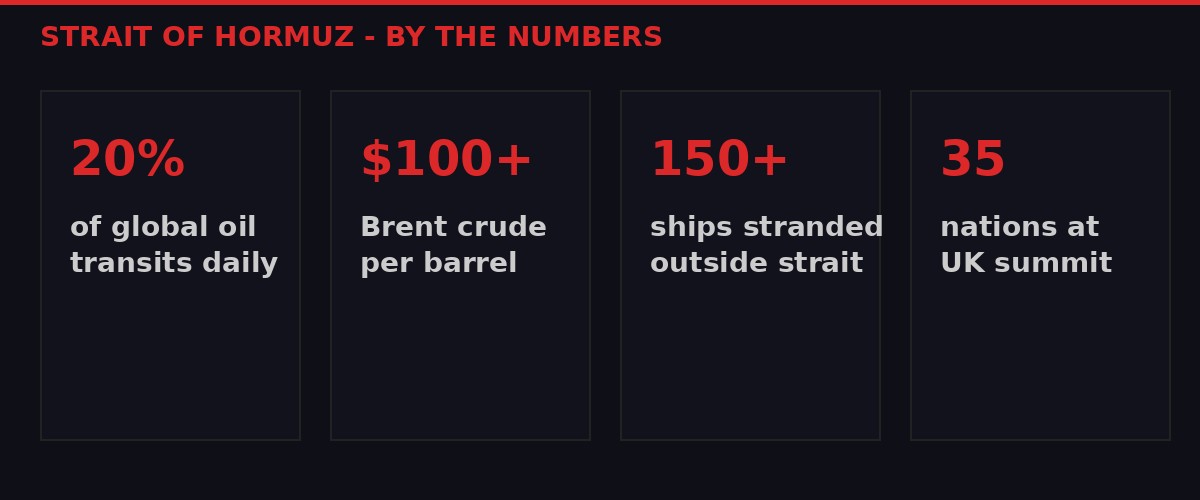
The Strait of Hormuz crisis in four numbers. Infographic: BLACKWIRE
The Chokepoint That Feeds the World

Global shipping has been thrown into chaos since Iran's closure of the strait in early March. Photo: Pexels
Before February 28, 2026, the Strait of Hormuz was the most important waterway in global commerce that most people never thought about. Roughly 20 million barrels of oil per day - about 20% of global seaborne crude trade - passed through its narrow shipping lanes, flanked by Iran to the north and Oman to the south. In 2024, an estimated 84% of crude oil and condensate shipments through the strait were bound for Asian markets, with China receiving a third of its total oil imports via this single passage (Wikipedia - Hormuz Crisis).
Qatar, the world's largest LNG exporter, relied on the strait entirely. Europe got 12-14% of its LNG from Qatar through Hormuz. The Persian Gulf also accounted for 30-35% of global urea exports and 20-30% of ammonia exports, making the strait critical not just for fuel but for global agriculture. An estimated 30% of internationally traded fertilizers normally transited the chokepoint.
When the US and Israel launched Operation Epic Fury on February 28, killing Supreme Leader Ali Khamenei in a decapitation strike and hammering military infrastructure across Iran, the Islamic Revolutionary Guard Corps responded by shutting it all down. The IRGC issued warnings prohibiting vessel passage. Then it started shooting. By March 4, at least 16 merchant vessels had been attacked, seven abandoned, 12 seafarers killed or missing, and a tugboat sunk. Tanker traffic dropped 70% within days. Then it dropped to zero.
The International Energy Agency called it "the largest supply disruption in the history of the global oil market" (Wikipedia - Economic Impact). Brent crude surpassed $100 per barrel on March 8, peaked at $126, and has been hovering above $100 ever since. US gas prices blew through $4 a gallon for the first time since Russia's invasion of Ukraine. The crisis dwarfed the 1973 oil embargo, the 1979 Iranian Revolution, and the 2022 energy shock combined.
On March 27, Iran declared the strait formally closed to any vessel traveling "to and from" the ports of the United States, Israel, and their allies. The remaining trickle of traffic - a couple of Chinese-owned vessels in late March - only proved Tehran's point: Iran decides who passes and who doesn't.
Trump's Message to Europe: Fight for Yourself

The US has told its allies to secure the strait themselves, even as American strikes created the crisis. Photo: Pexels
The summit exists because of a specific sequence of American statements that, taken together, amount to a withdrawal from the liberal international order's most basic commitment: if we break it, we help fix it.
On March 15, President Trump called on "countries of the world that receive oil through the Hormuz" to join a coalition to reopen the strait. Nobody came. The UK hesitated. France equivocated. Gulf states were too busy being bombed to volunteer their navies. Trump's Hormuz coalition call landed with zero takers, a fact BLACKWIRE reported at the time.
By March 31, frustration had curdled into contempt. Trump posted on Truth Social:
"I have a suggestion for you: Number 1, buy from the U.S., we have plenty, and Number 2, build up some delayed courage, go to the Strait, and just TAKE IT. You'll have to start learning how to fight for yourself, the U.S.A. won't be there to help you anymore, just like you weren't there for us. Iran has been, essentially, decimated. The hard part is done. Go get your own oil!"
The message was received. Not as an insult, but as a statement of policy. Defense Secretary Pete Hegseth echoed it: allies should "start learning how to fight" for themselves or lose American support entirely (AP News). Secretary of State Marco Rubio said the administration would "reexamine the value" of NATO once the Iran war concluded (State Department transcript).
And on April 1 - the same day he addressed the nation on Iran, the same day Artemis II launched, the same day the Supreme Court heard birthright citizenship arguments - Trump told the Telegraph he was "absolutely" considering pulling the United States out of NATO entirely.
Britain heard all of this. And Keir Starmer decided that waiting for Washington to come around was no longer a viable strategy.
What the Summit Will Actually Discuss
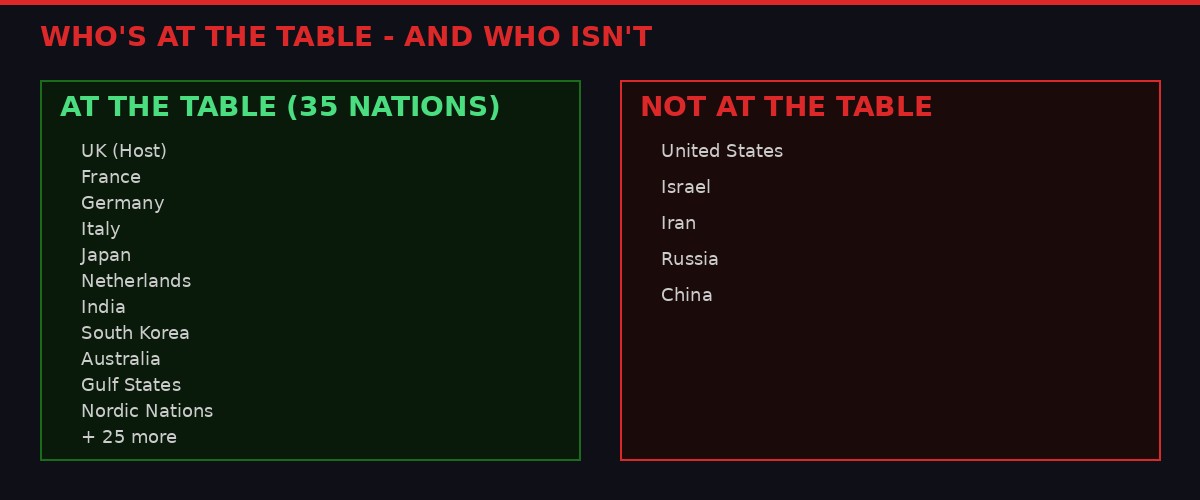
The diplomatic lineup for the April 2 Hormuz summit. Infographic: BLACKWIRE
Speaking at a Downing Street press conference on April 1, Prime Minister Starmer laid out a two-phase plan. Phase one: a virtual diplomatic summit on April 2, hosted by Foreign Secretary Yvette Cooper, with representatives from 35 countries. Phase two: a follow-up meeting of defense leaders next week to "look at how we can marshal our capabilities and make the strait accessible and safe after the fighting has stopped" (Al Jazeera).
The summit will assess "all viable diplomatic and political measures" to restore freedom of navigation, guarantee the safety of trapped ships and seafarers, and resume the movement of vital commodities. Participants include the signatories of a joint statement from late March declaring readiness to contribute to appropriate efforts to ensure safe passage. Among the confirmed attendees: the UK, France, Germany, Italy, Japan, the Netherlands, India, South Korea, and Australia (Straits Times).
The US is understood to not have been directly invited. This was a deliberate choice, not an oversight. Downing Street sources indicated that the UK and the US are "working together on the initiative" at a bilateral level, but that Washington's presence at the multilateral table would complicate the diplomatic messaging - particularly given Trump's public hostility toward allied participation and his simultaneous threats to abandon NATO (Politico Europe).
Starmer was blunt about the difficulty ahead: "I do have to level with people on this. This will not be easy."
He's right. The summit faces three fundamental problems. First, Iran still has the capacity to attack shipping even as its navy is being systematically destroyed by CENTCOM. Mobile missile launchers on Iran's southern coast remain a lethal threat. Second, any escort operation requires minesweeping - Iran threatened to mine the strait, and the narrow waterway is the perfect environment for asymmetric naval warfare. Third, the question of who pays, who commands, and who absorbs the political risk of confronting Iran while the US simultaneously bombs it is unresolved.
The Military Dimension: Aspides, Cyprus, and the Gulf

European navies are being asked to do what the US won't: escort commercial shipping through contested waters. Photo: Pexels
The diplomatic summit is only half the story. The other half is military, and it is already moving.
On April 1, Starmer announced that Britain would deploy additional troops and air defense systems to the Middle East to protect Cyprus and Gulf allies from Iranian attacks. The deployment includes reinforcements to the UK's Sovereign Base Areas at Akrotiri and Dhekelia on Cyprus, which have served as staging points for British reconnaissance and support operations since the war began.
France moved first. On March 9, President Macron announced a "purely defensive, purely support" escort mission for merchant ships transiting the strait, operating within the framework of Operation Aspides - the EU naval mission originally established to protect Red Sea shipping from Houthi attacks. France dispatched a dozen ships to the wider Middle East, including two frigates specifically assigned to escort commercial vessels through Hormuz. Germany and Italy joined the effort within days (Wikipedia - Hormuz Crisis).
Operation Aspides had already proven the concept. Since its establishment in early 2024, the EU Naval Force had provided a defense-only protection umbrella for hundreds of commercial vessels in the Red Sea, refined secure communication protocols, and operated alongside partners including India and Gulf states. The Hormuz mission would be a scaled-up version of the same model - but against a far more capable adversary than the Houthis (EUObserver).
The challenge is formidable. Iran's coast along the strait bristles with anti-ship cruise missiles, including Chinese-supplied C-802s and domestically produced Noor and Qader variants. The IRGC Navy - distinct from Iran's conventional navy, which CENTCOM has largely destroyed - specializes in swarm tactics using fast attack craft armed with rockets and torpedoes. The strait's narrowest point is just 21 miles wide, with shipping lanes only two miles across. For a convoy escort operation, that geometry is a nightmare.
The Al Jazeera Centre for Studies laid out the framework in a recent analysis: intensive bombardment of coastal areas, suppression of mobile missile launchers, and naval escort toward a secure corridor. But such an operation would be massive. CENTCOM has struck over 12,300 targets inside Iran as of April 1, and the Iranian coast remains dangerous. Any European-led escort mission would operate in an active combat zone without the American carrier strike groups that typically anchor such operations.
The Economic Pressure Driving the Talks
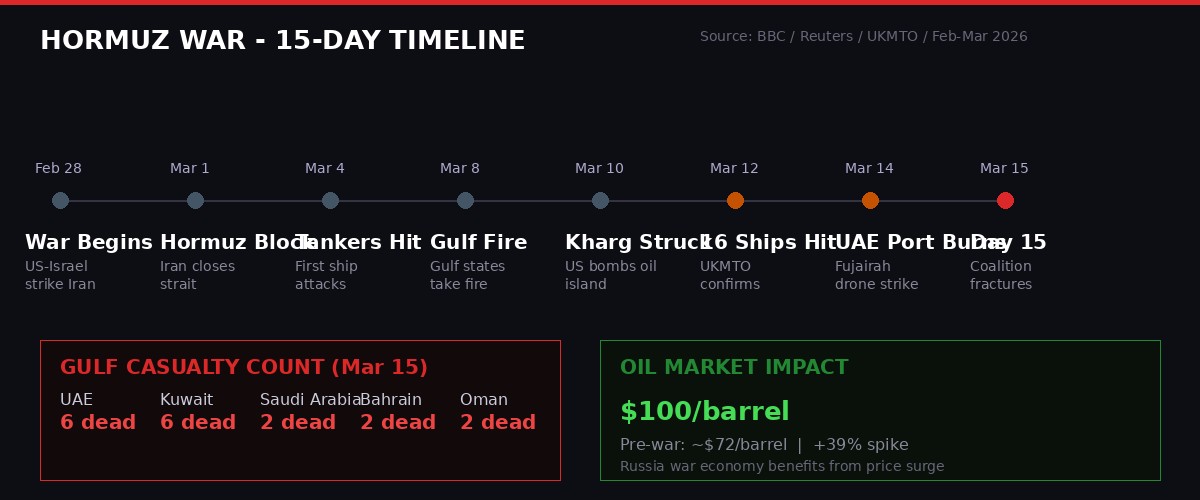
Five weeks of crisis: the Hormuz timeline. Infographic: BLACKWIRE
The urgency behind the summit is not abstract geopolitics. It is grocery prices, heating bills, and factory closures.
The economic impact of the Hormuz closure has been catastrophic and is accelerating. The closure triggered what the International Energy Agency characterized as the single largest supply disruption in the history of the global oil market. Oil production from Kuwait, Iraq, Saudi Arabia, and the UAE collectively dropped by 10 million barrels per day as of mid-March because there was nowhere to send it - the tankers couldn't leave the Gulf (Wikipedia - Economic Impact).
Europe is being hit from multiple directions simultaneously. The suspension of Qatari LNG exports - Qatar declared force majeure on all contracts after tankers could no longer exit the Gulf - has created a gas supply emergency that coincided with historically low European storage levels, estimated at just 30% capacity after a brutal 2025-2026 winter. Dutch TTF gas benchmarks nearly doubled to over 60 euros per megawatt-hour by mid-March. The European Central Bank postponed planned interest rate reductions, raised its 2026 inflation forecast, and cut GDP growth projections. UK inflation is expected to breach 5% this year. Shell warned that Europe could face fuel shortages as early as this month.
The Gulf states themselves are in crisis. The maritime blockade triggered a "grocery supply emergency" across the Gulf Cooperation Council, where nations rely on the strait for over 80% of caloric intake. By mid-March, 70% of the region's food imports were disrupted. Retailers like Lulu Retail resorted to airlifting staples. Consumer prices spiked 40-120%. Iranian strikes on desalination plants - the source of 99% of drinking water in Kuwait and Qatar - pushed the crisis from economic to humanitarian.
The aviation sector cratered. Emirates and Qatar Airways faced near-total cessation of operations due to multinational airspace closures. Tourism revenues evaporated. The Gulf's image as a permanently safe destination for expatriates, immigrants, and tourists has been "irreversibly shaken," according to the Qatar-funded Middle East Council on Global Affairs.
Beyond the Gulf, the cascade continues. The Philippines declared a state of energy emergency on March 24. Vietnam faced fuel shortages and panic buying. Bangladesh and Pakistan - price-sensitive economies dependent on Middle Eastern energy - are in acute distress. Even Australia and India, with larger reserves, are dealing with the second-order effects of panic buying and market speculation.
Nobel Prize-winning economist Paul Krugman told CBS News that oil prices could easily reach $150 per barrel, and that "$200 is not crazy" if the strait remains closed. EU Energy Commissioner Dan Jorgensen warned of prolonged turmoil: "It will not be short because even if there was a peace tomorrow, there will still be consequences because energy infrastructure in the region has been ruined by war" (CBS News).
Why the US Isn't There - and Why That Matters

The 35-nation summit marks a realignment in global security architecture. Photo: Pexels
The American absence from the summit is not a technicality. It is a signal - one that both the organizers and the absent party intended.
For the UK and its partners, excluding the US solves an immediate diplomatic problem. Trump has spent the past week publicly berating every ally for insufficient support. Having the US at the table while simultaneously threatening to quit NATO and telling Europe to "just TAKE IT" would have made constructive diplomacy impossible. The summit needs to produce actionable plans, not political theater.
There is also the legal and operational reality. The US is an active belligerent in the conflict that created the Hormuz crisis. American warplanes are still bombing Iranian targets as the summit convenes. Any reopening plan must, by definition, involve at least a partial de-escalation - and the US has shown no interest in scaling back operations. Trump told Reuters on April 1 that the US would leave Iran "pretty soon" but could return for "spot hits" as needed. That is not a ceasefire. It is an open-ended authorization for further strikes.
For Trump, the summit's existence actually serves American interests in a counterintuitive way. He has been demanding that allies shoulder more of the security burden for years. Here they are, doing exactly that. If the UK-led coalition succeeds in reopening Hormuz, Trump can claim credit for forcing Europe to step up. If it fails, he can point to European weakness as justification for his "America First" approach to the alliance.
But the strategic implications run deeper than any one president's calculations. The Hormuz summit represents the first major multilateral security initiative of the 21st century organized explicitly without American participation. It is not a case of the US declining to join - it is a case of the rest of the world deciding it cannot wait for American leadership that has been openly withdrawn.
This pattern has been building for years. The EU established its own defense initiatives. Japan and South Korea deepened bilateral security ties independent of Washington. ASEAN built security architecture that assumed American unreliability. But those were incremental adjustments to a US-led order. The Hormuz summit is something different: an emergency response to a crisis created by American action, organized by American allies, with American exclusion as a design feature.
Iran's Position: Defiant, Degraded, Dangerous

Iran continues to strike across the Gulf even as its conventional military is systematically dismantled. Photo: Pexels
Any plan to reopen the strait must contend with the fact that Iran, while significantly degraded, is not defeated and shows no signs of capitulating.
CENTCOM's operational update as of April 1 is staggering in its scale: over 12,300 targets struck, more than 155 Iranian vessels damaged or destroyed, 13,000 combat flights flown. The US claims to have largely annihilated Iran's conventional navy and significantly degraded its ballistic missile production capacity. B-52 strategic bombers are now flying over Iranian territory - a sign that Iran's air defenses have been substantially weakened.
But Iran is still fighting. On April 1, the IRGC announced a new wave of missile and drone attacks targeting US and Israeli sites in the Gulf, as well as Israeli cities including Tel Aviv and Eilat. Iranian drones hit fuel depots at Kuwait's international airport. A missile struck an oil tanker leased to QatarEnergy. Fourteen people, including children, were injured by Iranian missiles fired at central Israel.
President Masoud Pezeshkian released an open letter to the American public, claiming Iran harbors no ill will toward US citizens while simultaneously warning of "consequences that extend far beyond Iran's borders." The IRGC posted a kill list of 17 US tech companies - Apple, Google, Meta, Microsoft, Nvidia, Tesla, Boeing, and others - threatening to target their Middle Eastern operations "for every assassination in Iran."
Trump claimed on Truth Social that Iran had requested a ceasefire and would be granted one upon reopening the Strait of Hormuz. Tehran called the claim "false and baseless." Iran denies engaging in any negotiations with the United States. US intelligence agencies believe Iran is not currently willing to negotiate (NPR).
This disconnect between American victory rhetoric and Iranian defiance is what makes the Hormuz summit so urgent. Trump says the war is "pretty much winding up" and will conclude in "two weeks, maybe three." His own aides believe he is "mostly improvising, rather than following a clear plan on Iran," according to the Times of Israel. The gap between declared policy and operational reality is a chasm - and the 35 nations meeting on April 2 are looking into it.
The Houthi Variable: A Second Chokepoint

The Houthis' entry into the war threatens to close the Bab-el-Mandeb strait, creating a second maritime chokepoint. Photo: Pexels
The summit's planning documents reportedly account for a complication that makes the crisis even worse: the Houthis.
Yemen's Iran-backed Houthi rebels officially entered the war on March 28, vowing an "escalation" in attacks on Israeli and allied shipping. The Houthis had already been disrupting Red Sea shipping since late 2023, forcing commercial vessels to avoid the Bab-el-Mandeb strait and the Suez Canal in favor of the longer Cape of Good Hope route. Their formal entry into the Iran war raises the specter of a second maritime chokepoint closure simultaneously.
If both Hormuz and Bab-el-Mandeb are contested, the implications for global shipping are catastrophic. The two straits together control the vast majority of energy trade between the Middle East and both Europe and Asia. Alternative routes - principally Saudi Arabia's East-West Pipeline (which can carry about 5 million barrels per day) and the UAE's Habshan-Fujairah Pipeline (1.5 million barrels per day) - provide only partial relief and require overland infrastructure that is itself vulnerable to Iranian missile attacks.
Operation Aspides was originally designed to counter the Houthi threat in the Red Sea. Extending its mandate to cover Hormuz while maintaining Red Sea patrols would stretch European naval assets thin. The UK's Royal Navy, already operating at historically low fleet numbers, would need to sustain simultaneous deployments in two active combat theaters - neither of which is close to British home waters.
What Success Looks Like - and What Failure Costs

The global energy system cannot survive an extended Hormuz closure. The summit must produce results. Photo: Pexels
The optimistic scenario for the summit: a framework agreement on a multinational escort force, a division of responsibilities between naval powers, a timeline for minesweeping operations, and a diplomatic channel to Iran (possibly through Oman or Qatar) to negotiate safe passage corridors. This would not reopen the strait immediately, but it would create the architecture for reopening once military operations scale down.
The pessimistic scenario: 35 countries issue a strongly worded communique, commit to "further consultations," and return to their capitals without concrete plans. Meanwhile, Brent crude climbs toward $130. European industry imposes 30% surcharges on chemical and steel products. Germany and Italy slide into technical recession. The Gulf's food crisis deepens. And the world waits for Trump to declare victory in a war that his own intelligence agencies say Iran hasn't conceded.
CNBC reported that oil industry executives and analysts believe the economic and market fallout "could escalate sharply if the Strait of Hormuz isn't reopened within roughly the next one to three weeks." That timeline aligns almost exactly with Trump's predicted conclusion of the war. If Trump is right and the conflict winds down by mid-April, the summit's work becomes the foundation for a post-war recovery. If he's wrong - if the war drags on, if Iran keeps fighting, if the Houthis escalate - then the summit's plans become the world's only lifeline.
The stakes are not hyperbolic. Deutsche Welle reported that the Gulf states are unlikely to sustain high investment spending during or after the war. The ECB warned of stagflation and recession across energy-dependent European economies. Fertilizer disruptions threaten agricultural yields in countries already struggling with food security. The cascading effects of a prolonged closure extend from gas stations in Nebraska to rice paddies in Bangladesh.
The Day the Order Shifted

April 2, 2026 may be remembered as the day the world stopped waiting for American leadership. Photo: Pexels
Historians will likely mark April 2, 2026 as a turning point - not because of what happens in the summit, but because of what the summit represents.
For 80 years, since the end of World War II, the security of global maritime trade has been fundamentally underwritten by the United States Navy. Freedom of navigation in the Persian Gulf has been, since at least Operation Earnest Will in 1987-1988, an explicitly American commitment. When Iran threatened the strait in 2011-2012, it was the US Fifth Fleet that kept ships moving. When the Houthis attacked Red Sea shipping in 2023-2024, it was the US that organized the multinational response.
That era is not ending with a bang or a whimper. It is ending with a Truth Social post telling Europe to "go get your own oil" and a 35-country summit that took Washington at its word.
Starmer is no revolutionary. The UK summit is not an act of defiance against the United States. It is an act of self-preservation by countries that have been told, in plain English, that the security guarantees they relied on for three generations are being revoked. When Trump says "the U.S.A. won't be there to help you anymore," Starmer and Macron and Scholz have to assume he means it - because the consequences of assuming otherwise and being wrong are too severe.
The 35 nations gathering today are not building an anti-American bloc. They are building the minimum viable alternative to American maritime security leadership. Whether they succeed or fail, the attempt itself rewrites the terms of the global order. The question is no longer whether the rest of the world can function without American military hegemony. The question is how fast they can learn.
The summit convenes in a few hours. The strait remains closed. The oil price remains above $100. The war remains hot. And 35 countries are about to find out whether they can do together what none of them could do alone - and what the United States has told them it will no longer do for them.
The hard part, it turns out, is not bombing Iran. The hard part is what comes after.
Get BLACKWIRE reports first.
Breaking news, investigations, and analysis - straight to your phone.
Join @blackwirenews on Telegram