Day 30: Houthis Open a Third Front as the Iran War Goes Regional
Yemen's Houthis fired two missiles at Israel on Saturday, entering the monthlong war and threatening global shipping for the second time in two years. Simultaneously: 2,500 US Marines arrived in theater, three journalists were killed in Lebanon alongside nine paramedics, Iran's parliament is drafting NPT withdrawal legislation, and three Bushehr nuclear plant strikes prompted an IAEA radiological warning. The Islamabad summit convenes Sunday.

Thirty days ago, the first US and Israeli bombs slammed into Tehran. What the Trump administration framed as a targeted operation to destroy Iran's nuclear program has become something else: a multi-theater regional war with no exit strategy, a spreading proxy network, and a new front opening every week.
On Saturday, that escalation took a decisive turn. Yemen's Houthi rebels fired two missiles at Israel - their first direct strike since the February 28 war start - threatening to replicate the 2023-2025 campaign that paralyzed Red Sea shipping and cost the global economy hundreds of billions of dollars. The Bab el-Mandeb Strait, through which roughly 12 percent of world trade passes, is now under active threat at the same moment the Strait of Hormuz sits effectively closed.
The same day: 2,500 US Marines arrived in theater, adding to the largest American military concentration in the Middle East in more than two decades. In Lebanon, an Israeli airstrike killed three journalists in a clearly marked press vehicle. Nine paramedics died in five separate strikes on healthcare facilities in southern Lebanon. In Tehran, Iranian parliamentarians drafted legislation to withdraw from the Nuclear Non-Proliferation Treaty.
The war that was supposed to be over in days is entering its second month with no ceasefire in sight, a diplomatic process collapsing in real time, and a regional architecture being redrawn in fire.

The Houthis Enter: A Second Shipping Chokepoint
Houthi Brig. Gen. Yahya Saree announced the missile launches on Al-Masirah satellite television, saying they targeted "sensitive Israeli military sites" in the south of the country. Israel's air defenses intercepted the projectiles, with no reported casualties confirmed. But the military significance is secondary to the strategic warning: the Houthis are back.
Between November 2023 and January 2025, the Houthi movement attacked more than 100 merchant vessels in the Red Sea with missiles and drones, sinking two ships and forcing the most significant rerouting of global maritime trade since the 2021 Suez Canal blockage. The campaign added weeks and thousands of dollars per voyage to shipping routes, as vessels chose the 6,000-mile detour around the Cape of Good Hope rather than risk the 1,800-mile Suez corridor.
That campaign ended - uneasily - in early 2025. The Houthis declared it paused after Gaza ceasefire negotiations produced a hostage deal. The underlying conflict never resolved. Now the Iran war has given them a new justification, a new target, and potentially a new campaign.
"The impact would not be limited to the energy market," said Ahmed Nagi, a senior Yemen analyst at the International Crisis Group. "If the Houthis increase attacks on commercial shipping, as they have in the past, it would further push up oil prices and destabilize all of maritime security." (AP News, March 28)

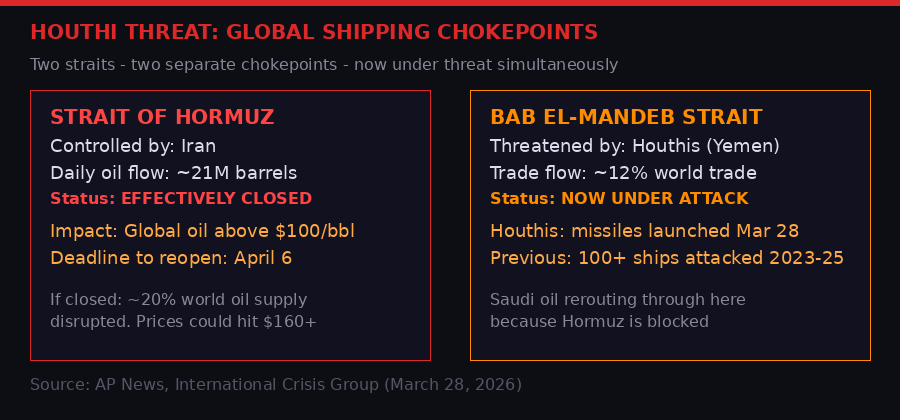
The geometry here is particularly dangerous. Saudi Arabia, with its own Hormuz access blocked by Iran's standoff, has been routing millions of barrels of crude oil per day through the Bab el-Mandeb and up the Red Sea. If the Houthis resume their targeting of commercial vessels in that channel, Saudi Arabia's export capacity - already strained - faces a second shock.
Oil markets hit $100 per barrel within the first two weeks of the war. Analysts tracking both chokepoints now estimate the realistic ceiling climbs considerably higher if Houthi attacks materialize at scale. The USS Gerald R. Ford aircraft carrier, which would be the natural deterrent force, arrived in Croatia on Saturday for scheduled maintenance - and sending it to the Red Sea risks drawing the kind of sustained missile barrage that damaged the USS Harry S. Truman in 2025.
The Houthis have held Yemen's capital Sanaa since 2014. Saudi Arabia launched a counteroffensive in 2015; that war produced one of the worst humanitarian catastrophes of the 21st century and ended in an uneasy ceasefire. The group answers to Iranian supply lines - and those supply lines, frayed by a month of US strikes on Iranian logistics infrastructure, have not been completely severed.
Iran's Nuclear Gambit: Eyeing the Exit From the NPT
The strikes are getting closer to the reactor core - literally.
On Friday, Israeli and US warplanes bombed a yellowcake uranium processing facility in Yazd, struck the Khondab Heavy Water Complex near Arak, and hit targets in or around the Bushehr Nuclear Power Plant - the civilian reactor on Iran's southwestern coast that Russia helped build and that generates electricity for millions of Iranians. The IAEA issued a rare warning about the "potential for a major radiological incident" after at least three projectiles landed in Bushehr's vicinity.
The strikes prompted a political explosion in Tehran. Ebrahim Rezaei, the spokesman for Iran's parliamentary national security commission, posted on X that it "would be meaningless for Iran to remain a signatory" to the Nuclear Non-Proliferation Treaty given that membership "has had no benefit for us." (Al Jazeera, March 28)
"His political reports about Iran's peaceful nuclear activities, lack of condemnation for aggression against our nuclear facilities, and now encouraging the enemies to attack Iran's nuclear sites, will bring the country to irrevocable decisions." - Mohammad Mohkber, senior adviser to the late Supreme Leader Khamenei, referring to IAEA Director Rafael Grossi (Al Jazeera, March 28)
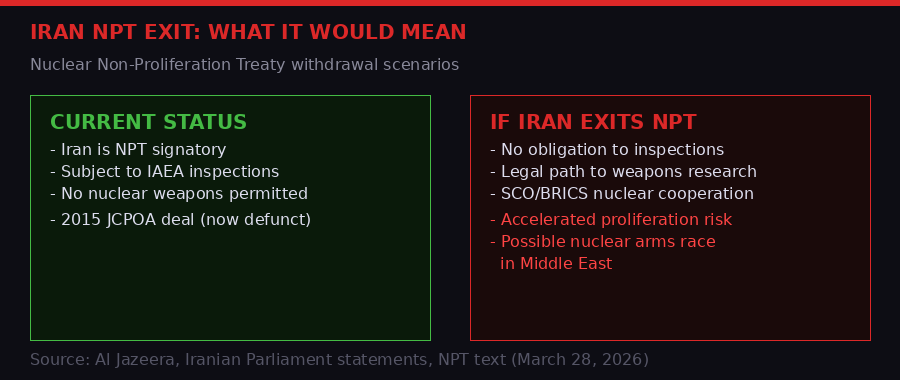
MP Malek Shariati from Tehran confirmed that a priority piece of legislation - formally withdrawing Iran from the NPT, revoking the nuclear restrictions tied to the now-defunct 2015 JCPOA deal, and establishing a new nuclear cooperation framework with SCO and BRICS partners - has been uploaded to an online parliamentary portal for review.
Parliament has not held formal sessions since the war began February 28. But this legislation does not require a formal session to generate pressure - its existence on the portal is itself a signal to Washington, Tel Aviv, and the IAEA.

IAEA Director Rafael Grossi told CBS News earlier this month that no conventional war has the capability to totally destroy Iran's nuclear program "unless it was nuclear war and you go for destruction unfathomable." Iranian parliamentarians labeled that statement "a provocative act" that "violates all international norms."
The NPT has 191 member states. Only three nations with nuclear weapons - India, Pakistan, and Israel - have never joined. North Korea withdrew in 2003; it now possesses an estimated 40-50 nuclear warheads. An Iranian withdrawal would follow the same legal path: 90 days' notice to the UN Security Council, citing "supreme national interests."
The difference between Iran in 2026 and North Korea in 2003: Iran's nuclear infrastructure is being actively bombed, its enriched uranium stockpiles are of uncertain status, and its scientists have been targeted in assassination campaigns for two decades. The practical path to a weapon from an NPT exit remains unclear - but the political signal to China, Russia, SCO partners, and BRICS members would be seismic.
Three Journalists, Nine Paramedics: Lebanon's Deadliest Day
The press vehicle was clearly marked. Four precision missiles hit it anyway.
On Saturday morning on the Jezzine Road in southern Lebanon, an Israeli airstrike killed Fatima Ftouni and her brother Mohammed Ftouni, both journalists for Al Mayadeen, and Ali Shuaib of Al-Manar. Other journalists in the vicinity were wounded. The Israeli military acknowledged the strike, claiming Ali Shuaib was embedded within a Hezbollah intelligence unit and had been tracking Israeli troop positions - an allegation that Al-Manar and Al Mayadeen rejected, and one that follows a documented pattern of claiming press targets were combatants without providing evidence.
For Fatima Ftouni, the war had already come home. Earlier this month, she reported live on television about the death of her uncle and his family in an Israeli strike. She had already processed one personal loss as a correspondent. Saturday morning, she was killed doing the same job.
"All the journalists that I'm speaking to here today say that they were just doing their job, and that the journalists that are still here are going to continue to carry out their work despite the obvious dangers." - Al Jazeera's Obaida Hitto, reporting from Tyre, southern Lebanon (Al Jazeera, March 28)

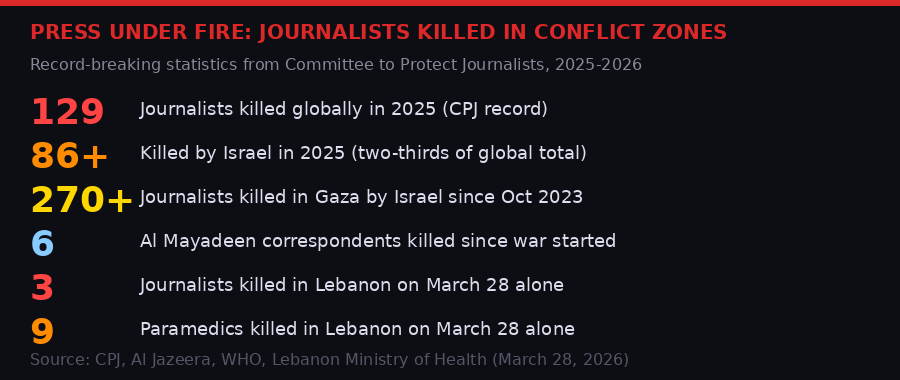
The same day, nine paramedics were killed in five separate strikes on healthcare facilities in southern Lebanon. WHO Director-General Tedros Adhanom Ghebreyesus documented the toll: five health workers killed in Zoutar al-Sharqiya, two more in Kfar Tibnit, one at a health facility in Ghandouriyeh, one in Jezzine. Seven additional paramedics were wounded.
"Repeated attacks have severely disrupted health services in southern Lebanon," Tedros said, noting that four hospitals and 51 primary healthcare centers are now closed and several others are operating at reduced capacity. (Al Jazeera, March 28)
Lebanese President Joseph Aoun called it "a flagrant crime that violates all norms and treaties under which journalists are granted international protection during armed conflicts." Prime Minister Nawaf Salam described it as "a flagrant violation of international humanitarian law."
Al Mayadeen has now lost six journalists since hostilities began - Farah Omar, Rabih Me'mari, Ghassan Najjar, Mohammad Reda, and now the Ftouni siblings. That is not incidental attrition. It is a pattern that the Committee to Protect Journalists tracked across 2025 with alarm, recording 129 journalist deaths globally - the most since CPJ began collecting data over three decades ago - with Israel responsible for approximately two-thirds of those deaths.
The total number of journalists killed by Israel since October 7, 2023 now exceeds 270. The CPJ states Israel has killed more journalists than any other government in its recorded history. Israeli officials consistently claim the reporters were linked to armed groups; press freedom organizations consistently find the evidence lacking.
According to Lebanon's Ministry of Health, 1,142 people have been killed and more than 3,300 injured in Israeli attacks on Lebanon since the war's March 2 expansion. Israeli troops are pushing further into the south toward the Litani River. The entire area south of the Litani is, in the words of Al Jazeera's reporters on the ground, "a no-go zone." Approximately 20 percent of the population of southern Lebanon is staying put in defiance of Israeli displacement orders - a decision Al Jazeera's correspondent described as "turning into a very deadly gamble."
The American Buildup - and the Ground Troop Question
Two thousand five hundred US Marines arrived in the region on Saturday. They join a force that has been steadily and significantly accumulating since February 28 - a buildup that now represents the largest American military concentration in the Middle East in over two decades.
The newly arrived Marines are trained for amphibious landings. At least 1,000 paratroopers from the 82nd Airborne Division - trained to parachute into hostile or contested territory and secure key positions and airfields - have been ordered to theater. Two Marine Expeditionary Units, comprising approximately 5,000 Marines and thousands of sailors, are being drawn from the Japan-based USS Tripoli and a rapid-response force from San Diego. The US had approximately 50,000 troops in the region before the war began.

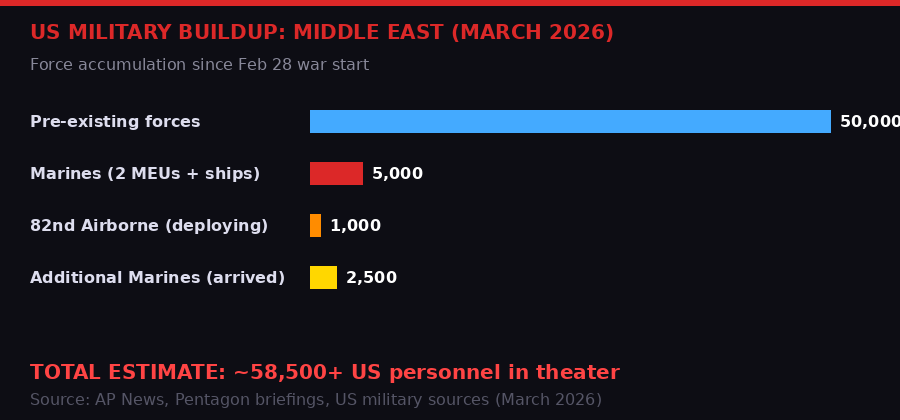
The composition matters. Marines do embassy protection and civilian evacuation. The 82nd Airborne does something else: rapid seizure of airfields and key terrain in actively hostile environments. Their deployment - and the presence of Maj. Gen. Brandon Tegtmeier, the division commander, alongside his staff - represents a capability set that goes beyond defensive operations.
White House spokeswoman Anna Kelly: "President Trump always has all military options at his disposal."
US Secretary of State Marco Rubio has said Washington "can achieve all of our objectives without ground troops." But objectives remain undefined in public. The US has struck more than 11,000 Iranian targets in 29 days. Israel's military said Saturday it would finish attacking "essential weapons production sites" within "a few days." That claim has been made before.
More than 300 US service members have been wounded in the war. At least 13 have been killed. Iran fired six ballistic missiles and 29 drones at Prince Sultan Air Base in Saudi Arabia on Friday alone, injuring at least 15 troops - five of them seriously. That base sits 60 miles from Riyadh. It has been hit three times in one week.
"We now have the Islamic Republic on steroids. We are afraid they will take this revenge out on the people, which they very openly see as the enemy from inside." - Iranian doctor speaking anonymously to AP News, Rasht, Iran (March 28, 2026)
The wounds to US forces at Prince Sultan are classified information that two anonymous officials shared with AP despite not being authorized to do so - a signal of either alarm or frustration within the chain of command, or both. The base is a strategic logistics hub. Iran has demonstrated both the will and the capability to hit it repeatedly, with escalating munition loads.
Diplomacy in Parallel - and in Crisis
Pakistan announced Saturday that Saudi Arabia, Turkey, and Egypt would send senior diplomats to Islamabad for talks arriving Sunday - a two-day summit aimed at finding an end to the fighting. Pakistani Prime Minister Shehbaz Sharif said he held "extensive discussions" with Iranian President Masoud Pezeshkian on regional hostilities.
The diplomatic track looks thin from the outside. Iran's Foreign Minister Abbas Araghchi told his Turkish counterpart that Tehran was "skeptical" about recent diplomatic efforts and accused Washington of making "unreasonable demands" and exhibiting "contradictory actions." (AP News, March 28)
The core impasse: Trump envoy Steve Witkoff delivered a 15-point action list to Iran proposing a ceasefire framework that would reopen the Strait of Hormuz and restrict Iran's nuclear program. Tehran rejected it and countered with five points of its own - demanding reparations, a ceasefire to precede any other discussion, and recognition of Iranian sovereignty over the Hormuz waterway. The positions are not adjacent to each other.

Trump says he's negotiating. Iran says no negotiations are happening. Both things contain partial truths that make the partial lies harder to trace.
Trump has also issued a deadline: April 6, the date by which he says the Strait of Hormuz must reopen or unspecified consequences follow. Eight days from today. Iran has allowed humanitarian aid and agricultural shipments through the strait following a UN request - a minimal concession. The full commercial reopening Washington demands is not on Tehran's current offer sheet.
The economic stakes of those 8 days are not abstract. Oil above $100 per barrel is already reshaping fiscal calculations in every energy-importing country on earth. Agricultural commodity prices - Iran is a major source of fertilizer precursors - are spiking in markets from sub-Saharan Africa to Southeast Asia. If the Hormuz standoff continues into April and the Houthis activate a parallel Red Sea campaign, the second-order economic shocks will reach populations with zero connection to the war itself.
Inside Iran: A Country Enduring, a Government Tightening
The internet has been completely cut inside Iran since mid-January - first during the January protests that killed thousands, and continuously since. Only a government-controlled intranet operates. AP spoke to ten people across the country, most anonymously, to piece together a picture of daily life that state media cannot provide.
What emerges is a country living in recurring shock with no clear exit. Daily explosions shake homes. An unprecedented economic crisis - inflation running at 70 percent, the rial collapsed, businesses shuttered - preceded the war and has now been compounded by it. Government workers receive salaries; private sector employment is collapsing. In the north of the country, relatively untouched by airstrikes, cities like Rasht have been overwhelmed by internal refugees from Tehran and other bombed areas.

"I think we've experienced everything bad possible," a 26-year-old designer in Tehran told AP. "From the terrible atmosphere of January and the killings and arrests to the war."
Hospitals in Rasht are operating with nearly double their patient load. A doctor at a pediatric hospital there told AP that medicines are running out, patients are asked to purchase antibiotics and IV fluids from the market themselves, and the internet blackout has severed his ability to access patient histories and check dosages. He has also had to abandon a personal effort to document the January crackdown toll because witnesses are unreachable and online databases are inaccessible.
State media released videos of "confessions" on Saturday, including one showing a girl with her face blurred who said she was apprehended for filming missile strikes from her family home's window and sending footage to foreign-based media. The Basij paramilitary - charged with internal security and present in neighborhoods across the country - has stepped up patrols even as its units are themselves being targeted in airstrikes.
One woman in her 40s, speaking to AP, expressed a sentiment now circulating in private conversations across the country: "This is what our situation has come to - we are willing to endure war in the hope of being freed from them."
The "them" is the theocracy. The war that Trump framed as liberation has, for many Iranians, produced the exact opposite: an Islamic Republic hardened by external attack, more militarized, more paranoid, more brutal in its internal security operations, and now capable of pointing to Bushehr's near-miss as evidence that the outside world will bomb civilians with nuclear proximitals and call it strategic necessity.
The Casualty Map: 3,100 Dead Across Seven Fronts
The war now kills people in seven theaters simultaneously. The official numbers, almost certainly undercounts, tell a story of multi-front attrition that has no precedent in recent Middle Eastern history.
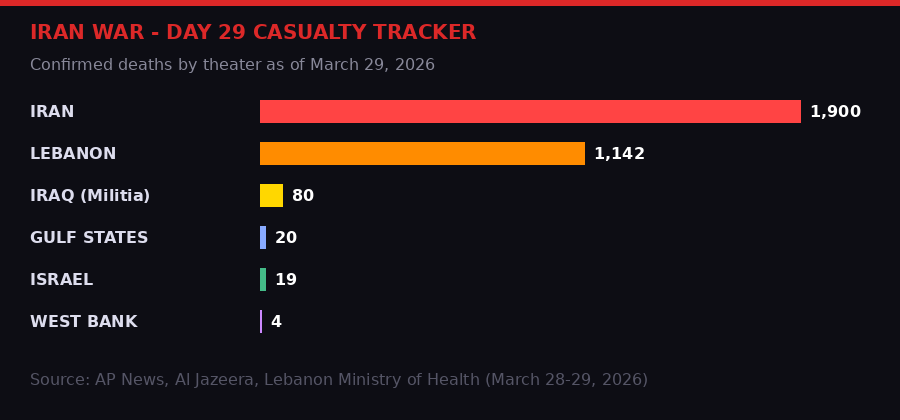
Iran's government acknowledges more than 1,900 killed. In Lebanon, more than 1,142 are dead - with that number climbing after the single bloodiest day in weeks. In Iraq, where Iranian-backed militia groups have entered the conflict, 80 members of the Iraqi security forces have died. Twenty people have been killed in Gulf states, where Iranian missile and drone strikes continue targeting US-linked facilities. Nineteen Israelis have been killed. Four have died in the occupied West Bank.
Those numbers do not include the January protests, which some independent monitors estimated killed thousands before the war's formal February 28 start date. They do not fully account for militia fighters on either side, who are not reliably reported. They do not include the cumulative death toll in Yemen from a separate war that the Houthi entry will now likely re-intensify.
The aggregate is somewhere above 3,100. The trajectory, with strikes intensifying and new fronts opening, is upward.
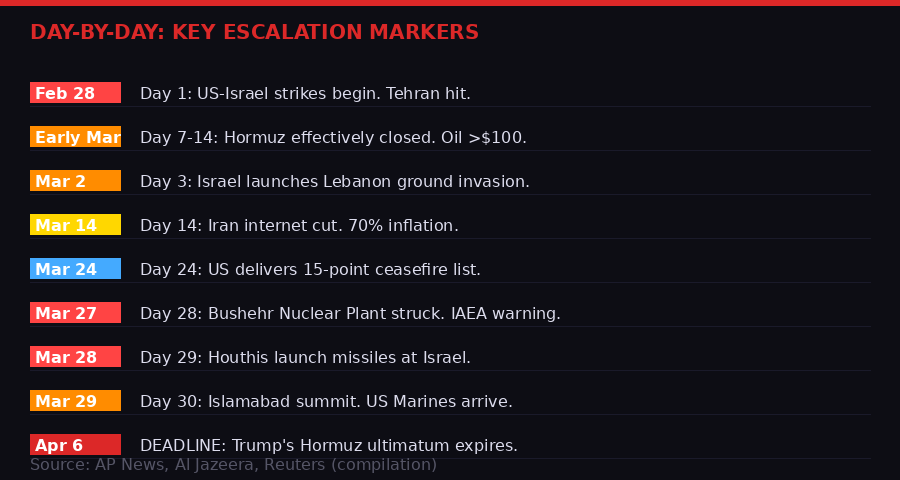
What Comes Next: The Eight Days Before the Deadline
April 6 is not a random date. Trump set it as the point at which he will enforce the Hormuz reopening demand, though no one has clearly defined what enforcement looks like. The military options for forcing an Iranian-controlled strait open are not surgical - they involve either direct attack on Iranian naval assets inside the strait, attacks on coastal missile batteries, or both. Each carries escalation risk that the existing air campaign, however destructive, has so far avoided.
In those eight days, several tracks run simultaneously:
- Islamabad summit (Sunday-Monday): Saudi Arabia, Turkey, and Egypt meet in a Pakistan-brokered format that Iran is not attending directly. The diplomatic products, if any, will need Iranian buy-in that Tehran has not signaled.
- Houthi threat assessment: Whether Saturday's missile launch was symbolic or the first strike of a renewed Red Sea campaign will become clear within days. If commercial vessels are targeted, oil markets will react within hours.
- NPT legislation: Iran's parliament needs to formally convene to vote. That has not happened in 29 days. But the threat itself reshapes every diplomatic calculation - negotiators in Islamabad and Washington must now price in what a nuclear-unconstrained Iran means for a post-war settlement.
- Bushehr status: Three projectiles in the vicinity of a nuclear power plant. The IAEA's radiological warning has not been walked back. If cooling systems are damaged or radiation released, the war crosses a threshold that would require a qualitatively different international response.
- Lebanon ground advance: Israeli troops are pushing toward the Litani River. Hezbollah has claimed dozens of operations in the past 24 hours. The ground campaign is accelerating at the same moment that northern civilian infrastructure is being struck.
For ordinary Iranians, the eight days before April 6 look like what the previous 29 looked like: explosions, no internet, dwindling medicine, collapsing businesses, and a government that has made it illegal to film the bombs falling on your city.
"We're going to make it better," an engineer in Tehran told AP, referring to the country's post-war rebuilding. "I'm going to be stronger after this war. I will be damaged, just like my country. But that's it. This is life."
He is not wrong about damage. He may be wrong about its ceiling.
Get BLACKWIRE reports first.
Breaking news, investigations, and analysis - straight to your phone.
Join @blackwirenews on Telegram