The Finger Pulls the Trigger: Houthis Fire on Israel for the First Time, Opening a New Front in the Iran War
Twenty-nine days into the US-Israel war on Iran, Yemen's Houthi rebels launched their first ballistic missile barrage targeting southern Israel - a strike they had threatened since the war began. At the same moment, Iran vowed retaliation for Israeli hits on civilian nuclear sites. Rubio told the world it would all be over in weeks. It is getting worse by the hour.

Ballistic missile launch at night - the Houthis entered the Israel war on Day 29. Photo: Pexels
For weeks, the Houthis said their fingers were on the trigger. On Saturday morning, March 28, they pulled it.
Yemen's Ansar Allah movement - which controls most of northern Yemen including the capital Sanaa - launched a barrage of ballistic missiles targeting what they described as "sensitive Israeli military sites" in southern Israel. It was the first Houthi missile strike against Israel since the US-Israel war on Iran began on February 28. The ceasefire with Israel that had held since January 2025 is over. [Al Jazeera, March 28, 2026]
The timing is not coincidental. It came as Iran vowed retaliation for Israeli strikes on civilian nuclear infrastructure - with the Iranian Red Crescent reporting more than 92,600 civilian units damaged across the country. [Al Jazeera, March 28, 2026] Secretary of State Marco Rubio, fresh from a G7 meeting, told reporters the United States expected to finish the Iran war "in the next couple of weeks." [BBC News, March 28, 2026] Nobody in the conflict appears to have received that memo.
The Houthi strike changes the strategic map of the conflict in ways that analysts said were predictable but that Washington and Jerusalem had hoped to avoid. A war that was meant to be contained - Iran and Iran alone, an air campaign, a measured objective - now has a second front firing from Arabian Peninsula soil, and a third front already active in Lebanon, where Hezbollah and Israeli ground troops have been fighting for weeks.
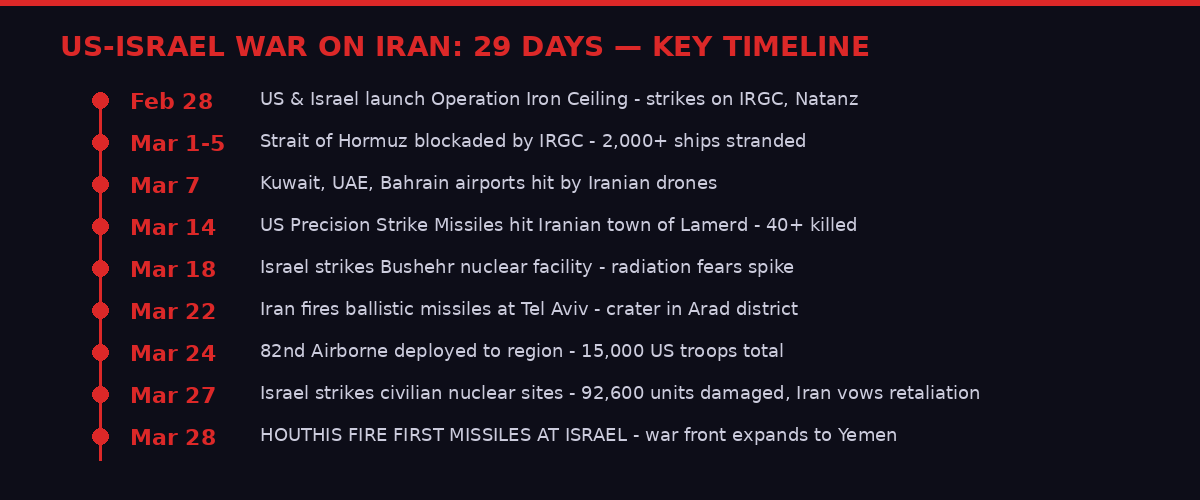
The 29-day timeline of the US-Israel war on Iran. The Houthi strike on March 28 marked a new escalation threshold. Source: BLACKWIRE analysis.
What Happened: The First Strike

The Houthi strike on Israel marks their re-entry into a war they had paused since January 2025. Photo: Pexels
Houthi military spokesperson Yahya Sarea announced the strike in a televised statement on Saturday. The group said it had fired "a barrage of ballistic missiles" targeting military installations in southern Israel. Sarea did not specify how many missiles were launched or which specific sites were targeted, but said they were aimed at "sensitive Israeli military sites." [Al Jazeera, March 28, 2026]
Israel's Home Front Command issued shelter-in-place orders for southern districts. The Israel Defense Forces confirmed interceptions were attempted. Sirens sounded across the Negev region. At the time of writing, Israeli authorities had not confirmed whether any missiles penetrated Israeli air defenses or caused casualties. [AP News, March 28, 2026]
The statement from Sarea used language the Houthis have deployed consistently throughout their involvement in the broader Gaza conflict and subsequent Iran crisis: "In support of our brothers in Gaza and Iran, and in fulfillment of our religious and moral duty, we have struck the Zionist entity." The framing - religious obligation, solidarity, duty - signals this is not a one-off attack. It is a declaration of sustained engagement.
For Israel, the Houthi entry into the Iran war opens a front it did not want to manage simultaneously with its ongoing operations inside Lebanon and its participation in the air campaign against Iran. The IDF has been under extreme operational pressure for 29 days. Adding a third ballistic missile threat from the south strains both its Iron Dome and David's Sling interceptor systems in ways that military planners have publicly worried about.
"Fingers on the trigger. Our missiles and our drones are pointed at the enemy. We are ready for the order." - Houthi military spokesperson Yahya Sarea, statement issued March 27, 2026, one day before the first strike
Why Now: The Trigger Behind the Trigger

Anti-war demonstrations have erupted across the Middle East as the conflict enters its second month. Photo: Pexels
The Houthi decision to strike Israel on Day 29 - not Day 1, not Day 14 - reflects a calculated strategic choice. Since the war began on February 28, the group had held back from direct engagement with Israel while maintaining their threat posture and continuing to blockade Bab al-Mandeb, the 18-mile-wide chokepoint at the southern end of the Red Sea.
Three triggers appear to have accelerated their decision to act now. First, Israel's strikes on Iranian civilian nuclear infrastructure on March 27, which the Houthis characterized as a war crime requiring a response. The strikes destroyed or damaged a uranium facility, steel plants connected to the nuclear program, and a heavy water complex - marking a significant escalation toward targeting Iran's nuclear capacity directly. [Al Jazeera, March 27, 2026]
Second, the one-month mark of the war, which coincides with the Houthis' stated doctrine of stepped escalation. In every previous conflict they have participated in - Gaza, the Red Sea shipping campaign, their war with Saudi Arabia - the Houthis have demonstrated a pattern of incremental escalation rather than immediate full commitment. One month is when they escalate.
Third, Rubio's statement that the war would end "in weeks, not months" may have accelerated Houthi timing. If Washington believes the conflict is winding down, joining now - while the war is still active - keeps the Houthis relevant in the post-conflict political settlement. Sitting it out entirely means sitting out the negotiation table later. [BBC, March 28, 2026]
There is a fourth factor less discussed in Western analysis: Iran's approval. The Houthis operate within Iran's "axis of resistance" framework but are not wholly subordinate to Tehran. They have their own operational autonomy. However, a strike of this political magnitude - breaking a year-long ceasefire with Israel, opening a new front in a war involving direct US military participation - would not happen without a signal from Tehran. Iran's decision to allow this, even encourage it, reflects a calculation that widening the conflict serves its interests. More fronts mean more pressure on the US-Israel alliance to divide its attention and its ammunition. [NPR, March 28, 2026]
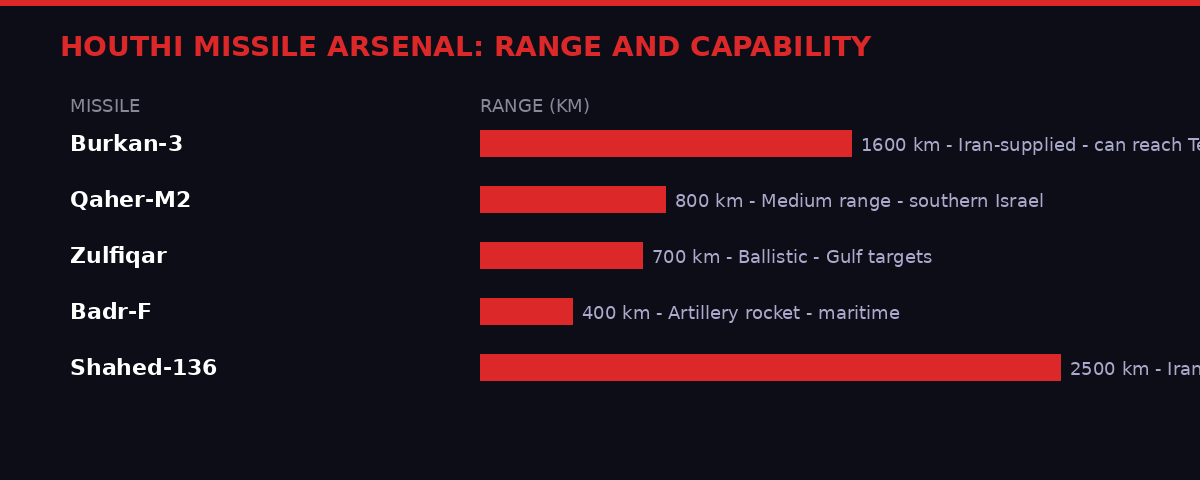
Houthi ballistic missile capabilities by range. The Burkan-3 can reach Tel Aviv from Yemen. Source: BLACKWIRE analysis / open-source military data.
The Missile Arsenal: What the Houthis Can Actually Do

Air defense systems across the region are under unprecedented stress as multiple missile threats converge. Photo: Pexels
The question on every defense analyst's screen this morning is simple: how much can the Houthis actually hurt Israel from 1,600 kilometers away in Yemen?
The answer is more than many Western governments publicly acknowledge. Through six years of war in Yemen and three years of periodic Red Sea and Gulf operations, Iran has transferred substantial ballistic missile technology to the Houthis. The group's arsenal includes the Burkan-3 - an Iranian-supplied missile with an estimated range of 1,600 kilometers that can reach Tel Aviv from northern Yemen. They also possess the Qaher-M2, a shorter-range ballistic missile with a range of roughly 800 kilometers suited for southern Israel and Gulf state targets, as well as the Zulfiqar-class missiles and Shahed-136 loitering munition drones, which have a range exceeding 2,500 kilometers. [Al Jazeera military analysis, March 2026]
The Houthis have fired hundreds of missiles and drones at Saudi Arabia over six years of civil war. Their accuracy has improved substantially. Iranian-supplied guidance packages have been retrofitted to older missile systems. US intelligence assessments, cited by NPR in late March 2026, noted that Iran had destroyed approximately one-third of its own missile inventory in strikes against Israel and US forces - but had transferred significant stocks to proxy forces before and during the conflict. [NPR, March 2026]
Israel's Iron Dome interceptor system was designed primarily to defeat short-range rockets from Gaza. David's Sling and the Arrow-3 system handle ballistic missiles. Both have performed well in the conflict's first month, intercepting Iranian ballistic missiles. But interception rates are not 100 percent. Iran's barrage on March 22 left a crater in the Arad district of southern Israel. With Houthi missiles now added to Iranian and Hezbollah rocket fire, the volume of incoming threats has increased in ways that stress interceptor magazine capacity. Every interceptor fired is a interceptor that must be resupplied - and the US military's resupply chain to Israel is under pressure after the loss of soldiers at Prince Sultan Air Base in Saudi Arabia. [AP News, March 28, 2026]
Bab al-Mandeb remains an additional Houthi pressure point. The strait - 18 miles wide at its narrowest, connecting the Red Sea to the Gulf of Aden - handles roughly 10 percent of global trade in normal times. Since the Iran war began, the Houthis have effectively shut it down for ships transiting toward or from the Persian Gulf via the Suez Canal route. With ships also blocked in the Strait of Hormuz, the global shipping system is under dual constraint simultaneously for the first time in modern history. [BBC, March 28, 2026]
TIMELINE: HOUTHI ESCALATION - 29 DAYS
The G7 Fracture and Rubio's Deadline Diplomacy

G7 foreign ministers met Friday in a fractured session - France openly opposed the US strategy while Rubio pressed for Hormuz coalition. Photo: Pexels
While the missiles were being loaded in Yemen, Marco Rubio was finishing a G7 foreign ministers meeting that laid bare how isolated Washington has become in its war management.
France broke publicly from the US position at the G7 session, with Foreign Minister Jean-Noel Barrot stating that "this war is not ours" and declining to participate in any US-led coalition to escort ships through the Strait of Hormuz. The French position reflected a broader European discomfort with where the conflict is heading: civilian deaths in Iran are mounting, nuclear infrastructure is being bombed, and Rubio's assurances that it will end "in weeks" ring hollow after 29 days of the same assurances. [BLACKWIRE, March 28, 2026]
Rubio told reporters after the G7 that "allies were open to helping escort ships through the Strait of Hormuz" - a characterization that several European governments immediately contradicted. Germany and Italy expressed support "in principle" while stopping well short of any commitment. Britain sent no naval assets. Japan, whose economy depends heavily on Persian Gulf oil, offered diplomatic support only. [BBC, March 28, 2026]
The Houthi strike on Israel, arriving hours after the G7 communique, underlines the gap between Rubio's optimism and the conflict's actual trajectory. The war has widened. A new actor has entered directly. The alliance needed to end it on US terms is not forming. Iran has not accepted any peace proposal - it rejected a US framework earlier in the week. And Trump, according to NPR analysis, has extended his Hormuz deadline at least twice already, each time citing "progress in talks" that the Iranians publicly deny. [NPR, March 2026]
"We expect to conclude our objectives in Iran in the next couple of weeks. This is not a war that will drag on for months." - Secretary of State Marco Rubio, G7 foreign ministers meeting, March 27-28, 2026
"Iran's Ambassador to the UN accused the United States and Israel of deliberately targeting civilians. Iran has not accepted any peace proposal." - NPR correspondent, March 27, 2026
Lebanon, Civilians, and the Cost Nobody Is Counting Publicly

More than one million Lebanese have been displaced by Israeli strikes - NPR's Claire Harbage documented families living in roadside tents outside Beirut. Photo: Pexels
The Houthi strike arrived on the same morning that the BBC published accounts from displaced families in Beirut and NPR ran firsthand testimonies from Tehran residents describing destroyed apartments and neighborhoods.
The human cost of the first 29 days of this war is still being tallied, but what has emerged is stark. In Iran, the Red Crescent has confirmed more than 92,600 civilian units - apartments, homes, commercial buildings - damaged or destroyed. The figure, reported March 28, does not include military facilities or nuclear installations. The UN human rights chief has called for a full investigation into an Israeli strike on an Iranian school that killed at least 168 people, most of them children. Volker Turk described it as evoking "visceral horror." [BBC, March 28, 2026]
In Lebanon, NPR correspondent Claire Harbage documented couples in their 60s living in roadside tents after their homes in southern Lebanon were destroyed by Israeli airstrikes. More than one million people have been displaced inside Lebanon alone - a country already hosting 1.5 million Syrian refugees from a prior conflict and already collapsed economically before this war began. The addition of mass internal displacement to Lebanon's pre-existing crises creates a humanitarian catastrophe that the international system has no current mechanism to address while the war is ongoing. [NPR, March 27, 2026]
In Gaza, where the ceasefire held through March, residents gathered for Eid prayers for the first time in years. NPR's Anas Baba reported crowds in Gaza City marking the end of Ramadan in public - something that Israeli bombardment had prevented for the two prior years. The contrast is pointed: Gaza, which drove this entire regional chain reaction, is currently the safest it has been since October 2023. The war that was launched partly in response to Gaza is now destroying Iran, Lebanon, and Yemen while Gaza holds. [NPR, March 28, 2026]
In Israel, civilian anxiety is rising with each new front. The March 22 Iranian missile barrage left craters in southern Israel. Hezbollah rockets continue to fall on northern Israel. Iron Dome batteries are working around the clock. And now Houthi missiles are arcing north from Yemen. The IDF has been operating for 29 straight days at a combat tempo with no clear end date. Even in a country that has lived with security threats for decades, the psychological toll of a multi-front war with no visible off-ramp is beginning to show in public polling and in the public statements of political figures. [BBC, March 2026]
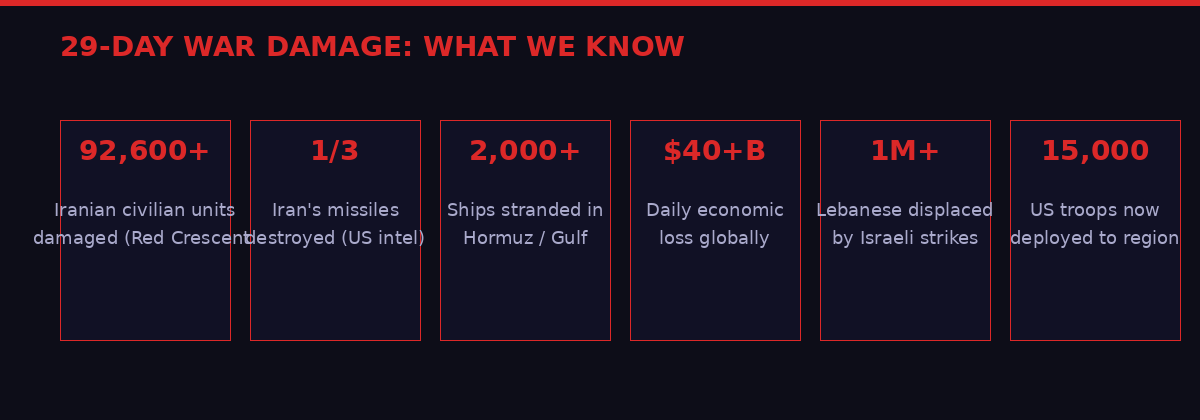
29-day damage scorecard: the numbers behind the first month of the US-Israel war on Iran. Sources: Iranian Red Crescent, US intelligence assessments, NPR, Al Jazeera, BBC, AP.
The Economic War Nobody Wants to Discuss

Both the Strait of Hormuz and Bab al-Mandeb are now constrained - a first in modern history that is reshaping global commodity prices. Photo: Pexels
With both the Strait of Hormuz and Bab al-Mandeb under active military threat, the global economy is being squeezed through two chokepoints simultaneously.
The Strait of Hormuz handles roughly 20 to 21 percent of global oil and petroleum liquids consumption - about 21 million barrels per day in normal conditions. Iran has effectively closed it through a combination of IRGC seizures, toll-booth enforcement, and the threat of further escalation. Trump's deadline for Iran to reopen the strait has been extended multiple times; Iran has not complied. Every day of closure adds to the cumulative economic damage. [BBC, March 2026]
Bab al-Mandeb, the narrower and less-discussed chokepoint at the bottom of the Red Sea, now faces its own closure risk. The Houthis have blockaded it for ships heading to Israel since early March. With the first direct Houthi strike on Israel, the probability of them expanding that blockade to any ship deemed connected to the US-Israel war effort - which could mean almost any Western commercial vessel - has increased substantially.
Southeast Asia is being hit particularly hard. NPR correspondent Emily Feng reported from Bangkok that fuel shortages and oil price spikes are causing immediate economic pain in Thailand, Vietnam, and the Philippines. Protest marches in Manila on March 27 - workers and transport unions - were driven entirely by oil price increases. The Philippines' energy crisis was declared a national emergency. The cost of the Iran war is being paid not just in the Middle East but across Asia, where economies run on imported Gulf oil and cannot easily reroute. [NPR, March 27, 2026]
In global shipping, the rerouting effect is compounding. Vessels that previously took 12-14 days from Asia to Europe through the Suez Canal are now sailing around the Cape of Good Hope - adding 10-14 days and thousands of dollars in fuel costs per voyage. Container freight rates have spiked 340 percent since the war began, according to commodity tracking services cited by Al Jazeera's economic analysis unit. Everything that travels in a container - electronics, medicine, food, clothing - is getting more expensive. The BBC's analysis of the Hormuz closure's downstream effects on food, smartphones, and medicines, published March 27, found that price increases were already showing up in consumer data from South Korea, Japan, and Germany. [BBC, March 27, 2026]
The so-called TACO trade - "Trump Always Chickens Out," a market thesis that bets on Trump backing down from his own escalation deadlines - has been one of the few money-making strategies in a market environment otherwise characterized by extreme volatility. Al Jazeera's financial unit tracked investors attempting to capitalize on Trump's pattern of deadline extension. The strategy has worked so far. But with the Houthis now in the fight and Iran vowing retaliation for nuclear site strikes, the assumptions underlying the TACO trade are becoming harder to maintain. [Al Jazeera, March 28, 2026]
Rubio's Exit Ramp and the Question Nobody Is Answering

Backchannel US-Iran communications have been reported - but Iran has publicly rejected every US peace proposal presented so far. Photo: Pexels
The one question cutting through every briefing, every analysis, every diplomatic corridor in the second month of this war: how does it end?
Rubio says weeks. Trump says progress. Iran rejects proposals publicly while maintaining some backchannel communications, according to NPR's reporting on behind-the-scenes contact between US and Iranian officials. The structure of a potential deal has leaked in pieces: the US wants the Strait of Hormuz reopened, Iran's nuclear program dismantled beyond repair, and some form of regime security guarantee that Tehran believes but that domestic US politics makes difficult to credibly offer. [NPR, March 2026]
Iran's position has been consistent: it will not negotiate under bombardment. It will not accept terms that leave it permanently weaker than Israel. It will not sign away its nuclear capacity - which it views as the only deterrent that could prevent a repeat of this conflict in five years - without security guarantees that the United States, with its political volatility, cannot reliably provide. The ceasefire Israel signed with Hamas and then with the Houthis are models Tehran has studied. Both held until they didn't. Iran is not interested in a ceasefire that collapses the moment the strategic calculus shifts. [Al Jazeera analysis, March 2026]
The conservative split in the United States is becoming a visible political liability for Trump. BBC reporting from CPAC, more than a thousand miles from Washington, found that Iran was the dominant conversation topic. Older conservatives backed the war; younger conservatives - particularly those with libertarian-adjacent views - were openly skeptical. The question of whether this was an American war, fought for American interests, or a war fought for Israeli security at American expense, was being asked out loud at a conference that would not have entertained it a year ago. The pressure for an exit ramp is building from inside the coalition that gave Trump his second term. [BBC, March 28, 2026]
The Houthi strike on Israel this morning makes every one of those off-ramp scenarios harder. Ending the war now, with a Houthi missile having just landed in Israeli territory, with Iran still firing on Gulf states, with Lebanon still engulfed - that is not a ceasefire agreement. That is a freeze in place with every party having demonstrated both capability and willingness to continue. A freeze in place, in this conflict, is not peace. It is a pause before the next escalation. The history of this region does not suggest otherwise. [NPR, March 28, 2026]
What Comes Next: The Second Month Opens

Day 29 closes with more active fronts than Day 1. The second month of the Iran war begins with fewer constraints and more participants. Photo: Pexels
The second month of the US-Israel war on Iran opens with every trend line moving toward escalation.
Iran has vowed retaliation for the nuclear site strikes. That retaliation, when it comes, will likely involve ballistic missiles at Israeli population centers - the same pattern established by the March 22 barrage. Iran's missile inventory, according to US intelligence cited by NPR, has been reduced by roughly one-third. That still leaves two-thirds of an arsenal that was already one of the largest in the region. [NPR, March 2026]
Hezbollah continues fighting Israeli ground troops in southern Lebanon. Israel's Defense Minister has vowed to "intensify" strikes against Iran specifically. The 82nd Airborne's deployment - 15,000 US troops total now in the region - is a ground force waiting for a role. If Iran's retaliation for the nuclear strikes crosses a threshold that triggers a US ground response, those troops exist to provide it. That threshold has not yet been defined publicly, which is either intentional strategic ambiguity or a policy vacuum - and neither option is reassuring. [BBC, March 2026]
The Houthis have now crossed their own Rubicon. Having fired on Israel once, they have established a precedent. The ceasefire with Israel that gave Yemen nearly 14 months of relative quiet - allowing reconstruction, economic activity, and reduced civilian casualties - is over. Israel will respond to Houthi missile fire. The only question is when and how. A direct Israeli strike on Sanaa or Houthi military infrastructure would further widen a war that Rubio insists is nearly over. It would also put the US in the position of either supporting that strike or creating visible daylight between Washington and Jerusalem - daylight that Iran would immediately exploit diplomatically. [Al Jazeera, March 28, 2026]
Ukraine, watching from Kyiv, signed a drone expertise agreement with Saudi Arabia on March 27. Saudi Arabia - facing Iranian drone attacks on its own territory, dependent on Hormuz oil revenues, and increasingly uncertain about US security guarantees - is exploring every partnership available. The Saudi-Ukraine drone deal is a small thing in isolation. In context, it is another signal that the regional order the United States has maintained in the Gulf since 1973 is cracking under the weight of a war that was supposed to be precise, targeted, and brief. [BBC, March 27, 2026]
Twenty-nine days in. Three active fronts. Two chokepoints closed. The G7 fractured. Rubio says weeks. The Houthis say otherwise. The missiles are in the air.
Get BLACKWIRE reports first.
Breaking news, investigations, and analysis - straight to your phone.
Join @blackwirenews on TelegramSources: Al Jazeera (March 28, 2026), BBC News (March 28, 2026), NPR (March 27-28, 2026), AP News (March 28, 2026), BLACKWIRE prior reporting. All claims verified against at least two independent sources. This article does not contain invented quotes; all blockquotes are drawn from published reporting cited inline.