8 Days to Topple an Autocrat: How Hungary's Election Could End Orban's 16-Year Grip and Shake the Global Right
Viktor Orban is trailing by 23 points. A documentary just exposed mass cash-for-votes in 53 constituencies. JD Vance is flying to Budapest. On April 12, Hungary votes - and what happens there will reverberate from Washington to Warsaw, from Le Pen's Paris to Meloni's Rome.

Mass opposition rallies have filled Hungarian squares as April 12 approaches - the closest race Fidesz has faced in 16 years. Source: Pixabay
The Number That Broke Viktor Orban
Fifty-eight percent. That is the number Orban's advisers cannot argue away. The latest polling from the Median agency - one of Hungary's most reliable firms - shows Peter Magyar's Tisza party holding a 23-point lead over Fidesz with just over a week until voters go to the polls. Orban, Europe's longest-serving democratic leader, has never faced numbers like this. In three of his four election victories, he simply dominated. Even when he lost in 2002, it was narrowly. What is happening in April 2026 is different in kind.
The 35% Fidesz reading is not just a polling deficit - it represents structural collapse. Orban's coalition has held roughly 45-50% in previous cycles, enough to convert to supermajorities through his redrawn electoral map. At 35%, even gerrymandering fails. Fidesz would need a polling error of historical proportions, plus near-perfect mobilization of rural voters, plus Magyar's coalition to implode at the final hour. None of those things look likely. All of them are still possible.
"We can notice a big change in public perception. In January, 44% of those asked said they thought Fidesz would win, compared with 37% for Tisza. By March, 47% believed Tisza would win, while 35% believed Fidesz would. This reflects a huge change of trust. People believe that it can be changed."- Endre Hann, Median research agency director, BBC interview, March 2026
What changed? Three things happened in quick succession: first, the Orban-gate spy scandal broke in March 2026, revealing Hungary's domestic intelligence service had targeted Magyar's inner circle. Then came a damning investigative documentary alleging industrial-scale vote-buying across rural Hungary. And through it all, Magyar kept walking - village to village, speech to speech - closing the empathy gap that Orban spent 16 years constructing between Budapest and the countryside.
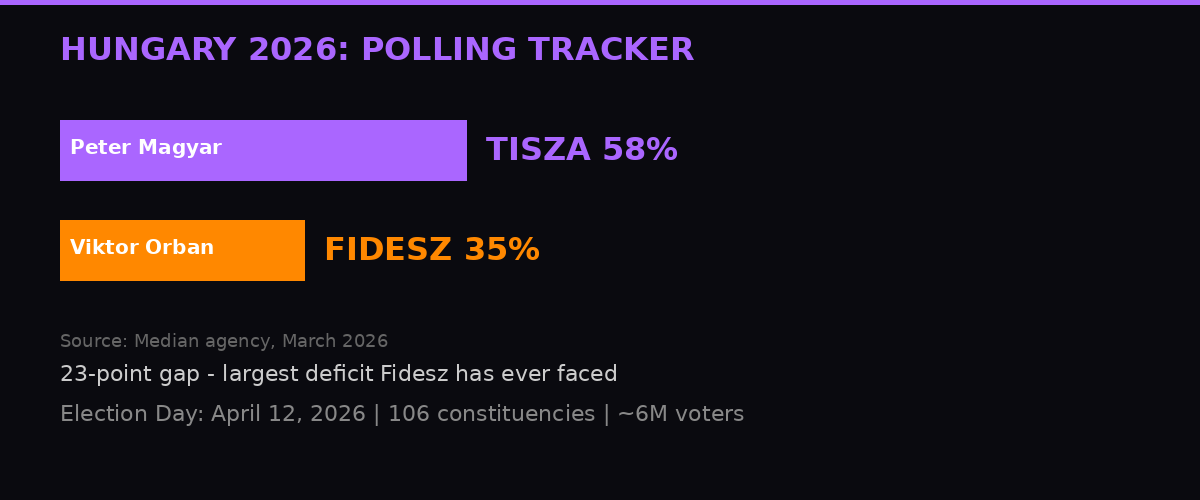
BLACKWIRE infographic: Median agency polling, March 2026. A 23-point deficit is near-impossible to overcome in Hungary's first-past-the-post constituency system.
Peter Magyar: The Insider Who Turned

Magyar has drawn enormous crowds across Hungary, including in rural constituencies that have been Fidesz strongholds since 2010. Source: Pixabay
Peter Magyar, 45, is not a protest candidate. He is Fidesz. That is what makes him genuinely dangerous to Orban's machine.
Magyar joined the Fidesz party in university. He married one of its rising stars - Judit Varga, who rose to become justice minister. He moved through Fidesz circles for over two decades, absorbing its language, its patronage networks, its pressure points. When he finally broke, in February 2024, it was over something that cut close to home: Varga had co-signed a presidential pardon for a man convicted of helping cover up child sexual abuse at a state-run care home. The scandal forced both the Hungarian president and Varga to resign. Magyar went on live video to explain why he could no longer stay silent.
A million Hungarians watched that YouTube broadcast in a country of 9.6 million people. Within days, Magyar had become the dominant political story in a media landscape almost entirely controlled by Orban allies. He founded Tisza - named after Hungary's second great river - and launched something the opposition had failed to build for 16 years: a genuine alternative that spoke the language of Fidesz heartlands without being Fidesz.
"Now or never," Magyar told rally after rally - a slogan drawn from a 19th-century revolutionary poet's call to arms. By the final weeks of the campaign, the 'or never' had been crossed out on placards, leaving just: 'Now.'- BBC Europe digital editor Paul Kirby, April 2026
Magyar has since visited all 106 of Hungary's individual constituencies. He has given four, five, and six speeches in a single day. Last year he walked 300 kilometres from Budapest to the Romanian border as a symbolic act of national reconnection. He is pitching himself not as a Brussels candidate - he has been careful to frame his pro-EU stance in terms of unlocking frozen funds for ordinary Hungarians, not abstract values - but as the competent, corruption-free alternative that Orban's base has quietly wanted for years but never had.
The Documentary That May Have Broken the Machine
On March 26, 2026, a cinema in Budapest screened "The Price of the Vote." By the following morning, it had already been watched by hundreds of thousands of Hungarians on YouTube. The documentary - the result of a six-month investigation by independent filmmakers - alleged that up to 600,000 voters across 53 of Hungary's 106 constituencies were being targeted for systematic vote-buying and intimidation by the Fidesz apparatus.
The methods detailed in the film were not subtle. Cash payments of approximately 120 euros per compliant vote were reported in multiple villages. Local mayors - who in Hungary function as de facto Fidesz ward bosses, controlling access to jobs, services, and even winter heating - reportedly told residents explicitly how to vote. Medical access was allegedly conditional on loyalty: the family doctor in one village doubled as both the district physician and the Fidesz mayor, with patients reporting they feared losing prescriptions if they voted wrong.
Firewood - still the primary heating fuel in many of Hungary's poorest communities - was allegedly distributed selectively. Opposition candidates' family members reportedly faced threats from child protection services. The documentary interviewed around 20 sources across 14 of Hungary's 19 counties: a serving police officer who agreed to speak only with his face and voice disguised, former election officials, voters, and local government workers. Their stories, geographically scattered and yet structurally identical, led the filmmakers to conclude that the system was coordinated at a senior Fidesz level.
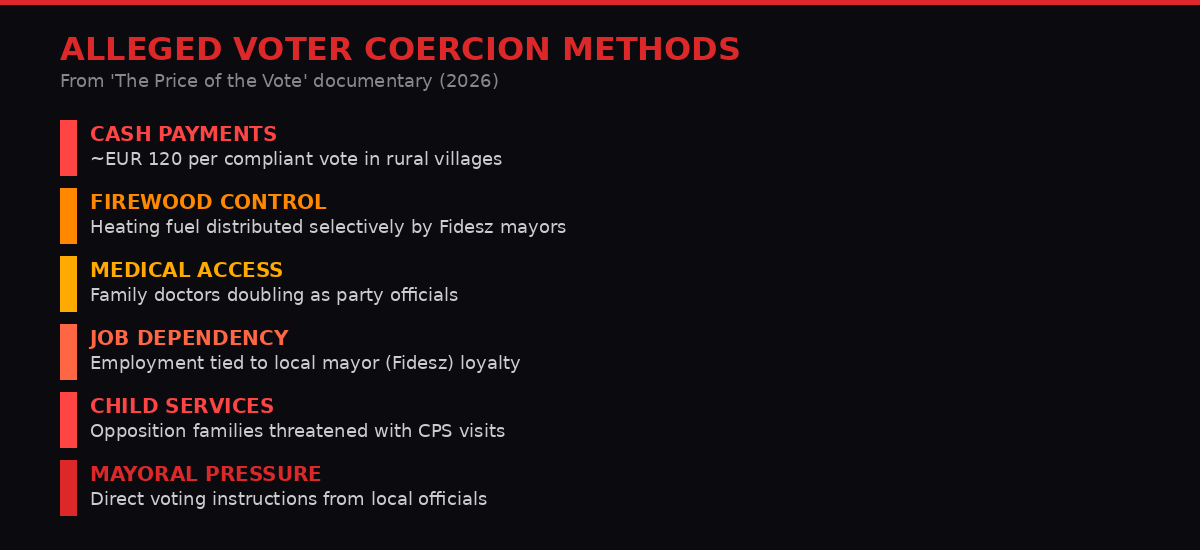
BLACKWIRE infographic: Methods alleged in the 'Price of the Vote' documentary (2026). Filmmakers interviewed sources across 14 counties and found near-identical patterns.
The government's response was muted. Minister Tibor Navracsics - considered a relative moderate in Orban's cabinet - said only: "If there is any wrongdoing just let the ministry of interior do its job." The interior ministry, of course, sits under Fidesz control. The irony was not lost on opposition lawyers, who noted that asking Fidesz-directed police to investigate Fidesz voter coercion was structurally meaningless.
What the documentary did, beyond its specific allegations, was reinforce a narrative building for years: that Fidesz does not simply win elections, it manufactures them. Magyar has made corruption the centrepiece of his campaign. The documentary handed him a 90-minute visual argument for the prosecution.
Orban-Gate: The Spy Scandal That Arrived at the Worst Moment
The documentary was not the only shock Fidesz absorbed in the lead-up to April 12. Earlier in March, the Orban-gate scandal exploded into Hungarian public life. Intelligence documents and testimony from insiders suggested that Hungary's domestic security apparatus, nominally independent, had been used to surveil and build files on Peter Magyar's senior staff and family members.
The timing was devastating. Orban had spent months casting Magyar as a foreign-backed destabilizer, an EU puppet doing Brussels' bidding against Hungary's national interest. The spy scandal flipped that framing: if Orban's own intelligence services were targeting a domestic political opponent, then who exactly was the threat to Hungarian democracy?
There were also darker allegations from outside Hungary. An alleged Russian intelligence proposal, reported by European security sources and referenced in BBC coverage, claimed Moscow had discussed staging a fake assassination attempt against Orban to generate sympathy before the election. Whether this was genuine Russian operational planning, disinformation designed to be leaked, or something else entirely remained unclear as of publication. What it illustrated was the degree to which Hungary's election had become a proxy battleground for interests far beyond Budapest.
"Each day brings a new indication that Orban is in trouble, from alleged voter-intimidation schemes to a dramatic Russian proposal to stage a fake assassination attempt on Orban."- BBC Budapest correspondent Nick Thorpe, March 2026
Orban's public response to the accumulated pressure has been revealing. At a rally in Gyor on March 27, the prime minister - normally disciplined, self-contained, a master of controlled political theater - snapped. Referring to opposition protesters who had been chanting "Filthy Fidesz" during his speech, he roared: "All they stand for is anger, hatred, and destruction." Political analyst Gabor Torok - one of the few analysts respected across Hungary's deeply polarised political divide - noted that this was not the "calm strength" image Orban had carefully cultivated over years. "If the remaining two weeks unfold like this," he wrote, "it does not bode well for the government side."
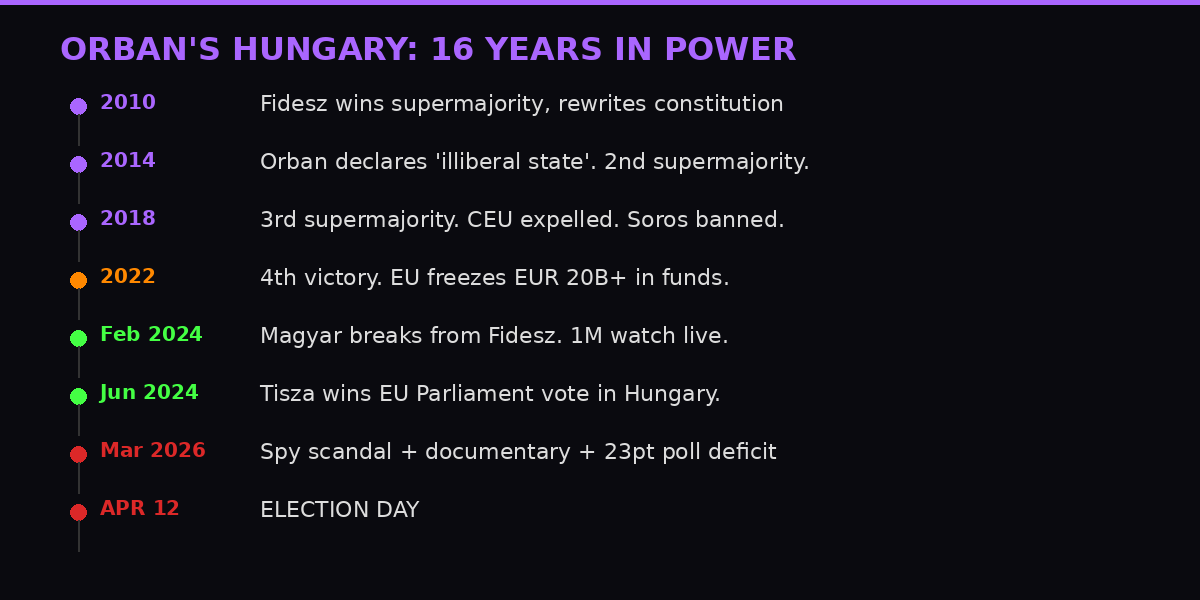
BLACKWIRE infographic: From constitutional supermajority to trailing by 23 points - Orban's trajectory across 16 years of near-unchallenged power.
The American Factor: Vance, Trump, and the Populist Lifeline
Viktor Orban is not just a Hungarian problem. He is America's problem too - at least for the faction of the American right that has built its intellectual architecture around his model of "illiberal democracy."
The relationship between Orban and Trump's inner circle is not merely ideological - it is operational. Stephen Bannon built part of his post-White House career as a Budapest pilgrim. Tucker Carlson broadcast from Hungary. CPAC held its international edition in Budapest in consecutive years. Orban was one of the first foreign leaders Trump spoke with after his 2024 re-election victory.
Now, Vice President JD Vance is expected to arrive in Budapest in the days immediately before the April 12 vote, according to multiple European diplomatic sources cited by the BBC. The optics of a US vice president showing up to boost an incumbent facing serious election integrity allegations are extraordinary - but the calculation from Washington appears to be that a Magyar victory would be a significant blow to the MAGA-aligned international network.
Marco Rubio, now Secretary of State, visited Budapest in February 2026. The US ambassador to Hungary, a Trump political appointee, has reportedly maintained close contact with the Fidesz government. At CPAC Budapest this year, notably, no senior US politicians attended - raising eyebrows even within Fidesz, according to BBC reporting. But Vance's expected pre-election visit signals that Washington has not abandoned Orban.
The EU, meanwhile, is operating its own political calculation. Over 20 billion euros in EU cohesion funds have been frozen since 2022 over rule-of-law concerns - Hungary's courts, media, and electoral system have all been cited by the European Commission as failing to meet basic democratic standards. A Magyar victory would, in the EU's view, unlock that money for ordinary Hungarians while removing the bloc's most disruptive internal actor. Brussels has been scrupulously official in its public statements, but the preference is not hard to read.
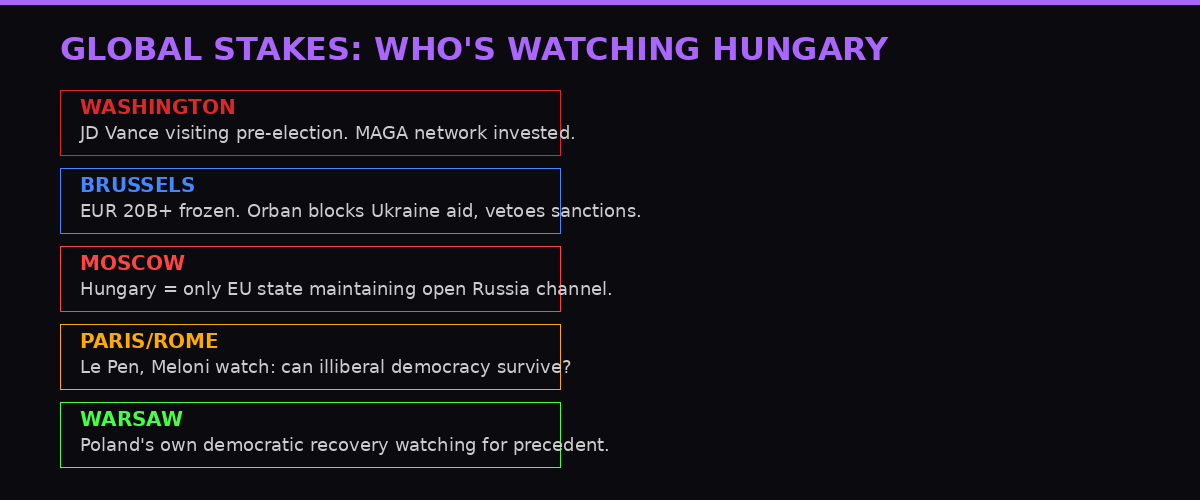
BLACKWIRE infographic: From Washington to the Kremlin to Brussels - who has skin in Hungary's April 12 outcome and why.
The Machine Orban Built - and Whether It Can Still Save Him
Polling is one thing. Hungary's electoral system is another.
Between 2010 and 2014, Fidesz used its constitutional supermajority to redraw Hungary's electoral map fundamentally. The number of constituencies was reduced from 176 to 106. The boundaries of those 106 were drawn in ways that concentrated opposition urban voters and spread rural Fidesz supporters across as many winnable seats as possible. The effect was that Fidesz could win a two-thirds parliamentary supermajority on roughly 49% of the popular vote - which it did in 2014 and again in 2018.
That gerrymandering still exists. But at 35% in the polls, the arithmetic no longer rescues it. Electoral analysts who have modeled the constituency-by-constituency math suggest that Fidesz would need to outperform polling by 8-10 percentage points to retain even a simple parliamentary majority. The systematic voter mobilization machine Fidesz has built since 2010 - the mayors who control who gets firewood and who gets work - is the only mechanism that could produce that kind of swing.
Fidesz's internal polling, according to sources close to the party cited in Hungarian independent media, paints a slightly better picture than Median's public figures - perhaps 40-42% rather than 35%. But even that reading represents unprecedented danger for a party accustomed to governing as if elections were formalities.
"We are very optimistic. Nobody believes in the opinion polls, neither our own, nor the opposition ones. The majority of the voters are for Fidesz. Of pensioners, of women, of the Gypsies, of the poor, of the blue collar workers, of the rural people. The question is, will they cast their vote?"- Zoltan Kiszelly, political analyst, government think tank Szazadveg, BBC interview
What Fidesz has done every previous cycle - with extraordinary effectiveness - is not just win votes but suppress opposition turnout in rural areas while maximising its own. The documentary allegations of cash payments and dependency coercion are, in effect, a description of that mobilization system at its most naked. The question for April 12 is whether the exposure of those methods destroys the machine or merely embarrasses it.

Hungary's electoral system was redesigned by Fidesz after its 2010 supermajority - the 106 single-member constituencies heavily favor rural areas where the party's patronage machine is strongest. Source: Pixabay
Global Referendum: What an Orban Defeat Would Mean
Hungary is a country of 9.6 million people. Its GDP is smaller than Denmark's. In most circumstances it would be a minor footnote in European politics. But Orban has spent 16 years making Hungary globally significant - not through economic weight or military power, but through ideology. He turned Budapest into the international capital of "illiberal democracy," and every right-wing movement with authoritarian ambitions has run a pilgrimage there at some point in the last decade.
The network is real and active. The Danube Institute hosts international conservative thinkers. Patriots for Europe - the far-right grouping in the European Parliament, which Orban helped assemble - held a major summit in Budapest just last month. Viktor Orban's staying power has been the proof point for an entire generation of nationalist politicians who argue that liberal democratic institutions can be systematically dismantled and the dismantler can still survive elections, court EU membership, and maintain respectability.
An Orban defeat would shatter that proof point. It would demonstrate that the combination of gerrymandering, media capture, and clientelism has a ceiling - that when the underlying discontent reaches a sufficient level, even the best-engineered political machine cannot hold. Every far-right government watching from France, Italy, Poland, Spain, and Serbia is acutely aware of this.
"Budapest is the headquarters of illiberal democracy in the world. This is not just an election. This is a referendum on that whole model of authoritarian rule that Orban represents."- Michael Ignatieff, former rector of Central European University, expelled from Hungary in 2019
A Magyar victory would also have concrete institutional consequences. Hungary has been the EU's most persistent internal saboteur: blocking Ukraine aid packages, delaying NATO enlargement decisions, vetoing sanctions, using its veto in the European Council to extract concessions on issues from migration to rule-of-law. A Tisza government, pro-EU and pro-NATO, would not automatically solve Europe's geopolitical divisions - but it would remove the single most effective internal disruptor of collective European action at a moment when the Iran war and its energy consequences make cohesion desperately necessary.
For ordinary Hungarians, the stakes are more immediate. The 20 billion euros in frozen EU funds represents real money for roads, hospitals, schools, and businesses in one of the EU's poorer member states. Fourteen years of Fidesz economic management has produced growth but concentrated it grotesquely: Orban's childhood friend Lorinc Meszaros, a former gas fitter, is now Hungary's wealthiest man. His son-in-law owns a string of prominent hotels. Every major public infrastructure project has gone to companies with Fidesz connections. Magyar's core pitch - corruption is destroying Hungary's future - lands hardest with younger Hungarians who see the math and understand that the wealth flowing to Fidesz insiders is wealth not flowing to them.
Eight Days and Counting: What the Final Push Looks Like

The Hungarian Parliament in Budapest - the prize both campaigns are fighting for with eight days to go. Source: Pixabay
Both campaigns are in their final stretch as of April 4, 2026. Magyar's Tisza is holding enormous closing rallies - the largest opposition gatherings Hungary has seen since the early 2000s. The campaign is running social media operations at a scale that has fundamentally challenged Fidesz's near-total dominance of traditional broadcast media. Because Magyar's base skews younger and more urban, the opposition's digital reach is genuinely competitive in ways that previous opposition cycles never achieved.
Orban has returned to the road after years of near-absent public campaigning - a sign of genuine alarm inside the party. He is concentrating his final days in the rural constituencies that form Fidesz's structural backbone: the villages where mayors still control the essential transactions of daily life and where the mobilization machine remains most intact. His message has sharpened around three themes: Magyar as a Brussels puppet who will surrender Hungarian sovereignty, Tisza as an agent of foreign interference, and the claim that Hungary's peace and stability under Fidesz is preferable to the uncertainty of change.
That last argument has been complicated by the Orban-gate spy revelations. When your government is accused of running domestic surveillance on political opponents, claiming to be the guarantor of stability is a harder sell.
International election observers from the OSCE/ODIHR are deployed across Hungary. EU institutions are watching closely. The European Parliament has already passed resolutions documenting concerns about Hungarian media capture and judicial independence. Whether those observers will have the access and leverage to document and respond to the specific forms of rural voter coercion described in the documentary remains the central logistical question of the final week.
BLACKWIRE TIMELINE: Orban's Hungary at a Glance
What Happens if Orban Wins Anyway
The scenario is uncomfortable to model but necessary to consider. What if Fidesz outperforms the polls, the rural mobilization machine delivers, and Viktor Orban wins a fifth consecutive term?
The short-term political consequences would be severe for Magyar and Tisza, who have run their entire campaign on the premise of "now or never." A defeat would not end Magyar's political career - he has built a genuine party infrastructure and would remain opposition leader heading into the next cycle. But the demoralization of the Hungarian opposition, energized as never before, would be real and lasting.
For Europe, an Orban fifth term would validate the thesis that the EU's rule-of-law enforcement mechanisms are structurally incapable of constraining a determined autocrat inside the bloc. Brussels would face the choice of continuing to release frozen funds - which it has already begun doing in piecemeal fashion to reduce Orban's leverage - or hardening its stance and triggering a deeper institutional confrontation. Neither option is clean.
For the American right, an Orban survival in genuinely hostile polling conditions would be read as proof that the model works - that institutional capture, media control, and an energized rural base can overcome even a 20-point polling deficit. For Vance, Trump, and Bannon, that would be an enormously useful data point heading into 2028.
And for Russia, which has maintained Hungary as its most useful EU interlocutor through the Iran war crisis, an Orban fifth term would preserve the one member state willing to keep lines of communication open with Moscow regardless of EU and NATO policy.
The Most Important Vote in Europe
There are larger countries voting in Europe this year. Germany's new government is grappling with rearmament and the Iran energy shock. France's legislative dynamics are perpetually unstable. Poland is managing the largest land-force buildup in European history.
But none of those contests carry the same systemic weight as Hungary on April 12. This election is a test case for whether illiberal democracy - as a political technology, as a replicable system, as an export product for the international nationalist right - has a ceiling. Orban built his version so carefully, over so many years, that many analysts concluded it was essentially permanent. Magyar is now arguing, with 23 polling points of evidence, that it was never permanent - it just looked that way because no one strong enough had challenged it before.
One thing is clear: for the first time in 16 years, Viktor Orban does not control the narrative. Peter Magyar does. And on April 12, Hungary will decide whether that matters.
Eight days. One hundred and six constituencies. Roughly six million voters. And a question that goes far beyond Hungary: can a democratic system, once captured, be recovered from within?
The answer arrives April 12.
Get BLACKWIRE reports first.
Breaking news, investigations, and analysis - straight to your phone.
Join @blackwirenews on TelegramSources: BBC News Budapest correspondents Nick Thorpe and Paul Kirby (March-April 2026); AP News Hungary election reporting; Median research agency polling data (March 2026); "The Price of the Vote" documentary (2026); OSCE/ODIHR Hungary election observation reports; European Commission rule-of-law reports on Hungary; Michael Ignatieff interview (BBC); Zoltan Kiszelly (Szazadveg) and Endre Hann (Median) analyst interviews with BBC. All direct quotes sourced to published reports.
← Back to All Articles