Orbán Pulls the Plug: Hungary Cuts Gas to Ukraine Over Russian Oil Standoff
Fifty-seven days after the Druzhba pipeline went dark, Viktor Orbán has launched his most aggressive retaliation yet - threatening Ukraine's gas supply while blocking a $106 billion EU loan and deploying soldiers to power plants. The April 12 election is three weeks away.

Industrial pipeline infrastructure. Hungary's Viktor Orbán announced a gradual cutoff of natural gas supplies to Ukraine on March 25, 2026. (Unsplash/file)
BUDAPEST - Viktor Orbán has drawn a line in the earth. Speaking via social media video on Wednesday, the Hungarian prime minister announced that Hungary would gradually cut off natural gas supplies to Ukraine until Russian crude oil deliveries through the Druzhba pipeline resume - a move that threatens to escalate an already combustible energy feud into an acute humanitarian and geopolitical crisis.
"As long as Ukraine does not supply oil, it will not receive gas from Hungary," Orbán declared, calling the Russian oil stoppage "Ukrainian blackmail." He added that Hungary would redirect the gas to fill its own domestic reserves.
The announcement is the sharpest escalation yet in a confrontation that has been building for nearly two months. The Druzhba pipeline - the Soviet-era artery that pumps Russian crude across Ukrainian territory and into Central European refineries - went offline on January 27 following what Ukrainian officials described as Russian drone strikes. Orbán, trailing in polls ahead of the April 12 election and facing the toughest challenge of his 16-year rule, has treated the shutdown not as a consequence of Russian aggression but as a weapon wielded by Kyiv.
The timing is not coincidental. Three weeks before Hungarians vote, Orbán has escalated a campaign that portrays Ukraine as a direct threat to Hungarian survival - deploying military forces around power plants, blocking a $106 billion EU loan to Kyiv, vetoing new EU sanctions against Russia, and now threatening to shut off gas to a country at war. AP
Key Numbers
- 57 days: Druzhba pipeline offline since January 27, 2026
- $106 billion (90B euros): EU loan to Ukraine that Hungary has blocked
- 45%: Share of Ukraine's gas imports that transited Hungary in 2025
- 38%: That share by January 2026 as routes were rerouted
- April 12, 2026: Hungarian parliamentary election - Orbán trailing in polls
- 16 years: Orbán's uninterrupted grip on power since 2010
The Pipeline That Broke Europe's Patience

The Druzhba pipeline - one of the world's longest - has been a central artery of European energy supply since the Soviet era. (Unsplash/file)
The Druzhba pipeline - "Friendship" in Russian - is one of the world's longest, stretching over 4,000 kilometers from Russia through Belarus and Ukraine into Central Europe. For decades, it has been the primary lifeline for landlocked nations like Hungary and Slovakia that remained dependent on Russian crude long after most of their European neighbors diversified away.
On January 27, that friendship ended - at least temporarily. A Ukrainian energy official attributed the shutdown to Russian drone strikes that damaged the pipeline infrastructure crossing Ukrainian territory. Russian repairs, they said, were impossible while the attacks continued. Orbán's government flatly rejected that explanation. Budapest accused Kyiv of deliberately blocking the flows, calling it "blackmail" designed to force Hungary into a more pro-Ukraine stance.
The dispute quickly became a proxy war within the war. Slovakia's Prime Minister Robert Fico - another Kremlin-friendly leader in the EU - echoed Orbán's framing, accusing Ukraine of economic sabotage. Both countries receive a special EU exemption that allows them to continue importing Russian fossil fuels, an exemption that was granted given their landlocked geography and supposed lack of alternatives.
Yet energy analysts and even infrastructure data challenge that framing. László Miklós, a chemical engineer and energy industry analyst, told the AP that there was "no rational explanation" for Hungary's refusal to pursue alternatives. The Adria pipeline, running from Croatia's Adriatic coast, has existed for decades. The Czech Republic - similarly landlocked - celebrated its "oil independence day" earlier this year after doubling the capacity of an Italian pipeline route. Hungary has not followed suit.
"Disconnection from Russian energy in an integrated European market should not be a problem, all conditions are there. It's the intention that is missing." - László Miklós, energy industry analyst, to the Associated Press
Miklós went further, arguing that Hungary's continued dependence on Russian energy is not an economic necessity but a political one - one that delivers windfall profits to the Hungarian government and its state oil conglomerate MOL while funneling billions into Russia's war budget. "Hungary buys Russian energy because the Hungarian government wants to help Russia arm itself," he said. AP
The Gas Cutoff: What It Means for Ukraine

Ukraine imports a critical portion of its gas needs through Hungarian transit routes - a supply now under threat. (Unsplash/file)
The gas cutoff threat is not an abstraction. According to Ukrainian energy consultancy EXPRO, roughly 45 percent of Ukraine's gas imports transited through Hungary in 2025. By January 2026, that figure had already dropped to 38 percent as Ukrainian energy operators scrambled to reroute supplies. But a full Hungarian cutoff would force Ukraine to find replacement volumes quickly - at higher cost, through more complex logistics, in the middle of a war.
Ukraine imports gas not only to heat homes and run hospitals, but to power the grid that has been under sustained Russian missile attack for three years. Each disruption compounds existing vulnerability. In 2025 alone, Russia conducted dozens of large-scale drone and missile strikes targeting energy infrastructure. Ukraine's grid has been patched and repatched. A gas supply disruption from a NATO member and EU country - even a partial one - would test those patches in ways that serve Russian strategic objectives.
Orbán's announcement came with a caveat: the cutoff would be "gradual." Hungarian officials did not specify the pace or timeline. That ambiguity is itself a pressure tactic - keeping Ukraine and EU partners guessing while Orbán extracts maximum political value from the threat.
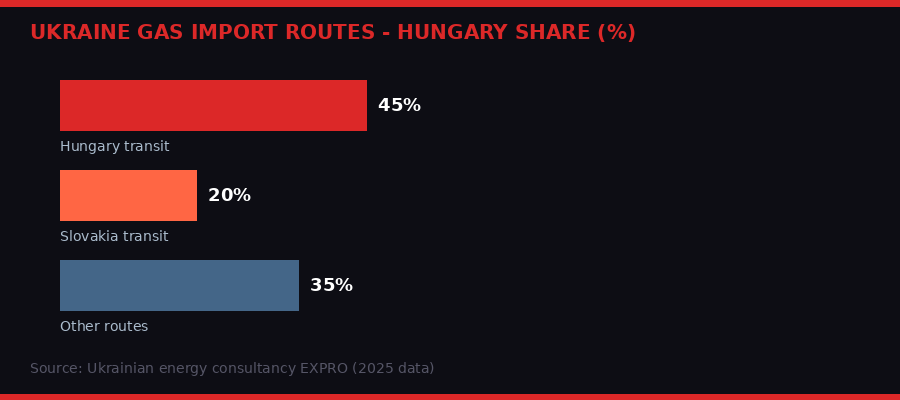
Ukraine's gas import dependency on Hungarian transit routes. Data: EXPRO (2025). Graphic: BLACKWIRE
Zelenskyy's position has hardened in kind. Speaking at a press conference earlier this month, the Ukrainian president said he would prefer not to repair the Druzhba pipeline at all. "To be honest, I wouldn't restore it. This is my position," Zelenskyy said, adding: "This is Russian oil, and there are certain principles that have no price. They kill us, and we have to give oil to Orbán because he cannot win elections without it?" AP
Both leaders are now speaking more to their domestic audiences than to each other. That dynamic makes resolution significantly harder.
Blocking the Lifeline: The $106 Billion EU Loan

EU leaders publicly condemned Orbán at a Brussels summit, accusing him of weaponizing Hungary's veto for election politics. (Unsplash/file)
The gas cutoff threat is the most recent and most dramatic action Orbán has taken - but it did not emerge in isolation. It is the culmination of a weeks-long campaign of economic and political warfare against Ukraine that has thrown the European Union into open crisis.
At the core of that campaign: Hungary's veto of a 90-billion-euro ($106 billion) EU loan to Ukraine, approved by all 27 member states in December. Orbán had previously signed off on the agreement. When Druzhba went offline in January, he reversed course - blocking disbursement until oil flows resume.
EU officials described the situation as urgent. The bloc believes Ukraine must receive a significant tranche of the loan by early May to continue funding its defense and the salaries of government workers keeping the country running. Without it, the pressure on Zelenskyy's government intensifies precisely as peace negotiations remain stalled and Russian forces press on multiple fronts.
At a Brussels summit in late March, European leaders stopped pretending to be polite. Finnish Prime Minister Petteri Orpo was blunt: "He's using Ukraine as a weapon in his election campaigning, and it's not good. We had a deal, and I think that he betrayed us." German Chancellor Friedrich Merz accused Orbán of running "a blockade in Europe now for domestic political reasons." Belgian Prime Minister Bart De Wever called it "unacceptable." AP
"It's unacceptable to decide with the leaders and then after say 'but I'm not ready to execute what I decided.'" - Belgian Prime Minister Bart De Wever, Brussels EU summit, March 2026
Orbán stood firm. In a video posted after the summit, he said he had been "under pressure from all sides" but had not yielded. "Attempts by a few European leaders to pressure us or blackmail us cannot succeed. If there is oil, there will be money. If there is no oil, there is no money."
The standoff has exposed fundamental structural weaknesses in EU decision-making. The bloc's requirement for unanimity on major financial and foreign policy decisions gives any single member state effective veto power over collective action - a design flaw that increasingly serves the interests of leaders with closer ties to Moscow than to Brussels. Hungary, with fewer than 10 million people, is blocking a loan package supported by the other 450 million EU citizens. AP
Orbán's Election Gamble

Hungary's April 12 election is the toughest challenge Orbán has faced in 16 years of uninterrupted power. Polls put challenger Peter Magyar's Tisza party ahead in multiple surveys. (Unsplash/file)
The linchpin of understanding everything Orbán is doing right now is the date: April 12. That is when Hungarians go to the polls, and it is shaping up as the most consequential Hungarian election in a generation.
For the first time in his 16-year rule, Viktor Orbán is trailing in independent polls. His challenger is Péter Magyar - a 44-year-old lawyer, former Fidesz insider, and one-time member of Orbán's own political family who broke with the party in 2024. Magyar's campaign has focused relentlessly on rising costs of living, eroding social services, rampant corruption, and the steady degradation of democratic institutions under Fidesz rule.
Magyar's rise was fueled partly by scandal. A presidential pardon issued to an accomplice in a child sexual abuse case sparked public outrage and forced the resignations of Hungary's president and justice minister. That moment crystallized what many Hungarians had suspected - that power in Hungary had become a closed network where accountability was optional and loyalty to Orbán was the only currency that mattered.
Orbán's response has been to change the subject entirely. His campaign has deployed a relentless anti-Ukraine message: Zelenskyy wants your money, wants your sons, wants to drag Hungary into a war it has nothing to do with. Publicly funded billboards across Hungary show AI-generated images of Zelenskyy flanked by EU officials, hand outstretched in what Fidesz frames as a demand for tribute. "Our message to Brussels: We won't pay!" the signs read.
This week, he escalated further. On Wednesday, Orbán ordered the deployment of military forces and police to power plants, substations, and energy distribution centers - claiming, without evidence, that Ukrainian intelligence services were planning to sabotage Hungary's energy infrastructure. He also banned drone operations in a county bordering Ukraine. No evidence for the alleged threat was made public. Security analysts told AP the claims appeared to lack substantiation. AP
- Ukrainian President Volodymyr Zelenskyy, March 2026
The strategy carries real risks. If it works - if Orbán can convince enough Hungarian voters that the real threat to their security is Kyiv rather than the collapse of independent institutions - he holds power. If it fails, Hungary is headed toward its first change of government in 16 years, with all the geopolitical reverberations that implies.
The EU's Structural Problem

The EU's unanimity requirement gives any single member state veto power over collective decisions - a structural flaw Orbán has used repeatedly. (Unsplash/file)
Orbán's gambit has forced a reckoning in Brussels that goes beyond this particular crisis. The EU's architecture was designed for an era when all member states were assumed to share basic commitments to democratic governance, the rule of law, and collective solidarity. That assumption is no longer safe.
The bloc has used Article 7 procedures and rule-of-law conditionality to freeze portions of Hungary's EU funding over democratic backsliding - Orbán's government has cracked down on independent media, imposed restrictions on civil society organizations, and built what critics describe as an "illiberal democracy" modeled in part on Putin's Russia. But these tools have proven insufficient to change Orbán's behavior. The money flows are paused; the vetoes continue.
The current crisis has prompted renewed calls to reform EU decision-making to allow qualified majority voting on a broader range of foreign policy and financial decisions, removing the single-member veto. Such reform would require unanimous agreement - creating a recursion problem that underscores how constrained the bloc's options truly are.
European Commission President Ursula von der Leyen and European Council President António Costa attempted a compromise this week, offering to fund repairs to the Druzhba pipeline themselves - essentially paying Hungary's ransom to unblock the Ukraine loan. An EU technical team traveled to Kyiv to await security clearance to inspect the pipeline damage. The offer has not been accepted. Orbán has vowed no compromise until the oil actually flows again. AP
Meanwhile, the gas cutoff announcement adds a new dimension. Hungary is not simply blocking financial transfers - it is now threatening to physically sever an energy supply route to a country whose survival matters to 26 of its 27 EU partners. The question of how far the bloc can go in compelling compliance from a member state that weaponizes every available lever has no clean answer under current EU law.
Druzhba: The Pipeline and Its History
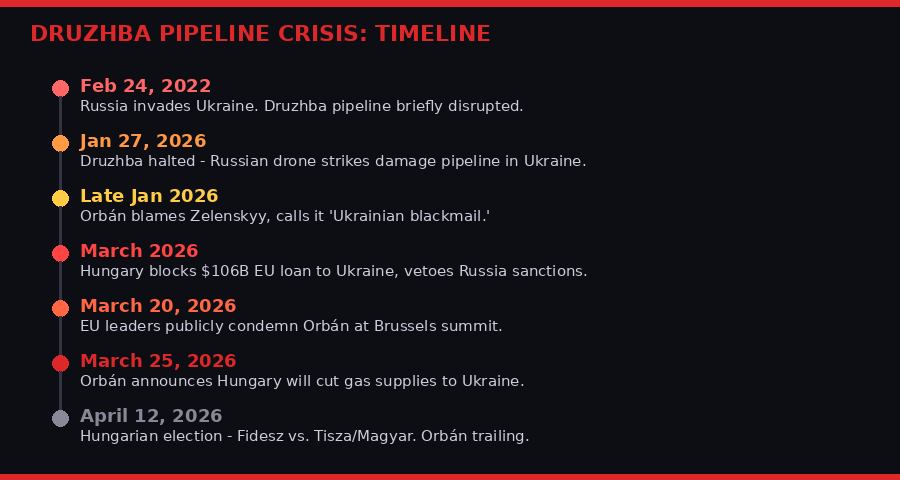
Timeline of the Druzhba pipeline crisis from the 2022 Russian invasion to Orbán's March 2026 gas cutoff announcement. Graphic: BLACKWIRE
The Druzhba pipeline has been at the center of European energy politics for six decades. Constructed in the 1960s under Soviet direction, it was designed to bind the Eastern Bloc together through shared energy dependency - a deliberate strategy of interdependence that made defection from the Soviet orbit economically costly. The "Friendship" was never entirely mutual.
After the Soviet collapse, the pipeline became infrastructure. Countries along its route needed it to run their refineries; Russia needed the transit revenue and the political leverage it provided. For decades, that leverage was mostly latent - applied through price negotiations, transit disputes with Ukraine, and the occasional winter gas crisis that reminded European capitals just how exposed they were.
Russia's 2022 invasion changed the calculus for most of Europe. Germany dismantled Nord Stream dependency within 18 months. The Czech Republic achieved oil independence in early 2026. Poland, Slovakia's neighbor, completed its alternative route years ago. The holdouts - Hungary and Slovakia, both with Kremlin-friendly governments - are now the last major consumers of Russian pipeline crude in the EU, protected by their special exemption and their leaders' calculation that Russian energy serves them better than European solidarity.
What has shifted is the context. In 2022, the Druzhba disruption was a Russian weapon aimed at Europe. In 2026, it has become a Hungarian weapon aimed at Ukraine - the same infrastructure, repurposed by a different hand. Orbán did not cause the pipeline to go offline. But he has been deliberately, methodically turning its absence into a political instrument. The gas cutoff threat is the latest and most acute manifestation of that strategy.
What Happens Next
Ukraine's energy grid has withstood three years of Russian attacks. A Hungarian gas cutoff would add new pressure to an already stressed system. (Unsplash/file)
Three scenarios are in play over the next four weeks, and the April 12 election will determine which path unfolds.
In the first scenario, Orbán wins reelection. That outcome would cement his mandate to continue blocking EU aid to Ukraine, sustaining the gas cutoff as a lever, and deepening Hungary's role as Moscow's principal advocate within European institutions. The $106 billion loan would remain frozen. The pipeline dispute would drag on. Ukraine would be forced to reroute gas imports at higher cost, drawing down reserves and straining a grid already running on emergency patches. European unity would fracture further as other EU leaders prove unable to compel compliance from a freshly re-elected Orbán.
In the second scenario, Magyar and the Tisza party win the April 12 election. The new government would face enormous pressure - from the EU, from NATO, from Ukraine - to reverse course on the pipeline dispute and unblock the loan. Magyar has promised to restore Hungary's Western orientation. But any new government would also face the practical reality that Hungary's energy infrastructure is genuinely intertwined with Russian supply chains, and rapid decoupling carries real costs. Change would come - but not overnight.
In the third scenario, the crisis deepens before the election. The gas cutoff accelerates, Ukraine faces acute supply pressure, EU leaders impose Article 7 consequences or move to strip Hungary of voting rights, and the entire episode becomes a constitutional confrontation within the bloc. This would test whether the EU has the tools and the political will to enforce collective decisions against a member that refuses to comply. Most observers believe it does not - yet.
Ukraine has said it hopes "one person" will not be able to block the EU loan indefinitely. But hope is not a strategy. The gas now flowing through Hungary to Kyiv represents a lifeline during a war. Orbán knows that. That is precisely why he is cutting it.
"We will win and we will win with force. We have political and financial tools, and with these we will compel them, unconditionally and preferably as soon as possible, to reopen the Druzhba pipeline. I will make no pact, there will be no compromise. We will defeat them." - Hungarian Prime Minister Viktor Orbán, March 2026
The line Orbán has drawn is not really about pipelines. It is about the limits of European solidarity, the durability of democratic backsliding within the EU, and whether a leader who has spent 16 years building an illiberal state inside a liberal alliance can continue to use that alliance's rules against its members' interests - and get re-elected for doing so.
The answer arrives on April 12.
Get BLACKWIRE reports first.
Breaking news, investigations, and analysis - straight to your phone.
Join @blackwirenews on Telegram