Inside the Kremlin's Ear: How Hungary Allegedly Leaked EU Secrets to Moscow
Hungary's Foreign Minister Peter Szijjarto was reportedly calling Sergei Lavrov during breaks in European Union council meetings - to tell Moscow what had just been discussed. If true, it is the most damaging intelligence breach inside NATO's civilian wing in the modern era. And Viktor Orban's first move was to change the subject.

The report, published by the Washington Post on Saturday March 22 and confirmed in broad strokes by the European Commission's demand for "clarification" the following Monday, describes a pattern of behavior - not a one-off lapse. Szijjarto allegedly made regular calls to his Russian counterpart during EU foreign affairs meetings, providing Lavrov with "direct reports on what was discussed" and possible next steps that EU member states were considering.
The timing is brutal. Europe is navigating the fourth week of the US-Israel war on Iran, a conflict that has shut the Strait of Hormuz, spiked global energy prices to 1970s-era crisis levels, and forced emergency meetings in capitals from London to Ankara. Every deliberation about how Europe responds - whether to support US military operations, how to protect Gulf shipping lanes, whether to trigger strategic oil reserves - was potentially landing on a desk in Moscow in near real time.
Orban's response was to announce that Szijjarto had been wiretapped. Not that the allegations were false. Not that the calls never happened. His first priority was to frame Hungary as the victim.
What the Report Actually Says

The Washington Post described the calls as deliberate and systematic. According to the report, Szijjarto would step out of EU foreign ministers' meetings during scheduled breaks and call Lavrov directly. The calls were not informal diplomatic outreach of the kind that any foreign minister might conduct - they were intelligence feeds. Szijjarto allegedly reported on the current state of EU discussions and what the bloc was considering doing next.
This is the distinction that makes the story so damaging: there is nothing inherently improper about a foreign minister maintaining contact with counterparts from non-EU states, including Russia. What is improper - and potentially illegal under EU treaty law governing classified deliberations - is feeding the content of confidential council sessions to a state that is actively at war with an EU candidate country and whose military is shaping the strategic environment that the EU is trying to navigate.
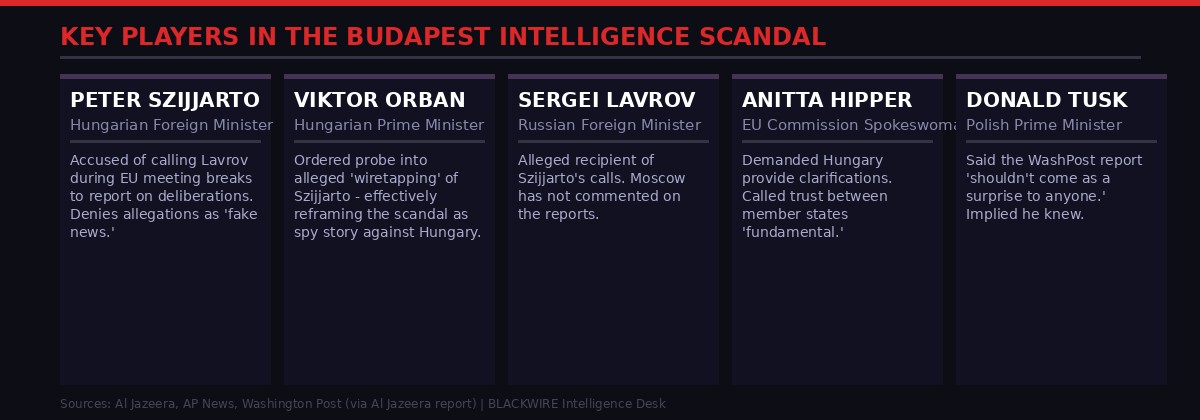
Szijjarto rejected the report as "fake news" and "senseless conspiracy theories." That denial was prompt, categorical, and completely unaccompanied by any evidence. He did not specify which elements were false, did not provide alternative accounts of his communications with Moscow, and did not propose any mechanism through which the allegations could be examined.
"Discussions within the EU, including among EU foreign ministers, are confidential. We will not tolerate any violation of them." - German Foreign Ministry spokesman, March 23, 2026 (AP News)
Poland's Prime Minister Donald Tusk, who sits across from Hungary at every EU Council session, was more direct. He said the report "shouldn't come as a surprise to anyone," and noted in a post on X that he personally takes the floor "only when strictly necessary and says just as much as necessary." The implication was clear: Tusk has suspected for some time that the room was not secure when Hungary was present.
Orban's Deflection: The Wiretap Gambit

Viktor Orban announced Monday morning that he had ordered an investigation into the alleged wiretapping of his foreign minister. "There is evidence that Hungary's foreign minister was wiretapped, and we also have indications of who may be behind it," Orban said, refusing to elaborate.
This is a familiar maneuver. When cornered on substantive wrongdoing, the Orban government reframes the story as a covert operation against Hungary. The allegations about Szijjarto calling Lavrov were generated by US intelligence intercepts - by the Americans listening in on Russian communications, not by anyone bugging Hungarian phones. But Orban's framing transforms an intelligence breach story into a sovereignty-violation story, which plays far better to his domestic base.
The Orban government has mastered this particular ju-jitsu over fifteen years in power. When the EU freezes cohesion funds over rule-of-law violations, Orban talks about Brussels trying to starve Hungarian children. When NATO allies push back on his bilateral dealings with Moscow, he frames it as warmongers trying to drag Hungary into someone else's conflict. When his foreign minister is accused of feeding EU deliberations to Russia, the press conference is about wiretapping.
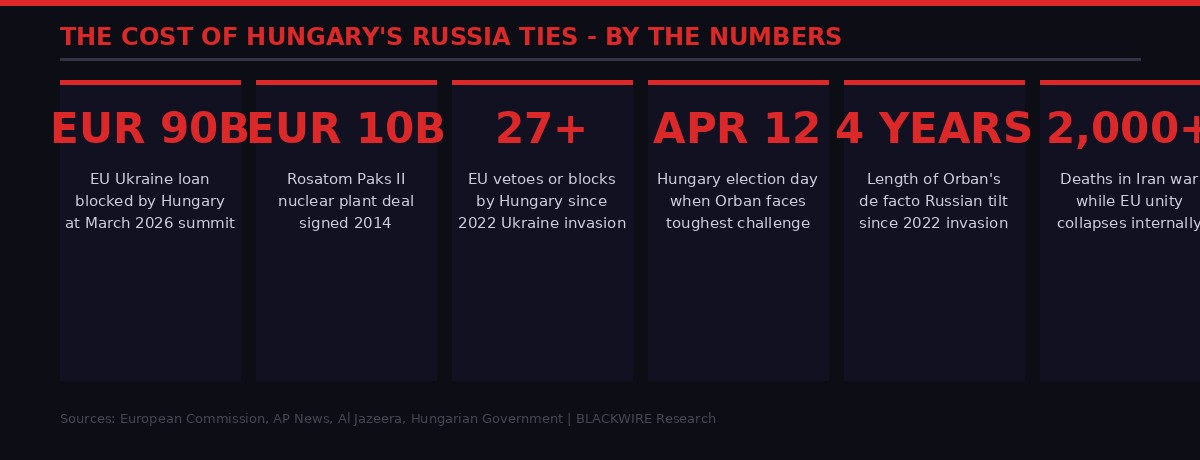
The context makes the deflection harder to sustain. Orban is facing the toughest re-election challenge of his career. Parliamentary elections are scheduled for April 12, and the centre-right Tisza Party - led by former Orban insider Peter Magyar - is leading or matching Fidesz in most polls. A genuine espionage scandal in the final three weeks of the campaign would be catastrophic. A story about wiretapping, by contrast, lets Orban play nationalist defender right up to election day.
Sixteen Years of Drift: The Structural Problem
The Szijjarto allegations are shocking in their specificity but not in their direction. For sixteen years, Viktor Orban has systematically oriented Hungary toward Moscow in ways that had no precedent for an EU and NATO member state. The question was never whether Hungary had Russian sympathies. The question was whether Orban's government crossed the line from pro-Russian political stance to active intelligence cooperation.
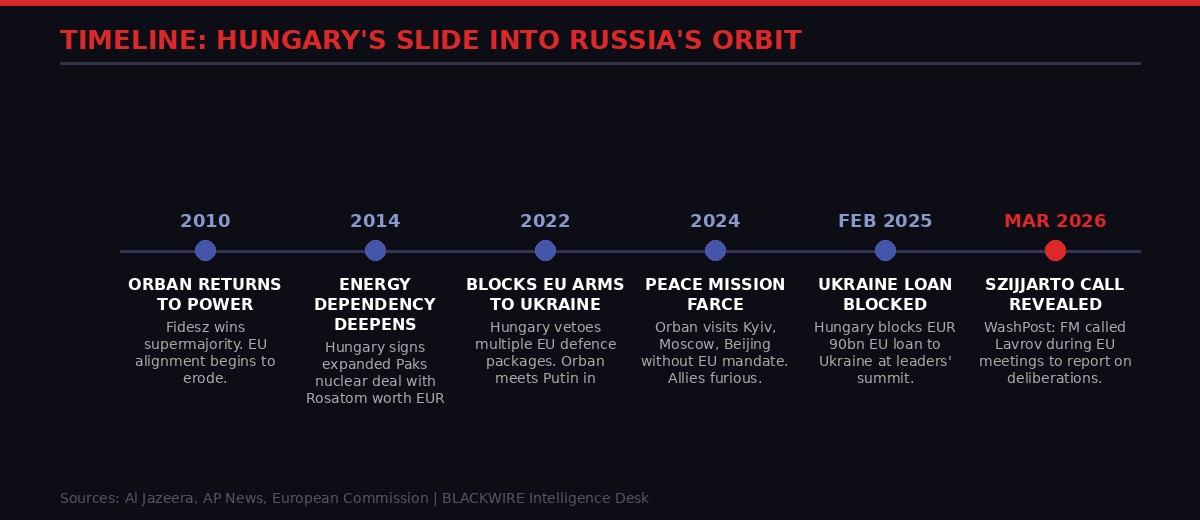
The structural architecture of Hungary's Russia alignment is well-documented. In 2014, Orban's government signed a EUR 10 billion deal with Rosatom, Russia's state nuclear company, to expand the Paks nuclear power plant - a contract that locked Hungary into Russian energy infrastructure for decades and came with financing from Moscow. Hungary became the EU state most economically dependent on Russian gas, by design.
After Russia's 2022 full-scale invasion of Ukraine, Orban was the only EU head of government to refuse military assistance to Kyiv, to block EU aid packages repeatedly, and to maintain warm bilateral relations with Putin. He visited Moscow in 2024 on what he called a "peace mission" - without consulting EU partners, without an EU mandate, and while EU foreign policy ostensibly coordinated a unified response to Russian aggression. European capitals were furious. Orban called them warmongers.
In the three weeks before the Szijjarto story broke, Orban had just blocked a EUR 90 billion EU loan to Ukraine at the March 2026 EU summit. The bloc was trying to coordinate a unified response to the Iran war - a conflict with massive energy security implications for every EU member. Every hour that the Strait of Hormuz remained closed was an hour of escalating pain for European consumers. In that context, Hungary's representation at EU deliberations was not an abstract diplomatic problem. It was a live operational security risk.
What NATO and Brussels Can Actually Do

The European Commission's response was careful. Spokeswoman Anitta Hipper said Hungary must provide "clarifications," and noted that trust between member states is "fundamental for the work of the EU." She did not announce an investigation. She did not invoke any specific treaty mechanism. She asked nicely.
That restraint reflects the structural reality: the EU has very limited tools for dealing with a member state that is actively compromising its security. Article 7 of the Treaty on European Union allows for the suspension of a member state's voting rights if it commits a "serious and persistent breach" of EU values - but triggering that mechanism requires unanimity among other member states, and Hungary can rely on at least some support from countries with similar instincts.
The more practical response has been to work around Hungary. Senior EU and NATO officials have reportedly excluded Budapest from the most sensitive deliberations for some time. NATO operates a tiered classification system, and there is nothing stopping alliance members from simply not sharing certain categories of intelligence with a member whose reliability is in question. The problem is that excluding a member state from council-level meetings is politically untenable as long as that state remains a formal member in good standing.
Germany's position - that deliberations are confidential and violations will not be tolerated - was the strongest official statement from any member state. But "will not tolerate" without a specified consequence is a warning that lands softly. The German Foreign Ministry did not say what happens if Hungary fails to provide satisfactory clarifications. Probably because nobody has a clean answer to that question.
The Intelligence Geometry: Who Knew What
The Washington Post report, like most intelligence stories of this type, was almost certainly based on intercepts. American signals intelligence operations against Russian diplomatic communications are extensive and routine. If Szijjarto was calling Lavrov from Brussels during meeting breaks, that call was almost certainly captured by NSA systems that monitor Russian foreign ministry communications as a matter of standard procedure.
The decision to publish that information - or to allow it to be published - is itself a decision. American intelligence agencies routinely sit on intercepted communications for years before sharing them with partner services or allowing them into the press. The timing of this report, three weeks before the Hungarian election and three weeks into the Iran war, is not a coincidence. Someone made a decision that now was the right time for this to become public.
Polish Prime Minister Tusk's "no surprise" comment suggests that Polish intelligence - which has been extraordinarily aggressive in countering Russian influence operations in Central Europe since 2022 - may have been aware of the Szijjarto-Lavrov calls for some time. Poland's intelligence services have spent four years essentially building a parallel eastern security architecture that does not depend on Hungarian cooperation, and Tusk's government has been openly contemptuous of Orban's Russia policy. His comment on X read less like a reaction to surprising news and more like confirmation of something he had been waiting to say publicly.
"That shouldn't come as a surprise to anyone. That's one reason why I take the floor only when strictly necessary and say just as much as necessary." - Polish Prime Minister Donald Tusk, X post, March 23, 2026 (Al Jazeera)
The Baltic states, Finland, and Sweden - the EU and NATO members who face the most direct threat from Russian military aggression and have the least tolerance for ambiguity about alignment - have been notably quiet publicly. That silence is probably not satisfaction. It is more likely calculation about how to respond in a way that maximizes pressure without triggering a crisis that fractures the alliance at a moment when it is already strained by the Iran conflict.
The Election Factor: Three Weeks and Counting

Viktor Orban has governed Hungary since 2010. He has won four consecutive supermajorities, each time after rewriting the electoral rules in ways that favored Fidesz. His control over Hungarian media is so comprehensive that most Hungarian voters receive their news through outlets that Orban's allies own or control. The opposition has had no comparable platform.
That context changed in 2024 when Peter Magyar - a former Orban loyalist and ex-husband of a former justice minister - broke with the government and began a civic movement that rapidly became the Tisza Party. Magyar is not a traditional opposition politician. He is an insider who speaks the regime's language fluently and understands its machinery. His support has been driven by disgust with Fidesz corruption rather than ideological opposition, which makes him more threatening than previous challengers who could be easily dismissed as Brussels puppets or Western agents.
The Szijjarto story lands in this context like a grenade. Magyar has built his campaign partly on the argument that Orban's Russia alignment is a national security disaster. He does not need to say much about the Washington Post report - it says it for him. And Orban's decision to respond by talking about wiretapping rather than denying the substance tells Magyar's voters everything they need to know about whether the allegations have merit.
Hungarian state media will minimize the story. Orban's control over the domestic information environment is real. But the story is everywhere on social media, every European outlet is covering it, and Hungarian citizens who want to find it can. The government's calculation is that the wiretapping narrative will satisfy enough Fidesz voters to hold the base while the broader electorate either doesn't see the story or discounts it.
That may be correct. Orban has survived scandals before that would have ended careers elsewhere. The question is whether this one is different in kind - whether the specific allegation of feeding EU deliberations to Moscow crosses a threshold that even his core base finds uncomfortable.
The Broader War Context: Why the Timing Matters
The Iran war has fundamentally changed Europe's strategic environment in three weeks. The Strait of Hormuz - through which roughly one-fifth of all traded oil and gas passed before the conflict began - has been effectively closed by Iranian retaliatory action. Energy prices are at their highest sustained level since the 1970s oil shocks. The International Energy Agency has called it a crisis worse than anything since that decade.
EU member states have been in constant deliberation about their response. Do they support US military operations and accept the political risk? Do they push for negotiations and accept the credibility cost? Do they trigger their strategic oil reserves and how fast? Do they authorize their Gulf-based naval assets to escort tankers through contested waters? Every one of these questions was being debated in the EU Council sessions where Szijjarto was reportedly present and calling Moscow on the breaks.
Russia's interest in those deliberations is not abstract. Moscow benefits strategically from high energy prices, from Western division, from any outcome that weakens the transatlantic alliance, and from any intelligence about what the EU collectively plans to do about the Gulf crisis. If the Szijjarto allegations are accurate, Russia had a real-time window into the EU's decision-making process at the most consequential moment in European security since the 2022 Ukraine invasion.
That is the headline that the wiretapping narrative is designed to obscure. It is not about one minister's calls. It is about whether Russia had advance knowledge of EU strategic deliberations while those deliberations determined Europe's response to a war that is reshaping global energy markets and military alignments. If the answer is yes, the damage to European strategic coherence is not a future risk - it has already occurred.
Timeline: Budapest's Drift from Brussels to Moscow
What Comes Next
The EU's clarification demand is unlikely to produce a satisfactory response from Budapest. Szijjarto has already denied the allegations. Orban has pivoted to the wiretapping narrative. The Hungarian government has no incentive to engage substantively with the allegations three weeks before an election it needs to win.
What happens after April 12 depends on the election result. If Orban wins - which remains possible despite Magyar's strong showing in polls - the EU faces the same problem it has faced since 2022 with no new tools: a member state that cannot be trusted in sensitive deliberations, that blocks Ukraine-related decisions by veto, and that maintains active bilateral relations with a state at war with an EU candidate country. The formal mechanisms for dealing with this situation are blunt instruments that require unanimity the EU does not have.
If Magyar wins, the picture changes considerably. Tisza has explicitly committed to re-aligning Hungary with its EU and NATO partners, cooperating fully on Ukraine support, and cleaning up the domestic media and judicial environment that Fidesz built over sixteen years. A Magyar government would presumably welcome any investigation into the Szijjarto allegations and would have strong domestic reasons to prosecute them seriously. The allegations would become a feature of the transition rather than a crisis to be managed.
But EU partners cannot wait for the Hungarian election to address the immediate security problem. The Iran war is ongoing. EU deliberations about the Gulf crisis, energy security, and strategic reserves are happening now. Every meeting where Hungarian ministers are present is a meeting where the same question hangs in the room: is this conversation going to Moscow?
There is no public sign that the EU has moved to formally exclude Hungary from sensitive sessions. There is every reason to believe that some member states are already making that calculation informally - keeping their most sensitive positions for bilateral conversations with trusted partners rather than flagging them in full council. That kind of informal exclusion hollows out the EU's collective decision-making without addressing the structural problem.
The Szijjarto allegations, if accurate, represent something qualitatively different from the political disagreements Europe has managed with Budapest for years. Political obstruction is a problem. Active intelligence feed to Moscow during a strategic crisis is a security breach. Europe does not have a mechanism for treating it as one. That gap - between what has allegedly happened and what the EU can actually do about it - is the most damaging legacy of sixteen years of hoping Hungary would eventually come back into line.
It didn't. And now Europe has to figure out what that means while the Strait of Hormuz is closed and the election clock in Budapest counts down to April 12.
Get BLACKWIRE reports first.
Breaking news, investigations, and analysis - straight to your phone.
Join @blackwirenews on Telegram