ICE at the Gate: Trump Deploys Immigration Agents to U.S. Airports as DHS Shutdown Enters Week Six

The scenes played out simultaneously at Hartsfield-Jackson Atlanta International, John F. Kennedy International in New York, Newark Liberty International in New Jersey, George Bush Intercontinental in Houston, and Louis Armstrong International outside New Orleans. ICE officers and agents in tactical vests stood near security lines and checkpoints, watching passengers queue in lines that had, just days before, stretched outside terminal buildings and into parking structures.
This was not the TSA. This was not airport security. This was Immigration and Customs Enforcement - the most politically radioactive law enforcement agency in America - deployed by executive order to paper over a staffing crisis that the president himself helped cause by refusing to sign a bill that would end it.
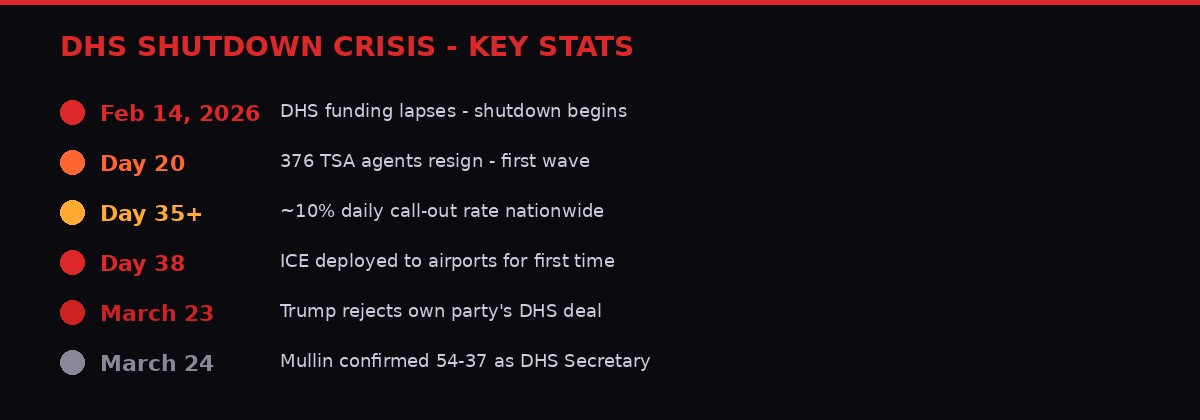
The same day ICE arrived at the gates, Trump rejected a DHS funding proposal from his own Republican Party. He then escalated his demands, insisting the Senate must also pass the SAVE America Act - a strict voter ID bill with essentially zero chance of passing - before he would consider any deal.
By Monday evening, the White House had also rejected a meeting request from Senate Democrats' lead negotiator, Sen. Patty Murray of Washington. The shutdown, which began February 14 when Congress failed to renew DHS funding, entered its 38th day.
What ICE Is Actually Doing at Airports

The Trump administration offered almost no detail on what exactly ICE officers would do when deployed to airports. White House border czar Tom Homan, who is leading the airport security effort, said immigration officers could "cover exits currently monitored by TSA agents, freeing them to work screening lines" - and could also check passenger IDs in some circumstances.
The practical reality: ICE officers cannot run X-ray machines. They cannot perform pat-downs with the legal authority TSA agents carry. They cannot conduct the complex bag checks and threat assessments that require weeks of specialized classroom training followed by months of supervised on-the-job learning.
"There is just zero chance for them to be operating X-rays, conducting bag checks and pat-downs. TSA agents receive lengthy classroom training in security screening procedures, followed by weeks or months of on-the-job training." - Keith Jeffries, former head of TSA security at Los Angeles International Airport, now VP at K2 Security Screening
Jeffries and other aviation security analysts say ICE can realistically provide crowd control and queue management - but those are peripheral functions, not the core bottleneck. The bottleneck is that 376 trained screeners have quit since February 14, roughly 10 percent of the remaining workforce is calling out each day, and the agents who do show up are working on empty - literally, with no paychecks - while their families face eviction notices and repossessed vehicles.
Beyond the question of effectiveness sits the question of intent. Trump on Monday suggested airports were "fertile territory" for immigration enforcement. He added, almost as an afterthought, that ICE was "really there to help." The two statements cannot both be fully true. An agency deployed to enforce immigration law and an agency deployed to manage travel queues operate from incompatible mandates.
Chicago Mayor Brandon Johnson said his office was "monitoring" the deployment of federal officers at O'Hare International. Atlanta Mayor Andre Dickens issued a statement saying officers would "report to TSA" and deployment was "not intended to conduct immigration enforcement activities." DHS declined to confirm those assurances or specify which airports received officers, citing security reasons.
The Deal Trump Killed

By Friday, White House staff had pitched Trump on a proposal to fund all of DHS except for the immigration enforcement operations at the center of the congressional dispute. The idea was a surgical compromise - get TSA agents paid, keep travelers moving, and continue fighting over ICE separately.
Trump rejected it.
He then added a new condition: the Senate must also approve the SAVE America Act - a strict proof-of-citizenship voter registration requirement that Democrats have called a voter suppression measure and that has broad opposition in the current Senate. Senate Majority Leader John Thune, R-S.D., said he sees "deal space" in the negotiations. His optimism appeared to lag what the White House was actually doing.
"This is a pox on everybody's house. You've got people standing in lines at the airports. This needs to be fixed." - Senate Majority Leader John Thune
The Monday White House rejection of a meeting with Sen. Murray - the top Democratic negotiator on the Senate Appropriations Committee - effectively ended any near-term path to resolution. Both chambers of Congress are also scheduled to be out of Washington the first two weeks of April. That means TSA workers could be working without pay for close to 60 days before a deal is even structurally possible.
Senate Republican Chair of Appropriations Susan Collins said the White House has "added to its offer" but declined to give details. Her careful, non-committal language suggested the negotiations are far from over but also far from any landing zone.
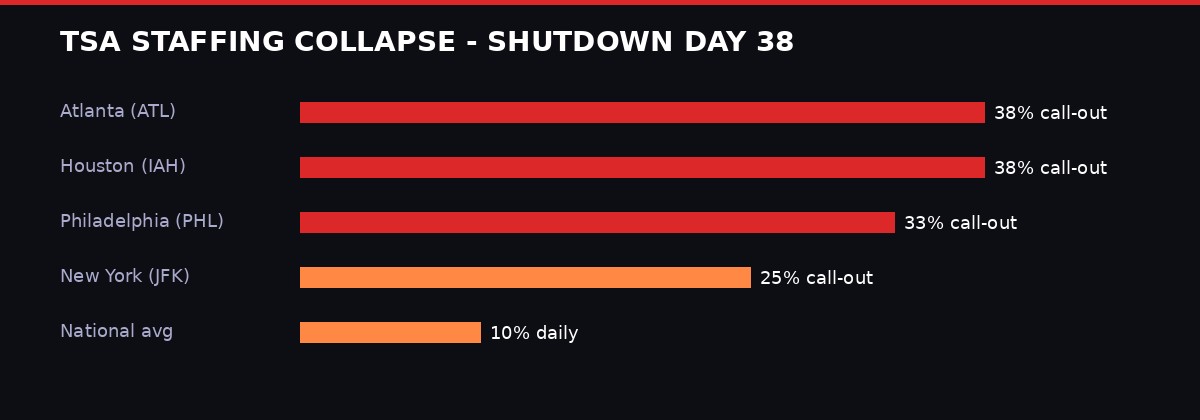
For travelers, the math is brutal: summer travel season begins in earnest in May. Spring break peaks in the next two weeks. And the partial shutdown has already left the TSA stretched thin enough that Atlanta's Hartsfield-Jackson - the world's busiest airport by passenger volume - saw 38 percent of its TSA officers call out on a single Wednesday. Houston's George Bush Intercontinental hit the same number the same day.
How America Got Here: The Full Anatomy of the Shutdown

The DHS funding lapse began Valentine's Day - February 14, 2026 - when Congress failed to renew department appropriations. It was not the first shutdown TSA workers had faced this year. They had worked through 43 unpaid days during the longest government shutdown in history last fall, and a brief four-day lapse earlier in 2026. By the time the February 14 shutdown hit, airport screeners had already spent nearly half of the past 170 days without full paychecks.
The precipitating political event was the shooting deaths of Alex Pretti and Renee Good in Minneapolis, killed by federal immigration officers during enforcement operations. Democrats in Congress made funding ICE and CBP without policy reforms a non-starter. Republicans refused to separate ICE funding from the broader DHS package. The standoff locked the agency funding into the immigration culture war, with airport security becoming the visible casualty.
TSA workers are classified as essential federal employees. They cannot strike. They cannot refuse to report. They must show up and screen passengers regardless of whether a paycheck arrives. The legal compulsion to work unpaid - combined with some of the federal government's lowest starting salaries (around $34,500 annually), historically low morale, and the particular indignity of being used as a political bargaining chip for the third time in six months - is driving the exits.
"It's just exhausting. Every day it just feels like this weight gets heavier and heavier on us." - Cameron Cochems, TSA union leader in Boise, Idaho, vice president of his regional AFGE chapter
Cochems, a four-year TSA veteran, described going to the airport food drive to find provisions for his family after his wife was unexpectedly laid off two weeks into the current shutdown. "Every day I come to the airport and I look at the food drive, see what things I can get for my family," he told AP.
A 2024 Government Accountability Office report found TSA had some of the lowest morale in the entire federal government, driven by years of comparatively low pay, limited advancement, and persistent workplace frustrations. The report warned the agency was at structural risk of high attrition even in normal conditions. The current shutdown is not normal conditions.
SHUTDOWN TIMELINE
ICE's Complicated Presence - Legal, Political, and Practical
The deployment of armed immigration enforcement officers to civilian airport checkpoints is legally novel and operationally murky. Federal law enforcement is a routine presence at international airports - CBP screens arriving international passengers, and HSI agents conduct cross-border criminal investigations. But deportation officers from ICE's Enforcement and Removal Operations standing near domestic TSA checkpoints is something different.
ICE agents are armed. They carry firearms, wear tactical gear, and operate under a legal mandate that is fundamentally about immigration status, not aviation security. Their training emphasizes immigration law enforcement, surveillance, and arrest operations - not threat detection, prohibited item identification, or passenger screening protocols.
Zach Griff, who writes the travel industry blog "From the Tray Table," said he was "encouraged" by the potential of using ICE to assist TSA on peripheral tasks but stressed the limits. "That is a specialized training process that the TSA goes through with all of its agents. That's not something that they can just kind of spin up," he said of baggage screening.
The political risks are compounding. ICE has been the target of sustained protests across multiple U.S. cities since Trump's immigration enforcement crackdowns expanded last year. Keith Jeffries, the former LAX security chief, noted that ICE's visible presence at airports could draw protesters directly into terminals - pulling even more security resources away from screening.
Trump's own Monday statement that airports were "fertile territory" for immigration enforcement - followed immediately by his insistence that ICE was "really there to help" - gave both critics and local officials legitimate reason to be skeptical of the assurances coming from Atlanta and other mayors. If ICE is legally empowered to make immigration arrests and the president publicly signals airports are enforcement targets, mayors' statements carry no legal weight against that mandate.
The San Francisco International Airport confirmed a separate ICE arrest at the airport in recent days, under circumstances unrelated to the TSA deployment. It underlined that the two missions - helping with lines and enforcing immigration law - were not cleanly separable in practice.
Mullin Takes the Helm - and Inherits the Crisis

The Senate voted 54-37 on Monday to advance Markwayne Mullin's nomination as Trump's next Homeland Security Secretary - largely along party lines, with two Democrats joining most Republicans. A final confirmation vote was expected as early as Monday evening or Tuesday.
Mullin, 48, an Oklahoma Republican and Trump loyalist, replaces Kristi Noem, who was fired by Trump earlier this month after an increasingly tumultuous tenure that saw DHS become the center of a political firestorm over mass deportation operations, the Minneapolis shootings, and three government shutdowns in six months.
Mullin's personal bond with Trump dates to 2020, when Trump showed extraordinary personal attention to Mullin's son after a severe brain injury during a high school wrestling match. The two men have been close ever since. During his Senate confirmation hearing last week, Mullin said he would cry recounting how the then-president called regularly to ask about his son's recovery while running one of the toughest elections of his career.
"He was running in one of the toughest elections he had been in, and the guy was still that concerned about my son. We were acquaintances before that. We've been friends ever since." - Markwayne Mullin, at his confirmation hearing
Mullin's confirmation gives DHS its third confirmed leader in Trump's second term. He inherits an agency with a 38-day funding lapse, 376 fewer frontline screeners than it had on Valentine's Day, a workforce in open financial distress, and now a controversial deployment of immigration enforcement officers into the heart of civilian domestic air travel.
His first crisis will be the one he helped cause - as a senator, Mullin was part of the Republican caucus whose failed negotiations led directly to this point. Now he must try to resolve it from the other side.
The Traveler Reality: Lines, Delays, and Fear

For the people actually trying to catch flights, the numbers translate to visceral chaos. At Atlanta's Hartsfield-Jackson on a recent Sunday, some travelers waited nearly six hours at the main security checkpoint, where only two TSA agents were on hand midafternoon to check IDs. Many missed their flights and scrambled to book later alternatives or join standby lists that were already dozens of names long.
Houston's George Bush Intercontinental saw travelers queue through the morning amid staffing shortages, then watched the same lines drop to under 10 minutes in the afternoon - unpredictability so severe that aviation analysts said it was impossible to warn travelers when or where problems would hit next.
The shutdown's impact on other DHS functions runs beyond the TSA. Hundreds of thousands of Homeland Security workers - including Secret Service agents and Coast Guard personnel - have also been working without pay since February 14. The Secret Service protecting the president. The Coast Guard patrolling America's maritime borders. All unpaid, all still working.
TSA staffing has a structural quality problem beyond just numbers. The GAO's 2024 report found that even before the shutdowns, attrition remained the agency's dominant challenge. The 376 agents who have quit since February 14 were not evenly distributed across all airports. High-turnover, understaffed airports absorbed the losses hardest. Building back that capacity will take months even after a funding deal is signed, because new screener training is not instantaneous.
The Bigger Picture: ICE Normalization and Air Travel Politics

Monday's deployment may be temporary. Or it may be the first step in a structural normalization of immigration enforcement at the heart of domestic civilian travel. Trump's language about airports being "fertile territory" for ICE - spoken on the same day he deployed them there - was not accidental.
The administration has systematically moved immigration enforcement into spaces previously considered off-limits: churches, schools, courthouses, and now airport security checkpoints. Each expansion is introduced with a pragmatic justification that masks the political logic. The airports deployment is framed as staffing assistance. The enforcement potential is built into the same deployment. The separation between those two missions requires trusting official assurances that have frequently proven inaccurate.
Sen. Lisa Murkowski, R-Alaska, one of the few Republican senators willing to push back publicly, called the plan a "bad idea." She argued the priority should be resolving the DHS funding standoff and getting TSA agents paid - not adding a new, potentially combustible layer to an already volatile situation.
"What we need to do is, we need to get the DHS issues resolved, we need to get the TSA agents paid. Do you really want to have even additional tensions on top of what we are already facing?" she told reporters at the Capitol.
Her question was pointed at her own party's president, who had just rejected her own party's funding proposal.
The United States is 38 days into a self-inflicted security crisis. Armed agents who lack the training for airport security are standing in the queues to compensate for the workforce hollowed out by a funding fight the White House escalated rather than resolved. The shutdown has no visible near-term exit. Congress goes on recess. The lines will get longer. The pressure will build.
What Trump calls leverage, the 50,000 workers eating from airport food drives call something else.
Get BLACKWIRE reports first.
Breaking news, investigations, and analysis - straight to your phone.
Join @blackwirenews on Telegram