The $2 Billion Bet: NYSE's Parent Legitimized Prediction Markets While Wall Street Bled
Intercontinental Exchange just committed nearly $2 billion to Polymarket. Kalshi is at $22 billion. Bitcoin hit $66,000. In the worst trading week of 2026, the prediction market sector just got its Wall Street coronation.

ICE's total Polymarket commitment hits nearly $2 billion, making it the largest institutional bet on prediction markets in history. (BLACKWIRE / VOLT)
On Friday, March 27, 2026, with the Nasdaq entering correction territory and $17 trillion in market cap erased from peak levels across the Magnificent Seven, the owner of the New York Stock Exchange quietly closed out one of the most consequential deals in the history of financial markets.
Intercontinental Exchange - the company that owns the NYSE, runs ICE Futures, clears hundreds of trillions in global derivatives annually - added $600 million to its bet on Polymarket, a crypto-native prediction market built on the Polygon blockchain. Combined with a $1 billion investment it made in October 2025, plus a planned $40 million purchase of shares from existing holders, ICE's total commitment to Polymarket is now approaching $2 billion.
That is not a venture bet. That is infrastructure-level conviction. The NYSE's parent company just wrote the largest institutional check in prediction markets history. At almost the exact same moment, rival Kalshi - the US-regulated prediction exchange - raised over $1 billion at a $22 billion valuation. One week. Two companies. Billions of dollars. The message is unmistakable: prediction markets are no longer crypto's weird cousin. They are the next major asset class.
KEY NUMBERS: ICE total commitment to Polymarket = ~$2B | Kalshi valuation (Mar 2026) = $22B | Kalshi estimated annual revenue = $1.5B | Bitcoin price at announcement = $66,000-$67,025 | Nasdaq correction from peak = -10.2%
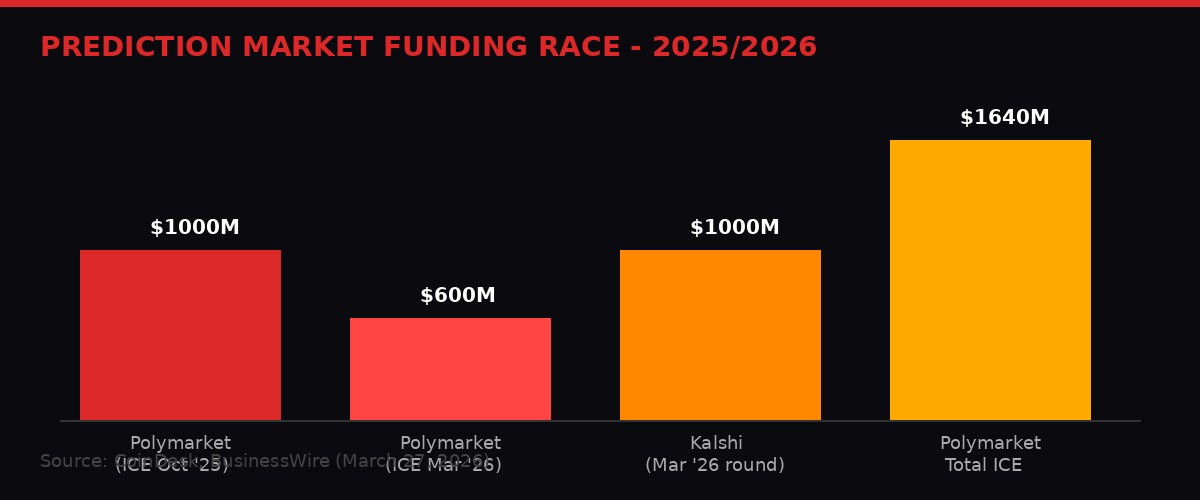
The prediction market funding surge: ICE stacks $600M on top of its $1B October investment as Kalshi raises $1B+ at a $22B valuation. (BLACKWIRE)
What Is ICE and Why Does This Matter So Much
Most people who watch crypto have a rough sense of who Polymarket is. Fewer appreciate what it means that ICE is writing them $2 billion checks.
Intercontinental Exchange is not just a stock exchange owner. ICE operates eleven regulated exchanges and marketplaces. It owns the New York Stock Exchange, ICE Futures Europe (the dominant venue for Brent crude trading), ICE Futures U.S. (where cotton, coffee and orange juice futures trade), and ICE Clear Credit (which clears credit default swaps, among the most complex derivatives in existence). ICE's data and technology services process 10 billion data records per day. The company had a market cap of roughly $80 billion heading into 2026. When ICE puts $2 billion somewhere, it is not speculating. It is building the next market infrastructure it intends to operate.
For perspective: ICE's 2016 acquisition of Interactive Data Corporation cost $5.2 billion and was the foundation of its current data business. Its 2018 acquisition of Virtu Financial's BondPoint platform cost $400 million. Its 2023 purchase of Black Knight, the mortgage data giant, cost $11.7 billion - the biggest deal in its history. The Polymarket commitment, at $2 billion, already sits in the same tier as the infrastructure bets that defined the modern ICE empire.
According to the announcement reported by CoinDesk on March 27, ICE said the investment will not materially affect its financial results - which means they are treating it as a strategic positioning play, not a financial return bet. That is how you acquire market infrastructure. You pay for the option to build the next trading venue before anyone else gets there.
"The backing from ICE gives Polymarket more than capital. It ties the platform to one of the upcoming names in global markets." - CoinDesk, March 27, 2026
The Prediction Market Legitimization Arc
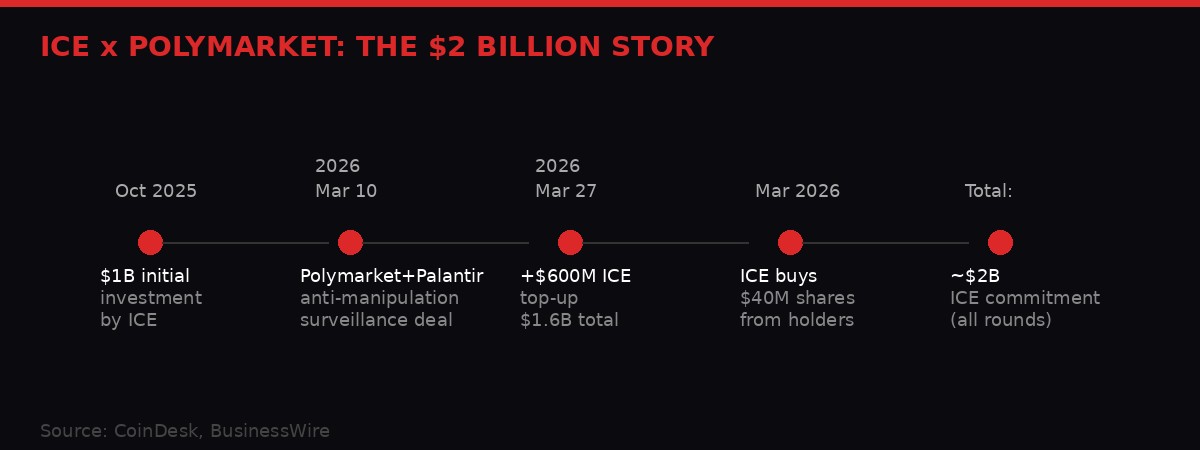
The ICE x Polymarket deal timeline: from $1B in October to nearly $2B total by March 2026. (BLACKWIRE)
Prediction markets have existed in various forms for decades. The Iowa Electronic Markets launched in 1988 as an academic research tool to forecast US presidential elections. Intrade ran from 2001 to 2013, attracting millions in volume before collapsing in a scandal involving its founder's death and allegations of improper use of customer funds. Betfair created liquid prediction markets for sports outcomes. But none of these ever reached escape velocity into mainstream finance. The market structure was wrong, the regulation was murky, the technology was too slow and too expensive.
Polymarket changed the calculus by building on Polygon, an Ethereum Layer-2 blockchain, and settling in USDC stablecoin. Suddenly you had permissionless, global, 24/7 markets that could settle in minutes with no clearing house delay and minimal transaction costs. The 2024 US presidential election markets on Polymarket processed hundreds of millions in volume, outperforming polling in predicting Trump's victory margin. That moment - when a crypto-native market beat every traditional forecaster on the single most-watched event in American politics - was the proof of concept the industry needed.
Kalshi found a different angle. Founded in 2018, it spent years battling the CFTC for the right to offer event contracts in the US under regulatory cover. It won key approvals in 2023 and 2024, letting it offer prediction markets on events from economic data releases to election outcomes to interest rate decisions - all legally, all regulated. That regulatory moat is what drives its $22 billion valuation and $1.5 billion estimated annual revenue. It is not bigger than Polymarket in volume, but it is probably the safer business.
ICE's $2 billion bet on Polymarket and Kalshi's $1 billion fundraise at a $22 billion valuation in the same week confirm what the industry insiders have been arguing for two years: prediction markets are not gambling adjacent. They are price discovery infrastructure. They are a more honest version of what financial markets are supposed to do.
The Regulatory Sword Still Hangs
None of this is clean. The regulatory picture remains genuinely complicated, and both ICE and the Polymarket team know it.
Prediction markets have faced criticism over their potential for manipulation by participants with privileged information. When Polymarket ran markets on whether a major CEO would resign, whether a government would release classified files, or whether a military strike would happen before a specific date - in each case, someone with inside knowledge could theoretically profit before the public became aware. That is not hypothetical. There are credible documented cases of suspicious trading patterns around Polymarket elections markets.
Carlos Pereira, a general partner at BITKRAFT Ventures, which manages over $1 billion across gaming, AI and digital assets investments, has been direct about the problem.
"There has been what seems to be insider trading. When you have a market that is new and by consequence a little bit fragile, making the news in negative ways can be dangerous. If markets don't show they are trying to manage insider trading, the odds of regulation becoming harsher and tapering growth would be much higher." - Carlos Pereira, BITKRAFT Ventures, CoinDesk (March 10, 2026)
Polymarket's response has been aggressive and smart. In March 2026, the company announced a partnership with Palantir Technologies and TWG AI to build a market surveillance system specifically designed to detect suspicious trading and manipulation in its sports prediction markets. The system uses Palantir's data infrastructure and TWG AI's analytics to monitor trading activity, screen participants, and generate compliance reports that could be shared with regulators or sports leagues.
More critically, Polymarket acquired a licensed exchange and clearinghouse earlier in 2026. That acquisition - the details of which have not been fully disclosed publicly - effectively gives Polymarket a regulatory foundation to operate in a way that Intrade never had. Combined with ICE's formal stamp of approval and institutional capital, it transforms the compliance narrative entirely. ICE does not back unregulated gambling operations. ICE backs the things it intends to be the infrastructure for.
Kalshi at $22 Billion: The Numbers Behind the Number
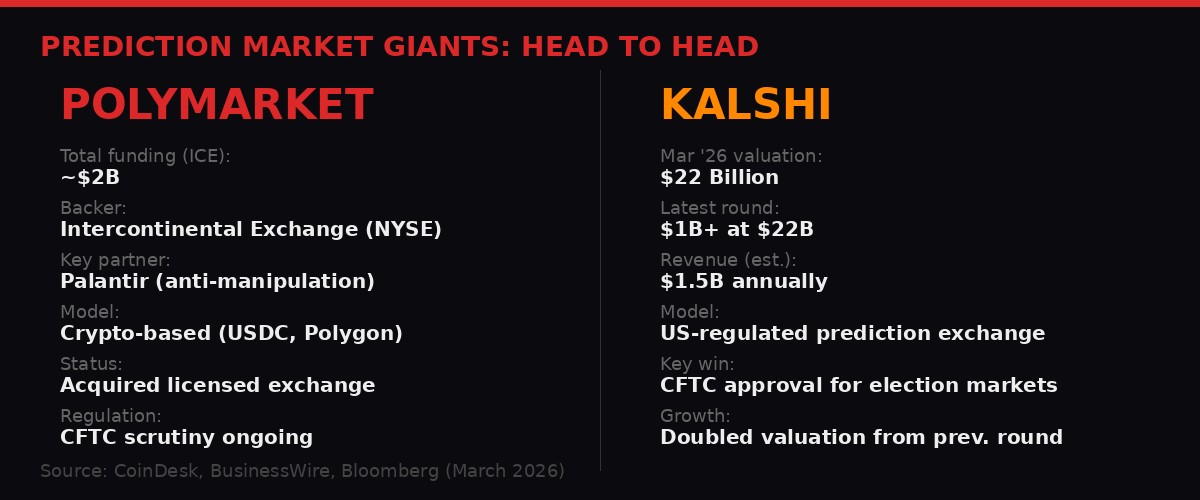
Prediction market heavyweights: Polymarket's institutional backing versus Kalshi's regulatory moat and revenue machine. (BLACKWIRE)
Kalshi's $22 billion valuation deserves scrutiny, not just celebration. The company's estimated $1.5 billion in annual revenue is real - but the multiple is aggressive by any standard measure. At 14.7x revenue, Kalshi is priced like a hyper-growth software company at peak market conditions, not like an exchange operator in a volatile macro environment.
For comparison: Nasdaq Inc. trades at roughly 10-12x revenue. CME Group, the world's largest derivatives exchange operator, trades at roughly 13-15x revenue. ICE itself trades at 9-11x revenue. Kalshi is being valued at a premium to every established exchange on Earth.
The bull case is straightforward. Kalshi is still early. Its $1.5 billion revenue figure is almost certainly understated relative to its total addressable market, which prediction market proponents argue includes everything that polling firms, political futures, sports wagering, economic forecasting services, and weather derivatives markets currently address - a combined market worth potentially hundreds of billions annually. If you believe prediction markets eventually eat the polling, political consulting, economic forecasting, and sports wagering industries, Kalshi at $22 billion looks cheap in ten years.
The bear case is equally direct. The regulatory environment could shift. One major scandal - a proven case of insider trading that results in Congressional hearings - could freeze growth for years. The CFTC under future administrations could reverse its approvals for election markets. And Kalshi's moat depends partly on regulatory complexity that Polymarket is actively working to reduce. If Polymarket fully regularizes its operations in the US, the $22 billion Kalshi premium shrinks considerably.
The investors who put $1 billion into Kalshi at $22 billion are making a bet that the regulatory runway is clear enough, and the growth trajectory steep enough, to justify the multiple. With Polymarket simultaneously getting $2 billion from the NYSE's parent company, they are probably right that the direction of travel is toward legitimization rather than crackdown.
The Market Backdrop: Blood on the Screens
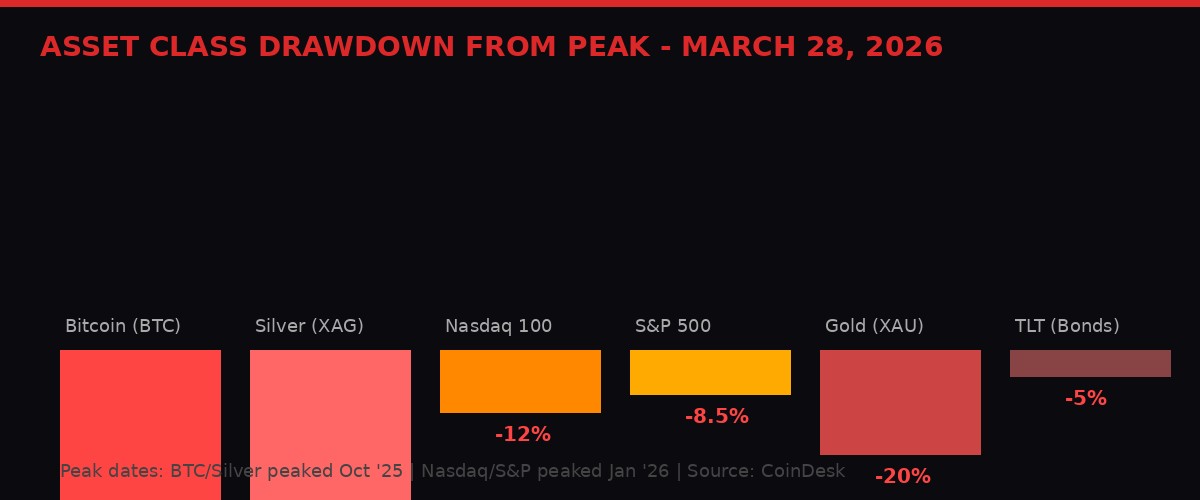
Where everything stands in March 2026: Bitcoin down 45% from its $126K peak, silver mirroring that fall, and the Nasdaq sliding into correction. (BLACKWIRE)
The timing of these deals is not incidental. They are happening in the context of one of the most brutal macro environments in years.
The week ending March 28, 2026 saw the Nasdaq 100 officially enter correction territory, down more than 10% from its January all-time high. The S&P 500 is down 8.5% from peak. Bitcoin, which touched $126,000 in early October 2025, is now at $67,025 - a 47% drawdown. Silver is down 45% from its highs. Gold has given back roughly 20%. The broad-based selloff has erased roughly $17 trillion in combined market cap from peak levels across the Magnificent Seven tech stocks, precious metals, and crypto.
The proximate cause is geopolitical. Iran conflict risk has introduced sustained uncertainty into oil markets, Treasury markets, and equity markets simultaneously. Richmond Fed President Tom Barkin warned this week that higher gas costs could dent consumer spending while describing hiring conditions as "fragile." Philadelphia Fed President Anna Paulson said the Iran situation created "new risks to both inflation and growth." The 10-year Treasury yield hit 4.5% intraday Friday before central bank comments pulled it back.
In this context, crypto stocks got annihilated. Coinbase (COIN) fell nearly 7%. Galaxy (GLXY) dropped nearly 7%. Gemini (GEMI) slid almost 9% - the steepest loss in the group. Robinhood (HOOD) fell nearly 6% despite announcing accelerated stock buybacks. Strategy (MSTR) and Twenty One Capital (XXI) both plunged about 6%. The ETH treasury plays - Bitmine Immersion (BMNR) and Sharplink Gaming (SBET) - were down roughly 5%. Miners extended their declines: Riot Platforms (RIOT), CleanSpark (CLSK), IREN, HIVE Digital, and Hut 8 all posted 5-8% losses.
Weekly pattern analysis from CoinDesk's Velo data shows a clear structure emerging since the Iran conflict began in late February: strong Monday gains averaging around 3% (driven by "relief rallies" that a Black Monday scenario hasn't materialized), followed by steady profit-taking through the week, with Friday seeing the most aggressive risk-off selling as traders reduce exposure ahead of weekend geopolitical uncertainty. Bitcoin's Friday performance has been negative in every single week since the conflict began.
Retail Capitulating, Whales Watching
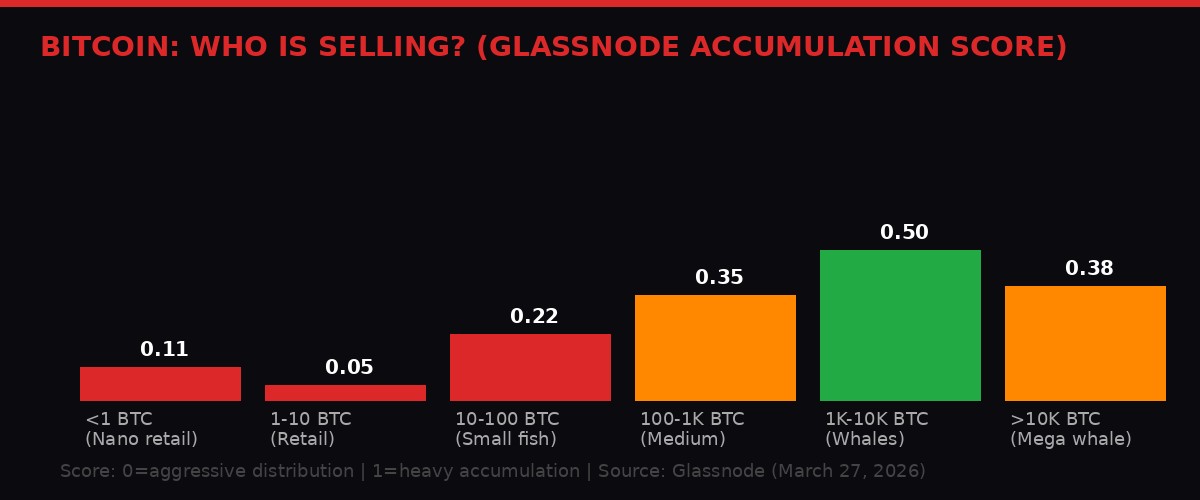
Glassnode's Accumulation Trend Score shows retail capitulation in real time: under-1-BTC wallets at 0.11, while whale cohorts sit at 0.5 - neutral, not selling, not buying. (BLACKWIRE)
Beneath the macro narrative, the on-chain data tells a specific story about who is driving Bitcoin's decline and who is waiting it out.
Glassnode's Accumulation Trend Score, broken down by wallet cohort, measures the relative accumulation or distribution behavior of on-chain participants over a rolling 30-day window. A score near 1 indicates heavy accumulation by large entities. A score near 0 indicates aggressive distribution - selling. The numbers published Friday tell a precise story.
Wallets holding under 1 BTC - the nano-retail cohort, millions of ordinary investors who bought Bitcoin as an inflation hedge or a speculative bet - have an accumulation score of 0.11. They are selling hard. Wallets holding 1 to 10 BTC are even worse: 0.05. That is nearly pure distribution. These are the people who get scared when prices fall 15% in a week. They are the same people who panic-sold in the COVID crash, the Luna collapse, the FTX wipeout. They are capitulating now.
Move up the wealth scale and the picture changes. Whales holding 1,000 to 10,000 BTC show a score of approximately 0.5 - neutral, watching. The largest cohort, entities with over 10,000 BTC, shows mild distribution but nothing like the liquidation patterns seen when Bitcoin was trading at $90,000 in late 2025. The smart money is not running. It is watching the retail hands shake out.
This is a classic distribution-then-accumulation setup. The macro pressure from Iran, the Nasdaq correction, the $17 trillion in paper losses across assets - all of this is providing cover for retail to exit at $67,000 while larger holders bide their time. The question is what price level forces the next reset. Bitcoin's $60,000 level, where it briefly touched in early February before bouncing, is the line that market participants are watching. A break below $60,000 would likely trigger institutional selling pressure that is currently absent from the on-chain data.
The Prediction Market Thesis in a War Economy
There is a deeper strategic logic to why ICE is doubling down on Polymarket in the middle of this market environment, and it has everything to do with what prediction markets are uniquely good at during geopolitical chaos.
Traditional financial markets price in geopolitical risk inefficiently. Equity markets are designed to price cash flows. Bond markets are designed to price credit and duration risk. Neither is structurally set up to answer questions like: "Will Iran accept a ceasefire before April 15?" or "Will the Fed cut rates this quarter even with oil above $90?" or "Will the Strait of Hormuz be fully reopened within 30 days?"
Prediction markets are exactly designed for those questions. They aggregate the collective judgment of people who have skin in the game about specific binary outcomes. When geopolitical risk is high and the answers to specific event-based questions have trillion-dollar implications for portfolios, the demand for accurate probability estimates becomes enormous. Hedge funds, sovereign wealth funds, commodity traders, airlines hedging fuel costs, insurance companies - all of them want real-time market prices on specific geopolitical outcomes. Prediction markets are the only instrument that can provide that.
ICE already operates the largest energy futures markets in the world through ICE Futures Europe, where Brent crude is the benchmark for roughly two-thirds of global oil trading. ICE already runs the markets that price the most geopolitically sensitive commodity on Earth. Adding Polymarket - a platform that could run real-time prediction markets on every geopolitical event affecting that commodity's price - is not diversification. It is vertical integration of the information ecosystem around the products ICE already operates.
The implied valuation for Polymarket embedded in ICE's $2 billion commitment has not been officially disclosed. But if Kalshi is at $22 billion on $1.5 billion in revenue, and Polymarket has significantly more volume than Kalshi in many market categories, the math suggests Polymarket could be valued north of $10-15 billion even conservatively. ICE's $2 billion at a $10 billion valuation would represent a 20% stake in the dominant global prediction market platform. That is not a portfolio bet. That is a controlling strategic position in the next generation of market infrastructure.
TIMELINE: THE PREDICTION MARKET LEGITIMIZATION ARC
What Comes Next: The Race to $100 Billion
The prediction market sector is now locked in a race that looks structurally similar to the early days of crypto derivatives, the first years of ETF proliferation, and the buildout of electronic trading venues in the early 2000s. Once institutional capital decides a new market structure is real, the growth curve is exponential until regulatory friction or a market crisis forces a reset.
The immediate competitive dynamics are clear. ICE-backed Polymarket has the volume, the global reach, the crypto-native infrastructure, and now the institutional imprimatur of the NYSE's parent company. Kalshi has the US regulatory approval, the $1.5 billion revenue machine, and a $22 billion valuation that suggests its investors believe it can grow into a multiples-larger company. The two platforms are currently pursuing different markets with different structures, but that divergence will not last forever.
The Palantir partnership is worth watching carefully. Palantir's involvement is not incidental - the company built its business on building data infrastructure for intelligence agencies and hedge funds. Its Tools for Defense Platform processes battlefield intelligence. Its Foundry platform processes trading signals at quantitative hedge funds. Adding prediction market surveillance to that portfolio is not a charity project. Palantir is building toward the position of being the compliance and intelligence layer for the next generation of financial markets. If prediction markets scale to where Polymarket and Kalshi's investors believe they will, Palantir's surveillance infrastructure becomes a critical piece of every prediction market operator's license to operate.
The wildcard is regulatory action. Congressional scrutiny of prediction markets has been growing throughout 2026, particularly around the use of political event markets. Several senators have called for CFTC review of whether existing approved markets violate restrictions on contracts based on gaming or awards/ceremonies outcomes. ICE's involvement makes a full CFTC crackdown significantly less likely - regulators rarely crush markets that the NYSE's parent company just committed $2 billion to build. But it does not make it impossible.
For Bitcoin and crypto markets broadly, the Polymarket funding news is directionally positive even against the backdrop of this week's selloff. The two stories exist in different timeframes. Bitcoin at $67,000 is a macro risk story driven by Iran, Treasury yields, and retail capitulation. The Polymarket $2 billion is a five-to-ten year infrastructure story about where financial markets are going. Both can be true simultaneously. The Nasdaq entering correction does not change the fact that ICE just told the world prediction markets are the next major asset class. And in a sector where the narrative eventually catches up with the capital flows, that matters more than where Bitcoin trades on a Friday in March.
THE BOTTOM LINE: ICE's $2B commitment to Polymarket + Kalshi's $22B valuation = prediction markets officially entering the financial infrastructure tier. Bitcoin's $67K level and Nasdaq's correction are the short-term noise. The $2 billion is the signal.
Get BLACKWIRE reports first.
Breaking news, investigations, and analysis - straight to your phone.
Join @blackwirenews on Telegram