
Two Oil Crises, One Gas Collapse: IEA Declares Iran War the Worst Energy Shock in Modern History
Day 28. 11 million barrels per day gone. 140 billion cubic metres of gas offline. Forty energy facilities across nine countries destroyed or severely damaged. The head of the International Energy Agency is no longer speaking in hedged diplomatic language. He is using words like "major, major threat."
The figures landed before most of the world had finished its morning coffee. Fatih Birol, executive director of the International Energy Agency, took the podium at Australia's National Press Club in Canberra and said what many economists had been whispering for weeks but few institutions had put on record in such stark terms.
"This crisis, as things stand, is now two oil crises and one gas crash put all together," Birol said Monday, his voice carrying the particular flatness of a man presenting numbers so bad he has decided to stop softening them. [AP, March 23, 2026]
The Iran war - now in its fourth week - has already surpassed every energy disruption in modern recorded history. Not collectively over time. Simultaneously, right now.

The Strait of Hormuz - through which one-fifth of global oil and LNG supplies normally transit - has been effectively closed since the third day of the war. / File photo
The Numbers That Should Terrify Every Government
The IEA framework is built on historical precedent. Two benchmarks define modern energy shock: the 1973 oil embargo triggered by the Arab-Israeli war, which cut roughly five million barrels per day from global markets, and the 1979 Iranian revolution, which knocked out another three to four million. Combined, the twin shocks removed roughly eight to ten million barrels per day at their peak.
The Iran war has removed eleven million barrels per day. More than both 1970s crises combined, in twenty-eight days. [IEA statement, AP, March 23, 2026]
On gas, the comparison is equally savage. Russia's invasion of Ukraine in 2022 triggered the worst European gas crisis since the 1970s - a shortfall of approximately 75 billion cubic metres that threw Germany into emergency rationing mode, drove European industry to curtail production, and sent household energy bills to previously unimaginable levels.
The Iran war has removed 140 billion cubic metres of gas from global supply. Almost twice the Ukraine gas shock. At the same time that the oil shock is running.
"No country will be immune to the effects of this crisis if it continues to go in this direction." - Fatih Birol, IEA Executive Director, National Press Club of Australia, March 23, 2026
Birol's language is unusually direct for a head of an intergovernmental body that has historically preferred phrases like "significant headwinds" and "elevated uncertainty." When the IEA director uses the phrase "major, major threat" - doubled for emphasis - financial markets listen. Asian stocks fell sharply Monday morning before Trump's deadline extension announcement gave Wall Street reason to exhale. [Al Jazeera, March 23, 2026]
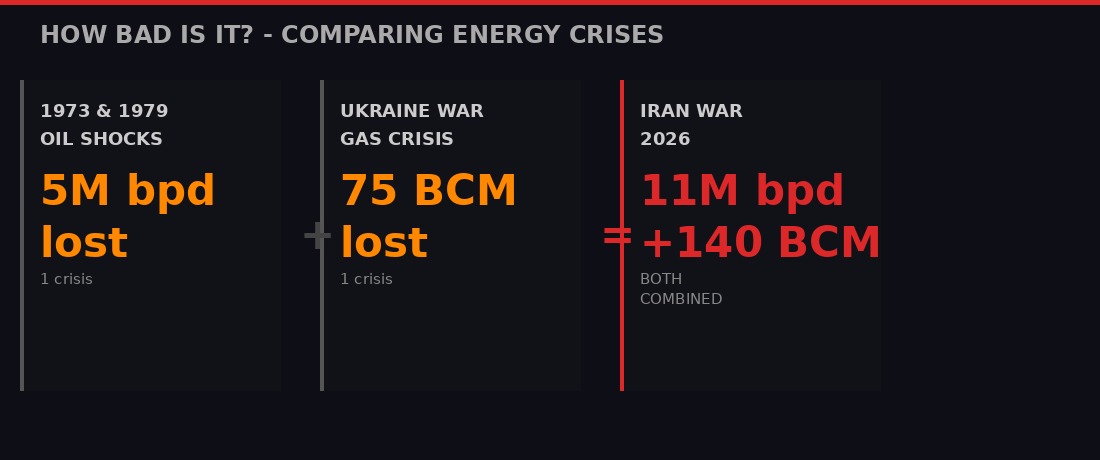
The Iran war's supply disruption exceeds the combined impact of the 1973 and 1979 oil shocks plus the 2022 Ukraine gas crisis. / BLACKWIRE infographic based on IEA data
Forty Facilities. Nine Countries. The Infrastructure War Nobody Voted For
The IEA chief went beyond oil and gas volumes to name something that rarely appears in the daily battle coverage - the physical destruction of energy infrastructure across the region.
Forty energy facilities across nine countries have been "severely or very severely damaged," Birol said. He did not enumerate them by country, but the war's footprint is visible. Saudi Arabia's Eastern Province has been targeted repeatedly. Qatar's Ras Laffan LNG complex - the world's largest - has been hit. The UAE has intercepted missiles targeting Abu Dhabi's industrial zones near Al Dhafra airbase. Bahrain, Kuwait, and Iraq have all had military installations struck, with ripple damage to nearby civilian energy infrastructure. [Al Jazeera, AP, March 2026]
Iran itself has taken by far the heaviest damage. US and Israeli strikes have targeted refineries, pipelines, gas processing facilities, and military production sites in rapid succession since February 28. The Iranian Red Crescent reported Monday that over 80,000 civilian building units have been damaged, including hospitals, schools, and Red Crescent facilities. [Al Jazeera, March 23, 2026]
Birol raised something that goes beyond barrels and cubic metres - the secondary supply chains that global industry quietly depends on but rarely considers until they stop.
"Some of the vital arteries of the global economy, such as petrochemicals, fertilizers, sulfur, helium - their trade is all interrupted," he said. Each one of those commodities branches into hundreds of downstream industries. Helium alone feeds semiconductor manufacturing, medical imaging, fiber optics, and aerospace. There is no substitute. There is no stockpile that lasts indefinitely. [AP, March 23, 2026]

Beyond crude oil, the war has disrupted global petrochemical, fertilizer, sulfur, and helium supply chains - secondary effects that compound over months. / Pexels
The 48-Hour Ultimatum That Became a Five-Day Extension
The IEA warning landed on the same morning that US President Donald Trump's 48-hour ultimatum to Iran was set to expire. The ultimatum - issued Saturday via Truth Social in capital letters - threatened to "obliterate" Iran's power plants if Tehran did not fully reopen the Strait of Hormuz.
Iran's response was immediate and unambiguous. The Islamic Revolutionary Guard Corps said it would strike power plants in all areas supplying electricity to US military bases, plus "economic, industrial and energy infrastructures in which Americans have shares." Parliament speaker Mohammad Bagher Qalibaf declared that desalination facilities across Gulf nations - the primary source of drinking water for millions - would be considered legitimate targets. Iran's Defence Council warned that any attack on its southern coast and islands would trigger the mining of all Gulf access routes, potentially closing the entire Gulf rather than just the strait. [AP, Al Jazeera, March 23, 2026]
Then, hours before the deadline expired, Trump posted again. The US had been having "very good and productive conversations" with Iran that would continue "throughout the week." The deadline was extended by five days. He claimed US envoy Steve Witkoff and his son-in-law Jared Kushner had met with an unnamed "respected" Iranian leader Sunday.
Iran's Foreign Ministry denied any such meeting had taken place. "Remarks by the US president are part of efforts to reduce energy prices and buy time to implement his military plans," the state-owned IRAN newspaper reported, citing Iran's foreign ministry. Iranian state television declared Trump had "backed down following Iran's firm warning." [AP, March 23, 2026]
Both claims cannot be true. Either talks happened and Iran is publicly denying them for domestic political reasons, or Trump invented productive diplomacy to buy himself a market-moving headline. Neither scenario inspires confidence in the durability of the reprieve.

Turkey and Egypt have emerged as the first coordinated mediators in the conflict, holding calls with both Iranian and US officials. / File image
Turkey and Egypt Step Into the Vacuum
While Washington and Tehran dispute whether they have spoken to each other, two regional heavyweights have stepped visibly into the gap.
Turkish Foreign Minister Hakan Fidan on Sunday held telephone calls with Iranian Foreign Minister Abbas Araghchi and counterparts from Qatar, Saudi Arabia, Pakistan, Egypt, and the European Union, according to Turkish officials. He also spoke with US officials as part of mediation efforts. It was the first coordinated multi-party diplomatic push since the war began. [AP, March 23, 2026]
Egyptian President Abdel-Fattah el-Sissi said Monday that Cairo had delivered "clear messages" to Iran focused on de-escalation. Egypt's Foreign Ministry described "constant efforts and communications with all parties in recent days." [AP, March 23, 2026]
This matters for one specific reason: Turkey and Egypt are not peripheral actors. Turkey has a functional relationship with Tehran going back decades, sits inside NATO without being aligned with the US war effort, and has maintained trade ties with Iran throughout the sanctions era. Egypt controls the Suez Canal, through which European energy imports from non-Gulf sources transit, and has enormous influence in Arab League positioning. If any two countries can serve as back-channel infrastructure for an eventual ceasefire arrangement, it is these two.
But their sudden activation also underlines how isolated the US has become in prosecuting this war. NATO allies have refused to contribute warships for the strait coalition. Gulf partners are being hit by IRGC missiles aimed at US bases and are now looking at threats to their own desalination plants. Saudi Arabia's Ministry of Defence on Monday said its forces intercepted a missile targeting Riyadh and destroyed drones over the kingdom's oil-rich Eastern Province. [Al Jazeera, March 23, 2026]
The countries that benefit most from US military action in this conflict are also taking the most collateral fire from Iran's retaliation doctrine. That is not a sustainable coalition geometry.

Turkey has emerged as the primary back-channel conduit between Tehran and Washington, a role it has played in previous Iran nuclear negotiations. / Pexels
The Markets Moved. The War Did Not.
Trump's announcement - whatever its diplomatic reality - hit markets with mechanical precision. Brent crude fell 9.7 percent to $101.26 within minutes of the post appearing on Truth Social, down from nearly $120 at its peak last week. The Dow Jones Industrial Average surged as much as 1,040 points. The S&P 500 jumped 1.8 percent. European markets, which had been down on the day, flipped to gains. [AP, March 23, 2026]
Asian markets, which closed before Trump's announcement, did not get the relief. South Korea's KOSPI fell 6.5 percent. Japan's Nikkei 225 dropped 3.5 percent. Hong Kong's Hang Seng fell more than four percent. [Al Jazeera, March 23, 2026]
The divergence between Asian and Western market outcomes on Monday is a snapshot of the asymmetric damage this war is inflicting by geography. Asia - which draws a vastly higher proportion of its oil from Gulf sources than either the US or Europe - has already been absorbing the shock for nearly a month. South Korea, Japan, and Taiwan are among the world's most oil-import-dependent economies. Brent at $112 means something fundamentally different to a manufacturing economy with no domestic oil production than it does to the United States, which is the world's largest petroleum producer.
Trump has been explicit about the domestic political pressure driving his urgency on the strait. Gas prices are climbing at US pumps ahead of November midterm elections. His Treasury Department on Friday made what analysts described as a strategically unusual move - temporarily lifting sanctions on some Iranian oil to try to push more barrels into global markets. The administration had simultaneously lifted some sanctions on Russian oil for the same reason. [AP, March 23, 2026]
The IEA had already tried to cushion the blow. Earlier this month it announced the coordinated release of 400 million barrels from emergency stockpiles - a volume Birol described Monday as "historic. We have never released so much oil to the markets." It barely moved prices. The structural deficit is too large for emergency stockpile releases to fill. [AP, IEA, March 2026]
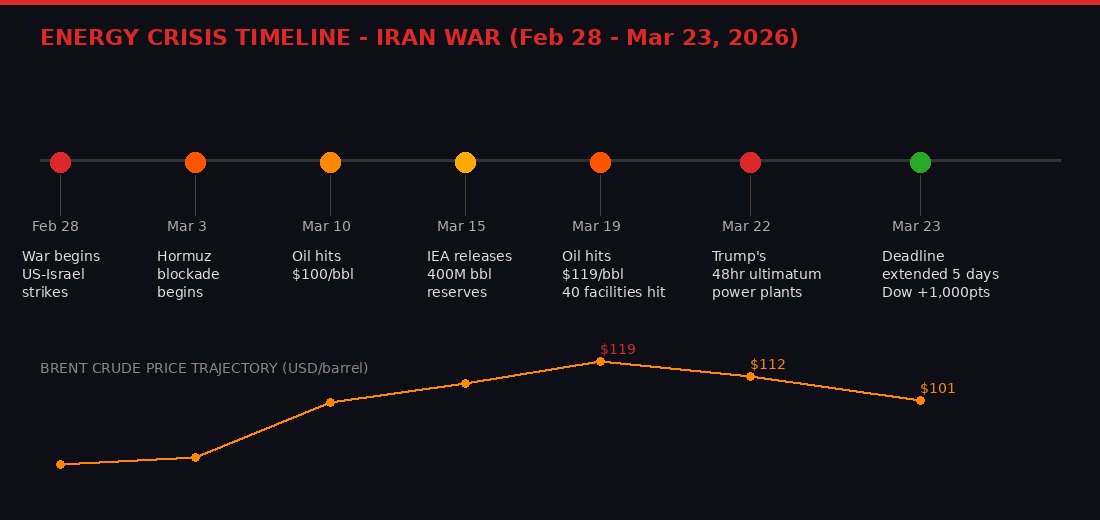
Oil prices surged more than 50 percent from the start of the war before Trump's deadline extension triggered a partial pullback Monday. / BLACKWIRE infographic
The War That Keeps Expanding
While diplomats talk, the military situation on the ground shows no signs of contracting.
Israeli forces launched what Al Jazeera's correspondent in Tehran described as an "unprecedented" wave of strikes against the Iranian capital on Monday - the second round of attacks in a single day. Explosions were reported in Tehran, Tabriz, Isfahan, Karaj, Ahvaz, and Bandar Abbas. One child was killed in a strike on a residential building in Khorramabad. Six people were killed in strikes on homes in Tabriz. A radio station was targeted in Bandar Abbas. A hospital was impacted in Ahvaz. [Al Jazeera, March 23, 2026]
CENTCOM Admiral Brad Cooper accused Iran of launching missiles and drones from populated areas, a claim he provided no evidence for - and one that legal scholars note functions as preparation for justifying strikes on residential zones under military necessity doctrine. [Al Jazeera, March 23, 2026]
Israel's northern front with Hezbollah is simultaneously intensifying. At least one person was killed in an Israeli strike on Hazmieh, near Beirut, Monday. Israeli military spokesman Lieutenant Colonel Nadav Shoshani last week said Israel had detailed plans for at least three more weeks of war. Israeli officials have been explicit that they want the US to maintain its campaign and are concerned Trump may wind down operations prematurely. [Al Jazeera, AP, March 23, 2026]
In the occupied West Bank, Israeli settlers rampaged through towns and villages for a second consecutive night, burning homes and cars across at least six communities. Nine Palestinians were injured. The attacks coincided with Eid al-Fitr. A 45-year-old man was shot in the foot in Deir al-Hatab, east of Nablus. The settler violence is occurring under the cover of Iranian war news that is consuming virtually all diplomatic bandwidth. [Al Jazeera, March 23, 2026]
Iran's death toll in the war has now surpassed 1,500, according to its Ministry of Health. Fifteen people have been killed in Israel by Iranian attacks. The civilian casualty ratio will not improve as strikes extend into residential areas across multiple Iranian cities simultaneously. [Al Jazeera, March 23, 2026]

Iranian Red Crescent Society reported Monday that more than 80,000 civilian building units have been damaged across Iran since the war began February 28. / Pexels
The Timeline: How 28 Days Changed the Global Energy Order
ENERGY CRISIS CHRONOLOGY - IRAN WAR 2026
What Happens Next: The Cliff at the End of Five Days
Trump's five-day extension creates a new deadline: approximately March 28, assuming the clock restarts from Monday. That date will arrive before any serious negotiation framework could realistically be established. Back-channel talks, if they are real, typically require weeks of groundwork before they produce deliverable terms. The JCPOA - the last major nuclear agreement with Iran - took two years of intensive negotiation.
The uranium demand Trump floated Monday makes any near-term deal structurally improbable. Iran has consistently refused to surrender enriched uranium to foreign control, viewing it as the core of its strategic deterrence. Mojtaba Khamenei, Iran's new supreme leader following his father's death in February, has shown no indication of being softer on nuclear red lines than his predecessor. Quite the opposite. [AP, March 23, 2026]
The IEA's Birol identified the single variable that matters above all others: "The single most important solution to this problem is opening up the Hormuz Strait as things stand now." Not sanctions relief. Not stockpile releases. Not demand-reduction measures. The strait. [AP, IEA, March 2026]
Iran will not open the strait while the US and Israel are bombing Iranian cities. The US and Israel say they will not stop bombing Iranian cities until Iran opens the strait. The IEA chief is standing in Australia telling anyone who will listen that the global economy cannot absorb much more of this.
Somewhere in that geometry - between Trump's Truth Social posts, Iran's denials, Turkey's phone calls, and Monday's market relief rally - is a war that has already broken every record for energy disruption and shows no structural sign of ending.
The next five days will tell whether Trump's announcement was diplomacy or theater. If it was theater, the world will find out at deadline. If it was diplomacy, the world still needs someone to explain what Iran gave in exchange for a reprieve it says it didn't ask for.
Status as of 16:15 CET, March 23, 2026: US-Israel war on Iran is in Day 28. Trump has extended the power plant strike deadline by five days. Israel continues strikes on Tehran and multiple Iranian cities. IRGC has struck Saudi Arabia, Kuwait, Bahrain, and UAE. Lebanese front is active. West Bank settler violence is escalating under cover of war news. Oil at $101/bbl after earlier hitting $112. Asian markets closed before Trump announcement; KOSPI -6.5%, Nikkei -3.5%. Dow +1,000 points on relief rally. No ceasefire negotiations publicly confirmed by both parties.
Get BLACKWIRE reports first.
Breaking news, investigations, and analysis - straight to your phone.
Join @blackwirenews on Telegram