No Hearing, No Bond: Federal Court Clears Way for Indefinite Immigrant Detention
The 8th Circuit has handed Trump's immigration crackdown its most sweeping legal victory yet - ruling that immigrants can be locked up with no bond hearing, no neutral judge, and no timeline. More than 30,000 habeas petitions now hang in the balance.

A federal appeals court on Wednesday ruled that the United States government can detain immigrants without offering them a bond hearing before a neutral judge - a decision that constitutional lawyers are calling one of the most consequential immigration rulings in decades and that the Trump administration immediately celebrated as a landmark victory.
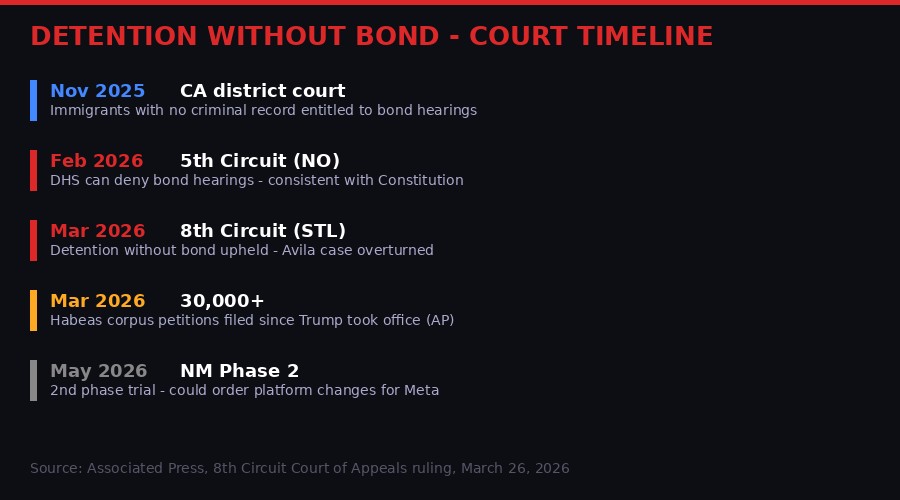
The opinion from a three-judge panel of the 8th Circuit Court of Appeals in St. Louis overturned a lower court ruling that had required a Mexican national, arrested in Minneapolis for lacking legal documentation, be given the opportunity to argue for release before an immigration judge. The 2-1 ruling marks the second federal appeals court to side with the administration on this question.
The practical consequences are immediate and vast. More than 30,000 habeas corpus petitions - the ancient constitutional mechanism by which any prisoner can demand a court explain the legal basis for their detention - have been filed in federal courts by immigrants claiming illegal detention since Trump took office, according to an Associated Press tally. Many have succeeded. Wednesday's ruling places that entire body of litigation on shakier ground.
"MASSIVE COURT VICTORY against activist judges and for President Trump's law and order agenda!" - Attorney General Pam Bondi, social media, March 26, 2026

The Case That Changed the Rules
The decision traces back to one man: Joaquin Herrera Avila, a Mexican national who had lived in the United States for roughly 29 years before federal immigration agents arrested him in Minneapolis in August 2025. He had no criminal convictions. He had simply never obtained legal documentation for his presence in the country.
The Department of Homeland Security detained Avila without bond and initiated deportation proceedings. When Avila's attorneys filed a petition for release - or at minimum, a hearing to determine whether his detention was legally justified - a federal judge in Minnesota sided with him. The lower court reasoned that Avila, having lived in the country for nearly three decades without ever "seeking admission" in any formal legal sense, fell outside the scope of the mandatory detention statute.
The 8th Circuit disagreed, flatly. Writing for the two-judge majority, Circuit Court Judge Bobby E. Shepherd held that the law was "clear that an 'applicant for admission' is also an alien who is 'seeking admission.'" In the court's reading, that language sweeps broadly enough to cover Avila and millions of others like him - people who entered without documentation and never formalized their status.
In dissent, Circuit Court Judge Ralph R. Erickson called the majority's interpretation "novel" - and warned that it departs sharply from 29 years of legal practice and five previous presidential administrations. Under that settled understanding, Avila would have been entitled to a bond hearing during deportation proceedings. Now, under this ruling, neither he nor the many millions of people in analogous situations have that right.
What habeas corpus means in this context: The Latin phrase translates literally to "you have the body." It is one of the oldest protections in common law - predating the U.S. Constitution - and allows any detained person to ask a court whether the government has the legal authority to hold them. Stripping that right from any class of people is historically rare and legally contested. The question now pending before multiple appellate courts is whether immigrants in mandatory detention qualify for habeas protections at all.

The Circuit Split and Why It Matters
Courts across the country have been dividing sharply on this question since Trump retook office in January 2025. The 8th Circuit ruling is the second appellate-level victory for the administration, following a February ruling from the 5th Circuit in New Orleans. Both courts held that DHS's decision to deny bond hearings to immigrants arrested across the interior of the country was consistent with the Constitution and federal immigration law.
But the picture at the district court level - one step below the appellate courts - is far more complicated. In November, a district court in California granted detained immigrants with no criminal history the opportunity to request bond hearings, with implications for noncitizens held in detention nationwide. Courts in Minnesota, New York, and Washington state have issued similar rulings in individual cases. Many of those decisions have now been appealed by the government.
Legal scholars describe the current state of play as a sprawling, multi-front constitutional battle that no single ruling can resolve. The simultaneous existence of conflicting decisions across different federal circuits creates exactly the kind of split that typically forces the Supreme Court to intervene - and several immigration advocacy groups have already signaled they intend to petition for Supreme Court review.
The American Civil Liberties Union, which represents Avila, did not immediately comment Wednesday on the 8th Circuit ruling. But the organization has filed emergency appeals in multiple cases over the past several months, arguing that mandatory detention without any individualized assessment of flight risk or danger to the community constitutes punishment before any determination of guilt - a practice that, its attorneys argue, the Constitution plainly forbids.

A System That No Longer Recognizes a Right to Be Heard
Under practice established over more than two decades and upheld across multiple administrations - Republican and Democratic alike - most noncitizens arrested in the interior of the United States with no criminal record were entitled to request a bond hearing before an immigration judge. The government would then have to demonstrate, to a neutral arbiter, why that person posed a flight risk or a danger to the community sufficient to justify continued detention.
That standard was not a guarantee of release. Plenty of immigrants were denied bond and remained in detention pending their cases. But the hearing itself was a check - a moment at which a disinterested judge rather than the detaining agency made the call.
What the 8th Circuit endorsed Wednesday is the elimination of that check for an enormous class of people. Under the mandatory detention statute the court interpreted, DHS simply detains. There is no individual review. There is no hearing timeline. The person remains locked up for as long as the government's immigration case proceeds - which, given the backlog in immigration courts, can mean years.
Immigration courts currently face a backlog of more than three million pending cases, according to data compiled by the Transactional Records Access Clearinghouse at Syracuse University. Average wait times before a hearing can stretch to several years in large jurisdictions. That means mandatory detention without bond hearing is, in practice, potentially indefinite incarceration - for people who have not been convicted of any crime and many of whom have lived in the United States for a decade or more.
"There could have been a bond hearing during his deportation hearings if he had been arrested during the past 29 years. Now, the Circuit Court has ruled that Avila and millions of others would be subject to mandatory detention under a novel interpretation of 'alien seeking admission' that hasn't been used by the courts or five previous presidential administrations." - Circuit Court Judge Ralph R. Erickson, dissent, 8th Circuit ruling, March 26, 2026

The Political Architecture Behind the Ruling
The 8th Circuit ruling did not happen in a vacuum. It reflects a strategic legal infrastructure that the Trump administration began building in its first term and accelerated dramatically after January 2025.
At the Justice Department, Attorney General Pam Bondi has directed department resources toward aggressive litigation of immigration cases at every level of the federal court system. The administration has consistently sought stays of lower court orders limiting its detention practices, and it has won many of those stays. At the appellate level, Trump's judicial appointments from both his first and second terms have reshaped the composition of several circuits, including the 5th and 8th - the two circuits that have now ruled in the administration's favor on bond hearings.
The legal theory underpinning both rulings also reflects careful drafting by DOJ lawyers. Rather than argue that all immigrants can be detained indefinitely - a position that would immediately confront the Due Process clause head-on - the government has focused on the specific statutory language governing "aliens seeking admission." By winning an expansive reading of that phrase, the administration has effectively extended mandatory detention to cover populations that were previously considered interior residents with corresponding rights to individualized bond review.
Congressional Democrats have introduced legislation that would restore mandatory bond hearings, but those bills have no path to passage in the current House. Republican leadership has declined to advance any immigration-related legislation that limits the administration's detention authority. The practical result is that the courts are, for now, the only arena in which these questions are being contested.

Day 41: Shutdown, Airports, and the Compounding Crisis
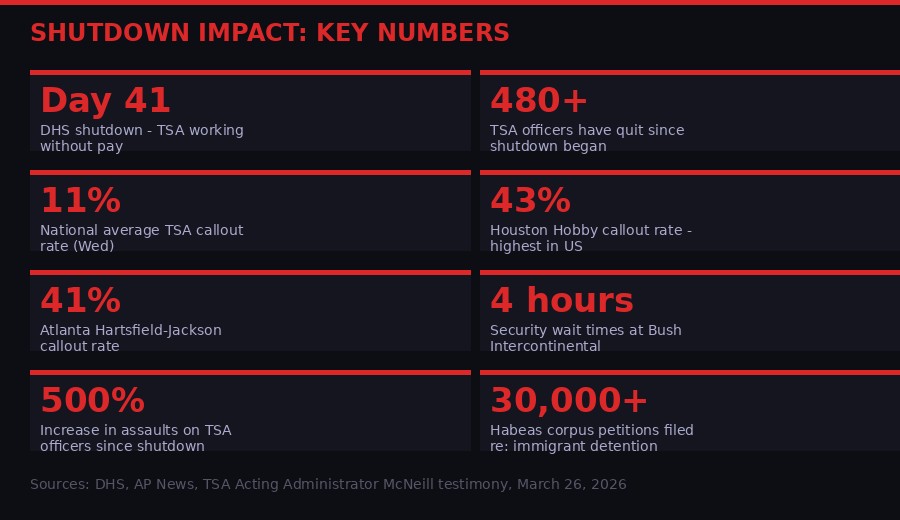
The detention ruling lands on the same day as a separate but intertwined domestic crisis: the partial government shutdown of the Department of Homeland Security, now in its 41st day.
TSA officers - the agents who screen passengers at the nation's airports - have been working without pay since the shutdown began. The results are visible and worsening. At George Bush Intercontinental Airport in Houston, wait times to clear security surged back to four hours on Thursday after briefly dipping. Atlanta's Hartsfield-Jackson International is reporting lines that extend beyond the terminal doors and down the sidewalk outside the building. Travelers have been told to arrive four hours early.
The acting TSA administrator testified to lawmakers Thursday that more than 480 transportation security officers have quit their jobs during the shutdown. The nationwide callout rate - the percentage of scheduled TSA workers who simply do not show up, because they cannot afford gas, childcare, or other basic costs without a paycheck - sits above 11% nationally and above 40% at several major airports.
"Some are sleeping in their cars, selling their blood and plasma, and taking on second jobs to make ends meet, all while being expected to perform at the highest level when in uniform to protect the traveling public." - TSA Acting Administrator, testimony to Congress, March 26, 2026
Trump, in a Cabinet meeting Thursday, suggested he was considering deploying the National Guard to airports. Legal experts immediately noted that using active-duty or National Guard troops for civilian law enforcement functions raises significant questions under the Posse Comitatus Act, which restricts the use of military forces for domestic policing. A social media post from the president Wednesday said he "may call up the National Guard for more help" - leaving the question of legality unaddressed.
Meanwhile, Senate Majority Leader John Thune told reporters Thursday that Democrats had been given a "last and final" offer on DHS funding. Democrats have been demanding procedural protections on immigration and customs operations; Republicans have refused to include them. With lawmakers set to leave for recess next week, the clock is running on a deal that both sides acknowledge would require significant concessions neither has yet offered.
30,000 Cases, One Question
The number that keeps appearing in legal filings and immigration advocacy reports is 30,000. That is the approximate count of habeas corpus petitions filed in federal courts by immigrants challenging their detention since Trump took office, according to the Associated Press. It is also the figure that illustrates just how large the legal battleground has become.
Habeas corpus - often called the "great writ" - is one of the foundational instruments of any legal system that aspires to prevent arbitrary imprisonment. Enshrined in Article I of the Constitution, it empowers courts to demand that the government justify any detention. Historically, the courts have been reluctant to strip habeas rights from any class of people entirely, because doing so essentially removes a check on executive power with no substitute mechanism.
The question now moving through multiple circuits is whether immigrants subject to mandatory detention can invoke habeas at all - or whether the administration's position, that the statutory detention scheme is constitutionally valid and judicially unreviewable, represents a correct reading of the law.
Many of the 30,000 petitions have succeeded at the district court level. Judges in California, Minnesota, New York, Washington, and Illinois have, in various cases, found that the government's detention of people with no criminal history and long ties to the United States is not legally justified. But appellate courts in the 5th and 8th Circuits have now reached the opposite conclusion. Until the Supreme Court steps in, different Americans in different parts of the country will face radically different legal realities depending on where the arresting ICE agent happens to have been operating.
The ACLU and a coalition of immigration advocacy organizations have been preparing petitions for certiorari - formal requests for Supreme Court review - in multiple related cases. Whether the Court agrees to hear any of them before the 2026-27 term remains uncertain. In the meantime, the government continues to detain people, the backlog in immigration courts continues to grow, and the 30,000 petitions continue to work their way through a system that is already vastly overwhelmed.

What Comes Next
The legal battle over immigrant detention without bond is heading toward a resolution that can only come from the Supreme Court - but the timeline for getting there is unclear, and in the meantime the administration is continuing to operate under what it has construed as its authority to detain indefinitely.
For Joaquin Herrera Avila, the man whose case produced Wednesday's ruling, the immediate future is continued detention. His attorneys at the ACLU will almost certainly appeal to the full 8th Circuit en banc - asking for a hearing before all of the circuit's judges rather than just the three-judge panel. That process takes months. If the en banc court upholds the panel ruling, the Supreme Court becomes the next stop.
For the broader population of undocumented people living in the United States - estimated at somewhere between 10 and 12 million people, according to various analyses from the Pew Research Center and the Department of Homeland Security's own internal estimates - the ruling represents a significant shift in risk calculus. The prospect of being arrested, detained without any hearing or timeline, and held in a facility for an indefinite period while awaiting immigration proceedings has become more real and more legally validated than it was a week ago.
The administration's position is not subtle about the intent behind this approach. DHS and DOJ officials have consistently argued that expanding detention and removing procedural protections acts as a deterrent - that the prospect of indefinite detention without bond discourages people from remaining in the country without documentation. Critics counter that deterrence arguments have never been accepted as a justification for stripping constitutional protections, and that the human cost of implementing this policy falls disproportionately on people with deep community ties, jobs, families, and no criminal history.
In Minneapolis, where Avila was arrested, advocates who work with the local immigrant community described the ruling as a source of profound fear. People who have lived in the city for decades - whose children were born in the United States, who own businesses and pay taxes and coach youth soccer teams - are recalculating their daily movements and asking lawyers whether going to the airport, the hospital, or even the grocery store represents an acceptable risk.
That is not a legal question. It is the lived consequence of a ruling issued on paper in a courthouse in St. Louis that landed, quietly and devastatingly, in neighborhoods across the country before Thursday morning was done.
Get BLACKWIRE reports first.
Breaking news, investigations, and analysis - straight to your phone.
Join @blackwirenews on Telegram