IOC Bans Trans Women From Olympic Female Events: The SRY Gene Test That Will Define LA 2028
The International Olympic Committee announced Thursday that all women competing at the 2028 Summer Games in Los Angeles must pass mandatory SRY genetic screening. The scientist who discovered the gene says using it this way is wrong. Intersex advocates say it harms millions. The White House is claiming credit. And the question of who women's sport is for just got louder.

The IOC announced the policy from Lausanne, Switzerland on Thursday. The ban takes effect at the 2028 Summer Games in Los Angeles. (BLACKWIRE graphic)
The most consequential ruling in Olympic history dropped Thursday with no warning shot. IOC President Kirsty Coventry, speaking via live-stream from Lausanne, Switzerland, announced that the women's category at future Olympic Games would be restricted to athletes who test negative for the SRY gene - a genetic marker associated with male sex development. The policy applies starting at the 2028 Summer Olympics in Los Angeles and covers all sports within the Olympic program.
The announcement ended years of drift and committee-speak. After the Paris 2024 boxing controversy that erupted around Algerian gold medalist Imane Khelif and Taiwanese competitor Lin Yu-ting - both cisgender women who were swept into a firestorm over gender eligibility tests they had not failed - the IOC convened a formal scientific review. That review is now policy.
Coventry's statement was direct: "At the Olympic Games, even the smallest margins can be the difference between victory and defeat. So, it is absolutely clear that it would not be fair for biological males to compete in the female category." (Source: NPR, March 26, 2026)
What followed that statement was less clear. Scientists who study sex genetics immediately pushed back on the test being used. Intersex advocates warned of cascading consequences for athletes who have nothing to do with the transgender debate. European nations that legally prohibit genetic testing for non-medical purposes are now being asked how their female athletes will comply. The Trump White House claimed the executive order it signed in 2025 made this happen. And Coventry flatly rejected that claim.
The IOC says the rule is about fairness. Critics say it is about politics dressed in lab coats. The 2028 Games in Los Angeles - in a country currently litigating trans rights at every institutional level - will be the arena where these arguments collide.
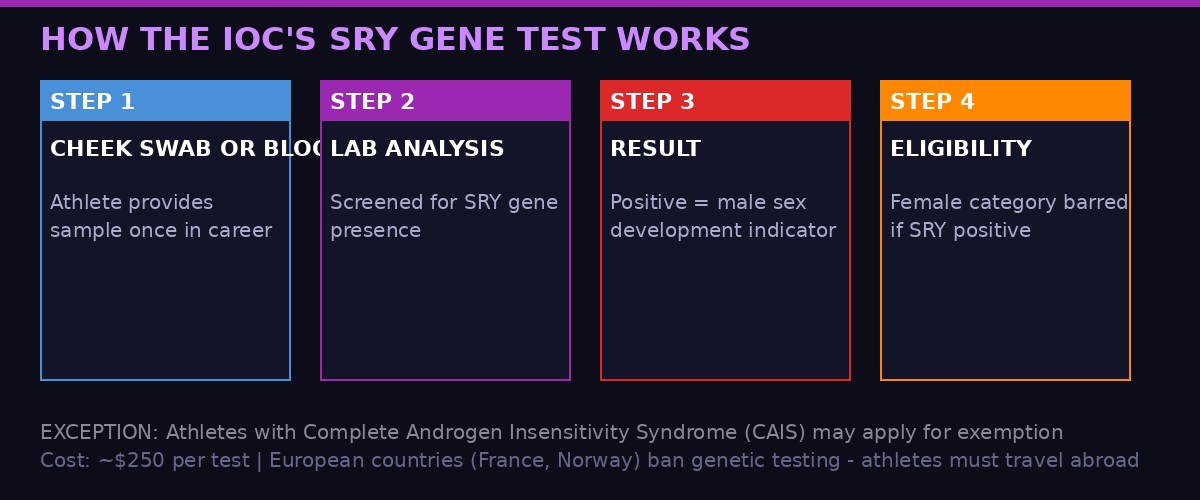
The four-step process: swab, lab analysis, result, eligibility ruling. The once-in-a-lifetime test costs roughly $250 per athlete - and it's not yet clear who pays. (BLACKWIRE infographic)
What the IOC Actually Announced
The rule is built around one biological marker: the SRY gene, short for Sex-determining Region Y. The SRY gene sits on the Y chromosome and triggers a cascade of events during fetal development that typically results in male physiological characteristics - testis formation, testosterone production, and the anatomical traits associated with male bodies.
Under the new IOC policy, eligibility for the women's category will be determined by a single genetic screening test. The test involves either a cheek swab or blood draw, analyzed in a laboratory for the presence or absence of the SRY gene. Athletes who test negative - no SRY gene detected - are cleared to compete in women's events. Athletes who test positive face a presumptive ban from the female category. The IOC says this will be a "once-in-a-lifetime test" barring reason to doubt the result. (Source: NPR, March 26, 2026)
There are narrow carve-outs. Athletes with a confirmed diagnosis of Complete Androgen Insensitivity Syndrome (CAIS) - a rare genetic condition where a person who is genetically male cannot respond to male-typical testosterone - may apply for an exception. But the IOC has not yet explained how that appeal process will work, what documentation it will require, whether it will involve physical examination, or who will adjudicate it. Those details are promised "in the months ahead."
KEY FACTS: The SRY Gene Policy
Effective date: 2028 Summer Olympics, Los Angeles
Test method: Cheek swab or blood draw - screened for SRY gene presence
Result: SRY positive = barred from women's category (with narrow CAIS exception)
Frequency: Once per career, unless result is disputed
Cost: Approximately $250 per test - funding mechanism unresolved
Scope: All Olympic events; not applicable to "grassroots or recreational" sports
Appeal route: Details not yet announced
The policy does not, on its face, mention transgender athletes. It does not use the word "transgender" anywhere. The IOC frames it as a sex eligibility standard rather than a transgender exclusion. But the practical effect is identical: any individual assigned male at birth who has transitioned to female - or who presents as female but carries the SRY gene - is ineligible to compete in women's events.
The IOC says the policy "does not apply to grassroots or recreational" sports programs. But experts told NPR they are skeptical that the cultural impact will stay contained to elite competition. When the governing body of the entire Olympic movement draws a line at the genetic level, every institution downstream takes note.
The Science the IOC Is Relying On - And Why Its Discoverer Disagrees
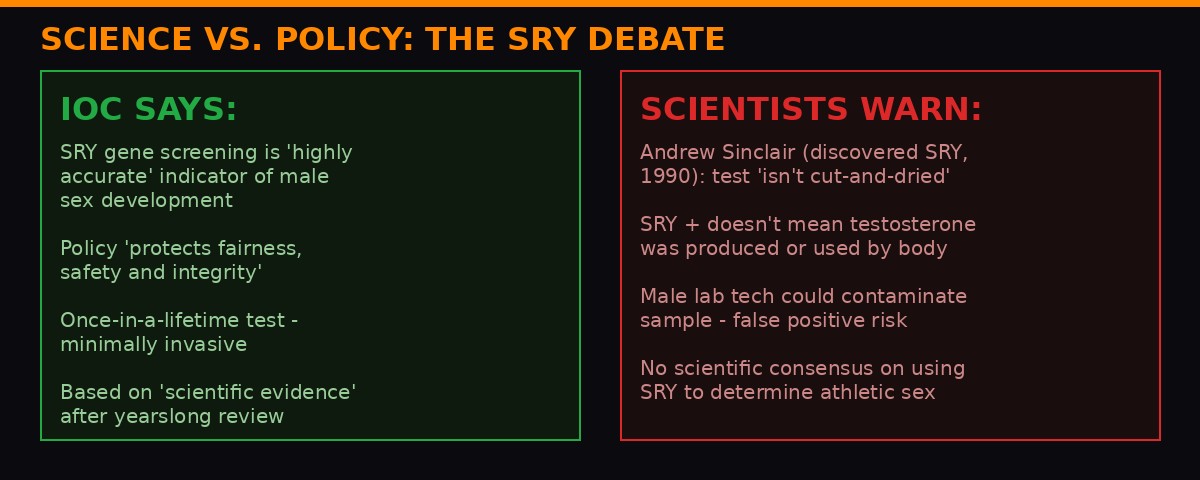
The IOC claims scientific basis. The scientist who discovered the SRY gene says it cannot be used this way. (BLACKWIRE infographic)
The person most qualified to judge whether the SRY gene test should determine Olympic eligibility is Andrew Sinclair. He is the scientist who discovered the SRY gene in 1990. His verdict: the IOC's use of the test is not scientifically supported.
Sinclair wrote in The Conversation in 2025 - after World Athletics adopted the same test - that the SRY gene "isn't cut-and-dried." His argument is precise and technically devastating: "All it tells you is whether or not the gene is present. It does not tell you how SRY is functioning, whether a testis has formed, whether testosterone is produced and, if so, whether it can be used by the body." (Source: The Conversation, 2025, via NPR)
This is not a fringe scientific view. The IOC's own framing - that SRY presence is "highly accurate evidence that an athlete has experienced male sex development" - overstates what the scientific community has agreed to. Genetics, endocrinology, and developmental biology all operate in gradients that the binary of "SRY present / absent" does not capture.
Jaime Schultz, a sports historian and professor of kinesiology at Pennsylvania State University, laid out the failure modes. A male laboratory technician handling a sample could contaminate it, producing a false positive result. Beyond contamination risk, an athlete could carry the SRY gene but have a body that cannot respond to the testosterone it may trigger - meaning no performance advantage whatsoever exists, but the athlete fails the test anyway and is excluded from competition.
"There's been moments where women have tested positive for this SRY gene, but their body can't respond to male-typical levels of testosterone, so there's really no athletic benefit associated with that gene. There's all sorts of genetic, chromosomal, environmental ... things that go into contemplating this." - Jaime Schultz, Professor of Kinesiology, Penn State University (NPR, March 26, 2026)
The gap between "SRY gene present" and "unfair athletic advantage exists" is wide enough to swallow entire sporting careers. The IOC has chosen a proxy measurement - one genetic marker - and built a hard eligibility wall around it, without the granular science that would be needed to justify that wall at the individual athlete level.
None of this means the IOC's concern is baseless. The underlying question - whether individuals who have undergone male puberty retain physiological advantages over individuals who have not, even after hormone therapy - is a real scientific question with real data. Studies from the British Journal of Sports Medicine and other peer-reviewed outlets have found that some strength and cardiovascular markers from male puberty persist after transition, at least in the short to medium term. But the SRY test does not measure any of that. It measures one gene's presence, which may or may not correlate with any of the variables that actually matter to athletic competition.
The Women Who Could Lose More Than Trans Athletes
The debate about transgender athletes in women's sport is real and contested. But the IOC's chosen testing mechanism hits a group that has nothing to do with gender transition: intersex women.
Intersex is an umbrella term covering roughly 1.7 percent of the population worldwide - individuals whose chromosomes, gonads, hormones, or reproductive anatomy do not fit standard definitions of male or female. Many intersex women have no idea they carry any variant that would affect Olympic eligibility. Some carry the SRY gene. Under the new policy, they would fail the test.
Erika Lorshbough, executive director of interACT - a nonprofit that advocates for intersex youth - told NPR the CAIS exception is welcome but inadequate. InterACT works with young athletes who have many intersex variations, not just CAIS. The exception does not clearly cover all of them. The appeal process has not been designed. And the test itself raises privacy concerns that are not hypothetical: genetic data is among the most sensitive personal information a person can produce. (Source: NPR, March 26, 2026)
"A process like that is going to run up into all the same thorny things that all of the other sex determination processes have come up against, such as, is this going to involve an examination of a girl's body? ... Will it require further biomedical testing? It's not clear what it is exactly they're up against in trying to just participate in their sport." - Erika Lorshbough, Executive Director, interACT (NPR, March 26, 2026)
The privacy dimension compounds in Europe. France and Norway have laws prohibiting genetic testing for non-medical or non-research purposes. Female athletes from those countries cannot legally take the SRY test on home soil. They would need to travel abroad to comply - adding cost, logistical burden, and a legal gray zone for their national federations that has not been resolved.
Schultz raised a concern that extends even further: the chilling effect on women who are not intersex, not transgender, but who simply worry. "If a woman suspects that she might not pass this screening, she might be deterred from pursuing sport altogether," she told NPR. "It doesn't just affect the people that are being tested, but it affects all women athletes." That deterrence - unquantifiable, but plausible - runs directly against the IOC's stated goal of promoting women's sport.
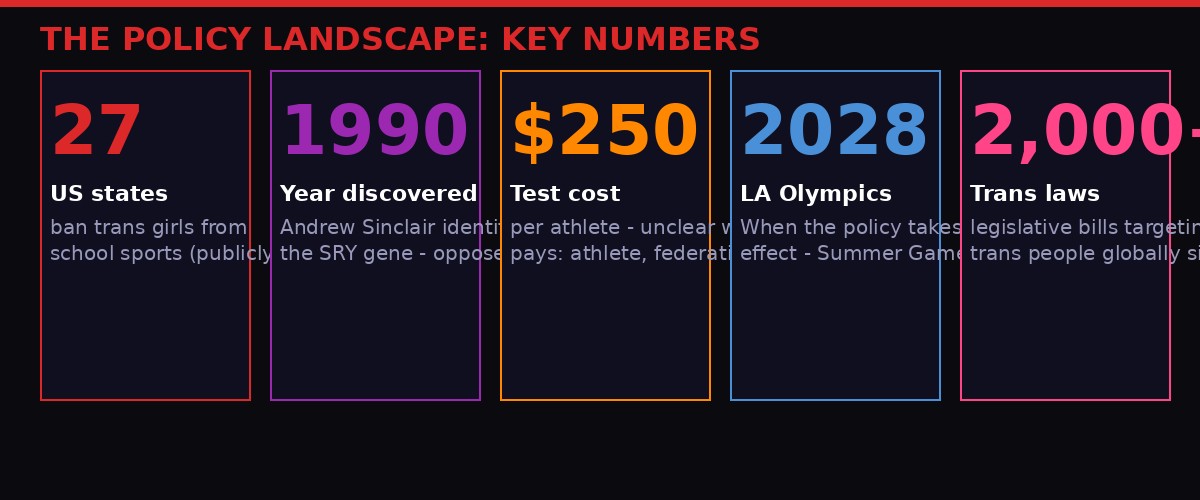
The numbers surrounding the IOC's new policy: from US state legislation to the cost of each test. (BLACKWIRE infographic)
The Road Here: Paris 2024 Lit the Fuse
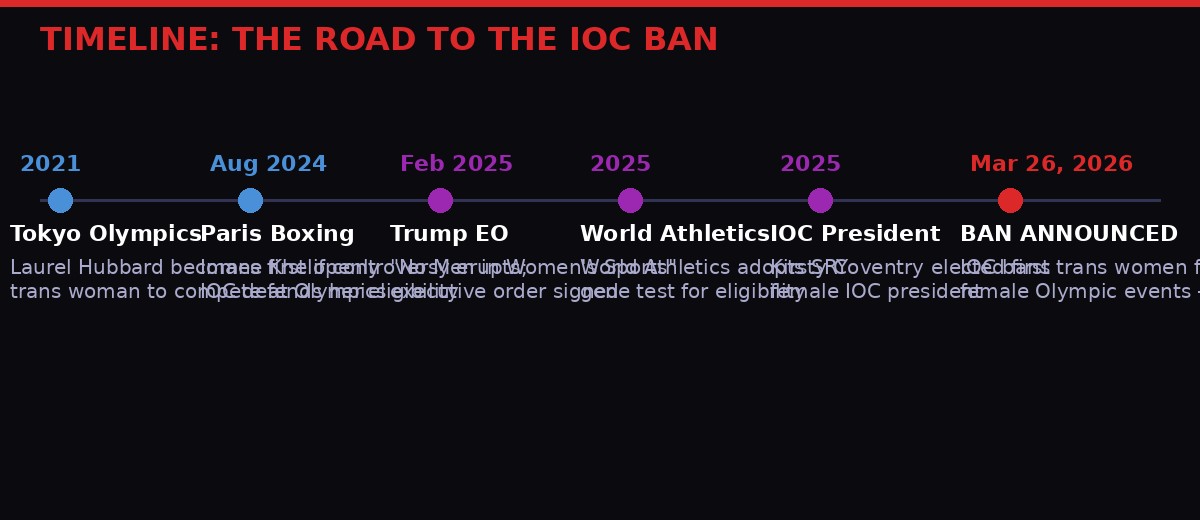
From Laurel Hubbard's historic Tokyo appearance to the Paris boxing firestorm to Coventry's Lausanne announcement: five years that changed Olympic eligibility forever. (BLACKWIRE timeline)
The path to Thursday's announcement runs directly through the boxing venue at the Paris 2024 Olympics. Two female boxers - Imane Khelif of Algeria and Lin Yu-ting of Taiwan - had been disqualified from the 2023 World Boxing Championships under eligibility rules set by the International Boxing Association (IBA), a body with deep ties to Russia that has been stripped of IOC recognition. The IBA cited failed gender tests but never publicly disclosed what those tests measured or what they found.
The IOC, which governed Paris boxing because the IBA had lost recognition, cleared both women to compete. Khelif won gold in the 66kg category. Lin won gold in the 57kg category. Both are cisgender women who have competed as women their entire careers. Neither has ever publicly identified as transgender.
But the controversy, amplified by right-wing politicians and commentators across the United States and Europe who framed it as proof of "biological males" in women's sport, did not dissipate after gold was awarded. It metastasized into a global conversation about gender eligibility that the IOC could no longer manage with committee statements. (Source: AP, 2024-2025)
Weightlifter Laurel Hubbard had made history at the Tokyo 2020 Olympics as the first openly transgender woman to compete at an Olympic Games. She did not medal. She did not break any records. No woman who transitioned after being assigned male at birth has been known to compete at an Olympics since Tokyo. But the political machinery activated by the Paris controversy needed a policy response.
The IOC began its formal scientific review in late 2024. Kirsty Coventry, who won seven Olympic medals as a swimmer for Zimbabwe before becoming Zimbabwe's Minister of Youth and Sport, was elected the IOC's first female president in 2025. She made the protection of women's sport a campaign pillar. The review she inherited became the policy she announced.
Notably, World Athletics - the governing body for track and field - adopted SRY gene testing in 2025 before the IOC did. The IOC's move now aligns Olympic eligibility standards with what the world's largest athletics federation already requires. That alignment was not coincidental; it signals institutional convergence on a single testing framework across the entire elite sport ecosystem.
Washington Claims Credit - Lausanne Pushes Back
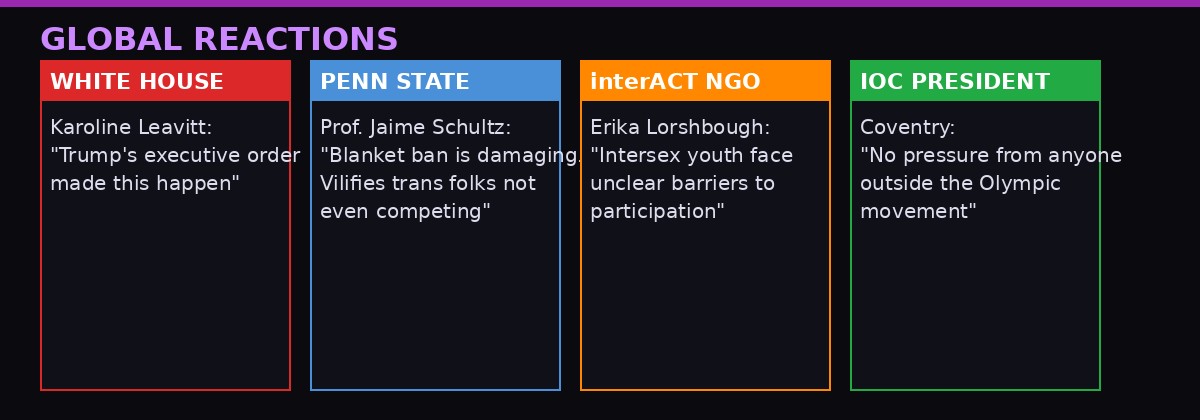
Four voices, four positions. The White House claimed the policy as a Trump win. Coventry said no external pressure existed. (BLACKWIRE graphic)
The Trump administration moved fast. White House spokesperson Karoline Leavitt posted on the same day as the announcement that Trump's February 2025 executive order - the "No Men in Women's Sports" order that threatened federal funding to institutions allowing transgender women to compete against cisgender women - "made this happen." The implication was clear: the IOC had bent to American political pressure.
Coventry rejected this directly at a press conference Thursday. "This was a priority for me way before President Trump came into his second term," she said. "There's not been any pressure [on] us to deliver anything, from anybody outside of the Olympic movement." (Source: NPR, March 26, 2026)
The truth is probably that both things can be simultaneously accurate without either fully explaining the outcome. Coventry campaigned on protecting women's sport before Trump's second term began. The IOC review was ongoing. But the political environment created by the Trump executive order, by 27 U.S. states passing laws barring transgender girls from school sports, and by the Paris controversy created a climate in which maintaining the status quo was no longer politically viable for any major sports institution.
The NCAA complied with Trump's executive order within days of its signing, reversing its previous policy that allowed transgender women to compete under certain conditions. The IOC took longer, and built a scientific testing framework rather than a blanket policy - but the direction of travel was set by a political landscape that made inaction untenable.
The Los Angeles 2028 Olympics will test this dynamic in the most direct way possible. The Games take place in a state - California - that has consistently expanded protections for transgender individuals. Federal law under the current administration points the other way. The IOC's new genetic testing requirement will be administered on American soil, in a context where American courts are actively litigating trans rights in sport, and where the legal status of any resulting exclusion decisions could be challenged under multiple overlapping frameworks.
Who Is Kirsty Coventry - and Why Her Credibility Matters

Coventry: seven Olympic medals, Zimbabwe's former Sports Minister, elected first female IOC president in 2025. She rejected claims of Trump influence on the policy. (BLACKWIRE profile)
The person who signed off on this policy is not a politician. Kirsty Coventry is a seven-time Olympic medalist - she won four silver and three bronze medals for Zimbabwe across three Olympic Games in swimming's backstroke and individual medley events. She served as Zimbabwe's Minister of Youth and Sport for years before entering the IOC structure.
She was elected IOC president in 2025, the first woman to hold the role in the organization's 130-year history. Her election was competitive and her mandate was explicit: strengthen women's sport, expand inclusion, and clean up governance. The transgender eligibility policy sits inside that mandate - a decision she framed as protective of women's fair competition, not as an exclusion exercise.
That framing matters because it distinguishes the IOC's posture from the overtly political rhetoric surrounding the issue in the United States. Coventry has no domestic political incentive to placate the Trump administration. Her constituency is the 206 national Olympic committees and the athletes they represent globally. The policy she announced has to make sense to Kenya, Japan, Germany, and Brazil - not just to swing voters in Pennsylvania.
Whether the scientific underpinning of the policy is adequate - and the scientific evidence suggests it is not fully adequate - the credibility of the messenger matters for how the world receives the decision. A female president of the IOC announcing that women's sport should be protected by women's sport's governing body lands differently than a male Republican senator making the same argument on a campaign trail.
That does not insulate the policy from criticism. Schultz put it plainly: "I think this blanket ban of transgender athletes is damaging. I think it can vilify trans folks who aren't even competing in sport." The harm she identifies is not to the competitive integrity of women's events - it is to the social environment that trans individuals inhabit, where exclusion from elite sport bleeds into exclusion from community, identity, and safety.
The Imane Khelif Aftershock - and What the Policy Actually Changes
One of the most pointed ironies of the announcement: the athletes who sparked the controversy that led to this policy - Khelif and Lin - almost certainly would not be affected by it. Both are cisgender women. If they carry no SRY gene, they pass the test. The boxing scandal that burned through Paris 2024 was built on a different test, run by a different organization, with no public disclosure of methodology or results. The IOC's new SRY standard is not the same as whatever the IBA used.
But one of them, Khelif, told BBC Sport this month that she is "willing to take a sex test for 2028" - suggesting she has nothing to fear from the IOC's new framework. The BBC report noted that she would need to pass the SRY screening to compete in Los Angeles. (Source: BBC Sport, March 2026)
The policy does not retroactively affect any past Olympic results. It does not apply to the Paris gold medals Khelif and Lin won. It creates a prospective standard for LA 2028 and beyond.
What it practically changes for transgender athletes: the previous framework gave individual international federations discretion over eligibility criteria, often involving testosterone level limits and time-on-hormone requirements. Those federation-by-federation rules allowed some space for transgender women to compete in events governed by federations with more permissive standards. The IOC's new baseline closes that space for Olympic competition - though it does not legally bind federations for non-Olympic events.
No transgender woman has competed at the Olympics since Laurel Hubbard in Tokyo 2021 - five years ago. The IOC's policy change addresses a problem that, in strict terms of active Olympic participation, does not currently exist at the Olympic level. But policy shapes culture, and the architecture being built for LA 2028 will shape the pathway for every female athlete between now and then.
The Financial and Logistical Reality Nobody Has Solved
The IOC has announced a test but has not yet answered the practical questions that will determine whether the policy is functional or a bureaucratic disaster.
The SRY gene test costs roughly $250 per sample. Multiply that across thousands of female athletes across 206 national Olympic committees competing across dozens of sports. The number is significant - not in absolute terms for wealthy nations, but potentially prohibitive for federations in developing countries with no budget surplus for genetic testing. Schultz raised the scenario directly: cash-strapped national committees could decide that sending fewer female athletes is easier than paying for compliance. (Source: NPR, March 26, 2026)
The IOC has not said whether it will fund the tests centrally, require national federations to pay, or pass the cost to individual athletes. Each option has different equity implications. A rich Swiss gymnast and a Ugandan distance runner do not face the same barriers to a $250 test - especially if the runner needs to travel internationally for it because her home country bans genetic testing.
The logistics of when testing occurs have also not been specified. Will athletes be tested at qualification? At accreditation? On arrival in Los Angeles? Will there be a centralized IOC testing facility, or will it be delegated to approved labs in each country? Each decision point creates its own set of appeals risks, privacy risks, and potential for discriminatory enforcement.
The IOC says more details are coming. That is almost certainly true - the 2028 Games are two years away. But the absence of implementation specifics means that the policy announced Thursday is, in operational terms, still a sketch. The sketch carries enormous political weight. The operational reality will be built over the next 24 months in a political environment that is not getting calmer.
What Happens Now - and What LA 2028 Will Really Be About
The next steps are immediate and complicated. International sports federations that have not yet adopted SRY testing will now face pressure to align their rules with the IOC's baseline for the Olympic cycle. Some - particularly in team sports with complex qualification structures - will need to work out how to integrate genetic testing into their existing eligibility frameworks without creating inconsistencies between Olympic and non-Olympic competition.
Legal challenges are probable. Civil rights organizations in the United States and Europe have already flagged the policy for review. The European Convention on Human Rights includes protections relevant to genetic privacy and non-discrimination that could be invoked by affected athletes. American courts are already adjudicating parallel questions about trans participation in sport - the Supreme Court appeared poised earlier this year to uphold state laws barring trans girls from school sports. The IOC's policy will feed into that legal environment as precedent or as target, depending on the jurisdiction.
The Trump administration's reaction will continue to shape American public discourse around the Games. Los Angeles has actively positioned itself as a welcoming, inclusive host city. California's legal environment protects transgender individuals in ways federal law under the current administration does not. The 2028 Games will not just be a sporting event - they will be a live demonstration of the tension between these competing visions of who belongs in public life.
For the athletes most directly affected - transgender women who train at elite levels, intersex women who may not know their genetic status, and cisgender women in countries where the test is legally complicated - the next two years are a waiting room. The IOC has issued a verdict but has not yet published the sentence details. The implementation guidance promised "in the months ahead" will determine whether the framework that arrives in Los Angeles is coherent, equitable, and defensible - or whether it generates the litigation, the boycotts, and the disqualification controversies that would make Paris 2024 look quiet.
Kirsty Coventry inherited a governing body that had been paralyzed by exactly this question for years. She has now forced a decision. Whether it was the right decision, built on sufficient science, with adequate protections for the women most vulnerable to collateral damage, is a question the next 24 months will answer in real time - with a global audience watching.
Get BLACKWIRE reports first.
Breaking news, investigations, and analysis - straight to your phone.
Join @blackwirenews on Telegram