34 Days in the Dark: Iran's Wartime Internet Blackout Is the Longest in Modern History
90 million people have been cut off from the global internet since February 28. International connectivity sits at 1%. Nobody is coming to reconnect them.
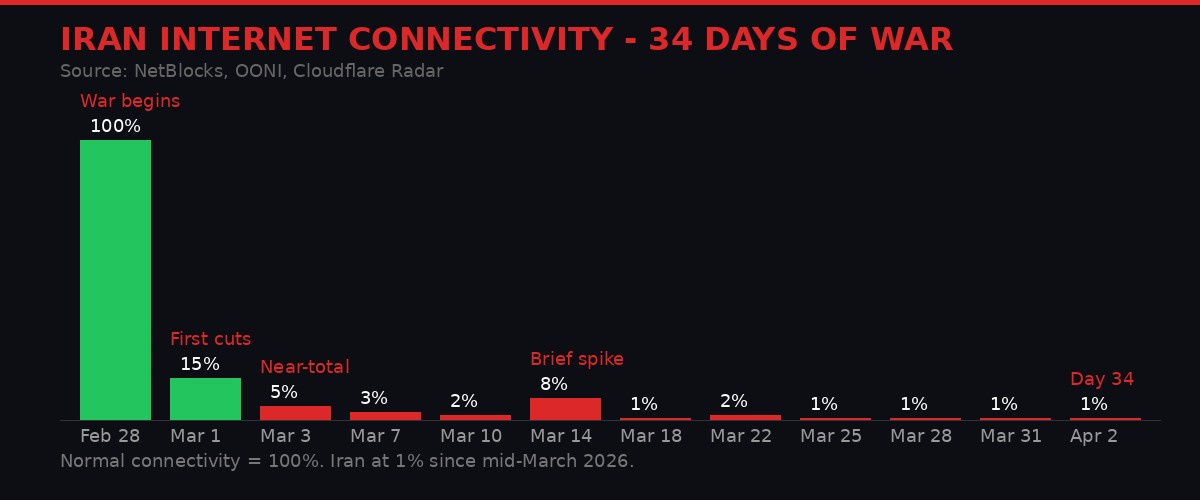
Iran's international internet connectivity collapsed within 72 hours of the first US-Israeli strikes on February 28, 2026. Source: NetBlocks, OONI.
The bombs stopped the power. The regime stopped the internet. Thirty-four days into the US-Israeli war on Iran, the Islamic Republic has been running the longest near-total national internet shutdown during active military conflict in recorded history. NetBlocks, the network observatory that tracks internet disruptions globally, confirmed on April 2 that Iran's connectivity to the outside world remains at approximately 1% of normal levels. The BBC independently verified the same figure on the same day.
The number demands context. One percent does not mean one in a hundred Iranians can browse the web. It means the aggregate international bandwidth available to an entire nation of roughly 90 million people has been throttled to a sliver so thin that functionally zero civilian internet traffic passes across Iran's borders. The data that does move belongs to state institutions, military systems, and a handful of satellite uplinks operating outside government control.
This is not a glitch. This is not collateral damage from bombed infrastructure. This is policy. The Iranian government made a deliberate decision within hours of the first cruise missiles striking Tehran on February 28 to sever the country's digital lifeline. And five weeks later, nobody - not the United Nations, not the European Union, not the technology companies that profit from Iranian users, not the coalition currently bombing the country - has taken meaningful action to reconnect 90 million people to the rest of humanity.
The war has killed more than 2,000 Iranians according to available counts. But the blackout has made the true number unverifiable. That is not a side effect. That is the point.
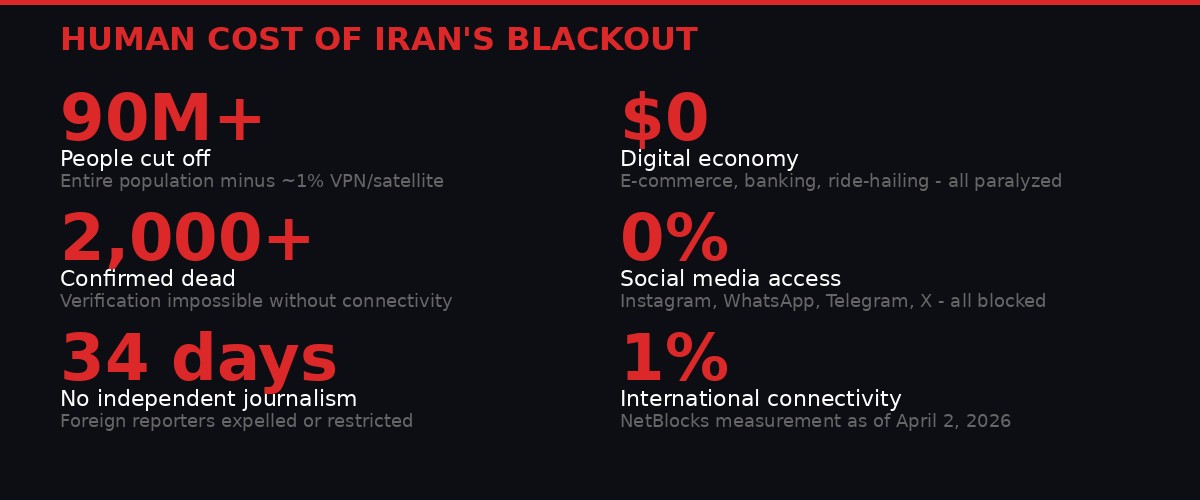
The human toll of Iran's 34-day digital blackout in numbers.
The Architecture of Disconnection
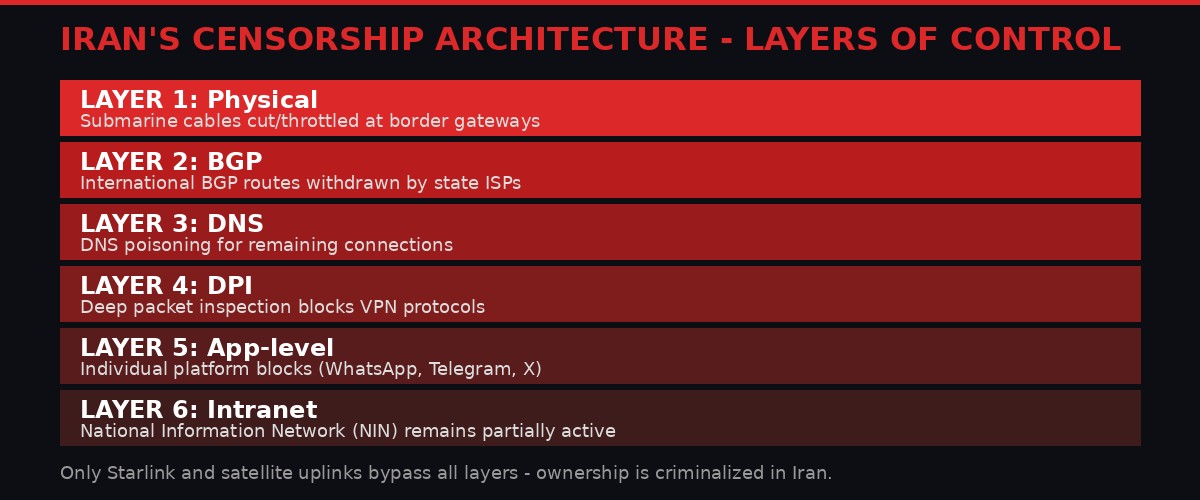
Iran operates a six-layer censorship architecture. During wartime, all layers activate simultaneously.
Iran did not simply flip a switch. The country's internet censorship apparatus is a layered system built over more than a decade, and understanding how 90 million people can be cut off requires understanding each layer of the architecture that makes it possible.
At the physical level, Iran's international internet traffic flows through a limited number of submarine cable landing points and terrestrial fiber connections to neighboring countries - primarily Turkey, Iraq, and the UAE. The Telecommunication Infrastructure Company of Iran (TIC), a state-owned entity, controls these border gateways. When war began, TIC throttled international bandwidth at the physical layer, reducing the flow to nearly nothing. This is the bluntest instrument, and the most effective.
The second layer is BGP routing. The Border Gateway Protocol is the system by which networks on the internet announce their existence to each other. Iranian state ISPs withdrew their international BGP routes, effectively telling the rest of the internet that Iranian networks no longer exist. From outside Iran, attempting to reach an Iranian IP address is like dialing a disconnected phone number. The routes simply are not there.
The third layer is DNS poisoning. For the fraction of traffic that somehow finds a path across the border, the regime's filtering system corrupts Domain Name System responses - the mechanism that translates website names into IP addresses. Requests for blocked domains return false addresses, leading users to government warning pages or simply nowhere.
The fourth layer involves deep packet inspection (DPI). Iran has invested heavily in DPI technology, much of it acquired from Chinese firms including Huawei and ZTE according to investigations by the Citizen Lab at the University of Toronto. DPI examines the actual contents and metadata of internet traffic in real time, identifying and blocking VPN protocols, encrypted tunnels, and any traffic pattern that does not match approved usage. During the current blackout, DPI has been deployed aggressively to crush VPN usage, with protocol signatures being updated as frequently as every few hours to catch new circumvention tools.
The fifth layer is application-level blocking. Even on the domestic National Information Network (NIN) - Iran's walled-garden intranet that remains partially functional - specific applications are individually blocked. WhatsApp, Telegram, Instagram, X (formerly Twitter), Signal, and essentially every international messaging and social media platform are inaccessible. Only domestic alternatives approved by the regime, such as the messaging app Soroush and the social network Rubika, are permitted.
The sixth and final layer is the NIN itself. Iran has spent years building a domestic internet that can function independently of the global network. During the blackout, this intranet has been the only digital service available to most Iranians. Government websites, approved banking applications, and state media operate on the NIN. Everything else is dark. The NIN is not a replacement for the internet. It is a cage with a government lock.
Together, these six layers create a censorship system that operates with near-total effectiveness. According to estimates from the Open Observatory of Network Interference (OONI), which has been collecting measurements from within Iran through trusted volunteers, fewer than 0.5% of Iran's population has maintained any meaningful access to the international internet during the blackout. Those who have are using illegal satellite uplinks - possession of which the Islamic Revolutionary Guard Corps (IRGC) has criminalized, with raids on suspected satellite equipment sellers intensifying since mid-March.
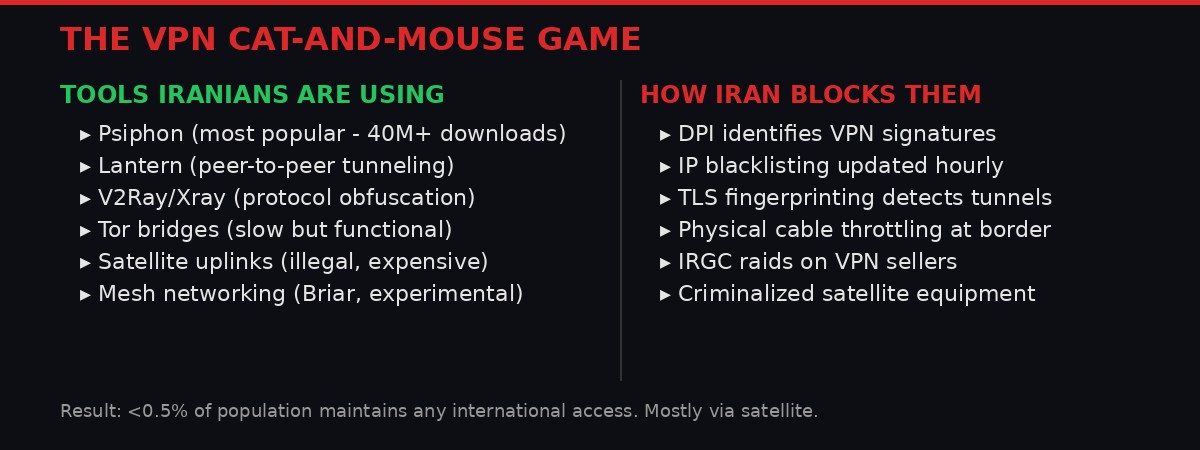
The cat-and-mouse game between circumvention tools and Iran's censorship apparatus.
Without a Record, There Is No War Crime
The most immediate consequence of the blackout is epistemological. Without connectivity, the truth of what is happening inside Iran exists only in the testimony of those who can get messages out - and almost nobody can.
Consider the numbers. The BBC reported on April 2 that more than 2,000 people have been killed in Iran since strikes began on February 28. Iran's health ministry has provided its own figures through state media. But both numbers are, by definition, incomplete. In a country where international connectivity is at 1%, where foreign journalists have been expelled or restricted, where the domestic press operates under wartime censorship, the actual death toll is unknowable. It could be 2,000. It could be 5,000. It could be 10,000. Nobody outside the Iranian government's inner circle has the data to say.
This is not speculation. It is the documented effect of internet shutdowns on conflict documentation. Access Now's annual report on internet shutdowns, released March 31, 2026, recorded 313 shutdowns across 52 countries in 2025. Their research consistently finds that shutdowns during conflict correlate with spikes in unreported violence, because the tools required to document abuses - camera phones uploading to social media, encrypted communications with human rights organizations, satellite imagery verification by open-source researchers - all require internet access.
"When the lights go out, the killing accelerates. Every shutdown we have documented has been accompanied by credible reports of increased state violence that could not be independently verified until connectivity was restored." - Access Now, #KeepItOn Coalition, 2025 Annual Report
Iran's blackout has lasted more than four times longer than Egypt's famous five-day internet shutdown during the 2011 revolution. It has lasted nearly five times longer than Iran's own previous record - the seven-day near-total shutdown during the November 2019 "Bloody November" protests, during which the regime killed an estimated 1,500 people according to Reuters, a figure that only emerged weeks after connectivity was restored.
The 2019 precedent is instructive. During that shutdown, the regime murdered hundreds of its own citizens in the streets. The full scope of the violence was documented by Amnesty International and the BBC Persian service only after the internet came back on - through videos that had been recorded on phones and stored locally, waiting for a connection that would carry them to the world. When 2026's blackout ends, if it ends, the evidence that emerges may rewrite everything currently known about this conflict.
Fergal Keane, the BBC's special correspondent, reported on April 2 from interviews with Iranians who managed to communicate through trusted intermediaries. One nurse described bodies arriving at her hospital "that were not recognizable... some had no hands, some had no legs." A former political prisoner described being shot during the January 2026 protests, still carrying metal fragments in his body. These are fragments of testimony. Not the full picture. The full picture is locked behind a wall of silence that the Iranian regime has built and that nobody has torn down.
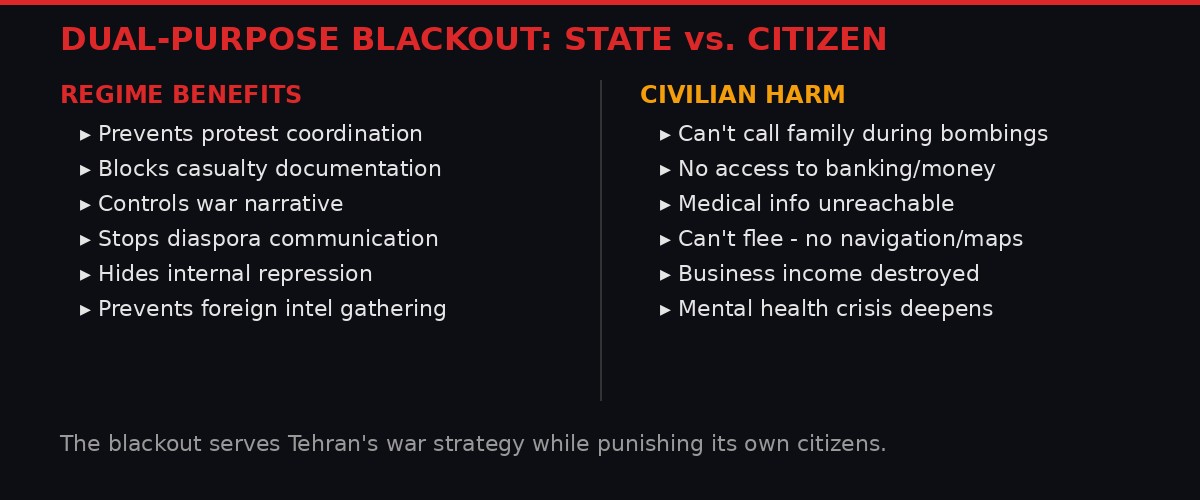
The blackout serves two masters: the regime's war strategy and its domestic repression apparatus.
The Dual-Purpose Weapon
Tehran's internet blackout is not purely defensive. It is a dual-purpose weapon that simultaneously serves the regime's military objectives and its internal security apparatus. Understanding this duality is essential to understanding why the blackout has lasted 34 days with no sign of ending.
On the military side, the blackout denies intelligence to adversaries. The US and Israeli military have relied heavily on signals intelligence (SIGINT) and open-source intelligence (OSINT) throughout the campaign. Iranian civilians posting videos of missile impacts, sharing coordinates of damaged infrastructure, or discussing military movements on social media would constitute an intelligence bonanza for opposing forces. By cutting the internet, Iran has blinded the open-source intelligence community almost entirely. Satellite imagery still works - Airbus Defence and Space Pleiades Neo satellites have provided some of the only independent verification of events on the ground - but the granular, street-level intelligence that comes from millions of smartphone-wielding civilians has been eliminated.
On the domestic security side, the blackout prevents the one thing the Islamic Republic fears more than American bombs: its own people organizing. Iran's modern protest movements - the Green Movement of 2009, the economic protests of 2017-2018, the Mahsa Amini uprising of 2022, and the massive anti-government demonstrations of late 2025 and early 2026 - have all been organized, amplified, and sustained through digital platforms. Without those platforms, collective action becomes atomized. Individuals may be angry, but they cannot find each other. They cannot coordinate. They cannot plan.
The BBC's Amir Azimi, editor of BBC Persian, wrote on April 2 that "Iran's focus on survival means the same regime still firmly in place." That survival depends on the blackout. The regime is fighting a two-front war - against American and Israeli air power from above, and against its own population from below. The internet shutdown is the weapon deployed against the second front. Trump's promise to bomb Iran "back to the stone ages" has, perversely, pushed some Iranians who oppose the regime into a defensive nationalist posture. But the regime takes no chances. The internet stays off.
The economic consequences of this dual-purpose strategy fall entirely on civilians. Iran's e-commerce sector, which had grown to roughly $35 billion annually by 2025 according to the Iran E-Commerce Association, has been virtually destroyed. Ride-hailing platforms Snapp and Tapsi, which employed hundreds of thousands of drivers, are non-functional. Digital banking, which had become the primary transaction method for millions of Iranians, works only partially and only through the domestic NIN. The freelance economy - Iranians working remotely for international clients, one of the few ways to earn foreign currency under sanctions - has been completely severed.
"Setareh," a young woman from Tehran interviewed by the BBC through trusted sources, described the economic catastrophe in human terms: "We cannot afford even basic food. What's in our pockets does not match market prices... the people I thought might have money to lend also don't have anything." Even before the war, food prices in Iran had risen 60% in the previous year. The blackout has accelerated a humanitarian crisis that was already severe.
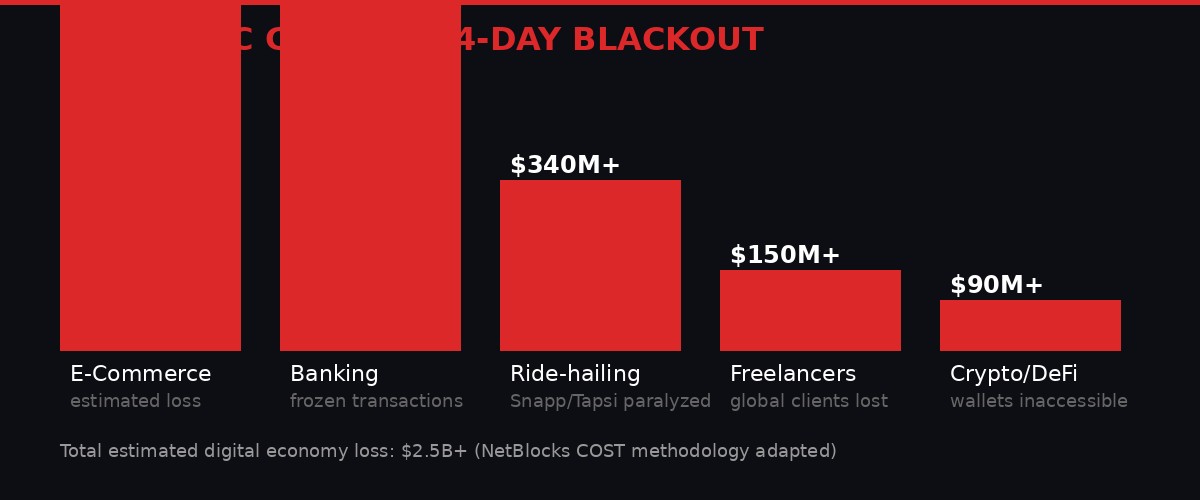
Estimated digital economy losses from 34 days of near-total internet shutdown.
Where This Fits in History
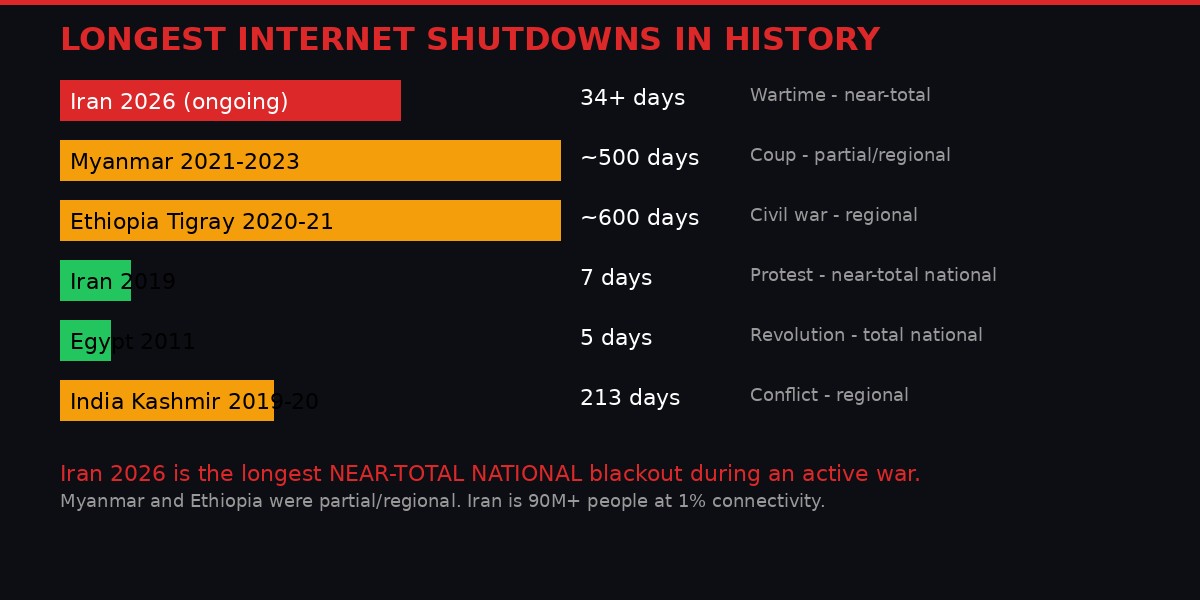
How Iran's 2026 blackout compares to history's longest internet shutdowns.
Iran's 34-day blackout is unprecedented, but understanding exactly how it is unprecedented requires careful comparison. Internet shutdowns are not rare events. Access Now documented 313 of them in 2025 alone. Some have lasted far longer than 34 days in terms of raw duration. What makes Iran different is the combination of three factors: scope (near-total national), duration (34 days and counting), and context (active war).
Myanmar's military junta imposed internet restrictions following its February 2021 coup that lasted, in various forms, for more than 500 days. But Myanmar's shutdowns were partial and regional. Mobile data was cut while fiber broadband remained partially available. Certain regions experienced total blackouts while Yangon maintained degraded access. At no point was the entire country reduced to 1% connectivity.
Ethiopia's Tigray region experienced a communications blackout lasting approximately 600 days during the civil war that began in November 2020. This was a total shutdown - but it was regional, affecting approximately 6 million people in Tigray rather than a national population. The rest of Ethiopia maintained internet access.
India's shutdown of internet services in Jammu and Kashmir following the revocation of Article 370 in August 2019 lasted 213 days for mobile internet and longer for full restoration. Again, this was regional - affecting roughly 12 million people - and was a 2G/4G throttle rather than a near-total national blackout.
Iran's own November 2019 shutdown, which lasted approximately seven days and affected nearly the entire country, had previously held the record for the most severe short-duration national blackout. During those seven days, the regime killed an estimated 1,500 people - a figure compiled by Reuters from three Iranian interior ministry officials, citing the country's Interior Ministry.
Egypt's January 2011 shutdown during the revolution lasted five days and was a near-total national disconnection affecting roughly 80 million people. It remains the benchmark for a rapid, complete national shutdown - but it lasted less than a week before being reversed under international economic pressure.
What Iran is doing in 2026 combines the worst elements of all these precedents. It is national in scope (like Egypt 2011), near-total in severity (like Egypt 2011), extended in duration (already longer than India Kashmir 2019), and occurring during an active military conflict where the population is simultaneously being bombed from the air and repressed from within. No country has maintained a shutdown of this severity, at this scale, for this long, during an active war.
The NetBlocks COST (Cost of Shutdown Tool) methodology, developed to estimate the economic impact of internet shutdowns, would place the direct cost of Iran's 34-day blackout in the range of $2.5 billion or higher, based on the size of Iran's digital economy and the duration of the disruption. This does not account for the destruction of long-term economic capacity - the businesses that will never reopen, the international relationships that will never be rebuilt, the talent that will never return.
The Information Vacuum and What Fills It
When a country goes dark, the information vacuum does not stay empty. It fills with propaganda, rumor, and manufactured narratives from every side of the conflict.
From inside Iran, the only information available to most citizens comes through state media - Press TV, IRNA, Fars News, Tasnim - all of which are organs of the government. These outlets report Iranian military strikes as victories and US-Israeli strikes as failures or war crimes. They amplify government messaging without question. When Iran's armed forces spokesperson Ebrahim Zolfaghari declared on April 2 that US and Israeli assessments of Iran's military capabilities were "incomplete" and that Tehran would step up attacks with "more crushing, broader and more destructive" operations, state media carried the statement without context or skepticism.
From outside, the information environment is dominated by claims from combatants. Trump posted on Truth Social that "the biggest bridge in Iran comes tumbling down, never to be used again," after a highway bridge linking Tehran to Karaj was struck. The Israeli military issues daily operational summaries. Pentagon briefings provide the US perspective. But the independent verification layer - the layer that would normally be provided by Iranian civilians filming events, by international journalists on the ground, by open-source investigators cross-referencing claims against evidence - barely exists.
Iran's diaspora community, estimated at 4-5 million people worldwide, has been almost completely cut off from family and friends inside the country. The BBC reported accounts from Iranian Americans, Iranian Europeans, and Iranian Canadians who have had zero contact with relatives for three weeks or more. These families do not know if their parents, siblings, or children are alive. They cannot call. They cannot message. They cannot receive photos or videos. The silence is total.
Behnam, a former political prisoner still hiding in Tehran after being shot during the January 2026 protests, told the BBC through intermediaries: "Once you see how easily your life can be threatened - that a simple incident or a twist of fate can mean death or survival - after that, your life no longer holds the same value for you." He keeps antibiotics and painkillers stockpiled. His X-ray shows metal fragments in his torso. He cannot share these images with the world because his world has been shrunk to whatever the regime allows him to see.
The information vacuum has real consequences for the war itself. On April 2, Iran's Foreign Ministry spokesperson Esmaeil Baghaei said Tehran "will not tolerate this vicious cycle of war, negotiations, ceasefire, and then repeating the same pattern." Trump claimed Iran had requested a ceasefire - which Tehran immediately denied. Without independent reporting from inside Iran, there is no way to determine which narrative is closer to truth. Both sides exploit the vacuum.
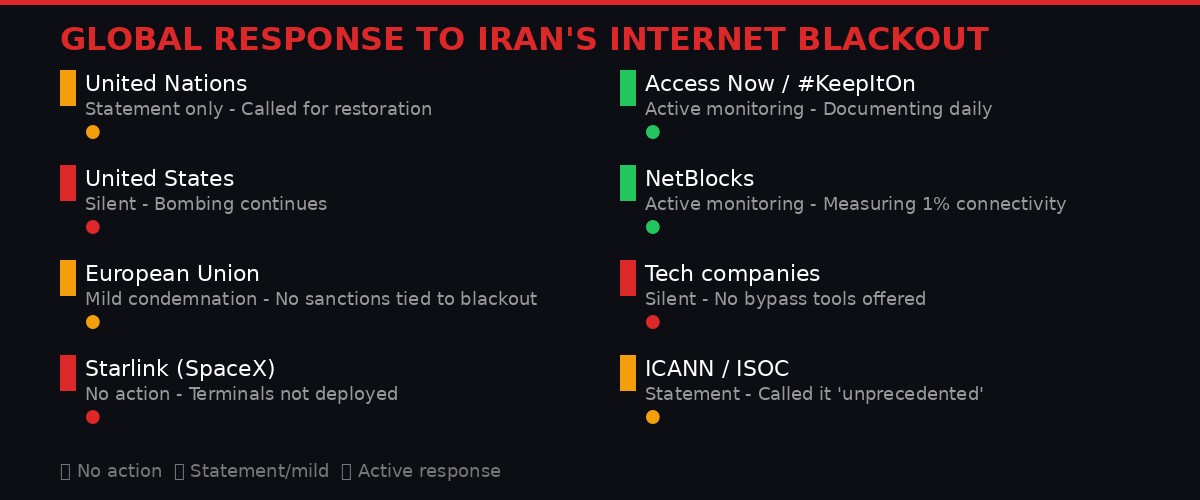
The international community's response to the blackout has been overwhelmingly passive.
Who Could Fix This - And Why They Haven't
The technology to bypass a national internet shutdown exists. The political will to deploy it does not.
SpaceX's Starlink satellite internet service could, in theory, provide connectivity to Iran without relying on ground infrastructure. Starlink terminals communicate directly with low-earth-orbit satellites, bypassing every layer of Iran's censorship architecture. During Russia's 2022 invasion of Ukraine, Starlink terminals were rapidly deployed to maintain Ukrainian connectivity. Elon Musk personally authorized the activation. Nothing comparable has happened for Iran.
There are practical obstacles. Starlink terminals must be physically present inside the country, and smuggling them in at scale is logistically challenging. Iran has criminalized possession of unauthorized satellite equipment. The IRGC conducts raids. But these obstacles existed in Ukraine too - terminals had to be physically transported into a war zone, and Russia jammed them actively. The difference is not capability. It is priority.
The US government, which is currently bombing Iran, has made no public statement calling for the restoration of internet access. This is a notable silence. During the 2019 Iranian protests, the State Department issued explicit support for Iranians' right to access the internet. During the 2022 Mahsa Amini protests, the Treasury Department issued a specific license (General License D-2) authorizing technology companies to provide internet services to Iran without violating sanctions. In 2026, with the US actively at war with Iran, the incentive structure has reversed. A connected Iranian population would generate intelligence for the US military - but it would also generate accountability. It would document civilian casualties. It would humanize the enemy. It would make the war harder to sell domestically.
The European Union has issued statements expressing concern about internet freedom in Iran but has taken no concrete action to provide connectivity or pressure for restoration. EU foreign ministers have been consumed by the Strait of Hormuz crisis and the broader economic fallout from the war. The digital rights of 90 million Iranians do not appear to be a priority.
Technology companies that serve Iranian users - Google, Apple, Meta, Microsoft - have been silent. Before the war, millions of Iranians used Instagram (which was intermittently accessible through VPNs), WhatsApp, and other platforms. These companies have not publicly called for the restoration of internet access, have not offered bypass tools, and have not taken any visible action to help their Iranian users get back online. The companies may calculate that any intervention would violate sanctions, draw regulatory scrutiny, or simply be futile against a state-level shutdown. But the silence is deafening.
The organizations actually doing the work are small and chronically underfunded. Access Now's #KeepItOn coalition - a network of 366 civil society organizations - has been monitoring and documenting the shutdown daily. NetBlocks continues to measure connectivity levels. OONI collects measurements from inside Iran through a network of volunteers risking personal safety to run probes. Psiphon, the anti-censorship tool, reports that it had more than 40 million downloads in Iran before the blackout, but the tool requires some minimal connectivity to function - and at 1%, even Psiphon cannot help most users.
The International Telecommunication Union (ITU), the UN body responsible for global telecommunications, has called the shutdown "unprecedented" but has no enforcement mechanism. The Internet Corporation for Assigned Names and Numbers (ICANN) has issued similar language. The Internet Society (ISOC) has published analysis. None of these organizations can force a sovereign state to reconnect its citizens.
Timeline: 34 Days of Digital Darkness
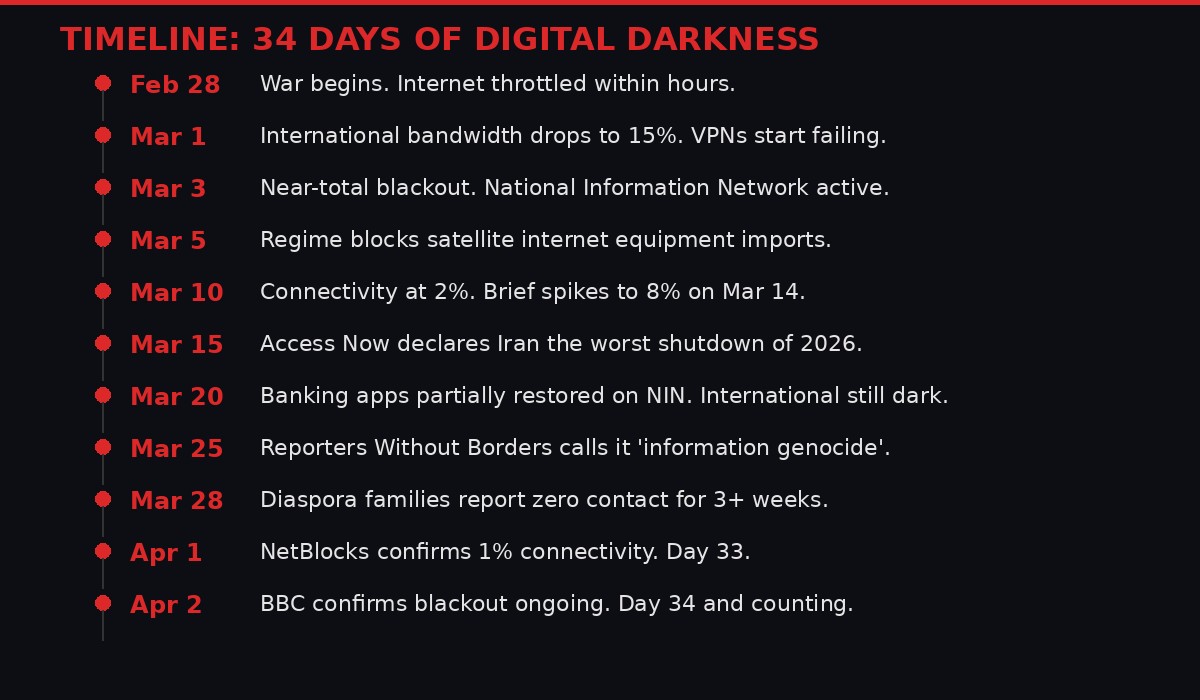
Day-by-day progression of Iran's internet shutdown from war's first hours to Day 34.
What Happens When the Lights Come Back On
Every internet shutdown ends eventually. When Iran's does, the consequences will be severe - and not in the way the regime hopes.
History provides a template. After Egypt's five-day shutdown in 2011, the evidence that emerged - videos, photos, testimony - fueled international outrage and contributed to the fall of the Mubarak regime. After Iran's own seven-day shutdown in 2019, the documentation that surfaced revealed a massacre far worse than initial reports suggested, leading to international sanctions specifically targeting officials responsible for the crackdown.
After 34 days, the volume of evidence waiting to emerge from Iran will be staggering. Iranians have been recording. Phone cameras do not need internet to capture video. The recordings are being stored on devices, on memory cards, on hard drives. Nurse "Tina" described bodies arriving at her hospital with missing limbs. Someone, somewhere, has photographs. Former prisoner Behnam has X-rays showing shrapnel in his body. Others will have footage of strikes, of IRGC raids, of arrests, of violence that the blackout was designed to hide.
When connectivity is restored - whether through regime choice, infrastructure collapse, or post-war settlement - this evidence will flood out. It will take weeks for human rights organizations to process, verify, and catalog what emerges. But emerge it will. The blackout can delay accountability. It cannot prevent it.
There is a darker possibility. If the war escalates further - if Trump's promise to hit Iran "extremely hard" in coming weeks materializes as an intensified campaign against civilian infrastructure - the evidence that eventually surfaces could document something far worse than what is currently visible. Iran's health ministry has already confirmed strikes on the Pasteur Institute, a century-old medical research center. The IDF has admitted striking the Tofigh Daru pharmaceutical company, which produces anesthetics and cancer drugs. "Tina," the nurse, warned that if "the conflict continues and infrastructure is targeted and medicines cannot be imported, then we will face very serious problems."
The internet blackout ensures that if those problems arrive - if hospitals run out of medicine, if clean water systems fail, if starvation takes hold - the world will not see it in real time. It will see it after the fact. Possibly months after the fact. And by then, the damage will be done.
Iran's President Masoud Pezeshkian wrote an open letter to the American public on April 1, asking whether "America First" was truly being served by this war. The letter was distributed through Press TV and state channels. It could not reach ordinary Iranians through their own internet because their internet does not exist. The regime cut its own people off from the world and then asked the world to listen to its message. The contradiction would be absurd if it were not so destructive.
Thirty-four days. One percent. Ninety million people. The longest wartime internet blackout in modern history continues. Nobody is counting because nobody can.
Get BLACKWIRE reports first.
Breaking news, investigations, and analysis - straight to your phone.
Join @blackwirenews on Telegram