Iran Puts UAE Nuclear Plant in Crosshairs as Gulf States Take Fire

Iran has published a list of energy targets across the Middle East that it says will be struck if the United States follows through on President Donald Trump's threat to bomb Iranian power stations - and that list includes the UAE's Barakah nuclear power plant, the only operational nuclear facility in the Arab world.
The threat, relayed through Iran's semiofficial Fars news agency and echoed by the judiciary's Mizan news outlet, raises the stakes of the four-week-old war to a level few analysts thought possible even a week ago. A strike on Barakah - which houses four reactors in the western deserts of Abu Dhabi - would not merely knock out electricity. It would trigger a regional nuclear emergency.
This is no longer a war being fought over airfields and missile silos. It has become a direct contest over the infrastructure that sustains civilian life across one of the world's most densely populated desert regions: power plants, desalination facilities, and now a nuclear power station 250 kilometers from Dubai.
Trump's ultimatum expires just before midnight GMT Tuesday. At the time of writing, Iran has shown no signs of backing down.
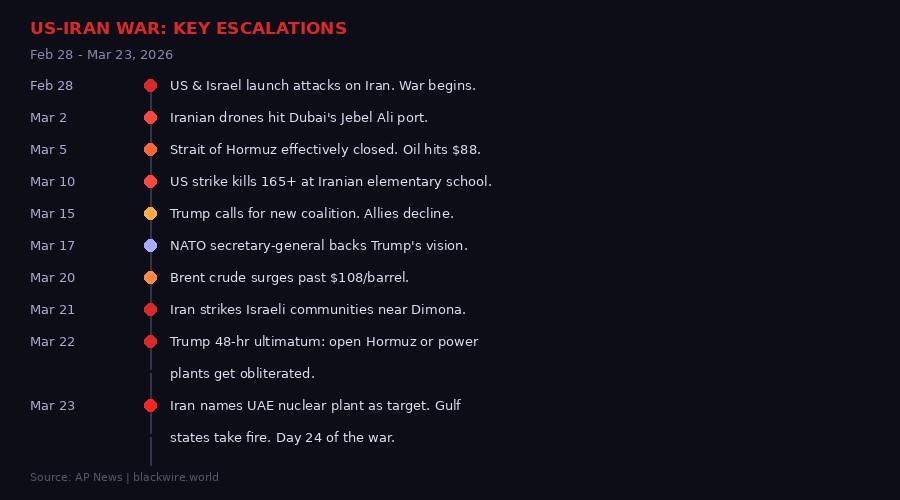
Iran Fires on Four Gulf States in Single Night

What happened overnight Sunday into Monday reads like a regional war breaking containment. Kuwait and the United Arab Emirates both reported air defenses dealing with incoming missile and drone attacks. Air raid sirens sounded in Bahrain. Saudi Arabia's Defense Ministry announced it had intercepted a ballistic missile targeting Riyadh and destroyed drones over the kingdom's oil-rich Eastern Province.
In Abu Dhabi, the UAE's air defense system intercepted a ballistic missile near Al Dhafra Air Base - the facility that hosts thousands of US Air Force personnel and serves as the main hub for American air operations in the region. One person on the ground was wounded by shrapnel from the intercept, according to AP.
Iran's Islamic Revolutionary Guard Corps issued a statement that left no ambiguity about the new targeting doctrine: if the United States strikes Iranian power plants, Iran will hit "power plants in all areas that supply electricity to American bases, as well as the economic, industrial and energy infrastructures in which Americans have shares."
"Do not doubt that we will do this." - Islamic Revolutionary Guard Corps statement, read on Iranian state television, March 23, 2026
The statement was followed within hours by the Fars news agency's publication of a target list. Prominent on it: the Barakah nuclear power plant in Abu Dhabi's Al Dhafra region, which operates four South Korean-built APR-1400 reactors and supplies roughly 25% of the UAE's electricity. The plant sits 270 kilometers from Dubai and 53 kilometers from the Saudi border.
Lebanese President Joseph Aoun separately called Israel's new campaign of destroying bridges across southern Lebanon "a prelude to a ground invasion," as the conflict's frontlines continued to multiply. The Hezbollah front, quiet for the first week of the war, has now opened into a second sustained theater of combat.
Trump's 48-Hour Clock and the War Crime Question

The ultimatum began as a 51-word social media post. Trump, writing from Florida on Saturday, warned the US would "obliterate" Iran's "various POWER PLANTS, STARTING WITH THE BIGGEST ONE FIRST!" unless Iran opened the Strait of Hormuz within 48 hours. The deadline runs to approximately midnight GMT Tuesday, March 24.
Trump's legal authority for such a strike has been questioned by military law experts even within conservative circles. Geoffrey Corn, a law professor at Texas Tech University and retired Army lieutenant colonel who served as a military lawyer, told AP the post "certainly has a feeling of ready, fire, aim."
"He overestimated his ability to control the events once he unleashed this torrent of violence." - Geoffrey Corn, Texas Tech University law professor and former Army legal counsel
Under the laws of armed conflict, strikes on civilian power infrastructure are not automatically prohibited - but they require a proportionality analysis showing military advantages outweigh civilian harm. In Iran's case, that bar is extraordinarily high: the country's power grid runs hospitals, schools, water treatment, and an estimated 90 million people's homes.
Corn stated flatly that an all-out attack on Iran's power system "would probably be a war crime." Iran's UN ambassador wrote to the Security Council calling any such strike "inherently indiscriminate and clearly disproportionate." Even Israel's own ambassador to Washington, Yechiel Leiter, urged restraint, saying on CNN: "We want to leave everything in the country intact, so that the people who come after this regime are going to be able to rebuild and reconstitute."
Democratic senators were blunter. Sen. Ed Markey of Massachusetts called the threat a war crime in progress. Sen. Chris Murphy of Connecticut said Trump had "lost control of the war and is panicking." Even Republican Sen. Thom Tillis, normally aligned with the administration, said on ABC: "You can't all of a sudden walk away after you've kind of created the event and expect other people to pick it up."
Trump's UN Ambassador Mike Waltz defended the threat on Fox News Sunday, arguing the Revolutionary Guard controls the infrastructure and uses it "to power the war effort." He described potential targets as "gas-fired thermal power plants and other types of plants" and told viewers "the president is not messing around."
The Barakah Factor: What a Nuclear Plant Strike Would Mean

The Barakah nuclear power plant is not just the Arab world's only operational nuclear facility - it is also a geopolitical symbol of enormous weight. Built by Korea Electric Power Corporation at a cost exceeding $24 billion, it was the first civilian nuclear power plant ever constructed in the Arab world and represents a decade of UAE energy policy designed to reduce oil dependence.
A conventional missile strike on Barakah would not necessarily trigger a Chernobyl-scale nuclear accident - modern reactor containment is designed to withstand significant physical damage. But a successful strike damaging the cooling systems, spent fuel pools, or reactor core could release radioactive material across a densely populated coastal corridor that includes Abu Dhabi, Dubai, and Sharjah - a combined metropolitan population of over 6 million people.
The plant sits on the coast of the Persian Gulf. Prevailing winds during March run westward - directly toward Qatar, Bahrain, and eastern Saudi Arabia. A worst-case scenario would contaminate some of the most economically critical real estate on earth: the oil fields, refineries, and ports of the eastern Arabian Peninsula.
Nuclear watchdog the International Atomic Energy Agency has not yet publicly commented on Iran's threat against Barakah. IAEA Director General Rafael Grossi has spent recent weeks focused on Iran's own nuclear sites - particularly the Natanz enrichment facility that was struck in the latest Israeli attack, and the Isfahan facility, which the IAEA says contains the bulk of Iran's estimated 441 kilograms of enriched uranium, now buried under rubble.
The prospect of a second nuclear site entering the target calculations - this time in a Gulf Arab state and potentially at risk of conventional attack - represents a qualitative escalation that goes beyond anything seen in the 24 days of this war so far.
The Water Wars Nobody Saw Coming
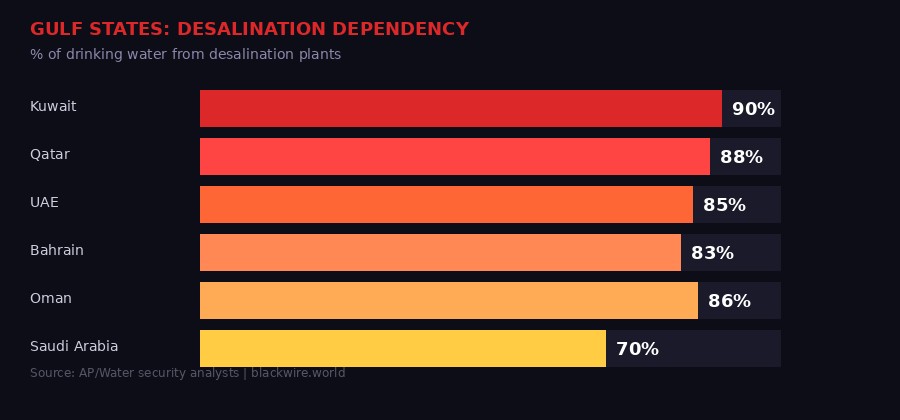
Iran's Revolutionary Guard statement explicitly listed "desalination facilities" as potential targets alongside power plants. To understand why that threat carries extraordinary weight, consider what Gulf Arab cities actually run on.
Kuwait gets roughly 90% of its drinking water from desalination. The UAE draws around 85%. Oman 86%. Bahrain 83%. Saudi Arabia, despite its size, desalinates roughly 70% of its national water supply. These are not backup systems - they are the primary water source for tens of millions of people living in one of the world's most arid regions.
Hundreds of desalination plants line the Persian Gulf coast, many of them co-located with power generation facilities in combined power-and-water stations. This architectural reality creates a brutal vulnerability: an attack aimed at a power plant can simultaneously destroy the water supply for an entire coastal city.
"None of these assets are any more protected than any of the municipal areas that are currently being hit by ballistic missiles or drones." - Ed Cullinane, Middle East editor, Global Water Intelligence
On Sunday, Bahrain formally accused Iran of damaging one of its desalination plants. Kuwait's Doha West desalination facility sustained damage from debris related to nearby port attacks. The UAE's Fujairah water complex was briefly suspected of being hit before its operator confirmed it remained operational.
A 2010 CIA analysis, declassified and referenced in the AP's reporting, warned that attacks on desalination facilities could trigger national crises across Gulf states - and that prolonged outages could last months if critical equipment were destroyed. The report noted more than 90% of the Gulf's desalinated water comes from just 56 plants, each one "extremely vulnerable to sabotage or military action."
David Michel, senior fellow for water security at the Center for Strategic and International Studies, called it "an asymmetrical tactic." Iran, unable to strike back at the US or Israel directly on their home soil, can impose crushing costs on the Gulf states - who in turn have every incentive to press Washington for a ceasefire.
The Oil Shock and Global Economic Fallout
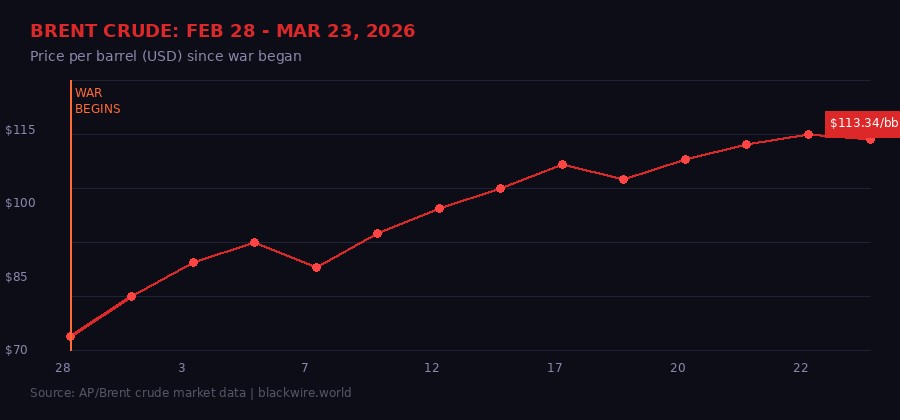
Brent crude traded at $113.34 per barrel in early Monday trading - up roughly 55% from the $73 it sat at the morning before the war began on February 28. The International Energy Agency's director Fatih Birol, speaking at Australia's National Press Club in Canberra on Monday, said the energy market impact has already exceeded the combined shock of the two 1970s oil crises and the Russia-Ukraine war.
"No country will be immune to the effects of this crisis if it continues to go in this direction." - Fatih Birol, International Energy Agency Director, March 23, 2026
Asian markets absorbed the latest escalation badly. Japan's Nikkei 225 fell 3.5% in afternoon Tokyo trading. South Korea's Kospi dropped 6.5%. Hong Kong's Hang Seng declined 4.0%. Shanghai shed 3.7%. Taiwan's Taiex fell 2.5%. In Singapore, Mizuho Bank analyst Ng Jing Wen stated the obvious: "Trump's ultimatum and Iran's retaliatory warnings point to a widening conflict that keeps energy disruption and market volatility elevated with no clear off-ramp in sight."
Wall Street closed Friday in its fourth consecutive losing week - the longest such streak in a year. The S&P 500 fell 1.5% to 6,506. The Nasdaq dropped 2%. The Dow shed 444 points. Ten-year Treasury yields jumped to 4.38%, up from 3.97% before the war. Fed rate-cut expectations, which had assumed at least two cuts in 2026, have evaporated entirely. Central banks across Europe, Japan, and the UK held rates steady at their most recent meetings, all citing energy inflation risks.
The direct consumer impact is already visible at American gas pumps. Trump's Treasury Department on Friday took the extraordinary step of lifting sanctions on some Iranian oil exports for the first time in decades - a move ostensibly designed to flood global markets with supply and relieve price pressure. The effect, if any, has yet to materialize. The Strait of Hormuz - through which a fifth of global oil flows - remains effectively closed to US, Israeli, and allied shipping. Qatar's Ras Laffan terminal, the world's largest LNG export facility, remains shut following a drone strike. Iraq's major oilfields at Rumaila and West Qurna have cut output as storage fills up.
If Trump follows through on his power plant threat and Iran retaliates by targeting Gulf Arab energy infrastructure, analysts have no credible price ceiling for oil in the near term. Goldman Sachs, JPMorgan, and Citigroup have all declined to issue revised forecasts, citing scenario uncertainty that has made conventional modeling essentially meaningless.
The War Trump Can't End

The deeper story running beneath Monday's escalation is the one AP's reporting has been methodically documenting for a week: Trump cannot find a way out of this war. In the space of eight days, his strategy has shifted from calling for a new international coalition to escort ships through Hormuz (allies declined), to suggesting the US could manage alone, to proposing other countries would "take over," to hinting the strait would somehow "open itself," to now threatening to obliterate civilian power infrastructure.
Each shift has come with a fresh round of presidential messaging, often in all-caps social media posts sent from Mar-a-Lago. The pattern reads less like strategy and more like improvisation under pressure.
US Central Command chief Admiral Brad Cooper gave his first one-on-one interview since the war began on Monday, calling the campaign against Iran "ahead or on plan." He said the US and Israel were targeting Iranian infrastructure to destroy its capacity to rebuild its military - "not just the threat today" but "the threat of the future." He then appeared on Farsi-language satellite television to deliver a message directly to Iranian civilians: "You need to stay inside for right now. There will be a clear signal at some point, as the president has indicated, for you to be able to come out."
That message, broadcast into Iranian homes in their own language, read to many observers as a warning of imminent strikes on populated areas - not as a reassurance. Iran's military immediately cited it as evidence the US was "targeting Iranian civilians."
NATO Secretary-General Mark Rutte, who has aligned himself closely with Trump throughout the war, attempted Monday to provide diplomatic cover, saying he understood Trump's frustration and that more than 20 countries were "coming together to implement his vision" of reopening the strait. He did not name the 20 countries or specify what they were actually doing.
The war that began February 28 with American and Israeli strikes on Iran has now killed over 2,500 people. Iran's death toll exceeds 1,500, according to its health ministry. Fifteen Israelis have been killed by Iranian strikes. Lebanese authorities say Israeli operations targeting Hezbollah have killed more than 1,000 Lebanese and displaced over 1 million. A Qatari military helicopter crashed Saturday - all seven aboard killed, Qatari authorities attributed it to mechanical failure.
What Happens When the Clock Runs Out

Trump's 48-hour deadline expires around midnight GMT on Tuesday. At this hour, there are three plausible paths forward, none of them clean.
The first is that Iran blinks. It agrees to allow neutral shipping through the Strait of Hormuz, Trump declares victory, and both sides pause. This is theoretically possible - Iran has consistently claimed the strait is open to non-enemy vessels, suggesting there may be face-saving language available to both sides. The problem is domestic politics in Tehran: any capitulation that appears forced by an American ultimatum likely accelerates the internal pressure on Iranian leadership.
The second path is that Trump backs down - or delays the deadline without executing the threat. This is the scenario Trump's own advisers may privately prefer. Israel's ambassador has urged restraint. NATO's chief is clearly trying to create diplomatic breathing room. Domestic US polling on starting a war with Iran remains deeply unfavorable. Trump could extend the deadline, claim progress on negotiations, and defer the threat indefinitely. The risk is a credibility collapse that emboldens Iran further.
The third path is the one Iran has prepared for: Trump strikes the power plants, Iran retaliates across the region, Barakah and the Gulf desalination network enter the target calculus, and a war that has already driven oil to $113 per barrel takes the next step toward something that has no historical precedent in modern energy terms.
The IEA's Birol has already warned the current crisis exceeds the combined impact of all previous energy shocks. The scenario in column three would make what has already happened look like a dress rehearsal.
Iran's Revolutionary Guard stated Monday it will "irreversibly destroy" economic and energy infrastructure across the region if its own infrastructure is targeted. "Entities that finance the US military budget are legitimate targets," parliament speaker Qalibaf added on X.
The Gulf Arab states - which have spent four weeks watching their air defenses light up and their energy exports stall - are now learning that being a US ally in this war has placed them squarely inside the next phase of it. Their neutrality, carefully maintained since February 28, has run out. Iran has named their nuclear reactor. Their desalination plants are on a published target list. Their air bases host American planes.
The deadline clock is running. Nobody is blinking yet.
Key Facts - March 23, 2026
- Iran's IRGC published a target list including UAE's Barakah nuclear power plant (4 reactors)
- Missiles intercepted over Abu Dhabi, Bahrain, Kuwait, and Saudi Arabia overnight
- Trump's 48-hour ultimatum to open Hormuz or face power plant strikes expires midnight Tuesday GMT
- Brent crude at $113.34/barrel - up 55% since February 28
- Iran war death toll exceeds 2,500; Iran casualties surpass 1,500 according to health ministry
- IEA Director Birol: impact on energy markets worse than 1970s oil shocks and Russia-Ukraine war combined
- Qatar's Ras Laffan LNG terminal (20% of world LNG supply) remains shut
- Israel launched "wide-scale wave of strikes" on Tehran infrastructure Monday morning
- Asian stocks fell 2.5-6.5% across major markets Monday
- Sources: AP News, IEA, US Central Command, Iranian state media (IRNA, Fars, Mizan)
Get BLACKWIRE reports first.
Breaking news, investigations, and analysis - straight to your phone.
Join @blackwirenews on Telegram