Washington's 15-Point Gambit: Iran Rejects Ceasefire Plan as 6,000 More US Troops Head to the Gulf
The United States slid a 15-point ceasefire proposal to Iran through Pakistani intermediaries on Tuesday night. By Wednesday morning, Iran's military had publicly told Washington it was negotiating with itself. Day 25 of the Iran War looks like every other day: airstrikes, missile alerts, a burning airport, and oil at $99 a barrel.

US air operations have continued daily since the war began on February 28, 2026. (Pexels)
The plan arrived in Tehran through Pakistan's diplomatic channel. Prime Minister Shehbaz Sharif confirmed on X that Islamabad is ready to "facilitate meaningful and conclusive talks" and that Pakistan is prepared to host negotiations. AP News, March 24 Three Pakistani officials, one Egyptian official, and a Gulf diplomat told AP that Washington had agreed in principle to attend talks in Pakistan. Iran had not yet agreed to attend.
The plan itself was never officially confirmed by the White House. Leaked details, reported first by Israel's Channel 12 and then by AP and BBC, describe a framework that demands Iran dismantle its three main nuclear enrichment sites - Natanz, Isfahan, and Fordow - hand all enriched material to the International Atomic Energy Agency, and abandon armed proxy networks across the region. In exchange: sanctions lifted, a civilian nuclear program at Bushehr preserved, and a removal of the perpetual threat of reimposed penalties. BBC, March 25
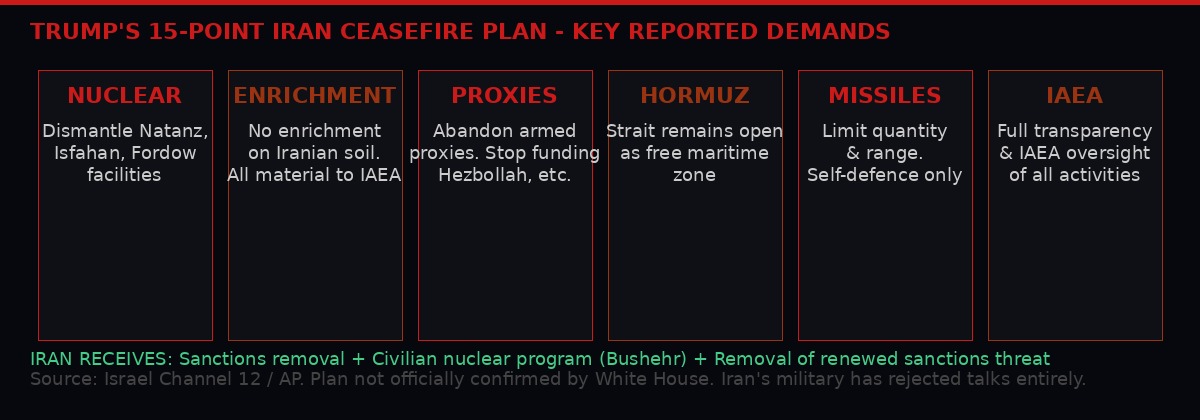
Key reported demands in the 15-point plan. The White House has not officially confirmed the contents. Source: Israel Channel 12 / AP.
Iran's military was not impressed. Lt. Col. Ebrahim Zolfaghari, spokesman for the Khatam Al-Anbiya Central Headquarters - the unified command overseeing both Iran's regular forces and the Revolutionary Guard - issued a direct response:
"Have your internal conflicts reached the point where you are negotiating with yourselves? Someone like us will never come to terms with someone like you. Not now, not ever." - Lt. Col. Ebrahim Zolfaghari, spokesman for Iran's Khatam Al-Anbiya Central Headquarters, March 25, 2026 (via AP)
The Headquarters added that "the strategic power you used to talk about has turned into a strategic failure." Iran's parliament Speaker Mohammad Bagher Ghalibaf had separately dismissed any talk of negotiations as "fake news." BBC Persian / AP
The Troop Surge: What 6,000 More Forces Actually Means

US Navy carrier operations in the Persian Gulf region have intensified since the war began. (Pexels)
While Washington's diplomats work backchannels in Islamabad and Cairo, the Pentagon is moving iron in the other direction. At least 1,000 soldiers from the 82nd Airborne Division are deploying to the Middle East in the coming days, three people with direct knowledge of the plans told AP. AP News, March 25 The 82nd Airborne is the US Army's designated emergency response force. It does one thing specifically well: it parachutes into hostile or contested territory to seize airfields.
This is not a garrison force. This is a forcible-entry unit. Its presence in theater tells a specific operational story - one that doesn't end with a handshake in Islamabad.
The Marines are already en route. The Pentagon is deploying two Marine units - approximately 5,000 Marines and several thousand sailors - bringing total US military presence in the region to well over 56,000 personnel against a pre-war baseline of roughly 50,000. AP News White House officials have framed these deployments as giving Trump "maximum flexibility." That phrasing, in military planning context, means options that include kinetic ones.
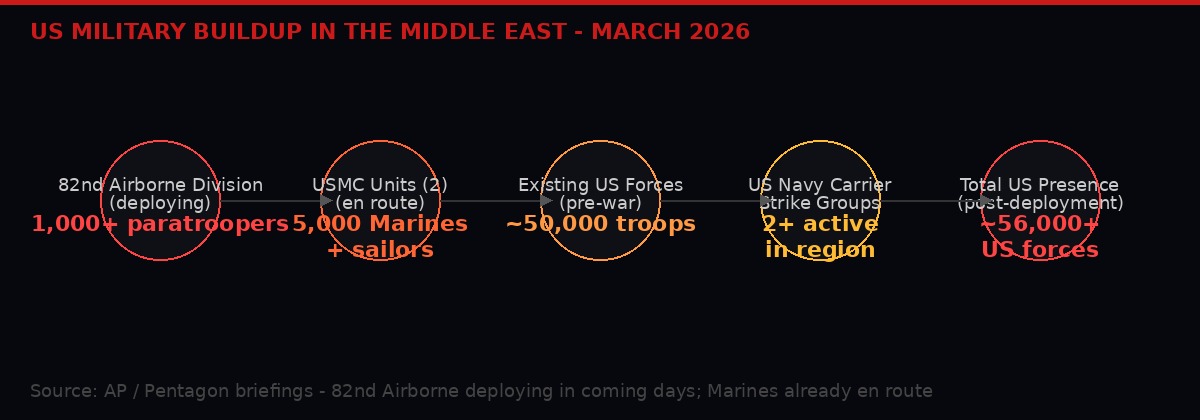
US military force buildup in the Middle East since February 28, 2026. Source: AP / Pentagon briefings.
The Marine deployment in particular has drawn pointed analytical attention. Marine units are trained for embassy protection, civilian evacuation, and - notably - amphibious assault. Kharg Island sits 33 kilometers off Iran's coast in the Persian Gulf. It processes nearly all of Iran's crude oil exports. Senator Lindsey Graham, a Trump ally, posted on social media last week: "He who controls Kharg Island controls the destiny of this war." AP News, Kharg Island analysis
The Pentagon bombed Kharg Island's military assets last Friday, leaving oil infrastructure intact. Iran has since threatened to mine the Persian Gulf if the US attempts to land troops. The Soufan Center, a New York-based security think tank, noted that Trump's pause on threatening Iranian power plants "could be aimed at buying time for the Marines to arrive." AP / Soufan Center analysis
Kharg Island - The $10 Billion Pressure Point
- Processes approximately 90% of Iran's oil exports
- Iran has exported 13.7 million barrels since the war began (TankerTrackers satellite data)
- JPMorgan warned a seizure would "immediately halt the bulk of Iran's crude exports"
- Energy researcher Petras Katinas (RUSI): "It doesn't matter which regime is in power - a takeover would give the US leverage"
- Iran has threatened to mine the Gulf if US troops appear to be moving on island
- US struck military sites on Kharg March 21 - left oil infrastructure intact
Strikes Continue: Israel Hits Qazvin, Iran Fires on Gulf States

Nighttime strikes on urban infrastructure have been reported on both sides throughout the conflict. (Pexels)
The war did not pause for diplomacy. The Israeli military announced new wide-scale strikes on Iran early Wednesday, targeting government infrastructure. Witnesses reported airstrikes in the northwestern Iranian city of Qazvin. Missile alert sirens activated across Israel simultaneously as Iran launched retaliatory attacks. AP News, March 25
This is the pattern that has held for 25 days without interruption. Both sides conduct strikes. Both sides suffer damage. Neither side shows operational collapse.
Iran's wider regional campaign continued on Wednesday. Saudi Arabia's Defense Ministry reported destroying at least eight Iranian drones over the kingdom's oil-rich Eastern Province. Missile alert sirens activated in Bahrain. Kuwait shot down multiple incoming drones - but one broke through. It struck a fuel tank at Kuwait International Airport, igniting a fire. Kuwaiti firefighters worked through the morning to contain the blaze. AP News, March 25
"We had a good life. But now, we do not know what will happen to us in the next few weeks. If this continues, it will definitely kill us and our family." - Carlos Bragal Jr., Manila jeepney driver, speaking to BBC about fuel price crisis from the Iran war
The attack on Kuwait airport is notable. Kuwait is not a party to the conflict. Kuwait City has not been designated a legitimate military target by any recognized legal framework. The ICC's founding chief prosecutor, Luis Moreno Ocampo, told BBC this week that Iran's attacks on Gulf neighbors - which did not attack Iran - would constitute crimes of aggression under the Rome Statute. He added that the US attacks on Iranian power plants carry the same designation under international law. Neither the US, Israel, nor Iran are ICC members, and the Trump administration has already sanctioned ICC judges. BBC, March 25
The Hormuz Chokehold: Asia Is Already Breaking
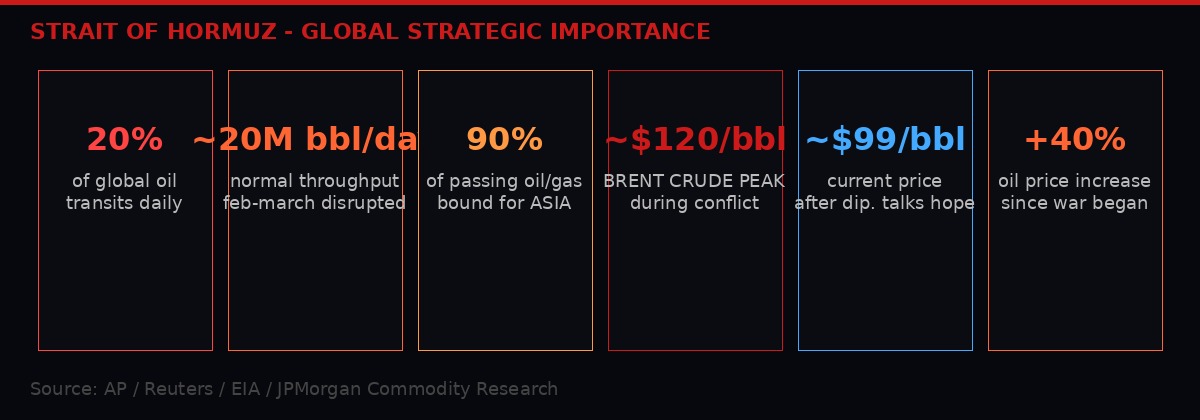
The Strait of Hormuz controls roughly 20% of global oil supply. Disruption has sent energy markets into crisis. Source: AP / Reuters / EIA.
The Strait of Hormuz is a 33-kilometer-wide bottleneck between Iran and Oman. Roughly 20 million barrels of oil pass through it on a normal day - approximately one-fifth of global supply. Since Iran effectively closed it on March 3, only a handful of vessels per day have been permitted transit. AP / Reuters
Brent crude hit $120 per barrel during peak panic. It has since retreated to just under $100 on ceasefire rumors - still up nearly 40% from the day the war began. AP News, March 25 JPMorgan's global commodity research team warned that a strike on Kharg Island, Iran's main oil terminal, could "immediately halt the bulk of Iran's crude exports, likely triggering severe retaliation in the Strait of Hormuz or against regional energy infrastructure." That strike has already happened. Iran has not fully retaliated against Kharg. Yet.
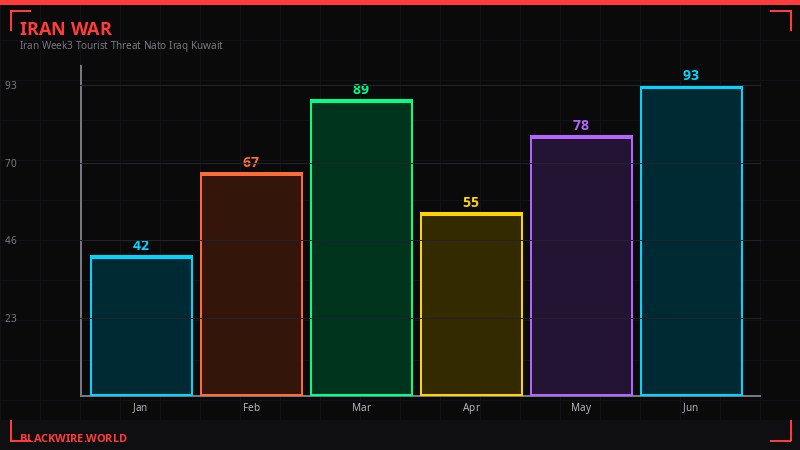
Brent crude price trajectory since February 28, 2026. The $120 peak came on March 17 - currently holding near $99/bbl on diplomatic signals. Source: Reuters / AP.
For Asia, the consequences are already concrete. Nearly 90% of oil and gas passing through the Strait is bound for Asian markets. The Philippines declared a national energy emergency on Tuesday. President Marcos cited "the resulting imminent danger posed upon the availability and stability of the country's energy supply." AP News, March 25 Chinese authorities are limiting fuel price hikes as citizens face a 20% jump in costs. Thai television anchors are dressing without suits to model energy conservation. Governments across Southeast Asia have shortened working weeks and closed universities early. BBC, March 25
In Bangladesh, Pakistan, and Sri Lanka - countries already carrying high dollar-denominated debt - a sustained $100-plus oil price risks cascading into currency crises. The war started by the US and Israel on February 28 is already being fought by people in Manila and Bangkok who had nothing to do with it.
Iranians Divided: No Uprising, No Consensus

Ordinary Iranians are caught between a government they distrust and a ceasefire that may leave it in power. (Pexels)
Trump and Netanyahu have repeatedly claimed the war is creating conditions for Iranian citizens to rise up against the Islamic Republic. After 25 days, there is no evidence that has happened. BBC Persian, March 25
Iran's police chief, Brigadier General Ahmadreza Radan, warned that anyone who took to the streets at "the enemy's request" would be treated as an enemy of the state. Iran's internet remains largely blacked out - a government-imposed blackout that forces those who want outside information to pay premium prices for black-market Starlink connections, themselves illegal under Iranian law. BBC Persian
The picture BBC Persian correspondents have built from contacts inside Iran is fractured. The people who support the government rally nightly in state media-amplified scenes. But the majority is not unified. Some want the war to end on any terms. Others, who oppose the Islamic Republic, fear that a ceasefire negotiated by the US would legitimize the current leadership while leaving it in power - and potentially more violent than before, given the December and January crackdowns that killed at least 7,000 people including more than 200 children, according to figures from Hrana, the US-based Human Rights Activists News Agency. BBC Persian / Hrana
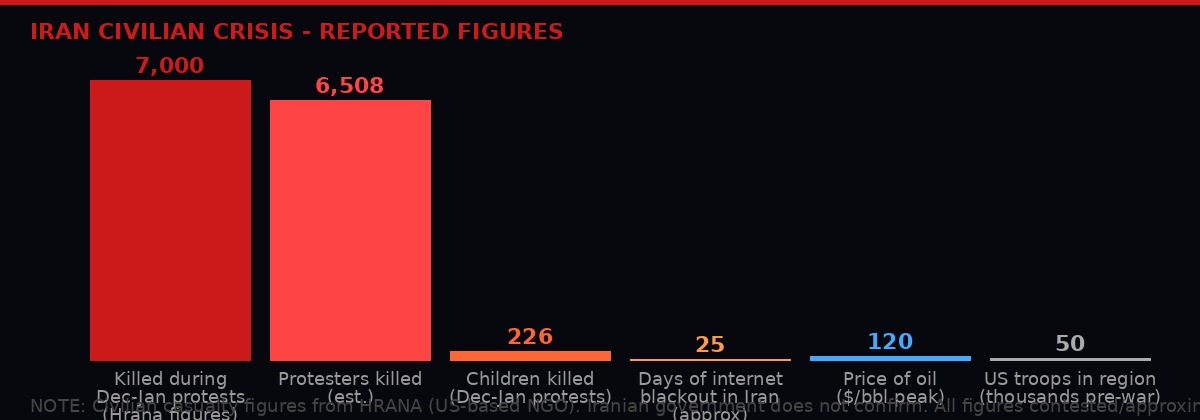
Key figures on the Iranian civilian crisis. Protest casualty numbers from HRANA; Iranian government does not confirm. (Source: HRANA / BBC)
"I don't know how to feel. If the war ends, the sounds of explosions will stop and the situation will become OK, but at the same time it's going to be us and a regime that's very weak - but they still have power over their own people. And they will become even more violent, I think." - "Kiana," woman in her 20s, Tehran, speaking to BBC Persian (name changed for safety)
The clearest analysis on who benefits from a negotiated settlement comes from those who want neither outcome. A ceasefire keeps Iran's government in place and ends the bombing. The continuation of the war keeps the bombing going and keeps the government in place. For the Iranian street - exhausted, online-dark, and watching prices spiral - both paths lead to the same regime.
The Rules-Based Order: Already in the Rubble

The ICC's founding chief prosecutor has called the US-Israel attacks on Iran a crime of aggression under international law. (Pexels)
Luis Moreno Ocampo, founding chief prosecutor of the International Criminal Court, drew a direct line this week from the Iran war to Russia's war in Ukraine. He told BBC that the US-Israel attacks on Iran constitute a crime of aggression under the Rome Statute: "The use of armed forces by a state against the sovereignty, the territorial integrity or the political independence of another state - that's it." BBC, March 25
Trump's threats to bomb Iranian power plants - which he has postponed but not withdrawn - would constitute attacks on civilian infrastructure under the Rome Statute, Ocampo argued. He drew a direct parallel to the ICC indictments issued against Russian officials for identical attacks on Ukrainian power grids. The White House dismissed this as "ridiculous," insisting Trump was "eliminating the threat posed by a rogue, terrorist regime." BBC
US Ambassador to the UN Mike Waltz offered a different legal theory: when a regime uses infrastructure to project military force, it becomes a legitimate target. The counterargument - that civilians dependent on those systems lose protection under this logic - was not addressed. CBS News / BBC
Iran's attacks on Kuwait, Saudi Arabia, and Bahrain face the same analysis. Those countries are not parties to the conflict. Their civilian energy infrastructure is not an Iranian military target under any recognized legal principle. The ICC prosecutor noted that Tehran's strikes on Gulf neighbors also qualify as crimes of aggression. Neither side in this war operates within the framework it claims to defend.
The war has demonstrated something broader. The rules-based international order - constructed over 80 years at enormous diplomatic and financial cost - is not collapsing in slow motion. It was never the structural reality. It was always a choice by the powerful to behave as though it were. When the most powerful state on Earth decides not to make that choice, the illusion ends quickly. What replaces it is not a new order. It is the old order: strength, threat, and leverage.
Timeline: 25 Days That Changed the Gulf
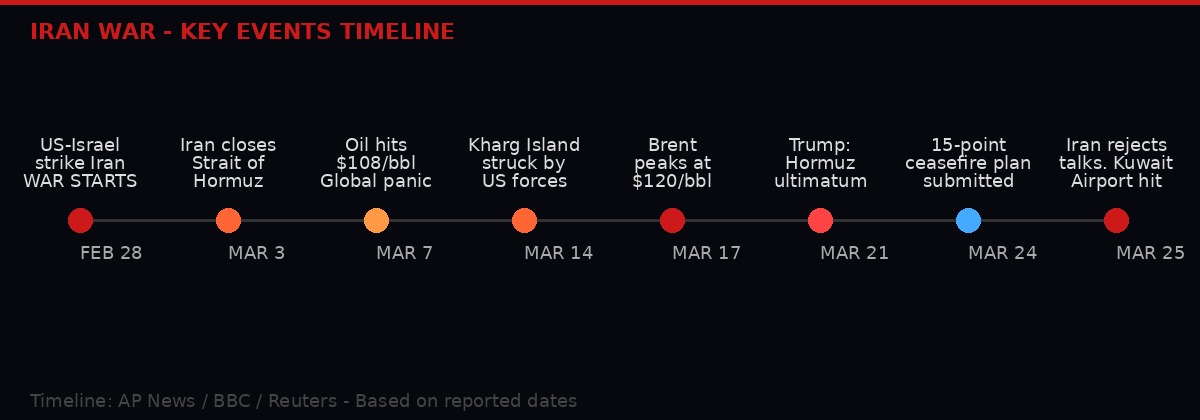
Key events in the Iran War since it began on February 28, 2026. Source: AP News / BBC / Reuters.
Iran War - Key Events
What Happens Next: Four Scenarios

US military planners face four distinct operational scenarios as the Gulf conflict enters its 25th day. (Pexels)
The war is now being fought on three simultaneous tracks that pull in different directions. Understanding which track dominates in the coming week determines what the region looks like by April.
Track One: Pakistan Talks Succeed. The ceasefire plan reaches a Iranian decision-maker with both the authority and willingness to negotiate. A one-month ceasefire is agreed. The Strait of Hormuz reopens. Oil drops to $75. Neither side has won. The Islamic Republic survives. The nuclear program survives in some form. Israel is furious. The US domestic political situation is complicated. This is the outcome financial markets are pricing a probability for - which is why crude dropped from $120 to $99 on ceasefire rumors.
Track Two: Talks Fail, War Continues. Iran's military command, which has publicly rejected any negotiation, holds. No ceasefire. The 82nd Airborne arrives in theater. More strikes on Kharg Island. Iran mines sections of the Gulf. Oil returns to $115-120. Global recession probability climbs. South Asian and Southeast Asian economies face dollar crises. The war enters its second month without a defined exit condition.
Track Three: Kharg Island Seized. Marine and 82nd Airborne elements land on Kharg Island. Iran's crude export capacity collapses. The Islamic Republic faces an existential economic threat. Iran mines the strait heavily and strikes Gulf Arab energy infrastructure with full force. Oil supply disruption reaches catastrophic levels. Saudi Arabia's Eastern Province - home to Aramco's primary processing facilities - comes under sustained attack. The global economy enters recession territory. This is the highest-risk scenario and the one that military assets being deployed are, structurally, configured to enable.
Track Four: Regime Collapse. The scenario Trump and Netanyahu have been publicly working toward. Sustained degradation of Iranian military and economic infrastructure produces internal fracturing within the Islamic Republic - factional splits, IRGC defections, civilian uprising. This has not materialized in 25 days and faces significant structural barriers. The government's internet blackout limits the coordination capacity of opposition actors. Fear of being designated an "enemy agent" for protesting is concrete and documented. This remains the stated objective - and the least likely near-term outcome.
What is certain, as of Wednesday morning, is that Iran struck Kuwait International Airport overnight, Israeli jets struck Qazvin at dawn, missile sirens activated across Israel and Bahrain, and 6,000 US service members are currently aboard ships and aircraft heading to a region that has been at war for 25 days. The 15-point plan sits in Tehran, unanswered. Iran's military command has already answered it in the only language they have chosen to use since February 28.
"The strategic power you used to talk about has turned into a strategic failure. The one claiming to be a global superpower would have already gotten out of this mess if it could." - Lt. Col. Ebrahim Zolfaghari, Khatam Al-Anbiya Central Headquarters, March 25, 2026
Neither side is losing fast enough to be forced to the table. That is the most dangerous condition in warfare. The war will continue until one of them is.
Get BLACKWIRE reports first.
Breaking news, investigations, and analysis - straight to your phone.
Join @blackwirenews on Telegram