The Smallest Soldiers: Iran Sends Children to Man Checkpoints as War Grinds Into Month Two
The IRGC's new "Homeland Defender Fighters" program recruits children as young as 12. An 11-year-old boy manning a Tehran checkpoint with his father is already dead. Four eyewitnesses describe armed teenagers on the streets of three Iranian cities.

Checkpoints across Iranian cities are now being staffed by minors, according to multiple eyewitness accounts. (Unsplash)
Alireza Jafari was eleven years old. He liked school. He was in the fifth grade. On March 11, 2026, he stood at a Basij militia checkpoint in Tehran alongside his father, helping patrol the darkened streets of a capital under bombardment. An Israeli drone strike hit the checkpoint. Both father and son were killed.
His mother, Sadaf Monfared, told the Tehran municipality newspaper Hamshahri that her husband had taken Alireza because there were not enough personnel - "only four people" at the checkpoint. She quoted Alireza as saying, before he left: "Mum, either we win this war or we become martyrs. God willing, we will win, but I would like to become a martyr."
He became a martyr. He was eleven.
Three weeks later, the Islamic Revolutionary Guard Corps made it official. On March 31, an IRGC official in Tehran announced a new program called the "Homeland Defender Fighters for Iran" that would enroll "volunteers" aged 12 and above into security duties including patrols and checkpoint deployment. The announcement was made through the IRGC-affiliated Fars News Agency, delivered as casually as a school enrollment notice.
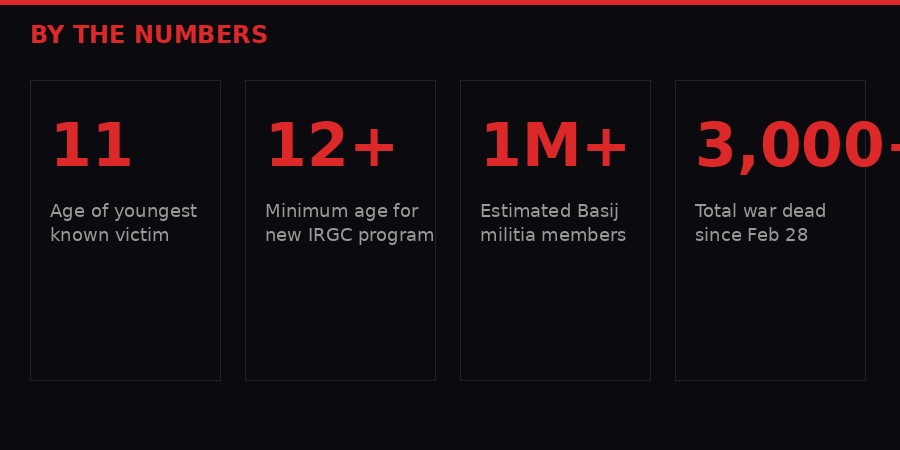
The numbers behind Iran's child recruitment crisis. (BLACKWIRE Infographic)
The Program: What the IRGC Is Building

The IRGC's new program formalizes what witnesses say has been happening informally since the war began. (Unsplash)
Rahim Nadali of the IRGC's Greater Tehran Muhammad Rasulollah Corps laid out the framework with bureaucratic precision. Children aged 12 and above would be placed on "various duties," he said, including street patrols and deployment at security checkpoints. Recruitment would happen at mosques attached to the Basij militia network across Tehran and at city squares where pro-government rallies have been held.
The Basij itself is a sprawling volunteer militia controlled by the IRGC with an estimated membership exceeding one million. It has historically served as the regime's street-level enforcement arm, deployed to suppress dissent during the 2009 Green Movement protests, the 2019 fuel protests that left hundreds dead, and the 2022-2023 Woman, Life, Freedom uprising triggered by the death of Mahsa Amini in morality police custody.
Now, under the pressures of a war that has killed more than 3,000 people in barely a month, the Basij is reaching younger. The "Homeland Defender Fighters" branding attempts to frame child recruitment as patriotic volunteerism. The reality, as captured by witnesses on the ground, is more disturbing: children standing at checkpoints in the dark, some armed, some wearing masks to hide faces that betray their age.
The timing is significant. Iran's conventional military infrastructure has absorbed devastating strikes since the US and Israel launched their joint offensive on February 28. Nuclear enrichment facilities at Isfahan, Natanz, and Fordow were hit in the opening days. Military bases across the country have been targeted repeatedly. The IRGC's command structure has taken losses. And the regime's ability to project control on the home front - always dependent on street-level militia presence - is showing cracks.
Recruiting children is not a sign of strength. It is the act of a security apparatus struggling to fill posts that adults no longer want to occupy. Holly Dagres, an Iran specialist at The Washington Institute for Near East Policy, told the BBC the move "underscores the desperation of the Islamic Republic" and shows "how deeply unpopular they are with their own population that it is struggling to recruit adults to staff security checkpoints."
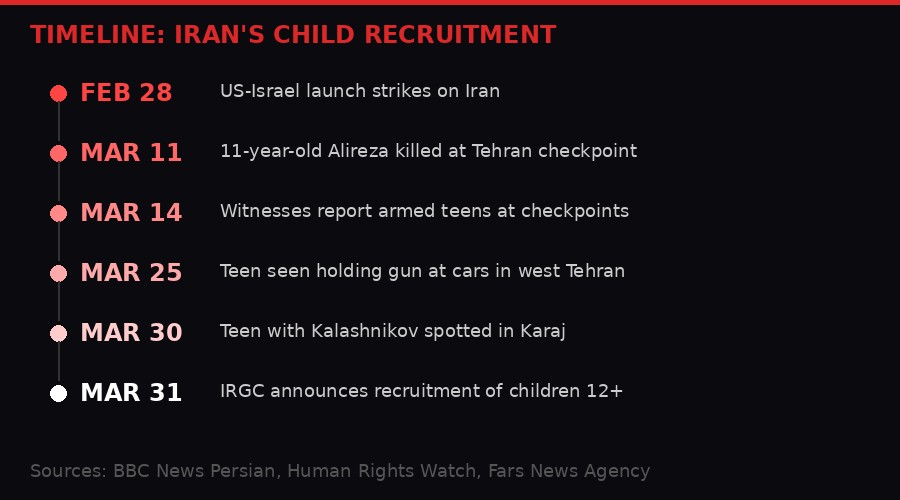
A timeline of child recruitment milestones since the war began February 28. (BLACKWIRE Infographic)
The Witnesses: Four Accounts From Three Cities

Despite a government-imposed internet blackout, witnesses have reached international media with accounts from Tehran, Karaj, and Rasht. (Unsplash)
Despite a government-imposed internet outage across much of Iran, the BBC managed to speak with four eyewitnesses who independently described seeing children under 18 at security checkpoints in three different cities. All names were changed for security reasons, a necessity in a country where speaking to foreign media about the regime's wartime conduct carries severe consequences.
The accounts paint a consistent picture across geography and time.
Golnaz, East Tehran, March 9: A woman in her twenties stepped outside after an air strike to assess the damage. She saw armed teenagers among the Basij forces operating in the area. The teens were carrying weapons and participating in post-strike operations alongside adult militiamen. She described them as visibly young - not men pretending to be soldiers, but adolescents thrust into a warzone.
Sara, West Tehran, March 25: Another witness in her twenties saw a teenager at a checkpoint holding a gun and pointing it at cars. He and other militia members were stopping vehicles and conducting searches. Sara described him as "short and slight" - the physical characteristics of a boy not yet through puberty being made to perform the work of an armed checkpoint guard.
Peyman, Karaj, March 30: A man in his twenties in the city of Karaj, located just west of Tehran, reported seeing what he described as a "teenage boy" wielding a Kalashnikov assault rifle at a checkpoint. His observation was visceral: "His moustache hadn't fully grown." The presence of a military-grade automatic weapon in the hands of a teenager whose facial hair had not yet come in captures the absurdity and horror of the situation in a single image.
Tina, Rasht, March 14: In the northern city of Rasht, hundreds of kilometers from the capital, a woman in her twenties saw young people on duty in a city square. They wore masks that covered their faces, but their age was unmistakable. "It's obvious that they are children," she told the BBC. "I can see it from their eyes. They are short as well. They stand in front of those adult forces. I feel pity for them and I get scared at the same time."
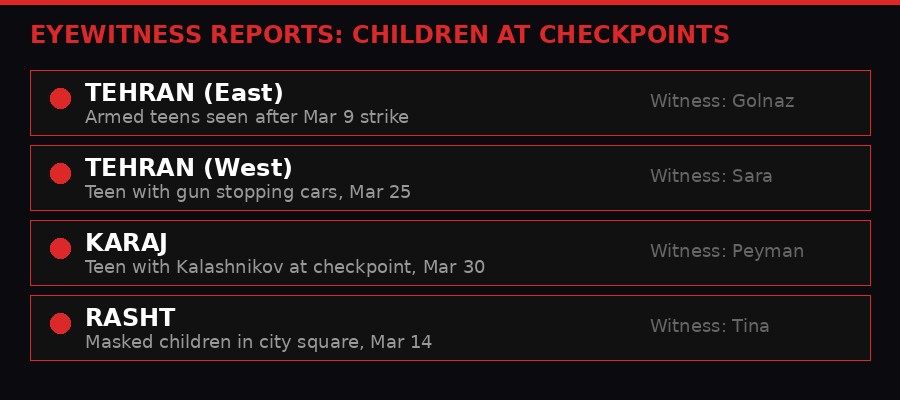
Eyewitness accounts from three Iranian cities describe children in armed checkpoint roles. (BLACKWIRE Infographic)
Additional witnesses who managed to connect to the internet told the BBC that the practice is ongoing. Some described patrols moving through neighborhoods at night carrying the Islamic Republic's flag and using loudspeakers - a presence designed to project authority but now staffed, in part, by children barely old enough for secondary school.
The Legal Abyss: What International Law Says, and What Iran Signed

Iran has ratified international protocols banning child recruitment - and appears to be violating them. (Unsplash)
The deployment of children in security and military roles during armed conflict is not a gray area under international law. It is explicitly prohibited under multiple frameworks that Iran has signed or is bound by.
The Optional Protocol to the Convention on the Rights of the Child on the involvement of children in armed conflict, which Iran ratified in 2010, sets 18 as the minimum age for direct participation in hostilities. It also requires states to "take all feasible measures to ensure that members of their armed forces who have not attained the age of 18 years do not take a direct part in hostilities."
The Geneva Conventions, to which Iran has been party since 1957, provide special protections for children in situations of armed conflict. Additional Protocol I requires parties to "take all feasible measures" to prevent children under 15 from taking "a direct part in hostilities" and prohibits their recruitment into armed forces.
The Rome Statute of the International Criminal Court classifies the conscription or enlistment of children under 15 into armed forces, or using them to "participate actively in hostilities," as a war crime. Iran is not party to the ICC, but the principle has achieved customary international law status, meaning it applies regardless of treaty membership.
Iran's own domestic law sets the military service age at 18. The Basij militia, however, exists in a legal gray zone - technically a "volunteer" organization rather than a formal military branch, though it is controlled by the IRGC and carries out armed security functions. This distinction may provide the regime with domestic legal cover, but it carries no weight under international humanitarian law, which looks at the nature of the activity, not the bureaucratic label attached to the organization performing it.
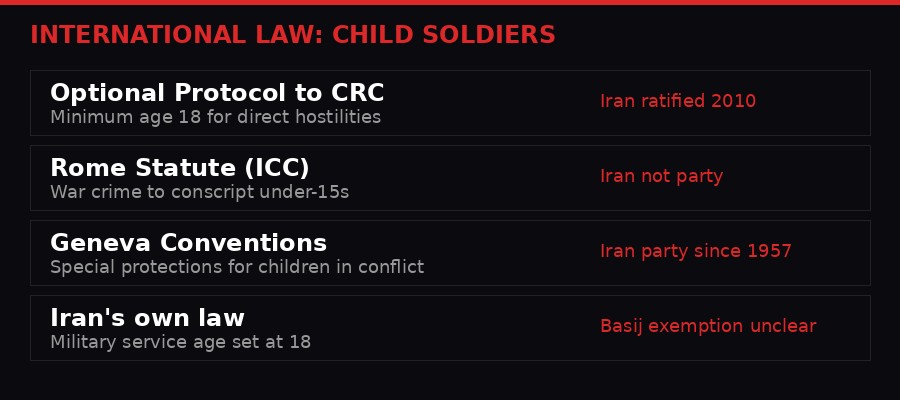
The legal frameworks Iran is violating by deploying children in armed security roles. (BLACKWIRE Infographic)
Pegah Banihashemi, an expert in constitutional law and human rights at the University of Chicago Law School, told the BBC that the deployment of children in security roles "introduces broader risks to society." She noted that "untrained minors operating under pressure, often with limited command structure and insufficient understanding of force, can unintentionally escalate violence and endanger civilians."
Bill Van Esveld of Human Rights Watch was more direct: "There is no excuse for a military recruitment drive that targets children to sign up, much less 12-year-olds. What this boils down to is that Iranian authorities are apparently willing to risk children's lives for some extra manpower."
The legal dimension extends beyond recruitment itself. Checkpoints are military targets. Israel has confirmed striking Basij checkpoints during the conflict. By placing children at these positions, the IRGC is positioning minors directly in the line of fire - at locations that have been and will continue to be targeted by air strikes. Alireza Jafari's death at a checkpoint on March 11 is not an accident or an aberration. It is the predictable outcome of using children as human infrastructure in a war zone.
The Basij Machine: A History of Youth Exploitation

The Basij has a decades-long history of mobilizing young Iranians, dating back to the Iran-Iraq War. (Unsplash)
Iran's use of children in armed conflict is not new. It is, in fact, central to the founding mythology of the Islamic Republic.
During the Iran-Iraq War (1980-1988), the Basij mobilized tens of thousands of young volunteers, many of them teenagers and some as young as 12, for frontline combat. The most notorious practice involved sending waves of young Basij members across minefields to clear paths for regular army units. They were given plastic keys, reportedly symbolic of the keys to paradise, and told that martyrdom awaited them. Estimates of the number of child soldiers killed during the Iran-Iraq War range from the thousands to the tens of thousands; precise figures remain disputed and politically charged within Iran.
The practice earned international condemnation at the time, and the Iran-Iraq War's child soldier legacy remains one of the most documented cases of systematic child military exploitation in modern history. The Basij's wartime role was immortalized in Iranian state propaganda as heroic self-sacrifice, creating a cultural narrative around youth martyrdom that persists in regime messaging to this day.
In the decades since, the Basij evolved into a domestic security force. During the 2009 Green Movement, Basij members - many of them young - attacked protesters, raided university dormitories, and operated as the regime's front-line enforcers. During the November 2019 protests triggered by a sudden fuel price hike, security forces including the Basij killed at least 1,500 people according to Reuters, citing Iranian interior ministry figures. The 2022-2023 Woman, Life, Freedom movement saw similar patterns of Basij street violence against protesters.
What makes the current moment different is the formal, public nature of the child recruitment announcement. Previous deployments of young people in security roles happened through informal channels - sons brought by fathers, neighborhood boys recruited at local mosques, teenagers swept into the machinery of state violence without official paperwork. The "Homeland Defender Fighters" program represents the regime openly declaring that it will recruit children for armed security duties during wartime, through official IRGC channels, and publicized through state-affiliated media.
The shift from covert practice to overt policy suggests that the manpower shortage is real and acute. A regime that preferred ambiguity now finds itself unable to maintain the fiction that children are not being used. So it is instead trying to normalize their use.
The War Context: Why Iran Is Running Out of Bodies

Over 3,000 dead in a month. Iran's military infrastructure is buckling under sustained US-Israeli strikes. (Unsplash)
The US-Israeli war on Iran, launched February 28, has been the most intense military campaign in the Middle East since the 2003 invasion of Iraq. More than 3,000 people have been killed. Nuclear facilities have been struck. Military bases across the country have been hit in rolling waves of air strikes.
On March 31 - the same day the child recruitment program was announced - US strikes hit Isfahan, sending a massive fireball into the sky over a city that houses one of Iran's three nuclear enrichment sites. Iran struck back by attacking a fully loaded Kuwaiti oil tanker in the Persian Gulf, demonstrating that it retains offensive capability even as its infrastructure degrades.
The Strait of Hormuz, through which roughly one-fifth of the world's oil moved during peacetime, has been effectively closed by Iranian action. Brent crude hovers around $107 per barrel, up more than 45% since the war started. US gas prices hit $4 per gallon on March 31 - the highest since 2022, according to AAA. The economic ripple effects are being felt globally, from European gas stations to Asian shipping lanes.
President Trump has escalated his rhetoric, telling allies to "go get your own oil" and threatening to widen the offensive to include Kharg Island, Iran's primary oil export hub, and possibly desalination plants. Defense Secretary Pete Hegseth, asked about ground forces at the Pentagon, said: "We don't want to have to do more militarily than we have to. But I didn't mean it flippantly when I said, in the meantime, we'll negotiate with bombs."
Inside Iran, the pressure on the security state is immense. The regular military is absorbing sustained damage from precision strikes. The IRGC's command structure has taken losses. And on the streets, the Basij must maintain the appearance of control across a country of 88 million people, many of whom despise the theocratic government and rose up in mass protests as recently as 2022-2023.
The population's relationship with the war is complicated. Many Iranians who oppose the regime also oppose foreign military intervention on Iranian soil. A young anti-government activist quoted by the AP said he plans to volunteer with the army if Trump follows through on threats to occupy Iranian territory. "If the idea of occupying islands or part of my country comes true," he said, "I'll be the first to defend Iran."
But defending the country and manning Basij checkpoints for a regime you despise are different things. The adults who might have volunteered are not volunteering. So the regime is turning to their children.
The International Response: Silence and Outrage

International institutions have so far been slow to respond to reports of child deployment at Iranian checkpoints. (Unsplash)
Human Rights Watch was among the first international organizations to sound the alarm. Bill Van Esveld's statement - that there is "no excuse" for targeting children as young as 12 for recruitment - was unambiguous. But HRW's ability to influence events inside Iran, particularly during wartime and under a government-imposed internet blackout, is limited.
The Kurdish human rights group Hengaw, which monitors conditions in Iran from outside the country, confirmed Alireza Jafari's death and identified him as a fifth-grade student killed while present at a Tehran checkpoint. Hengaw has been documenting rights abuses in Iran for years, including the violent suppression of Kurdish communities during the 2022-2023 protests, and its reporting carries credibility among Iran watchers.
UNICEF has not yet issued a public statement specifically addressing the IRGC's new recruitment program, though the organization has repeatedly stated that children should never be recruited or used in armed conflict. The office of the UN Special Representative for Children and Armed Conflict, currently Virginia Gamba, has historically documented cases of child soldier recruitment worldwide but faces challenges in accessing information from Iran, particularly during wartime.
The geopolitical context complicates any international response. The US and Israel are actively bombing Iran. European allies are fracturing over the war - Spain has closed its airspace to US military flights, Italy refused to let US bombers use the Sigonella air base in Sicily, and France has restricted overflight rights. In this environment, a coordinated Western response to Iranian human rights abuses during the very war the West is waging creates uncomfortable optics.
Russia and China, Iran's primary international backers, have shown no interest in condemning the child recruitment program. Both countries have their own histories of deploying young people in conflict zones and security roles, and neither has criticized Iran's wartime conduct in any meaningful way.
The practical reality is that an 11-year-old boy is dead, 12-year-olds are being formally recruited for armed checkpoint duty, and the international community is largely preoccupied with the broader war's economic and geopolitical consequences. Children make poor lobbyists, especially when they are standing at checkpoints in the dark, wearing masks to hide faces too young for the work they have been assigned.
What Comes Next: The Escalation Trap

The formalization of child recruitment suggests Iran expects the war to continue for weeks or months. (Unsplash)
The IRGC's decision to formalize child recruitment is a leading indicator. Governments do not build bureaucratic programs for temporary needs. The creation of a named initiative - "Homeland Defender Fighters for Iran" - with defined age thresholds, recruitment channels, and public announcement through official media suggests the regime is preparing for a protracted conflict.
Defense Secretary Healey, visiting the Gulf on March 31, said he expected the war to continue "for some weeks." Trump's rhetoric oscillates between threatening escalation and hinting at diplomatic offramps. Iran's leadership shows no signs of capitulation. Every week the war continues, the IRGC will need more bodies at more checkpoints in more cities.
The children of Iran are being fed into that arithmetic.
The deployment of minors at military targets creates a grotesque calculus for the attacking forces. If Israel has stated that it targets Basij checkpoints - and it has - and those checkpoints are now staffed by children, every strike carries the risk of killing more Alirezas. The IRGC knows this. The presence of children at checkpoints serves a dual purpose: filling a manpower gap and creating a human shield effect that raises the political and moral cost of strikes for the attacking side.
For the children themselves, the situation is existential in the most literal sense. They are standing in the dark at positions that are being bombed. They are carrying weapons they may not know how to safely operate. They are being asked to stop cars and search adults while their own voices have not yet broken. As Banihashemi warned, "untrained minors operating under pressure, often with limited command structure and insufficient understanding of force, can unintentionally escalate violence and endanger civilians."
The untrained minor with a Kalashnikov in Karaj. The short, slight teenager pointing a gun at cars in west Tehran. The masked children in the Rasht city square whose age was visible only through their eyes. These are not soldiers. They are children standing at the intersection of a regime's desperation and a war's indifference to who it consumes.
Alireza Jafari told his mother he wanted to become a martyr. He was eleven years old. He did not understand what he was asking for. The adults who put him at that checkpoint did.
Sources: BBC News Persian (Ghoncheh Hababiazad, March 31, 2026), Human Rights Watch (Bill Van Esveld statement), Fars News Agency (Rahim Nadali interview), Hamshahri (Sadaf Monfared interview), Associated Press (Iran war coverage, March 31, 2026), Hengaw Human Rights Organization, University of Chicago Law School (Pegah Banihashemi), The Washington Institute for Near East Policy (Holly Dagres), AAA fuel price data, Reuters (Iran war casualties). All witness names changed for security by BBC News Persian.
Get BLACKWIRE reports first.
Breaking news, investigations, and analysis - straight to your phone.
Join @blackwirenews on Telegram