Iran's Cluster Bombs Are Cracking Iron Dome

Three weeks into the US-Israel war on Iran, the Israeli military made a quiet, damning admission: its air defense systems had failed to intercept Iranian missiles that struck the towns of Arad and Dimona. The official explanation was that the weapons were "not special or unfamiliar." An investigation was underway.
That statement was technically accurate and strategically evasive. The missiles were familiar. The mechanism was not the problem. The problem is that Iran has systematically integrated cluster warheads into its ballistic missile arsenal - and that single change has transformed every intercept attempt into a game that favors the attacker.
The math is brutal. A standard ballistic missile presents a single target. Shoot it down and the threat is gone. A cluster-warhead missile presents one target - right up until it doesn't. Seconds before impact, the missile skin peels open, spins, and releases between 20 and 80 individual bomblets into the air. At that point, you no longer have one interception problem. You have dozens.
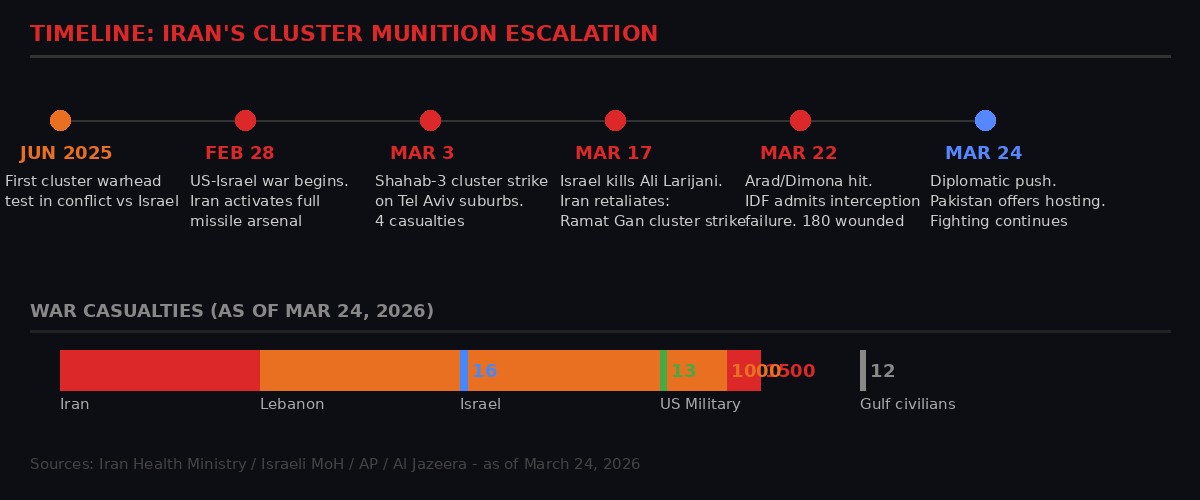
War Casualties - Day 24 (March 24, 2026)
How the Weapon Works

The cluster warhead is not a new weapon. It has been banned for signatories to the 2008 Convention on Cluster Munitions. Neither Iran nor Israel has signed. Both have used them. The irony of Israeli condemnation this week was not lost on the international community.
Uzi Rubin, founding director of Israel's missile defense programme and now a senior fellow at the Jerusalem Institute for Strategy and Security, described the mechanism plainly to the Media Line news agency: "The tip of the missile, instead of containing a big barrel of explosives, contains a mechanism which holds onto a lot of small bombs. And when the missile approaches the target, it opens its skin, it peels off and it spins around and the bomblets are released and fall on the ground."
The key point is the timing. Standard missile defense - Arrow, David's Sling, Iron Dome, Patriot - is calibrated to track a single projectile and launch an interceptor before impact. The systems work. Against a conventional ballistic missile, Israeli forces have achieved consistently high interception rates.
But cluster warheads change the intercept window. The missile must be destroyed before the payload opens and releases submunitions mid-flight. After that moment, the threat has already multiplied. You're no longer tracking one object. You're tracking dozens. Radar systems can be saturated. Interceptors are expensive. Bomblets are cheap.
"A single penetrating cluster missile can generate multiple impact points, debris fields, unexploded bomblets, civilian panic and heavy demands on bomb-disposal teams, emergency services and infrastructure repair. In resource-constrained or prolonged exchanges, this acts as a force multiplier, allowing sustained coercive pressure with lower launch rates." - Elijah Magnier, Brussels-based military and political analyst, speaking to Al Jazeera, March 24, 2026
The psychological dimension is deliberate. Unexploded bomblets - called UXOs in military parlance - can litter a strike zone for weeks. Emergency teams get called out. Residential areas become hazardous. The resource drain extends far beyond the initial strike. Rubin estimated that Iranian cluster warheads carry between 20 and 80 bomblets per missile, depending on type. The Kheibar Shekan, Iran's most battle-tested medium-range ballistic missile, reportedly carries warheads in the higher range of that figure.
The Weapons Iran Is Using
Iran's ballistic missile program is the largest in the Middle East. It was built over decades as a deterrent and power-projection tool for a country that cannot afford - and has not developed - a modern air force capable of competing with US or Israeli assets.
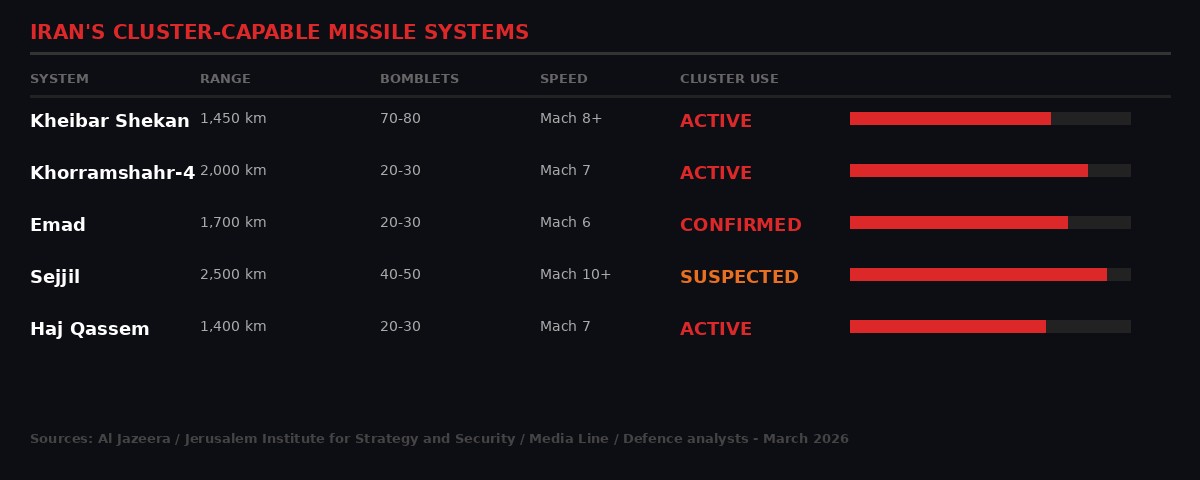
Defence analysts have identified the following systems as cluster-capable. The Kheibar Shekan has a range of approximately 1,450 kilometers and has been used in multiple confirmed strikes against central Israel. It carries a maneuverable reentry vehicle, meaning it can adjust course in the final seconds of flight - a feature that further complicates intercept calculations.
The Khorramshahr-4, with an estimated range of 2,000 kilometers, has been described as Iran's most accurate long-range ballistic missile. Its cluster variant was reportedly used in the March 22 strikes on Arad and Dimona - the attacks that prompted the Israeli military's unusual public admission of failure.
The Emad is an older system but has been confirmed in cluster warhead configuration. Its guidance system uses GPS-INS hybrid navigation, giving it an estimated circular error probable of around 500 meters - sufficient for area saturation when paired with a cluster warhead.
The Sejjil is the most concerning. With an estimated range of 2,000 to 2,500 kilometers, it is a two-stage solid-fuel missile - solid fuel meaning it can be launched within minutes of a decision, with no extended liquid-fuel preparation period that intelligence assets might detect. Its cluster integration has not been publicly confirmed in this war, but analysts assess the capability exists. Former Supreme Leader Ali Khamenei had previously capped Iranian missile ranges at 2,200 kilometers. That cap was removed after Israel's 12-day war in June 2025. The Sejjil is now theoretically range-cleared to reach targets well beyond the Middle East theater.
"Iran first demonstrated this capability publicly in June 2025 when it fired a cluster-warhead ballistic missile into central Israel. Its reuse in 2026 indicates that the capability is integrated and deliberate rather than improvised." - Elijah Magnier, military analyst, to Al Jazeera, March 24, 2026
What Failed Over Arad and Dimona

The March 22 strikes were a turning point. Iranian missiles hit Arad, a city of roughly 26,000 people in the Negev, and Dimona - a name that carries particular weight in Israeli security culture because of the nearby Negev Nuclear Research Center. Iran said the strikes on Dimona were deliberate retaliation for an Israeli strike on Iran's offshore South Pars gasfield in Isfahan province.
Israeli authorities evacuated hundreds from both towns. At least 180 people were wounded. Israeli air defense systems were activated, according to military spokespeople, but failed to intercept all incoming threats. The admission was carefully worded: the weapons were "not special or unfamiliar." The investigation was described as ongoing.
What that statement obscures is the mechanism of the failure. Standard air defense systems in Israel's layered architecture - from the short-range Iron Dome to the long-range Arrow-3 - are designed for different threat envelopes. Arrow is intended for exo-atmospheric intercept of long-range ballistic missiles. The problem with cluster warheads is they demand intercept at the right altitude. Too early and the guidance may not have committed to a trajectory. Too late and the payload has already separated.
The Israeli military has not publicly described which systems attempted intercepts over Arad and Dimona. The phrase "not special or unfamiliar" may refer to the missile airframe - which is known. But the warhead integration represents a qualitative shift that the existing defense architecture was not designed to comprehensively defeat.
Magnier described the defense problem precisely: "To stop a ballistic missile equipped with cluster bomblets, it must be intercepted before the payload opens and releases its submunitions. After the payload opens mid-flight, the missile goes from a single point of attack to multiple points, making it difficult to stop."
The March 22 failure over Dimona also carries a secondary signal. Iran struck near a nuclear research facility. Deliberately or not, that proximity demonstrates that Iran's guided ballistic missiles can reach militarily significant locations in Israel's southern interior. The psychological message is calibrated: if we can reach here, we can reach anything.
The Ramat Gan Strike and a Couple Who Couldn't Reach the Safe Room

On March 17, hours after Israel assassinated Ali Larijani - Iran's top security official - the IRGC launched a cluster missile strike at Ramat Gan, a dense suburb immediately east of Tel Aviv. The attack was explicitly described as revenge. Iran's Revolutionary Guards called it that by name.
Two people were killed. Both were in their 70s. They had a safe room in their home. They did not reach it in time.
Al Jazeera's Nida Ibrahim reported that the incident raised immediate questions about the adequacy of Israel's public warning systems. Air raid sirens are calibrated to give the public enough time to reach shelter. Against a conventional ballistic missile with a predictable trajectory, the warning window can be calculated and broadcast. Against a cluster warhead that opens mid-flight and sends dozens of submunitions on divergent paths, the geometry of the threat changes at the last moment. The siren window may no longer be sufficient.
Several other people were injured by falling shrapnel. A Tel Aviv train station sustained damage from submunitions that impacted its exterior. The dispersal radius of a cluster strike means that the lethal zone is not a point but an area - potentially hundreds of meters in diameter, depending on altitude of deployment and warhead type.
Israel has itself been accused of using cluster munitions in Lebanon in previous conflicts. Human Rights Watch documented their use in the 2006 Lebanon war. In 2024 and 2025 strikes on southern Lebanon, similar allegations emerged. The current war's dynamic - Iranian cluster strikes on Israeli cities - is, in the words of Al Jazeera's analysis, "a twist of fate for a country that has itself been accused of using these dangerous weapons."
Tehran Under Black Rain: The Environmental Dimension

While missile exchanges dominate the tactical picture, a slower catastrophe is unfolding over Tehran. US and Israeli strikes on oil depots, refinery infrastructure, and industrial sites have produced enormous quantities of petrochemical smoke. Black rain has been falling over the Iranian capital.
Al Jazeera's podcast "The Take" documented the phenomenon on March 24, interviewing Narges Bajoghli, a cultural anthropologist at Johns Hopkins University, on the public health implications. The contamination is not limited to the strike radius. It seeps into lungs, infiltrates soil, and enters water systems.
The compounds released by burning oil infrastructure include benzene, a known human carcinogen, along with toluene, xylene, and polycyclic aromatic hydrocarbons. Short-term exposure produces respiratory distress. Long-term exposure is linked to elevated cancer rates, neurological damage in children, and reproductive health consequences. The populations most at risk are those who cannot evacuate - the elderly, the poor, people in areas where public transport has been disrupted by the war.
This is not incidental damage. Striking energy infrastructure in a densely populated capital is a choice. The military logic is clear - degrading Iran's oil revenue, disrupting fuel supplies, signaling cost. The civilian health cost is also clear. It simply receives less attention than missile trajectories.
QatarEnergy's declaration of force majeure on March 24 - citing production disruptions from Iranian attacks on the Ras Laffan facility - captures the regional scale of infrastructure damage on all sides. Qatar's LNG CEO Saad al-Kaabi told Reuters that two of 14 LNG trains were damaged, wiping out 17 percent of LNG export capacity and causing an estimated $20 billion in lost annual revenue. The repair window: three to five years. The affected customers: Italy, Belgium, South Korea, and China.
"Targeting energy infrastructure constitutes a threat to global energy security, as well as to the peoples of the region and its environment." - Majed al-Ansari, spokesperson, Qatar Ministry of Foreign Affairs, March 2026
Diplomacy While the Missiles Fly: Pakistan, Ghalibaf, and the Kushner Channel

On Monday, March 23, Trump posted on Truth Social that Washington and Tehran had held "very good and productive conversations regarding a complete and total resolution of our hostilities." He gave Iran a five-day pause before any strike on power plants. Markets briefly responded - Brent crude dropped. Then it climbed back above $100 a barrel by Tuesday morning, up nearly 40 percent since the war started on February 28.
Iran's Foreign Ministry rejected the characterization. The IRGC issued a statement that Iran's forces would continue "until complete victory." Iranian military spokesman Maj. Gen. Ali Abdollahi Aliabadi did not define what victory meant. That ambiguity is probably deliberate.
Multiple sources - three Pakistani officials, one Egyptian official, and a Gulf diplomat, all speaking anonymously to AP - confirmed that the US had agreed in principle to talks in Pakistan. The proposed US delegation: special envoy Steve Witkoff and Jared Kushner. The obstacle: convincing Iran to send anyone.
Trump, speaking at the White House on Tuesday, confirmed negotiations were underway and named Witkoff, Kushner, Secretary of State Marco Rubio, and Vice President JD Vance as involved parties. He referred to talking with "a man that I believe is the most respected - not the supreme leader" - declining to name the contact out of what he characterized as concern for that person's safety.
Axios, Politico, and multiple Israeli outlets named the contact: Mohammad Bagher Ghalibaf, speaker of Iran's parliament. Ghalibaf promptly denied it on X: "No negotiations have been held with the US, and fake news is used to manipulate the financial and oil markets and escape the quagmire in which the US and Israel are trapped."
Whether Ghalibaf is the contact or not, the structural problem with any negotiations is deep. Iran is highly suspicious of the US - twice under the Trump administration, Washington has launched military strikes during periods of ostensibly high-level diplomatic engagement, including the February 28 strikes that started this war. Any Iranian official willing to engage risks appearing complicit in legitimizing US military action. Any agreement would need sign-off from new Supreme Leader Mojtaba Khamenei - whose father, Ali Khamenei, was killed on the war's first day.
Pakistan's prime minister publicly offered to host talks on March 24. Turkey and Egypt are also involved in mediation efforts, according to diplomatic sources. The Egyptian official described the immediate focus as "trust-building" - not a ceasefire framework, not a formal agreement, just enough confidence-building to create a mechanism for Iran to reopen the Strait of Hormuz without appearing to capitulate.
That mechanism is the core pressure point. One-fifth of the world's oil and LNG transits through Hormuz. Every week it remains closed is a week of compounding economic damage to Europe, Asia, and the Gulf states caught in the crossfire. Iran's chokehold is its most powerful leverage. It will not relinquish it without something in return.
TIMELINE: KEY EVENTS - WAR WEEK 4
Lebanon Gets Dragged Back In

The war is not contained to the Iran-Israel axis. Israel has been striking Beirut's southern suburbs, the Dahieh, this week - targeting what its military describes as infrastructure used by Hezbollah. Lebanon's Health Ministry reported at least three killed in a strike on a residential apartment southeast of the capital, including a 3-year-old girl. Five more people were killed in the south. In northern Israel, a woman died from shrapnel during an attack from Lebanon.
Lebanon's government took a notable step on March 24: it declared Iran's ambassador persona non grata and ordered him to leave within days. Iranian flights have been banned from Lebanese airspace, out of fear that they are being used to ferry weapons and funding to Hezbollah.
The move reflects a split that has been building for weeks. Top Lebanese government officials have accused Iran of dragging Lebanon into a war that the Lebanese state did not choose and cannot afford. The 2006 war devastated Lebanon's infrastructure. The 2024 conflict caused severe damage again. A third cycle of destruction, tied to a war in which Iran is the principal combatant, has generated significant public anger in a country where not everyone views Hezbollah as Lebanon's defender.
Israeli strikes in Lebanon have killed more than 1,000 people and displaced more than one million, according to Lebanese authorities. The Lebanese government's expulsion of the Iranian ambassador is, in part, an attempt to create visible political distance from Iran - to signal to Israel and the international community that Lebanon is not a willing extension of the Iranian war effort.
That signal may not change Israeli targeting calculations. From Israel's military perspective, Hezbollah infrastructure on Lebanese soil is a threat regardless of what Beirut's political class says. The war's geography has always extended from Tehran to Tel Aviv through Lebanese territory, and that dynamic has not changed.
Colombia: 66 Soldiers Dead in Military Transport Crash

Away from the Iran theater, Colombia is dealing with a military disaster of its own. A C-130 Hercules transport aircraft carrying 128 people - 115 soldiers, 11 crew, and 2 national police officers - crashed shortly after takeoff from Puerto Leguizamo on Monday, March 23. At least 66 people were killed. Four military personnel remained missing as of Tuesday. Fifty-seven people were evacuated to hospitals in Bogota and other cities.
General Hugo Alejandro Lopez Barreto, head of Colombia's armed forces, confirmed the death toll and said there was no indication the crash was caused by an attack from illegal armed groups. Puerto Leguizamo sits in Putumayo province, in the Amazonian lowlands bordering Ecuador and Peru - territory with significant activity from FARC dissidents and drug trafficking organizations.
Colombian aviation expert and military analyst Erich Saumeth told AP that the aircraft had been donated by the US in 2020 and underwent a detailed overhaul in 2023 with engine inspections and key component replacements. "I don't think this plane crashed because of a lack of good parts," Saumeth said. He said investigators would need to determine why all four engines failed so quickly after takeoff.
President Gustavo Petro, using the disaster to press his longstanding argument for military modernization, warned that budget constraints and "bureaucratic difficulties" had obstructed his efforts to upgrade Colombian military equipment. Critics pointed out that the Petro administration had reduced military flight hours due to budget cuts - a reduction that produces less experienced aircrews. The cause of the crash was under investigation as of Tuesday evening.
What Comes Next

The contours of any ceasefire are becoming clearer - and the obstacles are enormous. The Strait of Hormuz remains closed. Global energy prices are up nearly 40 percent since the war started. Iran has lost more than 1,500 people. Israel has lost 16. The asymmetry in casualties runs parallel to the asymmetry in economic damage - Iran's oil infrastructure is being systematically degraded, but the Strait closure is hurting every economy that depends on Gulf energy exports.
Trump's self-imposed deadline for Iran to reopen Hormuz has already been extended once. The five-day pause on power plant strikes is the current negotiating table. What the US wants is clear: reopen the strait, halt the missile program, abandon nuclear ambitions. What Iran wants has not been publicly stated in terms that could form the basis of an agreement. "Complete victory" is a slogan, not a negotiating position.
The cluster munition dimension will not disappear even if a ceasefire is reached. The weapons have proven effective. Iran has demonstrated the capability is integrated into its missile arsenal, not improvised. Any future confrontation will inherit this knowledge. Israeli air defense architects will need to rethink intercept doctrine against cluster-warhead ballistic missiles - a problem that has no cheap solution.
Thousands more US Marines are heading to the Gulf. Speculation in military circles centers on whether the US may attempt to seize or neutralize Kharg Island, which handles the bulk of Iranian oil export capacity. That operation would mark a significant escalation - moving from air strikes to naval and amphibious operations that could not be walked back easily.
Pakistan's offer to host talks, backed by Turkish and Egyptian mediation, gives both sides a face-saving off-ramp if they want one. Whether they do - whether the US calculates it can achieve its stated objectives through continued military pressure, whether Iran calculates it can absorb that pressure without political collapse - is the question on which the war turns.
For now, on March 24, 2026, the missiles are still flying in both directions. The cluster warheads are still opening mid-flight over Israeli cities. The black rain is still falling over Tehran. The Strait of Hormuz is still closed. And the diplomatic back-channels are operating at exactly the same time as the air defense radars.
Get BLACKWIRE reports first.
Breaking news, investigations, and analysis - straight to your phone.
Join @blackwirenews on Telegram