The Water Weapon: Iran Threatens to Destroy Gulf Desalination Plants as Trump Gives 48-Hour Power Plant Ultimatum

Desalination infrastructure across the Gulf now sits within range of Iranian strikes. Hundreds of plants supply drinking water to tens of millions. (Pexels)
The war between the United States, Israel, and Iran crossed a new threshold Sunday night. This is no longer just a fight over missile stockpiles and nuclear centrifuges. Both sides are now explicitly threatening the infrastructure that keeps modern civilization running - power plants on one side, drinking water on the other.
President Donald Trump issued a 51-word ultimatum from Florida Saturday night: open the Strait of Hormuz within 48 hours or the U.S. will destroy Iran's power plants, starting with the largest. Iran's parliament speaker responded within hours, threatening to "irreversibly destroy" vital infrastructure across the region - including the desalination facilities that produce nearly all drinking water for Kuwait, Bahrain, Oman, Saudi Arabia, and the UAE.
On Sunday, Bahrain confirmed Iranian strikes had already damaged one of its desalination plants. Hundreds more sit within range along the Persian Gulf coast, each one supplying drinking water to cities that have no other source. The fourth week of a war that has already killed more than 2,000 people and pushed oil to near $99 a barrel is now a race to see who blinks before the taps go dry.
LIVE DEVELOPMENT: Israel detected additional Iranian missiles fired toward southern communities Sunday evening, hours after strikes wounded at least 175 people near the Dimona nuclear research site. Iran and the U.S. have both threatened each other's civilian energy infrastructure within 48 hours. No ceasefire talks are publicly underway.
The 48-Hour Ultimatum and What It Actually Means

Trump's ultimatum targets Iran's energy grid - power plants that supply hospitals, homes, and water treatment facilities. (Pexels)
Trump's late-Saturday post was 51 words, heavy on capitals. The message: open the Strait of Hormuz within 48 hours or the U.S. will "hit and obliterate" Iran's power plants - "STARTING WITH THE BIGGEST ONE FIRST." No legal review was apparent in the message's tone. No targeting criteria were specified. No offer of talks was extended.
UN Ambassador Mike Waltz defended the threat Sunday on Fox News, framing it in narrow legal terms: Iran's Revolutionary Guard, a U.S.-designated terrorist organization, controls much of the country's infrastructure. Potential targets include, Waltz said, "gas-fired thermal power plants and other types of plants." He wanted to get ahead of the "hand-wringing," he said.
The hand-wringing has substance behind it. Laws governing warfare do not explicitly ban attacks on power plants, but legal scholars say they are permitted only when the military advantage demonstrably outweighs civilian harm - a high bar when electricity runs hospitals, water treatment, home heating, and food supply chains across an entire nation.
"It certainly has a feeling of ready, fire, aim. He overestimated his ability to control the events once he unleashed this torrent of violence." - Geoffrey Corn, military law professor, Texas Tech University; retired U.S. Army lieutenant colonel and military lawyer, speaking to AP News
Sen. Ed Markey of Massachusetts was blunter: "Trump has no plan to reopen the Strait of Hormuz, so he is threatening to attack Iran's civil power plants. This would be a war crime." Sen. Chris Murphy of Connecticut: "He's lost control of the war and he is panicking."
Iran's U.N. ambassador filed a formal letter to the Security Council: attacks on power plants "would be inherently indiscriminate and clearly disproportionate." Tehran noted the irony - the White House has already faced international backlash over a U.S. missile strike on an Iranian elementary school in Minab that killed more than 165 people.
Israel's own ambassador to Washington cautioned Trump against the all-out attack he described. "We want to leave everything in the country intact, so that the people who come after this regime are going to be able to rebuild and reconstitute," Yechiel Leiter told CNN's State of the Union. Even U.S. allies are telling Trump to hold back.
Iran's Counter-Threat: Destroy the Water

Gulf desalination plants convert seawater to drinking water through energy-intensive reverse osmosis. They have no viable alternative in the region's arid climate. (Pexels)
Iranian parliament speaker Mohammad Bagher Qalibaf's response came fast. If Iran's power plants are targeted, he posted on X, then energy and desalination facilities across the region - those "critical for drinking water in Gulf nations" - would be considered legitimate targets and "irreversibly destroyed." Then he added a second post: "entities that finance the US military budget are legitimate targets."
That second statement is a threat aimed at Gulf Arab states that host U.S. military bases - Saudi Arabia, Bahrain, Qatar, Kuwait, the UAE. All of them depend on desalination for drinking water. All of them have significant portions of their civilian population concentrated in cities that would face a water crisis within days of a major plant outage.
Iran already hit a Bahraini desalination plant Sunday - Bahrain confirmed this, though it said supplies had not yet gone offline. Bahrain, home to the U.S. Navy's Fifth Fleet, has been repeatedly targeted since the war began February 28. The island nation is small, densely populated, and almost entirely dependent on desalinated seawater for drinking water.
Earlier in the war, the U.S. destroyed a desalination plant on Iran's Qeshm Island, cutting water to 30 villages. Iran's foreign minister, Abbas Araghchi, called that strike "setting a precedent." His point: don't complain when we apply the same logic you already used.
"Everyone thinks of Saudi Arabia and their neighbors as petrostates. But I call them saltwater kingdoms. They're human-made fossil-fueled water superpowers. It's both a monumental achievement of the 20th century and a certain kind of vulnerability." - Michael Christopher Low, director of the Middle East Center, University of Utah, speaking to AP News
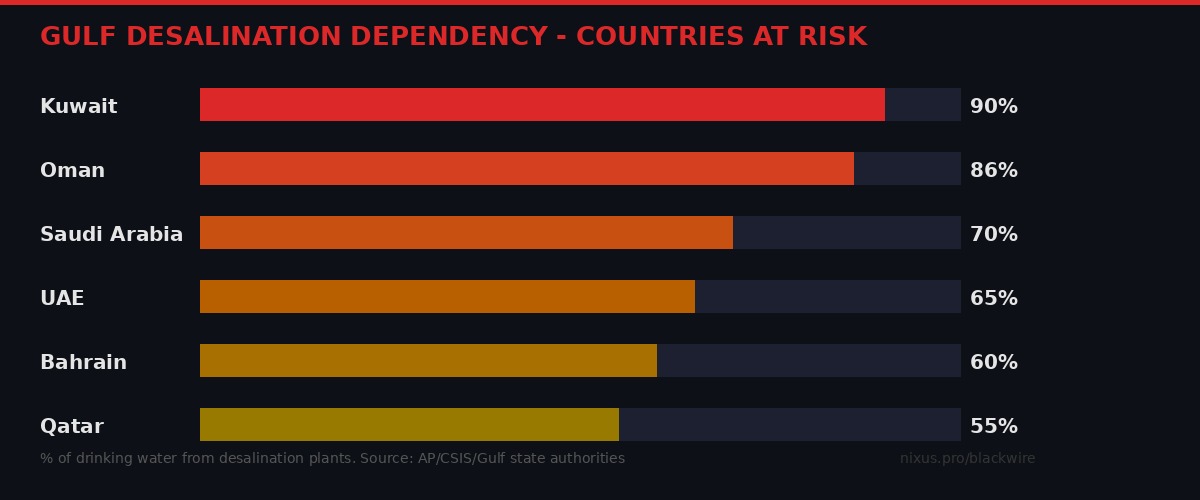
Desalination dependency by country - the percentage of each Gulf nation's drinking water that comes from seawater conversion plants. Kuwait leads at 90%, meaning virtually no natural freshwater source exists. (BLACKWIRE / AP / CSIS data)
The Scale of Gulf Water Vulnerability

Gulf cities like Dubai, Kuwait City, and Manama have populations in the millions dependent almost entirely on desalinated water. (Pexels)
The Strait of Hormuz dominates the war's economic narrative. But the desalination threat may be the more immediate human catastrophe if it escalates. Hundreds of plants line the Persian Gulf coast from Iraq through Kuwait, Saudi Arabia, Bahrain, Qatar, the UAE, and Oman. These are not redundant systems. They are the water supply, full stop.
Kuwait gets 90% of its drinking water from desalination. Oman, 86%. Saudi Arabia, 70%. The UAE, around 65%. These numbers are not the result of poor planning - the Gulf has almost no freshwater aquifers capable of sustaining modern urban populations. Desalination was the technology that made cities of millions possible in an environment where it does not rain for most of the year.
Desalination plants are physically large, hard to hide, and easy to find on satellite imagery. They are frequently co-located with power stations because the reverse osmosis process is enormously energy-intensive. That integration is also a vulnerability: hit the power source and the water stops. The plants are, as David Michel of the Center for Strategic and International Studies put it to AP News, "not any more protected than any of the municipal area" around them.
March 2 set the tone. Iranian strikes on Dubai's Jebel Ali port landed 12 miles from the world's largest cluster of desalination infrastructure. The water kept flowing - but the margin was noted. Satellite imagery flagged a possible fire near the Fujairah F1 power and water complex in the UAE. The operator said the facility was undamaged, but the message was already delivered.
Kuwait's Doha West desalination plant sustained damage from drone debris intercepted near nearby port facilities. Bahrain's water infrastructure has been under intermittent pressure since week one of the war. The strikes have been probing - testing responses, mapping vulnerabilities, establishing precedents.
Iran's parliament speaker has now made the escalation framework explicit: if power plants are fair game, so is water. Ed Cullinane, Middle East editor at Global Water Intelligence, warned that even partial damage cascades across systems. "Desalination plants have multiple stages - intake systems, treatment facilities, energy supplies - and damage to any part of that chain can interrupt production," he told AP News.
Trump's War Without an Exit - The Strategic Collapse

The U.S. Navy has roughly 50,000 personnel supporting the war effort in the Middle East, with more marines en route - even as Trump signals a wind-down. (Pexels)
The power plant ultimatum is the latest in a sequence of contradictory moves that expose the absence of a U.S. endgame. Over roughly a week, Trump has said the U.S. was "winding down" the war, announced deployment of three additional warships and 2,500 more marines, lifted sanctions on Iranian oil for the first time in decades, floated the idea of letting "other nations" police the Strait of Hormuz, suggested the strait would "open itself," and then threatened to obliterate Iranian power infrastructure.
Sen. Thom Tillis, a Republican from North Carolina, put it plainly on ABC's "This Week": "You can't all of a sudden walk away after you've kind of created the event and expect other people to pick it up."
The Pentagon has asked Congress for an additional $200 billion to fund the war. That is not a number associated with a conflict being wound down. It comes days after news that 50,000 U.S. service members are already supporting the effort - and three more warships with expeditionary Marine units are on the way, units designed for amphibious landings.
NATO's secretary-general, Mark Rutte, tried to project calm Sunday, saying more than 20 countries were "coming together to implement" Trump's vision of making the strait navigable. But previous coalition requests produced formal rejections. France, Germany, and Britain have all declined to deploy warships to a hot strait where, as retired French Vice Admiral Pascal Ausseur put it to AP, "sending warships or civilian vessels into the Strait of Hormuz would be suicidal."
Trump lifted sanctions on Iranian oil sales this week in an attempt to push more oil into global markets and ease the pump prices that are eating into American consumers' tax refunds. But the move gave away leverage without securing the strait's reopening. Iran collected the benefit and kept the missiles in place.
"Trump has no plan to reopen the Strait of Hormuz, so he is threatening to attack Iran's civil power plants. This would be a war crime." - Sen. Ed Markey (D-MA), speaking to reporters, March 22, 2026
Nuclear Shadows Over the Negev

Iranian missiles struck communities near Dimona in the Negev Desert Saturday night. Dimona hosts a secretive nuclear research facility widely believed to be Israel's nuclear weapons complex. (Pexels)
While the infrastructure threats dominate Sunday's news cycle, the war's most dangerous dimension is playing out in the Israeli desert. Iranian missiles struck communities near the Dimona nuclear research site in the Negev Saturday night, wounding at least 175 people, including those treated at southern Israel's main hospital. Prime Minister Benjamin Netanyahu called it a "miracle" that no one died. Israel detected more missiles fired toward the same area Sunday evening.
Dimona is where Israel is widely believed to produce nuclear weapons - though the country maintains a policy of deliberate ambiguity, neither confirming nor denying possession. The fact that Iran targeted communities near this facility, twice, inside a single 24-hour period, marks a deliberate escalation in signaling. Iran knows what Dimona is. The targeting was not accidental.
The strike on Iran's Natanz nuclear enrichment facility Saturday preceded the Negev attack. Iran's state media framed the Dimona-area strike as explicit retaliation. Israel denied responsibility for the Natanz hit. The Pentagon declined to comment. Iran's judiciary agency said there was "no leakage" from Natanz. The IAEA has reported that most of Iran's estimated 441 kilograms of enriched uranium - enough, if further processed, to potentially fuel weapons - is actually buried beneath rubble at Isfahan, not Natanz.
The nuclear subtext to this war has been present from the first strikes on February 28. The stated goals included degrading Iran's nuclear program, dismantling its missile production, and cutting off its support for armed proxies from Hezbollah to Houthi forces in Yemen. Netanyahu claimed Sunday that Israel and the U.S. were "well on their way" to these objectives. Military analysts have noted that Iranian missile launches have decreased in frequency - but not stopped, and not changed in targeting logic.
Lebanon: Bridges Fall, Invasion Threat Grows

Israel has begun systematically targeting bridges over the Litani River in southern Lebanon, a move Lebanese President Aoun called a "prelude to a ground invasion." (Pexels)
A separate front is accelerating north of Israel. Israeli Defense Minister Israel Katz ordered the military to expand its target list Sunday to include bridges over the Litani River in southern Lebanon. The stated military rationale: Hezbollah is using these crossings to move fighters and weapons southward. Israel struck the Qasmiyeh bridge near the coastal city of Tyre, giving residents one hour's warning before the hit.
Lebanese President Joseph Aoun called the bridge strikes "a prelude to a ground invasion." That framing is consistent with how Israeli forces have historically softened logistics corridors before major ground operations - cutting roads and bridges to slow reinforcement and resupply before pushing forces through.
Hezbollah claimed responsibility Sunday for an airstrike that killed a 61-year-old Israeli farmer, Ofer Moskovitz, in his car near the northern border town of Misgav Am. Israel's military initially attributed the death to a rocket attack, then said it was investigating whether Israeli soldiers may have accidentally fired the fatal shot. Two days earlier, Moskovitz told a radio station that living near the Lebanese border felt "like Russian roulette."
Lebanese authorities report more than 1,000 people killed by Israeli strikes and over one million displaced. Hezbollah has fired hundreds of rockets into northern Israel since the war began, citing the killing of Iran's Supreme Leader Ayatollah Ali Khamenei as the trigger. Katz also ordered the military to accelerate destruction of Lebanese homes near the border - a measure that goes beyond tactical necessity into the language of demographic clearance.
At the same time, an Israeli civilian killed in Misgav Am underscores that northern Israel communities are not protected by geography. The border is a two-way pressure point, and any Israeli ground push into Lebanon opens a third active combat front in a war where the Strait of Hormuz is already demanding most of the world's attention.
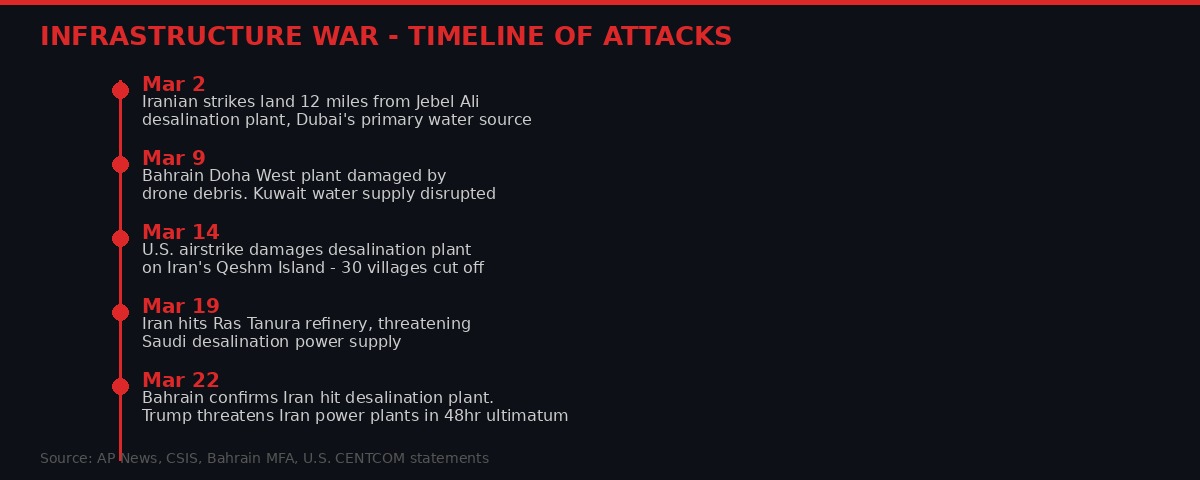
Infrastructure attacks have escalated steadily across the four weeks of conflict - from near-misses at the war's opening to confirmed strikes on water and energy facilities as of Day 26. (BLACKWIRE / AP / CSIS)
The Economic Feedback Loop

Gulf oil fields are cutting production as storage fills, a disruption that could take weeks or months to reverse even after hostilities end. (Pexels)
The war's economic dimensions are compounding. Brent crude rose from $72.97 the day before fighting began to nearly $99 on Thursday - a 35% spike in under four weeks. LNG prices have spiked globally since Qatar shut down Ras Laffan, the world's largest LNG export terminal, after a drone strike disrupted operations. Qatar produces 20% of the world's liquefied natural gas. The shutdown forced QatarEnergy to invoke force majeure with its contracted customers across Asia and Europe.
The S&P 500 dropped 1.5% Friday. Gas prices in the United States are rising fast enough to eat into the tax refunds Trump has been touting. Spiking fuel costs flow through the entire economy - transportation, agriculture, manufacturing, heating, everything that moves or needs energy. The Federal Reserve is watching an inflation spike it did not model for and cannot control through interest rate adjustments alone.
Iraqi oil production has been curtailed at the Rumaila and West Qurna fields because storage capacity is full - tankers cannot move through a strait choked by Iranian threats, so oil has nowhere to go. "It's going to take time to restart production in some of these fields even if the Strait of Hormuz reopens," a Gulf energy analyst told AP. Some wells, once shut, need weeks or months before they can safely resume output. The economic damage is not a tap you turn back on.
Saudi Arabia's East-West pipeline - built precisely to bypass Hormuz by routing oil from the Persian Gulf to the Red Sea port of Yanbu - lacks the capacity to compensate for the full strait closure. The Fujairah terminal on the Gulf of Oman partially reopened after initial disruption, but cannot handle the full diverted volume either. The world's energy system has been designed around the assumption that Hormuz works. It does not, currently, work.
The Trump administration's attempt to relieve price pressure by lifting sanctions on Iranian oil was an act of strategic desperation. The move surrendered one of Washington's primary economic levers over Tehran without extracting any concession. Iran now has partial sanctions relief and a closed strait. The calculus does not favor the administration.
What Happens in 48 Hours

Trump's 48-hour deadline expires Monday. Iran has not moved toward compliance. The U.S. military has not telegraphed strike packages. The window is closing. (Pexels)
The 48-hour window Trump set expires Monday. As of Sunday evening, there are no public indications that Iran is moving toward compliance. The strait remains closed to commercial traffic. Iranian state media has treated the ultimatum as a propaganda gift - framing Iran as defending its people against American threats to their power and water supply.
If Trump does not follow through, his credibility as a deterrent actor takes a direct hit. If he does follow through with power plant strikes, Iran's parliament speaker has explicitly committed to destroying desalination infrastructure across the Gulf - threatening not just Iranian civilians with darkness, but millions of Gulf Arabs with thirst. The retaliation target list Iran has set does not fall on American soil. It falls on the populations of Bahrain, Kuwait, Saudi Arabia, and the UAE.
Those Gulf states are watching Sunday's exchanges with undisguised alarm. They have long supported U.S. military presence in the region as a stabilizing force. A war that now explicitly threatens to shut off their drinking water as a direct consequence of American military action is not the deal they signed up for. The political pressure on Gulf monarchies to call for a halt - regardless of what Washington wants - is rising by the hour.
France's Emmanuel Macron has been pressing an international plan to escort vessels through the strait when fighting eases. But the retired French naval officers most familiar with the Hormuz passage have been direct in their assessment: any vessel attempting to transit the strait now, civilian or military, would be "a sitting duck." The diplomatic track presupposes a cessation of hostilities that neither side appears willing to initiate.
The war that began February 28 as a targeted campaign against Iran's nuclear and missile infrastructure has mutated into a mutual threat to the most basic civilian systems - power and water - across one of the world's most densely populated and economically sensitive regions. The 48-hour countdown is not a timeline toward resolution. It is a countdown toward the next escalation in a conflict that has shown no inclination to de-escalate on its own.
Two thousand people are dead. Oil is near $100 a barrel. A nuclear research site was struck twice in 24 hours. And the world's most important oil passage remains closed, with both sides now explicitly threatening to make civilian life on the other side unlivable. Day 26. The deadline expires Monday.
Get BLACKWIRE reports first.
Breaking news, investigations, and analysis - straight to your phone.
Join @blackwirenews on Telegram