Iran's 4,000km Missile: Diego Garcia Strike Rewrites the War's Threat Map
Two Iranian ballistic missiles targeted a joint US-UK base in the Indian Ocean - more than twice Iran's publicly claimed range limit. Israel's military chief says Berlin, Paris, and Rome are now in range. The war's strategic geometry has permanently shifted.

The Indian Ocean. Diego Garcia lies 4,000km from Iranian launch sites - a distance Iran officially claimed its missiles could not reach. (Pexels)
DEVELOPING - March 22, 2026: US confirmed two Iranian ballistic missiles were fired at Diego Garcia atoll, Indian Ocean. One was intercepted by a US warship. Iran denies responsibility. The UK has condemned "reckless Iranian threats." Israeli military chief claims Iran used a two-stage ICBM-class weapon. Experts say the strike range - if confirmed - means European capitals are now within operational reach.
The most consequential single intelligence revelation of the four-week US-Iran war did not come from a nuclear site or a naval skirmish in the Strait of Hormuz. It came in the form of two ballistic missiles crossing 4,000 kilometres of open ocean in the dead of night, targeting the most significant joint military staging base in the Indo-Pacific.
Diego Garcia is a coral atoll in the Chagos Archipelago, British Indian Ocean Territory - a name that barely registers in civilian news cycles during peacetime. But on the night of Thursday-to-Friday, March 20-21, US media confirmed Iranian ballistic missiles had been fired at the island's joint US-UK military base. One missile failed mid-flight. The other was intercepted by a warship. No casualties were confirmed.
The physical damage was negligible. The strategic damage is not. [AP News, March 22; Al Jazeera, March 22]

Diego Garcia hosts B-2 Spirit bombers and strategic tankers that have been central to US strikes on Iran. Satellite imagery from April 2025 showed six B-2s staged there. (Pexels/representational)
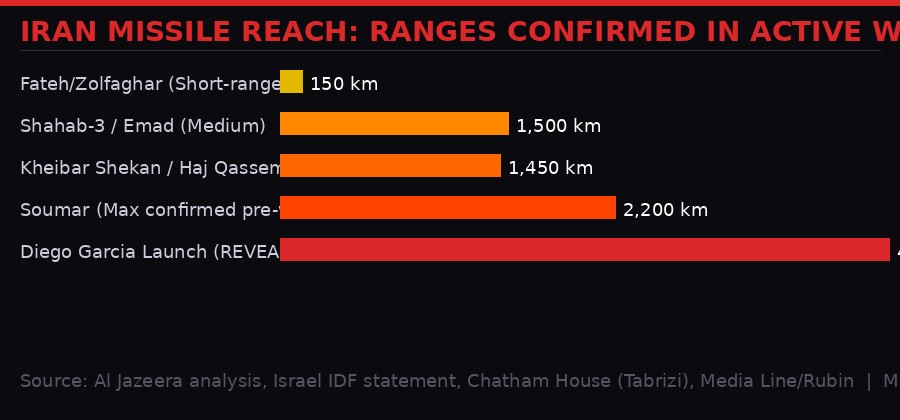
Iran's known missile inventory by range class - and the Diego Garcia launch distance that breaks all prior assessments. BLACKWIRE graphic.
The Range Problem: What Iran Said vs. What Iran Did
For years, the consensus on Iranian ballistic missile capability had a ceiling. Iran's foreign minister Abbas Araghchi stated plainly in an NBC interview on March 8 - two weeks into the current war - that Iran had intentionally limited its missiles to a range of below 2,000 kilometres. [NBC/Al Jazeera, March 8]
"We have capability to produce missiles, but we have intentionally limited ourselves to below 2,000km of range because we don't want to be felt as a threat by anybody else in the world." - Abbas Araghchi, Iranian Foreign Minister, NBC interview, March 8, 2026
That statement is now operationally irrelevant.
Diego Garcia is approximately 4,000 kilometres from Iran. The Wall Street Journal and CNN reported the launches independently. The UK government confirmed the attack - though without providing operational specifics. An Iranian official denied responsibility to Al Jazeera.
The range gap matters enormously. Iran's most capable previously confirmed systems - the Soumar land-attack cruise missile and the Shahab-3 variants - were assessed at 2,000-2,500 kilometres. An accurate ballistic missile reaching Diego Garcia would require a range of at least 4,000 kilometres. That is either an entirely new system, a significantly upgraded existing platform, or evidence that Iran's stated range limits were political theatre from the beginning.
Muhanad Seloom, a lecturer at the Doha Institute for Graduate Studies, told Al Jazeera the implications were immediate and far-reaching. [Al Jazeera, March 22]
"These missiles to Diego Garcia mean Iran has 4,000km-plus ballistic missiles, and that hasn't been revealed before. All reports before that said Iran had a 2,000km range and not beyond that. If you reverse the direction of these missiles, then they could reach London, so that changes the calculus not only for the US and its justification for the war but also for a reluctant London and European Union to join the war." - Muhanad Seloom, Doha Institute for Graduate Studies, Al Jazeera, March 22, 2026

Ballistic missile launches create distinctive trajectories trackable by US early warning satellites. The Diego Garcia launch was confirmed by US media citing defence officials. (Pexels/representational)
Israel's Military Chief Draws the Map for Europe
Israeli military chief Eyal Zamir did not miss the moment. In a video statement released after the Diego Garcia incident, he characterised the Iranian weapon as "a two-stage intercontinental ballistic missile with a range of 4,000km." [Al Jazeera, March 22]
Zamir's framing was direct and intended for a European audience:
"These missiles were not intended to hit Israel. Their range reaches the capitals of Europe. Berlin, Paris and Rome are all within direct threat range." - Lt. Gen. Eyal Zamir, Chief of the Israeli General Staff, video statement, March 22, 2026
The statement serves an obvious Israeli strategic objective: drawing reluctant European powers into the war's orbit, or at minimum eroding their neutrality. Israel has lobbied for Western involvement since February 28. But the underlying data point stands regardless of motivation.
Aniseh Bassiri Tabrizi, an associate fellow in the Middle East and North Africa Programme at Chatham House, told Al Jazeera that the denial pattern itself tells a story. Iran has consistently denied attacks that would cross previously uncrossed red lines - civilian infrastructure hits, strikes that would provoke European escalation, operations that expose previously hidden capabilities. The Diego Garcia denial fits that mould precisely. [Chatham House/Al Jazeera, March 22]
"It signals the Iranian capability to reach far beyond 2,000km, and therefore, is something that is likely to provoke further concern and, therefore, response particularly from the UK but also from other countries." - Aniseh Bassiri Tabrizi, Chatham House, Al Jazeera, March 22, 2026
The UK's reaction underscored the sensitivity. Foreign Secretary Yvette Cooper condemned "reckless" Iranian attacks while Prime Minister Keir Starmer simultaneously moved to limit UK exposure - Starmer confirmed the UK would not use its Cyprus base for Iran-related offensive operations, distancing London from direct military participation even as London's assets were being targeted. [AP News, March 22]
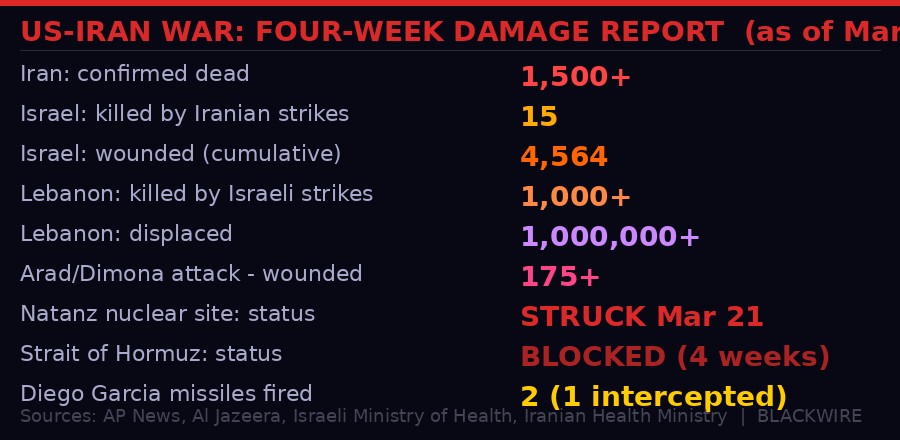
Cumulative human cost of the US-Iran war as of Day 23. The economic damage - Strait blockade, oil price surge - compounds the military toll. BLACKWIRE graphic.
Arad and Dimona: The Nuclear Shadow Strike
The Diego Garcia launch had a parallel track playing out simultaneously in southern Israel. On Saturday night, Iranian missiles struck the towns of Arad and Dimona - both located in the Negev Desert, within kilometres of Israel's Negev Nuclear Research Center, the country's primary nuclear facility. At least 175 people were wounded at Southern Israel's main hospital, according to deputy director Roy Kessous in a statement to the Associated Press. Prime Minister Netanyahu called the lack of fatalities a "miracle." [AP News, March 22]
Iran said the strikes were direct retaliation for the US-Israeli attack on the Natanz nuclear enrichment site in Isfahan province, which occurred on Saturday. The Israeli military denied involvement in the Natanz strike. The Pentagon declined to comment. The Natanz facility is one of Iran's most strategically significant enrichment sites - its degradation or destruction has been a core US-Israeli stated objective since the war began. [AP News, Iranian Atomic Energy Organisation statement, March 22]
The tit-for-tat pattern is accelerating. Israel hit Iran's nuclear infrastructure. Iran hit near Israel's. The International Atomic Energy Agency confirmed that the bulk of Iran's estimated 441 kilograms of enriched uranium is buried beneath the rubble of its previously struck Isfahan facility. The symbolic and strategic value of the Arad-Dimona strikes is not tactical - it is a message. Iran can reach the Israeli nuclear site if it chooses to.
An Israeli military spokesman acknowledged that air defence systems had failed to intercept some of the Iranian missiles - despite being activated. His explanation - that the weaponry was "not special or unfamiliar" and that an investigation was underway - did little to address the core failure. [Al Jazeera, March 22]
Defence analyst Uzi Rubin, founding director of Israel's missile defence programme and a senior fellow at the Jerusalem Institute for Strategy and Security, described the mechanism that is defeating Israeli interception systems. Iran is deploying cluster warheads - each missile dispersing 20 to 80 bomblets upon approach, multiplying the interception problem exponentially. [Media Line/Uzi Rubin, cited in Al Jazeera, March 22]
"The tip of the missile, instead of containing a big barrel of explosives, contains a mechanism which holds on to a lot of small bombs. When the missile approaches the target, it opens its skin, it peels off and it spins around and the bomblets are released." - Uzi Rubin, founding director, Israel Missile Defense Organization, via Media Line, March 2026
Iran has used cluster munitions since the 12-day June war that preceded the current conflict. Amnesty International has categorised it as a flagrant violation of international humanitarian law - a convention to which neither Iran nor Israel are signatories. [Amnesty International statement, June 2025, cited Al Jazeera]

The Negev Desert, southern Israel - site of the Dimona nuclear research facility and the Iranian missile strikes on Arad and Dimona on March 21-22. (Pexels/representational)
Trump's 48-Hour Ultimatum: Power Plants or Nothing
Against this backdrop of missile escalation and nuclear shadow-play, US President Donald Trump on Saturday night issued his latest attempt to pressure Iran into reopening the Strait of Hormuz: a 48-hour ultimatum threatening to "obliterate" Iran's power plants if the waterway was not opened. The message, posted to social media in 51 words - much of it capitalised - lacked any policy framework or legal justification. [AP News, March 22]
The ultimatum arrives at the end of a week in which Trump's strategy has visibly unravelled. He sought a multinational naval coalition to escort tankers through Hormuz - allies declined. He suggested the US could manage alone. Days later he implied other countries would need to take over. Then he floated the idea that the strait might "open itself." Simultaneously, his Treasury Department lifted sanctions on some Iranian oil exports - conceding leverage that Washington has used as its primary Iran policy tool for years - in an attempt to suppress oil prices. [AP News, March 22]
Republican Senator Thom Tillis of North Carolina put the political problem plainly on ABC News:
"You can't all of a sudden walk away after you've kind of created the event and expect other people to pick it up." - Sen. Thom Tillis (R-NC), ABC's "This Week," March 22, 2026
Democratic senators moved further. Ed Markey of Massachusetts framed the power plant threat as a war crime. Chris Murphy of Connecticut said Trump had "lost control of the war." Geoffrey Corn, a military law professor at Texas Tech and a retired Army lieutenant colonel who previously served as a military lawyer, told AP that the 48-hour post had the appearance of a message that had never undergone legal scrutiny. [AP News, March 22]
"It certainly has a feeling of ready, fire, aim. He overestimated his ability to control the events once he unleashed this torrent of violence." - Prof. Geoffrey Corn, Texas Tech University / retired US Army, AP News, March 22, 2026
International law does not categorically prohibit attacks on power plants - but requires a military advantage assessment that clearly outweighs the civilian cost. Hospitals, water treatment, heating systems and domestic refrigeration all depend on Iran's power grid. Iran's UN ambassador wrote to the Security Council calling the threatened attack "inherently indiscriminate and clearly disproportionate" and a war crime. [IRNA/AP News, March 22]
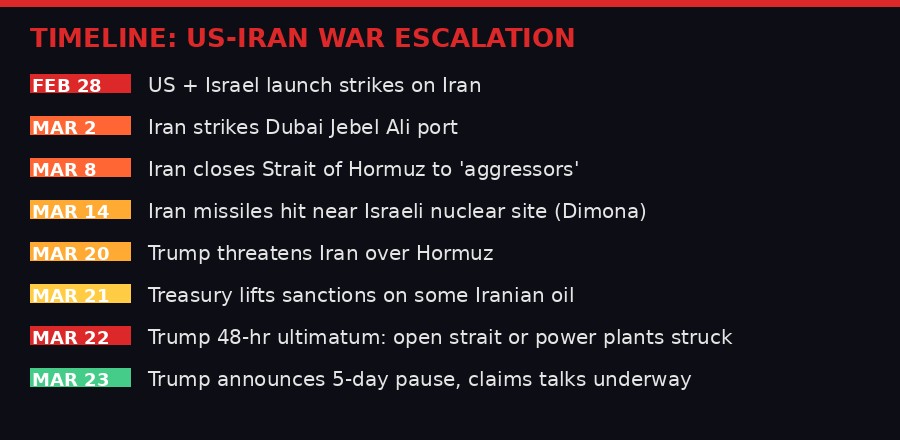
Key escalation points from February 28 to March 22. The Diego Garcia strike and the Natanz-Dimona nuclear exchange mark a qualitative shift in the war's trajectory. BLACKWIRE graphic.
Iran's Counter-Threat: The Gulf and Europe in the Crosshairs
Iran's parliament speaker Mohammad Bagher Ghalibaf responded to Trump's power plant ultimatum on X with a counter-threat that substantially widens the war's potential damage radius:
"Immediately after power plants and infrastructure in our country are targeted, vital infrastructure as well as energy and oil infrastructure across the entire region will be considered legitimate targets and will be irreversibly destroyed." - Mohammad Bagher Ghalibaf, Iranian Parliament Speaker, X/Twitter, March 22, 2026
The IRGC followed with a statement specifying that energy facilities in countries hosting US military bases would be "lawful targets" - a designation that encompasses nearly every Gulf Arab state. Saudi Arabia, the UAE, Qatar, Kuwait, and Bahrain all host US military installations. Their desalination plants, oil processing infrastructure, and power grids would all qualify under Tehran's stated criteria. [IRGC statement via Al Jazeera, March 22]
Gulf desalination is not an abstraction. Saudi Arabia produces approximately 30% of its freshwater through desalination. The UAE and Kuwait are even more dependent. These facilities run on power grids. Destroy the grid or the plants themselves, and the humanitarian cascade is immediate and severe. [AP News background, March 22]
Iranian President Masoud Pezeshkian maintained a defiant posture separate from the military threats, posting on X that the Strait was "open to all except those who violate our soil." Foreign Minister Araghchi insisted the waterway was "not closed," attributing shipping disruptions to insurance markets spooked by the war - not Iranian blockade. [Al Jazeera, March 22]
The diplomatic track is thin but still running. Turkish Foreign Minister Hakan Fidan held separate calls with Araghchi, Egyptian FM Badr Abdelatty, EU foreign policy chief Kaja Kallas, and US officials on Sunday to seek a path to ceasefire. No framework has been announced. Netanyahu on Sunday called on world leaders to formally join the US-Israel war on Iran, claiming some were "already moving in that direction." No leader publicly confirmed that characterisation. [Reuters/Al Jazeera, March 22]

Gulf oil and energy infrastructure - what Iran has now explicitly designated as legitimate targets if US power plant strikes proceed. (Pexels)
Lebanon: A Third Front Deepens
The Lebanon front, often overshadowed by the Iran-Israel missile exchange, is developing its own lethal momentum. Hezbollah - firing since February 28 in declared solidarity with Iran following the killing of Supreme Leader Khamenei in the war's opening strikes - killed an Israeli civilian in northern Israel on Sunday. An Israeli farmer named Ofer "Poshko" Moskovitz, 61, was killed in his car in the village of Misgav Am near the Lebanese border. [AP News, March 22]
Moskovitz had told an Israeli radio station two days earlier that living near the Lebanese border was like "Russian roulette." He was right.
Israel's military and Defence Minister Israel Katz expanded the target list in Lebanon on Sunday to include bridges over the Litani River. Katz said Hezbollah was using the bridges to move fighters and weapons south toward the Israeli border. An Israeli airstrike hit the Qasmiyeh bridge near Tyre - preceded by one hour's warning. Destroying bridges does not neutralise Hezbollah; it isolates the civilian population and fragments logistics. [AP News, Al Jazeera, March 22]
Lebanese President Joseph Aoun called the bridge targeting "a prelude to a ground invasion." Israeli Brigadier General Effie Defrin confirmed that "more weeks of fighting against Iran and Hezbollah are expected." [AP News, March 22]
Lebanese authorities count over 1,000 dead and more than one million displaced since the war began. Hezbollah has fired hundreds of rockets into northern Israel. This is a slow-burn front - not the war's decisive theatre, but increasingly autonomous in its logic. [AP News, March 22]
Katz also ordered the military to accelerate the demolition of Lebanese homes near the border - a measure that, whatever its tactical rationale, creates facts on the ground that complicate any future ceasefire and inflames civilian displacement.

Israeli airstrikes on Lebanese bridges and infrastructure have compounded displacement of over one million people. (Pexels/representational)
The Bigger Picture: A War Without an Exit Plan
Twenty-three days into a war that killed former Supreme Leader Ali Khamenei on its opening hours, eliminated significant Iranian missile production and air defence infrastructure, destroyed key naval assets, struck Kharg Island (Iran's primary oil export terminal), bombed the Natanz enrichment facility, and generated the worst oil disruption since the 1970s - there is no victory on the horizon for any party.
Iran has not collapsed. No popular uprising against the Islamic Republic has emerged - one of the stated US-Israeli war aims. The Iranian state, diminished and battered at the top, is still fighting. The IRGC is intact enough to launch ballistic missiles at a base 4,000 kilometres away. Iranian cluster munitions are defeating Israel's air defences at rates that forced the Israeli Air Force to consider rationing interceptors to conserve stock. [Times of Israel, March 20, cited in Al Jazeera]
The economic damage is escalating. One-fifth of global oil supply normally transits Hormuz. With tanker traffic essentially stopped by attacks and insurance market collapse, the pressure on oil prices is systemic and global. Trump's domestic political clock - midterm elections later this year - is running faster than the military campaign.
Netanyahu's claim that the war is going well does not withstand scrutiny. Israel has absorbed 4,564 wounded and 15 dead from Iranian missile strikes - unprecedented in Israeli history outside of full conventional wars. A nuclear-adjacent strike hit within kilometres of the Dimona facility. Air defence gaps have been exploited. The northern border with Lebanon is bleeding.
And now, the most alarming revelation of all: Iran possesses - or has acquired - ballistic missiles with at least 4,000 kilometres of range, far beyond any prior public assessment, placing London, Berlin, Paris and Rome within theoretical strike distance. Whether the Diego Garcia launch was an operational test, a deterrence signal, or both, the calculation for every European government just changed. The war they were watching from a safe distance may not have a safe distance anymore.
The 48-hour clock Trump set on Saturday expires sometime on Monday. What happens next - whether the US strikes Iranian power plants, whether Iran retaliates against Gulf desalination infrastructure, whether the Lebanon front expands to full ground war, whether a Diego Garcia follow-up tests whether the interception holds - none of it is predictable from the current trajectory.
What is predictable is this: four weeks in, the war has not produced the outcomes its architects promised. It has produced a theatre of escalation with no visible ceiling and no agreed floor.
Get BLACKWIRE reports first.
Breaking news, investigations, and analysis - straight to your phone.
Join @blackwirenews on Telegram