Iran Breaches Israeli Air Defenses Near Dimona. Iran's Parliament Speaker Calls It "A New Phase of Battle."

In the early hours of Sunday, March 22, the most significant tactical shift in three weeks of the US-Israel war against Iran became undeniable. Iran's missiles had gotten through where they were never supposed to get through - the layered air defense ring around Dimona, home to Israel's Negev Nuclear Research Center, the worst-kept nuclear secret in the Middle East.
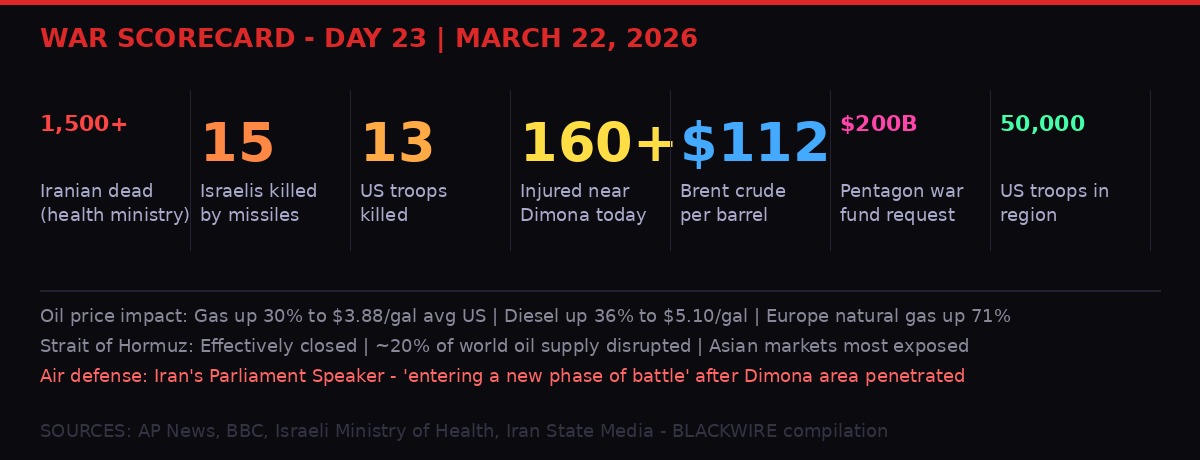
Israeli Prime Minister Benjamin Netanyahu toured the city of Arad, about 35 kilometers north of the nuclear center. He called it "a miracle" that no one was killed by blasts that heavily damaged multiple apartment buildings. He urged civilians to heed sirens and rush to shelters. Rescue workers said at least 64 people were taken to hospitals after direct hits in Arad alone. In Dimona, some 20 kilometers west of the nuclear research center, the toll reached at least 96 more injured. Total injured in the two strikes: 160 and climbing, according to Israeli medics cited by AP.
Iran's Parliament Speaker Mohammad Bagher Ghalibaf posted on X with poorly concealed triumph. "If the Israeli regime is unable to intercept missiles in the heavily protected Dimona area, it is, operationally, a sign of entering a new phase of the battle," he wrote. The UN nuclear watchdog, the International Atomic Energy Agency, said it had received no reports of damage to the Israeli nuclear center or abnormal radiation levels - but the psychological and strategic impact of the air defense failure was immediate and enormous.
How Iran Punched Through the Iron Dome

Israel operates the world's most mature and layered missile defense architecture. Iron Dome handles short-range rockets. David's Sling covers medium-range ballistic missiles. Arrow 3 - the system designed specifically to intercept ballistic missiles at high altitudes and long ranges - was built precisely to handle threats like Iranian Shahab and Fattah series missiles. The Negev Desert region, home to the nuclear research center, is among the highest-priority air defense zones in the entire country.
That it was penetrated on Day 22 and 23 of the war signals one of several alarming possibilities: Iran is using a new maneuvering re-entry vehicle that can evade intercept, the sheer volume of simultaneous salvos is exhausting intercept capacity, or both. Israeli military officials confirmed they were "not able to intercept" the missiles that hit Dimona and Arad and said they were investigating the failure. That statement - unusually transparent for the Israeli Defense Forces - underscores how seriously the military is treating the development.
Iran's missiles are fired from sites inside Iran, some 1,500 to 2,000 kilometers away depending on trajectory. Iran has consistently maintained an official self-imposed ceiling of 2,000 kilometers on its ballistic missiles. Recent strikes on Diego Garcia - roughly 4,000 kilometers from Iran - suggest that ceiling has been quietly discarded, possibly using adapted versions of Iran's Simorgh space launch rocket, according to Justin Bronk, a senior research fellow at the Royal United Services Institute (RUSI). The same extended-range technology could be enhancing accuracy and terminal velocity on shorter-range Negev-bound missiles as well.
Israeli hard-line national security minister Itamar Ben-Gvir toured Arad on Sunday, declaring that Israel is in a "historic battle" that "must continue until victory." But within the Israeli security establishment, the mood is less triumphant. The combination of Hezbollah rockets from the north killing a man in Misgav Am - confirmed Sunday - and ballistic missile penetrations in the south represents a genuine two-front squeeze that air defenses alone cannot solve.
What Breached Israeli Defenses - Quick Facts
- Saturday and Sunday strikes hit Dimona (20km from nuclear center) and Arad (35km from nuclear center)
- 160+ injured combined in the two cities - at least 64 taken to hospital in Arad alone
- Israel's military confirmed it was "not able to intercept" the Dimona-area missiles
- IAEA: No nuclear facility damage or abnormal radiation reported
- Iran's Parliament Speaker Ghalibaf declared it "a new phase of battle" on X
- Hezbollah killed one Israeli civilian in northern Misgav Am the same day - two-front escalation
The 48-Hour Clock: Trump's Ultimatum and Iran's Counter-Threat

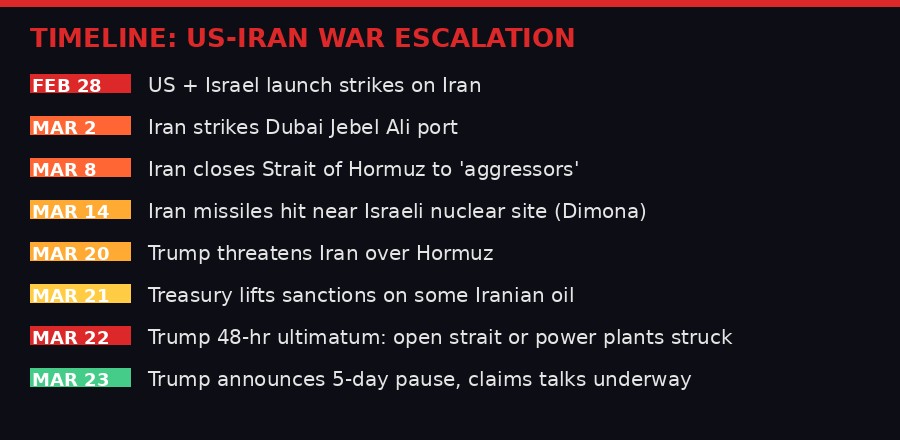
On Saturday evening, President Donald Trump posted on Truth Social in all-caps bursts. He gave Iran 48 hours to fully open the Strait of Hormuz. The consequence for failure: the United States would "hit and obliterate" Iran's power plants, "STARTING WITH THE BIGGEST ONE FIRST." The clock started Saturday evening. It expires Monday.
Trump may have been pointing at Iran's Bushehr nuclear power plant - the largest in the country, already struck during week one of the war - or at Damavand, a natural gas facility near Tehran. Attacking civilian power infrastructure at that scale would be a significant escalation even by the standards of a war that has already struck multiple nuclear sites.
Iran responded within hours. An Iranian military spokesperson, cited by state media and semiofficial outlets, issued a counter-threat: any US or Israeli strike on Iranian energy facilities would trigger "attacks on US and Israeli energy and infrastructure assets - specifically information technology and desalination facilities - in the region." Iran is explicitly threatening to knock out water desalination plants across the Gulf - infrastructure that Qatar, the UAE, Saudi Arabia and others depend on for most of their drinking water.
Iran's envoy to the International Maritime Organization, Seyed Ali Mousavi, offered a carefully worded signal about the Strait of Hormuz: navigation is possible for "everyone except enemies." Tehran is already directing ships from China and Asian partners through the waterway. The message is that Iran will determine passage rights - and Washington will not.
The Strait of Hormuz, at its narrowest only 33 kilometers wide, channels roughly 21 million barrels of oil per day in normal conditions - approximately one-fifth of global oil demand. Iran's mining operations, missile and drone attacks on commercial ships, and threats of further strikes have stopped nearly all Western-flagged tankers. The economic pressure from this blockade is exactly why Trump is threatening the power plants.
The War's Economic Blast Radius

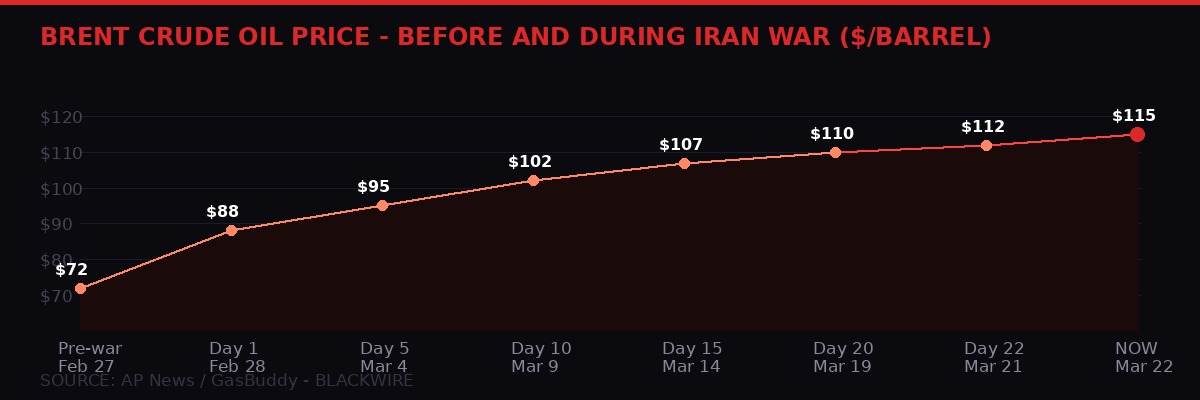
The war's economic effects have spread well beyond the battlefield. Brent crude oil - the international benchmark - was trading above $112 per barrel on Friday, up from roughly $72 before the war started on February 28. Analysts say prices could go higher, not lower, regardless of what happens in the next 48 hours. Even if the Strait reopens tomorrow, the damage to shipping insurance markets, tanker scheduling, and refinery supply chains will take weeks to unwind.
American drivers were paying an average of $3.88 per gallon for regular gasoline on Thursday, a jump from $2.98 before the war - roughly a 30% increase in three weeks. Diesel - which powers the trucks and ships that move virtually every good in the global economy - has risen 36% to $5.10 per gallon in the US. Patrick De Haan, head of petroleum analysis at GasBuddy, wrote on X that higher oil and gas costs are now running "half a billion dollars more every single day" for the US economy compared to three weeks ago.
The economic whiplash is being felt unevenly. California, which relies on gasoline imports from Asia, hit $5.62 per gallon. Louisiana, with its own oil production and refinery capacity, sat at $3.52. In Europe, natural gas benchmark prices - already volatile after years of post-Ukraine disruption - have climbed 71% since the war began, according to Intercontinental Exchange data.
Food economists warn that grocery prices will follow with a lag. David Ortega, professor of food economics and policy at Michigan State University, told AP that if oil prices remain elevated for more than a month, "we're in different territory." Transportation costs are already embedding themselves into every supply chain. Patrick Penfield, professor of supply chain practice at Syracuse University, is already tracking 10-30% surcharges on container shipping costs.
The S&P 500 dropped 1.5% on Friday alone - partly triggered by an Israeli strike on Iran's gas fields and an Iranian retaliation that crippled a major LNG terminal in Qatar. If Trump's ultimatum fails and he attacks Iranian power plants, the market reaction could be significantly worse. Traders who have already been repricing war-risk premiums are watching this Monday deadline with acute attention.
Economic Damage Snapshot - Day 23
- Brent crude: $112/barrel - up ~56% since pre-war $72
- US regular gasoline avg: $3.88/gal (was $2.98) - up 30%
- US diesel avg: $5.10/gal - up 36%
- California gasoline: $5.62/gal
- European natural gas benchmark: up 71% since war began
- S&P 500: dropped 1.5% Friday alone after Qatar LNG terminal hit
- US daily energy cost increase vs pre-war: ~$500 million extra per day (GasBuddy estimate)
- Pentagon war funding request: $200 billion (pending)
Congress Without an Exit Map

President Trump launched the war under the War Powers Act, which gives a president 60 days to conduct military operations without a formal vote from Congress. Republicans have beaten back every Democratic resolution attempting to halt the campaign. But that unity is fraying around the edges as the costs mount.
Senator Thom Tillis (R-NC) - generally supportive of military action - put the uncomfortable question directly to AP: "The real question is: What ultimately are we trying to accomplish?" Trump's answer - that he will know when the war is over because "I'll feel it in my bones" - has triggered rare bipartisan alarm. Virginia Senator Mark Warner, top Democrat on the Senate Intelligence Committee, was blunter: "When he feels it in his bones? That's crazy."
House Speaker Mike Johnson has tried to project confidence, telling AP this week that the "original mission is virtually accomplished now" - that US forces have degraded Iran's ballistic missiles, production capacity, and naval power. But Johnson acknowledged that Iran's ability to threaten Hormuz is "dragging it out a little bit."
The administration's stated goals have been a moving target since the war began. Preventing a nuclear weapon. Eliminating ballistic missile programs. Degrading proxy support networks. Regime change - sometimes. The goalposts have shifted repeatedly, leaving lawmakers across the aisle struggling to evaluate when and whether any definition of "victory" could be met.
In an extraordinary contradiction last Friday, Trump said the US was "getting very close to winding down" its military efforts - and then, roughly 24 hours later, threatened to destroy Iran's power plants. The same week, the Pentagon announced it was sending three more warships and 2,500 additional Marines to the region, the second such deployment announcement in a week, bringing total US forces supporting the war to approximately 50,000. A $200 billion supplemental war funding request is sitting at the White House waiting for Congressional approval, which Democratic leader Chuck Schumer called "preposterous."
The contradictions are not lost on allies or adversaries. Iran is reading the mixed signals as potential weakness. Congressional Republicans are reading them as strategic incoherence. Markets are pricing the uncertainty into every forward contract touching energy. And the 48-hour ultimatum now hanging over Monday morning is the latest demonstration that this war is being fought - and potentially expanded - without a coherent exit architecture.
The Diego Garcia Stretch and a War Going Global

Earlier this week, Iran fired two ballistic missiles at Diego Garcia - the joint US-UK military base in the Indian Ocean. Neither missile reached the island. But the attempt itself was remarkable: Diego Garcia is approximately 2,500 miles (4,000 kilometers) from Iran, well beyond the 2,000-kilometer self-imposed limit Iran had long claimed for its ballistic missile program.
Justin Bronk at RUSI told AP that the attempt may have involved the improvised use of Iran's Simorgh space launch rocket, "which could offer greater range as a ballistic missile," though at reduced accuracy. If that analysis is correct, Iran has effectively debuted an improvised ICBM capability in live combat conditions - the first time any non-superpower has done so in modern warfare.
Diego Garcia is home to roughly 2,500 mostly American personnel and has supported every major US military operation since Vietnam - Iraq, Afghanistan, the Houthi campaign. The US deployed nuclear-capable B-2 Spirit bombers there last year during the Houthi campaign. Britain initially refused to let the US use Diego Garcia for attacks on Iran. After Iran began striking regional neighbors and commercial shipping, the UK reversed course, permitting US bombers to use Diego Garcia for strikes on Iranian missile sites. On Friday, London extended that permission to include sites being used to attack Hormuz shipping.
The UK's position has put Prime Minister Keir Starmer in a difficult spot. Iranian Foreign Minister Abbas Araghchi said Starmer was "putting British lives in danger by allowing UK bases to be used for aggression against Iran." The UK-Mauritius deal over Chagos Island sovereignty - which Trump had already called "an act of GREAT STUPIDITY" - is now stalled in Parliament as London struggles to maintain Washington's support for the agreement.
The war has also drawn in Lebanon again. Hezbollah said it was behind a strike on Sunday that killed a man in the northern Israeli town of Misgav Am - what the Israeli military described as a rocket attack. Israeli medics found the man dead in his car; video released showed two vehicles ablaze. Hezbollah launched strikes on Israel days after the US-Israeli attack on Iran began, saying it was retaliating for the killing of Iran's Supreme Leader Ayatollah Ali Khamenei. Israel has since bombarded Lebanon and expanded ground forces in the south, with Lebanese authorities reporting more than 1,000 killed and over a million displaced by Israeli strikes.
Natanz, Dimona, and the Nuclear Shadow

The same Saturday that saw Dimona-area missiles penetrate Israeli air defenses, Iran's main nuclear enrichment site at Natanz was hit again. Israel denied responsibility. Iran's judiciary news agency Mizan said there was no leakage. The Pentagon declined all comment on the Natanz strike.
Natanz has now been hit in the first week of the current war and was previously struck in the 12-day conflict last June. The IAEA reported that the bulk of Iran's estimated 441 kilograms of enriched uranium - at 60% and 90% enrichment levels according to previous IAEA monitoring reports - is elsewhere, buried under rubble at the Isfahan facility, which was hit in the first week of the current war.
Israel is widely believed to possess nuclear weapons, though it maintains a policy of neither confirming nor denying. The proximity of Iranian missile strikes to the Dimona nuclear research center - and Iran's Parliament Speaker publicly framing it as a breakthrough - suggests Tehran may be deliberately threading a needle: signaling capability without triggering the kind of existential calculus that might force Israel's hand on nuclear deterrence.
The IAEA said it had received no reports of damage to the Israeli nuclear facility or abnormal radiation readings in the area. But the Israeli failure to intercept missiles in what was considered among the most protected airspace in the country is a genuine operational shock that Israeli planners will be working urgently to address.
Qatar experienced its own crisis this weekend. Six people were killed in a Qatari military helicopter crash in the Persian Gulf nation's territorial waters - three Qatari forces and three Turkish nationals. Qatar's Defense Ministry said the crash was caused by a "technical malfunction." The timing, in the middle of an active war theater, adds to the cascading regional instability even if unrelated to direct combat.
Trump's Pearl Harbor Moment and the Allies Left Watching

On Thursday, a Japanese TV reporter at a White House press conference asked Trump why he had not informed allies before launching the attack on Iran. Trump's answer has reverberated across Tokyo since. "Who knows better about surprise than Japan?" Trump said. "Why didn't you tell me about Pearl Harbor, OK?"
Japan's Prime Minister Sanae Takaichi was sitting next to Trump when he said it. She responded with a glance at her ministers and rolled her eyes, then let the comment pass. Japan needs the US relationship too much - 50,000 American troops are stationed on Japanese soil, and Japan depends on the US nuclear umbrella to deter China and North Korea - to make a scene in the White House.
But the domestic fallout in Tokyo was swift. Japan's liberal Asahi newspaper ran an editorial calling Trump's comparison "a piece of nonsense that ignores lessons from history." Foreign policy analyst Tsuneo Watanabe wrote in the Nikkei that the comment signaled Trump was "not bound by existing American common sense." The TV reporter who triggered the exchange, Morio Chijiiwa of TV Asahi, explained that he had meant to ask why allies were being dragged into a war they weren't consulted on - and Trump used Pearl Harbor to justify secrecy rather than engage the actual question.
The incident crystallizes the broader problem facing US allies. They are being asked to commit forces, bases, and political capital to a war they didn't vote for, fought under constantly shifting rationales, with no clear endpoint. Britain extended Diego Garcia access. Japan is being pressed to escort tankers near Hormuz. Other US allies have largely declined. Trump called Japan and other nations "uncooperative" for not moving faster on Hormuz security. The coalition that the US usually relies on in major military operations is notable by its absence.
What happens Monday morning - when the 48-hour Hormuz ultimatum expires - may determine whether the next chapter involves an even more fragmented alliance, a dramatically escalated economic war against Iran's civilian infrastructure, or some combination of both. None of the options are clean.
Get BLACKWIRE reports first.
Breaking news, investigations, and analysis - straight to your phone.
Join @blackwirenews on TelegramWhat Happens Next: The Monday Deadline

The 48-hour countdown Trump posted Saturday expires sometime Monday. Three scenarios are in play.
In the first, Iran blinks. Tehran announces some form of reopening of the Strait - perhaps selective, perhaps limited to non-US-allied vessels, similar to what they already allow for Chinese-bound ships. Trump claims victory. Brent crude pulls back. Markets rally. The war enters a negotiated pause. This scenario is considered least likely by analysts watching Iranian domestic politics: conceding to an ultimatum after successfully penetrating Israeli air defenses near Dimona would be read internally as humiliation at a moment of perceived strength.
In the second, Trump backs down or reframes. He may declare the 48-hour warning produced "progress" without any measurable Hormuz opening and walk back the power plant threat. This preserves a diplomatic off-ramp but further damages US credibility - particularly in the eyes of Iran, which is already reading Washington's mixed signals as indecision.
In the third, Trump strikes Iranian power plants. The economic and humanitarian consequences would be severe - Bushehr and Damavand are civilian infrastructure. An attack on Bushehr's nuclear power plant would raise immediate IAEA alarm regardless of Iranian claims about no leakage. Iran has already promised to retaliate against US and Israeli energy and IT assets across the region, including desalination facilities. The Gulf states - most of which depend on desalinated water - would face an acute humanitarian crisis if that threat is carried out. Oil prices would spike further. The S&P 500 would likely drop. And Congress would face enormous pressure to force a formal war vote or cut off funding.
What is clear, as Day 23 ends, is that Iran has demonstrated a new tactical capability against Israel's most protected airspace, the US is facing a 48-hour inflection point with no good options, and the war is generating economic damage across the global economy that will outlast the military campaign by months regardless of how it ends.
The death toll - surpassing 1,500 in Iran per the state broadcaster, 15 Israelis killed by Iranian missiles, 13 US military members dead, and hundreds of civilian casualties across Lebanon and Gulf states - is still rising. And Monday is coming.