
Missiles hit two Israeli cities within 35 kilometers of Israel's nuclear research center. Iran's Natanz site struck again the same day. A separate volley traveled 4,000 kilometers to challenge a UK-US Indian Ocean base - doubling Iran's previously declared range limit. Week four of the Iran War just crossed a line nobody wanted to cross.

The night of March 21, 2026, delivered what military analysts have spent three weeks dreading: a direct attack on the geographic perimeter of Israel's nuclear weapons infrastructure. Iranian ballistic missiles struck the cities of Dimona and Arad in Israel's Negev desert - 20 and 35 kilometers respectively from the Negev Nuclear Research Center - leaving buildings shattered, at least 64 people hospitalized, and three apartment structures assessed as at risk of collapse. (AP, March 21)
Israel's military said it was unable to intercept the missiles. The army chief, General Eyal Zamir, had stated hours earlier that "the war is not close to ending." By midnight, that assessment looked like an understatement.
The same day, Iran's Natanz uranium enrichment facility - already struck in the 12-day June 2025 war and again in the first week of this conflict - took another hit. Iran's IAEA ambassador Reza Najafi confirmed the attack at a special session of the Board of Governors in Vienna. (AP/IAEA, March 21) Israel initially denied responsibility. The Pentagon declined comment.
And separately - 4,000 kilometers southwest of Tehran - Iran launched missiles at the UK-US joint military base on Diego Garcia in the Indian Ocean. The attack was unsuccessful but its strategic implications are severe: Iran's self-declared ballistic missile range cap is 2,000 kilometers. Diego Garcia is exactly double that distance.

The Negev Nuclear Research Center at Dimona is Israel's nuclear weapons production and maintenance facility. It has been in operation since 1958. Israel refuses to confirm or deny possessing nuclear weapons, but experts at the Federation of American Scientists estimate between 80 and 200 warheads, including submarine-launched cruise missiles capable of reaching 6,500 kilometers. (FAS, via AP)
Dimona city sits 20 kilometers west of the facility. Arad is 35 kilometers to the north. Tonight, Iranian missiles hit both. Whether the targeting was symbolic pressure or a genuine attempt to hit the research center itself remains unclear - the missile that struck near Arad appeared to hit an open area, according to rescue workers on the scene. But the message is unmistakable.
"If the Israeli regime is unable to intercept missiles in the heavily protected Dimona area, it is, operationally, a sign of entering a new phase of the battle." - Mohammad Bagher Ghalibaf, Iran's Parliament Speaker, via X
Israeli Prime Minister Benjamin Netanyahu acknowledged the gravity without theatrical understatement: "This is a very difficult evening," he said, adding that more emergency resources were being dispatched to the Negev. Israel's army chief, speaking separately, said Iran had fired what he described as a "two-stage intercontinental ballistic missile" - the first such public claim of the conflict. Iran issued no statement confirming the weapon type.
The United Nations nuclear watchdog, the IAEA, said it had received no reports of damage to the Israeli research center and detected no abnormal radiation levels in the area. That matters: the Dimona facility is believed to store plutonium and may house assembled warheads. A direct strike would constitute a catastrophic radiological incident, not just a military one.
Footage from Israel's emergency services showed what emergency workers described as the largest crater they had seen from an Iranian missile strike in the current conflict. The outer walls of apartment buildings were sheared away. At least 64 people were transported to hospitals, with seven assessed as seriously injured. The damage pattern across a residential neighborhood suggests a large unitary warhead, not a cluster munition or fragmentation device.

Natanz sits 220 kilometers southeast of Tehran. Before the war, it was the primary site for Iran's uranium enrichment program. The IAEA documented advanced centrifuges operating there at 60% enrichment - a short technical step from weapons-grade 90%. A 2022 IAEA assessment placed approximately 970 pounds (440 kilograms) of that enriched material at various Iranian facilities, the bulk of it since confirmed as buried under rubble at Isfahan following strikes in earlier phases of the conflict.
The Natanz facility has now been struck three separate times. Israel's first attack on June 13, 2025 left the above-ground Pilot Fuel Enrichment Plant "functionally destroyed," per IAEA Director General Rafael Grossi's own assessment. A US follow-up strike on June 22 hit the underground halls with bunker-busting bombs, "likely decimating what remained," in Grossi's words.
The current war's first week saw further strikes. And now, Day 22 brings a third round on the same site.
At the Vienna special session - convened at Russia's request - Iran's IAEA Ambassador Reza Najafi was explicit. "Again they attacked Iran's peaceful safeguarded nuclear facilities yesterday," he told reporters, confirming Natanz as the target when asked directly. IAEA chief Grossi offered cautious language, saying the agency had "no indication" nuclear installations had been hit "up to now," while acknowledging the agency could not reach Iranian nuclear regulatory authorities by phone due to the conflict's communication disruptions.
"When nuclear armed states are at war, the world always takes notice because we don't like it when nuclear arsenals are available for decision makers." - Or Rabinowitz, scholar, Hebrew University / Stanford University, via AP
Russian Foreign Ministry spokesperson Maria Zakharova warned the strikes posed a "real risk of catastrophic disaster throughout the Middle East." The IAEA reminded parties that "many other countries in the region that have been targeted militarily have operational nuclear power plants and nuclear research reactors, as well as associated fuel storage sites." That is a reference to Bushehr, Iran's operating Russian-built reactor on the Persian Gulf coast - a facility whose breach would scatter radioactive material across the Gulf and potentially beyond.
Israel denied involvement in the Natanz strike. The Pentagon declined to comment. Neither statement constitutes a denial. Both statements are standard operational security protocol when sensitive targeting is involved.

Iran has previously stated a self-imposed cap on its ballistic missile range of 2,000 kilometers - roughly 1,240 miles. That figure has been treated as a strategic red line, a signal of restraint designed to keep European capitals and distant US installations outside the threat envelope.
Diego Garcia is 4,000 kilometers from Iran. Exactly double that limit.
Britain's Ministry of Defense confirmed the attack was unsuccessful - it's unclear how close the missiles came - and condemned what it called "Iran's reckless attacks." But the attempt itself, regardless of outcome, changes the strategic picture fundamentally.
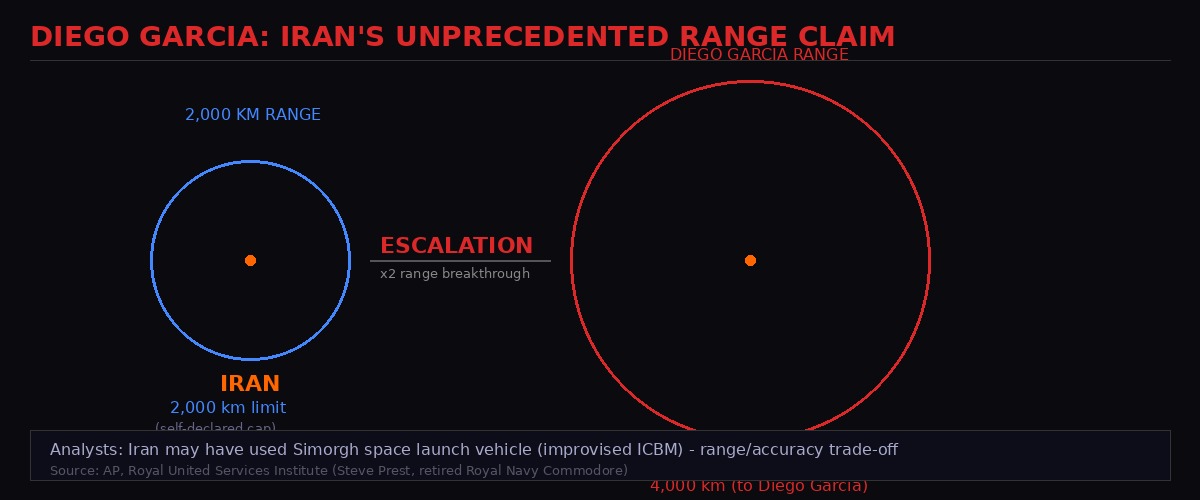
Steve Prest, a retired Royal Navy commodore and senior analyst at the Royal United Services Institute, offered the clearest technical explanation: "If you've got a space program, you've got a ballistic missile program." Justin Bronk, senior research fellow at the same institution, assessed that Iran may have used its Simorgh space launch rocket in an improvised ballistic configuration - "which could offer greater range as a ballistic missile, though at the cost of reduced accuracy." (RUSI, via AP)
Israel's army chief stated Iran fired "a two-stage intercontinental ballistic missile." If that assessment is accurate - and the IDF rarely makes such statements publicly without analytical backing - Iran has demonstrated, or come very close to demonstrating, an ICBM-class capability. Washington has long alleged Iran's space program masked a ballistic missile development track. That allegation just got visual confirmation over the Indian Ocean.
Diego Garcia is the United States' most strategically significant Indian Ocean installation. It houses approximately 2,500 personnel, has supported operations from Vietnam to Iraq to Afghanistan, and was acknowledged in 2008 to have been used for CIA rendition flights. Nuclear-capable B-2 Spirit bombers deployed there last year during the Houthi campaign.
Britain initially refused to allow US attacks on Iran to be launched from Diego Garcia. After Iran began striking Gulf neighbors and Iran-backed forces attacked regional targets, London changed its position - authorizing US bombers to use the base for strikes on Iran's missile sites and, on Friday, for operations targeting coastal anti-ship missile infrastructure along the Strait of Hormuz.
Iranian Foreign Minister Abbas Araghchi responded on X that UK Prime Minister Keir Starmer "is putting British lives in danger by allowing UK bases to be used for aggression against Iran." The missile strike on Diego Garcia followed that statement within 24 hours.

Head of US Central Command, Admiral Brad Cooper, stated Saturday that Iran's capacity to attack vessels through the Strait of Hormuz had been "degraded." He cited strikes earlier in the week using 5,000-pound bombs on an underground coastal facility used to store anti-ship cruise missiles and mobile launch platforms. The Trump administration also announced it was temporarily lifting sanctions on Iranian oil already loaded on ships as of Friday.
Iran's oil ministry replied that it "essentially has no crude oil left in floating storage." If accurate, the sanctions waiver is an empty gesture - an optic of economic relief without substance.
The real economic pressure is running in both directions. The UAE joined 21 other countries - including the United Kingdom, Germany, France and Japan - in expressing "readiness to contribute to appropriate efforts to ensure safe passage" through the strait. (AP, March 21) That is diplomatic language for a maritime coalition. How that coalition translates into operational force, and whether Iran chooses to test it, will determine oil market trajectory in the coming weeks.
A missile alert sounded in Dubai on Saturday night. Saudi Arabia reported it had downed 20 drones in its eastern region - home to the country's largest oil installations, including Abqaiq, whose 2019 Houthi drone strike temporarily knocked out 5% of global oil supply. The United States has deployed three additional amphibious assault ships and roughly 2,500 Marines toward the Middle East, multiple AP sources confirmed, all speaking under condition of anonymity to discuss operational movements.
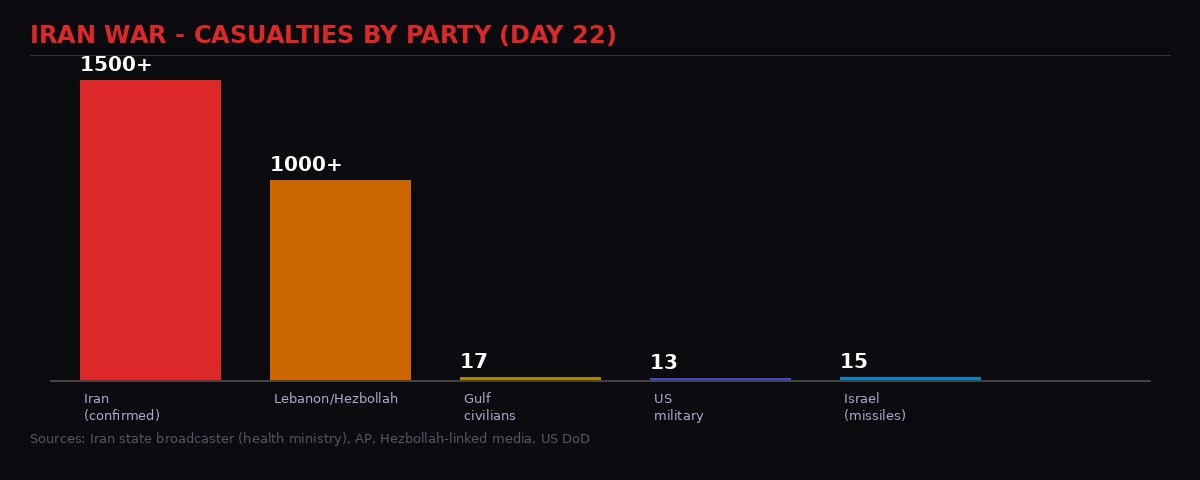
Iran's war toll now exceeds 1,500 dead, per the state broadcaster citing the health ministry. That figure almost certainly undercounts - the Islamic Republic's health data has historically lagged reality during crises, and internet restrictions imposed since the conflict began limit outside verification. War monitors using open-source satellite imagery and social media analysis have noted widespread damage to civilian and military infrastructure far beyond what official statements acknowledge.

The Lebanon front has received less attention than the direct Iran-Israel-US exchange, but the casualty numbers are staggering. Israeli strikes targeting Hezbollah have killed more than 1,000 people and displaced over one million Lebanese, according to the Lebanese government. Civilian assets, including health infrastructure, have been targeted. (AP, March 21)
Israel's military confirmed Saturday that it was conducting a "targeted ground operation" in southern Lebanon. Clashes were reported in the village of Khiam with Hezbollah fighters. Four militants were confirmed killed in the operation, according to the Israeli military.
Hezbollah's capacity has been significantly degraded since the 2024 ceasefire collapsed. The IRGC's Quds Force - which provided logistical and operational support to Hezbollah - has itself taken heavy losses in the Iranian theater. But Hezbollah retains an estimated 100,000-150,000 rockets and missiles according to pre-war IDF estimates, and its tunnel infrastructure in southern Lebanon remains largely intact despite Israeli operations in 2024.
The coordination between Iran's direct strikes and Hezbollah's Lebanese operations represents an attempt to force Israel to fight on two geographic fronts simultaneously while managing its own civilian defense. The Israeli home front is under sustained pressure - 15 Israelis killed by Iranian missiles as of Saturday, alongside four additional deaths in the West Bank and an unknown number of injuries from tonight's Dimona-area strikes still being tallied.

One of the war's stated objectives - from both Washington and Jerusalem - has been regime change. Not through invasion, but through strategic attrition: destroy the IRGC, eliminate the Basij enforcement apparatus, and create conditions for Iranians to "rise up" against their government. In three weeks, that strategy has produced no visible results on the ground inside Iran.
Israel has struck Basij checkpoints prolifically - Armed Conflict Location and Event Data documented at least 15 checkpoint strikes in a single day on March 11. Israeli Prime Minister Netanyahu issued a Farsi-language statement urging Basij members' mothers to convince their sons to lay down arms. The IDF targeted the Basij top commander, General Gholam Reza Soleimani, and killed him in early March.
None of it has broken the force's operational capacity. The Basij, according to expert analysis, is designed to absorb exactly this kind of targeting. "The Basij chief is chosen not for expertise but for ideological rigidity and demonstrated loyalty to the supreme leader," said Hamidreza Azizi, an expert on Iran's security and foreign policy at the German Institute for International and Security Affairs. "In most cases, Basij units operate autonomously or semiautonomously, particularly in operational matters." (AP/GISS, March 21)
Residents of Tehran report that security force presence has intensified, not diminished. Five or six new checkpoints appeared in a single upscale neighborhood, one resident told AP under condition of anonymity. Vehicle searches, document checks, phone inspections - the apparatus of enforcement is holding. Iranians who film strike footage or attempt to bypass the internet blackout face arrest. The communications blackout itself has limited the ability of opposition voices inside Iran to coordinate or communicate internationally.
"There have been no signs of an uprising, while internet restrictions limit information from Iran." - AP analysis, March 21, 2026
Supreme Leader Mojtaba Khamenei - appointed to the role amid the conflict after his father's health deteriorated - has not been seen in public since taking the position. Who is actually directing Iranian strategy at this point is, by AP's own assessment, genuinely unclear.

Israel's nuclear deterrence has always rested on ambiguity - the unconfirmed but widely understood possession of nuclear weapons creates a threat that opponents must take seriously without providing the political cost of acknowledged proliferation. The Dimona research center is the physical heart of that deterrent. It has never been targeted before in any conflict in Israel's 78-year history.
Tonight, Iran targeted it. Or rather, it targeted the cities around it, close enough that the message is impossible to misread.
The strategic logic is clear, even if the execution stopped short of a direct hit on the facility: Iran is telling Israel that its nuclear deterrent is not deterring Iranian missiles. It is telling the United States that the escalation ladder has more rungs than Washington has planned for. And it is telling the IAEA that the agency's warnings about nuclear safety in conflict zones are not theoretical.
The IAEA's Grossi stated plainly that Iran and regional countries with operational nuclear facilities face "increasing threat to nuclear safety" as the conflict continues. Bushehr, Iran's Russian-built reactor on the Gulf coast, has not been struck. That restraint has been deliberate on Washington's part - striking a functioning reactor would constitute an environmental and humanitarian catastrophe that would internationalize the conflict in ways that even the current regional spillover has not. Russia has made clear, through Zakharova's statement and through its special IAEA session request, that it is watching Bushehr closely.
The US has now struck three of Iran's nuclear sites across two separate military campaigns - the June 2025 12-day war and the current conflict. Iran has now targeted Israel's nuclear perimeter. Both sides have crossed lines that, before February 28, were considered inviolable constraints on Middle Eastern conflict.
There is no ceasefire in sight. Israel's army chief said so explicitly. The Trump administration has offered "shifting rationales" for the war - regime change, nuclear elimination, proxy network destruction - without achieving any of them. Iran has not collapsed. Its leadership has not been confirmed killed. Its nuclear program has been set back but not eliminated. And it has just demonstrated a ballistic missile range that, if the Diego Garcia attempt reflects a genuine capability, means no US or allied installation within 4,000 kilometers of Tehran can be considered safely outside the threat envelope.
That includes Ramstein Air Base in Germany at roughly 4,200 kilometers. It includes most of NATO's southern flank. It includes every capital between Tehran and the edge of Western Europe.
The simultaneous targeting of Natanz and Dimona's perimeter on a single day represents the most dangerous 24-hour period of the Iran War to date. Both sides have now struck the other's nuclear infrastructure. Iran has demonstrated - or is asserting - a ballistic range that invalidates its own stated limits. A ceasefire requires both parties to believe they have achieved their objectives or that continued fighting risks costs they are unwilling to pay. Neither condition currently exists. The next 72 hours are critical.
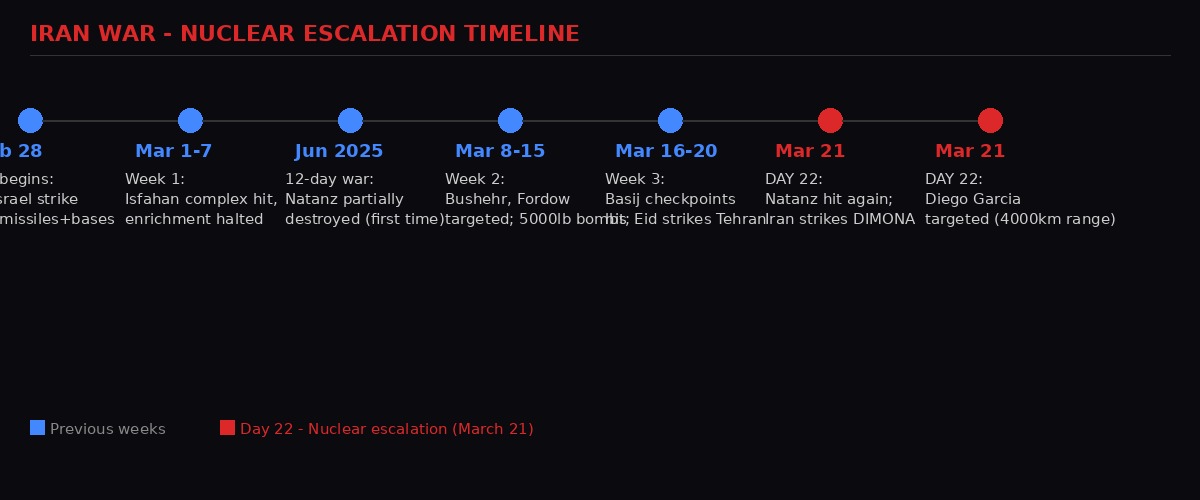
June 13, 2025: Israel strikes Natanz. IAEA confirms Pilot Fuel Enrichment Plant "functionally destroyed." Israel launches what becomes known as the 12-day war.
June 22, 2025: US follow-up strike hits Natanz's underground halls with bunker-busters. IAEA says underground centrifuge cascades "likely decimated."
February 28, 2026: US and Israel launch the current war. First strikes target IRGC command infrastructure, missile sites, and air defense networks.
March 1-7 (Week 1): Isfahan complex struck. The IAEA says the bulk of Iran's 440kg of enriched uranium is now buried under rubble at Isfahan.
March 8-15 (Week 2): Bushehr nuclear power plant targeted in approaches but not struck directly. Fordow and underground facilities hit with 5,000lb bombs.
March 11: Israel begins systematically striking Basij checkpoints across Tehran. 15+ documented in a single day.
March 16-20 (Week 3): Basij top commander General Gholam Reza Soleimani killed. Iran's IRGC spokesman killed. Eid al-Fitr prayers held in Tehran as strikes continue. IRGC spokesman's funeral broadcast nationally.
March 21 (Day 22): Natanz struck a third time. Iran retaliates with missiles hitting Dimona and Arad - first strike on Israel's nuclear research perimeter. Simultaneously, Iran launches missiles at Diego Garcia, 4,000km away - double its stated range limit. Saudi Arabia downs 20 drones over eastern oil fields. Dubai missile alert.
Mojtaba Khamenei, Iran's new Supreme Leader, has not appeared publicly since his appointment. Who is directing Iranian military operations is not confirmed. The IRGC's command structure has been heavily targeted. Its ability to coordinate a response of this geographic scale - simultaneous strikes in Israel's Negev and the Indian Ocean - suggests either significant command resilience or pre-delegated authority to lower-level operational commanders.
Get BLACKWIRE reports first.
Breaking news, investigations, and analysis - straight to your phone.
Join @blackwirenews on Telegram