Iran Hits Dimona, Natanz Struck Again: Nuclear Sites on Both Sides Now in the Crosshairs

Dimona: Iran Targets Israel's Nuclear Heart

An Iranian ballistic missile hit the town of Dimona in southern Israel late Saturday, wounding rescue workers treating victims for shrapnel injuries, according to Israeli emergency services. The missile hit the populated area around the Negev Nuclear Research Center - the facility Israel has never officially acknowledged as a weapons production site, but which every regional intelligence service treats as the cornerstone of the Israeli nuclear deterrent.
Israel is widely believed to hold between 80 and 400 nuclear warheads, making it the only nuclear-armed state in the Middle East. It has maintained a policy of nuclear ambiguity since the 1960s - neither confirming nor denying possession. (AP News, March 21, 2026)
The strike on Dimona is not confirmed to have caused damage to the research facility itself. Israeli rescue services said they treated "several people for shrapnel injuries" in the surrounding residential area. No radiation alert was issued. But the symbolism is immense: Iran fired at the location its leadership has called "the Zionist bomb factory" for decades, and the missile landed close enough to draw blood.
"Iran is targeting Israel's nuclear program." - Iranian state television, March 21, 2026
Israel has never publicly confirmed any details about the Dimona facility's capabilities beyond describing it as a "research center." The state of Dimona's infrastructure after Saturday's missile impact remains unknown. Israeli military censors have not released damage assessment photographs.
This is not the first time the facility has been in the crosshairs of regional adversaries. During the 1991 Gulf War, Iraq fired Scud missiles that fell in southern Israel - some in the Negev region. But no previous conflict has seen a state actor deliberately target the Dimona site by name, as Iran did on Saturday.
The Negev Nuclear Research Center at Dimona has been operational since 1963. It is not subject to IAEA safeguards because Israel, unlike Iran, has never signed the Nuclear Non-Proliferation Treaty. A physical strike on the reactor would risk radioactive contamination across a region already under siege.
Natanz Struck Again - What Survives Underground?

Earlier Saturday, the Natanz nuclear facility - located approximately 220 kilometers southeast of Tehran - was struck in what Israeli and American officials declined to claim or deny. The Iranian judiciary's official news agency, Mizan, said there was "no leakage" following the attack. The International Atomic Energy Agency (IAEA) confirmed it had been informed and was assessing the situation. (AP News, March 21, 2026)
This was the second confirmed strike on Natanz since the war began. The first came in week one, damaging surface buildings. Satellite imagery from that initial strike showed multiple structures destroyed. But the real value of Natanz is underground: the facility has deep-buried centrifuge halls that were hardened precisely because Iran anticipated aerial strikes.
The IAEA said before the war that the bulk of Iran's estimated 970 pounds - roughly 440 kilograms - of enriched uranium was buried beneath the rubble at the Isfahan facility, with a lesser amount at Natanz. That material is now in a status no one outside Iran can verify. The IAEA lost contact with inspectors inside Iran in the war's early days, when the government restricted foreign access and imposed internet blackouts across several provinces.
"Such strikes pose a real risk of catastrophic disaster throughout the Middle East." - Russian Foreign Ministry spokeswoman Maria Zakharova, March 21, 2026
Zakharova's warning, issued Saturday, is one of the clearest articulations of the risk that Western governments have been reluctant to say aloud. A strike that breaches a containment vessel at a facility holding enriched uranium does not produce a nuclear detonation - but it can disperse radioactive material across hundreds of square kilometers depending on yield, wind direction, and the nature of the munitions used.
Russia and China have both condemned the strikes on Iranian nuclear infrastructure from the beginning of the conflict. Neither has taken military action. Both have substantial economic stakes in Iranian energy and infrastructure projects, and both are watching carefully to see whether the US-Israeli campaign succeeds in permanently disabling Iran's nuclear program - or simply buries it deeper.
Diego Garcia: Iran's Missile Range Is Not What It Claimed

The most strategically significant development of the day was not the Dimona strike - it was what Iran fired toward Diego Garcia. The joint British-American military base, located on a tiny atoll in the Chagos Archipelago roughly 4,000 kilometers from Iran's coast, was targeted by Iranian missiles in an unsuccessful strike that nonetheless revealed something alarming: Iran either has missiles capable of flying twice their previously stated maximum range, or it has adapted its space launch vehicles into improvised intercontinental ballistic weapons. (AP News / British Ministry of Defense, March 21, 2026)
For years, Iran publicly maintained a self-imposed cap on its ballistic missile program: a stated maximum range of 2,000 kilometers. That limit was partly diplomatic cover - a signal to Europe that Tehran's missiles were designed to threaten Israel and the Gulf, not Paris or London. It was also a technical constraint Iran acknowledged, citing manufacturing choices and guidance system limitations.
Diego Garcia is 4,000 kilometers from Iran. The missile reached - or nearly reached - the island. That doubles the claimed maximum range in a single engagement.
"Iran had fired a two-stage intercontinental ballistic missile." - Israeli Army Chief Gen. Eyal Zamir, March 21, 2026
Justin Bronk, a senior research fellow at the Royal United Services Institute (RUSI) in London, offered a technical explanation: the attempt may have used Iran's Simorgh space launch rocket in an improvised ballistic configuration, "which could offer greater range as a ballistic missile, though at the cost of reduced accuracy." (AP News, March 21, 2026)
Steve Prest, a retired Royal Navy commodore, was blunter: "If you've got a space program, you've got a ballistic missile program." (AP News)
The strike was unsuccessful - British officials said Iran's missiles did not hit the base and declined to specify how close they came. But the attempt has demolished a diplomatic fiction that Western governments had allowed to persist for years. The Pentagon has long alleged that Iran's space program masked an ICBM development track. Saturday's strike provided the most direct public evidence yet that those allegations were correct.

Diego Garcia is not incidental to this war. The base houses roughly 2,500 mostly American personnel and has been described by US defense planners as "an all but indispensable platform" for operations across the Middle East, South Asia, and East Africa. The US deployed nuclear-capable B-2 Spirit bombers there during the Houthi campaign last year. Britain initially refused to allow the base to be used for strikes on Iran, reversing that position as Iran attacked its regional neighbors. (AP News)
Trump Says "Winding Down" - Then Deploys 2,500 More Marines

Within a few hours on Friday, President Donald Trump delivered a set of statements so contradictory that analysts struggled to reconcile them into a coherent strategy. On his Truth Social platform, Trump wrote that the United States was "getting very close to meeting our objectives as we consider winding down our great Military efforts in the Middle East." He claimed the US had adequately degraded Iranian naval, missile, and industrial capacity, and prevented Tehran from acquiring a nuclear weapon.
Hours later, the Pentagon confirmed it was deploying three additional amphibious assault ships and approximately 2,500 more Marines to the region. That brings total US personnel supporting the war effort to over 50,000. (AP News, March 21, 2026)
The Pentagon is simultaneously seeking an additional $200 billion from Congress to fund the war effort - a sum Senate Democratic leader Chuck Schumer called "preposterous." That request does not suggest a war winding down.
"The war is not close to ending." - Israeli Army Chief Gen. Eyal Zamir, March 21, 2026
Israel's defense minister Katz stated that strikes would "increase significantly" next week. Israeli Defense Forces said they were conducting a "targeted ground operation" in southern Lebanon on Saturday, where clashes with Hezbollah intensified around the village of Khiam. Israeli strikes on Hezbollah positions in Lebanon since the war's start have killed more than 1,000 people and displaced over a million, according to the Lebanese government. (AP News)
Trump's mixed signals extend to the Strait of Hormuz, the chokepoint through which roughly one-fifth of the world's oil supply transits. On Friday he wrote: "The Hormuz Strait will have to be guarded and policed, as necessary, by other Nations who use it - The United States does not!" Then, in the same post, he said the US would help if asked.
The contradiction matters economically. Iran has mined and attacked shipping in the strait throughout the conflict. Brent crude reached $112 per barrel Friday. An Israeli strike on Iranian gas fields and an Iranian retaliatory strike on a major Qatari liquefied natural gas terminal crippled regional energy infrastructure. The S&P 500 dropped 1.5% on Friday alone as markets processed the chaos. (AP News)
To partially offset the energy market disruption, the Trump administration lifted sanctions on Iranian oil that was already loaded on ships as of Friday - the first such relief in decades. Iran's oil ministry responded that it "essentially has no crude oil left in floating storage." The sanctions relief was simultaneously a lifeline to the Iranian government and an admission that the war's economic blowback on American consumers is politically unsustainable.
Congress Without a Plan - or the Power to Force One

Three weeks into a war begun without a congressional vote, Republican lawmakers are growing restless - though not restless enough to act. Under the War Powers Act, the president can conduct military operations for 60 days without congressional approval. That clock is running. Democrats have pushed multiple resolutions to halt the campaign; Republicans have voted them all down along party lines. (AP News, March 21, 2026)
But the $200 billion Pentagon funding request is forcing a reckoning. Even senators in Trump's own party are struggling to articulate what success looks like.
"The real question is: What ultimately are we trying to accomplish?" - Sen. Thom Tillis, R-N.C., to AP News, March 2026
House Speaker Mike Johnson offered an optimistic framing: "I do think the original mission is virtually accomplished now. We were trying to take out the ballistic missiles, and their means of production, and neuter the navy, and those objectives have been met." He acknowledged the Hormuz situation was "dragging it out a little bit." (AP News)
The problem is that Iran fired what Gen. Zamir characterized as an ICBM at Diego Garcia on Saturday. That does not look like a country whose missile capacity has been neutralized. The Natanz facility was struck - again. And missiles from Iran reached the perimeter of Israel's nuclear facility. None of this resembles a "virtually accomplished" mission.
Sen. Mark Warner, top Democrat on the Senate Intelligence Committee, cut to the center of it: "Regime change? Not likely. Get rid of the enriched uranium? Not without boots on the ground." Trump has ruled out a ground invasion. His administration has hinted at possible special forces deployments without defining their objectives.
The 60-day War Powers clock will force a vote in late April. At that point, Congress will have to either authorize the war retroactively or take a step no Republican majority has been willing to take against a president of its own party. The $200 billion request will arrive around the same time. The legislative collision will define whether this conflict has democratic backing or remains a presidential military adventure operating on borrowed time.
The US-Iran war began February 28, 2026. Under the War Powers Act, Congress must vote to authorize or halt military operations within 60 days - putting the legal deadline around April 29, 2026. Democrats have already filed multiple resolutions; Republicans have blocked them all. The $200 billion funding request will require a separate vote.
The Gulf's Nervous Neutrality Cracks

Iran claimed Saturday that its naval forces had destroyed facilities at the Al-Minhad base in the UAE and the Ali Al Salem airbase in Kuwait, asserting both had been used in attacks on Iranian territory. Neither the UAE nor Kuwait confirmed the strikes. A missile alert sounded Saturday night in Dubai. Saudi Arabia reported shooting down 20 drones over a two-hour period over its eastern region - the same region that contains the bulk of the kingdom's oil production infrastructure. (Al Jazeera, March 21, 2026)
For three weeks, Gulf states have tried to maintain the fiction of non-involvement. Qatar hosts the US Central Command forward headquarters at Al-Udeid Air Base. UAE soil hosts American military infrastructure. Kuwait has served as a staging area for US logistics. Iran has attacked all three - and all three governments have managed their public responses with extreme care, fearful of being drawn into a direct war with Tehran while simultaneously unable to expel American forces.
The UAE joining a 22-nation statement of "readiness to contribute to appropriate efforts to ensure safe passage" of shipping through the Strait of Hormuz represents a quiet but meaningful step. The statement included the UK, Germany, France, and Japan. It does not commit any nation to military action, but it signals that the international community is building the diplomatic architecture for some form of multinational naval response to Iranian mining and missile attacks on commercial shipping.
Japan's position is particularly acute: the country sources 90 percent of its crude oil from the Middle East and is almost entirely dependent on Hormuz transit. Tokyo has been conducting intense diplomacy with Tehran, and Iran announced Saturday it would allow Japanese ships to pass through the strait. That announcement - a carve-out for a specific non-belligerent nation - suggests Iran is managing its Hormuz strategy with more precision than its public statements about "closing" the waterway would imply. (Al Jazeera, March 21, 2026)
Trump's response to the Gulf states and NATO allies who have declined to contribute to the Hormuz patrol was characteristically sharp. At a White House session on Friday he called NATO nations "cowardly" for their lack of military support - echoing language he had already used to pressure European governments into taking sides. The insult landed poorly in Brussels, where NATO secretary-general meetings have been dominated by the question of how far Article 5 - collective defense - applies to a conflict the alliance did not authorize and whose endgame no member state can define.

Who Is Running Iran? Khamenei Has Not Been Seen in 22 Days

Supreme Leader Ayatollah Mojtaba Khamenei has not appeared publicly since being named to his role at the start of the conflict. The vacuum this creates at the top of Iran's command structure is not a minor bureaucratic curiosity - it goes directly to the question of who authorizes Iran's most consequential military decisions, including Saturday's strike toward Dimona and the Diego Garcia launch.
The Islamic Revolutionary Guard Corps (IRGC) operates its missile program under a parallel command structure that, in theory, reports to the Supreme Leader. In practice, the IRGC has its own institutional culture, its own economic empire, and its own strategic preferences that do not always align with elected officials or even the clerical hierarchy. In a war where the Supreme Leader is invisible and the elected president is managing a collapsed economy, the IRGC is the operational decision-making center. (AP News analysis, March 21, 2026)
Internet restrictions inside Iran make independent reporting nearly impossible. The death toll of over 1,300 inside Iran is the number circulating through open-source monitoring and leaked communications - it cannot be verified. Casualty figures from strikes on military sites, Republican Guard facilities, and alleged dual-use infrastructure are almost entirely opaque.
The US and Israel have offered "shifting rationales" for the war, as AP News documented: from hoping to trigger a popular uprising that topples the Islamic Republic, to eliminating Iran's nuclear capability, to destroying its missile program, to ending its support for armed regional proxies. None of these objectives have been achieved. No visible uprising has materialized. Natanz has been struck twice and may still be partially functional underground. The missile program just launched something at a target 4,000 kilometers away. And Hezbollah, Hamas, and Houthi operations continue.
"When he feels it in his bones? That's crazy." - Sen. Mark Warner, D-Va., responding to Trump's statement that the war will end "when I feel it in my bones"
The Ramadan timing is not irrelevant. Saturday was the end of the holy month, and worshippers converged on Tehran's grand mosque as airstrikes continued overhead - a scene that Iranian state media broadcast as evidence of public resilience. Whatever internal pressure the war has created within Iran's population, it has not translated into the street-level uprising that US planners apparently anticipated. The regime, whatever form it currently takes, is holding.
The War Is Entering Its Most Dangerous Phase

Nuclear facilities on both sides are now in active target sets. Missiles that were supposed to max out at 2,000 kilometers are hitting targets 4,000 kilometers away. The world's most critical oil transit chokepoint is mined and under missile threat. A US president is simultaneously claiming victory and deploying additional amphibious forces. Congressional authorization is weeks away from its legal deadline. The war's supreme commander in Iran has not been seen publicly in over three weeks.
The Hormuz situation deserves particular attention. The US Central Command chief, Adm. Brad Cooper, said this week that Iran's ability to attack vessels had been "degraded" - that 5,000-pound bombs had struck an underground facility used to store anti-ship cruise missiles and mobile launchers. But degraded is not destroyed. Mines do not require missile launches to close a strait. Iran has been seeding mines in international shipping lanes for weeks, and clearing them requires either a ceasefire or a sustained mine-countermeasures naval operation that no country has formally committed to conducting.
The global economic implications are cascading. Brent crude at $112 per barrel is already embedding inflationary pressure into every supply chain that depends on maritime freight. The Iranian retaliation on Qatar's LNG terminal removed a major natural gas supply node from global markets. Countries like South Korea, Japan, and Taiwan - heavily dependent on Middle East energy - are facing fuel price shocks they cannot easily absorb. The US partial sanctions relief on Iranian oil at sea is a political gesture toward price relief that Iran itself says is meaningless.
What happens in the next 48 to 72 hours will determine whether the nuclear dimension escalates or is implicitly capped by mutual deterrence. Israel's defense minister promised strikes would "increase significantly" next week. If those strikes include further targeting of Iranian nuclear infrastructure, and Iran responds by threatening to fire at Dimona again - or succeeds in hitting it - the conflict will cross into territory where no existing ceasefire architecture applies and no regional mediator has standing.
Egypt, Qatar, and Turkey have all offered mediation channels. None has produced results. The UN Security Council is paralyzed by Russian and Chinese vetoes on any resolution that legitimizes the US-Israeli campaign. The IAEA is operating without inspectors on the ground. The War Powers clock is ticking in Washington.
Day 23 begins with no exit ramp visible.
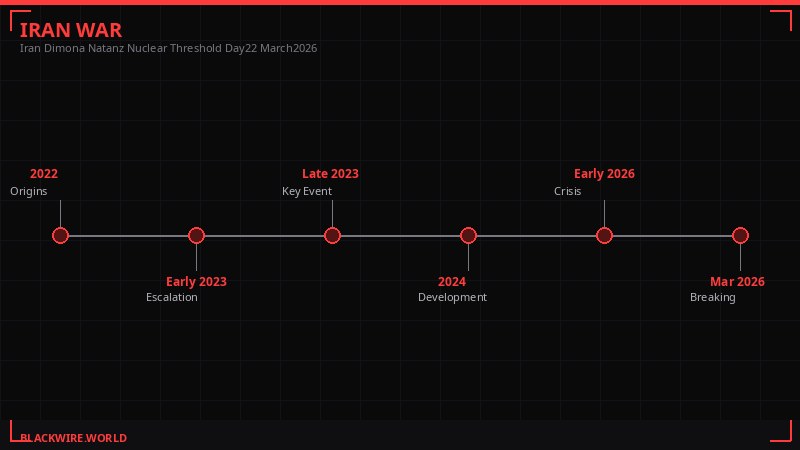
TIMELINE - NUCLEAR SITES IN THE US-IRAN WAR
Get BLACKWIRE reports first.
Breaking news, investigations, and analysis - straight to your phone.
Join @blackwirenews on Telegram