MARCH 22, 2026 | 07:15 UTC | FIELD REPORT
Nuclear Facilities in the Crosshairs: Iran Hits Near Dimona, Trump Issues 48-Hour Power Plant Ultimatum
Iranian ballistic missiles punched through Israeli air defenses Saturday and landed near the Dimona nuclear research complex - the open secret that holds Israel's nuclear arsenal. Hours later, Donald Trump posted a 48-hour ultimatum on Truth Social: open the Strait of Hormuz or he will "obliterate" Iran's power plants. The war is three weeks old and it just found a new gear.

Aerial photograph showing damage pattern from ballistic missile impact, southern Israel, March 21, 2026. [Reuters/Maxar satellite imagery]
Trump has threatened to target Iran's power infrastructure if the Strait of Hormuz is not fully reopened within 48 hours. Iran has responded by threatening to strike US-linked energy infrastructure across the entire region. The clock is running.
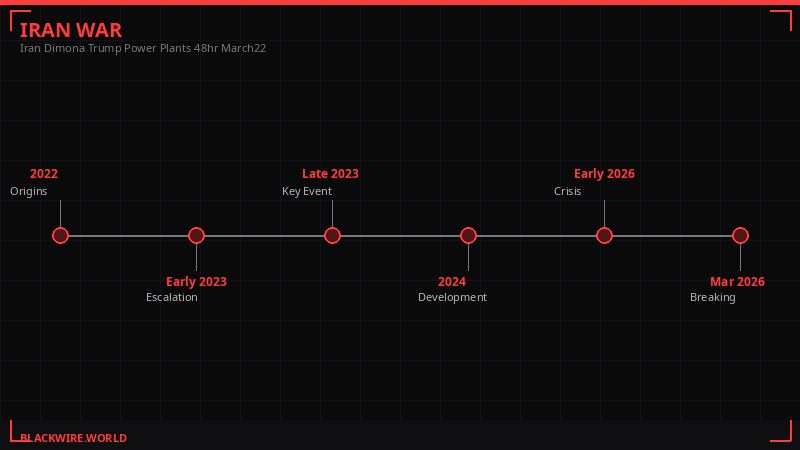
Timeline: Key escalation events from the US-Israel war on Iran, February 28 - March 22, 2026. [BLACKWIRE / Sources: BBC, Al Jazeera, CSIS]
The Strike on Dimona: Air Defenses Fail Again

The Shimon Peres Negev Nuclear Research Center at Dimona has been Israel's open secret for six decades. Saturday's strike was the closest any attack has come to the facility. [File image]
At roughly midnight local time Saturday, two Iranian ballistic missiles broke through Israeli air defense systems and detonated in the Negev desert. One struck the town of Dimona, roughly 13 kilometers from the Shimon Peres Negev Nuclear Research Center. The second hit the nearby town of Arad, a harder residential strike that left dozens injured and apartment blocks shattered.
Israeli firefighters confirmed the scale of the failure in a public statement: "In both Dimona and Arad, interceptors were launched that failed to hit the threats, resulting in two direct hits by ballistic missiles with warheads weighing hundreds of kilograms." Israel's Magen David Adom ambulance service reported treating 40 people in Dimona - 37 with mild injuries, one 10-year-old boy in serious condition. In Arad, 68 people were treated including 10 in serious condition. (BBC News, March 22, 2026)
Iranian state TV framed the Dimona strike as direct retaliation for an earlier attack on Iran's Natanz nuclear enrichment facility - itself one of the primary targets when the US and Israel launched the war on February 28. Iran's Atomic Energy Organisation (AEOI) described the Natanz strike as a violation of the Nuclear Non-Proliferation Treaty, though it confirmed "no leakage of radioactive materials" and said there was "no danger to residents of the surrounding areas."
The IAEA moved quickly to contain escalation. Director General Rafael Grossi said the agency was "not aware of any damage to the nuclear research facility" at Dimona and confirmed "no increase in off-site radiation levels" had been reported. But Grossi issued a stark warning: "Maximum military restraint should be observed, in particular in the vicinity of nuclear facilities." (BBC News)
"Maximum military restraint should be observed, in particular in the vicinity of nuclear facilities." - Rafael Grossi, IAEA Director General, March 22, 2026
The Dimona complex - formally the Shimon Peres Negev Nuclear Research Center - has been Israel's open nuclear secret for roughly six decades. No Israeli government has officially acknowledged it holds weapons-grade material, but the country is universally understood to be the only nuclear-armed state in the Middle East. Targeting it - even peripherally - crosses a line that analysts say no Iranian strike had previously come this close to crossing.
Israeli authorities immediately launched an investigation into how the missiles penetrated the defense grid. The failure is embarrassing given the Iron Dome, Arrow, and David's Sling layers that were supposed to provide layered interception. The warheads, reportedly weighing hundreds of kilograms each, suggest Iran used its more capable medium-range ballistic missiles - not the drone swarms that interceptors have handled more easily.
Nuclear infrastructure targeted across Iran and Israel during 22 days of conflict. IAEA confirms no radioactive releases at any site as of March 22. [BLACKWIRE / IAEA, BBC News]
Trump's 48-Hour Ultimatum: Power Plants or the Strait

Iran operates several major power generation complexes. Trump's ultimatum threatens them directly if Hormuz is not reopened within 48 hours. [File / Pexels]
On Saturday evening, President Trump escalated from military strikes to a public ultimatum of a different order. Writing on Truth Social, Trump warned that if Iran did not "fully open, without threat" the Strait of Hormuz within 48 hours, the US military would begin targeting Iranian power plants - "starting with the biggest."
The threat carries enormous humanitarian implications. Civilian power infrastructure - hospitals, water treatment, heating systems in a country of 89 million people - would be directly at risk. International law experts have noted that targeting power plants with clear civilian use could constitute a violation of the laws of armed conflict under the Fourth Geneva Convention, though the US and its allies have disputed such characterizations when confronted with the issue.
Iran's response came fast. Tehran warned that any attack on its energy infrastructure would trigger retaliatory strikes on US-linked energy targets across the entire region - oil facilities, pipelines, refineries. Iranian state media reported the regime would cause "insecurity" in the Red Sea and "set fire" to energy facilities throughout the Gulf. (BBC News analysis, March 22, 2026)
"If Iran doesn't fully open, without threat, the Strait of Hormuz in the next 48 hours, the US military will be targeting Iranian power plants, starting with the biggest." - Donald Trump, Truth Social, March 22, 2026
The ultimatum sits awkwardly alongside Trump's own statements from the previous day. On Friday he had outlined a numbered list of US war objectives on Truth Social - degrading Iran's military, destroying its nuclear program, eliminating support for proxy groups. The Strait of Hormuz was not on that list. He said reopening the waterway should be the responsibility of other nations more dependent on Gulf oil exports, noting the US is a net energy exporter.
Within 24 hours, that position reversed into a 48-hour threat over the same chokepoint. BBC correspondent Anthony Zurcher, reporting from Florida where Trump was based Saturday, noted the contradiction: "The war is 'very complete, pretty much,' Trump has said, but new American ground forces are moving into the region. It is 'winding down,' but US and Israeli bombing continues unabated." (BBC News)
Diego Garcia: Iran Takes the War to the Indian Ocean

Diego Garcia, the joint US-UK military base on the Chagos Islands, Indian Ocean. Iran reportedly fired two ballistic missiles at the base - one intercepted, one failed in flight. [File image]
Before the Dimona strikes dominated headlines Saturday, a separate escalation had already occurred that most of the public caught only after the fact. Late Thursday into Friday morning, Iran reportedly launched two ballistic missiles at Diego Garcia - the joint US-UK military base in the Chagos Islands in the Indian Ocean, roughly 2,350 miles from Iranian territory.
Neither weapon reached its target. One missile failed in flight. The other was intercepted by a US warship. The US military declined to comment. The BBC said it understood the reporting from the Wall Street Journal and CNN - which cited unnamed US officials - to be accurate. (BBC News, March 22, 2026)
The strategic significance is considerable regardless of whether the missiles hit. Diego Garcia is the Indo-Pacific's most important US power projection base. It can accommodate B-52 and B-2 strategic bombers and has been the launch point for operations across the Middle East for decades. Iran attempting to strike it - even unsuccessfully - signals both intent and a willingness to extend the conflict far beyond the Persian Gulf theater.
Whether Iran actually possesses ballistic missiles with the range to reach Diego Garcia is also a serious question. Defense analysts have noted the base sits at the outer edge of plausible Iranian missile range. Either Tehran has upgraded its capabilities beyond what was previously assessed, or the reports are accurate but the missiles were of a type that failed before reaching anywhere close to the target.
UK Foreign Secretary Yvette Cooper, speaking Saturday, confirmed she was aware of the incident and said supporting UK interests included "taking defensive action against ballistic missile threats." She reiterated the UK would not be drawn into offensive operations, but the framing had quietly shifted. The missiles meant for Diego Garcia changed the political calculus in London.
The UK Expands: Hormuz Strikes Now Permitted from British Bases

RAF Fairford, Gloucestershire - one of two UK bases the US can now use to strike Iranian missile sites targeting the Strait of Hormuz. The expansion was approved by ministers on Friday. [File image]
On Friday, after ministers met in London to review the war, Prime Minister Keir Starmer's government approved a significant expansion of US access to British military facilities. Previously the US could use RAF Fairford and Diego Garcia only for defensive operations - preventing Iranian missiles from striking British interests. That restriction was removed for a specific category of operations: US strikes on Iranian missile sites targeting shipping in the Strait of Hormuz.
The change was framed under the same "collective self-defence" doctrine, but the practical effect is different. US forces can now use UK bases to go offensive against Iranian launch sites. The distinction matters both legally and diplomatically. A Downing Street spokesperson said ministers had agreed that "Iran's reckless strikes, including on Red Ensign vessels and those of our close allies and Gulf partners, risked pushing the region further into crisis and worsening the economic impact being felt in the UK and around the world." (BBC News, March 21, 2026)
Trump's reaction to the news was pointed. He told reporters: "It's been a very late response from the UK. Surprised because the relationship is so good but this has never happened before. They were really pretty much our first ally all over the world." He had previously called NATO allies "cowards" for refusing to offer warships to facilitate reopening the shipping channel.
Iran's Foreign Minister Abbas Araghchi escalated verbally in response. He told his UK counterpart Yvette Cooper that the decision was "putting British lives in danger" and that Iran would "exercise its right to self-defence." Iran's foreign ministry also described UK participation as direct "participation in aggression."
The UK is now in an uncomfortable halfway house. It is not formally at war with Iran, not conducting offensive strikes itself, but is providing the geography from which US offensive strikes will be launched. The Liberal Democrats and Greens have both called for a parliamentary vote on the terms of the agreement. Conservative leader Kemi Badenoch called it "the mother of all U-turns."
"Iran's reckless strikes, including on Red Ensign vessels and those of our close allies and Gulf partners, risked pushing the region further into crisis and worsening the economic impact being felt in the UK and around the world." - Downing Street spokesperson, March 21, 2026
The Cost Ledger: $800 Million in US Damage, 22 Days In

Wreckage from Iranian strikes on US-allied military infrastructure across the Middle East. A CSIS / BBC Verify analysis puts total US asset damage at approximately $800 million in the first two weeks alone. [File]
A new analysis from the Center for Strategic and International Studies (CSIS) and BBC Verify, published Saturday, attempts to put a dollar figure on what the Iran war has cost the United States in military assets destroyed or damaged. The number is $800 million in the first two weeks - higher than anything previously reported publicly.
The biggest single loss: an AN/TPY-2 radar system, used for the long-range interception of ballistic missiles, was destroyed by an Iranian strike at a US air base in Jordan. The CSIS reviewed defense department budget documents and placed the radar's replacement cost at approximately $485 million. An additional $310 million in damage has been assessed across buildings, facilities, and other infrastructure at US bases and bases used by American forces regionally. (BBC Verify, March 21, 2026)
Iran's targeting strategy has been methodical, not random. Satellite imagery analyzed by BBC Verify shows Iran has struck at least three air bases more than once: Ali Al-Salim in Kuwait, Al-Udeid in Qatar, and Prince Sultan in Saudi Arabia all show fresh damage appearing in successive phases of the conflict. The repeat strikes suggest Iran is specifically targeting infrastructure that regenerates - defense systems that get repaired and brought back online, fuel and logistics storage, communications nodes.
Russia reportedly shared intelligence with Tehran on American military dispositions in the region, which would explain the precision of several strikes. The US has 13 confirmed military deaths since the war started February 28. The US-based Human Rights Activists News Agency (Hrana) estimates the overall death toll has reached nearly 3,200 people, including approximately 1,400 civilians.

Estimated damage to US military assets in weeks 1-2 of the Iran war. THAAD radar system in Jordan accounts for the single largest loss. [BLACKWIRE / CSIS, BBC Verify analysis]
The $800 million figure does not include aircraft losses, naval damage including to the USS Gerald Ford, or the cost of ammunition expended in the intercept missions running continuously across the theater. The full bill is almost certainly north of $1.5 billion when operational costs are factored in, according to military budget analysts. Congress is being asked for additional billions in emergency war funding.
The Hormuz Stranglehold: Shipping, Oil, and the Global Economy

Before the war, approximately 138 ships transited the Strait of Hormuz daily, carrying a fifth of global oil supply. Iranian closure has reduced that to a trickle. [Pexels / File]
The Strait of Hormuz is 33 kilometers wide at its narrowest point. Before February 28, approximately 138 ships transited it daily, carrying roughly 20 percent of all global oil exports. About 100 million barrels of oil enter the market every day worldwide - and a fifth of that moved through that corridor. Since Iran began enforcing its closure in retaliation for US-Israeli strikes, that daily transit has dropped to near zero for non-Iran-approved vessels. (Joint Maritime Information Centre data, via BBC)
The downstream effects are visible in every energy market. Brent crude has climbed past $127 per barrel - up from roughly $72 before the war. European natural gas benchmark prices briefly hit 183 pence per therm before easing. The war has added an estimated 30 to 40 percent premium to global energy costs in less than a month. Countries that were already managing inflation are now dealing with a supply shock of the kind not seen since the 1973 OPEC embargo.
Japan has been given partial relief: Iran announced it would allow Japanese ships to transit the strait. Japan sources approximately 90 percent of its crude oil from the Middle East and the concession is economically significant - but also strategically notable. Iran is selectively enforcing the closure, using it as leverage against different states, rewarding neutrality and punishing involvement.
Qatar's LNG processing complex at Ras Laffan - hit when Israel struck South Pars gas field and Iran retaliated - is running at reduced capacity. QatarEnergy said approximately 17 percent of its export capacity was affected. Qatar's prime minister Mohammed bin Abdurrahman Al-Thani called it a "very dangerous escalation" with "significant repercussions for global energy supplies." Qatar hosts the US Al-Udeid Air Base, making it simultaneously a war staging ground and a casualty of the conflict it is facilitating.

Before vs. now: The Strait of Hormuz shipping collapse and its impact on global oil supply. Japan receives selective exemption; all other non-Iranian-approved vessels face threat of attack. [BLACKWIRE / JMIC, QatarEnergy, Reuters]
In an effort to manage the price spiral, the US has taken an extraordinary step: lifting sanctions on some Iranian oil. Treasury Secretary Scott Bessent announced a narrowly tailored, short-term authorization permitting the sale of Iranian crude currently loaded on vessels at sea. The authorization runs until April 19. Bessent said it would bring approximately 140 million barrels to global markets. (BBC News, March 21, 2026)
The contradiction is blinding. The US is simultaneously bombing Iran and buying its oil. David Tannenbaum, director of Blackstone Compliance Services, told the BBC: "Essentially we're allowing Iran to sell oil, which could then be used to fund the war effort." Rachel Ziemba of the Center for a New American Security was more measured: "The US government is definitely in an every-barrel-counts situation because of the scale of the supply shock. They're looking to find additional oil wherever they can."
The US-Israel Fault Line: Netanyahu Acts Alone

The Trump-Netanyahu relationship has shown its first major fractures after Israel's unilateral strike on Iran's South Pars gas field. Trump said he was not informed in advance. [File]
The war's most significant political development of the week may be the emerging fracture between the US and Israel over war aims and coordination. Israel struck Iran's South Pars gas field - part of the world's largest natural gas reserve - without informing Washington in advance. Trump posted publicly that he had not known about the strike beforehand. Three unnamed Israeli officials subsequently told Reuters the attack had in fact been coordinated with the US - a denial of the denial that left everyone confused about who is actually running the war's targeting. (BBC News, March 20, 2026)
Netanyahu addressed the confusion at a press conference Thursday. He said Israel "acted alone" in the South Pars strike and confirmed Trump had "requested that there be no further such attacks" on energy targets. He denied Israel had "dragged the US into the war or misled Trump." He attacked the Caspian Sea - where Iran's navy had assets - and called Iran's military degradation "massive." He said Israel could create conditions for Iranian regime change but said the population would need to "exploit those conditions at a certain point."
Trump's Friday post on Truth Social - his most detailed public statement of war objectives - conspicuously did not include regime change as a goal. Gone too was any reference to Iran's "unconditional surrender," which he had insisted on in the early weeks. The revised list: degrade Iran's military, destroy its nuclear program, eliminate support for regional proxies, protect US allies. Iran's anti-American leadership could theoretically survive under this framework.
Military analysts are watching a second strand: a Marine Expeditionary Unit of approximately 2,500 troops, dispatched from Japan, is en route to the Middle East and is expected to arrive within days. A second Marine force of similar size departed California and is expected in mid-April. The analysts suggest Kharg Island - Iran's primary oil export terminal - may be the objective. Capturing it would cut Iran's oil revenues and give the US a physical bargaining chip for any negotiation. (BBC News, March 22, 2026)
Trump, when asked Friday about ground troops, said: "I'm not sending ground troops to Iran. But if I were, I certainly wouldn't tell you." The ambiguity is intentional. The uncertainty about US ground intentions adds pressure to Iranian decision-making without committing the US politically. Whether that calculated ambiguity holds when Iranian missiles continue to land near Israeli nuclear facilities is a different question.
Civilians, Casualties, and What Comes Next

Civilians displaced by the Iran war face a humanitarian picture that remains underreported. HRANA estimates approximately 1,400 civilians among the war's 3,200 dead in the first three weeks. [File / Pexels]
The human cost is still being tallied. The US-based HRANA estimates the overall death toll has reached approximately 3,200 people in 22 days of war, including roughly 1,400 civilians. Those figures cover Iran, Israel, and the broader region. They do not fully account for the indirect casualties from the energy shock - hospitals running on reduced power, patients unable to access care, industrial accidents linked to fuel shortages in countries that depend on Gulf oil.
In Israel, Saturday's strikes on Dimona and Arad sent 108 people to hospital treatment in a single night. A 10-year-old boy was in serious condition in Dimona. In Arad, 10 people were in serious condition after an apartment block took a direct hit from a missile with a warhead weighing "hundreds of kilograms," per Israeli firefighters. Emergency medical technician Yakir Talkar described Arad as "a very severe scene" with "many wounded with varying degrees of injury."
Iran is fighting the war on two tracks: military strikes that are causing real damage, and an information campaign that state media is amplifying with inflated enemy casualty figures and "digital manipulation intended to glorify Iran," per BBC analysis of Iranian broadcast coverage. The gap between what Iran says is happening and what satellite imagery and independent verification shows is wide - but the domestic audience function of the propaganda matters for regime stability.
Inside Iran, the population is marking Nowruz - the Persian New Year - under conditions of active bombing and internet restrictions. Iranians have told the BBC they cannot smell the festival in the air this year. Tech-savvy citizens are using VPNs and satellite connections to contact family abroad, circumventing the regime's communications restrictions. Seven Iranian football players requested humanitarian visas in Australia during a recent tournament - five returned home. The regime faces pressure from below even as it prosecutes the war from above.
Saudi Arabia expelled Iran's military attache and four embassy staff members on Friday, following the Iranian attack on the Red Sea port of Yanbu - Saudi Arabia's main oil export outlet. The diplomatic rupture between Riyadh and Tehran, previously repaired in a Chinese-brokered deal, has fully collapsed. Yanbu is not only economically critical; it sits 1,200 kilometers from the Iranian border, meaning Iran's missiles are reaching deep into the Arabian Peninsula. Saudi Arabia's decision to close its airspace to Iranian aircraft and expel diplomatic personnel signals it now considers itself effectively a party to the conflict, even without formal declaration.
"Iran is being decimated." - Israeli Prime Minister Benjamin Netanyahu, press conference, March 20, 2026
Whether Iran is actually being decimated is less clear than Netanyahu's bravado implies. It has lost significant military infrastructure, taken serious damage at nuclear sites, and faces genuine economic pressure from the Kharg Island strikes and sanctions. But it has also successfully interdicted the world's most important oil shipping lane for three weeks, struck near an Israeli nuclear facility, targeted a remote Indian Ocean base, and survived the first three weeks of war with its regime intact. The question for the next 48 hours is whether Trump's power plant ultimatum is a negotiating tactic or a genuine operational order. Iran is betting it can absorb the pressure without opening Hormuz. Washington is betting Tehran will blink. Someone is going to be wrong.
Timeline: 22 Days of War - March 22, 2026
February 28, 2026: US and Israel launch joint strikes on Iran, targeting nuclear sites including Natanz, Fordow, and Arak, along with IRGC command infrastructure. Iran announces closure of the Strait of Hormuz within hours.
March 1-3: Iran begins enforcing Hormuz closure with naval vessels and threatens tankers. Oil prices begin climbing. First Iranian retaliatory drone and missile strikes hit US bases in Jordan, Qatar, and the UAE. Iran strikes Israeli cities including Haifa and Tel Aviv.
March 4-7: Iranian strikes on US bases escalate. CSIS later assesses $800 million in damage in weeks 1-2. US retaliates by striking IRGC air defense and missile systems. 13 US military deaths confirmed. Russia reported to have shared intelligence with Tehran on US force dispositions.
March 10: Iran launches drones at RAF Akrotiri, Cyprus - the UK's sovereign base. One drone strikes the runway causing "minimal damage." UK government acknowledges the attack publicly. Tehran warns London against facilitating US operations.
March 14-16: US bombs Kharg Island, Iran's primary oil export terminal. Trump describes Iranian oil infrastructure as "obliterated." Israel strikes Iranian naval assets in the Caspian Sea. HRANA estimates civilian death toll exceeding 1,000 by this point.
March 17-19: Israel, acting unilaterally, strikes Iran's South Pars gas field. Iran retaliates by striking Qatar's Ras Laffan LNG complex, affecting 17 percent of Qatar's export capacity. European gas prices surge 10+ percent. US-Israeli coordination publicly fractures when Trump says he was not informed of the South Pars strike.
March 20: UK government expands US basing rights to permit strikes on Iranian missile sites targeting Hormuz shipping. Saudi Arabia expels Iranian diplomats after attack on Yanbu port. Iran fires two ballistic missiles at Diego Garcia - one intercepted, one fails in flight.
March 21: Iran strikes Dimona and Arad in Israel. 108 casualties. Israeli air defenses fail. IAEA confirms no radiation release at Dimona nuclear center but calls for "maximum military restraint." Netanyahu holds press conference saying Israel "acted alone" on South Pars.
March 22 (today): Trump issues 48-hour ultimatum - open Hormuz or Iran's power plants will be targeted. Iran warns all US energy infrastructure in the region will be hit in retaliation. IAEA Director General issues nuclear restraint appeal. US lifts temporary sanctions on Iranian oil stranded at sea to relieve global price pressure. Clock running.
Get BLACKWIRE reports first.
Breaking news, investigations, and analysis - straight to your phone.
Join @blackwirenews on Telegram