Iran Threatens to Mine the Persian Gulf as Trump's Ultimatum Expires Tonight

Tehran has threatened to physically mine the Persian Gulf if the United States and Israel expand attacks to Iran's coastline or islands - a declaration that arrived the same morning Trump's 48-hour ultimatum to reopen the Strait of Hormuz was set to expire. The world is watching one chokepoint and counting down to a deadline that could trigger the worst energy catastrophe in recorded history.

The Ultimatum and the Mining Threat
On Saturday, March 21, President Donald Trump posted a warning on Truth Social that has since reordered energy markets and military planning rooms across four continents. Iran had 48 hours to reopen the Strait of Hormuz - the 21-mile-wide choke between Iran and Oman through which roughly 20 percent of global oil and liquefied natural gas normally flows - or face the destruction of its power infrastructure. According to the timestamp of Trump's post, the deadline expires at 23:44 GMT on Monday, March 23. That is tonight.
Iran's answer this morning was not compliance. It was escalation. Iranian military commanders announced that if US or Israeli forces extend their campaign to target Iran's coastal installations, islands, or port facilities, Tehran will deploy naval mines in the Persian Gulf. The threat transforms the entire waterway from a contested passage into a potential kill zone. Naval mines are indiscriminate weapons - Chinese oil tankers, Indian LNG carriers, and Pakistani cargo ships currently transiting the strait with no alignment to either side of the conflict would face the same risk as military vessels.
The statement follows an already significant night. Israeli forces destroyed the Qasimiyah Bridge over the Litani River in southern Lebanon on Sunday, removing one of the last major road links in the region as the Israeli Army Chief said operations against Hezbollah "have only begun" and will be "prolonged." Lebanese President Joseph Aoun described the bridge strike as "a prelude to a ground invasion." The front in Lebanon, dormant for weeks while focus shifted to Iran, is heating up at the worst possible moment.
"Iran threatens to mine Gulf if US-Israeli attacks target coast, islands." - Al Jazeera headline, March 23, 2026

The IEA Warning: Worse Than 1973 and 2022 Combined
The morning's most economically significant statement did not come from Tehran or Washington. It came from Fatih Birol, Executive Director of the International Energy Agency, speaking at the National Press Club of Australia in Canberra on Monday.
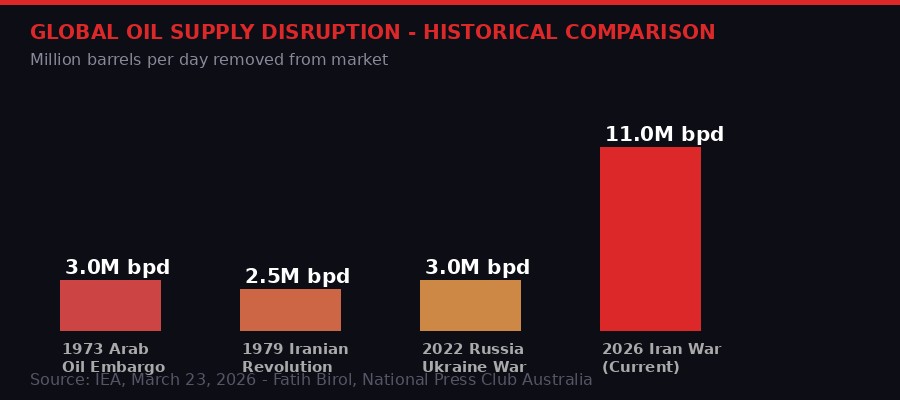
Birol's assessment was blunt. The world is not in a crisis comparable to the 1973 Arab oil embargo or the 1979 Iranian revolution. It is not in a crisis comparable to the natural gas shock that followed Russia's 2022 invasion of Ukraine. It is in a crisis worse than all three combined.
"This crisis, as things stand, is now two oil crises and one gas crash put all together." - Fatih Birol, IEA Executive Director, National Press Club Australia, March 23, 2026
The numbers behind that claim are stark. Iran's effective blockade of the Strait of Hormuz has removed approximately 11 million barrels per day from global oil supply - more than double the combined shortfalls of the 1973 and 1979 crises. The 1973 embargo cut roughly 4.3 million bpd from markets. The 1979 revolution removed around 3.5 million bpd. The current disruption exceeds both combined by a margin of more than 3 million barrels per day.
On natural gas, the damage is equally severe. LNG supplies have fallen by approximately 140 billion cubic metres since the start of the conflict. The entire shortfall from Russia's Ukraine invasion peaked at around 75 billion cubic metres. The current LNG shock is nearly double that. Birol said at least 40 energy facilities across nine countries have been severely damaged since fighting began on February 28. That figure encompasses refineries, gas processing plants, export terminals, and pipelines across Iran, Iraq, Saudi Arabia, the UAE, and beyond.
Oil prices have surged more than 50 percent since hostilities began. Brent crude stood at $112.80 per barrel as of 07:00 GMT Monday morning. Analysts have warned that prices could reach $150 or even $200 per barrel if the strait remains effectively closed and the mining threat is executed. The IEA had already announced plans to coordinate the release of 400 million barrels from emergency strategic reserves earlier in the conflict - a move that has so far failed to stop the price surge.
"The global economy is facing a major, major threat today, and I very much hope that this issue will be resolved as soon as possible." - Fatih Birol, IEA Executive Director, March 23, 2026
Birol added that he had not previously spoken publicly about the depth of the crisis because he felt it had not been "well appreciated by decision-makers around the world." His decision to go public in Australia - far from the epicenter - signals a deliberate choice to pressure governments globally, not just the US and its immediate allies.
Markets React: Asia Leads the Sell-Off
Global equity markets opened Monday in a state of controlled panic. South Korea's benchmark KOSPI plunged 6.5 percent - the steepest single-day decline since the early days of the COVID-19 pandemic in 2020. Japan's Nikkei 225 fell 3.5 percent. Hong Kong's Hang Seng Index tumbled more than 4 percent. Australia's ASX 200 closed 0.75 percent lower. In Europe, London's FTSE 100 was down 1.4 percent in morning trading while Frankfurt's DAX 40 fell around 2 percent.
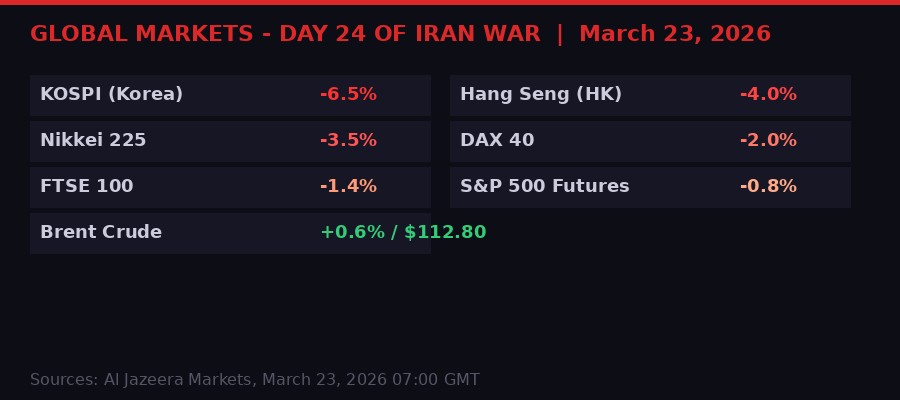
US equity futures indicated further losses at the Wall Street open. Futures tied to the S&P 500 were down about 0.8 percent as of 07:00 GMT. The currency moves accompanying the equity rout told the same story: safe-haven flows into the Swiss franc and Japanese yen, selling pressure on commodity-importing economies whose energy import bills are being crushed by the oil price surge.
South Korea's sensitivity to the crisis is structural. The country is among the world's largest oil and LNG importers on a per-capita basis. Its petrochemical and manufacturing sectors - the engine of KOSPI earnings - are directly exposed to energy input costs. A 50-percent oil price increase since February 28 has not just hit consumer fuel prices. It has hammered industrial margins across the economy. The KOSPI's 6.5-percent decline is not irrational panic. It is rational pricing of a supply shock that has no near-term resolution visible.
The AP report on gas prices published Monday illustrated the domestic US dimension. Spiking pump prices from the Iran war are on track to consume a significant portion of the tax refunds that Trump's administration had publicly touted as a benefit of its fiscal policies. The political irony is not lost on observers: a war launched by Trump's White House is now threatening to erase the economic credit Trump was counting on with American voters.

War on Three Fronts: Iran, Lebanon, and the Strait
The crisis as of March 23 is not a single-theater conflict. It is three simultaneous pressure points that interact and amplify each other.
In Iran, US and Israeli strikes have continued through Day 24. An unprecedented wave described as "extensive" hit Tehran on Saturday as Trump's ultimatum was being issued. The Israeli military confirmed hitting an Iranian gas field. Multiple senior Iranian security officials have been killed, including the Basij force chief. Iranian ballistic missiles have struck near Israel's nuclear site at Dimona, injuring 180 people in surrounding towns and raising questions about how such missiles penetrated Israel's sophisticated air defense systems. The attack on Diego Garcia - the US-UK base in the Indian Ocean - remains disputed, with Tehran denying responsibility even as London condemns it as Iranian.
In Lebanon, the situation shifted overnight. Israeli forces demolished the Qasimiyah Bridge over the Litani River, a crossing used by both civilians and logistics. The Israeli Army Chief told reporters the operation against Hezbollah "has only begun" and would be "prolonged." Tens of thousands of Lebanese civilians are sheltering in tents in Beirut as rain falls and strikes continue. An estimated 517,000 people have been displaced in Lebanon since the conflict expanded there. Lebanese President Joseph Aoun, speaking after the bridge strike, called it "a prelude to a ground invasion" - the first time a senior Lebanese official has used that phrase.
In the strait itself, only a handful of vessels not aligned with the US or Israel are still transiting. Chinese, Indian, and Pakistani-flagged ships have continued to move through. Iran's mining threat, if executed, would end even those transits. The strait would effectively be sealed. The IEA's estimate of 11 million barrels per day already removed from the market would increase further as the last trickle of non-aligned traffic stops.
"Starmer and Trump discuss need to open Hormuz strait as Israel warns 'weeks' of fighting to come." - BBC headline, March 23, 2026
The Trump-Starmer phone call on Sunday confirmed that reopening the strait is now the stated diplomatic objective of both Washington and London. The two leaders agreed it was "essential to ensure stability in the global energy market," according to a statement from Starmer's office. Whether that agreement translates into concrete action - whether allied naval forces attempt to clear the strait by force if Iran carries through with mining - is the central unanswered question.

The Contradictions in Trump's Messaging
No single aspect of this crisis is harder to read than the gap between what Trump says and what his military is doing. On Saturday morning - hours before issuing the power plant ultimatum - Trump told reporters his administration was "very close to meeting our objectives as we consider winding down" military operations against Iran. He has repeated versions of this "almost over" framing multiple times across four weeks of fighting.
The reality on the ground contradicts every version of it. The Israeli military spokesperson said last week that officials have detailed plans for at least three more weeks of war. The USS Gerald Ford carrier group has repositioned. Marines are forward deployed in Kuwait. The Pentagon identified a seventh US service member killed in the conflict. The US has bombed Kharg Island, Iran's main oil export terminal - a strike with generational consequences for Iran's export infrastructure regardless of how the conflict ends.
Al Jazeera's explainer published Monday morning framed the contradiction directly: Trump's changing messages are not a communications failure. They represent a genuine strategic uncertainty inside the White House about what the war's end state looks like. The original objectives - destroying Iran's nuclear program, coercing a surrender - have not been achieved. The war has instead expanded into Lebanon, threatened the Gulf states, and generated a global energy shock that is now politically damaging to the president who launched it.
The 48-hour ultimatum adds another layer to this confusion. If Iran does not reopen the Strait of Hormuz by tonight and Trump follows through on his threat to destroy Iran's power plants, the war expands dramatically. If Iran does not comply and Trump does not follow through, he absorbs a major credibility loss. If Iran complies - which Tehran has given no indication it will do - Trump can claim victory. The most likely scenario, according to analysts, is that none of these clean outcomes occur. The deadline expires. Iran does not comply. The world waits to see whether Trump blinks.

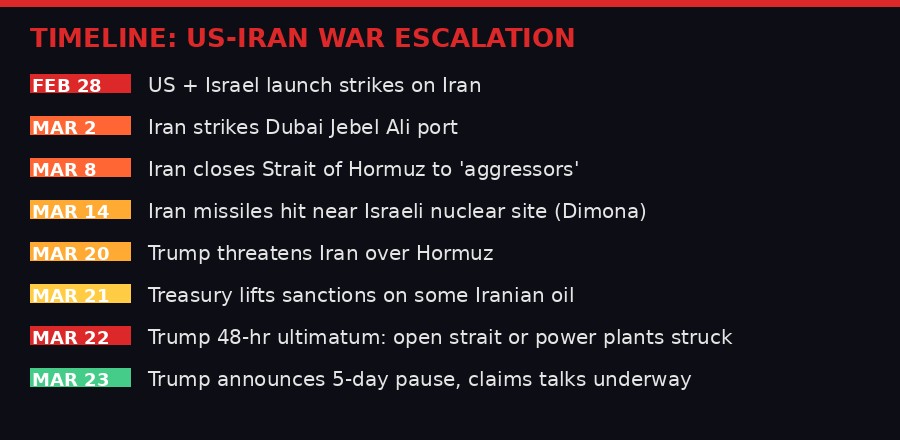
Timeline: 24 Days of Escalation
Who Gets Hurt Worst: The Global Supply Chain Reckoning
When the IEA says 40 energy facilities have been damaged across nine countries, the geographic reach of that damage matters as much as the aggregate number. The nine countries touched by the energy infrastructure war are not limited to combatants. They include Saudi Arabia, the UAE, Bahrain, Oman, Kuwait, and Iraq - Gulf nations that have officially stayed out of the conflict but whose refineries, desalination plants, gas processing facilities, and power grids have been targeted either by Iranian counter-strikes or by the cascading disruption of supply chains on which they depend.
Iran has explicitly threatened to strike Gulf desalination plants if Trump carries through on the power plant ultimatum. In the Arabian Peninsula, desalination is not a secondary infrastructure - it is survival infrastructure. Saudi Arabia, Kuwait, the UAE, Bahrain, and Qatar collectively depend on desalination for between 40 and 100 percent of their municipal water supply. A coordinated attack on desalination plants would not be an economic strike. It would be a humanitarian catastrophe affecting tens of millions of civilians in non-combatant countries.
The economic transmission belts of the crisis are already visible. South Korea and Japan - two of the world's largest oil and LNG importers by percentage of GDP exposure - are seeing equity markets reprice the fundamental assumption that global energy supply chains work. Europe, which spent three years reducing its dependence on Russian gas after 2022 only to find itself now exposed to the LNG supply collapse from the Gulf, faces its second major energy shock in four years.
The Philippines, which had already seen pump price spikes documented by AP News photographer Aaron Favila as of March 19, is among dozens of emerging market economies with limited hedging capacity and high energy import dependency. For these countries, $112 Brent crude is not a market signal. It is a balance of payments crisis in slow motion.
US domestic consumers are not insulated. The AP report on Monday described how spiking gas prices tied to the Iran war are set to eat up the tax refunds that Trump has touted publicly as a policy win. The political feedback loop - war launched to achieve strategic objectives, generating an energy shock that damages the administration's domestic credibility - is now operating at full speed. The deadline at 23:44 GMT is as much a political deadline for Trump as it is a military one for Iran.

What Happens After the Deadline
Three scenarios are on the table as of 12:00 CET, March 23, 2026.
Scenario one: Iran stands down. Tehran agrees to reopen the Strait of Hormuz before the 23:44 GMT deadline. This is the scenario the market wants. It is also the scenario that Iranian leadership has given no indication it intends to execute. Iran under new Supreme Leader Mojtaba Khamenei - installed following his father's death - has not shown a willingness to accept terms that look like public capitulation. Compliance before the deadline would be framed globally as surrender under American pressure, which the new leadership cannot afford.
Scenario two: Trump strikes Iran's power plants. The US follows through on the threat. Iranian power infrastructure is targeted, adding to the 40 energy facilities already damaged. Iran retaliates with mining operations in the Gulf. The strait effectively closes entirely. Brent crude moves toward $150 or beyond. Gulf state civilian infrastructure is threatened. The war expands in a way that makes the first 24 days look contained.
Scenario three: The deadline passes, Iran does not comply, and Trump does not immediately strike. The ultimatum is quietly shelved - or extended - while back-channel negotiations that the US has been conducting continue. This is the scenario that analysts watching Washington's mixed messaging consider most probable. Trump's statement that the war is "almost over" and the administration is "winding down" is hard to square with ordering strikes on power plants that would guarantee escalation. The "blinking" scenario carries its own consequences: Iranian leverage increases, the strait stays blocked, and oil prices drift higher rather than spike.
The IEA's Birol, in closing his remarks in Canberra, identified the "single most important solution" to the crisis: unblocking the strait. He is in consultation with countries about releasing additional strategic reserves if needed. But he was direct that emergency reserves are a bridge, not a solution. The bridge is getting shorter. Tonight's deadline is not the end of this crisis. It is the next branching point.
"I thought the depth of the problem was not well appreciated by the decision-makers around the world." - Fatih Birol, IEA Executive Director, explaining why he finally spoke publicly about the crisis, March 23, 2026

Get BLACKWIRE reports first.
Breaking news, investigations, and analysis - straight to your phone.
Join @blackwirenews on Telegram