Lights Out Doctrine: Trump's 48-Hour Power Plant Ultimatum and Iran's Hormuz Gamble
Iranian missiles punched through Israel's southern air defenses Saturday night, landing within kilometers of the Dimona nuclear research facility. By Sunday afternoon, Trump was threatening to obliterate Iran's power grid. Tehran fired back with a promise to seal the Strait of Hormuz forever. Week 4 of this war just crossed a threshold that analysts call "infrastructure war" - and there is no clean exit from it.

Iranian missiles struck the southern Israeli cities of Dimona and Arad late Saturday, wounding at least 175 people. It was the first successful breach of Israel's layered southern air defenses. (Illustrative - Pexels)
Dimona: The Missile That Changed the Equation

Drone footage showed structural damage in Arad and Dimona following the Saturday night strikes. Southern Israel's main hospital received over 175 wounded. (Pexels)
At approximately 2 a.m. local time Sunday, Iran launched a missile salvo toward Israel's Negev Desert. The target area: Dimona and the neighboring city of Arad. Israel's military, which has been intercepting hundreds of Iranian missiles since the war began February 28, could not stop them. Multiple warheads impacted residential areas of both towns. [AP News, March 22]
Southern Israel's main hospital received at least 175 wounded, according to the facility's deputy director Roy Kessous, who spoke directly to the Associated Press. Prime Minister Benjamin Netanyahu visited the stricken communities Sunday morning and called it a "miracle" no one died. By Sunday evening, Israel detected more incoming missiles from the same direction.
The Shimon Peres Negev Nuclear Research Center - the facility Israel has never officially acknowledged as a nuclear weapons production site - sits just outside Dimona. The International Atomic Energy Agency said Sunday it had received no reports of damage to the center and detected no abnormal radiation levels. But the physical proximity of the strike to the facility - and the fact that Israeli air defenses failed to stop it - sent a message Tehran had been trying to deliver for weeks.
"If the Israeli regime is unable to intercept missiles in the heavily protected Dimona area, it is, operationally, a sign of entering a new phase of the battle." - Iranian Parliament Speaker Mohammad Bagher Qalibaf, via social media, March 22, 2026
Iran's state media said the strike was retaliation for an earlier Israeli attack on Natanz, Iran's main uranium enrichment facility. Israel denied responsibility for Natanz. The U.S. Pentagon declined to comment. What is not in dispute: the missiles flew, they hit, and no one on either side can claim the same air war that defined weeks one through three.
Israeli officials claim Natanz was damaged but not destroyed - and the bulk of Iran's approximately 441 kilograms of highly enriched uranium was already buried under Isfahan's rubble from earlier strikes. But the Dimona breakthrough shifts the psychological terrain. Iran had not breached the southern air defense cordon before. Military analysts had considered it among the most heavily layered defensive zones in the world, backed by multiple Patriot and Arrow batteries. Qalibaf's gloating was not accidental; it was a strategic signal.
Netanyahu declared publicly that he and the U.S. were "well on their way to achieving war goals" - but visiting cities where over 175 people just got wounded by missiles you couldn't stop undercuts the message. The war's fourth week has been defined less by advances than by escalating exchanges that neither side has a clean answer to.
Trump's Ultimatum: 51 Words That Could Be a War Crime

Trump's Saturday ultimatum threatened Iran's largest power plants with obliteration if the Strait of Hormuz is not reopened within 48 hours. Legal scholars called it likely a war crime. (Pexels)
The president of the United States was in Florida when he posted the ultimatum Saturday. It was 51 words long, much of it in capital letters. The gist: open the Strait of Hormuz within 48 hours, or the U.S. will destroy Iran's "various POWER PLANTS, STARTING WITH THE BIGGEST ONE FIRST."
The reaction was immediate and split along predictable lines - administration officials defending it as tough-edged diplomacy, legal scholars describing it as a likely war crime, allies scrambling to explain it away, and Iran treating it as confirmation that the United States had run out of productive options.
"Trump has no plan to reopen the Strait of Hormuz, so he is threatening to attack Iran's civil power plants. This would be a war crime." - Sen. Ed Markey (D-MA), responding to Trump's post, March 22, 2026
Geoffrey Corn, a military law professor at Texas Tech University and a retired Army lieutenant colonel who served as a military lawyer, told AP the post "certainly has a feeling of ready, fire, aim." He said a widespread attack on civilian power infrastructure would "probably be a war crime" under international humanitarian law, which permits targeting power plants only if the military advantage outweighs civilian harm. It is considered an extremely high bar - the rules of war are designed, at their core, to separate civilian and military targets.
The White House has already been on the back foot after the U.S. was blamed for a missile strike on an Iranian elementary school that killed more than 165 people. The legal and political exposure is accumulating. Trump's team moved Sunday to justify the latest threat by arguing Iran's Revolutionary Guard Corps controls the country's infrastructure and uses it to power the war effort. UN Ambassador Mike Waltz specified "gas-fired thermal power plants and other types of plants" as potential targets, calling the IRGC a terrorist organization.
Trump gave Iran until Monday - 48 hours from the Saturday post - to reopen the strait. By Sunday evening, Tehran had not done so and was signaling it had no intention of complying. The clock was running.
NATO Secretary-General Mark Rutte, who has positioned himself closely to Trump throughout this conflict, tried to soften the message Sunday. He said more than 20 nations were "coming together to implement his vision" of reopening the strait. But the statement was vague about mechanisms and timeline - it read like damage control from an alliance watching a key member threaten civilian infrastructure in real-time on social media.
Israel's own ambassador to Washington, Yechiel Leiter, cautioned against the all-out approach. "We want to leave everything in the country intact, so that the people who come after this regime are going to be able to rebuild and reconstitute," he told CNN. It was a notable moment - Israel's representative in Washington publicly walking back the U.S. president's threat in the middle of a war they are fighting together.
Iran's Counter-Threat: The Full Hormuz Closure

Nearly all tanker traffic through the Strait of Hormuz has halted since early in the Iran war. A full Iranian closure would cut off roughly 20 percent of global oil supply. (Pexels)
Tehran's response to Trump's ultimatum was calibrated to match its severity. Iranian Parliament Speaker Qalibaf posted on X that if Iran's power plants and infrastructure are targeted, "vital infrastructure across the region - including energy and desalination facilities - would be considered legitimate targets and irreversibly destroyed."
The phrase "irreversibly destroyed" is doing heavy work. Desalination plants are not military infrastructure. They are the only source of drinking water for millions of people across Gulf states including Saudi Arabia, the UAE, Qatar, and Kuwait. Targeting them would be, by any reasonable reading of international law, a direct attack on civilian populations. But Qalibaf was not presenting a legal brief; he was presenting a deterrent calculus: hit our lights, we hit yours, and also take away the water.
Iran also said it would keep the strait open for vessels from countries it does not consider enemies. The carve-out is significant - it gives China and others a reason to stay neutral and refuse to join any coalition pressure campaign. It also signals that Tehran is managing escalation deliberately, not panicking. A complete and immediate closure would trigger the kind of unified international response that even Iran's closest partners might not shield them from. A selective closure - or a threat of one - preserves leverage.
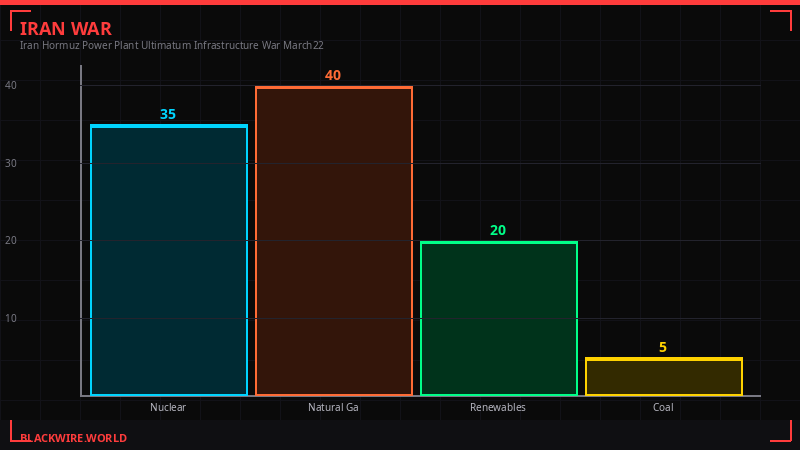
The war's economic toll has already been severe. Roughly one-fifth of global oil supply passed through the Strait of Hormuz before February 28. Since then, attacks on commercial ships and the threat environment have stopped nearly all tanker traffic. Some of the world's largest oil producers have made production cuts because their crude has nowhere to go. Gas prices in the United States have surged to the point where they are projected to eat into the tax refunds Trump has been using as a political talking point ahead of midterm elections. [AP News, March 22, 2026]
Trump's Treasury Department moved Friday to try to ease the pressure by lifting sanctions on some Iranian oil - the first time sanctions on Iranian crude have been relaxed in years. The move was a direct contradiction of the "maximum pressure" posture that has defined U.S. Iran policy since Trump's first term. It was also, by most readings, an acknowledgment that Washington cannot simultaneously wage war on Iran and keep global energy markets functional.
"He overestimated his ability to control the events once he unleashed this torrent of violence." - Geoffrey Corn, military law professor and former Army JAG officer, to AP News, March 22, 2026
The Strait's History: Why This Time Is Different

The U.S. Navy has maintained a significant presence in the Persian Gulf since the Iran war began. But reopening the strait by force against a determined Iranian resistance is a different proposition from previous standoffs. (Pexels)
The Strait of Hormuz has been weaponized before. During the Iran-Iraq Tanker War of the 1980s, both sides attacked vessels in and near the waterway. The U.S. Navy fought a one-day battle against Iran in 1988 and accidentally shot down an Iranian civilian airliner, killing 290 people. The strait never fully closed. In 2011-2012, Iran threatened closure in response to nuclear sanctions. It backed down. In 2018, similar threats followed Trump's withdrawal from the nuclear deal. Nothing happened.
What is different now: Iran's supreme leader is dead, killed in the opening strikes on February 28. Iran's air force, navy, and missile production have taken significant damage over four weeks. But the country is still standing, still fighting, still capable of targeted strikes that breach Israeli air defenses. The regime has nothing left to lose by demonstrating it can make the world economically bleed. Every previous Hormuz standoff was conducted in peacetime, under the threat of hypothetical military action. This one is happening in the middle of an active war where thousands of people have already died.
Iran and Oman both have territory along the strait's shores, and Iran controls key islands including Abu Musa and the Tunbs that sit directly in the shipping lanes. The IRGC has positioned fast-attack craft and anti-ship missile batteries throughout the area. Mining the strait - a tactic used in the 1980s - remains a theoretical option that no naval analyst dismisses. The U.S. Navy has minesweeping capability, but clearing a mined strait under fire, against an adversary with knowledge of the terrain, is not a quick operation.
Sen. Thom Tillis (R-NC), in a moment of bipartisan candor, told ABC Sunday: "You can't all of a sudden walk away after you've kind of created the event and expect other people to pick it up." The comment landed harder than it was probably intended to - a Republican senator from Trump's own party publicly acknowledging that the U.S. started something it does not know how to finish.
Lebanon: The Third Front Expands

Israel struck the Qasmiyeh bridge near Tyre, Lebanon, Sunday, giving one hour's warning. Lebanese President Aoun called the bridge campaign "a prelude to ground invasion." Israeli authorities have been destroying river crossings along the Litani. (Pexels)
While Iran-Israel-U.S. dynamics consumed global attention Sunday, the Lebanese front escalated quietly and methodically. Israeli Defense Minister Israel Katz ordered military forces to accelerate the destruction of homes near the Lebanese border and expand target lists to include bridges over the Litani River, which he said Hezbollah is using to move fighters and weapons into southern Lebanon.
Israel struck the Qasmiyeh bridge near Tyre Sunday afternoon, giving one hour's warning to evacuate. Destroying river crossings does two things: it slows Hezbollah resupply and it isolates civilian populations in the south from the rest of Lebanon. Lebanese President Joseph Aoun called Israel's bridge campaign "a prelude to a ground invasion." Lebanese authorities report more than 1,000 people killed in Israeli strikes and over 1 million displaced since the conflict opened.
Earlier in the day, an Israeli civilian - 61-year-old farmer Ofer "Poshko" Moskovitz - was killed in his car in the northern Israeli town of Misgav Am. The Israeli military initially said it appeared to be a rocket attack, then said it was "looking into the possibility" the death was caused by Israeli soldiers' fire. Moskovitz had told a radio station two days earlier that living near the Lebanese border felt like "Russian roulette." He was not wrong.
Hezbollah has continued firing rockets into northern Israel, invoking retaliation for the killing of Iran's Supreme Leader. The group claimed responsibility for the strike that killed Moskovitz's vehicle. Between the bridge strikes, the house demolition orders, and the continued rocket exchange, southern Lebanon is being methodically reduced to a conflict zone where civilian infrastructure is the primary target on both sides. The pattern looks less like counterinsurgency and more like preparation for something larger.
War Aims Versus War Reality: The Widening Gap

The US-Israel war against Iran enters its fourth week with publicly stated goals - destroying Iran's nuclear program, weakening its proxy network - increasingly disconnected from military and diplomatic reality. (Pexels)
Netanyahu listed the war's aims Sunday in terms broad enough to mean almost anything: weakening Iran's nuclear program, missile program, and armed proxies; "enabling the Iranian people to overthrow the theocracy." The goals have drifted since February 28. The original framing was surgical - take out the nuclear program, degrade the IRGC, and walk away. Four weeks in, it has become something else.
The nuclear program is degraded but not destroyed. Isfahan is partially rubbled. Natanz was struck again Saturday. Fordo was hit by bunker-busters in the original Operation Midnight Hammer. But the IAEA has confirmed that the bulk of Iran's enriched uranium is scattered - beneath rubble, in storage, in transit. The knowledge of how to enrich uranium does not die with a building. Iran has the scientists, the historical expertise, and now an unambiguous strategic motive to reconstitute the program the moment circumstances permit.
The IRGC has been hit hard but has not collapsed. It is still capable of directing Hezbollah operations in Lebanon, still capable of organizing missile strikes on Dimona. The theocracy is under pressure but has not been overthrown - and the idea that the United States can achieve regime change in Iran by bombing power plants sits uneasily with the historical record of what aerial bombardment of civilian infrastructure actually produces: not popular uprisings, but national unity against the attacker.
Trump's own messaging has become incoherent. He was discussing "winding down" operations last week. This weekend, he threatened to escalate to attacks on civilian infrastructure. He lifted Iranian oil sanctions while simultaneously threatening to obliterate the means by which Iran could produce energy. His allies at NATO are trying to hold together a coalition for a diplomatic solution while their principal is on social media posting ultimatums in capital letters.
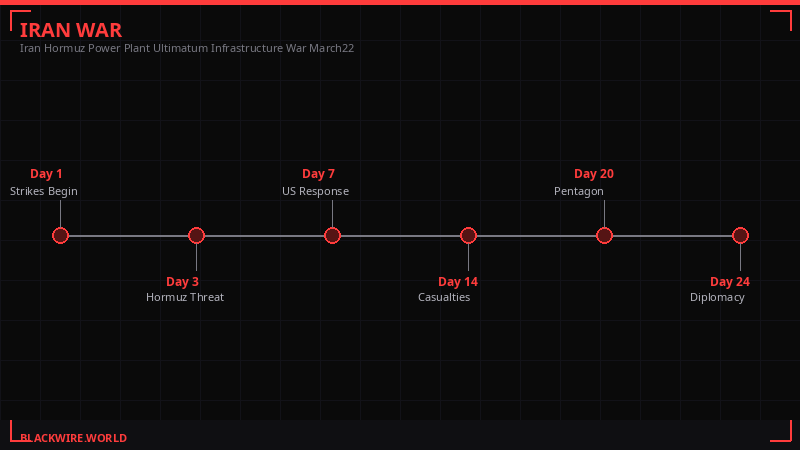
The gap between war aims and war reality is now visible from the outside. The United States entered this conflict with the assumption that Iran would fold quickly under overwhelming military pressure - as it has historically backed down from its Hormuz closure threats, as it has historically absorbed pressure without escalating to the point of direct confrontation. That assumption has not held. Iran is still fighting, still striking, still capable of surprise. And the Hormuz situation, which was supposed to be a pressure point on Iran, has become a pressure point on the United States and its allies instead.
What Happens After the 48 Hours

Trump's Monday deadline for Iran to reopen the Strait of Hormuz expires in the early hours of March 23. Neither side has shown signs of backing down. (Pexels)
The 48-hour clock expires Monday. There are three plausible outcomes and none of them are clean.
The first: Iran does not comply, the U.S. does not strike power plants. Trump blinks. He has already done this before - the "winding down" comment last week being the most recent example of a president who signals escalation and then steps back. If this happens, the credibility of future U.S. ultimatums in this conflict takes another hit, and Iran learns that threats can be waited out.
The second: Iran does not comply, the U.S. strikes Iranian power plants. This triggers Qalibaf's promised response: full Hormuz closure and attacks on regional desalination and energy infrastructure. At that point, the conflict is no longer a war between the U.S., Israel, and Iran. It is a war against the basic infrastructure of populated civilian societies across the entire Gulf. The humanitarian and economic consequences are incalculable and immediate. Oil at $150+ a barrel. Drinking water cut off to millions. Hospital systems collapsing across multiple countries simultaneously.
The third: some form of back-channel agreement materializes in the next 24 hours, allowing both sides to claim partial victory and pull back from the brink. Qatar, which lost seven military personnel Saturday in an unrelated helicopter crash but which has maintained channels to Tehran throughout this conflict, is the most likely intermediary. Saudi Arabia, watching its desalination infrastructure get named as a target, has a powerful incentive to push for de-escalation. The UAE and Kuwait are watching the same list with the same horror.
The most dangerous dynamic in the current moment is not the weapons - it is the absence of a clear off-ramp. The U.S. has no viable exit strategy that does not involve Iran maintaining some capacity to produce oil, use the strait, and function as a state. Iran has no incentive to comply with ultimatums unless it believes non-compliance will lead to its complete destruction - which it has decided to call the bluff on. The two positions are structurally incompatible, and the people caught between them are the civilians who need the lights to stay on and the water to keep running.
"He's lost control of the war and he is panicking." - Sen. Chris Murphy (D-CT), responding to Trump's power plant ultimatum, March 22, 2026
The Iran War began four weeks ago as a surgical operation to eliminate a nuclear program and remove a theocratic government from power. It has become something that resists any clean description. A war where the U.S. president threatens to cut electricity to millions of civilians. A war where Iranian missiles land next to a nuclear facility that Israel says doesn't officially exist. A war where a country's parliament speaker threatens to destroy the region's drinking water supply in retaliation. A war where the opening of a shipping channel has become more important than the original military objectives, and nobody in the leadership of any involved country can explain how it ends.
The lights-out doctrine was not in the original plan. Nothing about the last 48 hours was. That is the problem.
Iran War - Infrastructure Escalation Timeline
- Trump's 48-hour ultimatum expires Monday morning (March 23, approx. 10:00-12:00 local time depending on interpretation)
- Iran has not complied and has countered with a full Hormuz closure threat
- Israel detected additional Iranian missile launches toward southern Israel Sunday evening
- Lebanon bridge strikes continue; ground invasion signals intensify
- Total war dead: 2,000+ (Iran 1,500+, Israel 15 from Iranian strikes, Lebanon 1,000+, others)
- No ceasefire talks confirmed. Qatar/UAE mediation rumored but unconfirmed.
Get BLACKWIRE reports first.
Breaking news, investigations, and analysis - straight to your phone.
Join @blackwirenews on Telegram